

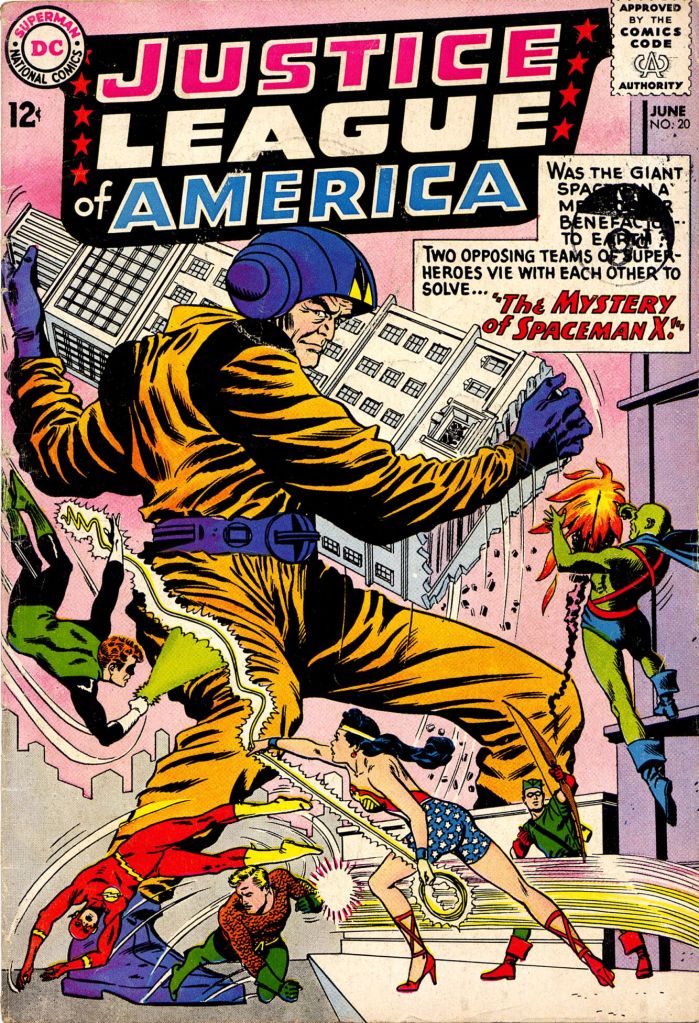
I’ve heard it said that this issue of JUSTICE LEAGUE OF AMERICA shows a bit of the influence that the growth of the new Marvel comics was having upon DC. I don’t know that I really believe that, though. Certainly, for as long as there had been team-up comics, there had been stories in which the different heroes competed with one another or fought with one another for some quasi-legitimate reason (typically that the audience loved to witness such fights, and so were quick to hand over their loose change.) But this is certainly a more contentious image than was was typical for the series this early in the title’s run.
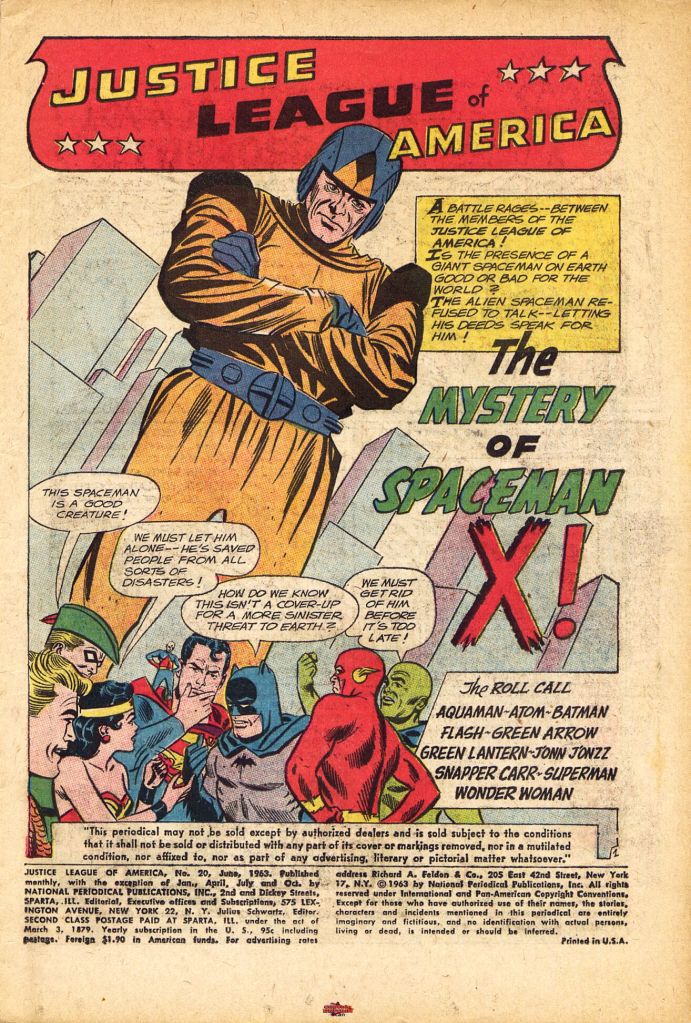
As usual, the issue was produced by writer Gardner Fox and artist Mike Sekowsky, under the oversight of editor Julie Schwartz. This opening splash page is far more cerebral than the cover image, with the heroes of the Justice League merely wrestling with the question of the motives of the gigantic Spaceman X, rather than wrestling with one another. It has to be said that the Leaguers who are here suspecting that the alien is a menace don’t really come across well–in particular J’onn J’onzz, whom you think would have more sympathy for a visitor from another planet.
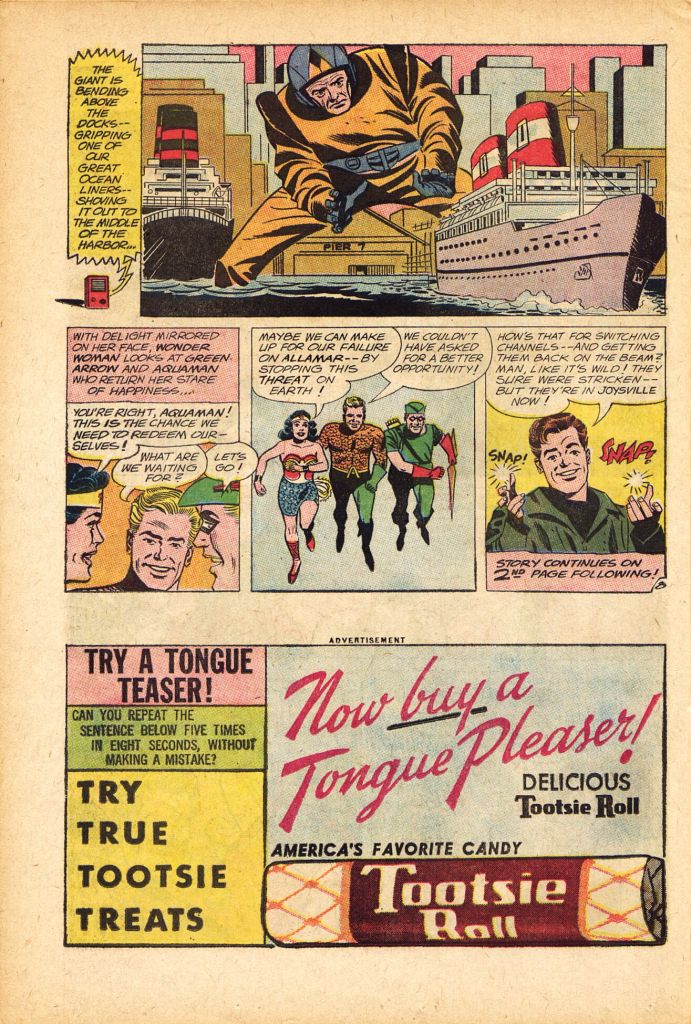
The story opens with a trio of Justice League members: Green Arrow, Aquaman and Wonder Woman, on a mission in deep space to destroy a device that has put the entire population of the planet of Allamar into a comalike slumber. Despite the best efforts of the JLA trio, they are unable to complete their task–they smash the machine, but the Allamarians are still caught in their debilitating comas–and so they must report their failure back to their fellow members. Thereafter, we learn that Superman’s super-hearing had a day earlier picked up a distress message from a trio of far-off worlds, each of which was being imperiled by a different type of machine. The League split its forces to take care of all three of these situations at the same time. Returning to Earth to check in, Wonder Woman, Aquaman and Green Arrow are just in time to hear reports of a giant who has landed in Harbor City and who is imperiling the ships. Happy for a chance to make up for their botched mission, the trio of super heroes head out to deal with the menace.
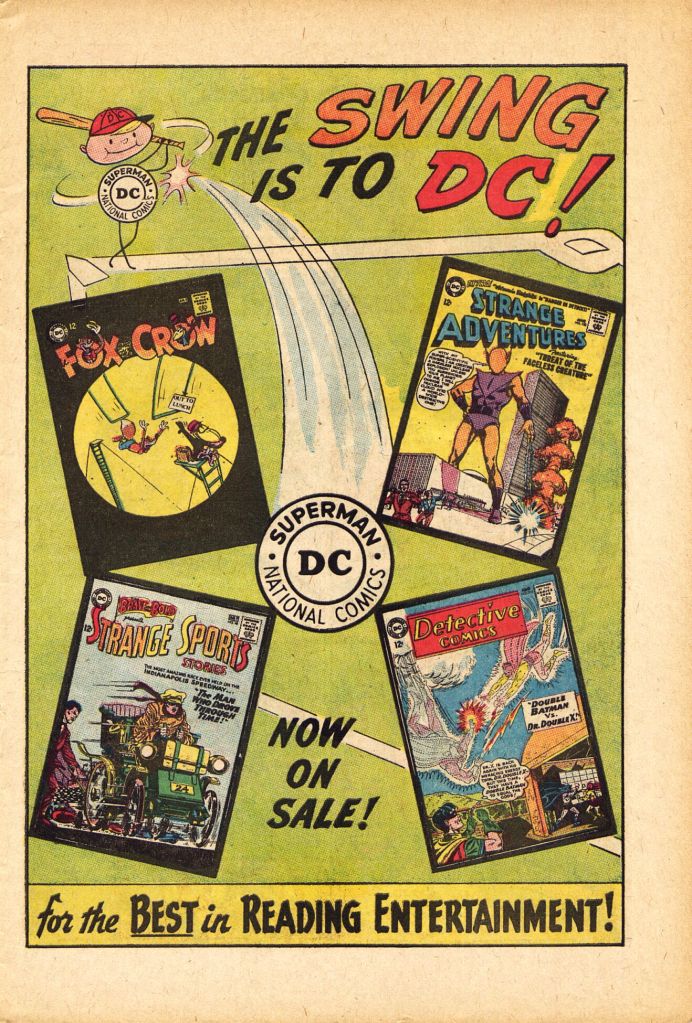
We get an atypical house ad here featuring company mascot Johnny-DC. It’s very much a precursor to the regular house ads that Marvel would eventually run, which did nothing more than showcase the covers of a few upcoming releases. It’s a pretty odd assortment of titles that are plugged in this one.
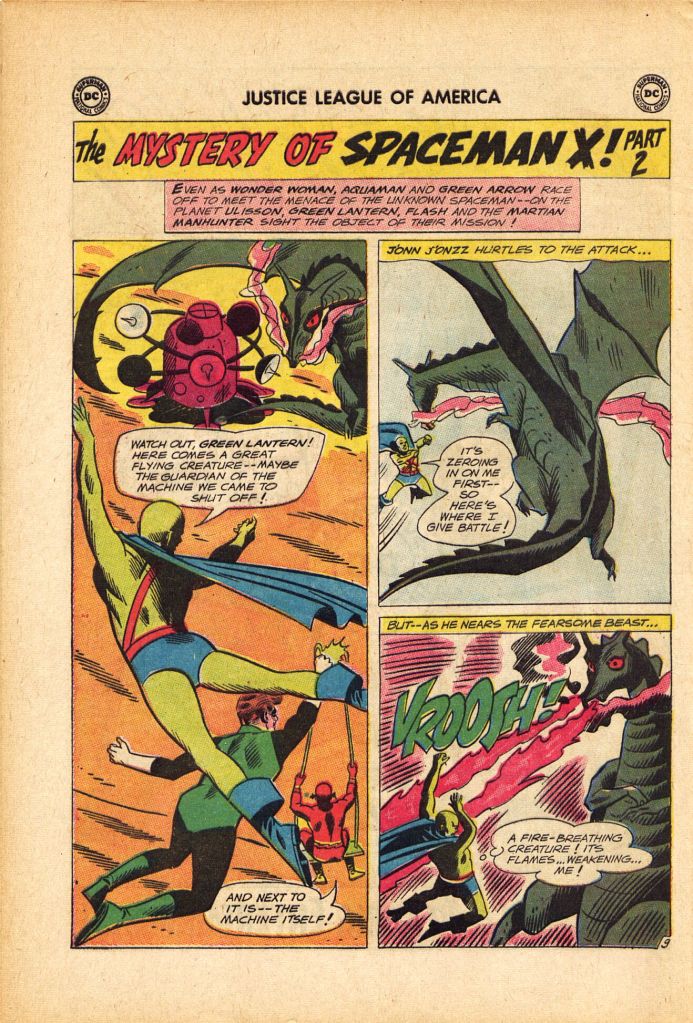
But before we can see what happens, out attention instead turns to the far-off world of Ullison, where a strange device has apparently petrified the population of that world, transforming them into stone. Green Lantern, the Flash and the Martian Manhunter arrive to do battle with the giant dragonlike creature who is guarding the machine and to destroy the device. Through quick-thinking and resourcefulness, they do just that–but as with the earlier team, this does nothing to eliminate the petrification from the Ullisonians. This second JLA team must similarly depart with their mission unsuccessful.
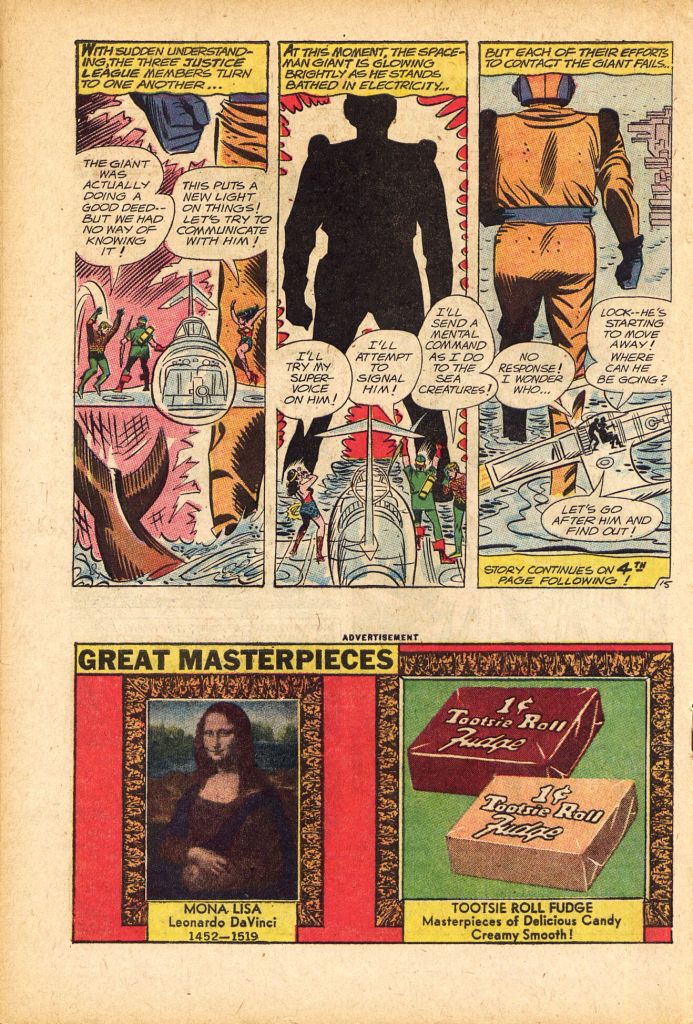
Back on Earth, the first JLA team arrives in Harbor City and attempts to make contact with the silent giant who is pushing the various ships bodily out to sea. When that doesn’t work, they attack the giant, but all of their efforts to halt him prove futile. Which is all just as well, because it soon becomes apparent that a freak electrical storm would have destroyed those ships had they remained where they were. Now, Aquaman, Wonder Woman and Green Arrow are convinced that the giant is altruistic and benevolent. But they still cannot make contact with him.
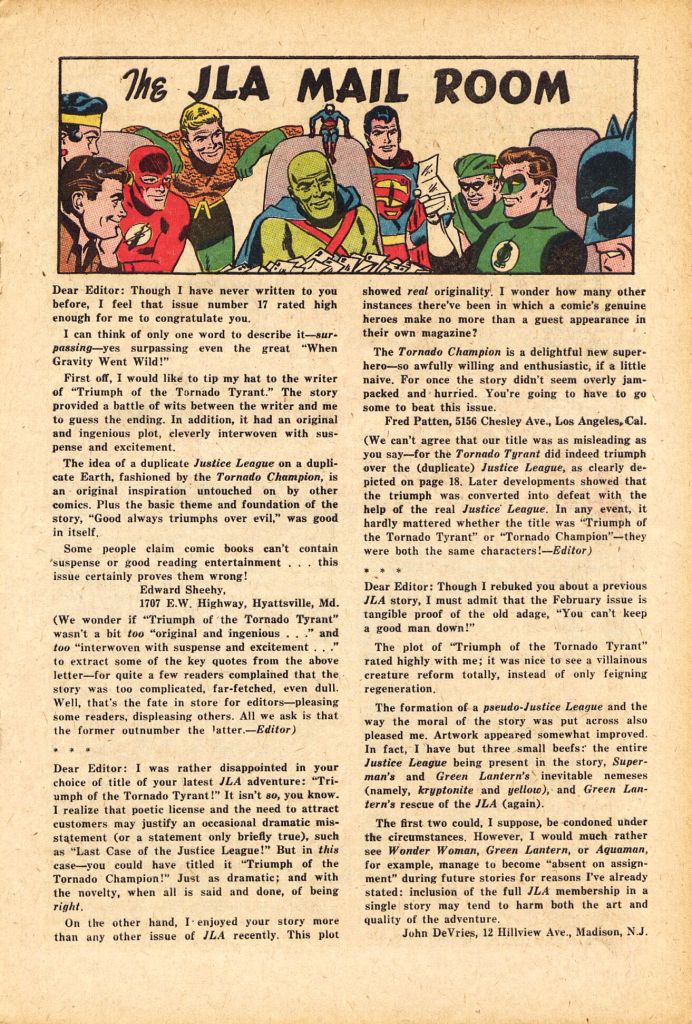
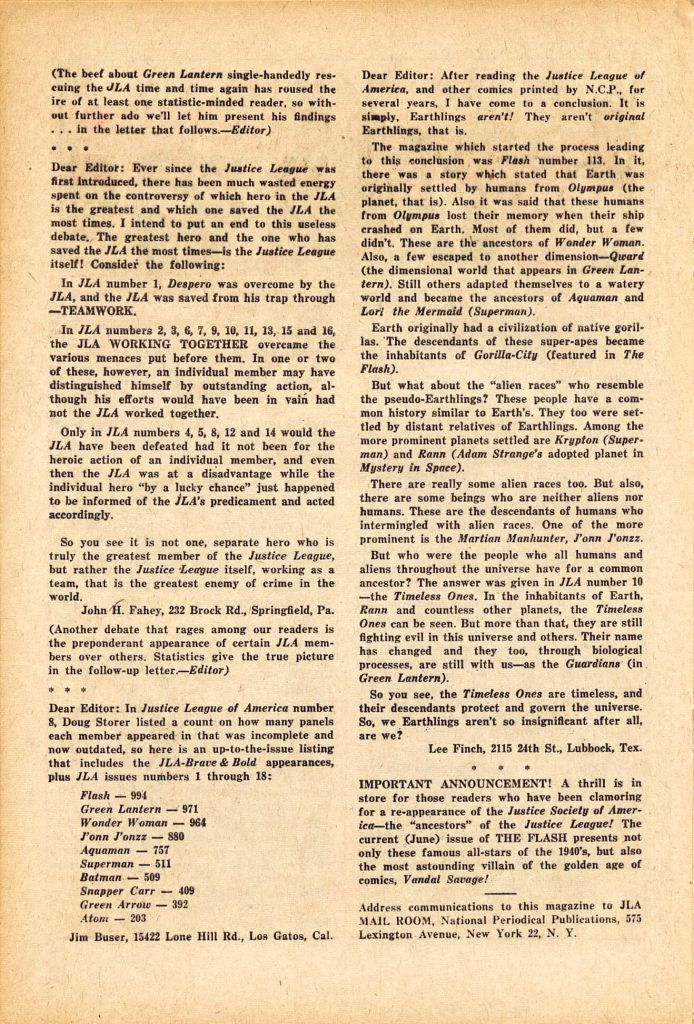
The story is interrupted between chapters at this point for the two-page JLA Mail Room letters page. This installment features a letter from Fred Patten, who would become an expert on the history of animated cartoons and one of the founders of the C/FO (The Cartoon/Fantasy Organization), one of the largest clubs devoted to animated films and television. The page also announces that the Justice Society of America, the precursors to the current Justice League, will be appearing in the current issue of FLASH. Only an issue later, they’d be the special guest-stars of the following issue of JUSTICE LEAGUE as well.
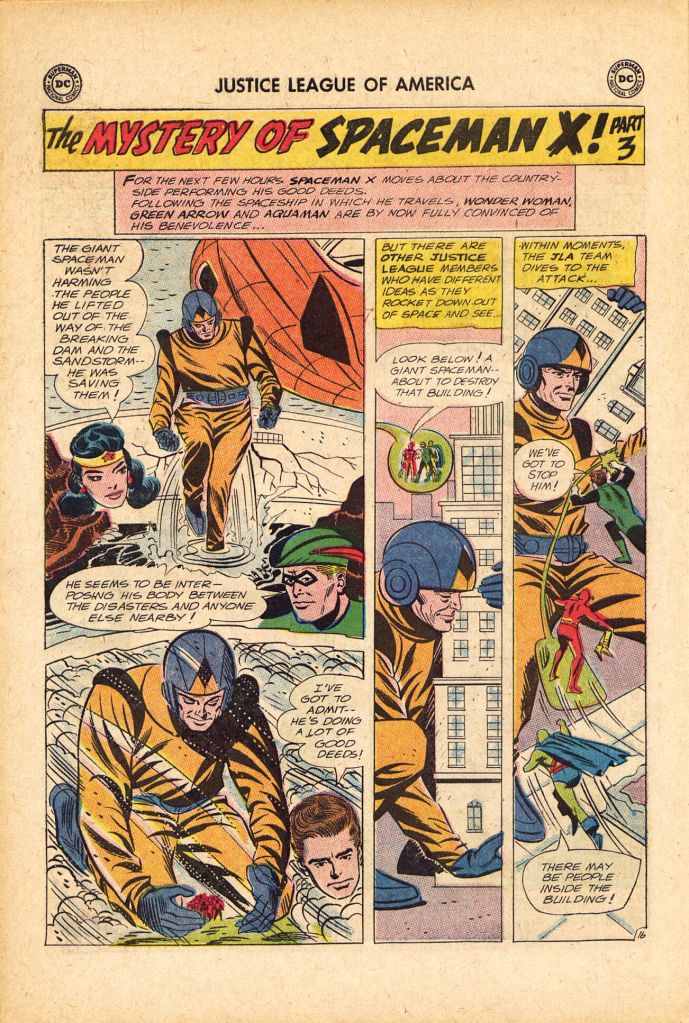
For the rest of the day, the giant, now dubbed “Spaceman X”, performs heroic deeds all across the countryside, followed and observed by the JLA trio. But when Green Lantern, Flash and the Martian Manhunter return from space and see the giant hefting up a building as he does on the cover, they assume that he’s a threat and leap to the attack. To justify the cover image, Wonder Woman, Green Arrow and Aquaman jump in, parrying the attacks from their fellow Leaguers until they can show them that Spaceman X appears to be benevolent. Meanwhile, off in space, Superman, Batman and the Atom arrive at the planet Zomarr, where a machine has seemingly uprooted the plantlike inhabitants, floating them in the air and preventing them from absorbing nutrients from the ground as they usually do. But before the heroes can destroy the machine, it suddenly stops working. Confused, they question one of the Zomarrians.
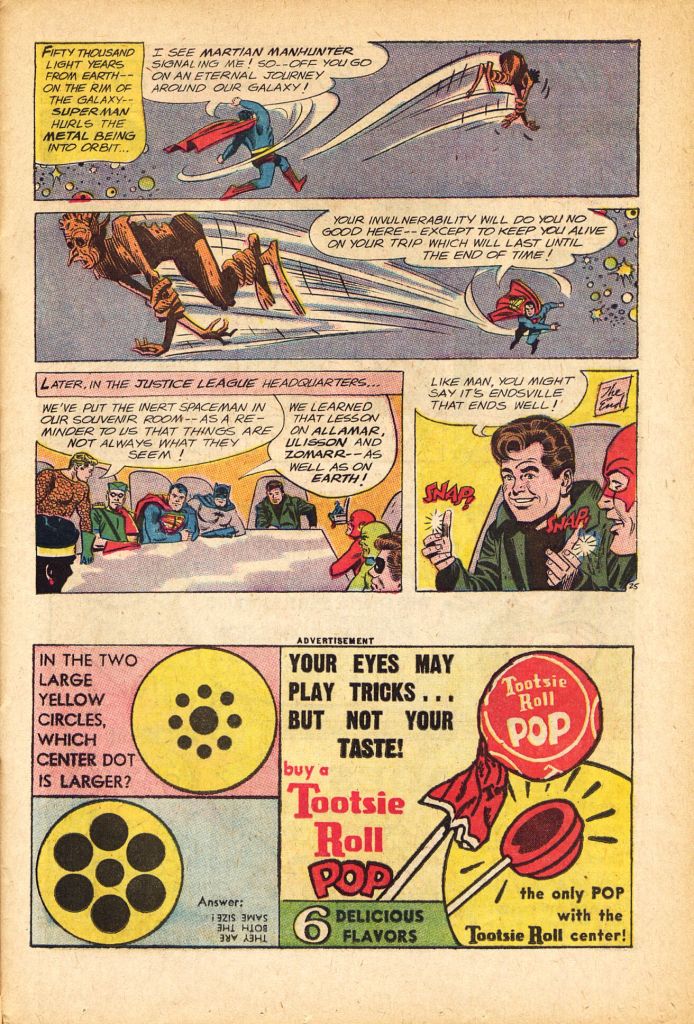
The people of Zomarr are quick to explain that the intergalactic tyrant Pallkan was responsible for the three machines–but that each machine controlled the menace on a different world than the one it was on. So when the two earlier teams destroyed their worlds’ machines, they wound up saving the Zomarrians as a result, even though it looked as though they had failed. Returning to Earth, Superman, Batman and the Atom are surprised to see their fellow Leaguers not doing anything about Spaceman X. Superman uses his x-ray vision to determine that Spaceman X is a robot being controlled by a far-off spaceship. That ship turns out to be a metal being, which has become invulnerable thanks to energies absorbed by the Spaceman X robot as it walked across the world. Fortunately, Superman is also invulnerable, and he’s able to drag the metal being far enough away into outer space that it loses contact with Spaceman X and becomes vulnerable. Superman thereafter hurls the creature into a perpetual orbit that will keep it from menacing anything else again. It’s a very strange ending t this story, in that Spaceman X winds up not having anything to do with the dangers on the three alien worlds–they just happen to hit at the same time.
 The Tom Brevoort Experience
I don’t see this as particularly Marvel in style. And even the Seven Soldiers of Victory wound up fighting each other in one issue.
LikeLike
Meant to include that Fox had the JLA putting Green Arrow on trial as a traitor in #5, and that was before Marvel was anything but monster books, Westerns and Patsy Walker.
The big difference, I think, is that the differences when the Leaguers clash are professional — how do we deal with this menace? — rather than Johnny Storm or the Beast quitting the team in resentment.
LikeLike
In addition, the DC stories tended to downplay physical confrontation between heroes. They might contend for a panel or two, and then on with the plot. In AMAZING SPIDER MAN #1, the first story features Parker complaining about how the FF and Ant Man don’t seem to have any money worries (the former hadn’t been kicked out of their digs for Reed’s stock failures at the time). Then the second story devotes most of two pages to showing how Spidey “auditions” for the FF, finding interesting ways to trump each of the foursome’s abilities, before he Spidey gets the bad news.
I can’t think of any two page battles between actual heroes (i.e., non-doppelgangers) before 1965. The fight between Metamorpho and the Metal Men in B&B 66 is a whopping eight pages (love them online reprint sites), but DC was definitely emulating the Marvel method by then.
LikeLike
Batman and Superman have a fight in Kandor in World’s Finest #143 (1964) and it’s intensely personal (https://atomicjunkshop.com/batman-splits-from-superman-then-fights-hydra-more-from-64/).
By 1965 Marvel’s “hero fights hero” was already wearing down into cliche for me.
LikeLike
I thought of that one, but it’s only five panels extended over two pages, so it’s not really constructed to play up the physical conflict, only its function in the plot. Edmond Hamilton wrote that WF, so he probably wasn’t at all influenced by the Marvel method, in contrast to guys like Drake and Haney, who did show such influence in their storytelling priorities.
LikeLike
The Spaceman X concept, and the debate the character’s apparent benevolence provokes among the JLA, were interesting ideas. Too bad the story doesn’t really follow through on either ina satisfying way. Also, Superman’s disposal of the metal being seems rather cruel. Was the alien that much of a menace?
LikeLike
The JLA gets quite ruthless in some stories. Superman kills the diamond alien he’s fighting in JLA 9 and in #27 they put an alien into a coma instead of trying to negotiate their conflict.
LikeLike
Here, most impressively, is Fred Patten (1940-2018) cosplaying as the Golden Age Flash, the year before this comic:
LikeLike