


It’s an argument that comes up every couple of months like clockwork, especially when some new film or television project is announced. There are always those that espouse that Batman, in order to be treated realistically, should carry and use a gun. And these people inevitably point to the character’s earliest days as justification, talking about how, when he started out, the Caped Crusader routinely carried a gun and blasted down evildoers. Now, these people haven’t really read the stories in question, they’re just going by second- or thirdhand reports online that say stuff like this, reports often written by others who likewise haven’t actually read all of these stories. So today we’re going to take a look at the first year of Batman’s publishing career and identify every instance in which he employs a firearm. I consider this a public service, and hope that this piece wil serve as a reference point to which those trigger-happy Batfans can be directed to help straighten out their impressions of the character. So let’s begin.
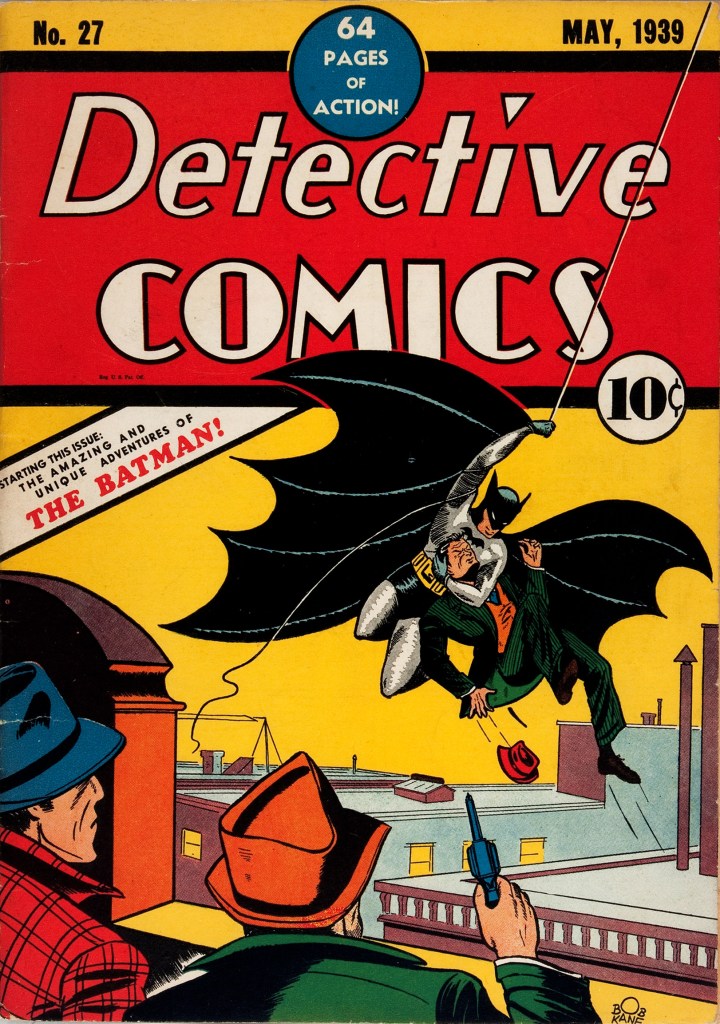
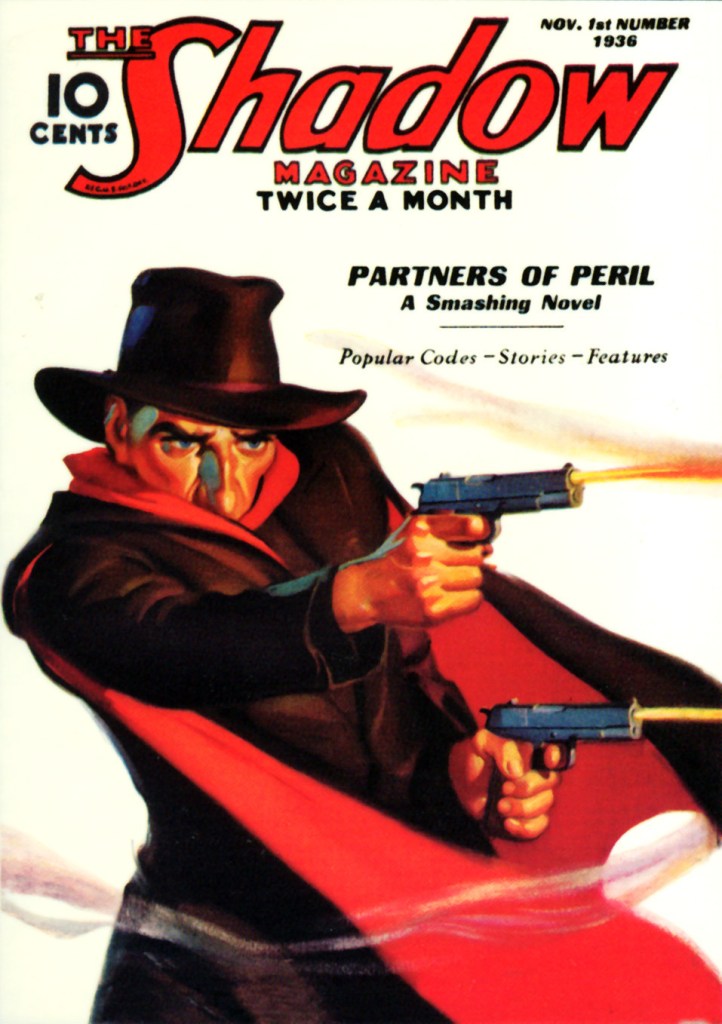
As I expect most everybody knows, Batman made his first appearance in issue #27 of DETECTIVE COMICS. But despite the fact that this first story by Bob Kane and Bill Finger was wholesale swiped from a three-year-old pulp story featuring the Shadow entitled “Partners of Peril”, written by Theodore Tinsley, unlike the Master of Shadows, Batman doesn’t so much as pick up a gun in this tale, much less fire one. He does punch a guy off a catwalk into a tank of acid, though.
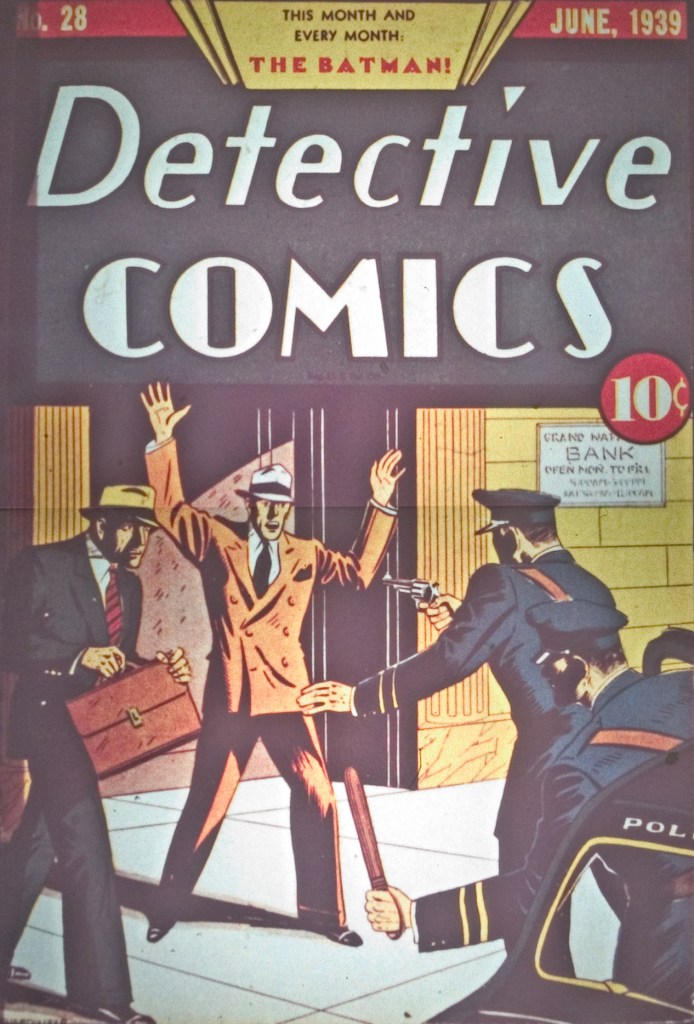
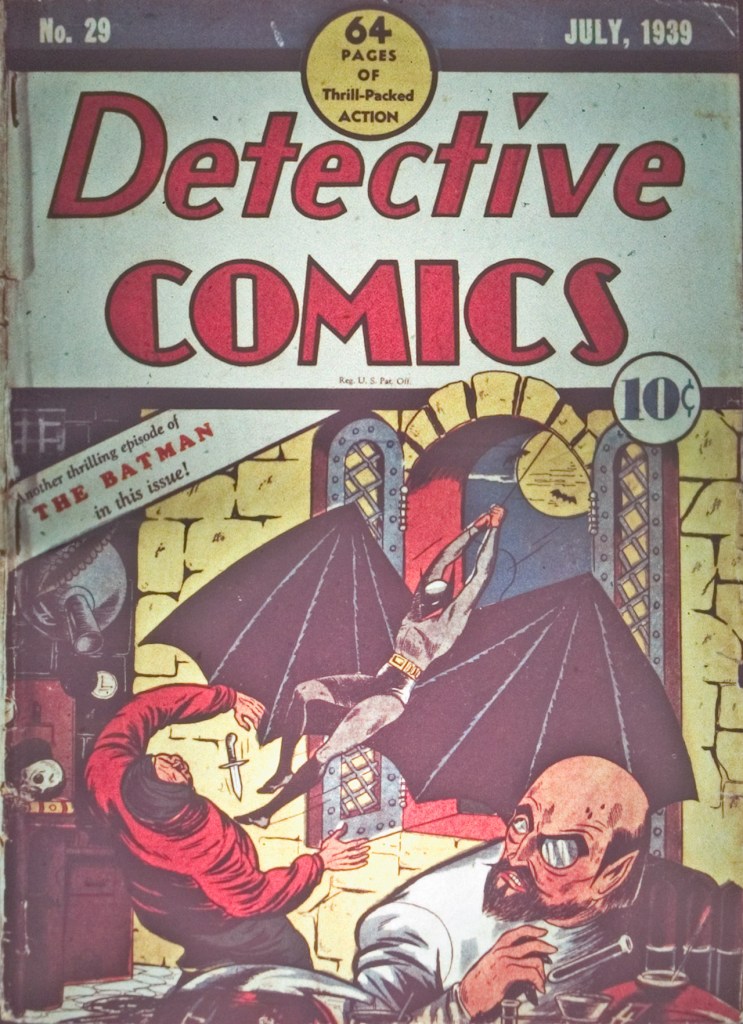
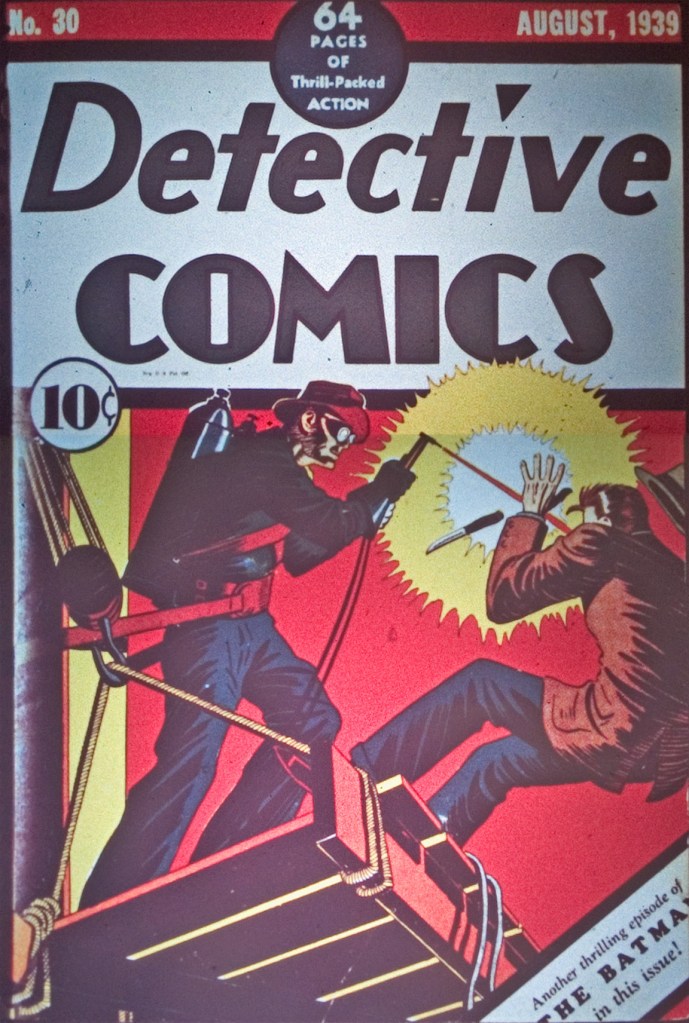
Likewise, in his second, third and fourth appearances, while he does break one guy’s neck with a flying kick, the Batman never carries nor uses a firearm of any kind. He’s still mostly working with gas pellets and a silken rope.

In DETECTIVE COMICS #31, the first half of a two-part struggle against the vampire known as the Mad Monk, Batman devises his Batarang (called a Baterang this first time out) and his Batgyro (an autogyro) for the first time. But still no guns.

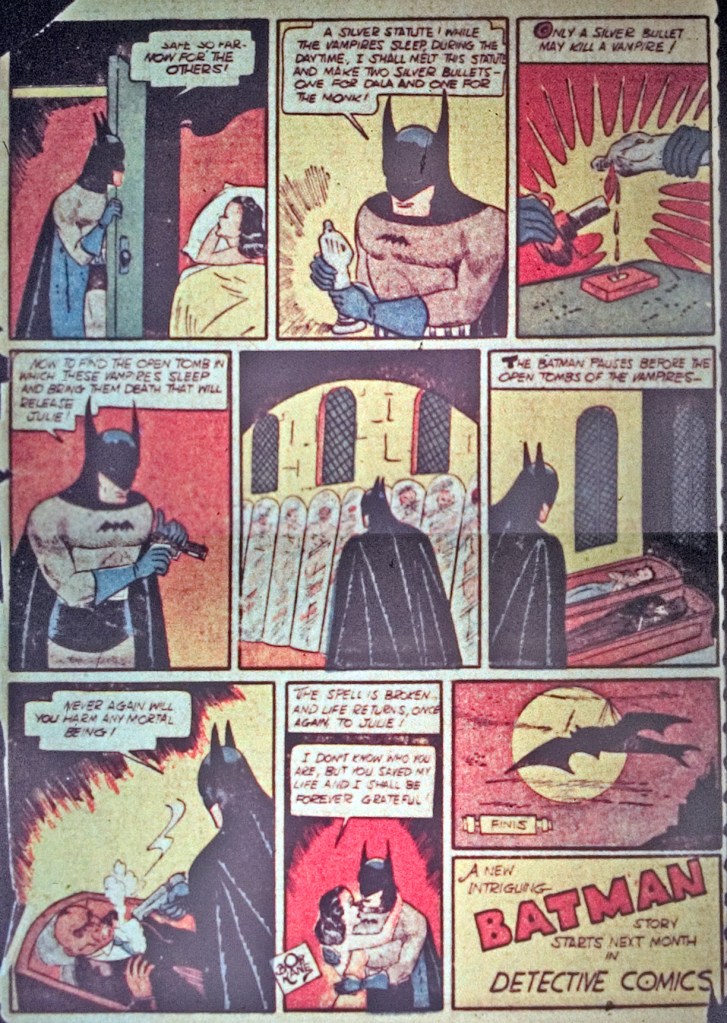
Finally, in DETECTIVE COMICS #32, the blessed event arrives–and it’s a bit underwhelming from a firearm point of view, if I’m being honest. Needing some manner in which to finish off the Mad Monk and his vampiric associate Dala, the Batman melts down some silver statues and casts them into silver bullets, then uses a gun to fire them into the prone figures of the two vampires as they sleep. I don’t know that silver is going to kill a vampire, it’s typically werewolves who are vulnerable to the stuff. But let’s not be too hard on Golden Age writer Gardner Fox. After all, he’s just given us the first example of Batman using a gun! (BATGUN TOTAL: 1)
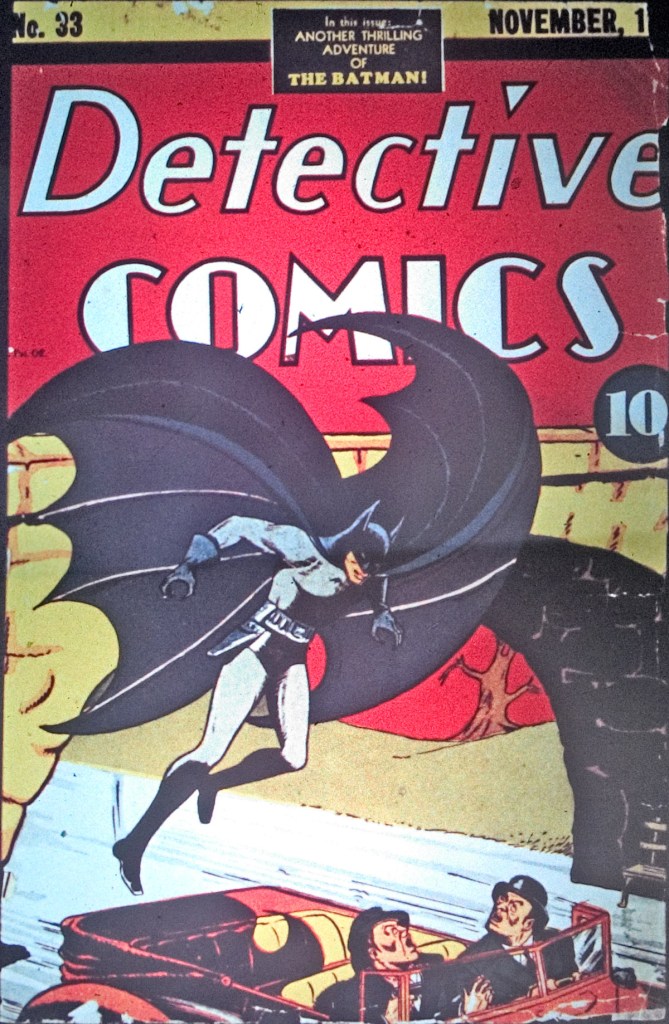

On the cover to DETECTIVE COMICS #33, Batman is depicted as having a holster attached to his utility belt. This is the issue that first reveals his origin, in a short two-page prologue. In the actual story, while battling the Dirigible of Doom, Batman does use a gun to blow up a deadly machine. But it counts, let’s say, even though it isn’t directed against a person of any kind. (BATGUN TOTAL: 2)
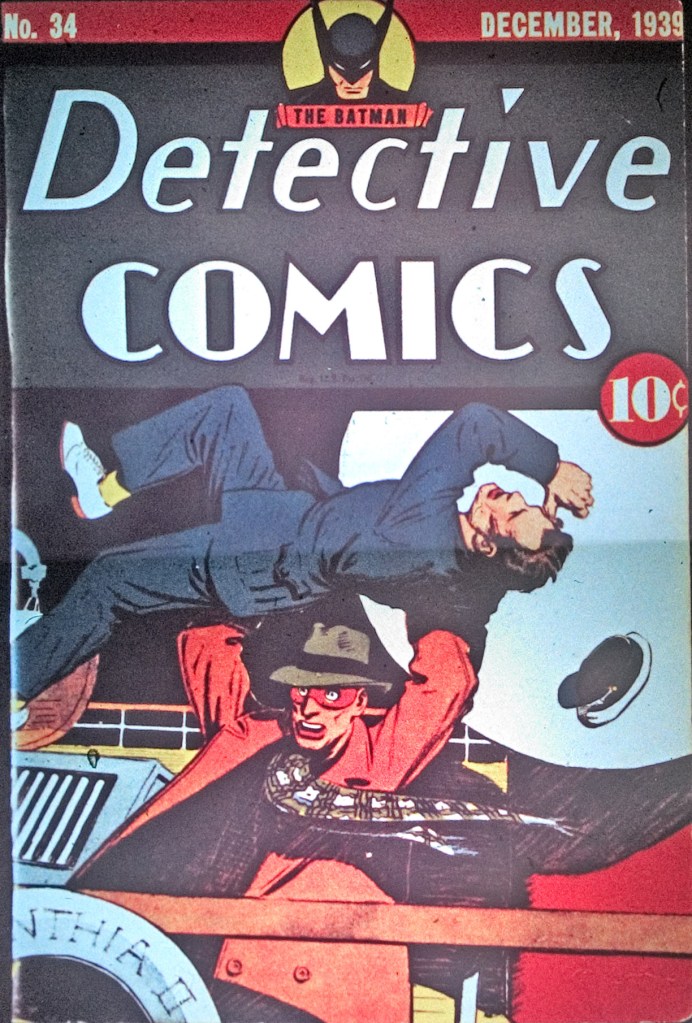
In DETECTIVE COMICS #34, the Batman contends with a wily, faceless foe. But he doesn’t use a gun anywhere in doing so.
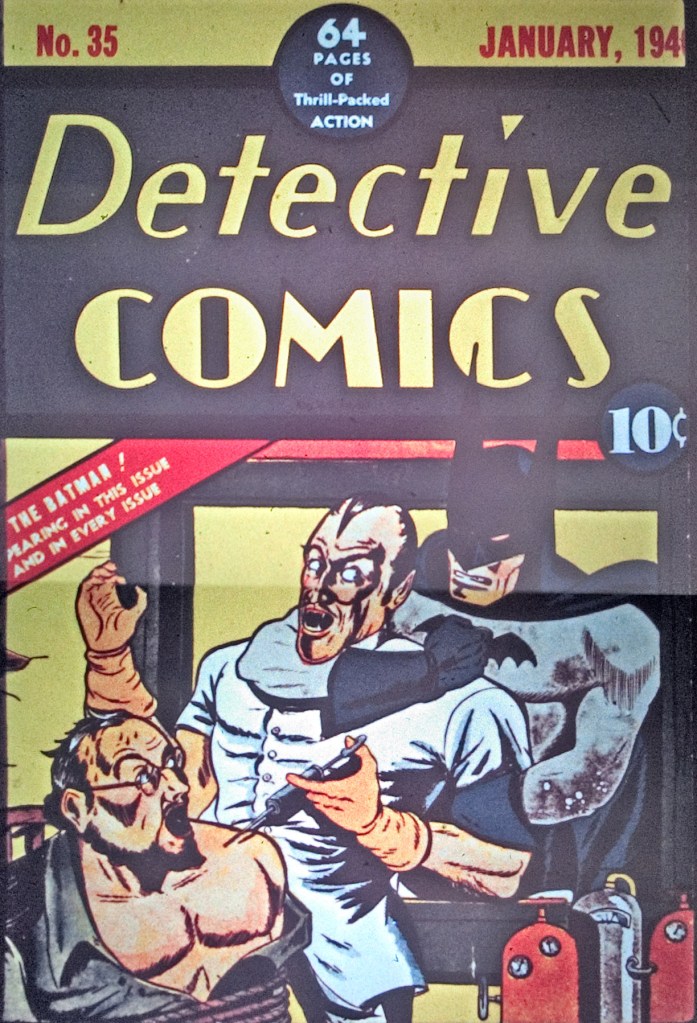

DETECTIVE COMICS #35 is where that splash page of a gun-toting Batman at the top of this page comes from, but sadly, it’s the only representation of Batman with such a weapon in the story. As it’s purely symbolic, I don’t think it gets added to the tally.
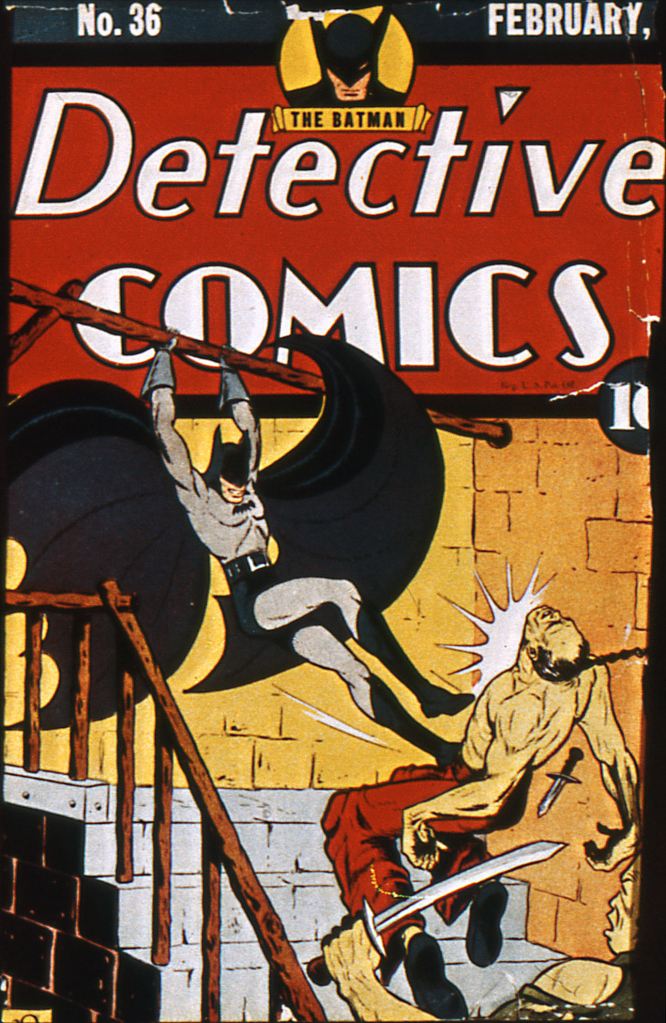
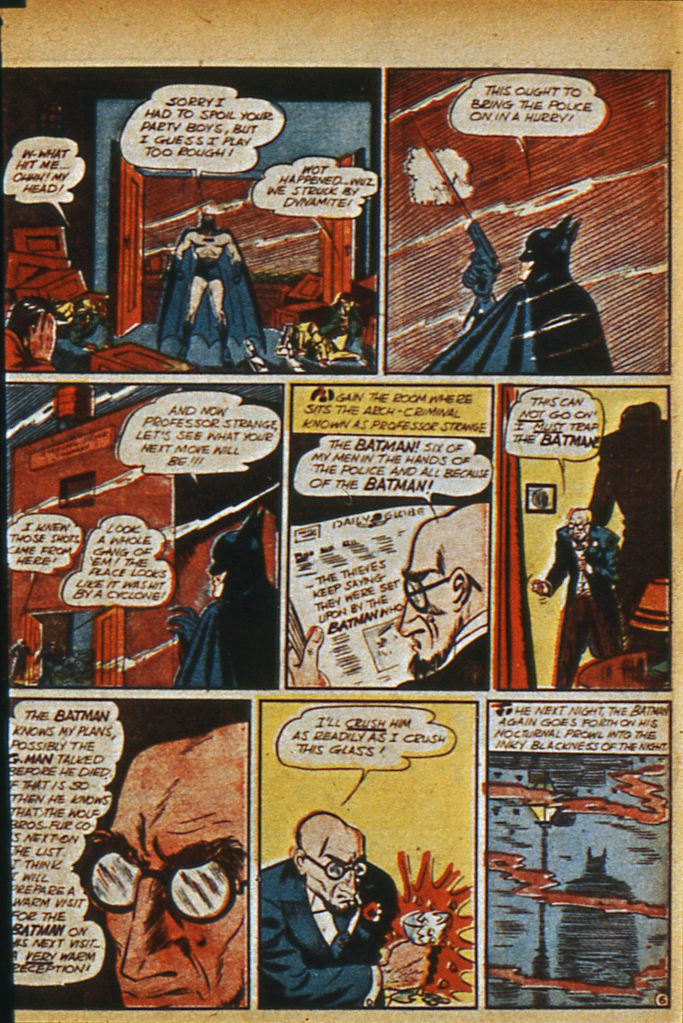
In DETECTIVE COMICS #36, Batman has his first battle with Dr. Hugo Strange, and he does use a gun in it momentarily. But not to take Strange’s life, rather to fire off a shot in the hopes of attracting the Gotham police to where he’s already defeated Strange’s men. Still, it’s a gun use, it counts. (BATGUN TOTAL: 3)
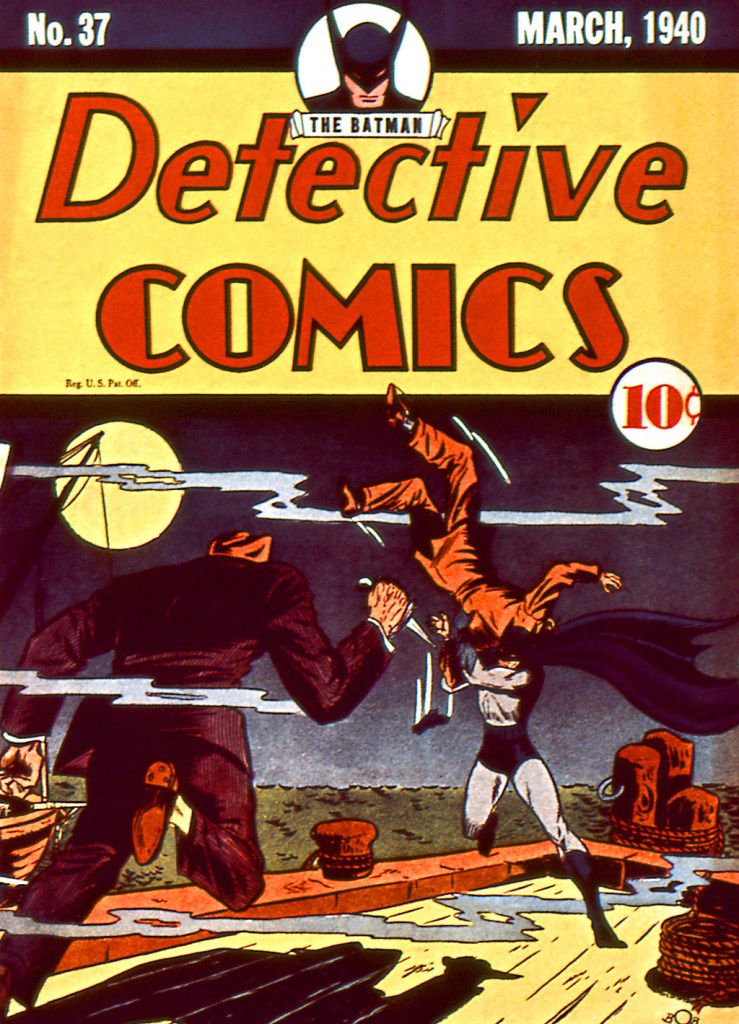
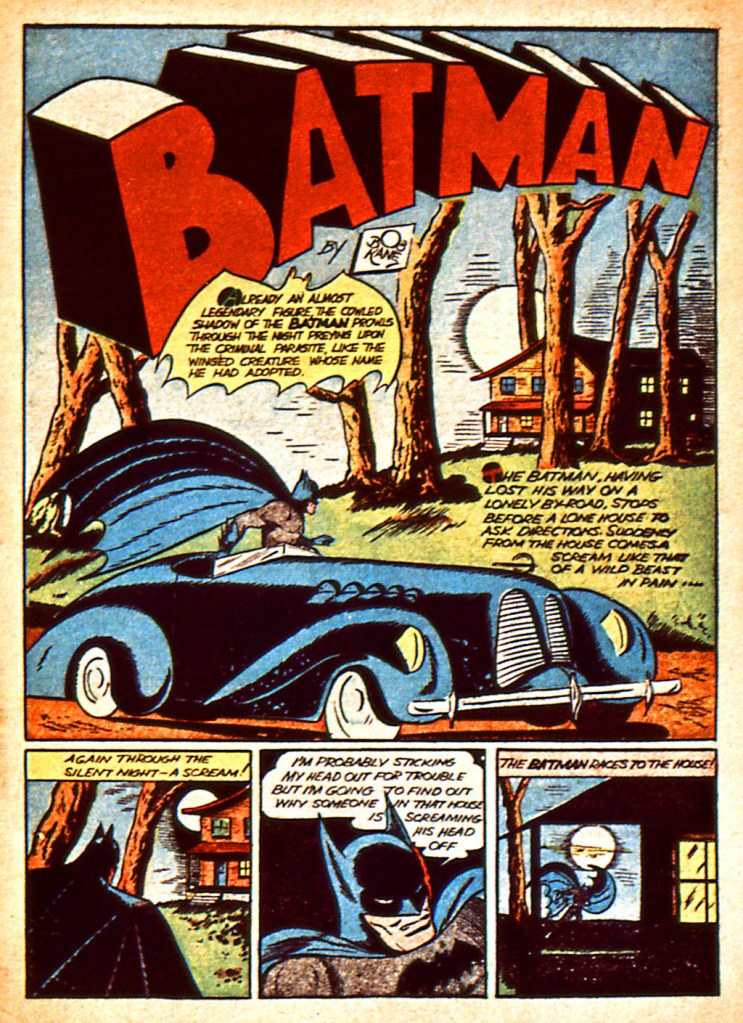
The story in DETECTIVE COMICS #37 opens with this wonderful bit of business where the invincible Batman is lost on the back roads and stops in full costume to ask for directions. But he doesn’t carry or use a gun in this issue–I’m assuming that the falling gun on this cover belongs to the goon Batman is in the process of throwing.
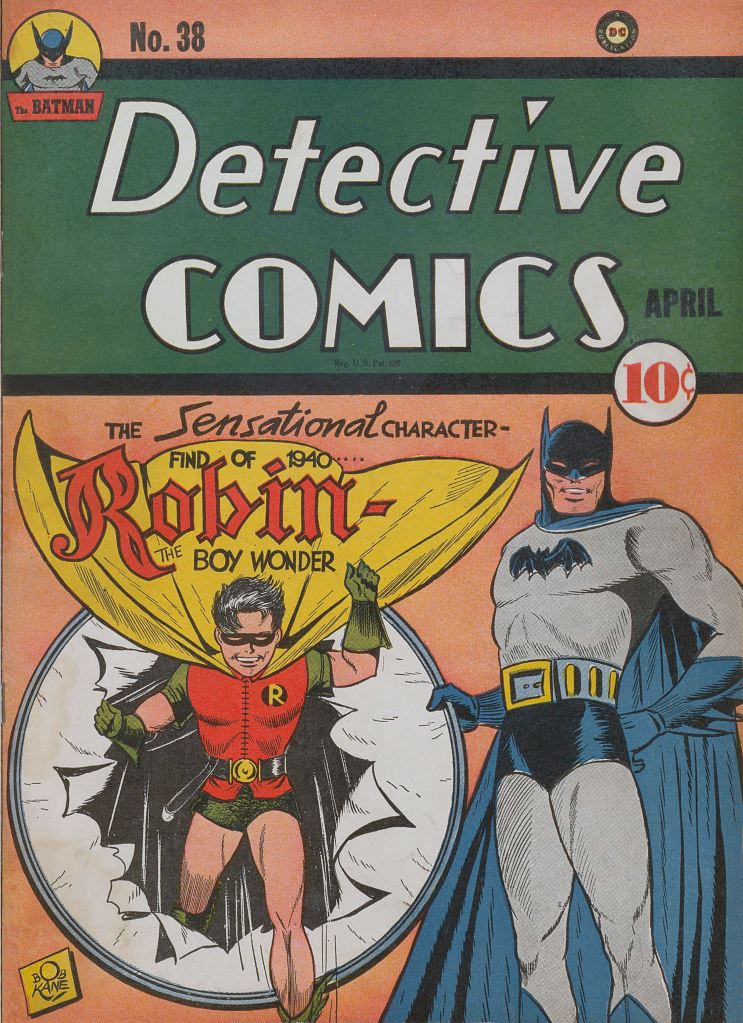
A big day for Batman in DETECTIVE COMICS #38 as he first meets and adopts Robin the Boy Wonder as his crime-fighting partner. But among the many tricks and stunts he teaches his young protege in this issue, gunplay is not one of them.


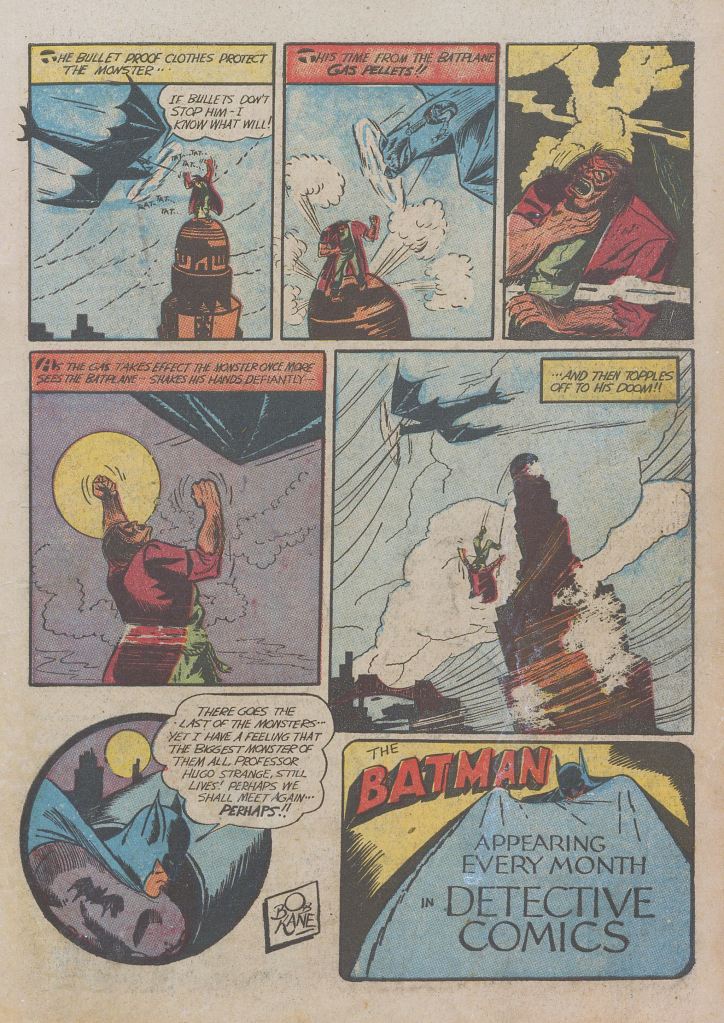
At this point, BATMAN #1 sees print, featuring a reprint of the Masked Manhunter’s origin and four other adventures, including the debuts of the Joker and the Catwoman. It also includes Batman’s second battle with Hugo Strange, a story that had been intended for DETECTIVE COMICS #38 but which was pushed aside for the more exciting debut of Robin. This story is famous in that it’s one that’s been most often seen, BATMAN #1 having been reprinted in its entirety a few times since the 1970s. In it, Hugo Strange uses a serum to turn a bunch of men into gargantuan monsters and outfits them with bulletproof clothes. Twice in this story, Batman uses guns mounted to his Batplane to shoot at and attempt to kill these seemingly-indestructible brutes. So we’ll give that a clear two-count. (BATGUN TOTAL: 5)
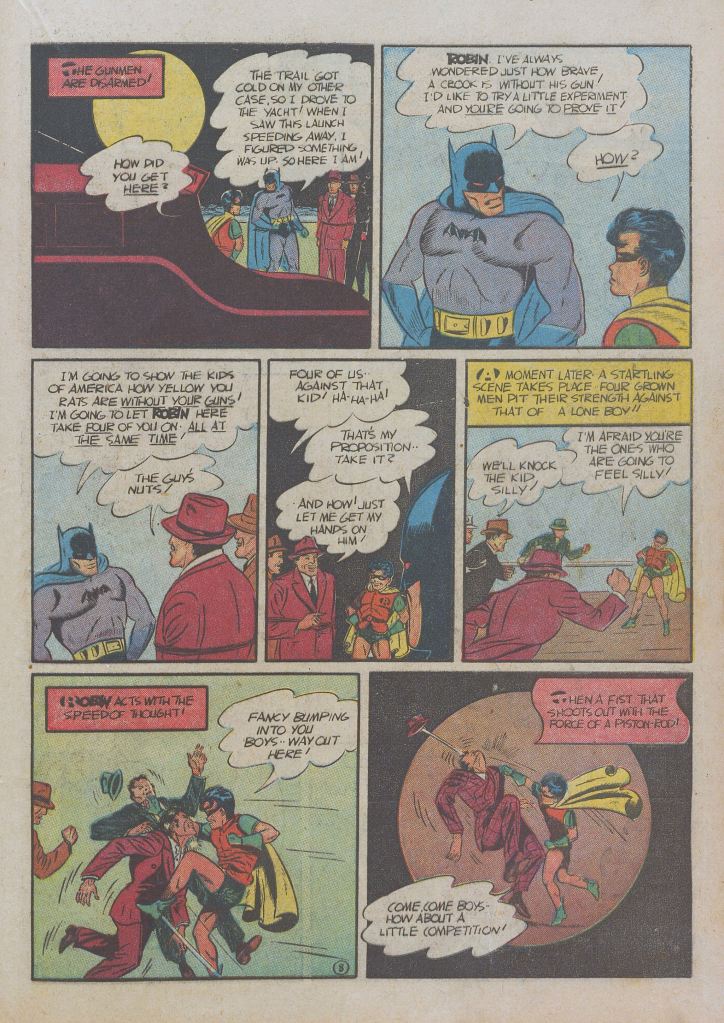
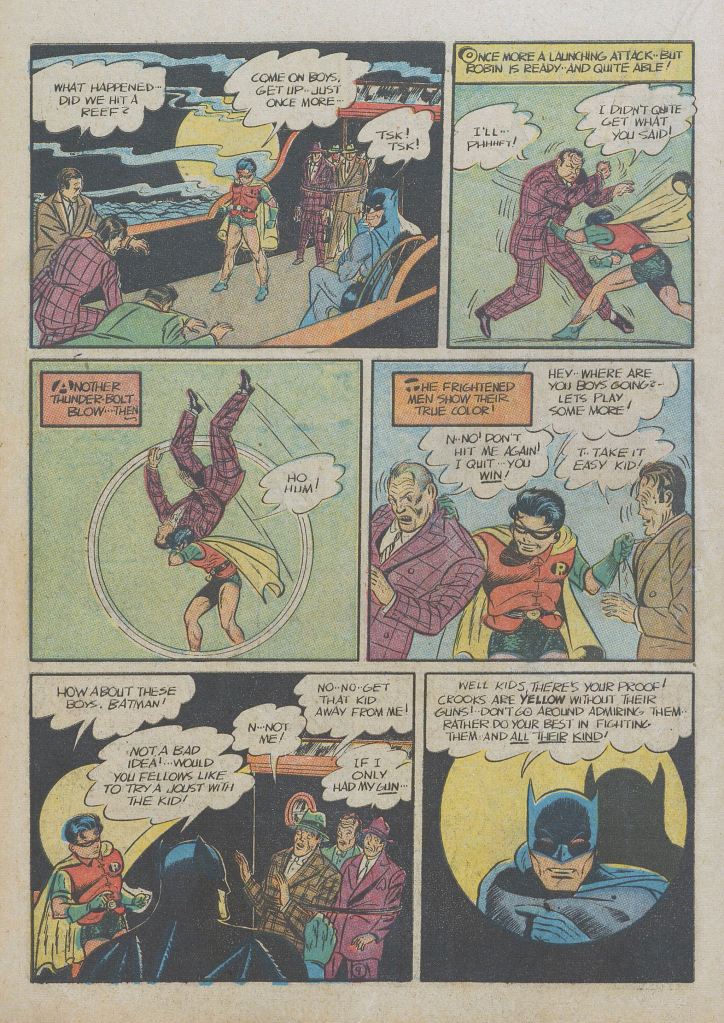
That story was also the tipping point for DC’s editorial director Whitney Ellsworth. He spoke with Kane at this point, and forbade Batman from ever carrying a gun or taking human life from here on out. Ironically, the Catwoman story in this issue also includes this two-page interlude in which Batman shows that an unarmed Robin can outfight a whole crew of criminals if they are without their guns–that it’s the guns that are dangerous, rather than the cowards who use them. It’s as close to an anti-gun sentiment as Batman would make in these years.
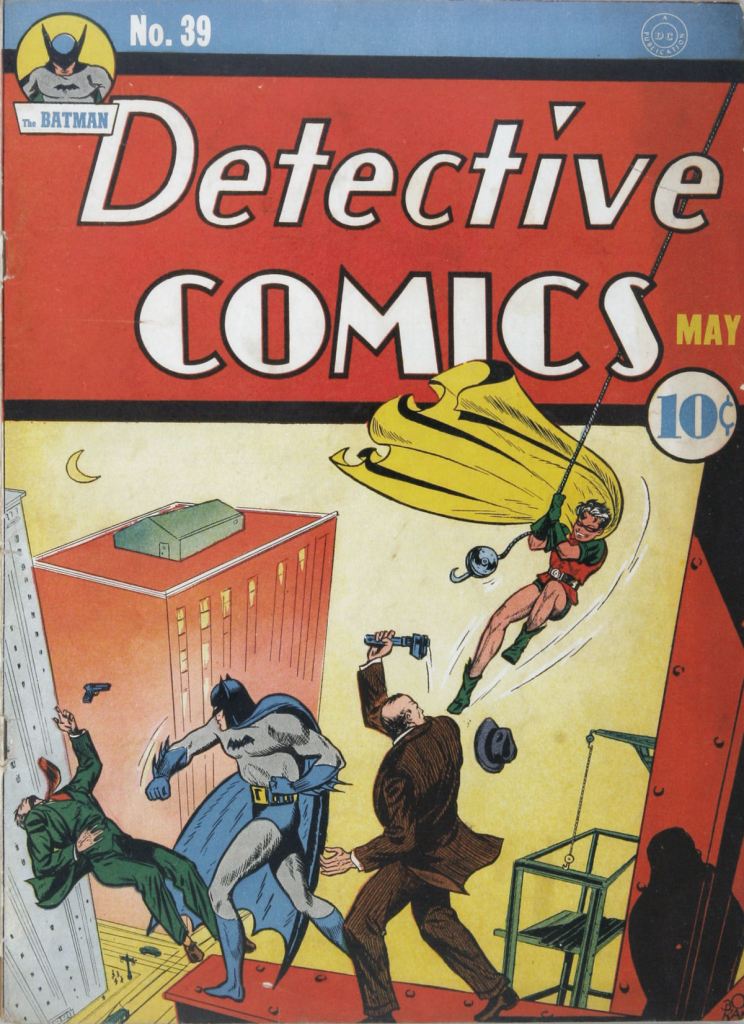
But just to fill out Batman’s first year, DETECTIVE COMICS #39 had the Dynamic Duo taking on a Tong in Gotham’s Chinatown. But no bullets were fired or firearms brandished by either of the pair in this adventure.
So as you can see, the total number of times that Batman used a gun in his supposedly-firearm-packing early days was 5, and in only two of those occasions did he turn it on a living being: a pair of vampires and a bunch of giants. This idea of the early Batman as a pistol-packing avenger is clearly conflated with that of the Shadow, who absolutely carried and used his barking 45s issue after issue–the Shadow’s bodycount must be truly staggering for this same period. Batman, though, was never that guy.


So when is Ellsworth’s, and thus Batman’s, stance on the use of guns made public? I believe it happens here, in the final story of four in BATMAN #4. And ironically, it comes right after Batman has used a gun to disarm another shooter in a speeding car. But for the first time, a caption tells us that “The Batman never carries or kills with a gun.”

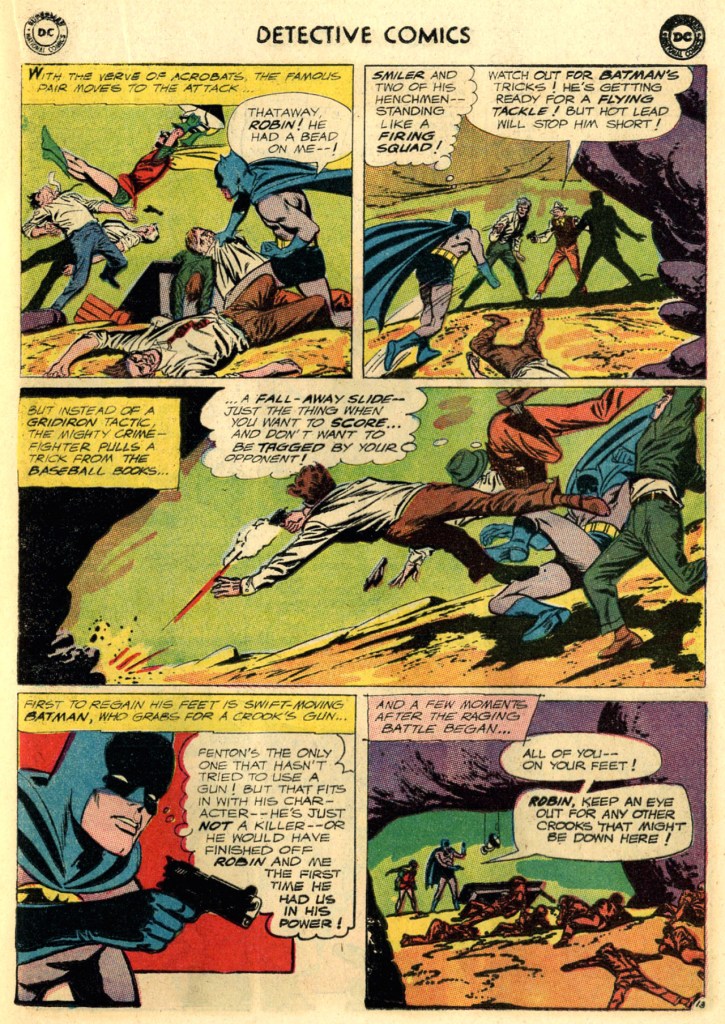
This remained the status quo of the character for decades, with one notable blunder along the way. In DETECTIVE COMICS #327, the first issue of editor Julie Schwartz’s attempt to update the character and increase his popularity again, Batman is shown using a criminal’s discarded weapon to hold a bunch of them at bay. Schwartz’s creative team of writer John Broome and artist Carmine Infantino were informed of their mistake by the readership, who wrote in to point out this error in droves.
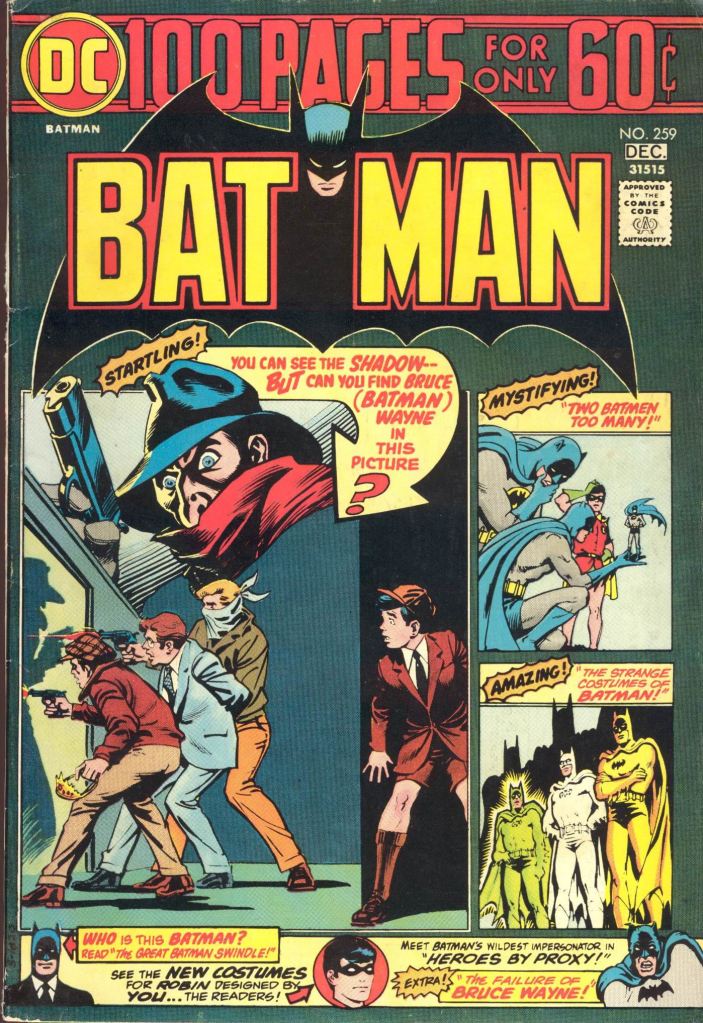

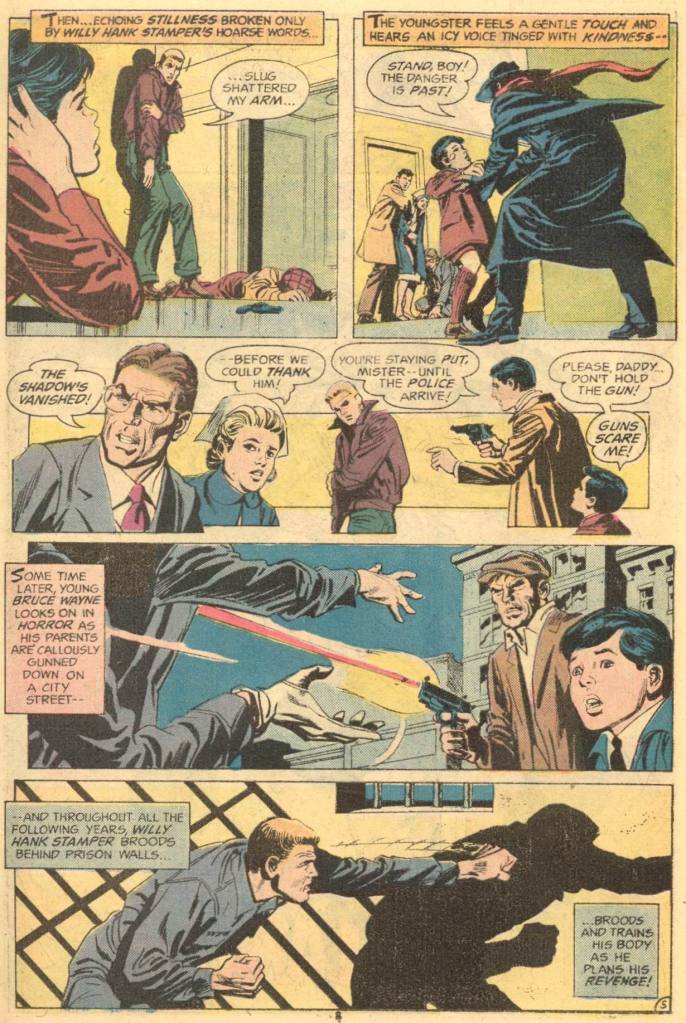
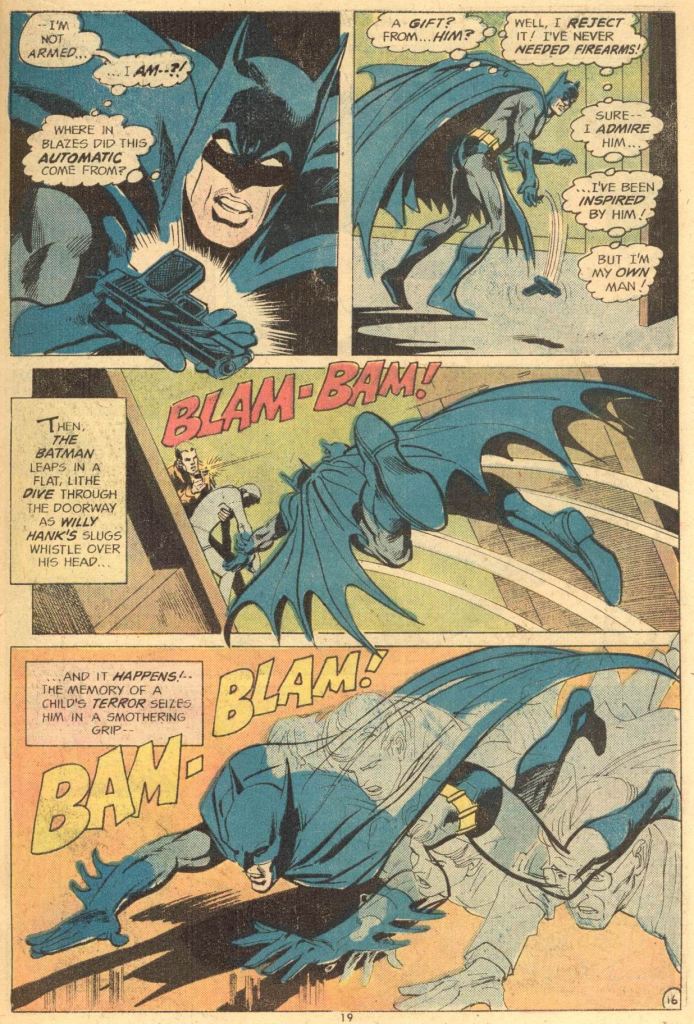
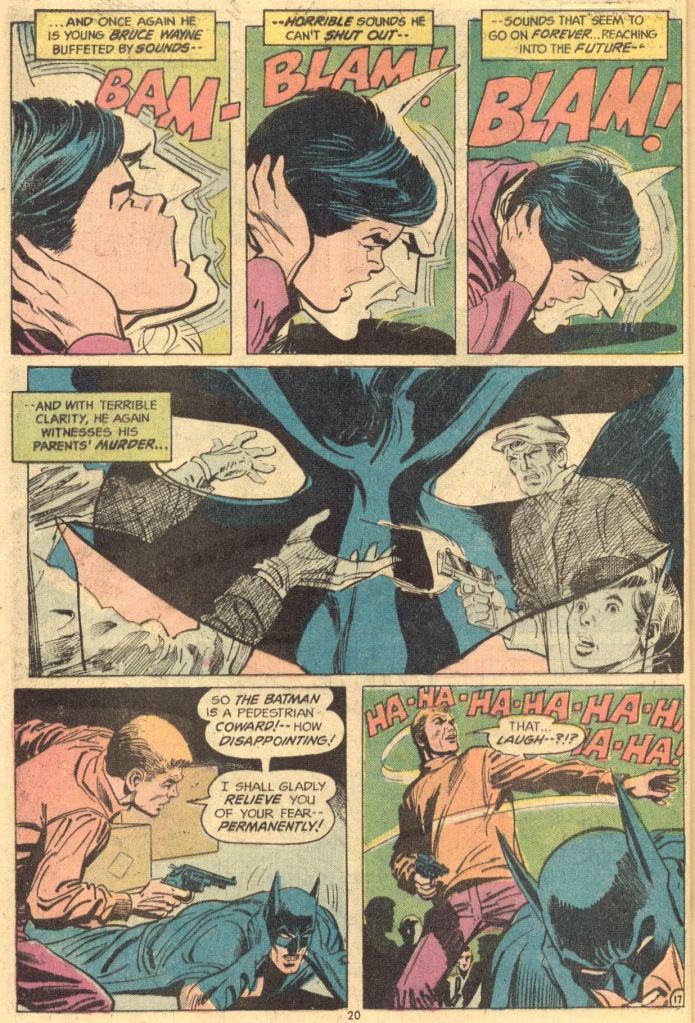

Which just leaves one question remaining: when did Batman’s dislike of guns get linked back to his origin and the murders of Thomas and Mattha Wayne? While there may have been an earlier story somewhere that connects them, the first one that I remember is this adventure from BATMAN #259, which ironically guest-stars the Shadow. In the story, we learn that before his parents were murdered, they and young Bruce Wayne were present when the Shadow prevented a robbery, and Bruce was traumatized by the gunfire. it was only a short while later that his parents were gunned down, and this combination of events gave him an aversion to firearms thereafter. In this story, the Shadow attempts to provide the Caped Crusader with a gun on multiple occasions, only for Batman to definitively reject it, and ultimately overcome his trauma on his own terms. It was written by Denny O’Neil and drawn by Irv Novick and Dick Giordano. A short while later, Denny would write the classic “There Is No Hope In Crime Alley” in DETECTIVE COMICS #457 which recounted Batman’s origin and incorporated his hatred for guns as a result into the mythos firmly.
 The Tom Brevoort Experience
Brings to mind Micheal Keaton’s Batman, firing at Joker from the Bat plane, and then Joker calmly taking him out with a single shot.
LikeLiked by 1 person
Even if Batman had used guns often in the early Golden Age, that hardly means he “should” do so forevermore. Superman did much more direct social action in the early Golden Age – so much that it would fun to have that character back in some form (it won’t work for high-powered Superman, but maybe for somewhat more than street-level powers). But I think the debate stems from the problem with Batman in terms of the space he occupies in the genre. He’s clearly rooted in the pulps, with the grotesque villains and having “only” top-human powers. But those pulp heroes used guns without apology, because they’re still human. The actual powered heroes don’t use guns because supposedly their powers work better or are more suited to the threats. If Batman’s opponents are flamboyant bank robbers and/or he’s focused on solving mysteries (remember, world’s greatest detective), then no guns is workable. But if his number-one foe is a sadist psychopath serial killer with an enormous body count, it becomes really hard on the suspension of disbelief to avoid “Just Shoot Him Already!”.
That is, I think it’s a mistake to view the issue in terms of “Batman was originally a gun-using character and it’s a retcon which should be discarded in making him a hoplophobe” (as you point out, factually wrong in essence). But I’d say the sophisticated idea often poorly phrased is more like “Batman is fundamentally a pulp hero, and putting his stories in a world with pulp-type villains engaging in merciless mass murder, yet him having hoplophobia, makes it too difficult to easily maintain the suspension of disbelief for an enjoyable story”.
LikeLiked by 2 people
And to that, I would argue that people seem to have been more than willing to suspend their disbelief in this regard for over 80 years, so it doesn’t seem to me to be a problem needing fixing. Not, to me, most of these questions often come down to, “What story are we trying to tell ourselves?” And here, what those advocates want is a heroic character who reflectively tells them that gun ownership and use isn’t just heroic, it’s also a necessity. And I simply don’t buy into that story.
LikeLiked by 3 people
Yes, I believe you’re exactly right on the point of “What story are we trying to tell ourselves?”. But as I think of it, story-telling has necessary rules which are often difficult to articulate in detail, because they’re not completely rational – and the more those rules are pushed, the less “good” of a story it becomes. There’s a bad critique of superhero stories which runs “You can believe in flying man, so why not believe in …”. The answer there can be complicated, but it comes down to which belief rules can be suspended easily, and which cannot.
It hasn’t really been “80 years”, or maybe it’s a story problem which has been getting slowly worse over the decades. In my view, the grim-n’-gritty-ification of Batman in general, and in particular the Joker, has pushed too hard on the no-guns rule overall. If Murder McKill boils a baby alive and makes his parents eat it as soup, a vigilante hero who cannot use a gun and shoot McKill at the first sign of resistance starts looking less like being heroic and more violating “believable” story rules than the flying man. It’s too obviously the author peeking out and saying “Guns Are Bad For Non-Police”. It doesn’t come across as being a hero, it comes off as at best a crippling neurosis and at worst ridiculous preaching.
This isn’t to argue that characters should be 90’s-style BludKyllGunz. That (AzBat) was far worse in the other direction. But making Batman’s rogue gallery more and more direct hands-on killers, and pushing the death count sky-high with the Joker, has ratcheted up the “realistic” violence to the point that Batman’s hoplophobia doesn’t fit well in that world. Trying to make it do so by authorial fiat is where the story falls down.
And yes, it’s absolutely true, “gun ownership and use isn’t just heroic, it’s also a necessity” *when dealing with armed and dangerous serial killers*. I don’t think it’s correct to dismiss the problem as (my phrasing) wanting to turn Batman into the Punisher. To be sure, there’ll always be some of that in fandom. But there’s a deeper issue that the more realistically violent the villains become, the more “no guns for the human hero” becomes unbelievable.
On reflection, I think what you’re getting at here is that there’s a “conservative” story about the ordinary citizen who uses a gun to take down a bad guy. This has a big problem because what if it’s not really a bad guy. But turning it on its head makes for a “liberal” story of the very worst certain bad guy should not be taken down *using a gun* by an ordinary citizen (here meaning non-police) – only by being so fantasy-skilled to use nonlethal techniques. Yes, that’s a longstanding part of the genre. But again, I’d contend it’s been made too obvious, too extreme, too absurd, in modern times.
LikeLiked by 1 person
Too bad real world doesn’t care whether you “buy into that story” or not.
Also I just don’t understand this mentality in supposed “fans”.
Batman used guns (originally but also in more Bronze Age and on, up until 2009’s Red Hood was made and completely sealed that avenue, original Under The Red Hood btw makes Batman into absolute lunatic and one of biggest character assassinations made by anyone, but hey everything for that anti-gun politics) more times than Captain America did and he ALSO has more confirmed kill count than Captain America and Iron Man do. AND No-kill and no-gun stances in Captain America and Iron Man actually came from their creators instead of strict censorship by editors that had absolutely 0 clue what characters they were doing (this is especially notable with how much they tried to get Superman right, right until Jerry Siegel returned in 1958 and for “absolute coincidence” Superman finally gained yellow sun explanation “from Mort Weisinger (who managed him for last 15-20 years since Siegel left twice with low gravity explanation that somehow worked in space).
And here come out movies where both Captain America and Iron Man use guns and kill lots of people , sometimes even just brainwashed good guys like in Avengers 2012 (something which original Cap and IM would have at least strong sentiments about). And nobody care because “hey he is a super soldier” (no Cap was never a soldier he just test subject was in a program that ended up in failure while making him independent superhero) and “he is playboy/etc/etc/etc” but when Batman or Superman kill or use guns, god forbid, even though this is how they were actually designed. And uproar always comes from “experts” and “real fans” not from normal audience.
This absolute dishonesty of desperately clinging to an ALTERNATIVE version of certain character by people that had absolutely 0 in common with original creators and Forcing ALTERNATIVE version to be simply because of your selfish needs and ideas is something I will never understand.
Thank god for Bob Kanigher or there would still be Kung Fu Wonder Woman and “fans” would regard that one as the “real deal” and would claim that original creator “just had no idea yet”
LikeLike
Ill likely regret this, but .. Batman stories like “Seduction of the Gun” “The Dark Knight Returns”, “Batman: Year One”, writers like O’Neil, Wein, Conway, Moench, Barr, Morrison, all stuck to the “no gun, no killing” rule. Miller’s Batman went as far as to say guns made killing too easy. A coward’s way. I always saw Batman as so impacted by his parents’ deaths that he wants to prevent it from happening to others. And if he can’t, then punishing the perpetrators. A delusions to go good.
LikeLike
The trouble with this “realistic” argument is that the Joker would be dead without Batman’s intervention. Either sent to the chair (legally he does not meet the insanity-defense standards) or shot “trying to escape.” After all, he murdered a police commissioner; cops aren’t terribly patient with cop-killers.
LikeLiked by 3 people
That’s the problem with making supervillains in corporate comic books with the “illusion of change” into sadistic mass murderers, it just breaks a lot of people’s suspension of disbelief completely beyond repair. But, really, at that point the only solution as a reader is to just stop buying the comic books. That’s what I had to do. I suppose it’s a fundamental flaw in a genre that used to have a complete turnover in audience every few years as they aged out of superheroes are now being read continuously by the same people for decades. That and too many fans growing up to become professionals who try to “age up” the material to suit their now-adult sensibilities without realizing that DC and Marvel are never going to let them get rid of the aforementioned illusion if change because these characters are more valuable as intellectual properties.
LikeLiked by 1 person
Writers’ assumptions that bigger and more horrible murders make the book more mature are part of the problem too. And that villains who simply steal stuff can’t be the basis for an entertaining story.
LikeLiked by 2 people
” Batman, in order to be treated realistically, should carry and use a gun” This is like the people who griped that Superman and Lois was ridiculous because Kryptonians and humans can’t interbreed. These are not realistic characters; pick a better hill to die on.
LikeLiked by 4 people
If we’re going by realism, the cops would have shot the Joker years ago. He’s killed cops, after all. Or he’d have gone to the chair because he doesn’t meet the definition of the insanity defense.
LikeLiked by 1 person
Maybe it’s just ’cause I’m weird, but I don’t read superhero comicbooks to get a dose of reality. I do want believable characterization. And Batman’s flawed, well meaning psyche still convinces me. I’m cool with him trying to stop people from committing similar crimes as the one that took his parents’ lives. He’s been my fave since I laid eyes on him, & that would change if he started regularly shooting to kill people. I had Garth Ennis’s stories to make the Punisher compelling enough despite that character’s gun use.
But nuts or not, Batman’s idea that using a gun is “cheating” makes him more vulnerable, & to me still heroic. Again, this is the same idea space where people have superpowers, so I’m good with suspending disbelief, instead thinking he could find another way to stop a killer from feeding parents their child in a soup. Otherwise, I’d dump superhero comics for good & just go crazy following heinous crime stories in the news. And I wouldn’t have hated the outcome of Superman vs. Zod in the “Man of Steel” movie.
Cool to see Batman & the Shadow shared more panels. The dramatic “Shadow” mag cover gives new interpretation to “pea shooters”. It looks almost like the guns are squirting urine. “Pee shooters”. 😉 Tom, thanks for this deeper dive into the myth about the myth. Sometimes I worry when I see you create a new “Bat-post”. I have this (mis)perception that you dislike/hate the character. I’ve disagreed with many of your observations about Batman & several of his stories (including that the early 80’s were somehow light fare until Miller’s “DKR”- maybe how he was played in JLA, but not Moench’s work on the Bat-books, even some of Conway’s from then could get dark, & the art by Colan & Mandrake was dark & brooding, too). But this article was a relief. 🙂
LikeLiked by 1 person
Batman’s only bat-gadget in his first story is… his handkerchief, which he uses to block a gas nozzle. To me, that makes him super-cool and should have remained the standard!
This is an awesome article – I love this kind of detailed cataloguing!
LikeLiked by 3 people
I don’t know much about hoplophobia other than it’s an irrational fear of guns, and Batman doesn’t fit the bill imo. He certainly doesn’t typically react around guns the way Indiana Jones reacts to snakes. It’s a principle not an irrational fear.
LikeLiked by 2 people
In Batman #331 (Jan 1981), he impersonates a police officer. There’s a part where a bunch of officers are doing shooting practice, and when (disguised) Batman is invited to participate, he has problem because he’s literally unable to shoot a gun even in target practice. Even though this risks blowing his cover. That’s clinical hoplophobia. It’s not that the mere sight of a gun will paralyze him with anxiety. But if he can’t even do target practice as part of being undercover, that’s a real psychological issue (interferes with crucial activities).
LikeLiked by 1 person
I don’t disagree, but I would file that under “an odd depiction” since Batman should be able to fire a gun at a target. It’s like making him afraid of ladders.
LikeLiked by 1 person
I don’t know why people think Batman using a gun would change the stories in any significant way. Even if Batman did carry a gun in modern-day stories, the Joker and the Penguin and Two-Face are simply too popular for DC Comics to have Batman kill them. Just look at the Punisher; the guy has been using guns since his very first appearance, but somehow he never manages to succeed at killing anyone other than a bunch of nameless, faceless one-off mobsters. Every time the Kingpin or Jigsaw or any costumed supervillain shows up suddenly Frank Castle can’t hit the broad side of a barn.
LikeLiked by 3 people
I think it makes Batman a more interesting character that he hates guns specifically because they remind him of his parent’s murder. I liked his team-ups with Nemesis where he was uneasy with Nemesis’ use of a gun even though Nemesis wasn’t being lethal with it.
LikeLiked by 2 people
This is an even more extensive post on the topic of Batman and guns:
http://sacomics.blogspot.com/2005/08/batman-and-guns.html
LikeLike
No Guns (and no kill) Batman only works in Silver Age .
And Dennis O’Neil along with Frank Robbins and many others who played Batman in more realistic stories while giving him gun-phobia and unwillingness to do what’s necessary completely broke character’s Why.
You can try to convince yourselves that sanitized and censored versions of superheroes are real deal, or even more inferior modern take where world is as bad as it gets but superheroes only can Talk and almost never actually deliver is the way, but it will simply never be because the core of superhero genre was created and completely fleshed out by Jerry Siegel and Joe Shuster in 1938. It is why Invincible (comics) was such success. Nature of these characters and the Whys of them (as well as of superhero genre itself) will eventually come forward as people, especially new will always notice that something wrong, purely by instincts. Make new characters or use specifically designed ones if you you really want message, not censored version by propped by inherently dishonest people, world has enough lies as it is.
LikeLike
It strikes me from your comment that you maybe didn’t read this piece beyond the headline. If you had, you’d realize that you’re proceeding from a false premise.
Now, if you want Batman to have guns and Superman to kill people, you’re entirely entitled to hold that opinion. But let me ask you this. In a world where these characters kill, what makes them to good guys? What separates them from whomever they fight?
LikeLiked by 1 person
in “the real world” these characters wouldn’t have autonomy or secret indentities for long. Superman is an impossibility, so I see no reason to try to impose other real world sensibilities like you’ve raised to him.
If “superheroes” killed while “crime fighting”, they’d be hunted by law enforcement with every effort & resource available. The US government wouldn’t tolerate them
A code of not killing could remove that immediate threat. Some officials would still want to have them controlled or eliminated. Others, like Jim Gordon could tolerate or cooperate with them.
LikeLike
I think it is harmful and absolutely disrespectful to completely subvert these characters like many today’s writers do. Especially when they Do put them in “no way” situation, but it is some other character that does the “bad” deed and our “pure” hero only gives speeches and bait covers. Not to mention, for some reason, I meet way less toxic neurotics online when I visit Spawn or any other “edgy” superhero fandom. Weird. Like when Richard Donner got threat letters for putting Christian imagery (even though Siegel and Shuster also did it, from Dr. Occult using device with cross on it to battle demons to The Spectre who was redhead guy with JC initials dies and brought back to life immedietally by “The Voice” in the first issue) into Superman film, and then John Byrne got death threats for all the changes including keeping both Kents alive during Superman’s adulthood, I don’t know if both of them told truth or simply lied as I never was there, but I AM in the timeline of Zack Snyder and I can see the usual “critique” he receives online since 2013.
Also I just find it personally more inspiring when Superman or Batman continue doing their generally non-lethal job after they killed/used gun/killed using gun/ other “no no” someone (like it happened in Bronze Age, but original comics too before 1941 ban ofc, and in case of reboot Superman under 90s team and in case of reboot Batman up until 2009 really) instead of completely subversive comic by Alan Moore with him immedietally dozing himself with golden kryptonite (wow man, you worked on construction and accidentally fell and now in free fall? well too bad that Superman caused chain of events in which omnipotent supervillain practically checked out himself and is now Kal is really sad about it and Supergirl is in the future), or Under the Red Hood (comic) where Batman would rather slice throat of his ex-sidekick.
And pretending that punch in the face is always non-lethal is Way more dangerous (I had kids killing each other at My school) than portraying Superman using machine gun of one of Luthor’s goon’s plane in order to shoot down another one just so they won’t succeed in air raiding bunch of civilians killing them and reigniting war between two countries for far longer. And pretending that goverment Won’t shoot at unregistered vigilante is also Very harmful. Let alone have Superman scare guy so much that he will fall some stories down and only then Superman will catch him, but it’s okay because he smiled and is a good guy, even though he literally had scene before that affirming that humans have weak hearts And his own foster dad literally died of a weak heart. Having character do any violence is already a propaganda of violence, that’s why original Wonder Woman mostly tied people or judo/threw them .
Also , as I see it people don’t really care about no-kill rule. Avengers in MCU kill people while cracking jokes, despite that Avengers started with having no-kill rules. But there is not even a reflection of that. It is when narration does reflect killing as something that Is bad but also was done/had to be done , is when that fiction becomes “edgy” these days. Hell, you can even Have character to do complete carnage like Batman/Bruce Wayne did in Nolan trilogy and also have him or his foes say “but you don’t kill” which will probably mean “but you don’t directly stab them/shoot/unlucky punch them, but you Do smash cabin of their truck upon the concrete roof of the bridge and blow entire monastery of ninjas and throw bombs on cops cars and run over them in your tank so its okay by me!” and people will be like “that’s okay, Batman totally doesn’t kill”.
So yeah yeah, this isn’t real life, and they would be find out and Terrance Yeakey’d or worse. And other stuff. Still, superhero sacrificing his own principles to save innocents > superhero that is only put in convenient situations >>>>>>>>>>>>>>>>>>>>>>>>>>>>>>>>>>>>>>>>>>>>>>>>>>>>>>>>>>>>>>>>>>>>>>>>>>>>>>>>>>>>>> “no-lethal” “purely angelic” “clean hands” “practically Jesus except we really don’t like Jesus or anything like that” superhero that only Talks and all incovenient situations are sorted out by other lethal characters that just happened to stand nearby, superhero will probably lecture them too after all that.
Especially when character was created certain way, it is like how Teenage Mutant Ninja Turtles , at least 2 of them just HAVE to constantly use their legs each time they fighting non-robots (also kinda racism to me, who says robots don’t have “souls”) just because original comics was never intended for kind of “audience” censorship every other version of TMNT is . And it is sad to see Invincible comics or Watchmen or any other “decontstruction/parody” getting praised for something that was already there in the originals’ comics (and “even” somewhere down the line too, but these weren’t made by free creators), And without trying. Especially when these originals was what truly birthed entire pop culture as everyone knows it today, and not the censored version dwindling in popularity and inspiration as well (maybe I would write differently if 90% of “wholesome/pure/clean/real heroic” Superman/Batman/you name it fans acted wholesome Online, at very least).
LikeLike
Respect to Tom for actually publishing my messages, instead of how his many colleagues decide to do when someone is disagreeing with their PoV.
LikeLike
I did not see this when it was published.
In the first two situations where Batman uses deadly force against someone with a firearm, (Detective Comics #32 and Batman # 1). Batman is shown using deadly force against others where his life and the lives of others are threatened and there is no other effective means to deal with the issuee
In Detective Comics #32, The Mad Monk & Dala, are vampires, undead creatures that can not only kill people but condemn them to the same kind of half life. Batman can’t cure them nor (within the parameters of this story) can he incapacitate them. Since they are vampires, there is a question whether shooting them would actually be “killing” or not.
Hugo Strange’s Giants in Batman # 1, presents a similar kind of issue. The Giants have been experimented on by Dr. Hugo Strange, probably without informed consent They are the victims. The increased mass and the mental damage would likely be irreversible, even today 76 years later. Batman, as presented in this story, does not have the capacity to subdue the Giants short of the use of deadly force.
As a general rule, the use of deadly force is authorized to prevent the immanent death or serious physical injury of yourself or another where a reasonable person in like circumstances might reasonably believe such threat exists. Additionally, lesser amounts of force should be considered first. See, e.g., 10 CFR § 1047.7; Dep’t of Justice Policy 1-15.000 (Use of Deadly Force0; and 609.066 AUTHORIZED USE OF DEADLY FORCE BY PEACE OFFICERS (Min, Statutes).
In the stories above. Batman (a highly skilled human adventurer with the attributes of an elite special operations combatant)_is confronted by two supernaturally powerful vampires who he reasonably believes are a danger to himself and others. He has no other way to deal with the threat. The use of deadly force is authorized.
In the Hugo Strange story. Batman would have no other way of dealing with the giants save by using deadly force (in one instance, by using a rope dropped from a plane to hang a giant, as well as shooting them.) They are clearly Hugo Strange’s victims, but Batman has no other way to subdue them, at this point in his career.
However, these stories appear in 1939 and 1940. Batman is presented as the only costumed adventurer.
In a world where Batman is (at least nominally) a JSA member. Is deadly force as authorized where Batman could ask Superman to physically subdue the giants without killing them or where Dr. Fate or the Specter could exile the Vampires to another realm? Is killing the giants as morally justified where Rex (“Tick-Toc”) Tyler, a brilliant and innovative Biochemist, is a friend and colleague who might be able to cure or incapacitate the Giants?
Fictional worlds are (dare I say it) FICTIONA:L.
However. they should carry that fictional reality forward in a way that operates logically from that fictional premise.
In the Danger Man/Secret Agent Man/John Drake TV series, John Drake did not use guns As the character says in one episode, “‘I never carry a gun. They’re noisy, and they hurt people. Besides, I manage very well without.” However. it made sense within the context of the show, Drake is an undercover, covert HUMINT operator. Engaging in running gun fights would hardly keep his profile low . . . . (The guy in the show worked assiduously to avoid the fate of the guy in the show’s theme song.)
A guy with serious Special Operator chops (for the sake of argument, someone with something like “Chargin’ Charlie” Beckwith or Dick Marcinko’s skill set) could do most of what the comic book Batman does. but would have to use firearms and explosives to go outside his “weight class” (e.g.,,, Vampires and Giants) unless he had allies in similar “weight classes.” In which case, he would need to call for a “consult.”
Oddly, the Haney/Boltinoff B&Bs were realistic in that they showed Batman as a well-respected and very connected figure in the superhero world, who could get people to help him where needed . . . .
LikeLike
I think Robin’s origin is worth bringing up. To get the goods on Boss Zucco, Batman lets him throw a henchman off a building, capturing the act on film. That’s not something he’d have been shown doing a few years later.
LikeLiked by 1 person