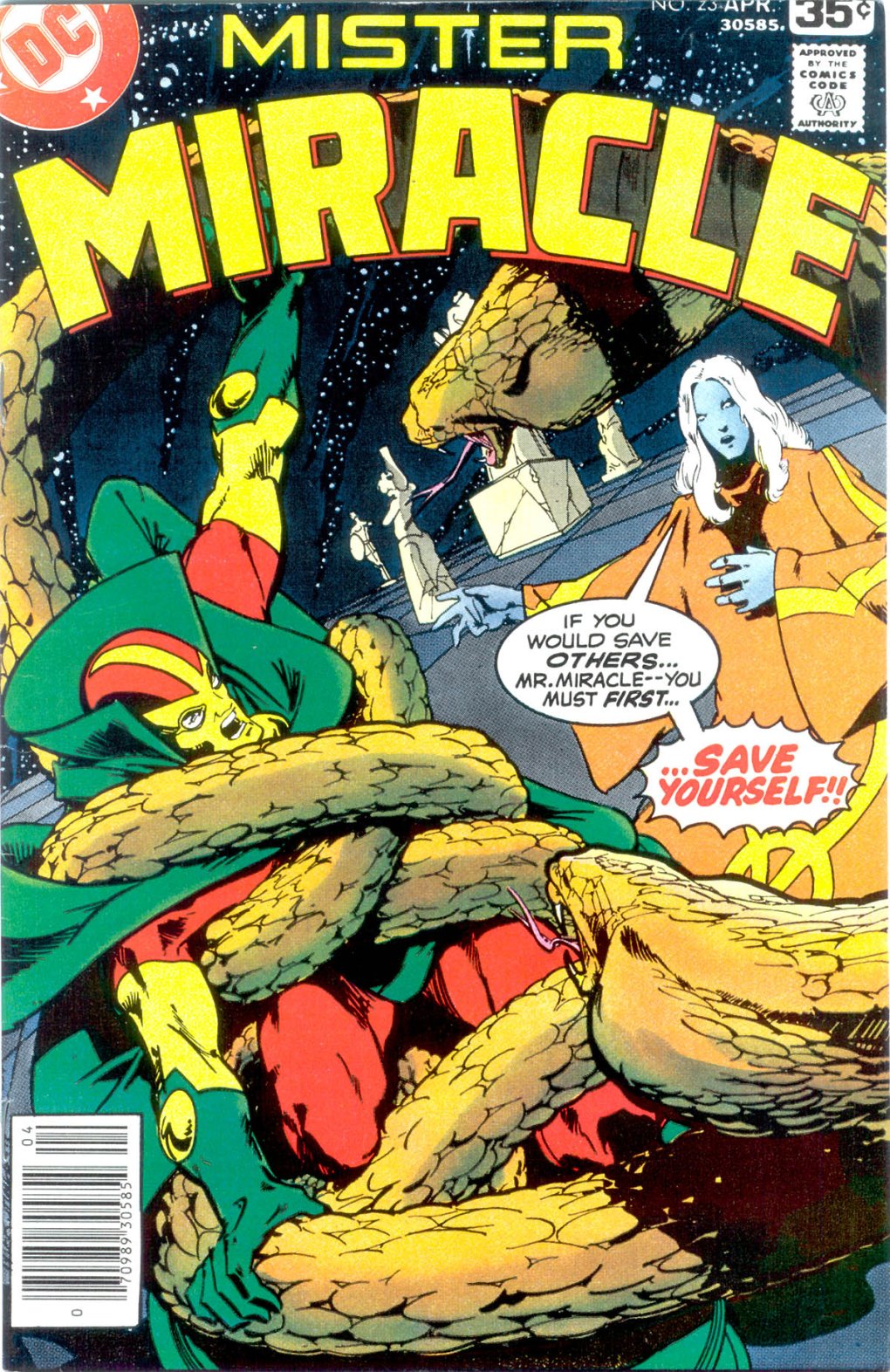


I’m pretty sure that this issue of MISTER MIRACLE was bought for my brother Ken while on a trip to our grandparents’ house one weekend. It was another small exposure for me of the Jack Kirby Fourth World mythos. But for all that it’s a pretty great comic by a top-flight creative team, it did nothing for me at the time, not quite fitting into my rigid paradigm for what a super hero comic book should be all about.

The story was by Steve Gerber and Michael Golden, and it would be difficult to find a better creative team to work on the story of a would-be messiah who grew up on a planet with the nail’s-head name of Apokolips. I’d be willing to bet that Golden colored it as well, the assignment being credited here to D.R. Martin, an in-joke denoting the Dr. Martin’s watercolor dyes which were used to color comic book pages at this time. Those sure look like Michael Golden magentas and purples on that splash page to me.

As conceived by Kirby, MISTER MIRACLE was a pretty odd series. On the surface, it was the story of a “super-escape artist”, a man whose particular skill was the ability to break any chain and liberate himself from any room–talents he used as a performing showman. But he was also the son of Highfather of New Genesis, and grew up in the dehumanizing orphanages of Armagetto, having been part of an exchange of hostages that insured te peace between New Genesis and its enemy, Apokolips. So while there was a lot going on underneath the surface, most Kirby issues tended to focus on putting Mister Miracle in peril and watching how he’d extricate himself (most often through the use of his “Mother Box”, a sophisticated living computer module.) It was the one series in Kirby’s Fourth World saga to avoid cancellation for awhile, but once he was forced to move it beyond Fourth World concerns, the heart and the life went out of MISTER MIRACLE, and it eventually folded.

But tanks to the skill of Kirby’s works and the boundlessness of his imagination, those titles had their fans even among the various creators in the industry. And when a regime change at DC brought Jenette Kahn to power, she brought a few of those series back based on their past sales figures, MISTER MIRACLE included. It fell to first Steve Englehart and then Steve Gerber to figure out what to do with Scott Free now that the larger Fourth World story was more open and free-form. This being the 1970s, and with Jesus Christ, Superstar still readily in mind, they decided to push Mister Miracle towards being a messiah-figure, the one who might liberate the oppressed citizens of Apokolips from the sinister Darkseid’s rule. This wasn’t a bad thought, as it gave Mister Miracle a mission, one which would bring him into regular conflict with other characters, so he no longer needed to either stumble into danger or to be pursued all of the time.
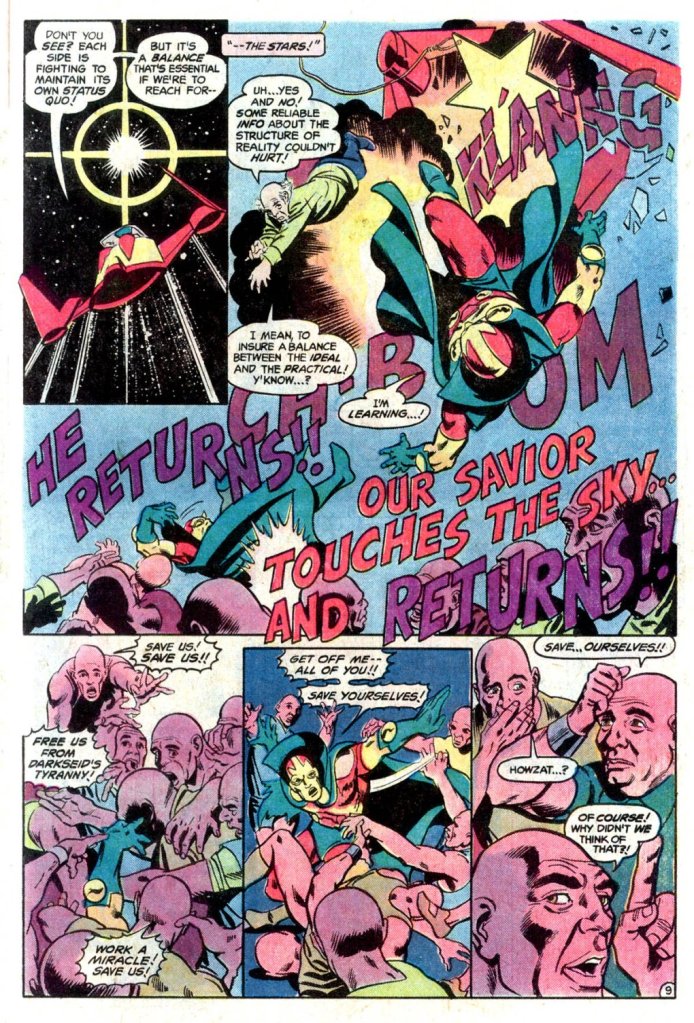
This gave Englehart and then Gerber the perfect canvas on which to produce the kinds of mind-expanding, trippy and pseudo-psychedelic stories of the sort that they had previously pioneered at Marvel. The conflicts became less physical and more metaphysical, and the point was more about exploring the nature of the human condition than in battling bad guys and overcoming villains physically. Consequently, though, this meant that in 1978 I didn’t have a lot of interest in it. My psyche wasn’t at a point where it needed to be explored, and the kinds of themes at work within this comic were ones that held no particular interest for me.
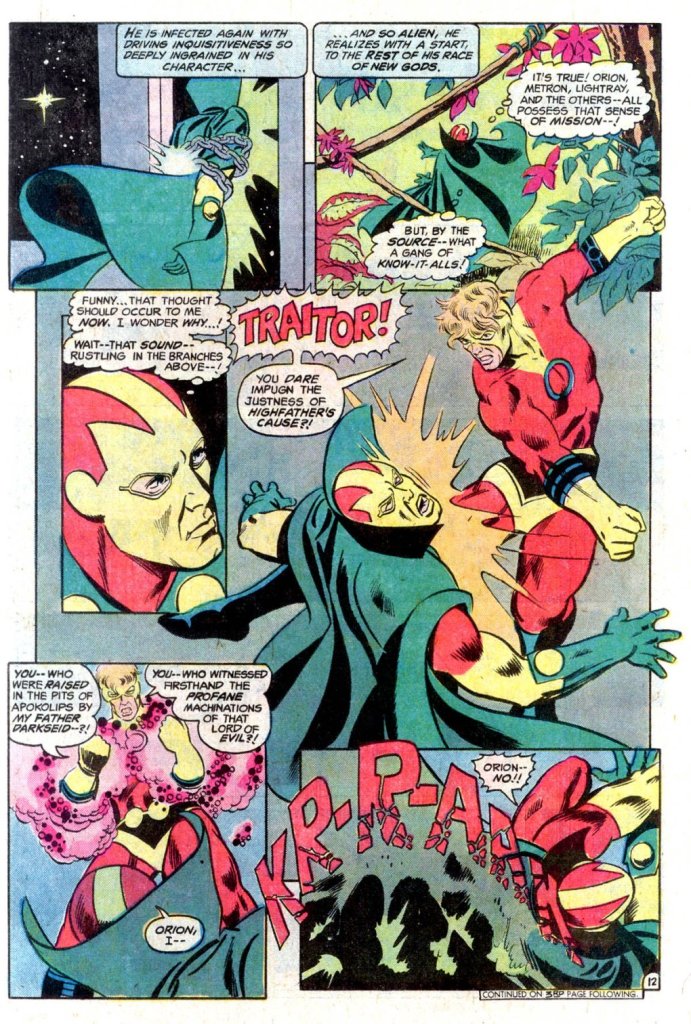
This particular issue was especially trippy. It opened with Mister Miracle having been zapped away from Apokolips by Darkseid, and finding himself falling onto a giant chess board floating in space–the domain of a being known as Ethos. For its own reasons, Ethos has chosen to put Mister Miracle through his paces, in order to get him to make some grand realizations about the universe and his own place within it. As such, we get a series of fantasy scenarios that play out with Scott Free as an active participant in them. They’re designed to make him learn and grow, but they’re also the sorts of absurdist scenarios that Gerber loved to indulge in.

The whole story leads up to a last-page revelation that Mister Miracle himself, the son of Highfather, is half-human. I can’t recall this particular plotline ever being followed up on, so I’ve no idea who Gerber might have intended his mother to have been. This definitely feels like a deviation from what Kirby had in mind, and so it’s probably better off forgotten. But in 1978, as today, the creators working on these characters were forced to grapple with the fact that so much of Kirby’s ultimate story never made it out of his head and onto the page. And so they were often forced to take things in their own directions–and those directions most often proved to be disappointing. As talented as all of these folks were and are, there was only ever one Jack Kirby.


This is maybe the comic that most influenced me as a writer when I was a kid. I hadn’t fully read the Fourth World books when I got this one: I think I HAD read “The Pact,” though, so I knew the basics.
The third or fourth comic I ever wrote — a Dynamite “What If” thing called ALTERED STATES: THE SHADOW — references this story pretty heavily. It KILLS me that the Gerber/Golden MISTER MIRACLE only lasted a handful of issues. I’d love to have read another 20 of these.
LikeLiked by 1 person
I loved this short run too. Looking back Gerber seems a perfect writer for the determined weirdness of Kirby’s Fourth World. His writing appealed to me more than Kirby’s certainly. The stilted dialog and dreadful character names were a turn off for me and I don’t think I’ve ever made it through reprints of the first volumes of MM, NG, and especially the Forever People. It didn’t help that the New Gods revival and this series were my introduction to Scott and that world and had more polished writers involved.
LikeLike
“As talented as all of these folks were and are, there was only ever one Jack Kirby.”
LikeLike
I would bet the “D.R. Martin” credit for colors meant that it was a gang job; both Marvel and DC used that, or “Doc Martin,” At times for those.
I would also bet that you’re right about those Golden purples, meaning he colored some of it.
And I’d bet that whoever gave this issue to Giella to ink, it probably wasn’t Larry Hama. And whether it went to Giella because he was fast and the book was running late, or because they contractually had to give him something to ink that week and this was available, it was a terrible, terrible creative choice. Talk about a mismatch!
LikeLiked by 1 person
If you’d never seen Golden’s artwork before, you might look at this issue and say, “Well, that looks pretty good”. I mean, the inks are not sloppy or haphazard, it’s a careful, professional job. But man, all of Golden’s stylistic trademarks just get completely buried.
LikeLike
Yeah, the storytelling and dynamics are all there, but the linework has been murdered and the faces all dulled to death.
I don’t like Giella inks at the best of times, and this was a long way from that.
LikeLiked by 1 person
“Mister Miracle” with a Golden opportunity. I guess it’s proof that there’s no magic Gerber baby formula.
Hey, the current “New Gods” is my fave non-Batman series. To say it’s “epic” is an understatement.
LikeLike