

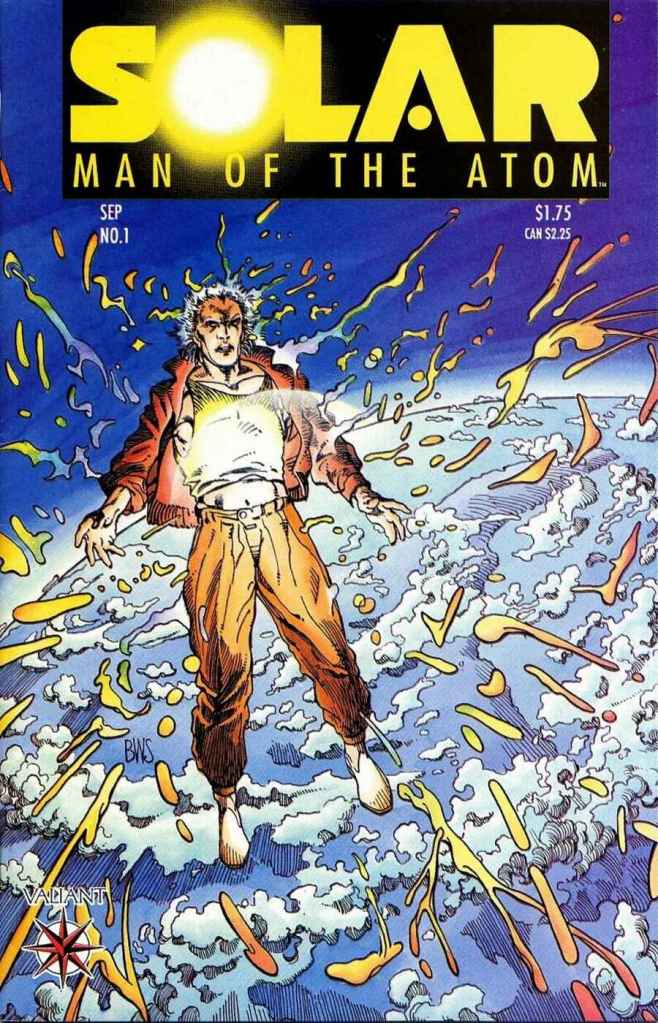
The second super hero title in Valiant’s new line of books was SOLAR, MAN OF THE ATOM #1. Like MAGNUS, ROBOT FIGHTER, the series was a revival of a property that had been published in the 1960s and 1970s by Gold Key: DOCTOR SOLAR, MAN OF THE ATOM. But unlike MAGNUS, SOLAR wasn’t set up as a continuation of that earlier series. Instead, its lead character, Dr. Phil Seleski, had read the Gold Key comics when he was a kid, and so when he experiences an accident in a similar manner to that earlier Doctor Solar, he is inspired to adopt his own version of that comic book character’s name and costume for his own. In this respect, the approach was similar to the way in which the silver Age Flash was in part inspired by reading the exploits of his golden age counterpart.
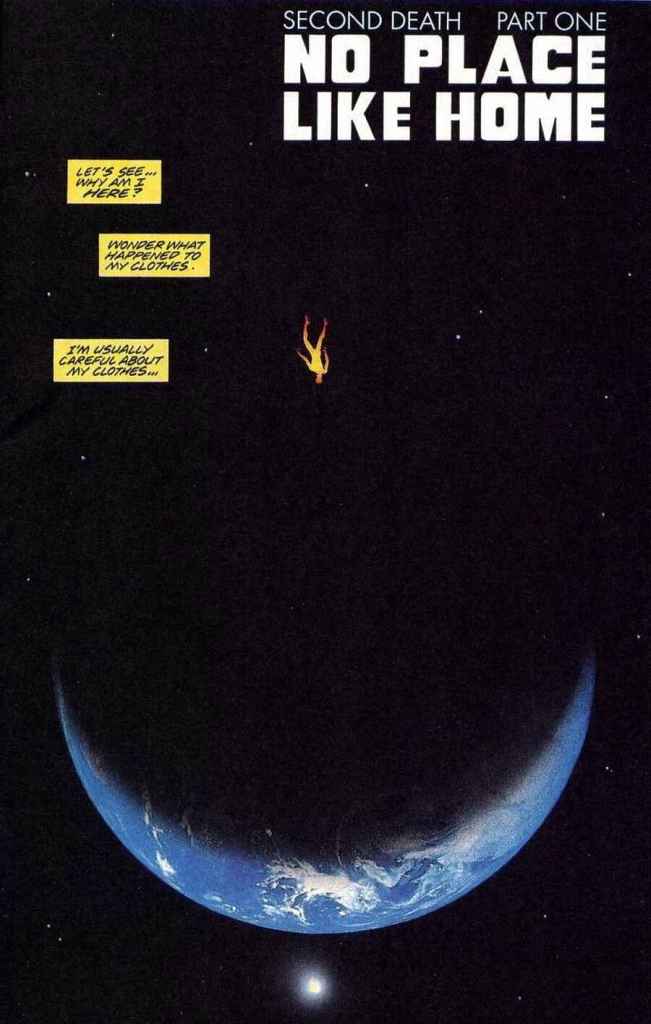
SOLAR #1 jumps into events mid-stride. No origin here–instead, a ten-part origin story called “Alpha & Omega” by Jim Shooter, Bob Layton, Barry Windsor-Smith and Janet Jackson was serialized across the first ten issues of the title, providing the necessary backstory as to how Phil Seleski became virtually omnipotent. As a bit of a gimmick connected with this story, each issue also included a fraction of what was being billed as the largest single comic book panel of all time, one that couldn’t be seen in its entirety until that tenth issue and the climax of the serialized story. The panel occupied the center spread in the book here, and given that this was right in the middle of the Alpha and Omega chapter for this issue, which itself had been nested within the main story, the structure of the issue is a bit confusing all around.
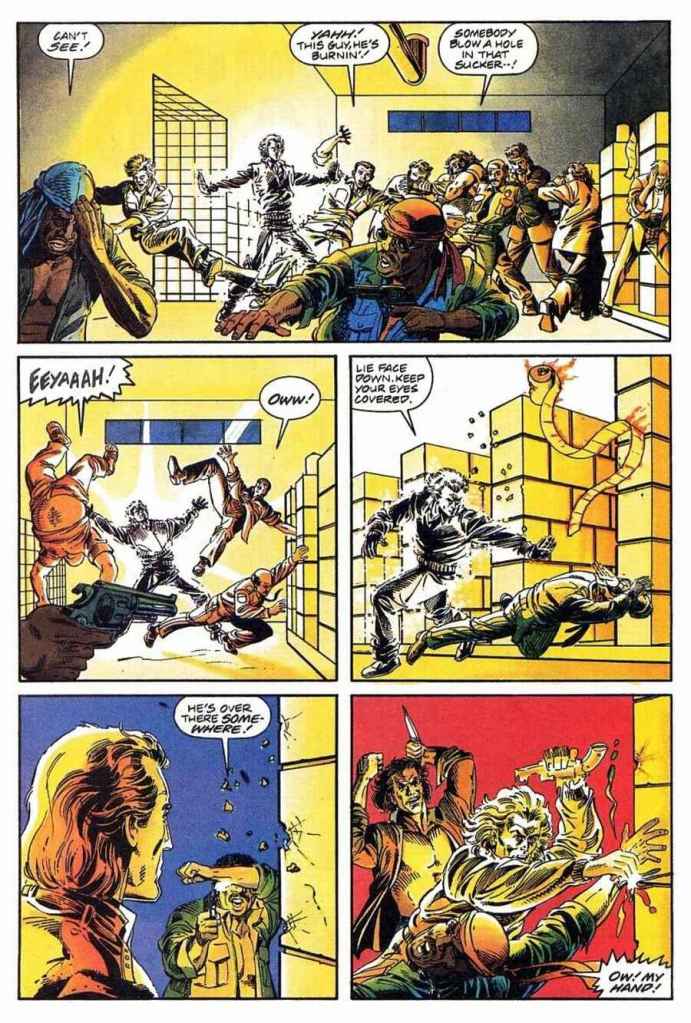
To back up for a second, Gold Key’s DOCTOR SOLAR started out life not as a super hero title but rather a scientific adventure strip. In an accident, Solar is exposed to massive amounts of radioactivity, which makes his presence harmful to those around him, forcing him to live in a lead-lined bunker. But it also grants him extraordinary powers that he uses to battle spies and saboteurs and the occasional monster or alien invasion. In the fifth issue of the 1960s series, Doctor Solar adopts the costumed identity of Man of the Atom, wearing a uniform that contained his deadly radiation and permitted him to walk among other people safely. Doctor Solar was one of three similar super heroes of the era who were all atomically powered and shared similarities in their origins and backgrounds. Captain Atom and Nukla were the other two. We covered the first appearance of solar as the Man of the Atom here:
It has to be said, for all that writer and editor Jim Shooter was a fiend for clarity, the set-up and structure of this first issue is a bit perplexing. It opens with Seleski, unidentified by name, floating in space at the edge of Earth’s atmosphere. He makes his way to his home in Muskogee where he runs into another version of himself, this one seemingly not an all-powerful apparition from space. Before either character can be named let alone explained, the glowing Seleski zips away. He expands his senses, learning that there’s a riot going on at a nearby prison and he decides to intervene. He does so, getting stabbed in the process, but while the puncture releases a devastating wave of energy from within him, he is essentially unharmed (which is more than can be said for the convict who stabbed him, who is instantly disintegrated by the backlash.) From there, we watch as the other Doctor Phil Seleski drives to his place of employment, a nuclear power plant, where he’s finally identified. We also meet his co-worker Gayle, who is clearly a reflection of the 1960s Doctor Solar’s girlfriend Gail.
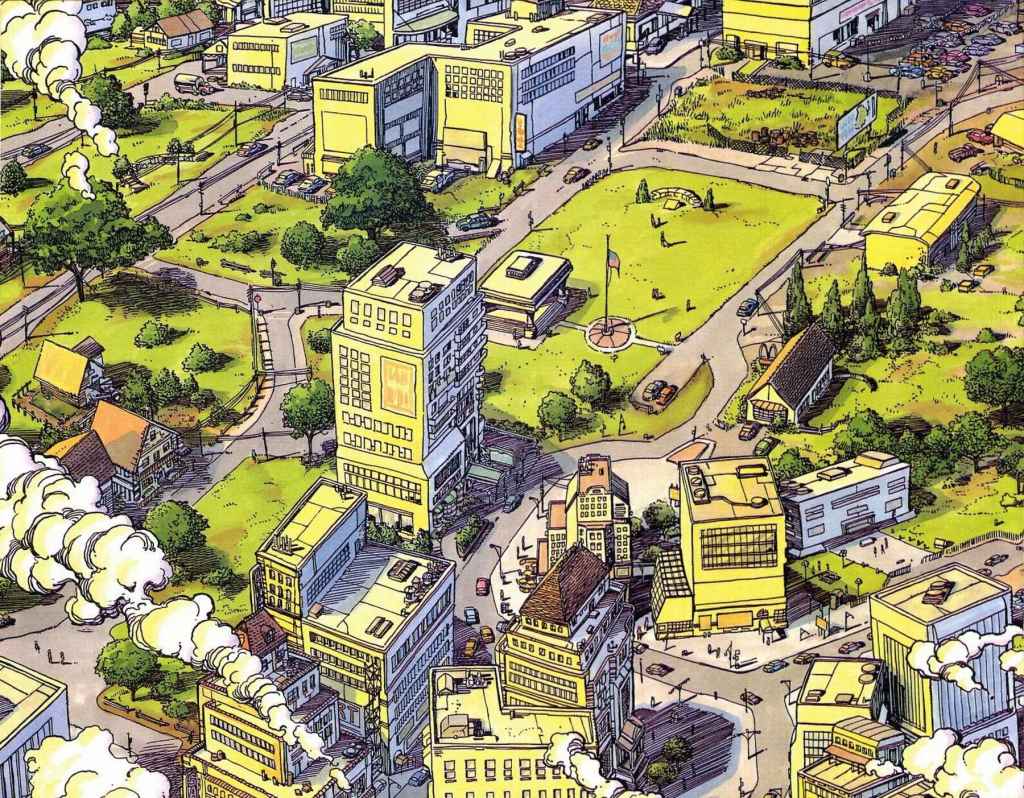
Meanwhile, the glowing figure is drawn to Russian waters, where he finds a pair of ships searching for a stricken nuclear submarine. Unbothered by any lack of air or light or the pressure of the depths, the glowing Seleski dives below the waters, seeking out the prize that the Russians are searching for. By diminishing gravity, the glowing figure is able to bring the stricken sub to the surface–but he’s not finished yet. He begins to extract the craft’s nuclear warheads, and when the Russians attempt to stop him, he’s shot, once again releasing strange energies from within his form, but this time not in an explosive discharge. The bullet wound doesn’t bother him in the slightest.
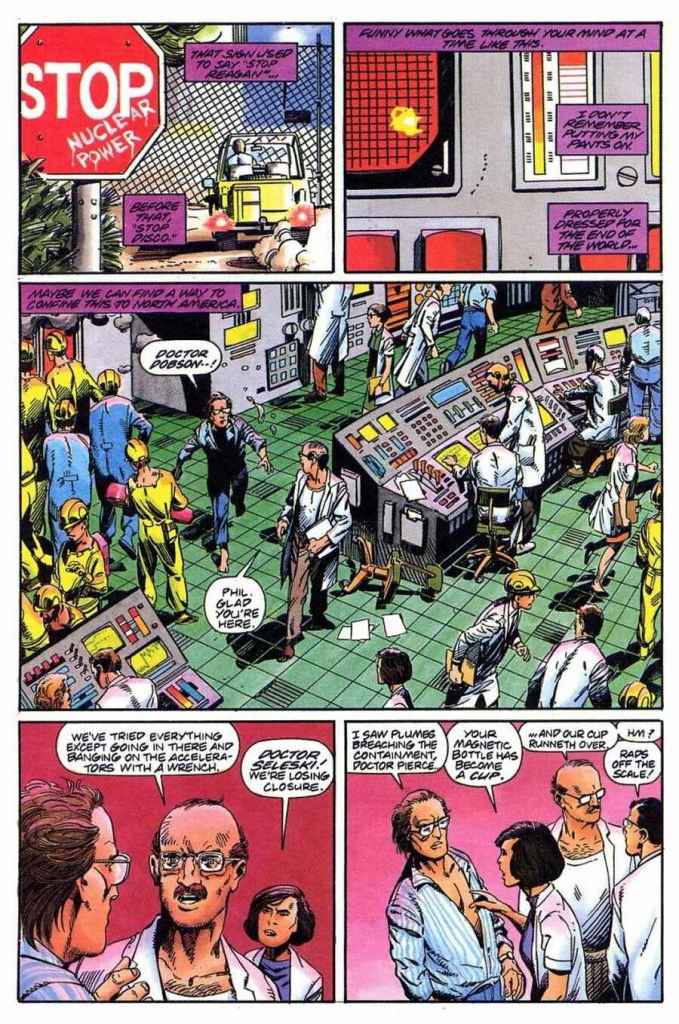
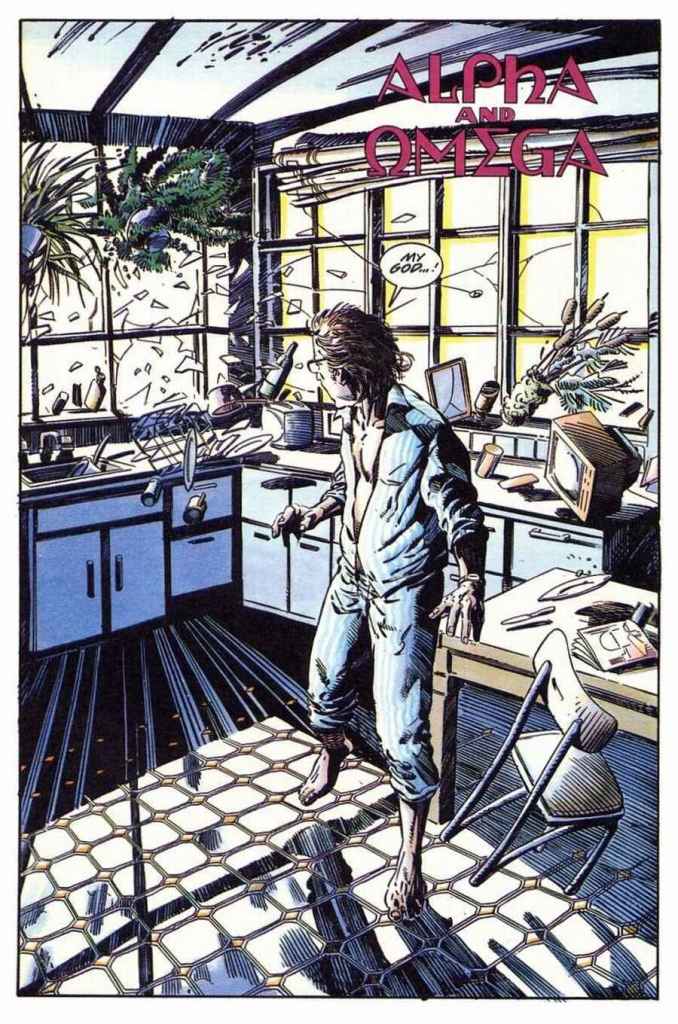
It’s at this point in the book where the “Alpha & Omega” chapter is inserted. In its pages, we’re introduced to Dr. Phil Seleski, who is awakened at his home by a ruckus outside. The nearby nuclear power plant at which he works is undergoing a critical failure, and Seleski races to the site in the hopes of being able to do something to prevent a full-on meltdown. The entire chapter is only 8 pages in length, with some nice artwork from Barry Windsor-Smith and Bob Layton that’s colored perhaps just a hair too garishly in full process color. The idea is that the individual chapters could be pulled out and assembled into a SOLAR #0 once teh story was concluded, though I can’t imagine many readers in 1991 choosing to deconstruct their comics in such a fashion. The segue back out of the origin story and into the main feature is similarly a bit abrupt and confusing.
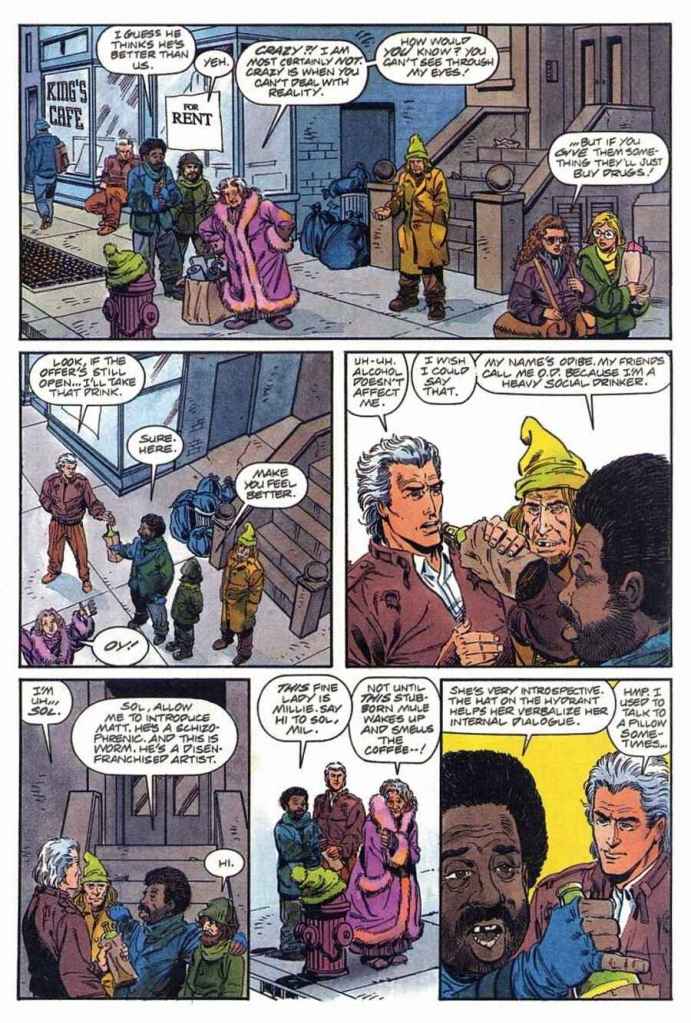
As the main story picks up, the glowing Seleski transports the Russian missiles into space, where he causes them to detonate, reconstructing his physical form Dr Manhattan-like after this has occurred. From there, he heads back down to the city, attempting to puzzle out his circumstances. He winds up interacting with a group of homeless people, and a discarded newspaper tells him that he’s somehow traveled backwards in time, to a point before teh accident that empowered him. Realizing this, Seleski heads back to his home, where he delivers a warning to his younger self, telling him that he’s not going to stand by and watch him make the same mistakes that he himself made–even if he has to kill his earlier self. Then he returns to the street community that has accepted him as one of their own. The call him Sol, due to the fact that he glows from time to time. And that’s where this first issue wraps up. There isn’t any costume introduced, nor is Solar called by that name in full nor Man of the Atom. In fact, one could be forgiven for thinking that this isn’t a super hero comic book at all.
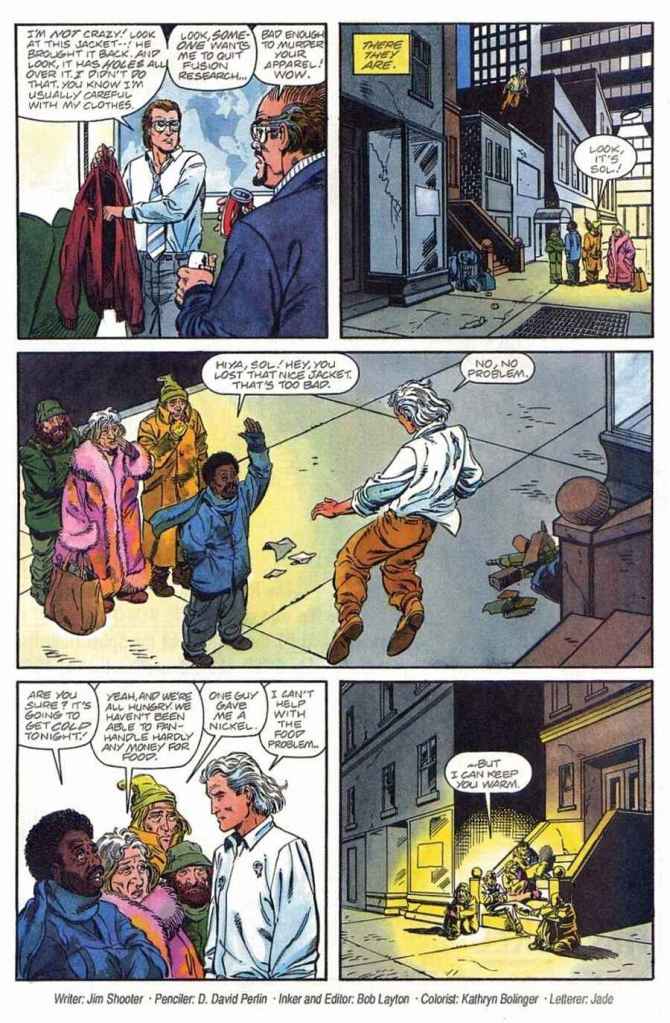
In many ways, SOLAR seems like a second draft of some of the themes that Jim Shooter had been playing with in STAR BRAND, that of an ordinary person gaining tremendous powers and having to figure out how best to use them. It feels like, just as with Ken Connell, there’s a goodly amount of Jim Shooter himself in this depiction of Phil Seleski. The artwork here is penciled by Don Perlin (credited as D. David Perlin perhaps in an attempt to separate him from teh legacy of his earlier work). Perlin was a journeyman artist who had never been a huge favorite of fans when he was at marvel but who always delivered the sort of clear and straightforward storytelling that Shooter preferred. Bob Layton slicked up Perlin’s presentation with his polished inks (he’s also credited as the book’s editor, though as with MAGNUS, I suspect that was largely a ceremonial title, an that Shooter was ultimately the one calling the shots here.) I can’t say that it strikes me as being especially commercial, but it is well-crafted, if bafflingly structured. It would take four issues and the conclusion of this first storyline for the timeline to work itself out and become a bit more immediately comprehensible. But if nothing else, the book was interesting.
 The Tom Brevoort Experience
I have no idea why I skipped this, what with Windsor-Smith and Perlin art. I’m one of the few who loved Perlin’s work I guess. His Werewolf always delivered and his more ordinary style made the general weirdness of Defenders work better than nearly every other artist ever on the book. I guess Solar got lumped in with the other licensed properties in my head. I’d absolutely hated the Gold Key properties.
LikeLiked by 1 person
Don Perlin was extremely good at deep-space stage-setting compositions, as can be seen with the pages here and his earlier Marvel work. When he was working with a strong inker, such as with Layton, or with Joe Sinnott or Pablo Marcos at Marvel, the pages look really sharp.
LikeLiked by 1 person
Having been familiar with Doctor Solar through the magic of my nearest comic shop’s discount bins, I picked this issue up when first on-sale.
I was hooked for the first 11 or 12 issue then after that no interest. That first 12-15 months of the Valiant Universe was very special but then Shooter was gone Speculators were everywhere due to the hype from carnival barker Gareb Shamus and his total rag Wizard and the magic was all gone.
Count me in as Fan of the Perlin/Layton team
LikeLike