

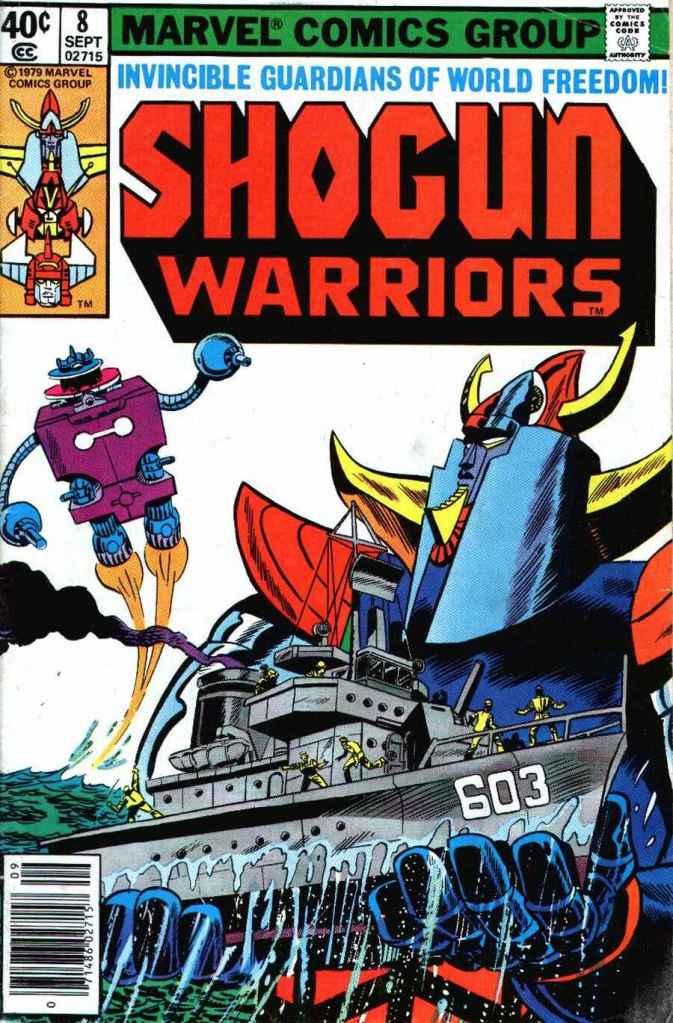
SHOGUN WARRIORS is a good example of a kind of comic book that you simply don’t see too often these days. It was based on a line of disparate toys imported from Japan under that umbrella marketing name and was used to give the localization of those different elements a cohesive backstory. In essence, it was a 32-page commercial for the toys, in the same sort of manner that syndicated animated shows in the 1980s would also fall into that same mold. That said, as was often the case with Marvel during this period, the creators involved brought some genuine energy and enthusiasm to what they were doing, and so while SHOGUN WARRIORS was never meant to be especially deep or sophisticated storytelling, it was a solidly crafted kids action-adventure comic book for the entirety of its run.
Pretty much ever since the enormous runaway success of their STAR WARS comic, the powers-that-be at Marvel, hungry for additional mainstream hits, went out of their way to license all manner of movies, television programs and toy lines that they thought might stand a chance of gaining a toehold in the marketplace. Most of these efforts were doomed to failure and a short run, but some, most notably MICRONAUTS, ROM, G.I.JOE and TRANSFORMERS became mainstay titles for years and years. So the batting average was relatively high, even though for every one of those books you can point to a MAN FROM ATLANTIS or a LOGAN’S RUN that didn’t really do any business.
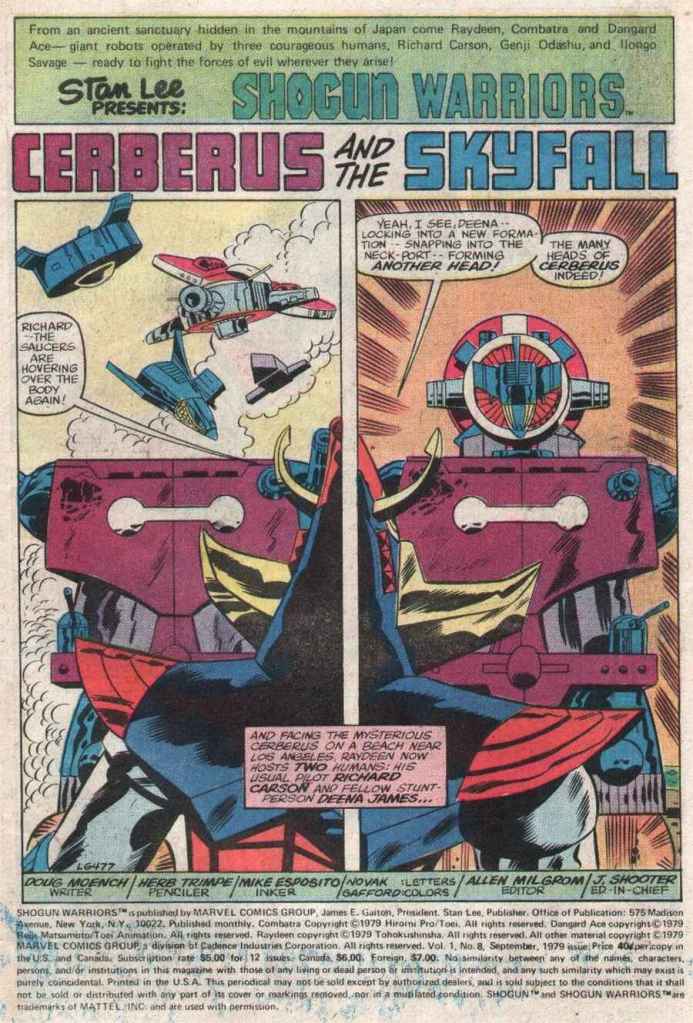
Throughout its 20-issue run, SHOGUN WARRIORS was possessed of a consistent creative team. The writer was Doug Moench, who was likely selected for the gig based on how well he’d handled Red Ronin in the pages of Marvel’s licensed GODZILLA series. Herb Trimpe was drawing that book as well, so it must have seemed like simplicity itself to have him do SHOGUN WARRIORS as well. If nothing else, when a kid plunked down his change for an issue of the book, he knew exactly what he was going to get each month. Trimpe in particular became someone who started to specialize in such licensed fare, also launching G.I.JOE in a couple of years. He was able to bring such series a bit of the Marvel spark of storytelling, and his increasingly-stiff artwork fit stories that were often about robots and vehicles as much as any human characters. Trimpe wasn’t especially a favorite artist of mine during this time, but I found his work entirely acceptable.
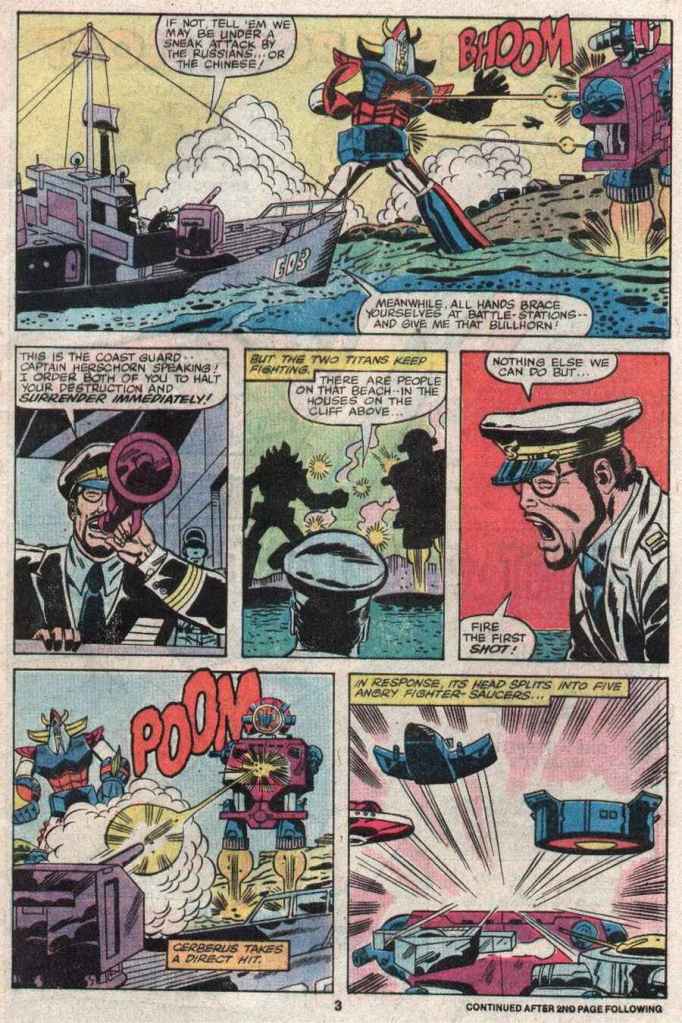
So getting into the story itself, by this point in the narrative, the three Shogun pilots had returned to their regular lives, though remaining in contact with the Shogun Sanctuary through communication pendants that they had been given. What this meant in practical terms was that this issue was largely a solo outing for stuntman Richard Carson and his giant robot Raydeen. Picking up where events left off, Raydeen confronted Cerberus, a series of five interlocking vehicles that had by the end of last time combined with a massive chassis to form a giant robot similar in scale to Raydeen itself. As the battle is taking place on a beach in Los Angeles, the Coast Guard quickly gets involved and is imperiled by the enemy mech. Rayden takes a moment out of the combat to scoop up the interfering ship and deposit it safely on the short–though it was going to be a job and a half to get it back into the water after everything was all said and done.
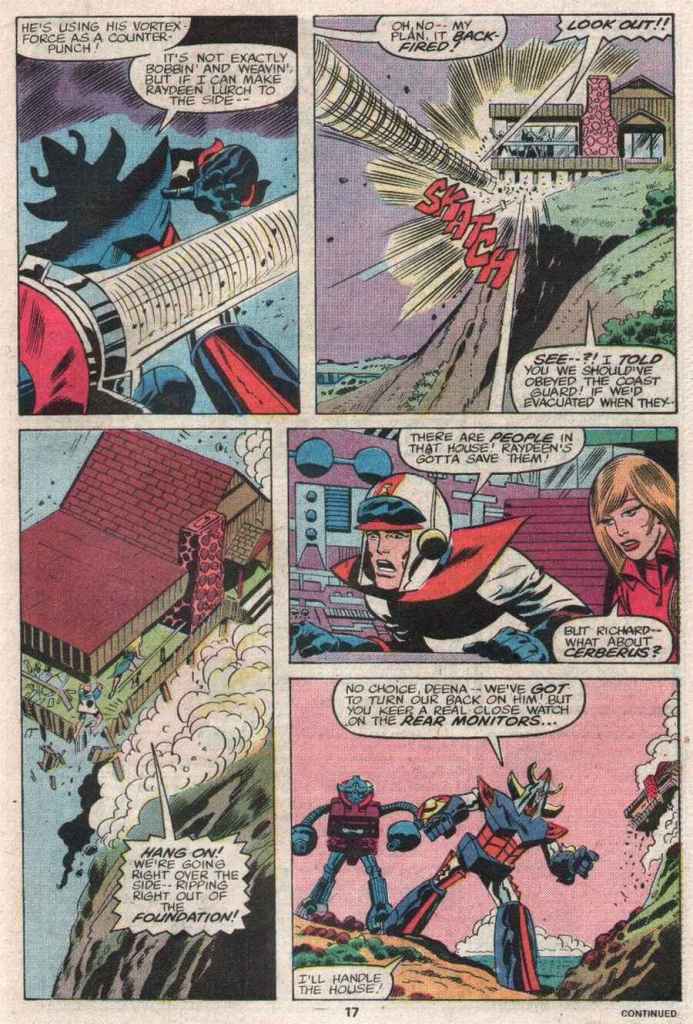
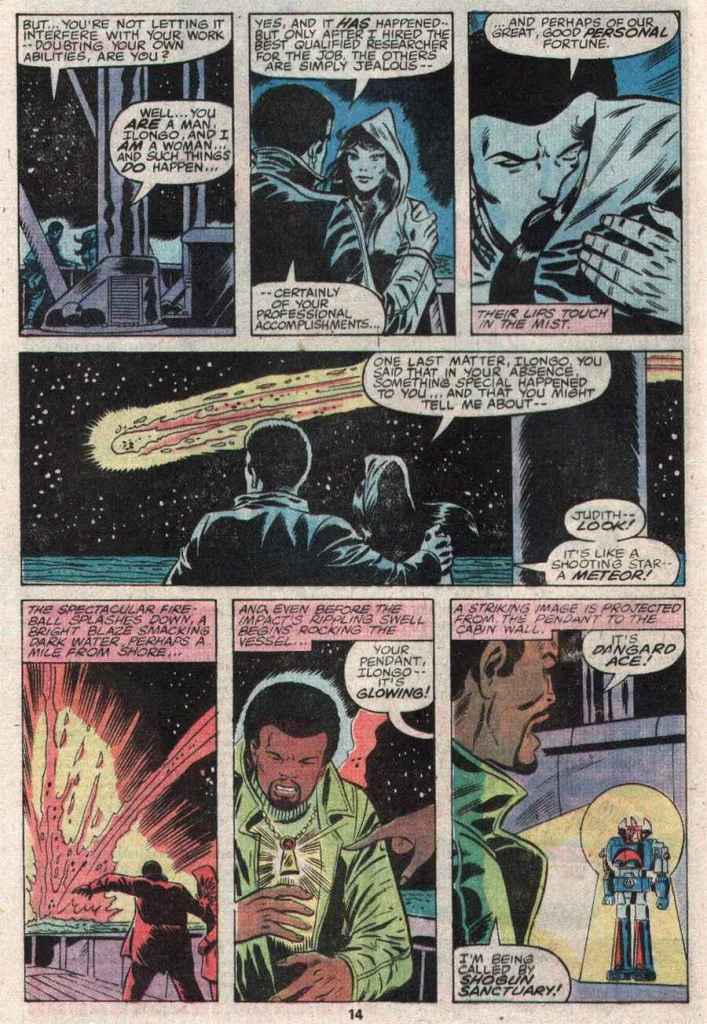
Meanwhile, Ilongo Savage, the pilot of Dangard Ace spies a meteorite crashing to Earth while out on an oceanic expedition. He gets a call from the Shogun Sanctuary telling him that it was anything but an ordinary meteorite and that he should approach it with caution. Back in L.A., Raydeen’s attempts to conquer Cerberus hit a snag when an errant missile winds up destroying the foundation of a cliff’s edge-built home, sending the structure toppling towards the rocks below. Raydeen is forced to expose its back to the enemy in order to catch the falling house before it can be obliterated, giving his foe a chance to strike. But Carson is able to place a well-timed Raydeen kick at Cerberus’ head, causing the five interlocking shits to separate from one another and halting the enemy advance until the home can be lowered to safety. With that accomplished, Carson unloads with the full array of Raydeen’s weaponry, damaging Cerberus’ torso and causing it to flee for safety.
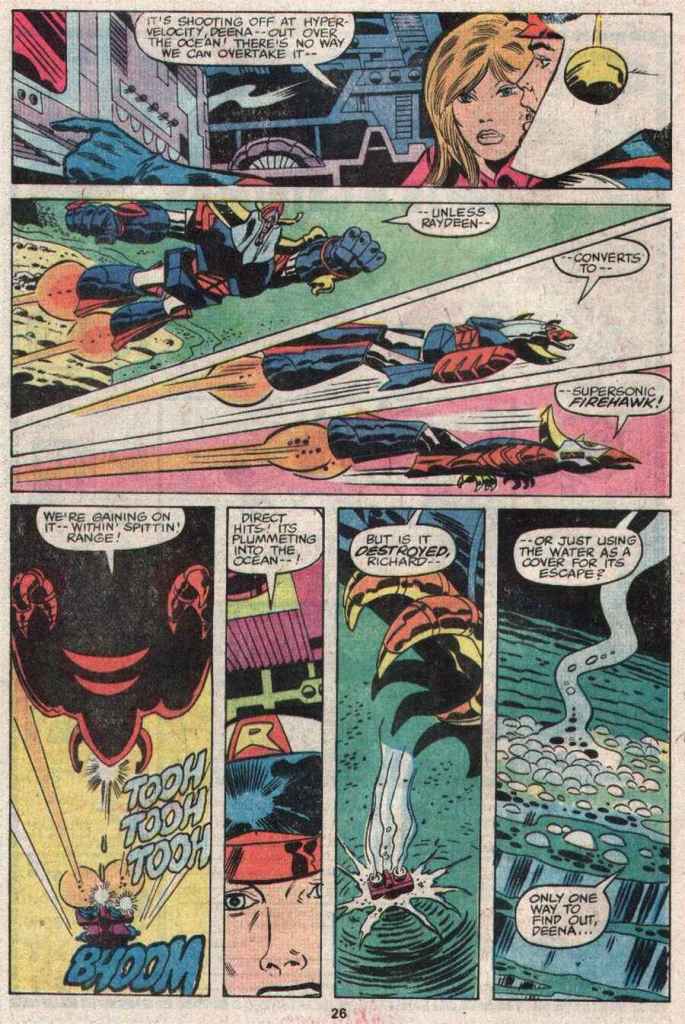
This gives Moench and Trimpe the opportunity to showcase another of Raydeen’s features, its ability to transform itself into its supersonic Firehawk mode. The Shogun Warrior gives chase and is eventually able to get within effective firing range, loosing a barrage that causes Cerberus to fall helplessly into the ocean. But when Raydeen submerges to make sure that the chaotic robot is finished, it can find no sign of its opponent, who it seems made good its escape under the cover of the waves. Elsewhere, in Japan, upon setting foot back in her mother country, Combatra pilot Genji Odashu is arrested by the authorities and taken into custody, leaving her friend and co-worker Kosei completely confused and worried about her.
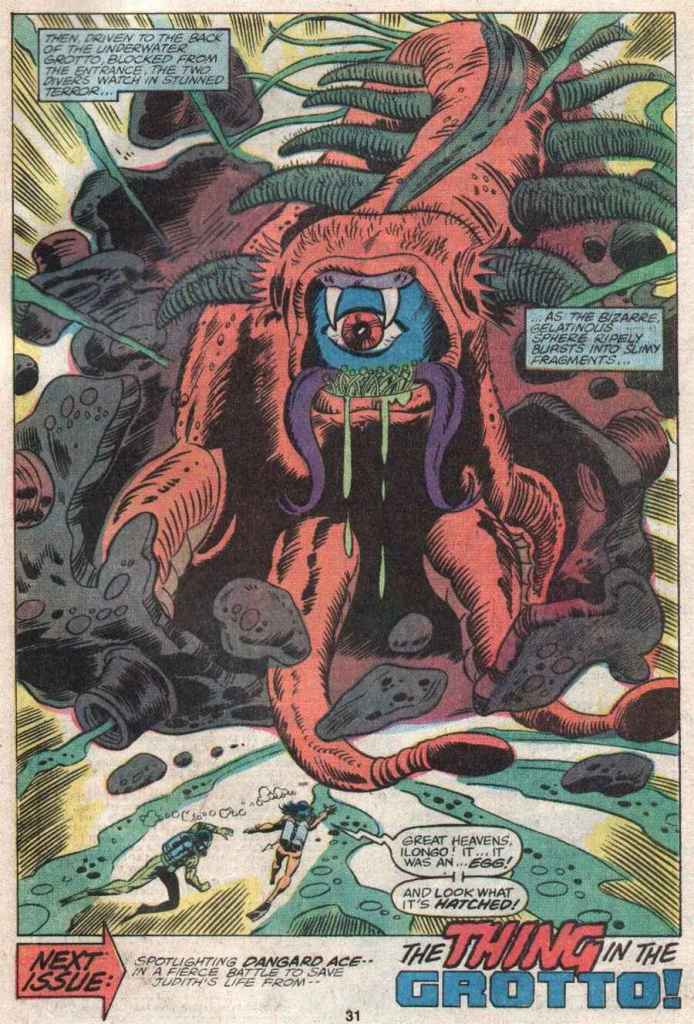
Finally, for the issue’s epilogue, we cut back to Ilongo Savage, who has executed a deep dive along with his girlfriend Judith in the hopes of seeking out the mysterious meteorite from space. Unable to locate it, the pair enters an underwater cavern, eventually locating the pulsating rock. But it turns out to be not so much a meteorite as an egg–from which hatches a monstrous, massive one-eyes creature. Clearly this Kaiju (not that that was a word my group of friends were familiar with in 1979) was going to be what Dangard Ace was going to be contending with next time. At this point, the story was To Be Continued! So as I said at the start, this issue was in no way deep or sophisticated, but in terms of being heavy on the action quotient and making the toys seem spectacular and desirable, it certainly did its job. My small group of comic book buying friends never differentiated between this any any of the other more mainstay Marvel titles in terms of its legitimacy.
 The Tom Brevoort Experience
“a kind of comic book that you simply don’t see too often these days?” Some companies making their whole living pushing out comics based on junk 80s & 90s toy lines!
LikeLiked by 1 person
I’ve never been overly fond of Mike Esposito’s inking, but the finished art here still looks nice. This series was definitely in Herb Trimpe’s wheelhouse. I’d like to read it. Looks like fun. Maybe one day Marvel will be able to get the rights to colect it.
LikeLike
I was nearly eighteen when this book came out and I enjoyed it as much as any kid did. Until his switch to an Image like style, I loved anything by Trimpe and Moench could get me to read nearly any comic he wrote. Yes, it wasn’t deep but it was action packed and not dumbed down like Shazam!.
LikeLike
Although I wasn’t collecting comics when this came out, it wouldn’t have been on my radar any more than Godzilla or even Star Wars. That’s only because at that time, my preferences were for the mainstream heroes. That said, I absolutely support comic books like The Shogun Warriors. I say that because for one thing, every comic book can be a first issue for someone, and a well-produced one is a good means of introducing someone into other comics. Although, as I’ve said before, I’m not a fan of Herb Trimpe’s work, I agree with Tom that a title of this nature brings out the best of his style. Also, as Tom’s stated, he and Moench put in the energy and enthusiasm to make what could be a rather mundane title more appealing.
LikeLike
Although much is said of “Kirby crackle” and his approach to machines and energy, I think Trimpe was good at drawing machines. He has his own style and is able to impart a sense of space, weight, and “workingness” to his machines, so SHOGUN WARRIORS is a great comic to read and also to evaluate Trimpe’s skill. Look at the first few pages here, how Trimpe makes the object connect and disconnect. No matter what you say about Trimpe’s art, he makes those objects (however geometrically ideal they might be) look like they’re supposed to be doing what they’re doing. There’s a kind of logic or reality to them. I taught SW #9 and #10 in one of my courses recently — the students, like me, appreciated how well paced the books are. Fluff? Yes. But fun fluff.
Does anyone know who drew the cover? I’m guessing it was Trimpe with someone (Milgrom?) doing the final touches. Raydeen does not look like Trimpe’s Raydeen. (It is a great cover nonetheless.)
LikeLike
As a Japanologist on this list, let me just say: no Japanese woman ever has had or will ever have a named like Genji Odashu. Genji of course must be pulled from the _The Tale of Genji_, the most famous Japanese and perhaps oldest psychological novel in world literature. Genji was Lord Genji — a playboy. So, that’s out. Odashu? I’ve never heard of this surname ever. It’s like a combination of Japanese and Chinese(-borrowed) sounds. Oda…something? Ok. But not -shu.
LikeLike
By the way, Ono Kosei, the friend of Genji Odashu is none other than Ono Kosei, the real pioneer of Japanese study of American Comics. Ono Kosei also was the first to translate Superman and then almost all of Marvel comics for a super-library. He also worked with Ikegami Ryoichi to “Japanese” Spider-Man into Supaidaa-man. I wish I knew how Doug Moench knew of Ono Kosei, but there’s no mistake it was a kind nod to Ono to have him as a real character in this series.
LikeLike