

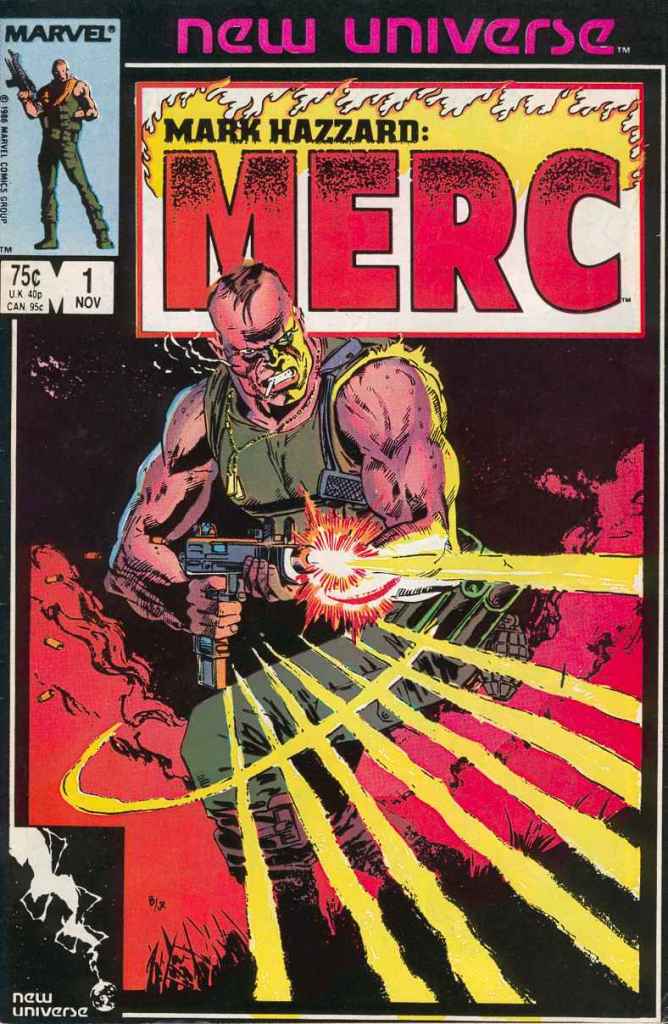
This next New Universe release was a bit of an outlier, as it didn’t truly have anything to do with the overarching concept of the New Universe at all. It featured no super-powers, no White Event, nothing at all extraordinary or beyond the realm of believability. What it was instead was an attempt to do a kind of contemporary military adventure series of the sort that filled the pages of men’s paperbacks. Created by Archie Goodwin–one of four concepts that Archie would whip together for the New Universe initiative, MARK HAZZARD: MERC seemed like a bit of a gamble for the direct sales market. Still, during this period, Marvel was continuing to fight to maintain its presence in the mainstream Newsstand marketplace, so you can see why having a book like MERC among the New Universe offerings made some sense. The company wasn’t quite yet at a point where absolutely everything it published had to be super heroes, even if it wasn’t as wide-reaching in terms of genre as rival DC.
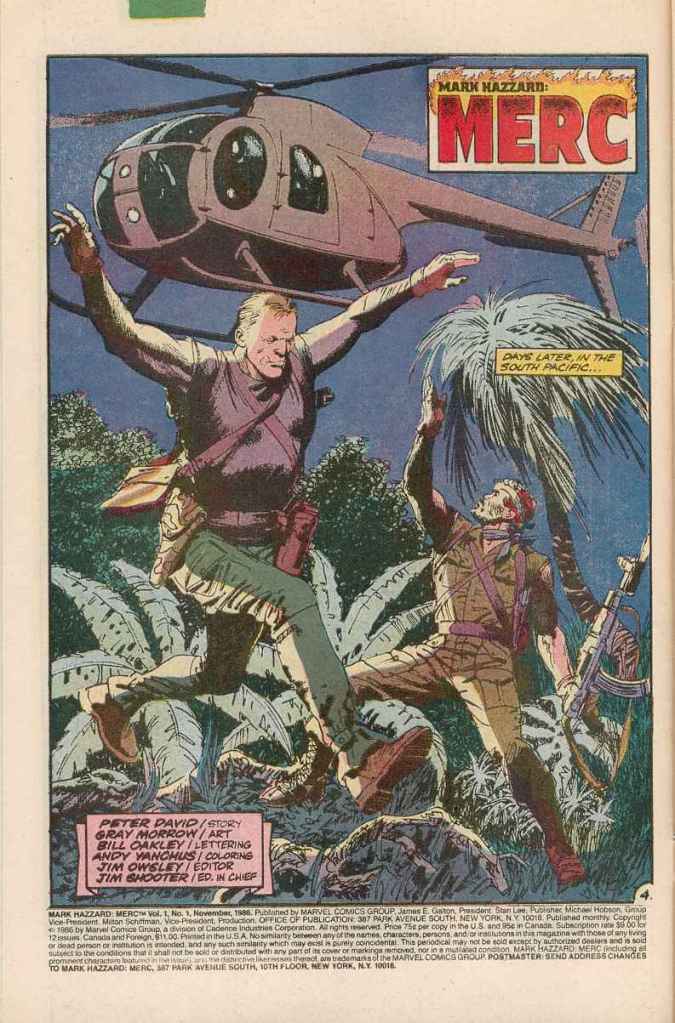
MARK HAZZARD: MERC #1 was written by Peter David, who was then just starting out his career as a writer. He had been laboring in Marvel’s nascent Direct Sales department working under Carol Kalish and trying to make inroads into getting stories published by the company. But there was strife and division between the sales department and Marvel editorial, so it was a difficult divide to bridge. David’s benefactor in this regard was editor Jim Owsley, who hired him to do a SPECTACULAR SPIDER-MAN Annual. From there, Owsley would turn to David with increasing regularity–as in this instance, when he needed somebody to execute Goodwin’s basic concept. David put his effort into making the series more than just a testosterone-fueled A-Team romp in which muscular men shot up foreign bad guys while making one-liner quips. He gave Hazzard a home life, with a wife who had divorced him due to his mercenary lifestyle and who had subsequently remarried. Hazzard was caught in-between wanting to be there for his ex-wife and their son and his obvious skill and love for the art of warfare through which he plied his trade.
Artistically, MERC #1 was the work of Gray Morrow, a fabulous artist whose style and approach wasn’t really suited to super hero work. Morrow’s characters were elegantly illustrated and realistically drawn–his influences were the great newspaper strip cartoonists rather than artists such as Jack Kirby of John Buscema. Morrow gave the series a strong visual identity. Unfortunately, due in part to the fact that these titles all went into production late, Morrow would only be on two issues before fill-in art jobs began to show up. He’d never entirely abandon the title during its short lifetime, but of the book’s dozen issues plus one Annual, he wound up drawing only five. Like the rest of the New Universe line, the series bounced from artist to artist for the duration of its run, never completely settling into a regular rhythm.
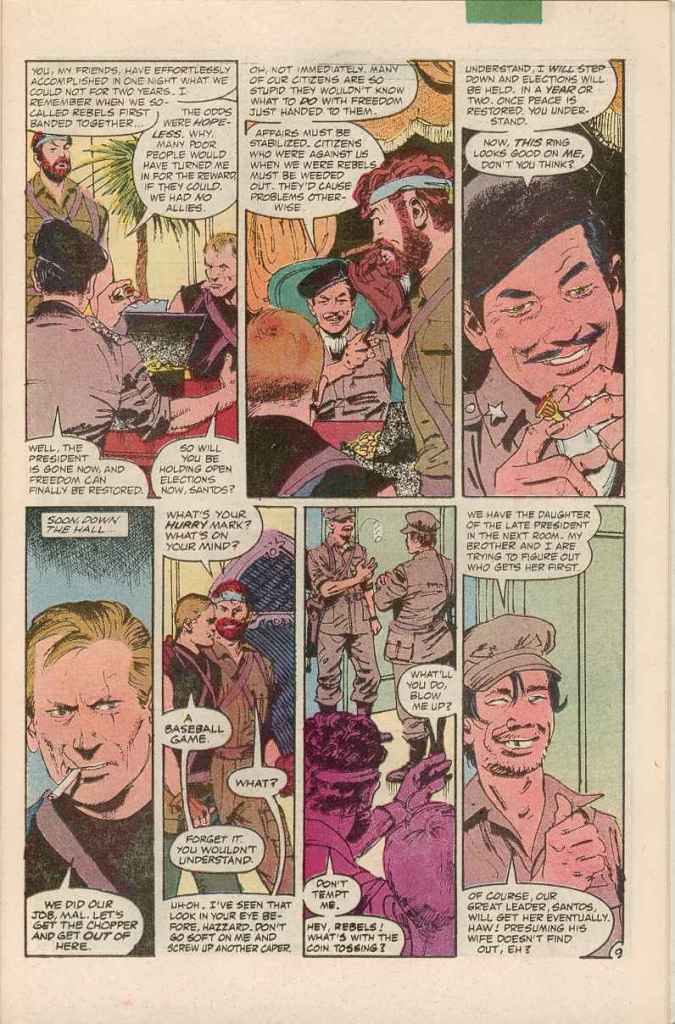
This first issue opens with an introduction to Hazard, who is walking back to his apartment from the market. He casually stops a would-be thief from making off with a piece of fruit before getting back to his place, which is filled with tomes on military history and tactics as well as a bevy of firearms and other weapons. Listening to his answering machine, Mark hears from his son Scott, who hopes he’ll be able to come to his little league championship that weekend. But Hazzard’s attendance is thrown into question when the final message is from his mercenary cohort “Treetop”, who tells Mark that they’ve got a job. They’re being hired by a band of rebels in a South Pacific island nation to either capture or kill the nation’s President, thus paving the way for a regime change. Hazzard and his buddy Mal Rossi make their way into the Presidential home and carry out their assignment, killing the occupants. All except the President’s teenage daughter.
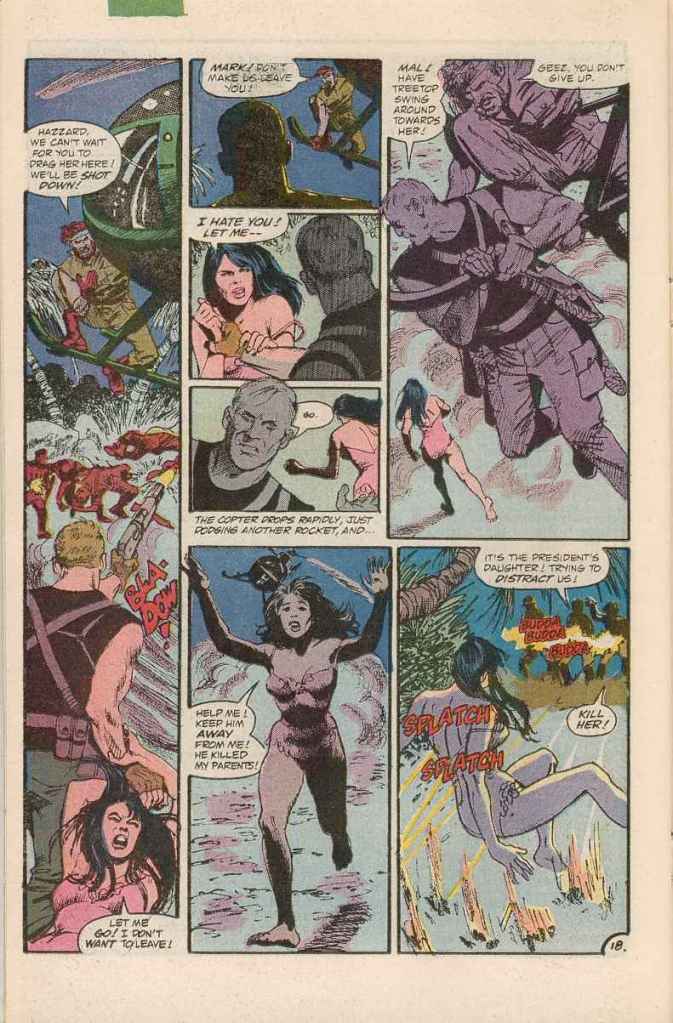
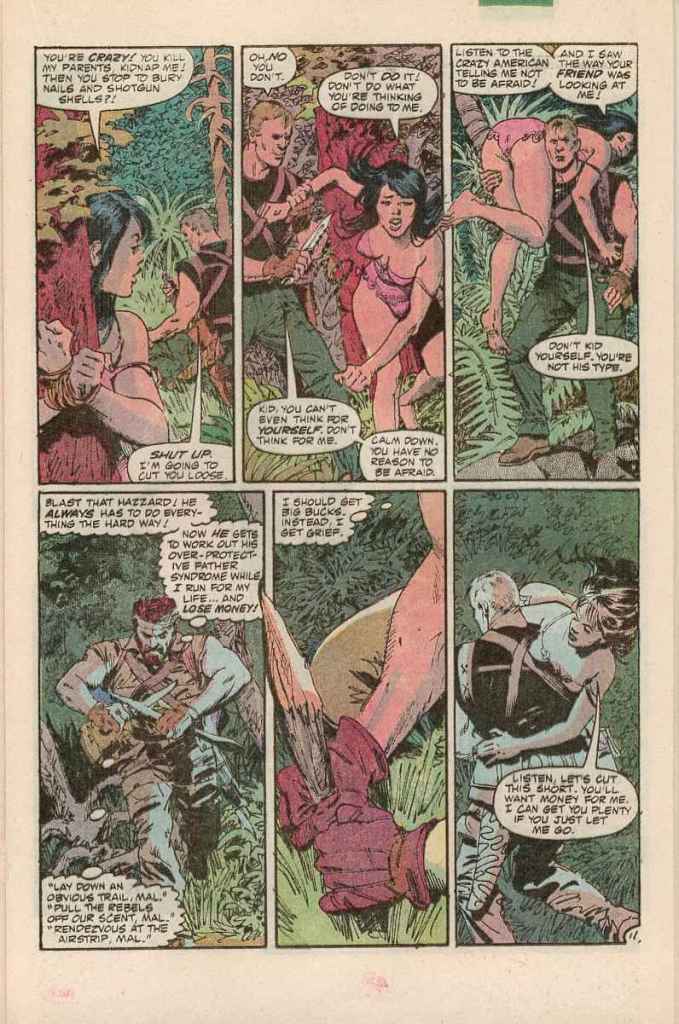
Having carried out their mission, Hazzard and Mal are paid by the rebel leader, who indicates that despite their slogans about freedom and democracy, doesn’t intend to hand over control of the nation now that he’s wrested it away from its former President. Hazzard is disquieted by the notion that he’s just replaced one greedy scumbag with another, and so when he comes upon some of the rebel soldiers arguing over who will get to have their way with the daughter first, he intercedes, carrying the girl off despite her protests. But thanks to his actions, he and Mal have gone from being heroes of the revolution to dangerous wanted criminals, and they have to fight their way to the exfiltration zone where they can be picked up by Treetop. Along the way, we learn more about Hazzard’s past in flashback, how he was once a promising West Point cadet before dropping out to join the army to fight in Vietnam, where he served three tours of duty. But as they get to the pick-up zone, the terrified girl breaks away from Hazard and runs back towards her attacking countrymen–who cut her down without a second’s hesitation. This is an appropriately nihilistic comic book.
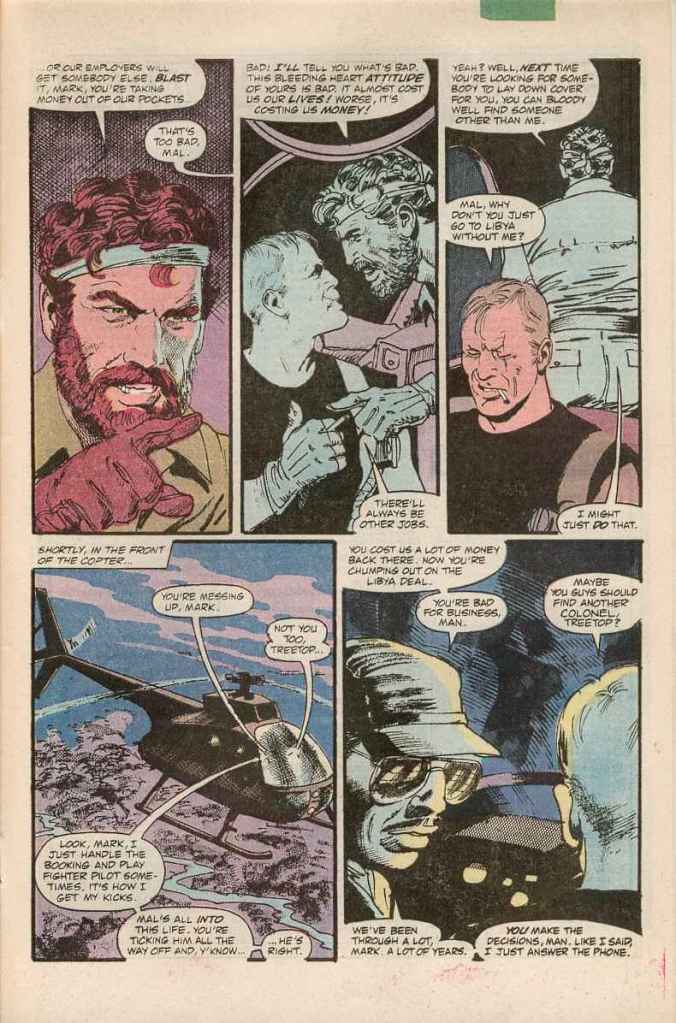
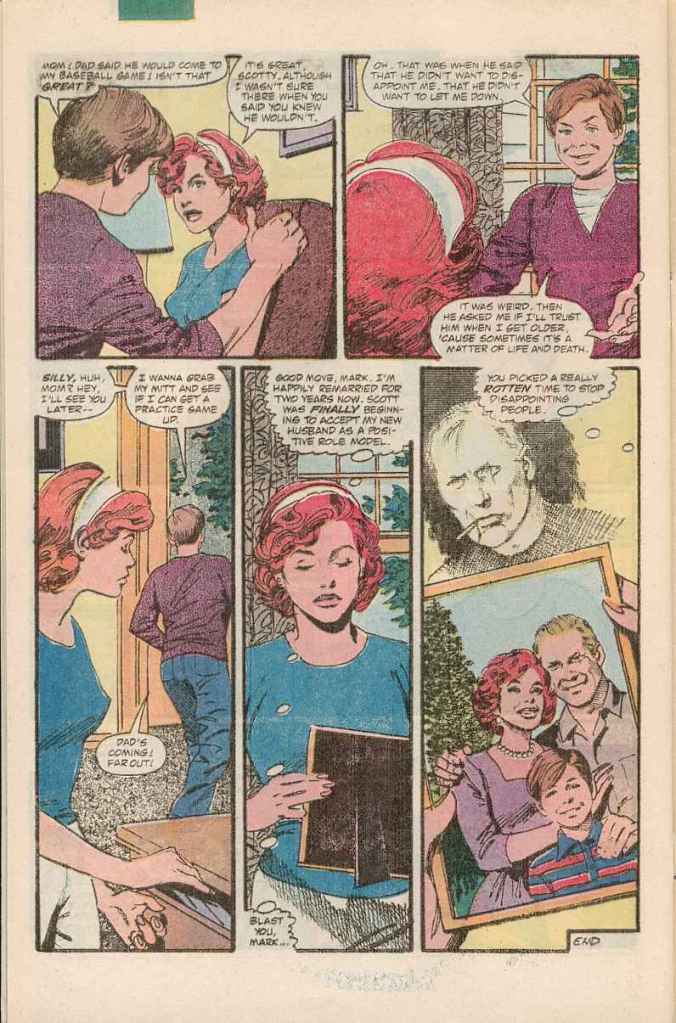
As the story wraps up, Hazzard, Mal and Treetop are able to get away, but not before having to kill the rebel leader in order to secure their departure. Mal’s pretty fed up with Hazzard’s strange moralizing, and even Treetop tells him that if he can’t get his head straight, he’s going to wind up getting himself or somebody else killed. As the book ends, Scott gets a call from Hazzard telling him that he’ll be able to make it to the little league game after all–much to the consternation of Hazard’s ex-wife Joan, who would prefer it if Scott could move on with his life without Hazzard’s self-destructive influence on it. So this is an attempt to do a more realistic sort of mercenary story–which has the unfortunate effect of making it difficult to find somebody to root for. Hazzard is clearly the central character, but he’s so morally compromised and ethically challenged that even when he tries to do the right thing, it’s tough to be in his corner.
MARK HAZZARD: MERC was one of the New Universe titles that was cancelled after only a year, and it was the lowest-selling book in the line. After four issues, Peter David moved on, and incoming replacement writer Doug Murray dialed up the military adventure and virtually wrote out the civilian cast, making MERC more of a straight-up war comic. But this clearly didn’t work in terms of increasing its popularity. For some reason, the decision was made to do a MERC Annual that year right before the end, and Murray made the audacious decision to kill off Mark Hazzard unexpectedly in that book. The final issue, #12, revolved around the extended cast of mercenaries who worked alongside Hazzard dealing with the aftermath of his demise. It’s perhaps the most memorable thing about this run, though this first issue isn’t badly crafted as a comic book. It was simply the wrong approach for the wrong concept at the wrong time. But a noble attempt at doing something different.
 The Tom Brevoort Experience
“Still, during this period, Marvel was continuing to fight to maintain its presence in the mainstream Newsstand marketplace…”
This is a strange statement. During this period half of Marvel’s sales were in the newsstand marketplace. Two of its three top-selling ongoing titles–TRANSFORMERS and G. I. JOE–did the bulk of their sales in the newsstand marketplace. Marvel also began getting carried by B. Dalton, Arbor (now CVS) drugstores, and other outlets in the newsstand marketplace that previously did not carry periodical comics.
LikeLiked by 1 person
For a second I thought that had it been a TV series I might have watched it, but then I remembered I never could get into Soldiers of Fortune, Inc. ( renamed in second and final season SOF: Special Ops Force — September 27, 1997 to May 22, 1999. Apparently Dennis Rodman and David Eigenberg’s “hip” characters and new plots led many to abandon the show leading to its cancellation ). Unlike Mark Hazard: MERC they worked for the U.S. government. Never bothered to take a look at this New Universe book either ( Only a couple of John Byrne’s Star Brand issues ).
LikeLiked by 1 person
Unlike the majority of NU titles, this one I definitely remember. First for the distinctive Gray Morrow art, then for the engaging story from Peter David (a name that didn’t register with me at the time, but most certainly did later). What stood out most to me was that I knew I’d never buy another issue and that had me feeling a bit guilty. I say that because this series seemed to hint at an extremely difficult personal journey towards some form of redemption for the lead character. That was something that seemed more substantial than the latest issue of some superhero putting down some supervillain.
But that was what I wanted. I wanted to lose myself in the latest drama with a billionaire wearing techno-armor or a group of mutants struggling to find acceptance in the world around them. I wanted the fantasy of a Norse God speaking Old English.
This is a long way of saying that Tom hit the nail on the head with his assessment. This wasn’t a comic for the New Universe or really targeted for guys like me hitting the comic shops.
Certainly several steps up from Kickers, Inc or Spitfire & the Troubleshooters.
LikeLiked by 2 people
I wonder if I would have picked this up if I’d noticed Peter David had written it. Probably not. I worshiped the water he walked on but I don’t like war comics (or war comics lite) and as much as I can admire Gray Morrow’s skill, his art was nevertheless a turn off for me.
LikeLiked by 1 person
Another good reason DC (and then Marvel) eventually adding the creative teams’ names to the covers was an improvement. I think Eclipse and maybe First Comics did it before DC.
LikeLiked by 1 person
All this talk of the New Universe and I had forgotten all about this book until now. I picked it up for the Morrow art alone and very possibly stuck with it for the whole run. Guessing this led to the more successful ‘Nam.
LikeLiked by 2 people
I was wondering the same thing yesterday. A review of Marvel’s Database (The ‘Nam Vol 1 1 | Marvel Database | Fandom) indicates that The ‘Nam was published on September 9, 1986. That same database has The Merc hitting the racks on July 29, 1986. Not much time difference.
LikeLiked by 2 people
Yeah, I don’t think MERC led to THE ‘NAM, but I suspect the success of G.I. JOE led to both.
LikeLike
Taking a look at the Unofficial Handbook of Marvel Comics Creators website, I saw that several of the later issues of Mark Hazzard: Merc that Gray Morrow drew were inked by Vince Colletta. To which I could only say “Why God? Why?!?” So, I then found some scans of those later issues and, yep, Colletta all but obliterates Morrow’s characteristic style. Ugh! Not to jump on the bandwagon of hating Colletta, but I’ve found his work in the second half of the 1980s to be especially poor.
LikeLiked by 3 people
I wasn’t paying much attention to the New Universe books. If I’d known Gray Morrow worked on this one, I might’ve picked it up, as I’ve always been a big fan of his. I probably wouldn’t have stuck with it, though, since military stuff has never been very interesting to me.From what I’m seeing, the New U reminds me a little of early-’70s DC, when they seemed to be throwing out every random idea they could come up with, in the hopes that something would stick. Strange Sports Stories. Weird War. Rima the Jungle Girl. Prez. Except all of those titles were at least *interesting*, if not ultimately successful.
LikeLiked by 1 person
Hey, WEIRD WAR lasted over 100 issues. I’d call it a success.
LikeLike
I had the good fortune to meet Gray Morrow in Baltimore a year or so before his tragic end. His work is lovely.Some of his poses here are reminding me of Dave Cockrum… who was half a generation younger. Perhaps Gray was a significant influence?
LikeLiked by 2 people
I never read this, but I really liked Gray Morrow’s artwork in general. He illustrated a pre-Byrne two-issue Lois Lane mini-series around this time (I think it was written by Mindy Newell?) that I remember liking quite a bit a the time.
LikeLiked by 1 person
I know I read this issue, but I’m pretty sure I never owned it. Maybe I read it in the office, or read Carol’s copy at the Kalish/Howell homestead.
But I had zero interest in the paramilitary adventures of a mercenary, even if Gray Morrow was drawing it. So I didn’t read any further.
LikeLike
Good logo, though.
But putting it in a rectangular box on a cover that’s already framed in a rectangular box looks awkward and unattractive. Especially because the bottom of the rectangular box doesn’t match up with the rectangular box right next to it, with the character image and price and all.
LikeLike
That cover just looks ridiculous to me. I’m not a gun-culture guy, but spray shooting from the hip in that twisted posture, while simultaneously biting a cigarette, strikes me as male version of the contorted-woman pose.
The idea of being “disquieted by the notion that he’s just replaced one greedy scumbag with another” doesn’t work well in a supposedly more realistic book about a mercenary. That’s a problem with the “men’s adventure” genre in standard comics – there’s a lot of dissonance between core assumptions of how the world works.
LikeLiked by 1 person
“The idea of being ‘disquieted by the notion that he’s just replaced one greedy scumbag with another’ doesn’t work well in a supposedly more realistic book about a mercenary. That’s a problem with the ‘men’s adventure’ genre in standard comics.”
Your assessment seems correct to me. But is the “men’s adventure” audience large enough to support those kinds of realistic storytelling? Print magazines, maybe, or now online websites, yes. But comics in 1987, and also in 2026? I’d be surprised. Actually more skeptical today as comics as an industry seems to struggle to significantly expand its audience.
Personally, I need my central characters in fiction to be relatable, or compelling. A hard-nosed soldier with no demonstrative empathy who just follows orders no matter what harm it causes isn’t a character I’d follow regularly, no matter how useful they are in real life. I understand we need soldiers (by that I mean military service people- I’ve met Marines who were insulted being called a “soldier”, which they only associate with someone in the Army, but in practice all “troops” or “war fighters” are “soldiers” as the word’s been historically used). They fight, they follow orders.
I’ve had and have friends and family who are ex-military, and their lives and personalities are fuller and richer than just following tough combat orders. I respect and value their service. And I’ve also met former military folks I can’t be friends with, as their lack of empathy and aggressive personalities were a “a bridge too far”.
LikeLiked by 1 person
This is just so not a fit with the rest of the New Universe that it sort of damages the feel of the whole. If you were buying all eight new comics, thinking they were forming some kind of complete story, and then found that one is just some kind of war adventure, it’s kind of off-putting…
LikeLiked by 1 person
Good point. Though that crossover could’ve happened eventually. I think just trying different genres was a decent idea. It’s all in the execution, too.
LikeLike
The cover puts me off. I don’t know who the character is. If I did, and already liked the guy, I’d trust he had good reason (or a compelling one) to be so intensely attacking (or defending against) someone or something. He looks crazed or mean, and that could be OK, if I could see if he was aiming at something worse than he appears to be. A Nazi, or anyone I could recognize as worth being so aggressive against.
But there isn’t anyone or anything else on the cover. So HE could be the villain. Actually, he wouldn’t look out of place shooting at Captain America, Daredevil, Wolverine, or Batman (except it’s a Marvel New Universe series, so Cap, DD, Logan, and especially Batman WOULD be out of place). But this “MERC” is definitely dangerous, and just from this image, I don’t think I’d pick up the issue. I might be in the minority.
The interior art looks great. And well-suited for a realistic, naturalistic background, characters, and circumstances. Morrow is a master. Gene Colan was another great who drew a lot of more “realistic” stories and characters (even in his abstract, distorted style). Morrow seemed even better suited for those types of stories. Including this one. Intricate, delicate, subtle, emotive, with spot on depictions of faces, figures, all kinds of organic and inorganic objects, and lighting. You recognize and believe what you’re seeing
I also like that Peter David invested so much to make Marc potentially more interesting. He has concerns outside of the immediate situations he’s in. He has ethics. He’s not just a lethal drone of a soldier. He has internal conflict. Which also is potentially interesting.
I’m almost sorry I missed this issue. Maybe if the cover was more representative of the character and story I might’ve tried it.
LikeLiked by 1 person
Never even bothered to read this one. I can now say that was the right choice.
LikeLike