

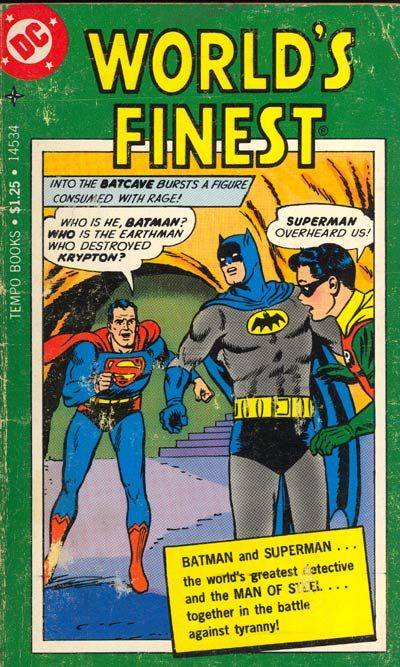
The last of the four Tempo DC paperbacks that I wound up buying was this one dedicated to WORLD’S FINEST and the team-ups between Superman and Batman. Again here, I can’t quite explain this purchase apart from it probably being an acquisition of opportunity: some point at which the number of available options was limited and I either had some disposable cash to hand or was able to convince a parent to buy the slim volume for me. I would typically go through cycles where one or another new release would trigger a short-term monofocus on a particular series as i became momentarily intensely focused on it. But I can’t recall that ever happening with WORLD’S FINEST, so that isn’t why I happened to own this particular volume.
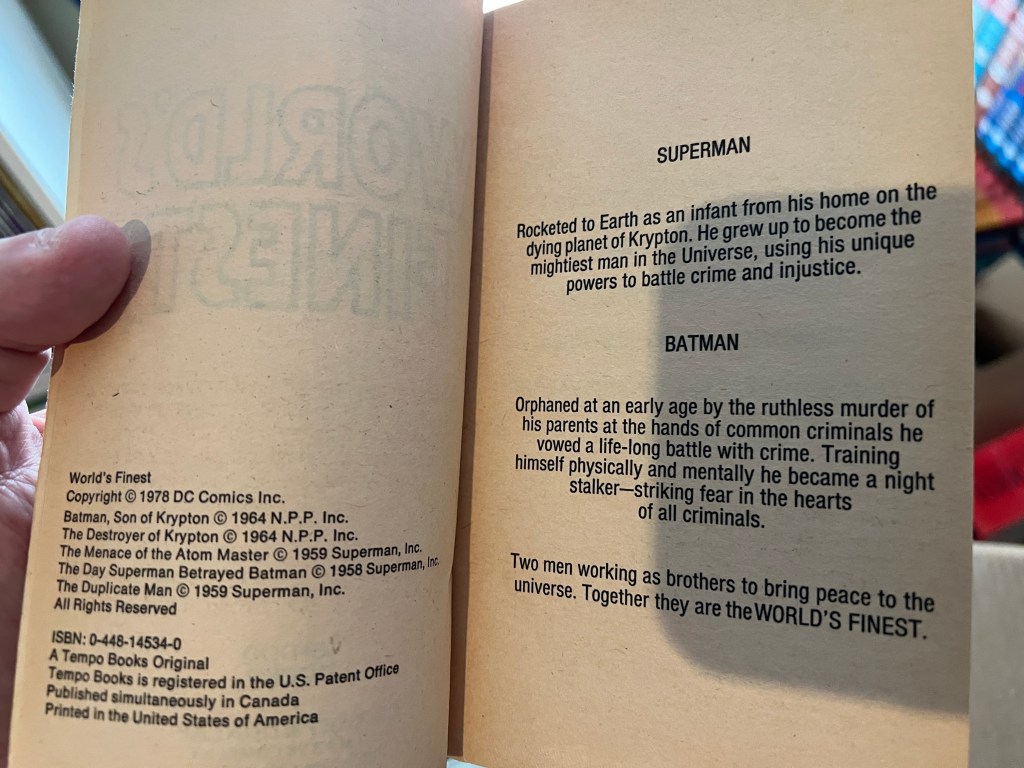
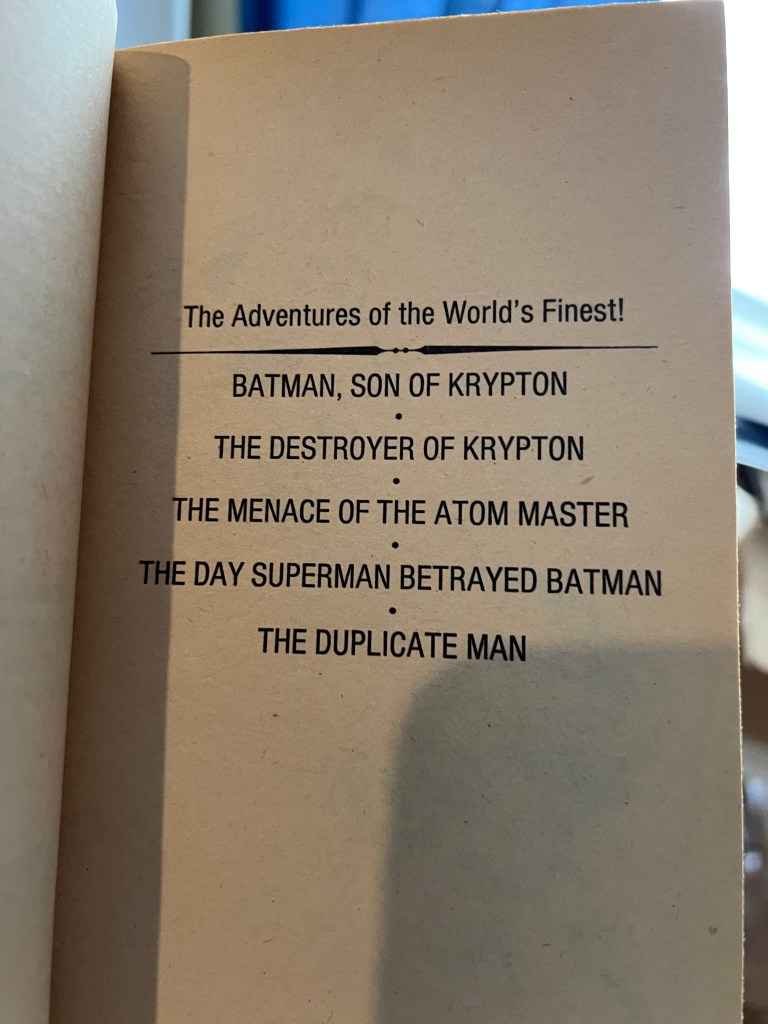
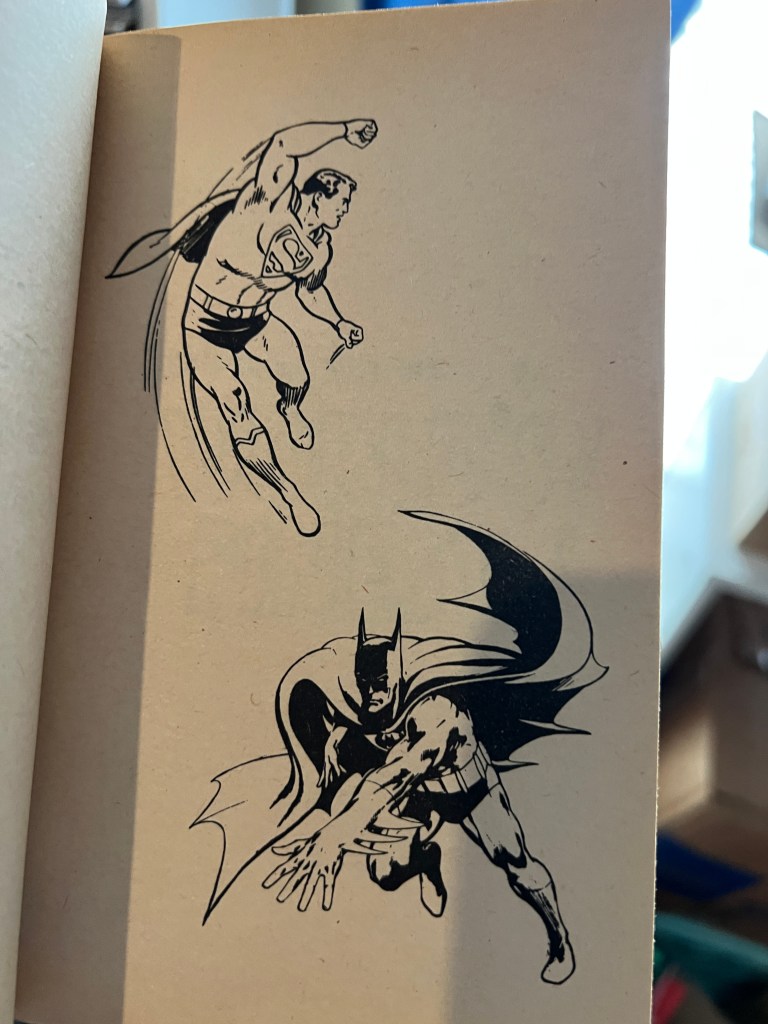
Like the other entries in this line, the contents of this edition are a bit of an eclectic selection, without any particular focus truly being paid to building a volume that would be inviting to a novice reader who might come upon it. Only the lead story was from the 1960s, the remainder of the book pulled from earlier adventures of the team published in the 1950s. It was a strange decision.
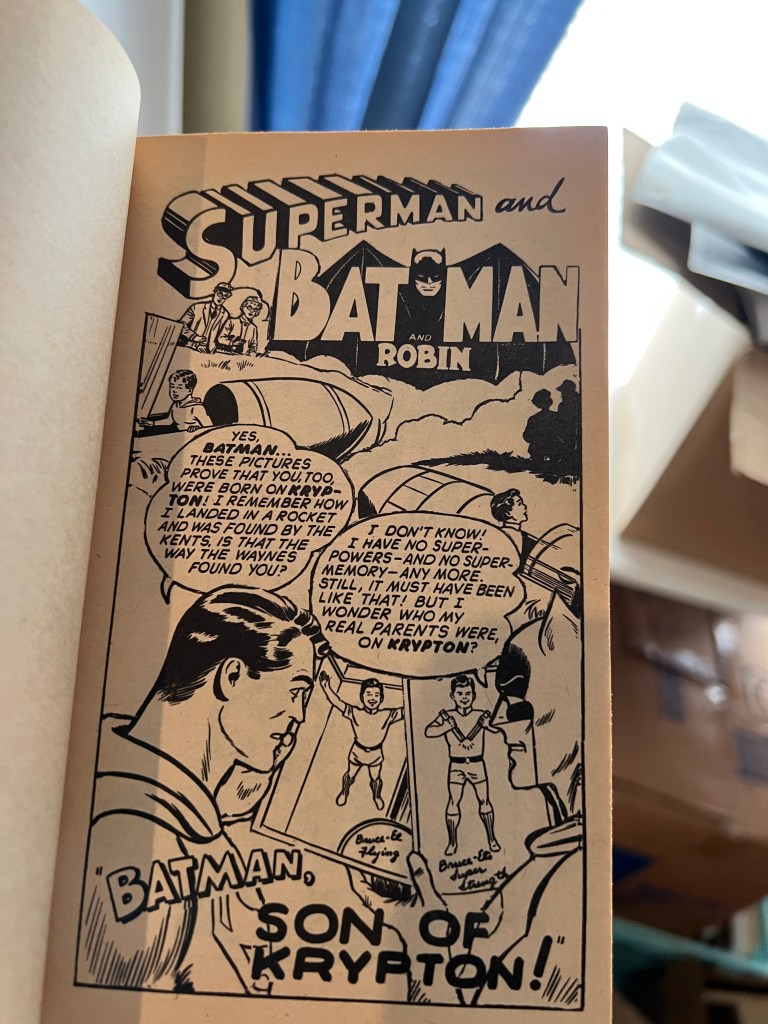
The opening two-part adventure was edited by longtime Superman editor Mort Weisinger, and was written by Edmond Hamilton and illustrated by Curt Swan. It was typical of the kinds of gimmick-concept stories that Mort liked best, and turned, as most of Mort’s WORLD’S FINEST work did, around the legend of Superman that he’d been steadily developing across multiple titles and several years. The hook is simple and designed to make any kid curious: Batman begins to uncover unexplained memories that he was also born on Krypton just like his close friend Superman. Investigating this strange situation leads Batman to Dr. Ellison, a scientist who lived next door to the Waynes back before they were murdered by dastardly criminals. It turns out that Dr. Ellison has a secret, one that Batman learns by spying on the man: he was the person who inadvertently destroyed Krypton in the first place! Dun-dun-dunnnnn!
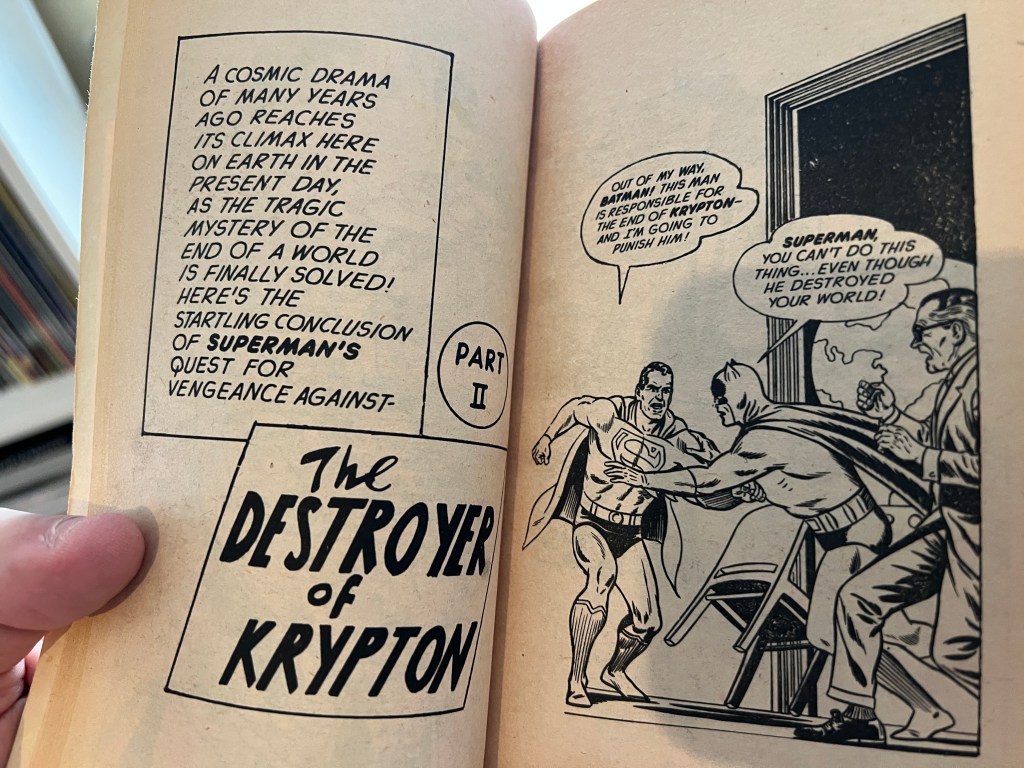
Of course, this is just the sort of information that would make Superman crazy, and so Batman resolves not to tell his buddy about it. But of course, the Man of Steel overhears anyway, and flies into a tremendous rage. This sets up a situation where Batman must battle Superman to keep him from learning the identity of the scientist. In the end, of course, the evidence shows that while Dr. Ellison thought he had destroyed Krypton by observing it years before (sharing what he had found with young Bruce Wayne, thus explaining Batman’s early memories of Krypton) he in fact wasn’t responsible for the planet’s destruction, and so everything comes out all right in the end. Though there is an emotionally false sequence where Superman uses a time-viewer to witness the destruction of Krypton firsthand, including the deaths of his parents, and his only concern is that it exonerates Dr. Ellison.
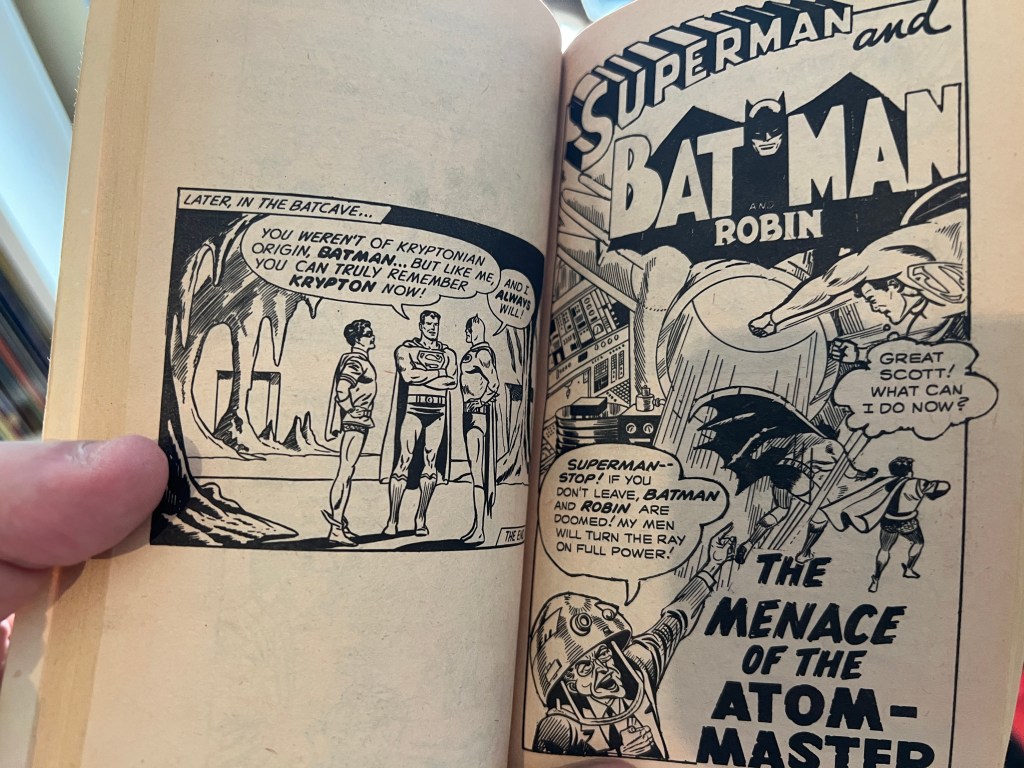
The rest of the stories in this book were the work of writer Bill Finger and artist Dick Sprang. Sprang’s lively and energetic depiction of both Batman and Superman had become a bit of a fan favorite over the years, despite the fact that his work wasn’t ever signed (apart from the required Bob Kane credit box) and so that’s almost certainly the reason why they were all included here. The first of these pits Superman and Batman against the Atom-Master, a criminal scientist who had developed a device that can create massive lifelike illusions, which he uses to commit crimes until he can improve his invention to the point where it can manifest actual physical objects.
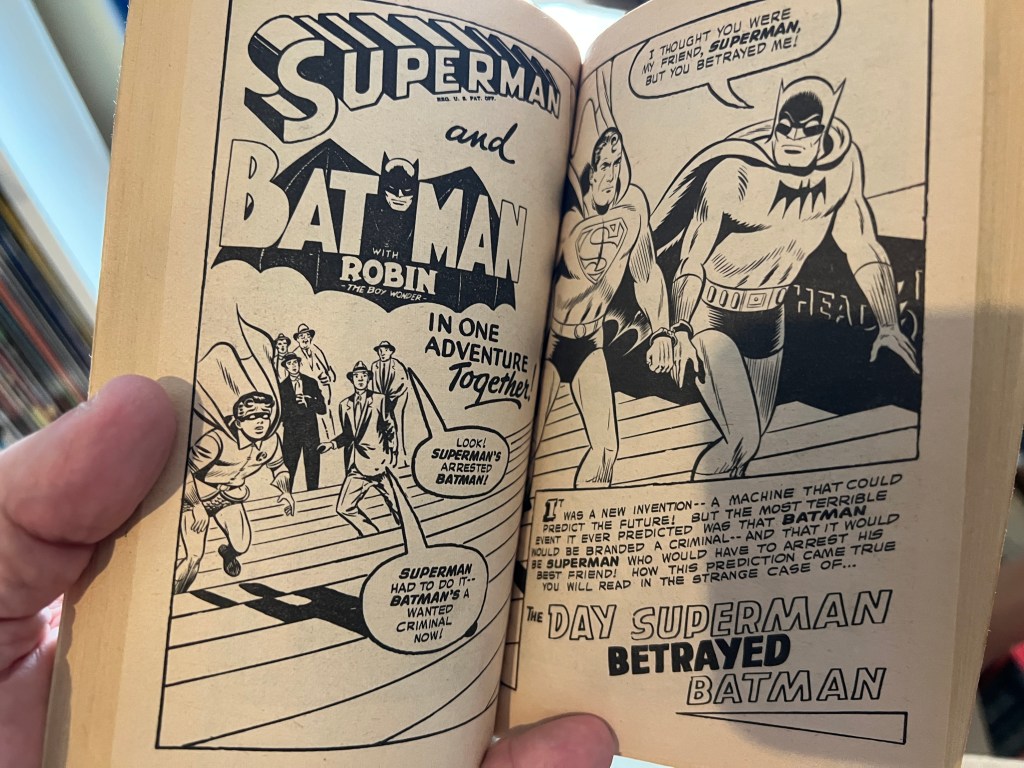
One of the most often recurring and most obvious story tactics in the WORLD’S FINEST stories was to pit its two leads against one another, either in meaningful competitions for charity and the like, or else in actual life-or-death conflicts. This next story appeared on the surface to be one of those. In it, the Condor Gang frames Batman for having taken a bribe. Superman has no choice but to track down and arrest his old friend before subsequently working to seek out the evidence to exonerate the Caped Crusader and bring the Condor Gang to ground.
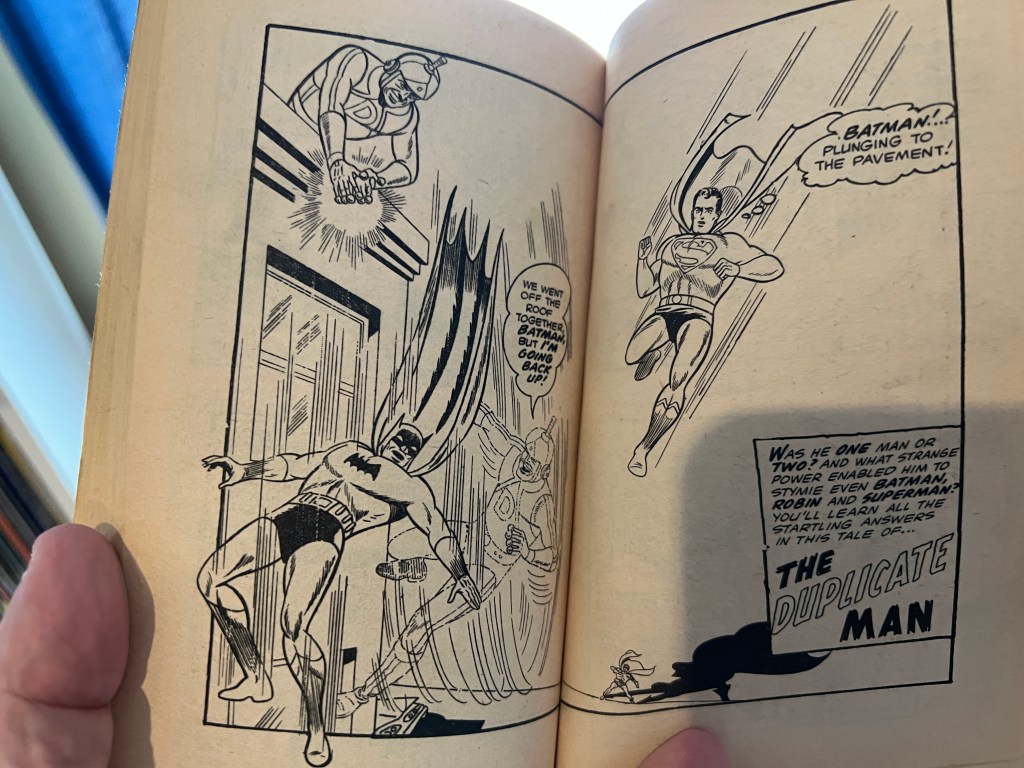
The final story is the one that i remember best from this volume. In it, Superman and Batman take on the Duplicate Man, an actual super-villain who possesses the power to split himself into two identical copies. Now, you wouldn’t think that would be enough to take on Superman with, But by keeping one of his two selves at a remove and then reuniting remotely with his “away-self” at opportune moments, the Duplicate Man is able to vex the two crime-fighters at least for the duration of this one story. As usual, Sprang’s artwork is really the show here, even with his pages cut apart and pasted up awkwardly on the paperback-sized pages.
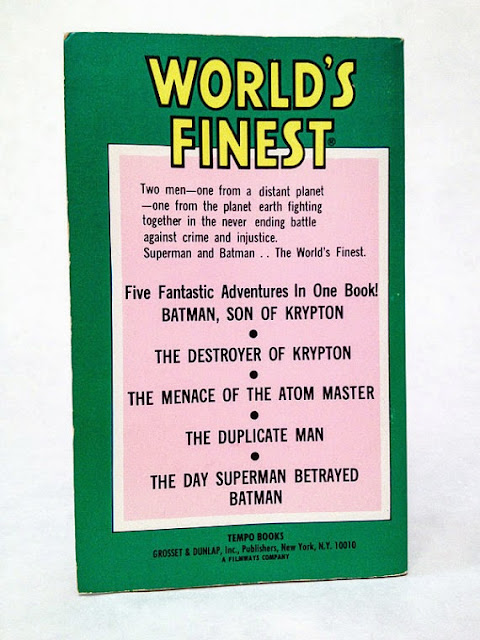
Despite the cover’s exultations, the book only really contained four fantastic adventures, not five–the lead story had been subdivided into two chapters, and so it was counted here twice as a way to goose the numbers. Ultimately, I didn’t like these volumes anywhere near as much as I did the Marvel equivalents–which were published in full color and while maintained the specific pages of the stories collected, even if that made the lettering relatively tiny. I had young eyes then, I could handle it.
 The Tom Brevoort Experience
I notice they added the yellow oval to Batman’s symbol on the cover, but not on the inside. Too much extra work, I suppose, and the difference would be less noticeable in black-and-white anyway.
LikeLike
One might also note how the Superman and Batman figures on the cover were extended rather awkwardly from a much smaller panel within the story.
LikeLike
I suspect these reprints were all chosen by Nelson, and Nelson didn’t see a difference in appeal between the 50s stuff and the later stuff. It was all about the story content to him, and the style was secondary, if that.
LikeLike
So went to comics.org to look up World’s Finest Comics#106 ( December 1959 ) the only appearance of Duplicate Man and when I clicked comics.org/world’s finest comics what do I see but the issue I was looking for. I like Duplicate Man ( especially how his technology allows him to escape the heroes by making the duplicate ( in duplicate form neither is the original ) cease to exist. Never understood why when the Zodiac was created for the Avengers [ The Avengers#72 ( January 1970 ) ] that a number of them didn’t have super powers, cause Duplicate Man’s powers would be perfect for Gemini ( Sure the robot Gemini could duplicate/split in two people [ The Defenders#50 ( August 1977 ) ] ). If Duplicate Man is smart he backed up how to remake his technology.
LikeLike