

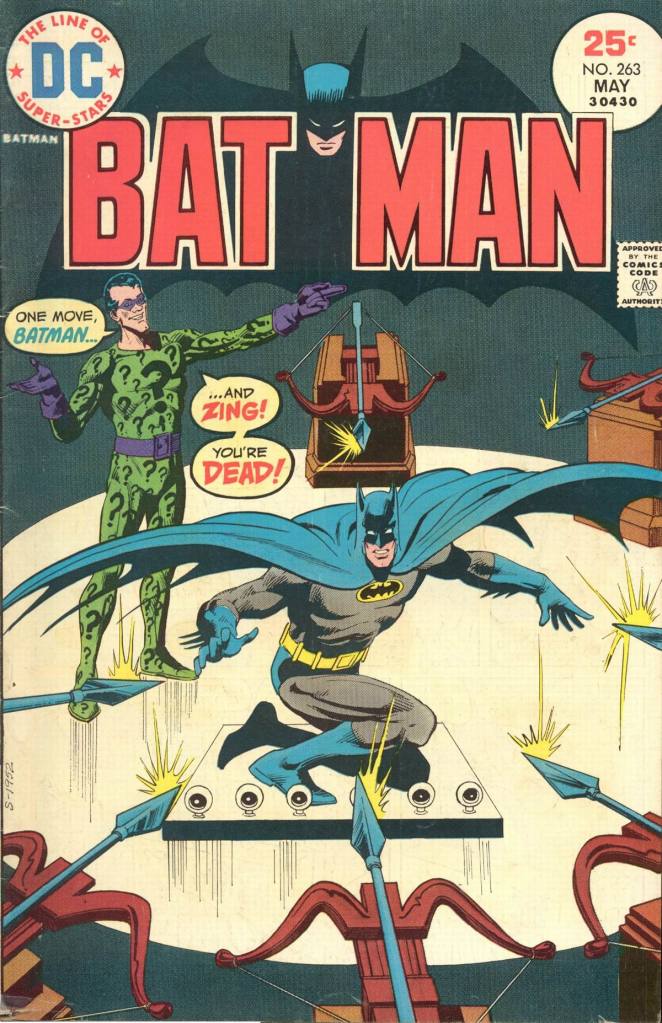
Especially in the first half of the 1970s in which I grew up, comic books were a ubiquitous item. Almost every kid read them, at least a little bit, and they were on sale in every candy store and convenience store you were likely to encounter. This changed as the decade went on and those outlets began to stop carrying comic books. But when I was a young kid, that was the way of things. Which is all to explain that the various kids on my block with whom I would naturally play (having no other options given the geography) all had periods in which they read some comic books too. None of them felt as strongly about doing so as I did, nor stuck with it for anything near as long as I did. But it could be depended on during this time that if you went to somebody’s house for a cub scout meeting or some other play date, you would come across a comic book or two. So it was with my next door neighbor Johnny Rantinella.
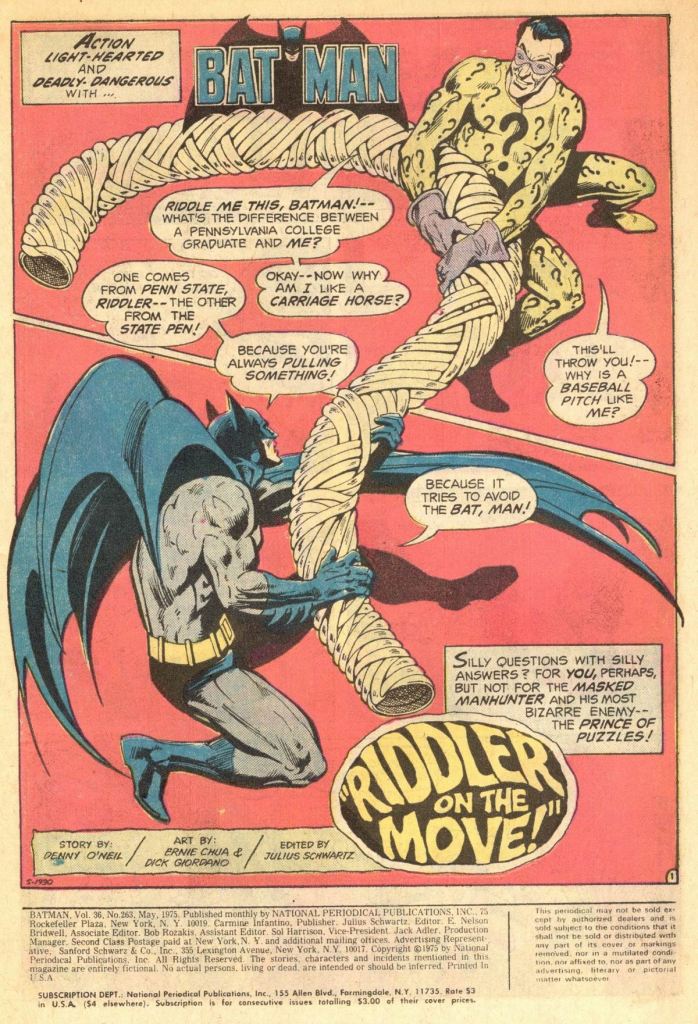
Johnny was a year younger than I was, but he was the eldest of three brother, like I was (at least until the birth of my youngest brother Mike in 1976) and the fact that we lived next door to one another meant that we did our share of hanging out together. I’ve no idea whatever became of him, I haven’t seen him in close to half a century. But Johnny would occasionally get comic books that he’d share with me, and we would trade on occasion as well–I can remember the drama that occurred when I convinced him to trade me his Flash Slurpee cup, and later another neighborhood kid, Charles Grella, convinced Johnny that I’d taken advantage of him and he wanted it back. In any event, this issue of BATMAN was one that was owned by Johnny, and one that I read at a certain point, so he must have lent it to me or else I read it over at his house one day. I was only so-so on the comic book adventures of Batman during this period, so I didn’t especially covet this comic book, though the story was strong enough that a couple of its bits remained with me.
This is another good example of the manner in which the creators behind BATMAN were being pulled in multiple directions during the 1970s. Fandom was very much interested in the shift to a more dark and menacing Masked Manhunter, and supportive of efforts in that direction. But the impact of the 1966 television series, still airing in ubiquitous reruns, was also a mighty influencer, especially when it came to a more civilian audience. Consequently, after staying away from the sorts of costumed criminals that had been de rigueur on television for several years, editor Julie Schwartz and his creators, notably writer Denny O’Neil, were starting to add them back into the mix. This resulted in a Batman who was a bit less dark and menacing than he had been, but one that also wasn’t as overtly silly as his television counterpart.
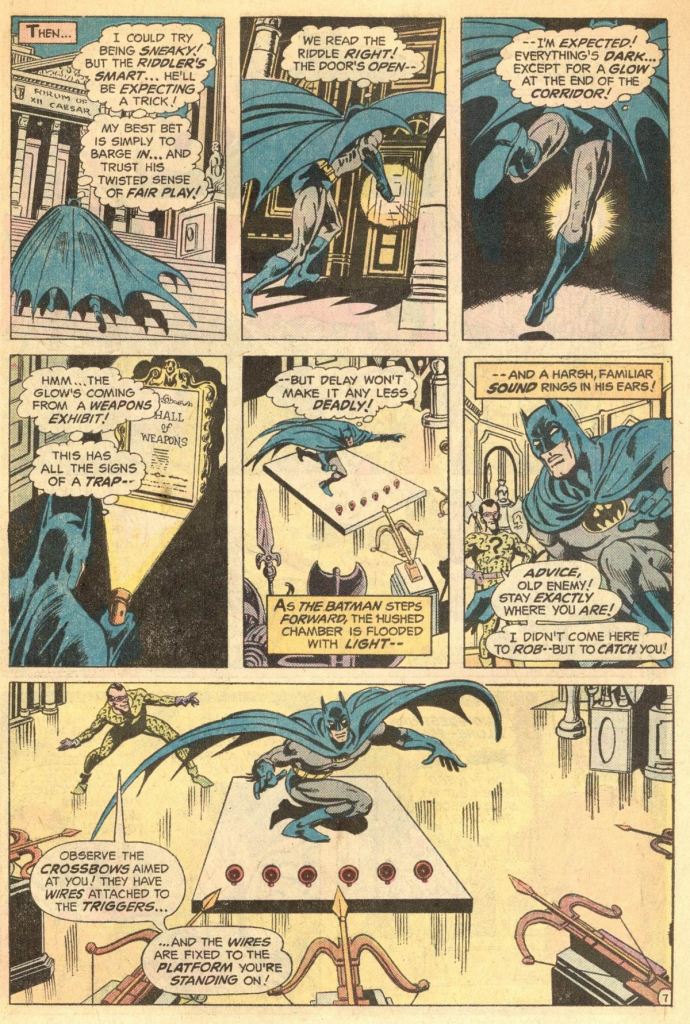
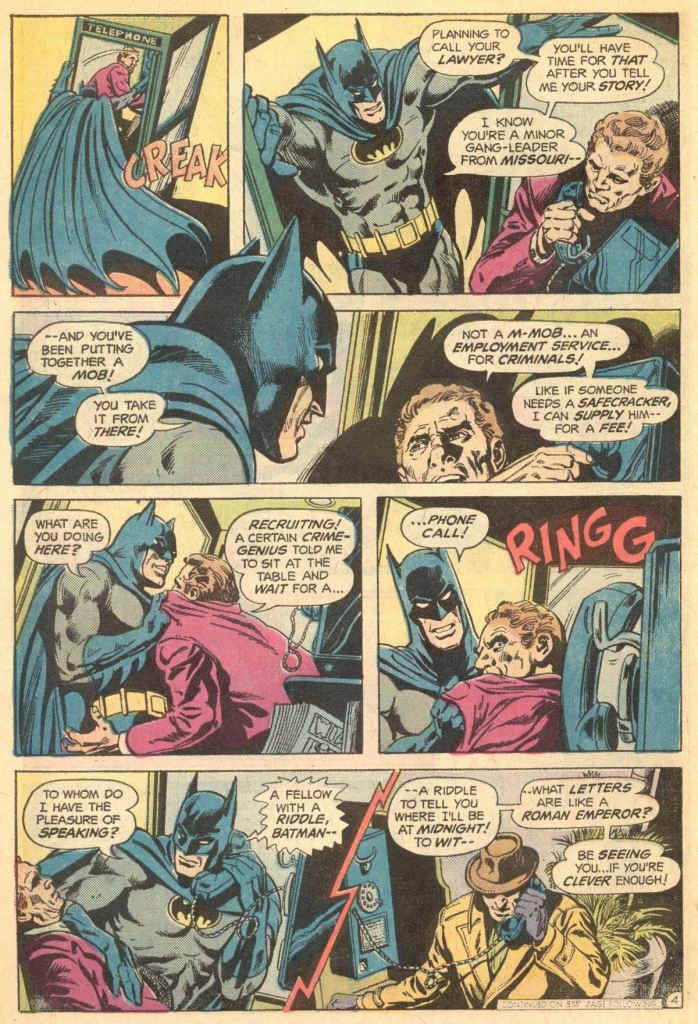
This story opens with the Batman breaking up a clandestine underworld meeting at a restaurant in the theater district of Gotham City. The organizer, Blair Brambel, has set up a kind of employment service for criminals, hooking up prospective employers with the exact type of henchmen they need. Brambel was waiting for a phone call from a prospective employer, the Riddler, and so Batman is there to receive the Riddler’s message–which, as always, is concealed in the form of a riddle he must puzzle out. Solving the riddle leads Batman to a newly-opened museum. But he winds up blundering into a death trap that the Riddler has set up for him: a pressure plate connected to a series of crossbows arrayed around the room and aimed directly at it. The platform also contains a series of switches labeled A-F, one of which, the Riddler tells his foe, will disarm the trap–the other will set it off. And the crossbows will sprint automatically in five minutes regardless.
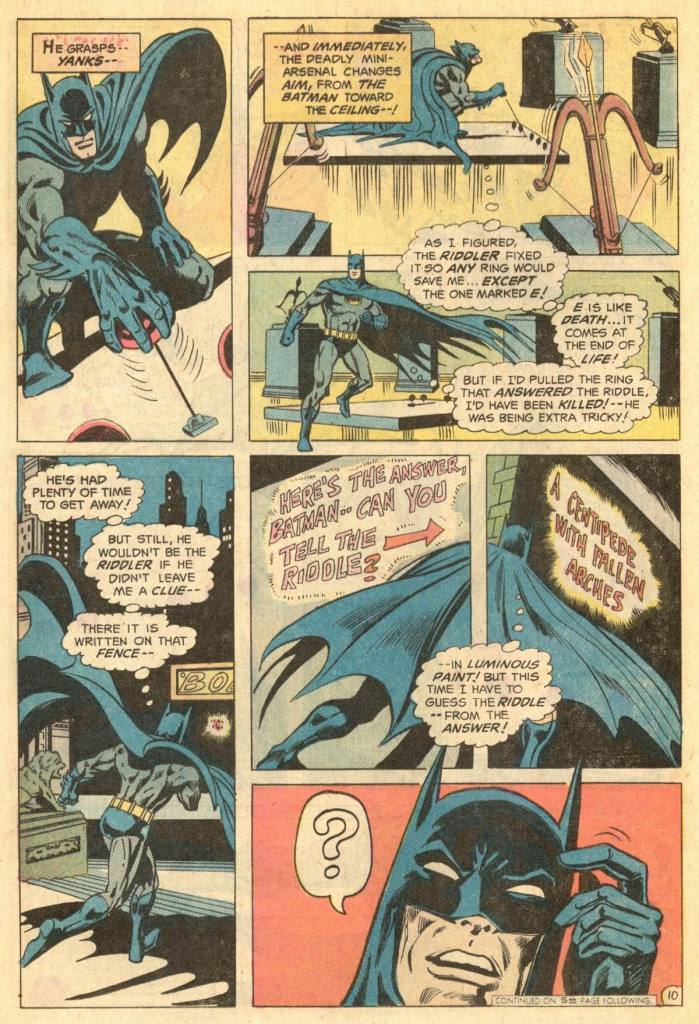
So this is a death trap of the sort that used to close out every first part episode of the television series, and one set up by the Riddler, so we were in very familiar territory. And it’s this trap and its solution that I remember best all these years ago. the Riddler leave batman with a riddle that points the way to his escape: What Letter Is Like Death? Batman dopes out that the answer is E–but he also figures that the Riddler’s message isn’t telling him which switch will release him, but rather which one will kill him, and end his own life. So he winds up pulling one of the other levers and is liberated.
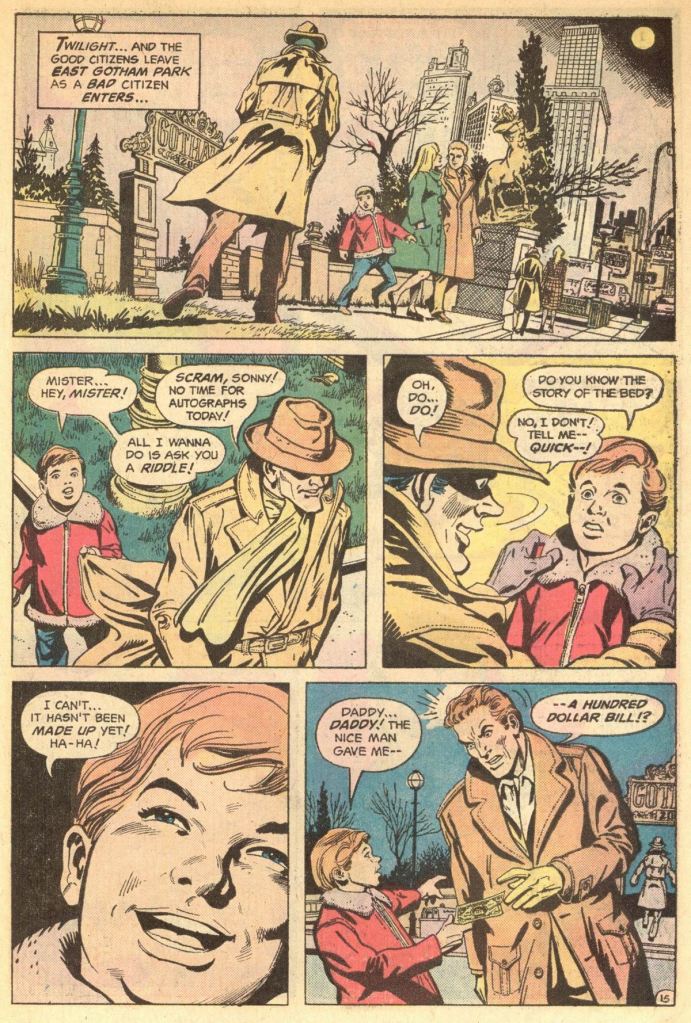
From here, there’s a fight aboard a freighter where the Riddler’s gang is attempting to heist a shipment of giraffes that provides some requisite action. But while the gang is captured, the Riddler himself makes his getaway–and this leads into the other moment that I recall from this story. Making his way across Gotham Park, the on-the-lam Riddler is accosted by a young child who proceeds to tell him a riddle. So taken is the criminal with this that he hands the boy a hundred dollar bill before going on his way. This felt like a quintessential Riddler moment to me, one that reinforced his obsession with games and puzzles and made him more specific and unique as a personality.
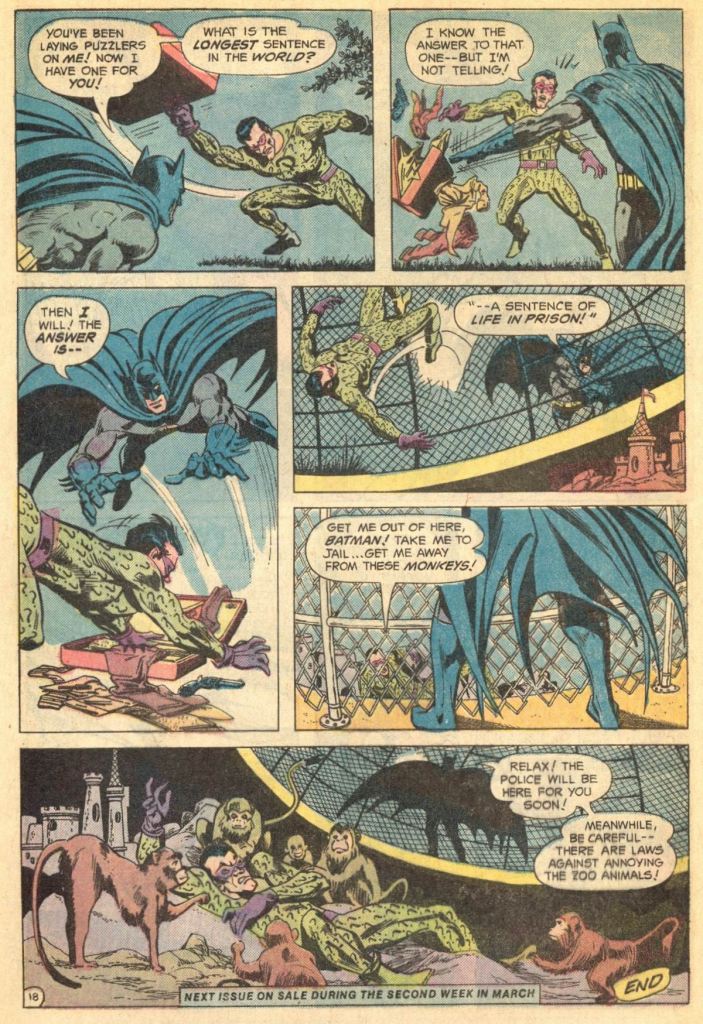
The story wraps up with the Riddler retreating to his hideout in the empty giraffe house at the Gotham Zoon, only to learn that Batman has worked out his location from his earlier riddles. No match for the Darknight Detective, the Riddler flees, and winds up knocked into in the monkey cage for his troubles. And that’s the end. The whole thing feels like it could have been an episode of the television series, even though the tone tries to hew closer to the style that Batman had recently been evidencing. So it isn’t a 100% successful hybrid of those approaches, but I do need to give Denny and Julie props for having managed this much as well as they had. As I say, i remembered some of these details for decades.
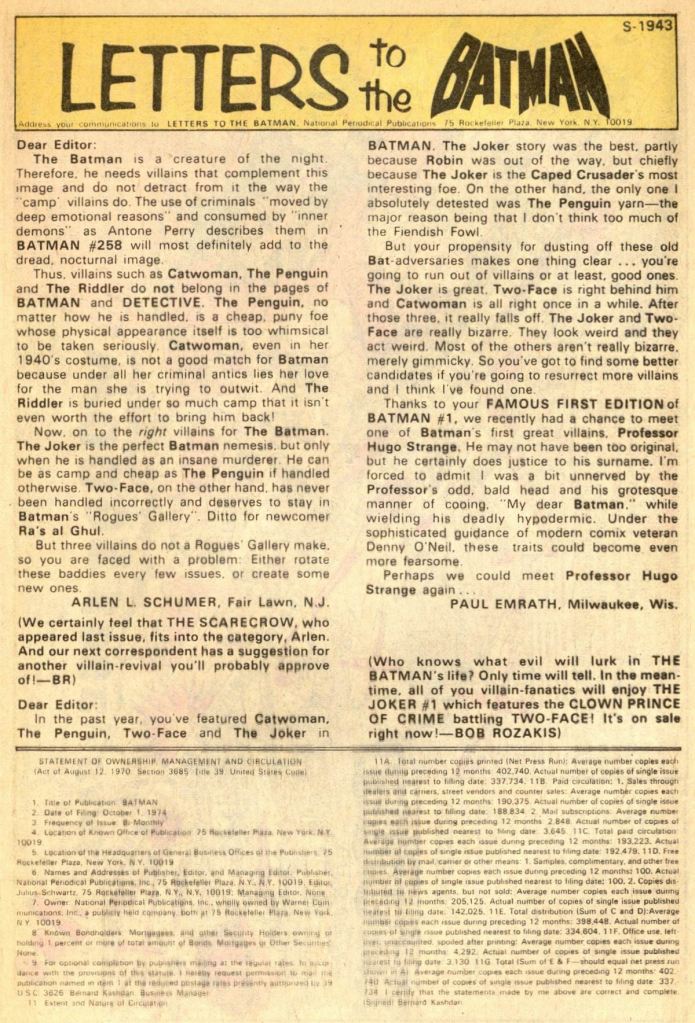
The Letters to the Batman letters page in this issue contains a letter from future designer and commercial artist Arlen Schumer. Even at this early date, he had strong opinions about who should be a part of Batman’s rogues’ gallery–I would guess that he didn’t love this issue’s story at the time. The page also runs that year’s Statement of Ownership which outlines how well the title had been selling the year previous. it indicates that BATMAN had been moving 192,479 copies on a print run of 337,734 copies, giving it an efficiency rating of just under 57%, which is a very strong percentage for the early 1970s. It’s clear that the omnipresence of Batman as a character helped to keep his title selling strongly, and that omnipresence included the live action show’s reruns as well as his appearances in SUPER FRIENDS and the like.
 The Tom Brevoort Experience
I was happy to see the villains back. Having a Bat who’s nothing but dark and grim never worked for me.
LikeLike
I don’t know why DC gave so much work — interior and cover art — to Ernie Chan. Because he was fast, and okay?
What a huge comedown after Nick Cardy. And here, even Dick Giordano can’t save the art….
LikeLiked by 1 person
It’s true, I tended to buy DC books despite Chan’s covers, rather than because of them.
LikeLike
I have long wondered this myself. so many covers with so much bizarre anatomy.
LikeLike
It was quite a jarring change in Batman after what preceded it. I remember the first issue with the Scarecrow as not being too bad, but I soon backed away from Batman and Detective Comics for a few years because Chua was drawing both. David V Reed wasn’t my cup of tea for the most part….it was just so different from what else was coming from DC. I did like the Underworld Olympics though.
LikeLike
Batman#400 ( October 1986 ) was my first book with the Riddler in it ( not to mention all the others: Joker, Black Mask, Mad Hatter, Killer Croc, Clayface III, Cavalier, Cat-Man, Poison Ivy, Penguin, Calendar Man, Crazy-Quilt, Black Spider, Dagger, Deadshot, Dr. Double X, Cluemaster, Killer Moth, Scarecrow, Night-Slayer, Tweedle Dum, Tweedle Dee, Two-Face, Ra’s al Ghul, Mr. Freeze and Doctor Phosphorous ) not counting any who appeared in Who’s Who: The Definite Directory of the DC Universe ( March 1985- April1987 ) which was information books and not them in action books. Before that it was either the 1966 Batman TV series and Saturday morning cartoons that predate Batman#400 that I saw the Riddler and a small number of those villains in.
LikeLiked by 1 person
I enjoyed Batman on TV. There was a silly aspect to it but there was an element of wit which was unusual. Sort of enjoyed Batman in the Justice League. The Super Friends were super lame though.
I’m generally uninterested in graphic violence where there’s body piercing and people being punched to death. So, it became fatiguing to see all these covers on after another year after year where the villain would declare death to the hero.
LikeLiked by 1 person