

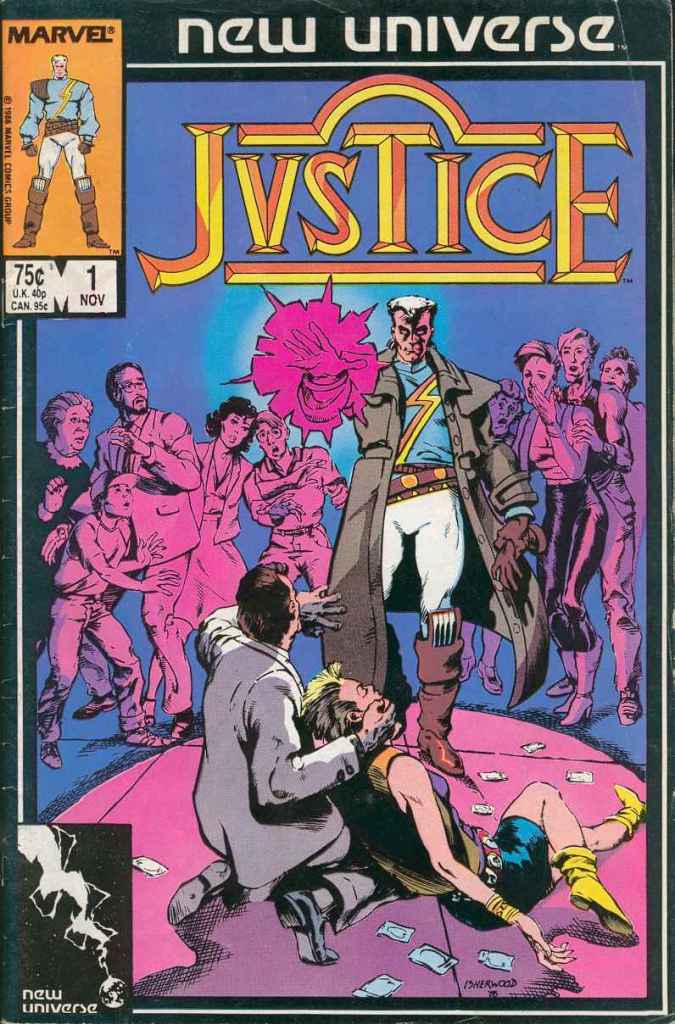
The development of the New Universe line had been a haphazard process. After several months had been spent in pursuit of high-minded goals in terms of creative innovation and the pedigree of those who would innovate said titles, in the end there was a mad dash to the finish line in terms of launching the eight titles that had been added to Marvel’s publishing schedule and bottom line. These books pretty much all wound up being created by Marvel insiders as opposed to top science fiction authors of the day, and in a number of cases, the books themselves were swiftly handed over to other hands. Such was the case for JUSTICE, which was put together by well-respected writer and editor Archie Goodwin. Goodwin, though, would only write the first issue before turning the book over to other hands.
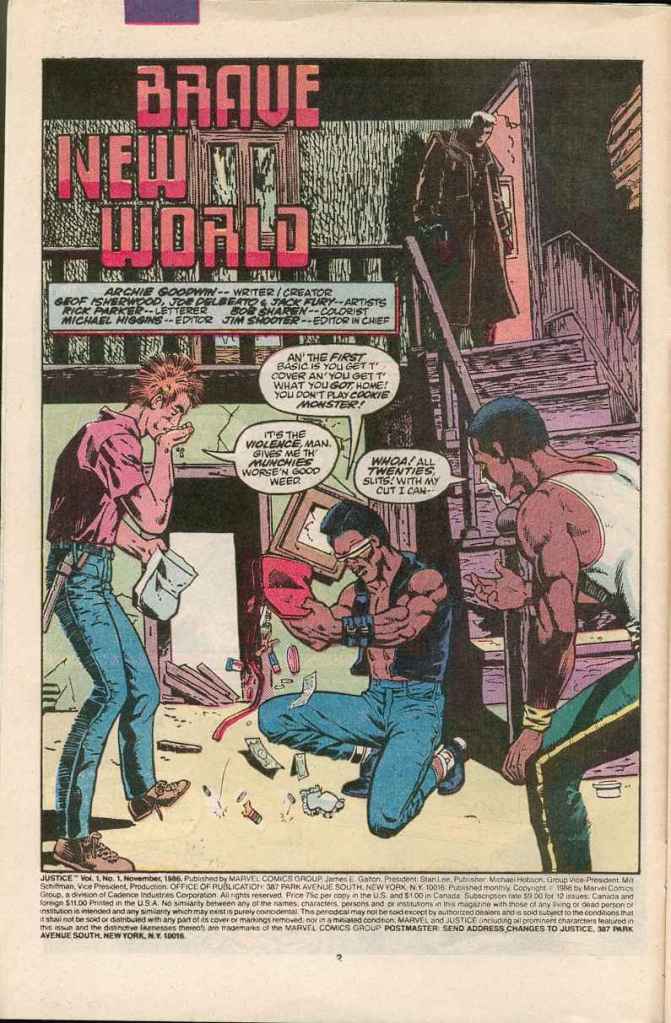
JUSTICE was the series launch that seemed to be the most at odds with the stated premise of the New Universe, which was intended to be the actual “world outside your window,” at least up until the point where the worldwide White Event unleashed super-powers. No Mer-People, no repulsors, no unstable molecules as EIC Jim Shooter puts it in the Universe News Bullpen Bulletins page in this issue. But JUSTICE flies in the face of this idea. It concerns Tensen, a misplaced “Justice Warrior” from another dimension who is pulled to Earth against his wishes and who must seek out the criminal Darquill and his son Conquest, who are themselves lawless wizards from his own universe. The whole idea of an alternate dimension populated by humanlike aliens who can past as regular people in our world flies in the face of the greater degree of realism that the New Universe was supposed to embody. But given that this was Archie Goodwin coming up with the concept, and that the deadlines were looming to get the books completed and to print, Shooter bent his own rules once again and permitted the series to move ahead.
Artistically, JUSTICE #1 was the work of Geof Isherwood, helped out with mandated changes and corrections by Joe Delbeato and the pseudonymous Jack Fury.
ADDITION: James Fry tells us: Jack Fury was occasionally other artists, but only on books I worked on as well. I had created the name as my own version of “The Crusty Bunkers” or “M(any). Hands”. the hope was that other artists would/ could use it as well. Issue # 1 of JUSTICE carried Jack’s byline. Jim Shooter wanted heaving gutfuls of the story redrawn before the book went to the printer, and it needed to happen over a single weekend. That time Jack consisted of myself, John Romita, Sr., Mike Harris, Doc Bright, Art Nichols, Andy Mushynsky, Frank Giacoia, and Vinnie Colletta.
Isherwood would remain the regular artist on the title at least through most of its first year (though as with the other books in the line, there’d quickly be fill-in art jobs scheduled), and would eventually write a couple of issues as well. The story is a strange mix of action movie tough guy tropes and the more science fictional idea of invaders from another mystic dimension. Its influences are plain to see in this first issue, as the lead character is intended to be the sort of hard-ass law enforcement agent of the type that was all over the B-movies of the period.
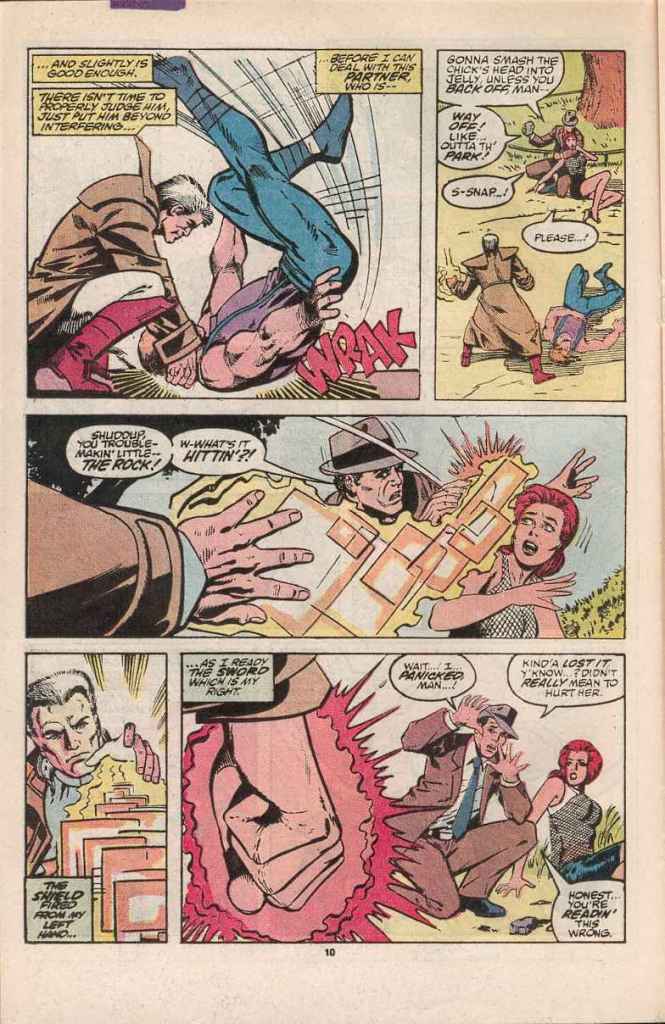
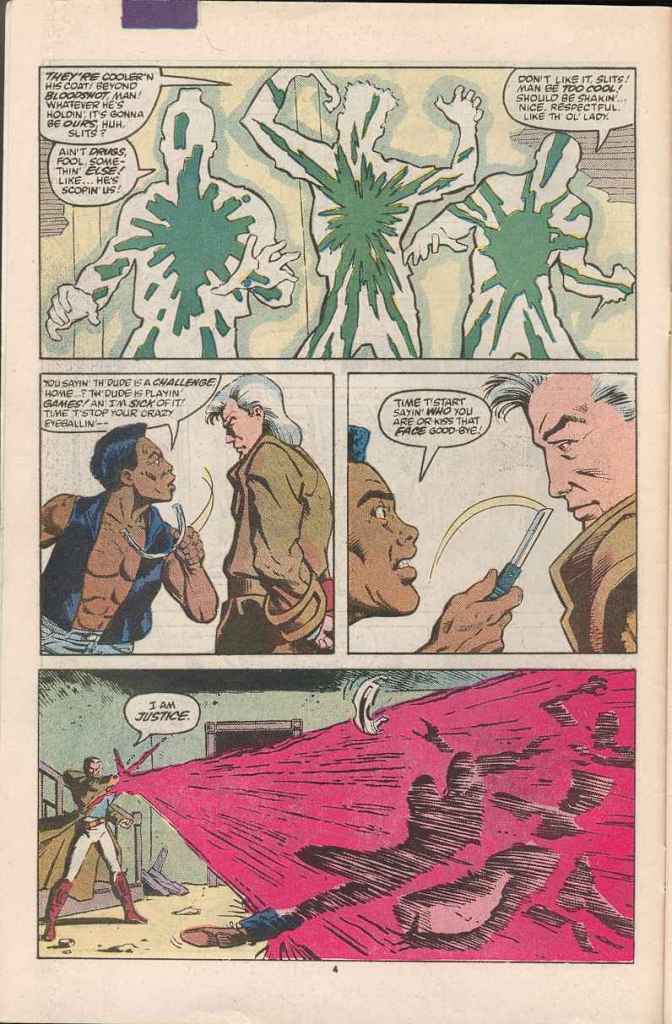
The story opens with the nameless and stoic Justice Warrior appearing in a crack house in Alphabet City in Manhattan. He swiftly shows off his three main powers: the ability to read the auras of people to determine whether they are inherently good or evil, the power to project a protective energy shield from his left hand, and the ability to unleash a destructive energy blast from his right, referred to as his sword. The Justice Warrior vaporizes the gang-bangers that he finds in residence, taking the stylized shades that one was wearing to disguise his pupilless red eyes, and then heads out into the wider world. Meanwhile, in California, Damon Conquest takes a call from his father, Darquill. They speak of the need to eliminate the Justice Warrior, indicating that he will likely be suffering some disorientation and memory loss as a result of his passage into this world.
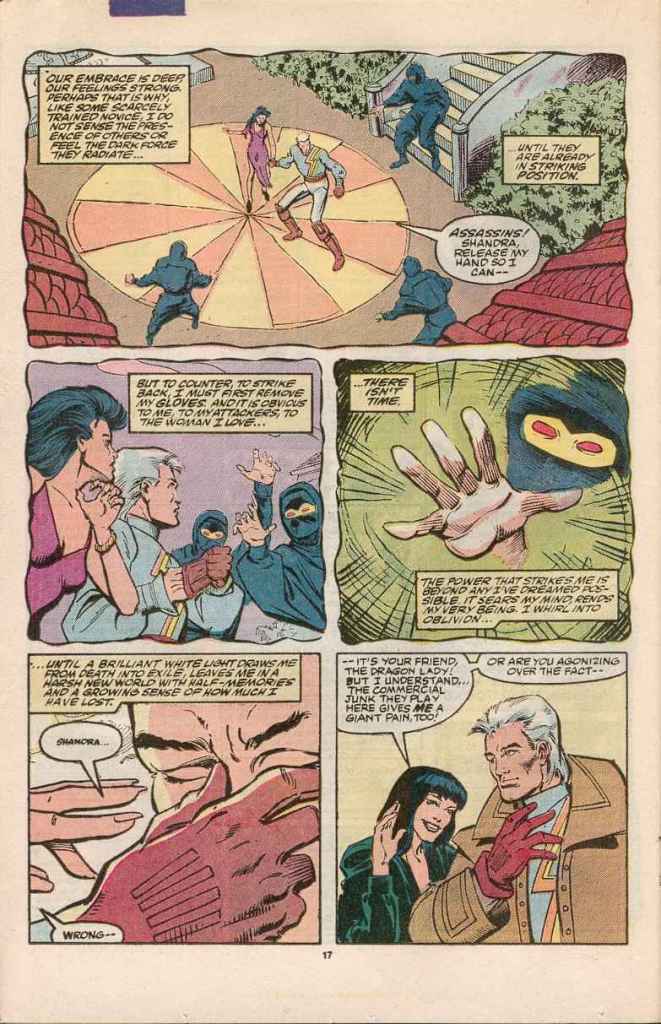
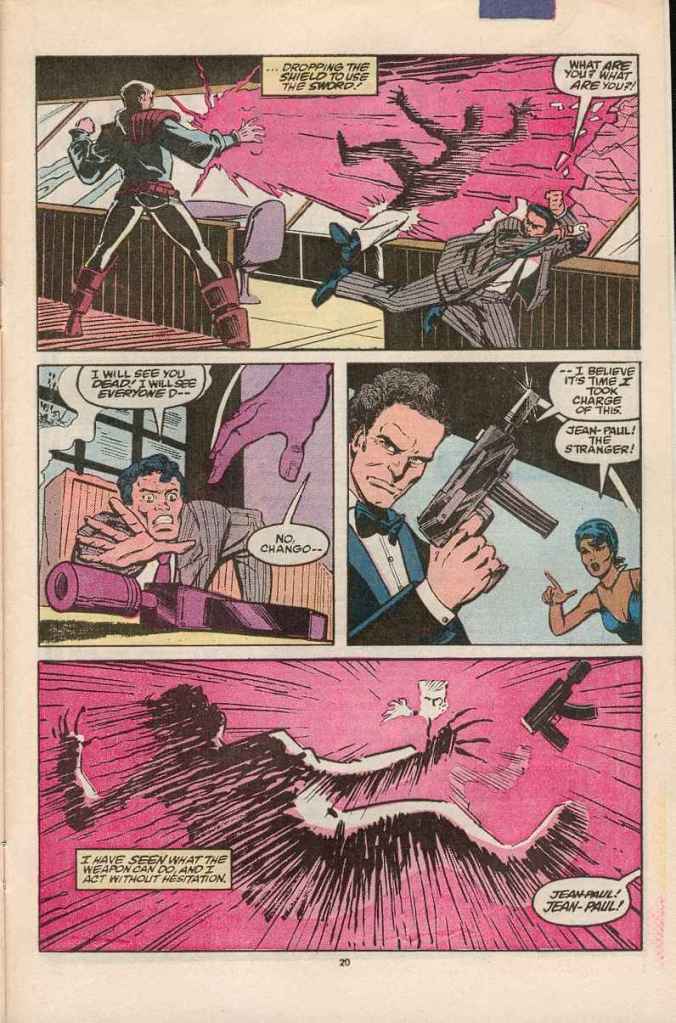
Tensen thereafter winds up attacking and killing some drug pushers, but not before he resolves to follow their corruption up the ladder to destroy the root of the darkness that is plaguing the city. This draws him to the Factory, a newly-opened industrial club in St. Marks Place that’s also a front for illegal drug activity. There, he encounters Rebecca Chambers, an undercover cop who is also trying to bring down the gang behind the drug smuggling. The sight of Chambers dancing causes Tensen to flash back to his beloved Shandra on his homeworld, and how he was ambushed and spirited away to this one. At this point, he remembers his name, and begins speaking aloud in perfect English, opening up. When there’s a falling out between the drug suppliers and the operators of the distribution ring that spills out onto the dance floor, Tensen gets involved, using his shield to protect bystanders and his sword to disintegrate anybody his Aura sight tells him is guilty. By the end, Chambers and her partner Hoyt Pittman have Tensen at gunpoint, intending to arrest him, as one of the people he disintegrated was an undercover cop (who, unbeknownst to the other two, was really working for the bad guys.)
JUSTICE #1 isn’t terrible, but it is a bit dull and lifeless, a by-the-numbers piece of work without a whole lot of enthusiasm filling its pages. The characters, human beings and aliens alike, are portrayed cartoonishly as broad caricature “types.” Goodwin, usually a total pro, feels like he’s discharging an obligation here rather than writing a story that he’s genuinely invested in. With the second issue, Steve Englehart came on board to take over the writing, though he’d only wind up doing four-and-a-half issues, several of which were drawn by artists other than Isherwood. With Englehart’s departure, the series floundered in the way that most of the New Universe launches did, lurching from creative team to creative team in what felt like a succession of fill-in stories. Nobody was driving the bus, nobody was being put into place with a strong enough command of the strip to take over and guide it into a direction. Given that fully half of the New Universe titles were cancelled at the end of the first year, you’d be betting safely to assume that JUSTICE was one of these, especially given how at odds the whole thing was with the premise of the universe. But that’s the exact opposite of what happened.
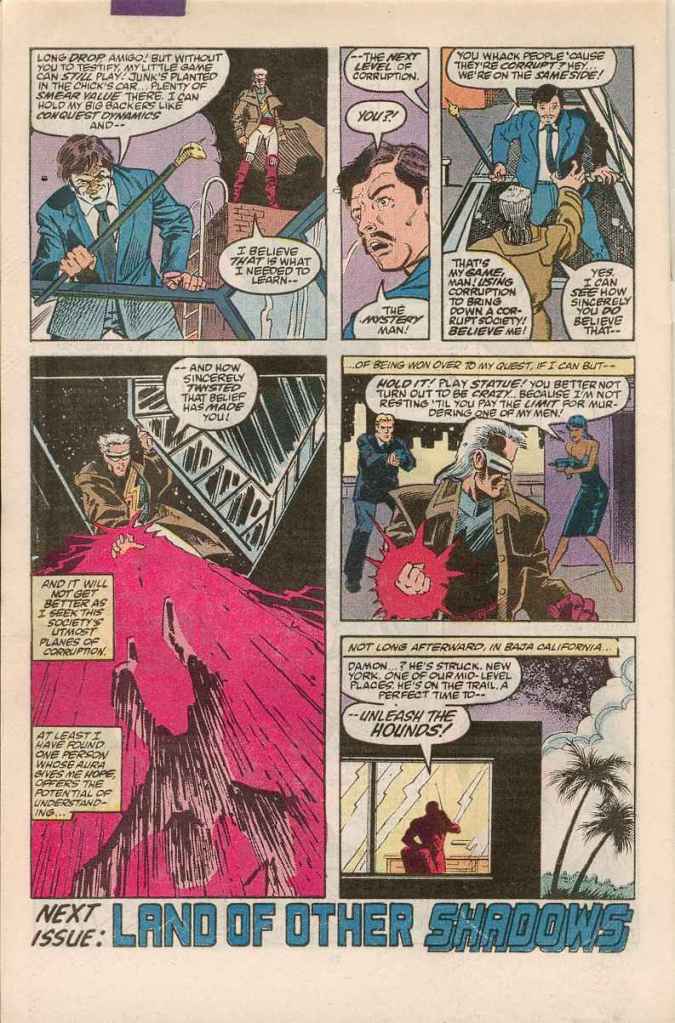
In issue #15, with Shooter gone and Mark Gruenwald put in charge of wrangling the flagging line, Peter David comes on board as writer and promptly reveals that everything that had been established within the series up to this point had been a lie, a delusion. This style of shock storytelling had become fashionable off of the back of Alan Moore redefining DC’s SWAMP THING in this manner, turning it into a critical darling and a commercial success. The abrupt change in series direction was gruenwald’s idea, to better bring the premise of the book into line with the other remaining titles and their shared world. It was revealed that Tensen was actually John Tensen, a DEA agent who had been subsumed into the fantasy of the criminal he was chasing, Darquill, whose paranormal ability allowed him to reshape reality in a limited fashion. Gone was all of the otherworldly lore and the quasi-mysticism. Tensen lost his ability to perceive auras but retained his other powers, and he adopted a less rigid, more nuanced stance on the concept of justice, policing other paranormals like himself who had chosen to use their abilities to harm others. Under David and artist Lee Weeks, the series became quite readable, albeit utterly divorced from what it had been for its first year of publication. Even after the series eventually concluded with issue #32, David kept coming back to the character: he introduced a thinly-disguised version of Justice in the sixth of the PSI-MAN novels he wrote under the pseudonym David Peters, and later created the Net Prophet during his time on SPIDER-MAN 2099, who was clearly meant to be John Tensen in another guise.
 The Tom Brevoort Experience
Joe Delbeato is not a pseudonym. He is, I believe, a Kubie, who started on DC’s New Talent Showcase, and worked quite a bit on their Kenner toy tie-ins.
Clearly though, Jack Fury is a pseudonym. His only other credits were inking on several issues of Mark Hazzard: Merc, also from the New Universe.
LikeLike
Google says kubie is a type of burger. It’d be weird if that really were the only definition.
LikeLike
I’m sorry, comic book slang. Kubie (noun): student of The Joe Kubert School of Cartoon and Graphic Art.
LikeLiked by 1 person
I feel like I’m seeing some Vince Colletta inking on some of these pages.
LikeLiked by 2 people
I did too but forgot to mention it in my comment. Isherwood is middle of the road for me. I never got worked up enough to hate or love his work. The art that looks Colletafied is the best I’ve seen of Isherwood’s art though.
LikeLike
Isherwood is one of my favorite Doctor strange artists, though, so we’ll have to agree to disagree.
LikeLiked by 1 person
I skipped out after issue one and only came back for PAD. The man was a demigod of a writer and I was never unhappy with any book of his I read. Too bad his Justice didn’t join the ones who got heavily featured in the 616 later on.
LikeLiked by 2 people
This looks bland at best. “Guy comes from another dimension to met out justice” requires the visual dynamics of a Gil Kane or Jim Starlin to have any kind of “oomph” I think.
His left hand does “this” and his right hand does “that” is frankly… pretty comic booky.
Any comic book essentially has an unlimited special effects budget, but the New Universe somehow managed to make comics that looked like low budget tv shows. Charlton Comics were like that as well, but they still managed to have an oddball/off-brand charm that made them appealingly strange. I’m surprised that Marvel editorial stuck with these as along as they did… 3 or 4 issues in did anyone (Shooter included) think that these books had the juice to be the way of the future?
LikeLiked by 1 person
Wraparound shades and a mohawk: do ’80s hoodlums get more stereotypical?
LikeLike
“…later created the Net Prophet during his time on SPIDER-MAN 2099, who was clearly meant to be John Tensen in another guise.”
It took a while, but this was explicitly stated in Spider-Man 2099 #44, PAD’s final issue of the original run.
LikeLike
Much as I wish I could offer some insightful or clever commentary, I truly don’t remember anything about this comic. I know I received it as I’d foolishly ordered all New Universe first issues. It didn’t have art like JrJr in Star Brand. Nor was it as difficult a read as either Spitfire or Kickers, Inc. Clearly an example of falling under the radar. Good thing I lived on a shoestring budget in those days or I may have also invested in New Coke.
LikeLike
I note that Joe Delbeato isn’t a pseudonym, he’s an artist with other Marvel and DC credits
LikeLike
“…with mandated changes and corrections by the pseudonymous Joe Delbeato and Jack Fury.”
Joe del Beato wasn’t a pseudonym, and I don’t think he was doing corrections; he was the inker/finisher of the issue. Jack Fury was pseudonymous, but since James Fry was talking about using the name on certain jobs on Facebook recently, I don’t think there’s any harm in saying that, yeah, that’s James.
Joe Rubinstein’s inks are evident on some pages, and he’s confirmed that he worked on the issue. There are spots that look like Vince Colletta, too, but I’m not familiar enough with del Beato’s work to say for sure it’s not him.
And yeah, this really reads like Archie slopped it out overnight, and it’s well-crafted because Archie’s a good craftsman even when he doesn’t care about the material. If Geof Isherwood was a stronger artist at this point (or was allowed to be a stronger artist, rather than following Jim Shooter’s ideas on clarity), it might have had more interest, the way, say, Atlas-Seaboard’s DESTRUCTOR did; another book I bet Archie didn’t care much about, but had art by Steve Ditko and Wally Wood.
I’m not sure if I ever bought this — I might have read through a copy at the office. I’d have been interested in the Englehart issues, but I didn’t have a lot of spare cash back then, and I think I’d mostly given up the New Universe as a trainwreck in the works, and may have not even looked at them.
LikeLiked by 2 people
The least they could have done is give ( when he was an extradimensional alien ) Tensen’s pretty girlfriend Shandra a different hair colour from Rom’s pretty girlfriend Ray-Na [ Rom#5 ( April 1980 ) ] and the Silver Surfer’s pretty girlfriend [ The Silver Surfer#1 ( August 1968 ) ] Shalla-Bal. I wonder if there was a support group for alien girlfriends whose alien boyfriends are either travelling or missing? At least Mar-Vell’s pretty alien nurse girlfriend Una had brown hair and not black.
LikeLike
Either Jim Shooter should have created or co-created the Heroes for his New Universe so they followed his rules for that universe or co-plotted or he should have done a better job as Editor in Chief in making sure the writers coloured within the lines of the New Universe. He was as bad a “father” for his “baby” as the Whizzer and Cyclops were for their kids ( In the Whizzer’s case the 2 Bova said were his ).
LikeLike
i never knew about the big plans for the New Universe so when I caught up a few years ago in the dollar bins, I didn’t mind all of the bad choices, but, man, how did Justice last the longest of all of these? DP7 seemed the strongest.
LikeLike
I’m in a minority — Justice clicked with me, Peter David’s It’s All A Lie therefore did not.
If Shooter wanted the NU protagonists to be the only weird things in an otherwise realistic world, that was a long shot to ever be a hit. Given how few of the series fit that template, maybe at some level he knew that too.
LikeLike
I bought the 1st issue and had no interest in it whatsoever. I did enjoy Isherwood on CONAN and SAVAGE SWORD, where his style fit much better. He did some nice work on DR. STRANGE years later as well. JUSTICE almost got my attention with PAD and Weeks, but the stink of New Universe kept me away. PAD made MERC a better book than it deserved to be as well.
LikeLike
This was the only New Universe book I bought, and only when Keith Giffen took over the art. If I remember correctly, he turned it into a very Keith Giffen comic for a while.
LikeLiked by 1 person
as far as New Universe comics go, D.P. 7 was my favourite.
not just a “this is the best of this bunch of titles”
it was a favourite comic overall of mine back then.
LikeLike
Same. Gruenwald lost me over time everywhere except this book.
LikeLike