

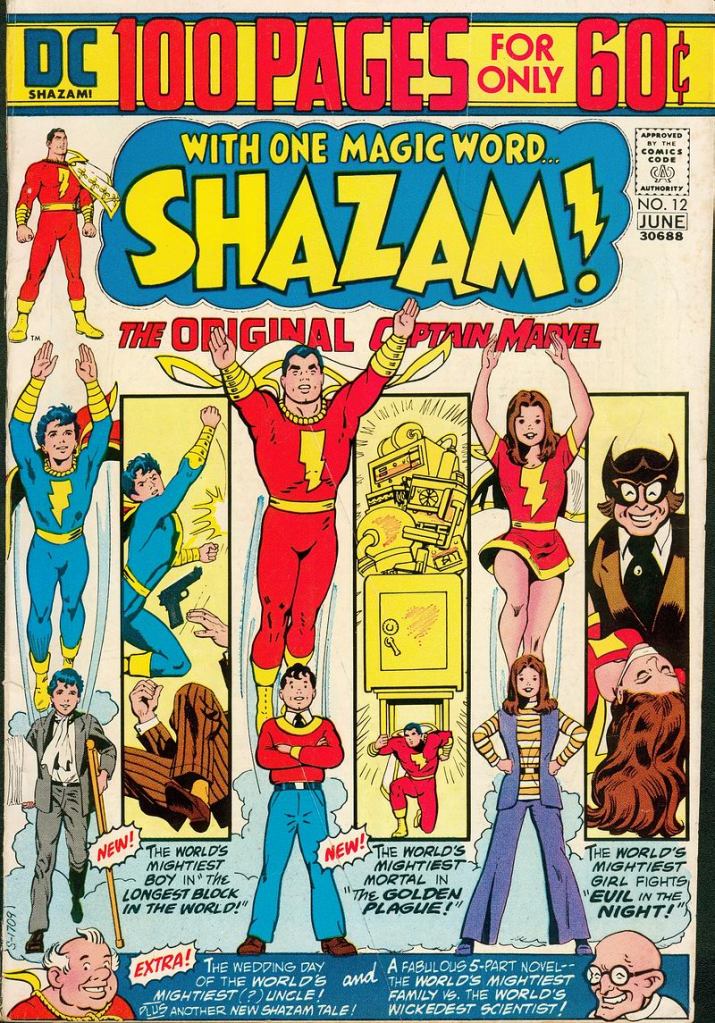
I continued to make my way through the complete run of SHAZAM that i had borrowed from my grade school friend Donald Sims one week. While it’s taking us months to go over these books, I read them all in two, maybe three days when I first borrowed them. This next issue was a return to my favorite format, the 100-Page Super-Spectacular. The series would remain in this format for the next several issues, with new stories backed up by a fat package of classic reprints. As I tended to think that the reprinted material was way better than most of the new stories, this arrangement suited me perfectly.
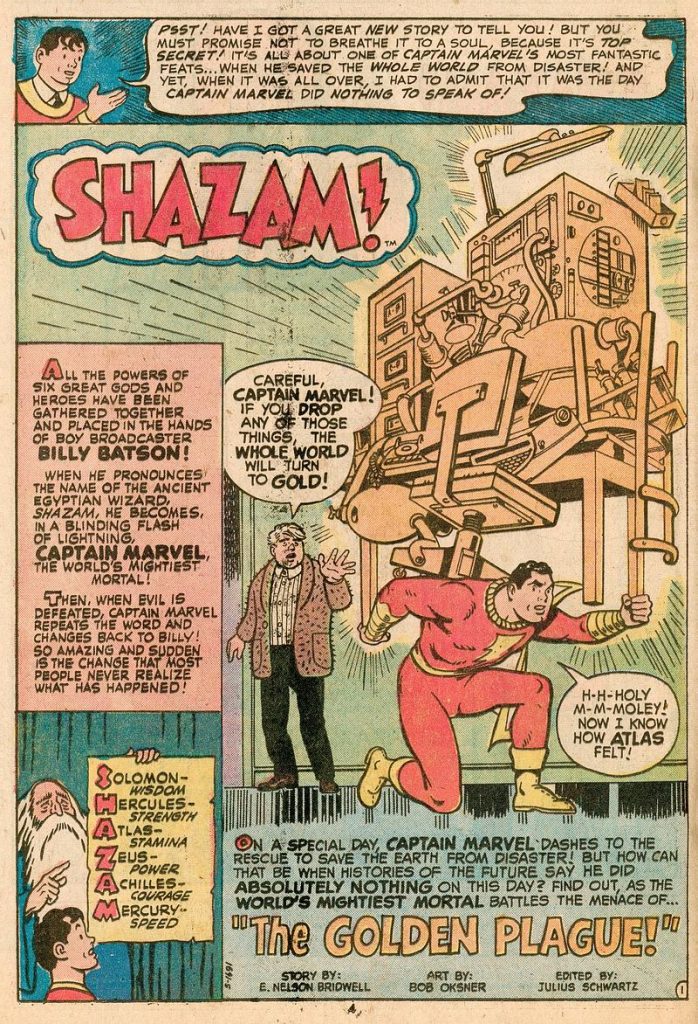
The opening story in the issue was new, though, but it was written by E. Nelson Bridwell, who had a genuine affection for the Marvels and their style of material. The art was provided by Bob Oksner, who turns in a fine job that channels the spirit of the departed C. C. Beck while retaining the essence of his own individual style. it concerns a visitor from the future, Jarl-499-642-831, a reported from tomorrow whom Bridwell names after Jon jarl, the hero who starred in a series of text stories in the old Fawcett CAPTAIN MARVEL ADVENTURES issues. Jarl has come back to this particular day because history records it as a date on which Captain Marvel performed no feats–and certainly that can’t be right. So Jarl accompanies Billy Batson as he heads out to interview Dr Kilowatt. But Kilowatt has inadvertently developed a Midas Effect that transforms everything it touches into gold. Captain Marvel is fortunately immune, but there seems no way of getting rid of the ever-expanding effect, which will soon become airborne. Marvel finds a solution, though–he extracts the gold fillings from Dr. Kilowatt’s teeth and encases the compressed Midas Effect inside them, figuring that they can’t transform gold into gold. Marvel says he’s going to stash the incredibly dangerous thing somewhere, and this explains why history shows him doing nothing today–because Billy didn’t want to reveal the existence of the Midas Effect to the world.
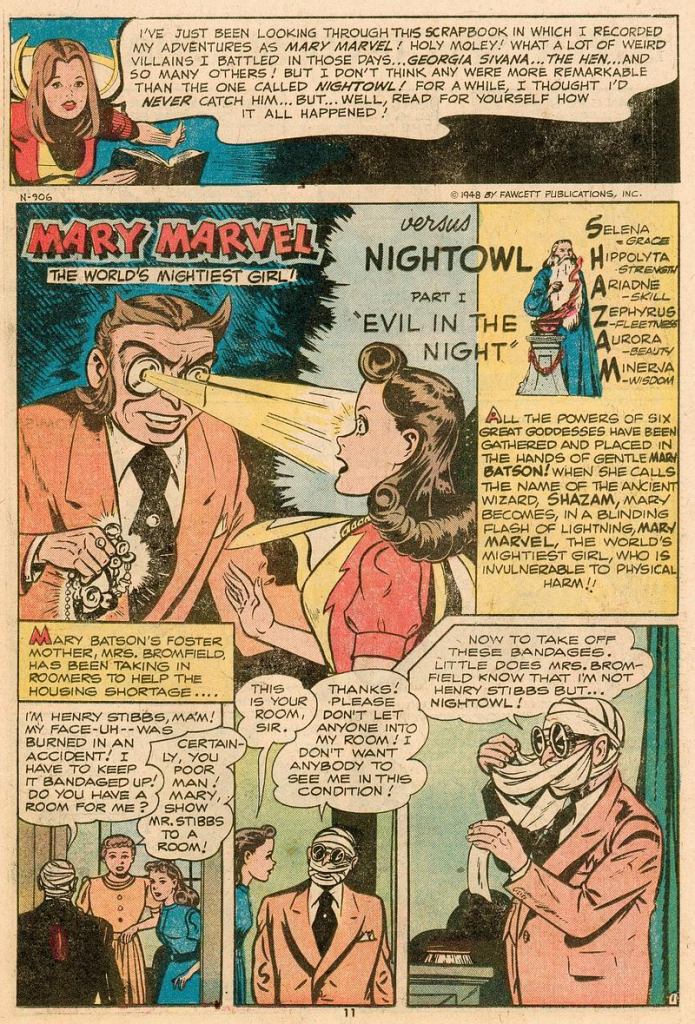
Then came the first of the reprinted stories, a two-part adventure of Mary Marvel taken from her solo series. It was written by Otto Binder and illustrated by Jack Binder and his studio–the second half looks to my eye like it was drawn by a different artist than the first half, so both parts must have been in production simultaneously. The story concerns Mary’s attempts to defeat and capture the criminal Nightowl, who uses a darklight flashlight in committing his crimes. At the end of Part One, Mary is left in a deathtrap of the sort the Batman television series used to feature. She survives, of course, and finds Nightowl secretly living in her own mother’s boarding house as the bandaged Mr. Stubbs.
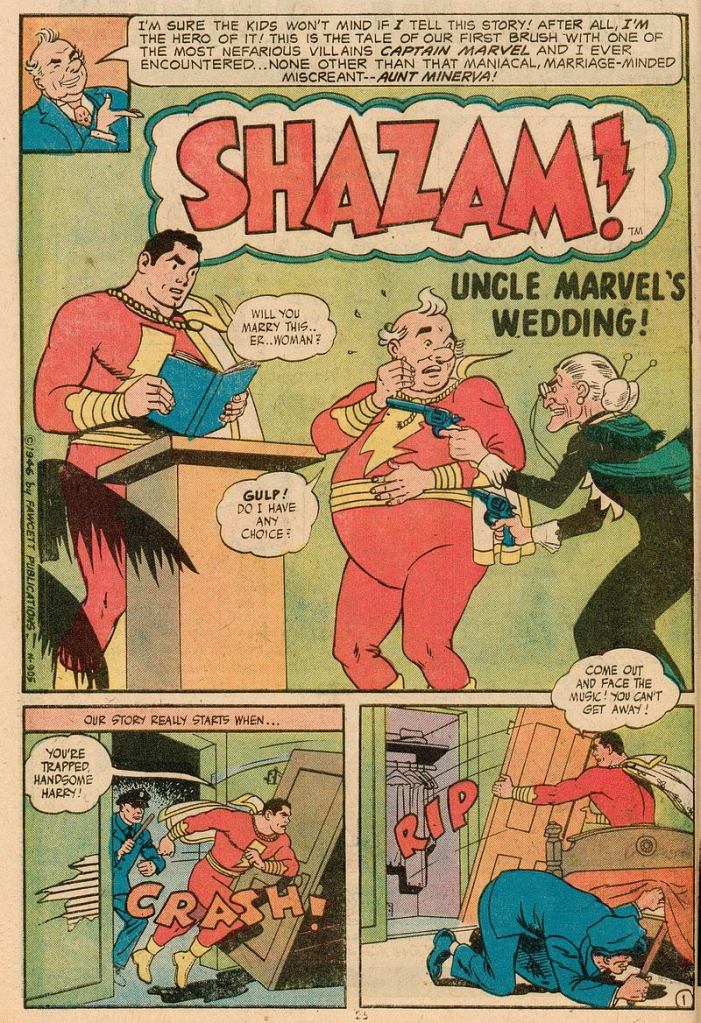
Next up was a Captain Marvel flight of fancy featuring both Uncle Marvel and the Captain’s recurring foe Aunt Minerva, the elderly crime boss. This was her first appearance, and as usual, Minerva is interested in landing a husband. She hires Uncle Dudley’s SHAZAM Inc. to carry out the job of finding her one. Of course, she swiftly decides that Uncle Marvel is the man for her after he displays his bravery, and it’s up to Cap to get Dudley out of this predicament. The story ends with Minerva’s affections having switched to the Big Red Cheese, which would be her status quo going forward. It was a fun yarn, written by Bill Woolfolk.
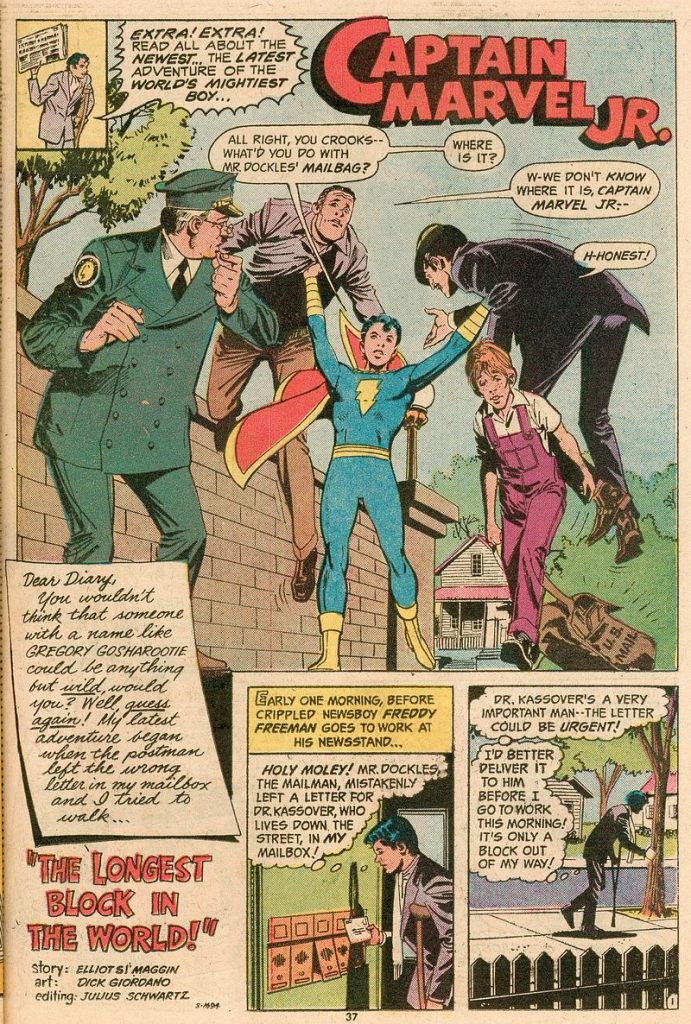
The next story was another all-new adventure, this one starring Captain Marvel Jr. and put together by writer Elliot S! Maggin and artist Dick Giordano. It’s about all of the trouble Freddy Freeman gets into as he attempts to return a misdelivered letter to its proper owner a block away. The letter is the target of some foreign spies, who use local dullard Gregory Gosharootie, the World’s Dullest Kid, to try and steal it back.Gregory has so little presence that people simply don’t notice him whenever he’s around, making him the perfect sneak-thief, even though he’s really a good-natured kid. But Junior is able to recover it and to put a stop to the spies. Freddy and Gregory wind up delivering it to Dr. Kassover, who is clearly a caricature of Henry Kissenger. Artist Giordano also swipes poses from golden age Junior artist Mac Raboy throughout this story, which is a bit strange.
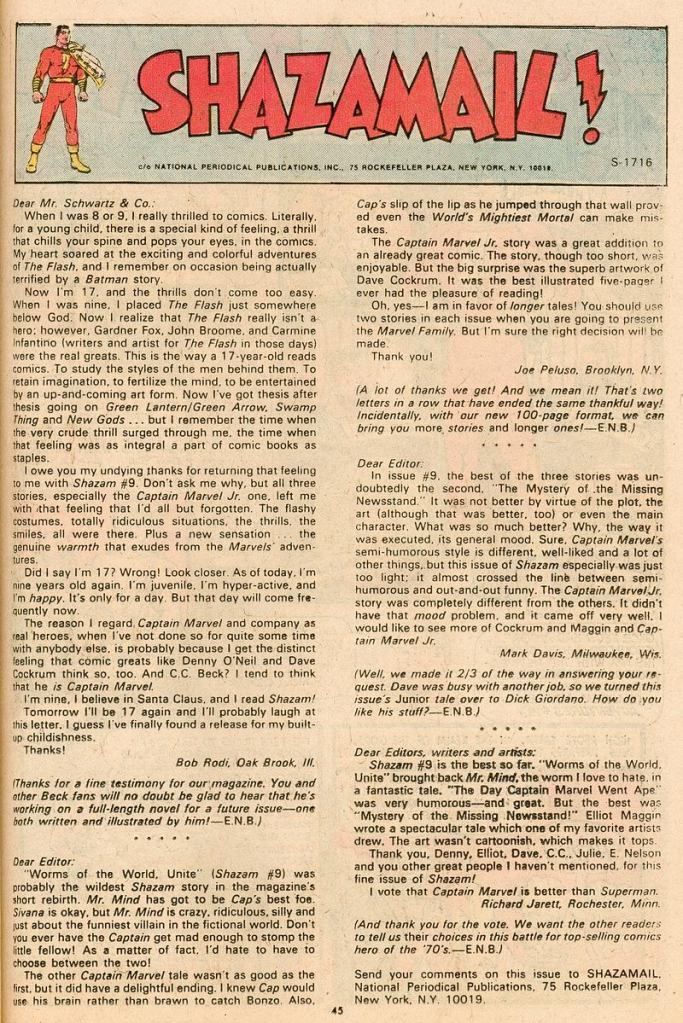
The Shazamail letters page comes next, and it includes a note from future author Bob Rodi, who was a frequent contributor to editor Julie Schwartz’s letters pages.
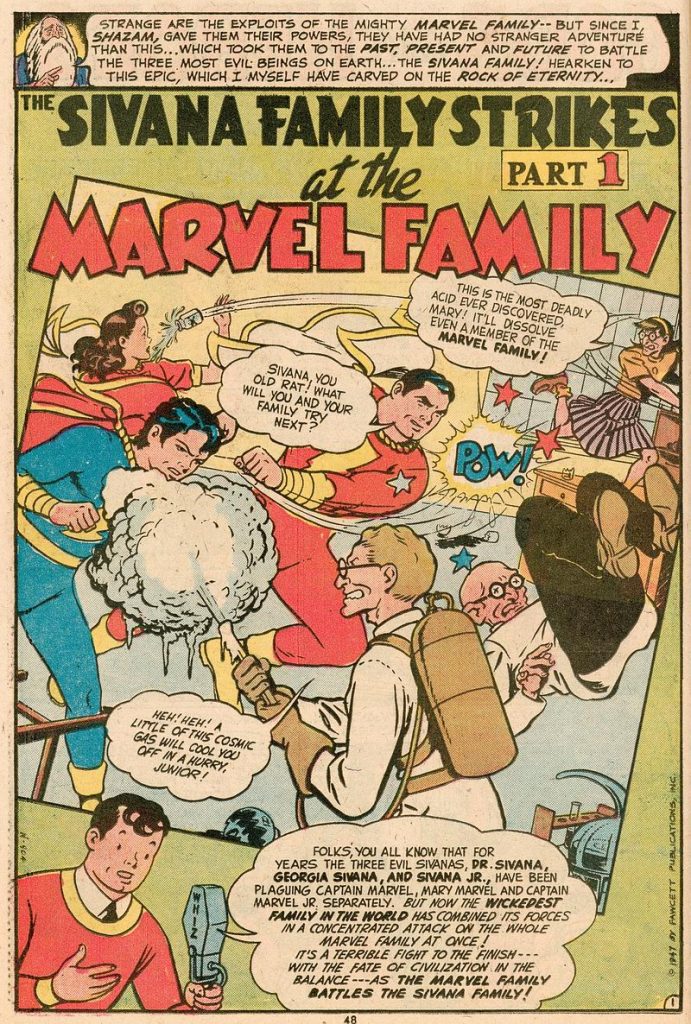
The big main feature of this issue was wasted on me, as I’d already read it in the SHAZAM: FROM THE 40S TO THE 70S hardcover book. But it was nice to experience it here in full color. it was a book-length epic from an early issue of MARVEL FAMILY that was structured like a Justice Society adventure in ALL-STAR COMICS. Across five chapters, the Marvels contended with the extended Sivana family in the past, present and future, separating at the close of the first chapter to head off into solo adventures then reuniting for the conclusion. What was interesting about it was that the artists for Mary and Junior’s solo strips, Jack Binder and Bud Thompson, handled their chapters, giving them the flavor of their own series. Pete Costanza did the opening and closing and also handled Captain Marvel’s solo chapter. Otto Binder, of course, wrote the story, as he did for more than half of the Marvel Family canon. This was sadly the only Marvel Family story to follow that JSA format.
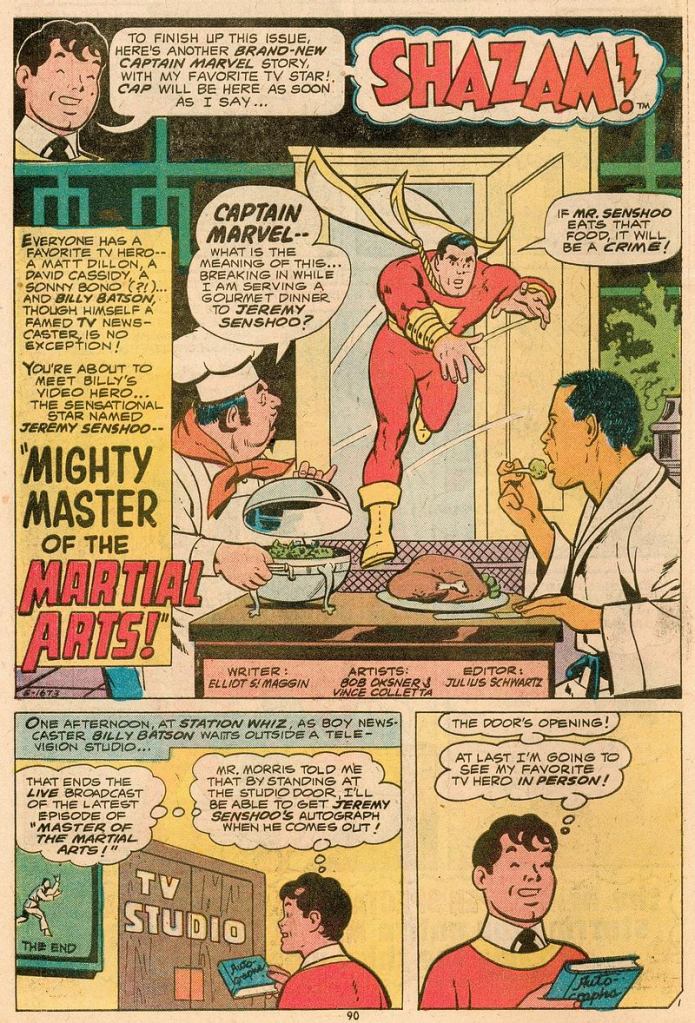
The final story in this issue was also new, and unfortunately a bit racist. It revolves around Jeremy Senshoo, the star of the television series Master of the Martial Arts, who is a bit of a hero to Billy Batson–and who is unfortunately colored a bright orange. Captain Marvel is confounded when Senshoo turns to crime, but it turns out to be the doing of the actor’s chef, who has been slipping mind-control drugs into his meals. And of course, even the greatest martial artist on the planet is no physical match for the World’s Mightiest Mortal. But Marvel is able to exonerate Senshoo and get his autograph for Billy, making sure that the chef pays for his crimes as well. This one is also illustrated by Oskner, but Vince Colletta’s weak inks mean that it’s a less polished effort than the opener.
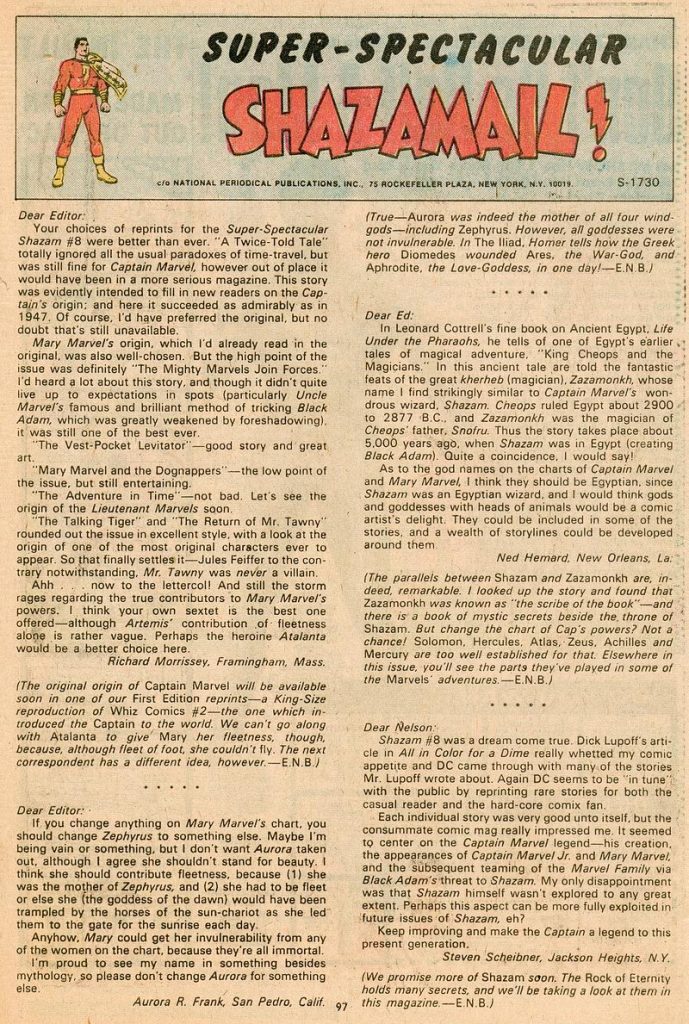
And the issue closes with a second Shazamail letters page, this one including a communication from DC super-fan Rich Morrissey.
 The Tom Brevoort Experience
Seems to me that rather than employ Raboy swipes, the more historically-appropriate course for Mr. Giordano would have been to paste up actual Raboy poses of Jr. throughout, like they did in the Golden Age!
LikeLike
I don’t think any book benefited from the super-spectacular format as much as Shazam! as most fans (I assume), like me, had no exposure to the classic stuff.
For all its flaws, I do like the moment in the martial arts story where Cap learn Senshoo’s autograph is worth as much as a 100 of the Big Red Cheese’s.
LikeLike
The 100-page Super-Spectaculars are my favorite comics format ever (well, maybe a close second to the tabloid-size books). Lots of great reading and memories, here.
You know, despite that unfortunate coloring (something both DC and Marvel did in this era), Jeremy Senshoo comes across pretty well for the time (not a high bar to clear, admittedly). He’s not grossly caricatured, he doesn’t talk like a fortune cookie, and the idea of an Asian actor being the lead in a popular TV show was WAY ahead of its time (I can’t help but think that Maggin was taking deliberate shots at David Carradine and “Kung Fu” here).
LikeLike
Like many who bought these off the newsstand, I don’t remember many if any of the new stories, except for issue one, but I remember many of the reprinted old stories with great fondness at that age. 100-page Spectacular were gold mines for a kid like me who wasn’t even born until late in 1959 and knew nothing of the golden age or early/mid silver age. Miss them greatly.
LikeLiked by 1 person
I’m two years younger and loved these giants for the same reason.
LikeLike
That cover is very crowded/cramped. Nicely drawn, but wow, no room for anything.
Looks like a Carmine design, at any rate.
LikeLike
A lot of the 100-pagers suffered from cluttered covers (DETECTIVE COMICS under Archie Goodwin was an exception). But boy, you sure could tell you were getting your money’s worth!
LikeLike
I really like the design on this one, which alternated scenes from the issue with hero images of Cap, Mary and Junior. Yes, it’s 6 tiny lengthwise strips, but I find it way more impactful than the other 100 page spectaculars (except Goodwin’s as noted) which tended toward a big box to the left and two boxes on the right. (Using white gives it an open feel as well).
LikeLike
The Golden Age Mary Marvel was (I believe) modeled on Judy Garland, but what about the 70s version? She has a distinctive look of her own and I’ve wondered over the years if it was based on anyone in particular.
LikeLike
It might have been based on the then-popular actress Linda Blair: https://www.youtube.com/watch?v=5YWHL1uKKqc
LikeLike
Wow! I think you are completely right about that. Thanks!
LikeLike
Ooh, good catch! She also reminds me a little of Susan Dey from “The Partridge Family”: https://youtu.be/Aka23-3fCT4?si=emo1tiy1rcPdGZJT
There was a certain “70s waif” look that was ubiquitous back then…
LikeLike
Yeah, I can see Susan Dey too, good one!
LikeLike
I always thought that
LikeLike
The reprinted Marvel Family story is an old favorite of mine. It’s unfortunate that Fawcett didn’t use “book length novel” format more often.
LikeLike
I read this as a six-year-old, probably a year after it came out (My dad bought be a bunch of three-packs of these 100 page comics one summer we were staying at my grandparents). I had been into superheroes and comics for about a year or so, but this was the first time I read a comic from cover to cover and thoroughly understood everything. Comics were a bit opaque as a reading experience as a kid in the ’70s. I could read well (and read voraciously), but contemporary comics often were more at a tween-and-teen comprehension level. I got the broad strokes, mostly from the visuals, but with this issue of Shazam! I understood everything.
I attribute that to the reprints which were pitched perfectly to my reading level (and the modern stories worked to that level too). And honestly, they’re fun comics. I loved the Mary Marvel strip at 6, and the Marvel Family story was amazing as well. Shazam! really probably kept my love of comic books alive now that I think of it.
Also, I didn’t mind Giordano’s swiping of Raboy. Dave Cockrum did it too!
LikeLike
Personally, Weiss was my favorite Junior artist of this era.
LikeLike