

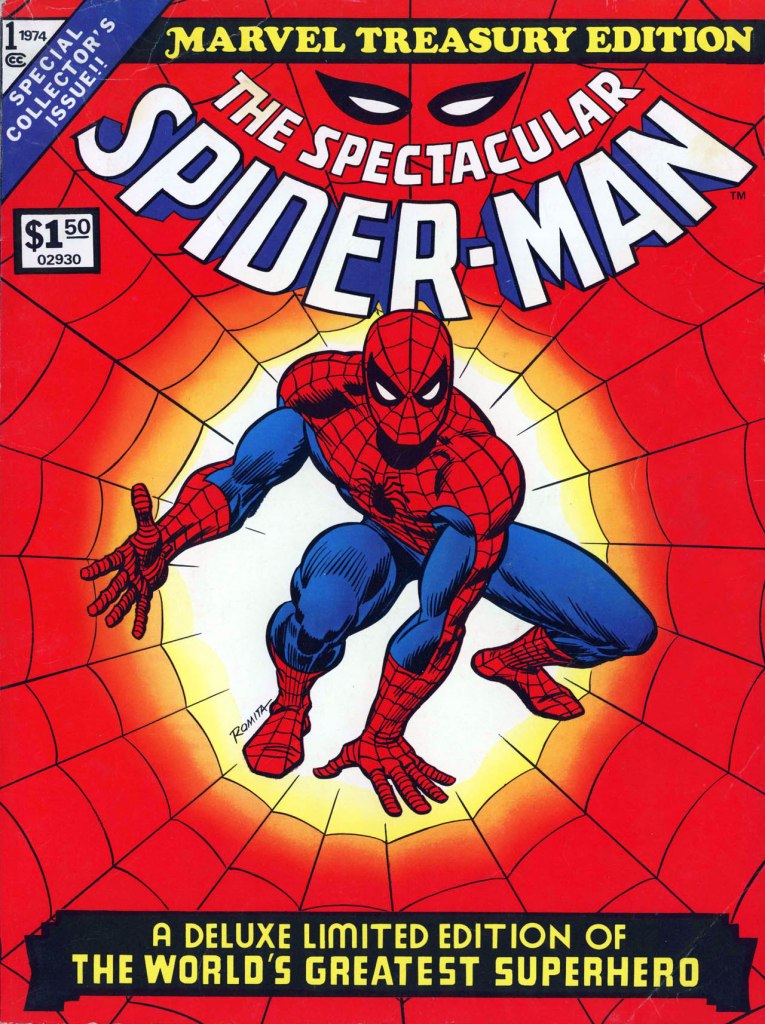
I don’t know that I ever borrowed this first MARVEL TREASURY EDITION from my grade school friend Donald Sims, but I definitely read it over at his house during one visit or another. And I can recall seeking him out a year or two later, when I was in Junior High, to offer to buy it from him. He wanted $10.00 for it, which was way more than I was willing to pay for it, so the whole venture came to nothing apart from a musty story in my memory. These treasury Editions were another attempt by publishers to break out of the diminishing sales ghetto they found themselves in at the early part of the 1970s. As a low-profit item, comic book racks were disappearing from candy stores and similar outlets in favor of candy racks and other merchandise that turned over more and brought in a greater profit. Treasury Editions, though, would typically be racked with the other magazines. They could stay on sale for longer, not tied to a given release schedule on the racks, and they were also sturdy enough to be sold into department store chains and toy store venues that otherwise didn’t carry comic books. DC, who initiated this format, priced their books at $1.00. The Marvel equivalent went for $1.50, but they were longer (100 pages with cover) and squarebound with a spine, so they were also sturdier. In a time before trade Paperbacks and the like, this was one of the only sources of vintage material available to readers in the period.
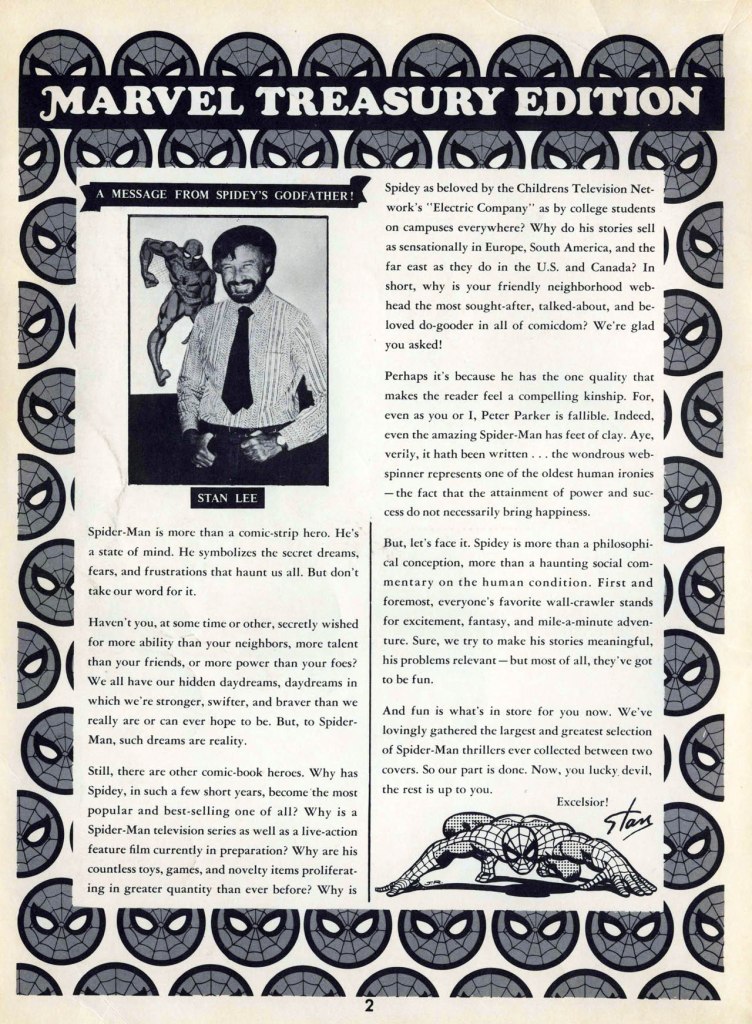
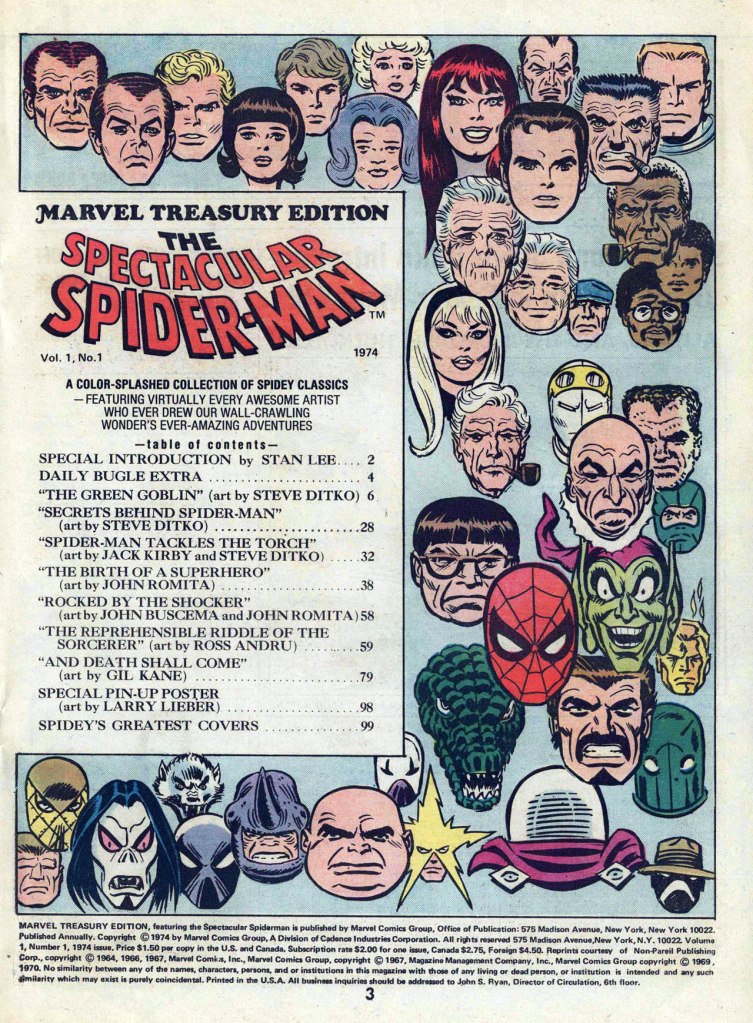
Accordingly, this first Treasury Edition was set up more like a book. There was something a bit more permanent to the presentation than you’d usually get in a regular comic book or black and white magazine. Publisher Stan Lee wrote an introduction for the inside front cover, and the book opened with a contents page illustrated by the great John Romita. The contents were assembled to give a thorough overview of the strip’s evolution over the course of the prior dozen years, though not quite getting all the way up to the present. No, this was still the Stan Lee show, focused on the victories of the 1960s and the Silver Age Marvel Bullpen. But that was the material that I liked best, so you’d get no argument from me.
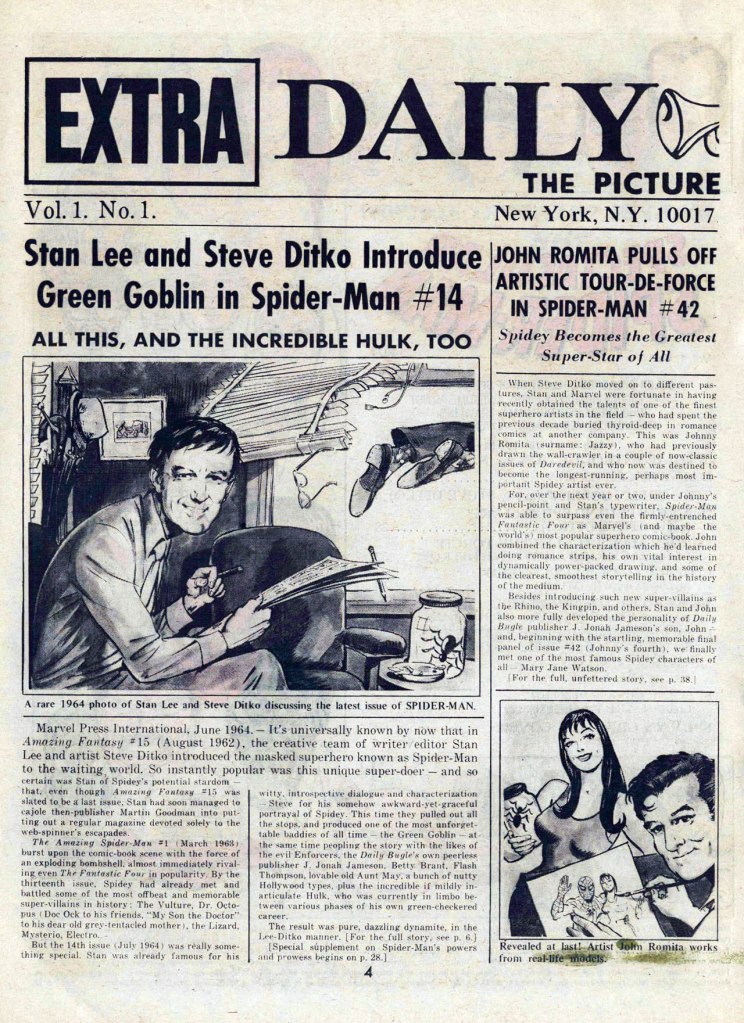
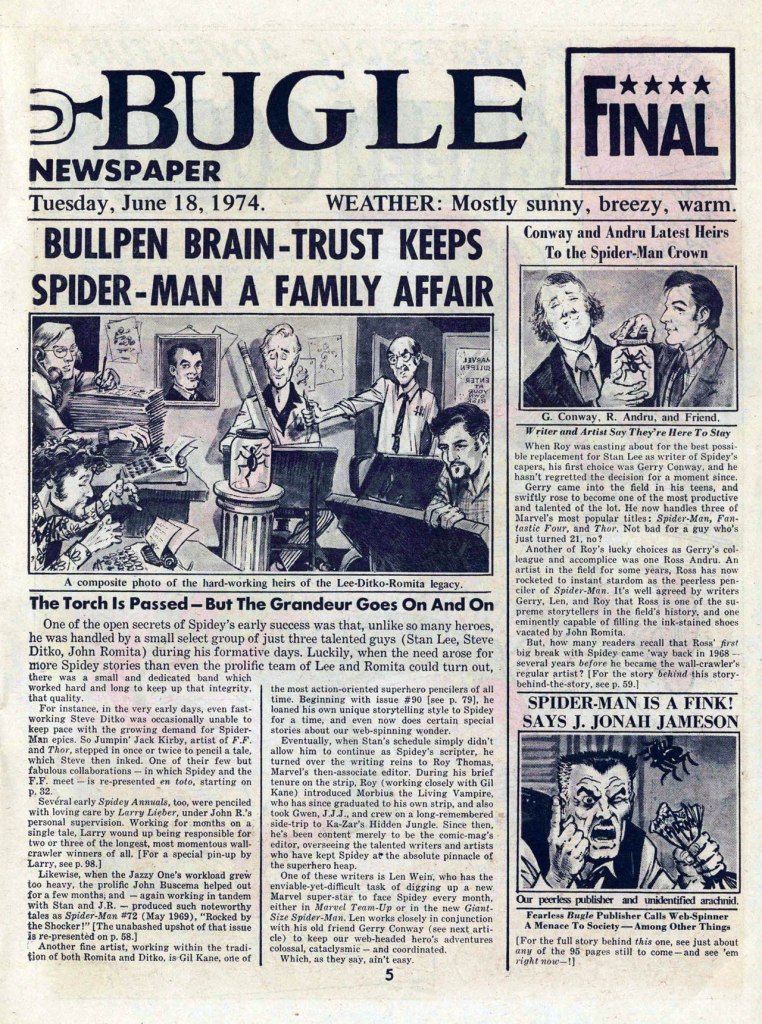
The book opens with this cool double-page feature illustrated by the terrific Marie Severin that broadly recaps the character’s history and provides some context for the assortment of stories and features that are included in this issue. As time went on and the Treasury Editions became more of a periodical format, flourishes such as this one were eliminated in favor of simply reprinting stuff and taking in cash, but at the outset you can see that an effort was being made to make this feel like a special publication.
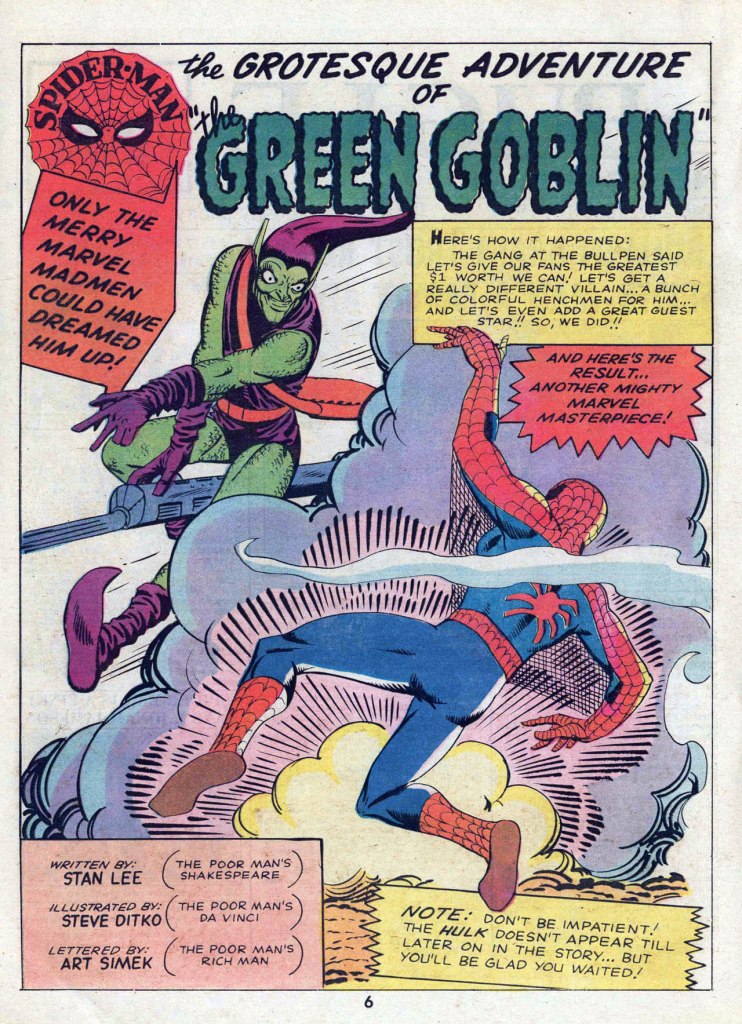
From there, we get to the stories, beginning with the first appearance of the Green Goblin from AMAZING SPIDER-MAN #14. I ought to mention for those who are unfamiliar with the Treasury format that these books were way larger than a typical comic book, more of a tabloid size. So they were presented with the artwork close to the size that it had originally been drawn at. This first story is from early enough that the series is still in its formative stages, but by the point where creators Stan Lee and Steve Ditko have more-or-less worked out what the character is all about. But not completely–Ditko years later told of Lee’s initial concept for this story in which a film crew on location would open a sealed tomb and release an actual goblin of some sort. Ditko thought that was too outlandish for the more grounded Spider-Man’s world, so while he kept the film crew as a part of the plot, he instead made the Green Goblin an underworld figure with the goal of taking over the mobs. Ditko also kept the Goblin’s true identity a secret, concealed from the reader–even though, at this point, there were precious few suspects whom the villain could turn out to secretly be. Also, the Hulk shows up, during that period where he didn’t have a regular series. Lee was trying to build the character back up to the point where he could become a headliner again, something that he and Ditko would accomplish in another year’s time or so.
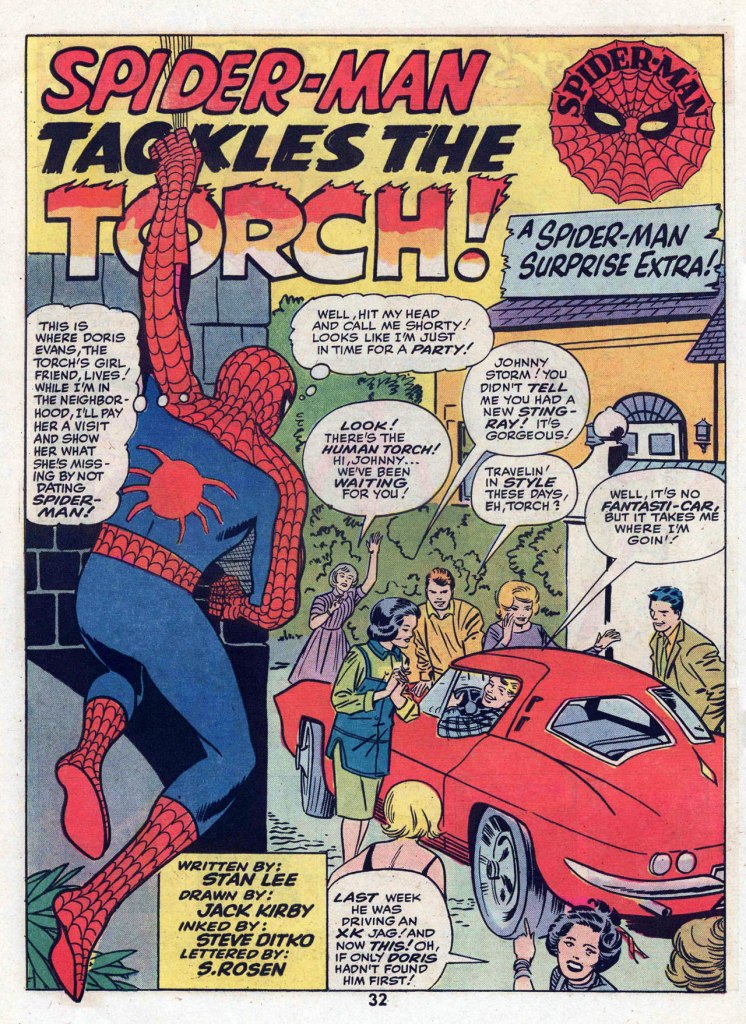
After a number of feature pages that describe aspects of Spider-Man’s powers and equipment, all culled from the first AMAZING SPIDER-MAN ANNUAL, we next get this short story illustrated by Jack Kirby from AMAZING SPIDER-MAN #8 in which the web-head crashes a party at his teenage rival the Human Torch’s place, and hijinks ensue. We cover this story in great detail at the link below, so there’s no real need to recap it once again here:
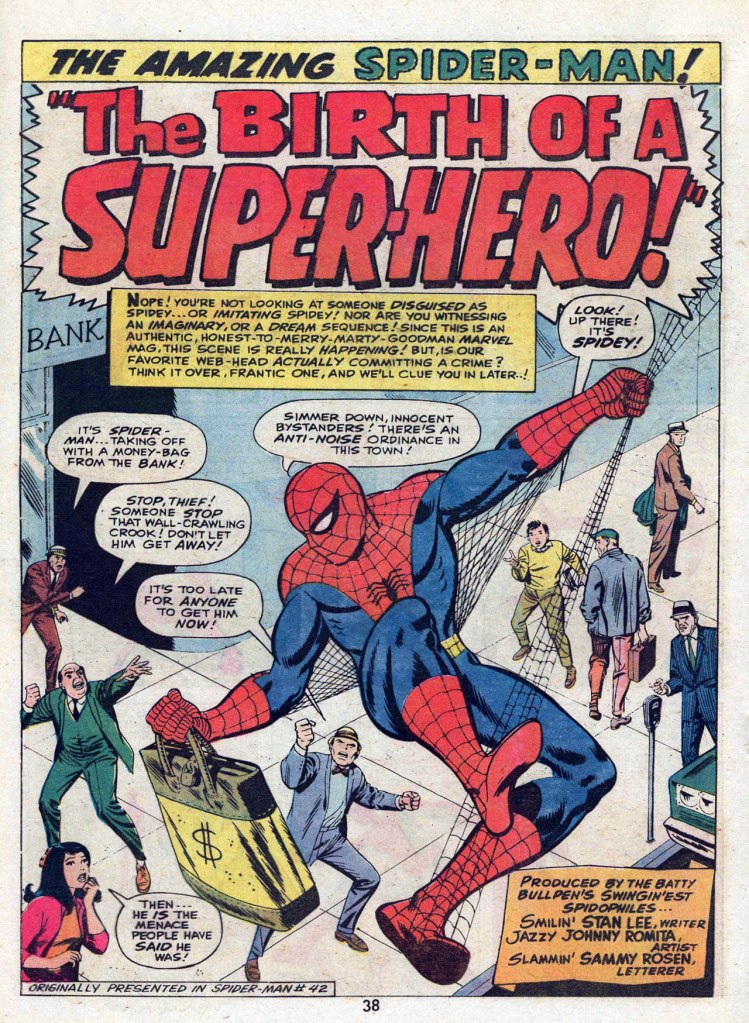
This is followed by a story from AMAZING SPIDER-MAN #42, memorable as it’s the first on-camera appearance of Mary Jane Watson, who had been a bit of a mysterious running joke up to this point, the niece of a friend of Spidey’s Aunt May that she was always trying to fix him up with. By this point, the artistic chores on the series had passed into the hands of John Romita, who initially attempted to emulate Ditko’s approach before eventually making the strip his own. His Spider-Man was a lot more full-figured and powerful, and his depiction of Peter Parker and his cast of characters had a lot more glamor to it, Romita having come to Marvel from the world of romance comics. While Ditko introduced all of the key elements of the series, it was Romita that propelled the character into becoming the most popular super hero in the field.
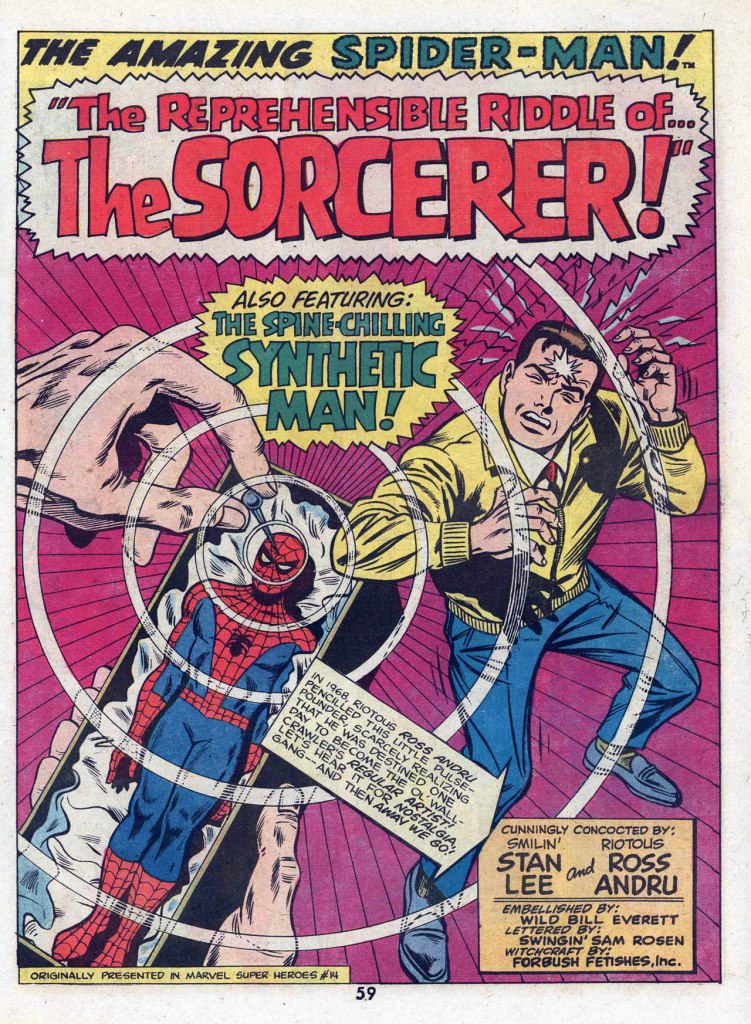
After a single page that excerpts material from AMAZING SPIDER-MAN #72 so as to showcase how artist John Buscema handled the wall-crawler, the next full-length story we get is this strange entry from MARVEL SUPER-HEROES #14. It had been intended as a fill-in job to buy Romita some breathing space on the schedule. But it turned out that Lee didn’t like the manner in which guest artist Ross Andru broke the story down, so it wound up being burned off in that issue of MARVEL SUPER-HEROES. Romita, though, was a huge fan of Andru, and so years after producing this story, Andru succeeded Romita as the AMAZING SPIDER-MAN’s main artist, a position he held when this Treasury Edition was published.
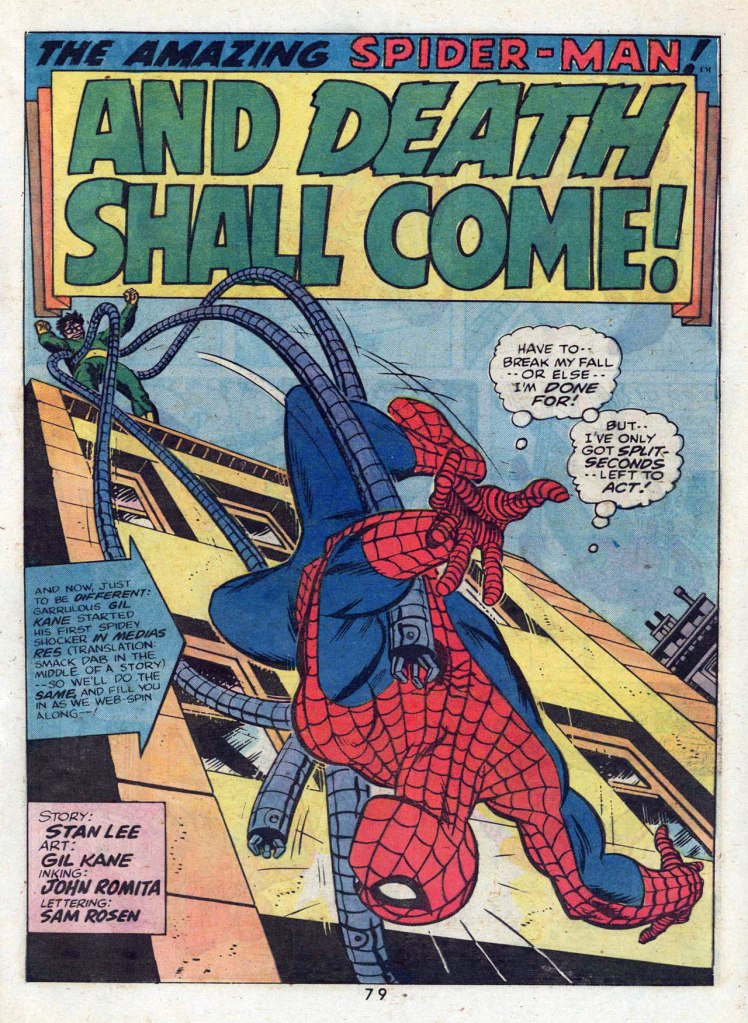
And finally, the book closes with a more recent issue illustrated by Gil Kane, with Romita inking. Kane succeeded in merging the strengths of both Ditko and Romita in his Spidey work. His Spidey was acrobatic and energetic in the manner of Ditko but retained his Romita-style physique and glamor. With Romita providing his polished inks and keeping all of the main characters on-model, it was a gloriously good combination. This story was also memorable for killing off a cast member, Police Captain George Stacy, the father of Peter Parker’s girlfriend Gwen Stacy.
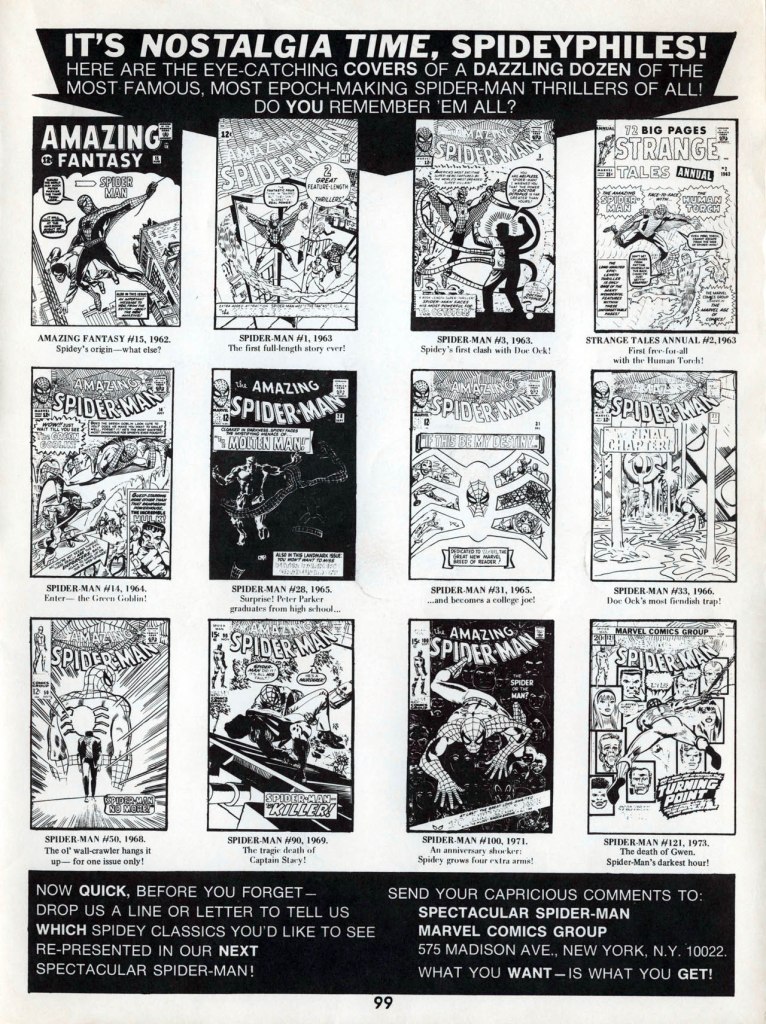
The last page reproduces a pin-up by Larry Lieber from a later AMAZING SPIDER-MAN ANUAL that illustrates where Spidey stacks up in relation to the other Marvel super-stars of the period in terms of his physical strength. And the inside cover, shown above, reproduces a dozen classic Spidey covers, only some of which go with the stories collected in this edition. As a young fan who was fascinated by the comic books of yesterday, features such as this one fired my imagination. I wasted desperately to be able to read all of these long-ago Spider-Man stories.
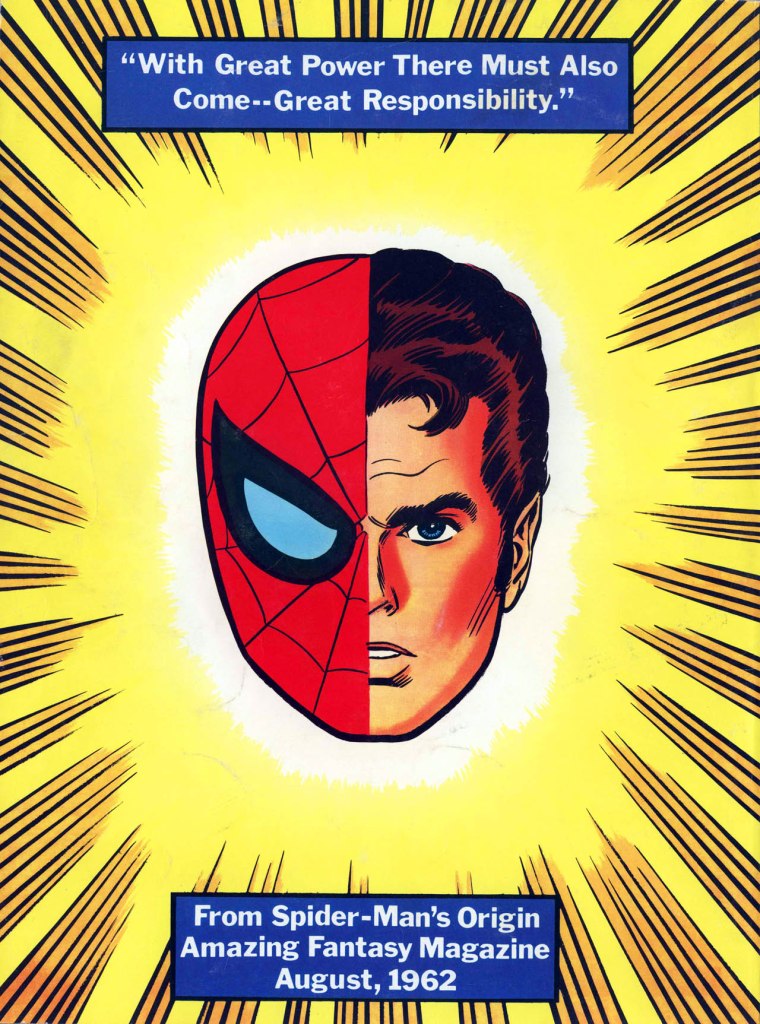
And while it’s become closely associated with the character in the years since, in 1974 the oft-quoted tag line from the first Spider-Man story hadn’t been much repeated outside of retellings of the character’s origin. So its spotlight on the back cover of this first Treasury Edition helped to propel it into the consciousness of the readership as an important principle of the hero. It’s also quoted properly here, something that wouldn’t always be the case in the years to come.
 The Tom Brevoort Experience
My first thought was I love the head shots by John Romita (Sr. ) of supporting cast and foes. Plus I don’t think I’ve seen this Marvel Treasury Edition before so went to comics.org to find the 2 my friend had that I saw the Hercules-Hulk fight in and Agatha Harkness single handedly defeating the Frightful Four ( Wizard, Trapster, Medusa & Sandman ).
LikeLiked by 1 person
Mr. Romita’s headshot of the Vulture reminded me a little of David Mazzucchelli’s version in “Daredevil” in the 1980’s. Thick inks.
LikeLike
I remember my Mum buying this for me for 50 pence,as well as the Avengers treasury,Captain America bicentennial battles and the Marvel Holiday grab bag. I read them till they fell apart. What a time
LikeLike
I remember looking through this on the stands when it came out but didn’t purchase it. I was tepid on the Spider-man of 1974. I was probably tempted by the Ditko and Kirby stories and the overall size but was probably not interested enough in the rest of the book to splurge $1.50.
This book definitely didn’t hit me where I live like the DC counterparts which featured much older material for .50 cents less.
LikeLike
I bought more Treasury Editions than I did DC’s tabloids, because I was more interested in the contents of the Marvel stuff. But I far preferred the DC side-stapled format over the squarebound Marvel version, which was always kind of lumpy and wrinkly.
They were an interesting experiment, and must have made money for a while. But times change, and so do markets…
LikeLike
Definitely agree, the large size just turned me off, and I skipped almost every version from either company that appeared through the 1970s.
LikeLike
Oh, I liked the size — I recently bought DC’s tabloid-size reprint of THE UNTOLD LEGEND OF THE BATMAN and it’s a delight at that size.
I just didn’t like the spine on the Marvel ones, not with that paper and that binding technology.
LikeLike
I also read a friends copy first and bought my own years later. At that time I didn’t realise I’d spend years collecting every Spider-Man comic under the sun. It only took a year to purchase the US editions of Amazing Spider-Man etc, but foreign issues took so much longer.
LikeLike
I bought very few of these large editions, the size never appealed to me, mainly because the books seemed like they’d wind up like Steranko’s History of Comics volumes in a year ir two, floppy, falling apart and coverlss. I’d love to see the two Steranko volumes reprinted in trade paperback size, which is also an almost perfect size and format for comics, as well.
LikeLike
It’s interesting to me to look at reprints then and reprints now. I would buy these on the stands and not really understand that I was buying a reprint.
Evidently, they could make reprints then that looked quite a bit like the original comic. Now completely different approaches are being taken with scanning and/or line recreation.
LikeLike