

By 1942, Jerry Siegel seemingly had it all. He was the creator and writer of Superman, a character whose first appearance set off a fad that changed the comic book industry, but who had thereafter gone on to conquer the worlds of newspaper strips, radio shows, the Macy’s Thanksgiving Day parade and animated cartoons. Siegel was by this point writing most of the Superman stories that were being released–more than any one artist could handle, which led to his partner Joe Shuster having to create a studio of fellow artists to handle the workload, and that wasn’t enough to get the job done either. Siegel was also making a ton of money, most of it coming from the newspaper strip. He was one of if not the best paid creator in the field of comic books at that moment. And yet, all this success didn’t make him happy.
For one thing, almost from the moment he and Shuster had done it, Siegel regretted having sold the rights to his creation to Harry Donenfeld and Detective Comics Inc, who raked in the lion’s share of the profits generated by the Man of Steel. But additionally, Siegel wanted to prove that he wasn’t a fluke success, that he could generate other popular characters and stories, and that the involvement of Joe Shuster or anybody else was incidental–that Superman was his brainchild and he worked because he was a Jerry Siegel creation. To this end, despite the fact that his employers begged him to simply focus on generating more Superman stories, Siegel throughout his life kept generating ideas for new characters and series, hoping to once again bottle the lightning that had led to the creation of Superman.
Despite the fact that Detective Comics Inc paid him less for any feature that wasn’t Superman, Siegel would not relent–and perhaps suspecting that it was possible that Siegel did have another ace up his sleeve, Donenfeld and his editorial team indulged Siegel from time to time. The first was in the launching of Siegel’s creation the Star-Spangled Kid in the inaugural issue of STAR-SPANGLED COMICS. While STAR-SPANGLED looked outwardly like a typical DC anthology series of the period, its initial issues were Star-spangled Kid-centric, running two and sometimes three tales of the character. Assorted other features filled out the package. DC made a big promotional push for the strip, running three-page preview ads for the new character in the flagship ACTION COMICS and proclaiming it as coming from the same hand that created Superman. The Star-Spangled Kid reversed what had already become the formula of the hero and the kid sidekick–in this pairing, the kid was the leader and the sidekick was the adult, Stripesy.
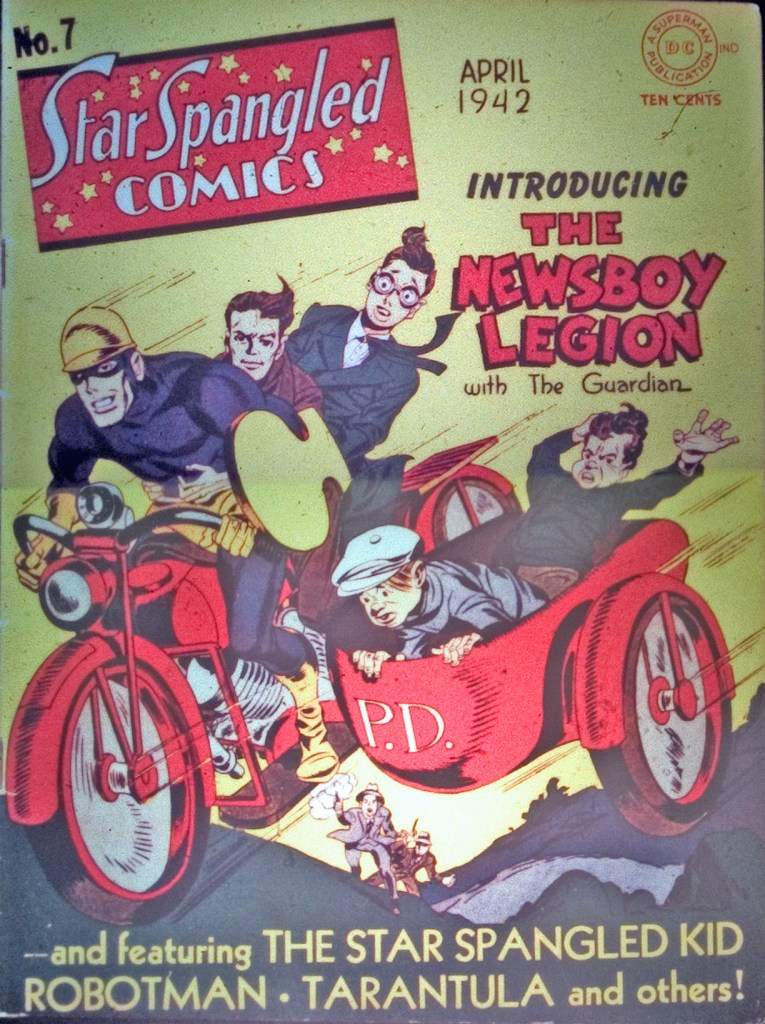
The Star-Spangled Kid wasn’t a failure per se–the strip ran throughout the 1940s, eventually transitioning into a series featuring the Kid’s sister Merry as the Girl of a Thousand Gimmicks. But it wasn’t another Superman, and sales on STAR-SPANGLED COMICS began to lag. By the seventh issue, steps had to be taken–and so the DC team turned over the reins and the cover spot to the creative team of Joe Simon and Jack Kirby, whom they’d lured over into their employ after the pair had created the wildly-popular CAPTAIN AMERICA COMICS for rival Timely. Their new strip was the Newsboy Legion, a kid gang series that regularly co-featured the Captain America-esque shield-carrying Guardian. It was a hit, and so the Star-Spangled Kid was relegated to the back pages.
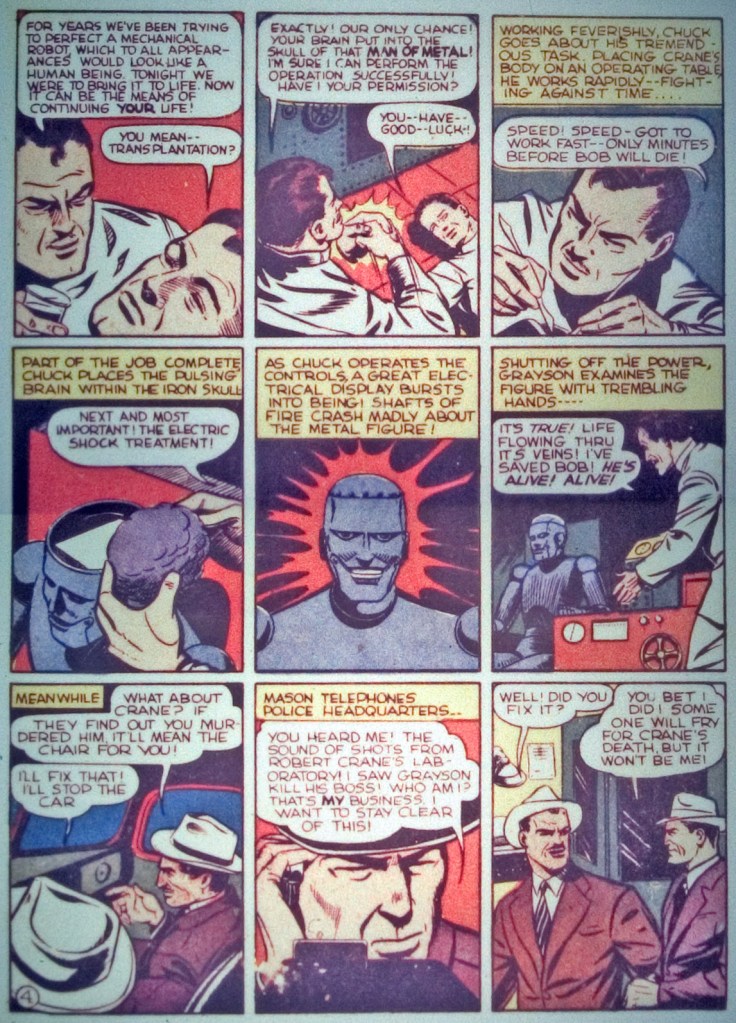
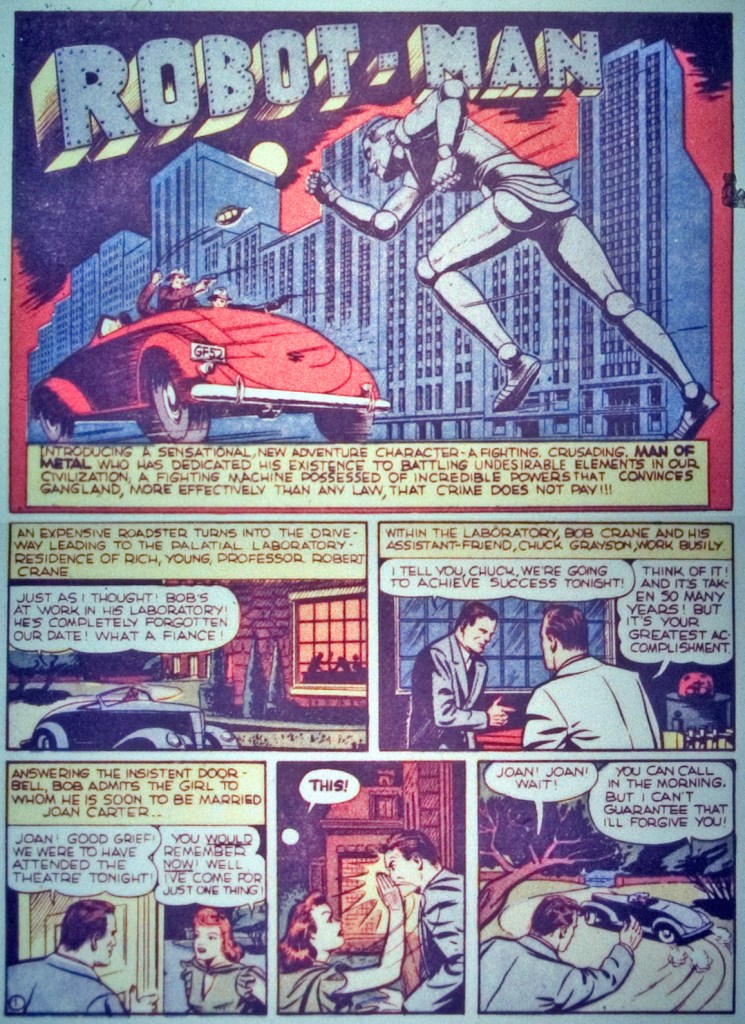
As what appears to have been a way of consoling Siegel on this change, DC went ahead with another new series that he’d been trying to peddle them. A science fiction aficionado, Siegel had come with an idea about a human being’s brain transplanted into a powerful artificial body, making him a Robotman. While DC had accepted a script for this feature from Siegel in 1941, it sat on a shelf for a while; nobody at the firm seemed especially keen on pursuing it. They wanted Siegel to stop messing around with penny-ante projects and focus on the firm’s breadwinner, Superman. But having taken STAR-SPANGLED COMICS away from him and cut down his workload of Star-Spangled Kid strips, it seems like DC threw him a bone. Robotman would premiere in that same issue, STAR-SPANGLED COMICS #7.

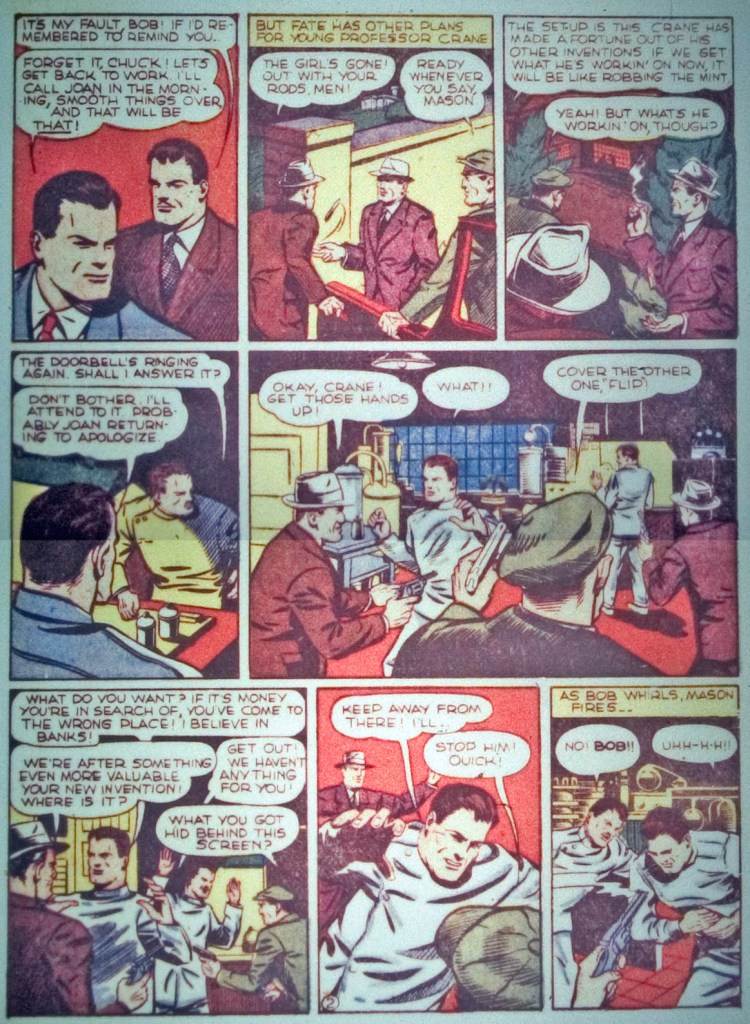
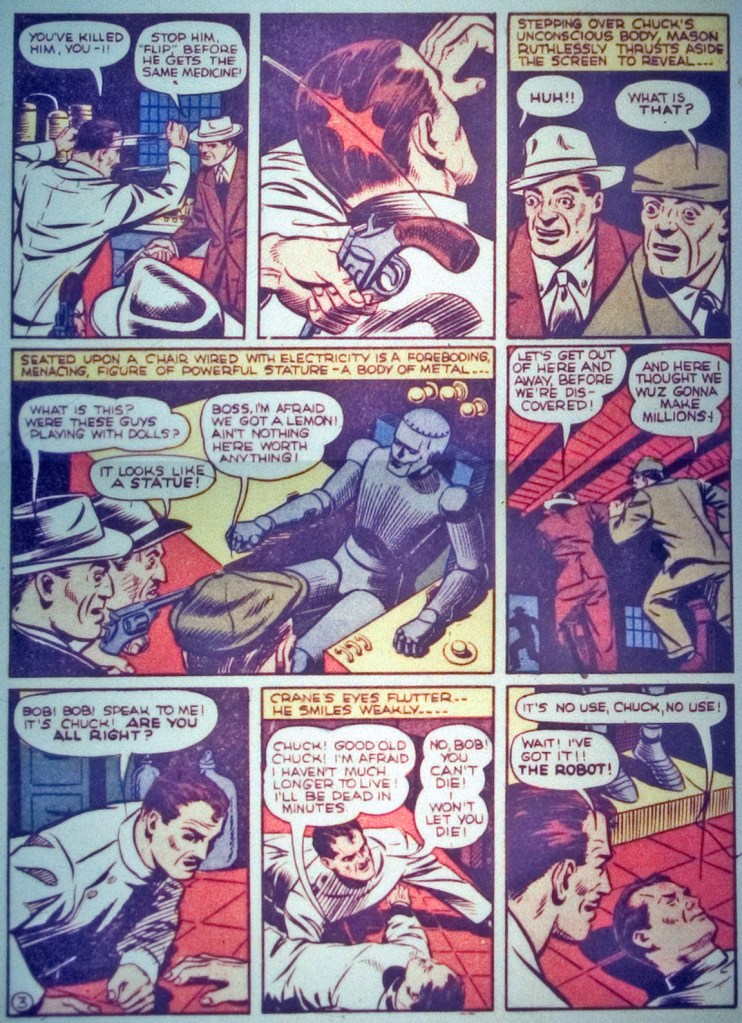
The story appears to have been commissioned in a hurry, and while up to this point Siegel had been negotiating with editor Whit Ellsworth about which artist should draw the series, in the end it was a product of the Superman studio, the initial story drawn by two artists working in tandem; Leo Nowak and Paul Cassidy. Nowak penciled the opening five pages and thereafter Cassidy penciled the rest and inked the entirety. It’s possible and even perhaps likely that Novak was intended to draw the entire thing, but got busy with more important Superman work and had to hand the assignment off. Either that or Siegel, Ellsworth or somebody else wasn’t happy with the opening pages and demanded a change in the art style.
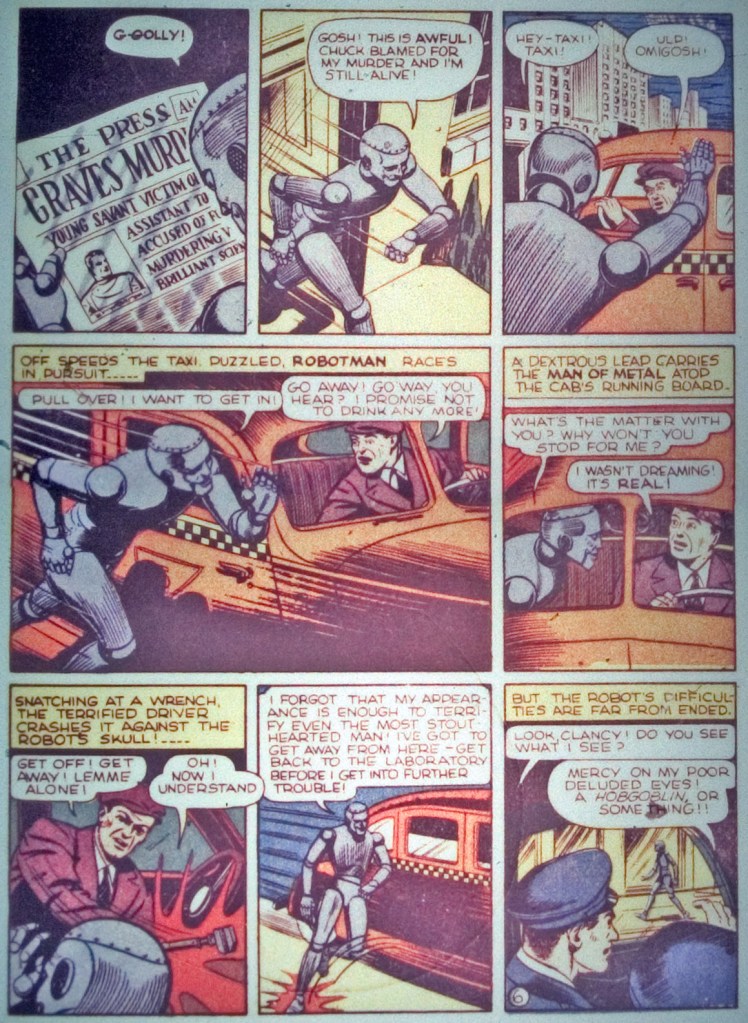
Robotman, it turned out, wasn’t a blockbuster either–and buried in the middle of STAR-SPANGLED COMICS, it seems that there wasn’t any expectation that it would be. But it proved to be a popular feature, one that continued on for many years well after Siegel abandoned it. It even survived the demise of STAR-SPANGLED COMICS, making the jump over to DETECTIVE COMICS and continuing to run in those pages through 1954.
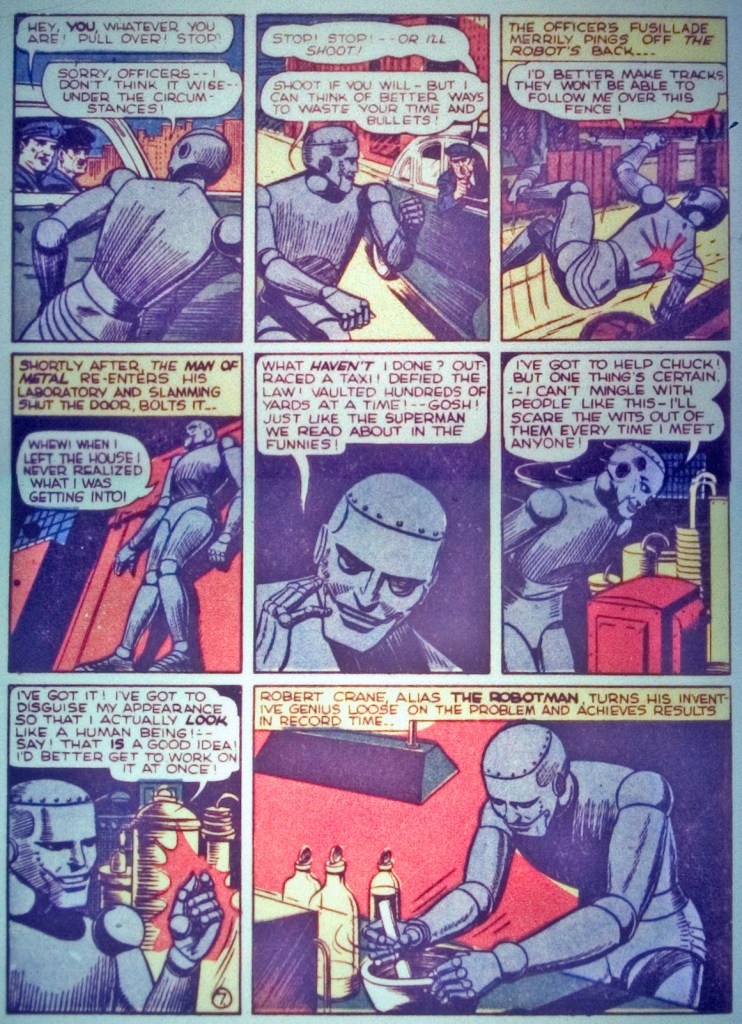
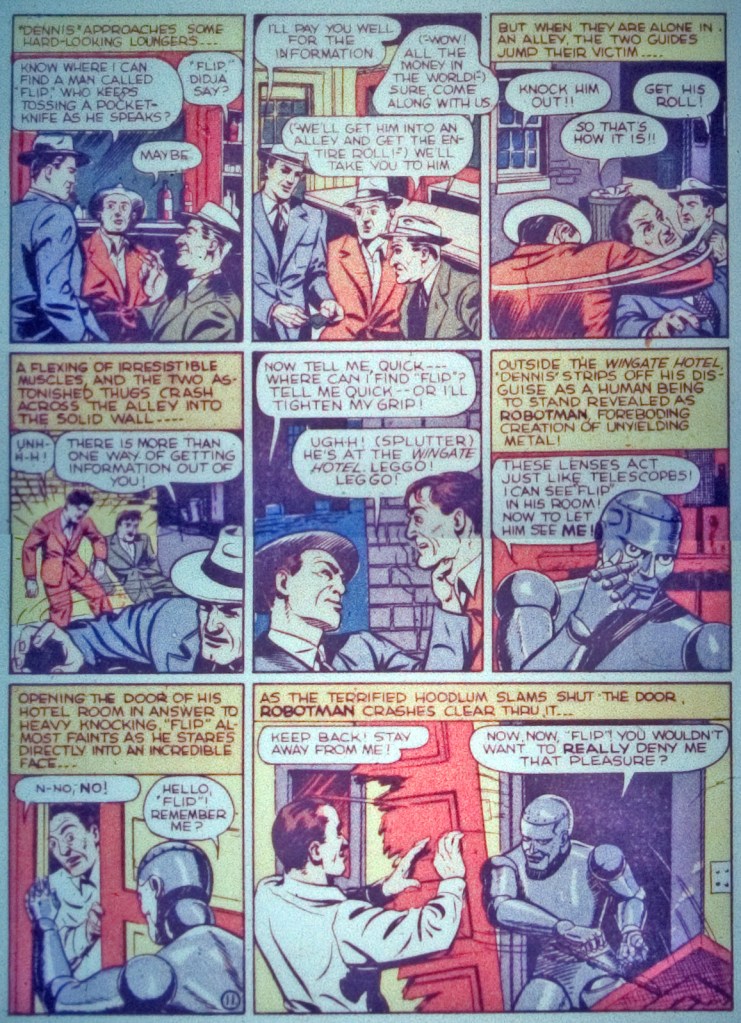
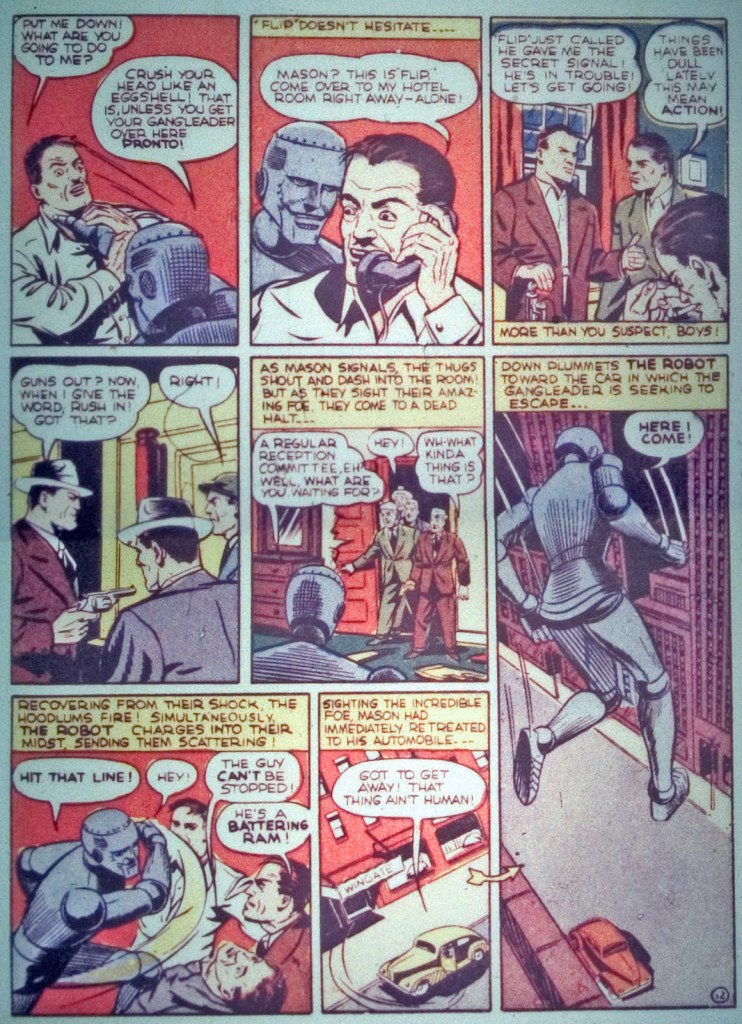
Siegel can’t resist dropping in a reference to his other popular character Superman in this inaugural story. And in truth, many of the feats that Robotman performs in his earliest appearances mirror the kinds of things that the Man of Steel routinely did.
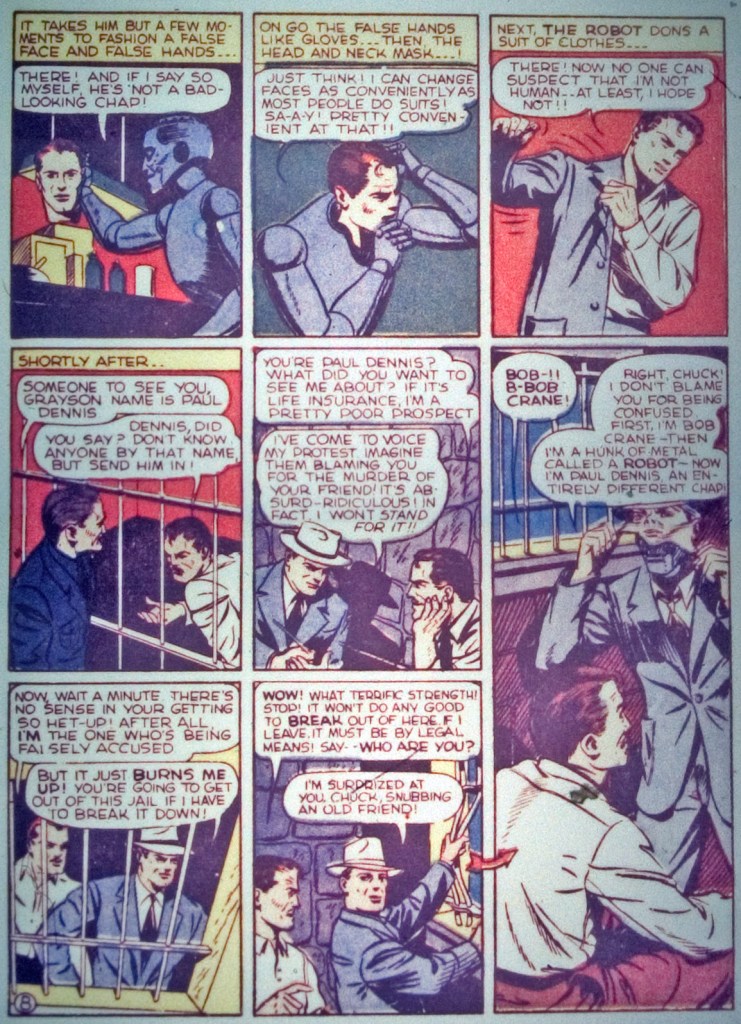
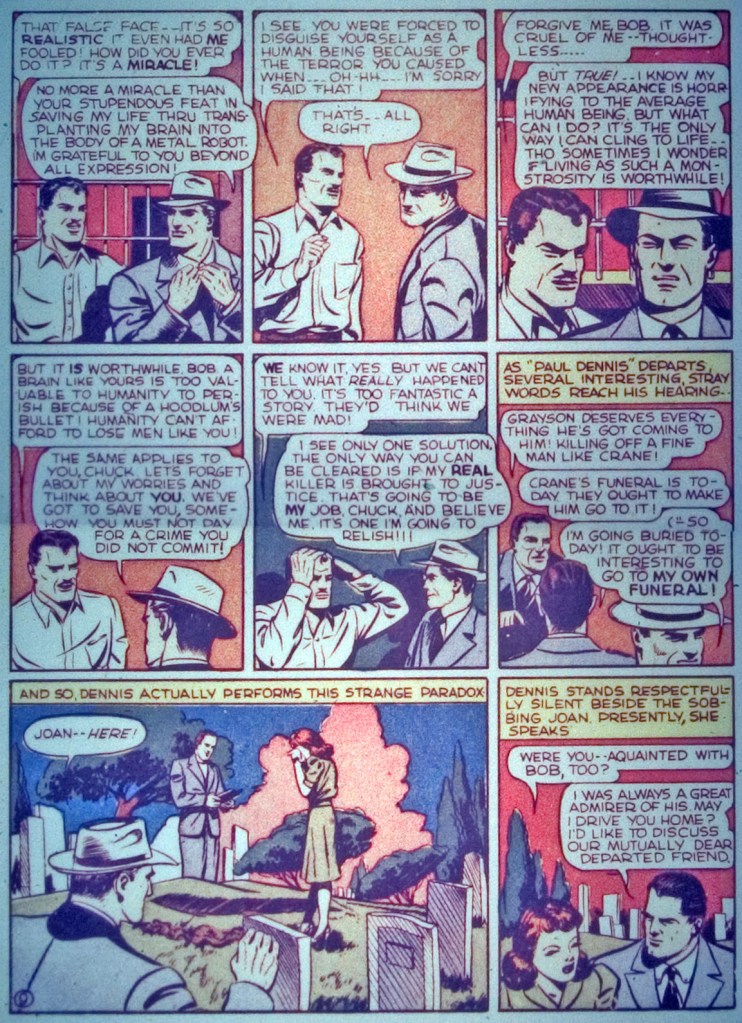
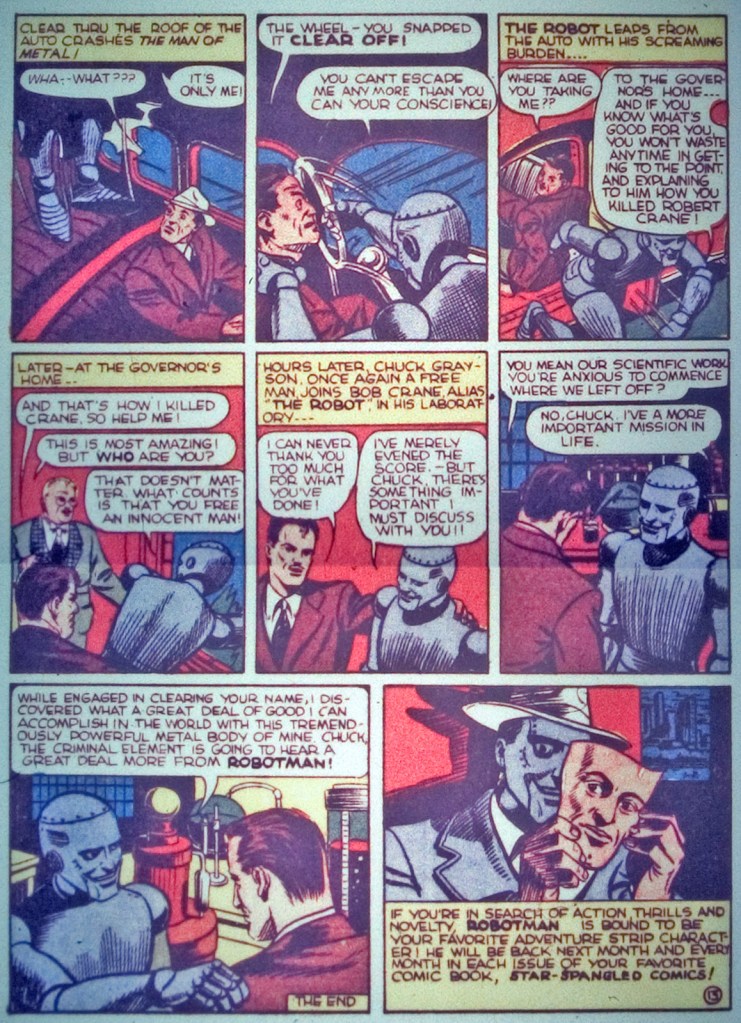
The use of a rubber mask to pose as a regular person is one of those conventions in a strip like this one that you simply have to accept at face value, regardless of how absolutely outlandish it is. Here, Bob Crane adopts the name Paul Dennis, which he’ll use as his alter ego for the remainder of his run.

 The Tom Brevoort Experience
The names Bob Crane and Chuck Grayson always struck me as being way too close to the names you’d see when you open every issue of Detective Comics. But Robotman’s an interesting golden age superhero – his shift from deadly serious heroism into silly comedy stuff (with his robot pooch Robbie) seems more pronounced than usual…
LikeLike
Say what you will but Siegel had a gift for laying down a tragic origin: Infant escapes destroyed planet, murdered detective becomes an angel or death, murdered scientist has brain transplanted into robot body.
LikeLiked by 1 person
What a lot of modern day readers also don’t know is that the first and last story of any anthology comics back then were considered the top two, the money-makers for the book. All other characters were just fillers for the book. But it is interesting that so many “filler” characters lasted longer than the Big Two of any book. And some are still with us today, thinking of Green Arrow and Aquaman here.
LikeLike
I don’t remember if I or anyone else pointed this out but there is another thing the Doom Patrol and the Fantastic Four have in common, both have 1 member who has a golden age counterpart: Golden Age Robotman ( Professor Bob Crane ) & Robotman ( Cliff Steele ). Golden Age Human Torch ( Jim Hammond ) & Human Torch ( Johnny Storm ). JERRY SIEGAL’S OTHER CREATIONS: Bouncing Boy, Brainiac 5, Triplicate Girl, Invisible Kid I, Matter-Eater Lad, Phantom Girl and Chameleon Boy and enemies Cosmic King, Lightning Lord and Saturn Queen. The Spectre ( & The Presence a fictional representation of the Abrahamic God ), Doctor Occult & Slam Bradley have already been mentioned, but there is Radio Squad, Henri Duval and Spy ( Bart Regan & Sally Norris )– wikipedia.
LikeLike
I liked Robotman in his All-Star Squadron appearances and his bromance with his fellow cyborg Steel/Commander Steel. Steel the Indestructible Man should have been created for Marvel and his origin should have been in this Timely Comics story: The Human Torch#2 ( Fall 1940 ) The Fiery Mask – “The Strange Case of the Bloodless Corpses” — Dr. Sendach ( an eminent stomach specialist — Joe Simon must have been inspired by the saying Cast-Iron Stomach cause Dr. Sendach replace peoples stomachs with mechanical ones ). His victims were called creatures and one had a Blue Costume and Cape ( he some how knocked out the Fiery Mask with a chair ), I would reveal that Dr. Sendach did Steel/Commander Steel like cybernetics too. The IRON GHOST { Shadow Comics#10 ( May 1941 ) 2 appearances ( Street and Smith ) ] is a robot created by Frank Reed: “It’s the ultimate in mechanical man, Barney! It’s made entirely of super-duralamine, the hardest metal known! it runs on unlimited atomic power! it can fly through the air like a rocket-or go through water like a torpedo!” Reed transfers his mind into the Iron Ghost and fights crime, but when Reed’s body is killed fighting an enemy, his mind is trapped in the Iron Ghost ( the Encyclopedia of Golden Age Superheroes – Jess Nevins ) — the closest thing the Golden Age has to the Golden Age Robotman.
LikeLike
That very last panel, with Robotman holding his human face, is almost a horror image. He’s a workable enough concept for a superhero. He has strength and toughness and some speed. And can have other powers as add-ons, like telescopic vision. But I can’t see thinking he’d be a hit like Superman. Very few people fantasize about being a brain in a robot body. I guess someone who manages to catch lightning in a bottle tends to look for more sparks. Or maybe diversification is good.
LikeLike
The Cliff Steele Robotman worked as part of an ensemble though. On one hand, you had Robotman and Negative Man, the “lifers” who had no regular lives outside of being DP superheroes, but you also had Elasti-Girl and Beast Boy, who had such lives and whose dramatic arcs the reader could invest in.
LikeLike