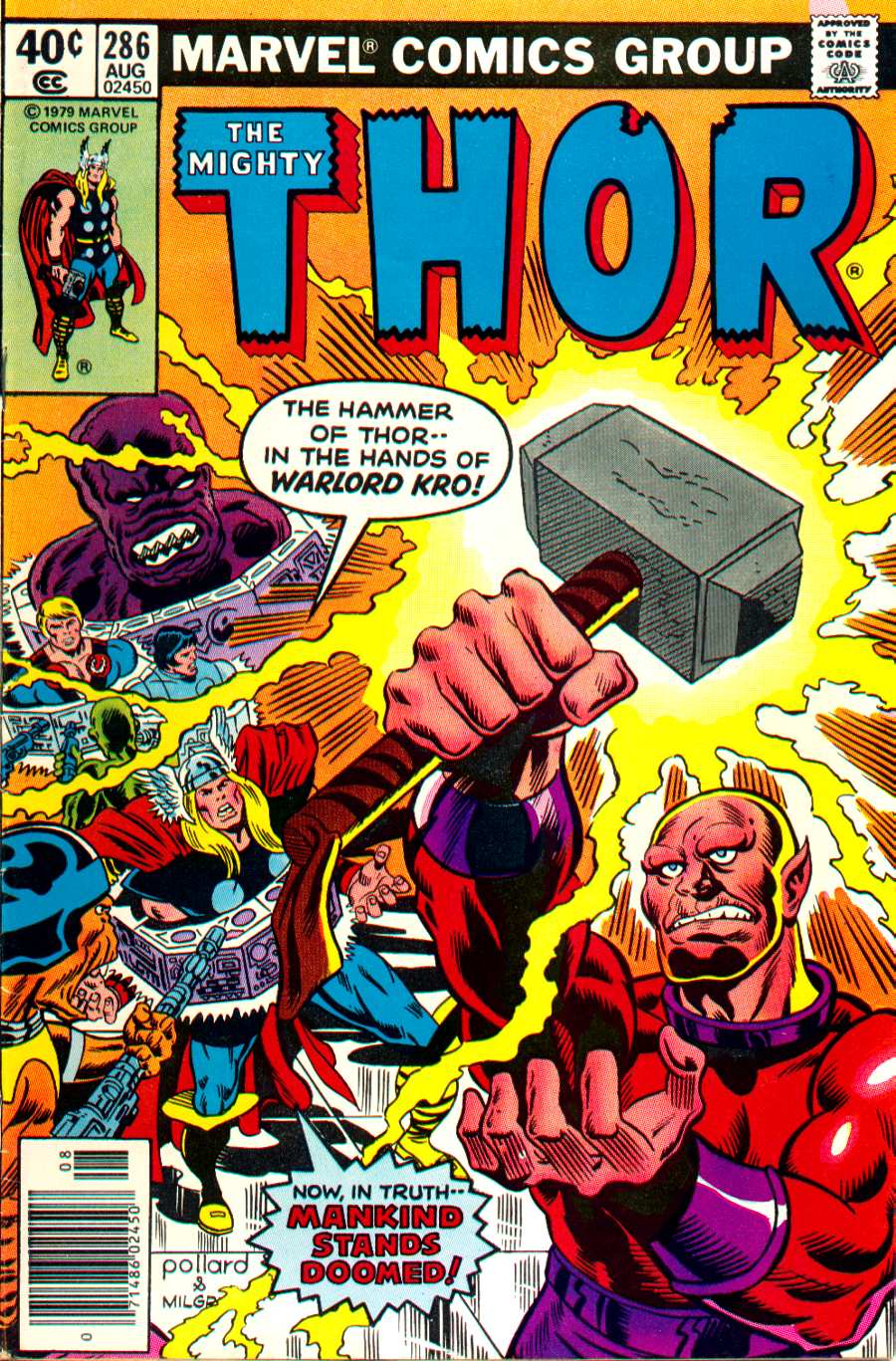


This was the issue that put me off of reading THOR, at least for a short while. I already wasn’t all that interested in the ongoing plotline involving trying to paste Jack Kirby’s Eternals into the Marvel Universe–I’d sampled ETERNALS and not found it much to my liking, so bringing all of this baggage into a series that I was reading wasn’t a sales draw for me. But this was the way of Marvel in the 1970s and certainly as events rolled forward into the 1980s and beyond. Absolutely everything needed to be somehow integrated into the ongoing super-saga of the Marvel Universe, with no exceptions. The promotional point that everything in every Marvel comic might in some way matter to every other Marvel comic was a potent one, and certainly got me to buy (or continue to buy) series that I might otherwise have let fall by the wayside. But it meant that certain integrations were going to be difficult, and this one with the Eternals was a prime example of that.
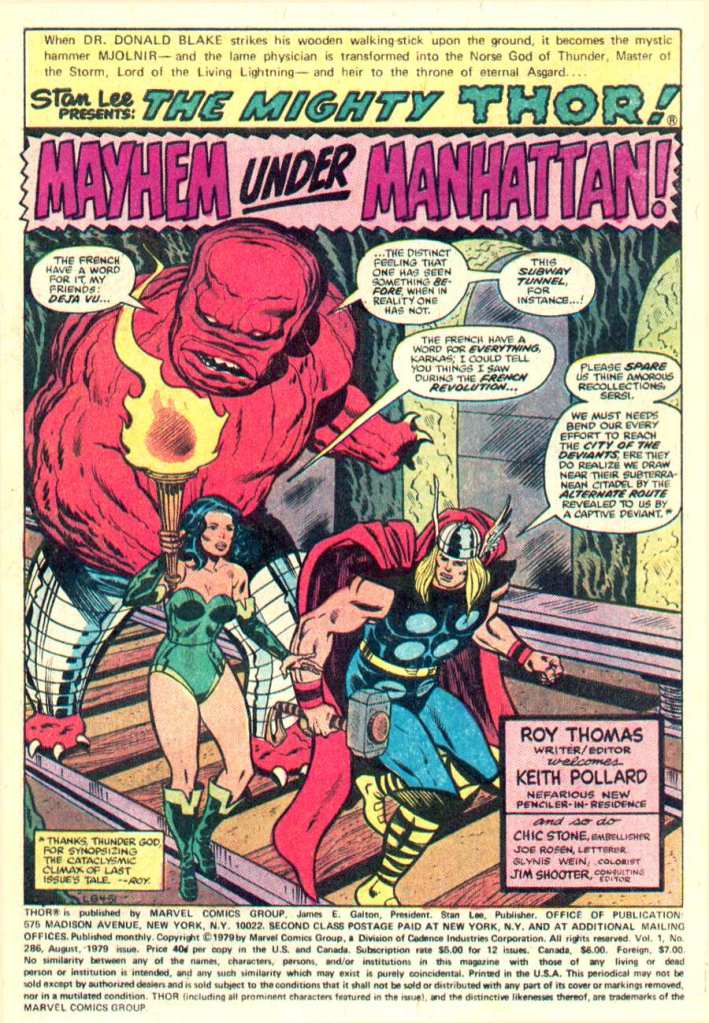
But the thing that helped make this issue my last one for a month or two was the change in art team. Keith Pollard had come on board as the breakdown artist. Now, I liked Pollard’s work in general, both on FANTASTIC FOUR and AMAZING SPIDER-MAN, both of which he had been drawing at around this time. But on THOR, he was mismatched with finisher Chic Stone. Stone’s style had always involved thick, lush outlining and an almost coloring book-like sparsity of detail beyond that. There was a coloring book feel to the work he inked, and it didn’t serve Pollard well here–especially since Pollard himself was only doing breakdowns and not truly spotting blacks or providing full details. He was there to provide the storytelling, it was up to Stone to perform the finishes. Stone was an accomplished artist in his own right, who was more than capable of filling in the details. But his approach in this instance led to artwork that felt too open and unfinished, at least to my eye.
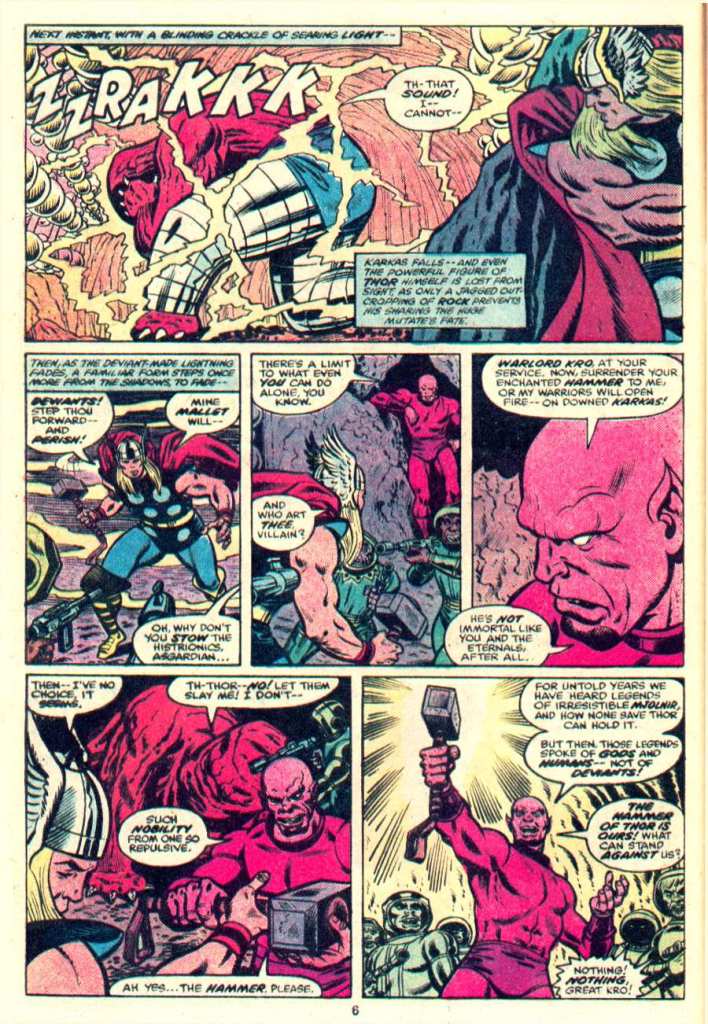
I was also bored stupid by the story itself, which felt a bit like homework that had to be done rather than an enjoyable read. The issue opens with Thor and a parcel of Eternals attempting to infiltrate the underground citadel of the Deviants, the long-suffering enemies of the Eternals, who were the source of mankind’s legends about monsters and demons. Except, of course, in the world of THOR, those mythological monsters and demons were all real. This outlines the essential dilemma of trying to put the Eternals into the Marvel Universe: it already had the actual Greek and Norse Gods running around, so the strip’s entire premise that those legendary figures were the product of early humans misunderstanding the advanced prowess and technology of these star-spawned races doesn’t fit at all. Anyway, Thor and crew are hoping to liberate some other Eternals who were carried away by the Deviants last time.
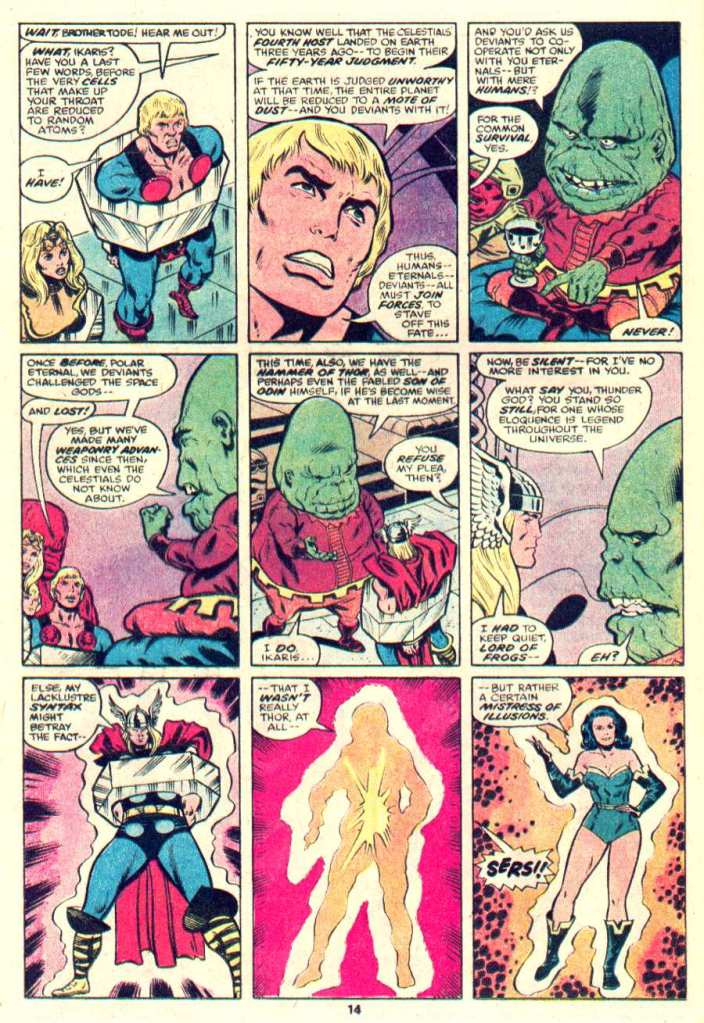
This, though, is a trap laid out by the Deviant Warlord Kro, and he springs it on the group, swiftly overwhelming Thor and his traveling companions. Thor is even forced to meekly hand over his hammer to Warlord Kro, who can somehow carry it around despite the enchantment that permits it to be lifted only by one that is worthy. That should be the tip-off clue, but Kro doesn’t know any better. And so when he presents his captives before the Deviant leader Brother Tode, it is swiftly revealed that they have captured not Thor but rather the Eternal Sersi in the guise of Thor, her powers of illusion putting over the deception. And what Kro has isn’t Thor’s hammer but rather Don Blake’s cane made by Sersi to look like the hammer. So, yeah, the cover is a cheat, big surprise. Blake, though, emerges from the shadows to reclaim it, stamping it on the ground and resuming his godly aspect.
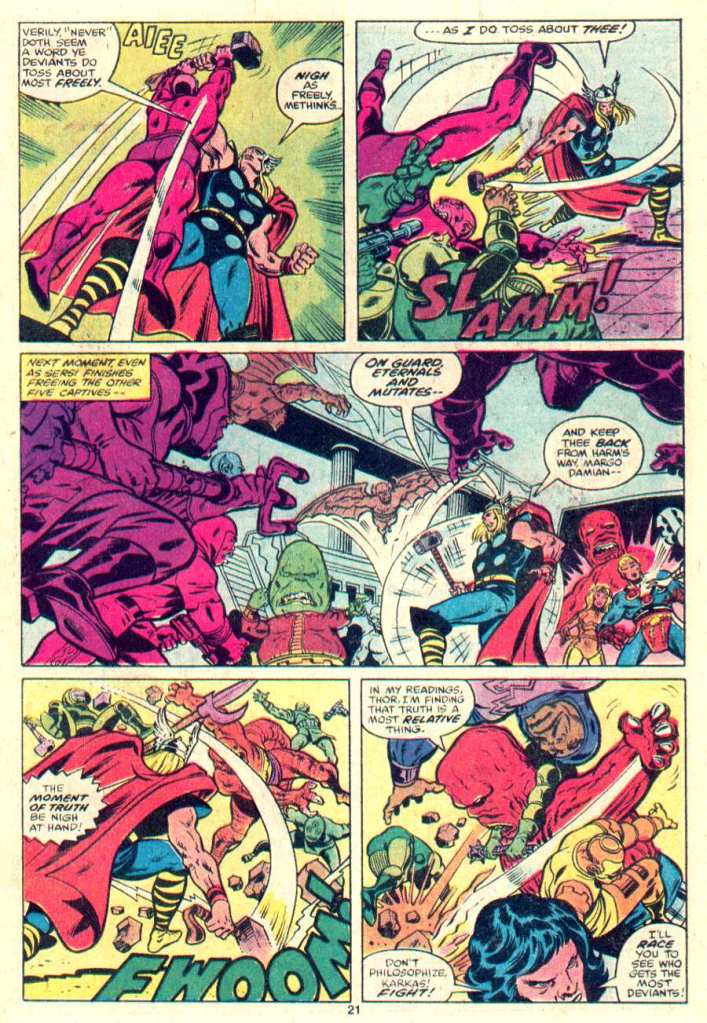
Thor and the Eternals were hoping to enlist the Deviants as allies in their campaign against their creators, the Celestials, who will judge the Earth in fifty years and destroy it if they find that it is not good. But after centuries of prejudice, the Deviants aren’t about to throw in their lot with the Eternals, and so negotiations immediately break down. What that means is that the rest of the issue is nothing more than an extended fight sequence, one that’s nicely choreographed by Pollard but which Stone’s inks let down.
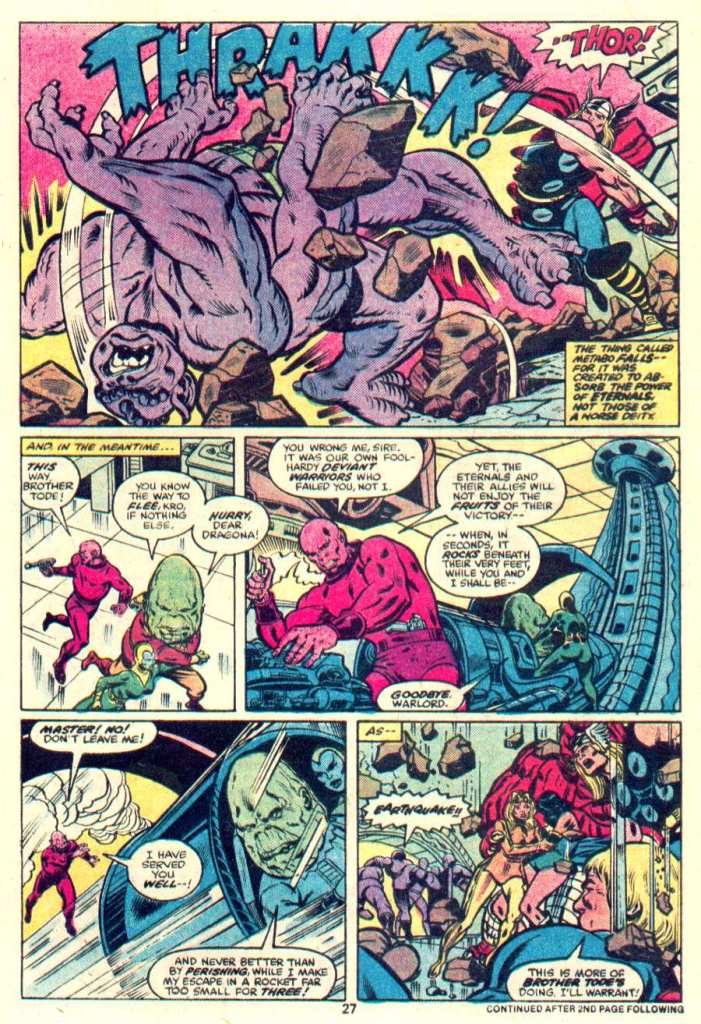
In order to give Thor a challenge and justify his position as the character whose name is on the cover, the deviants unleash the monstrous four-armed purple Metabo on the group. Metabo swiftly clobbers his way through all of the assembled Eternals, putting them out of the way so that Thor can have the spotlight to himself. This time, Metabo isn’t facing some stand-in for a god, he’s fighting an actual mythological god–and so Thor trounces him over a couple of pages. With events spiraling out of control, Brother Tode exercises the better part of valor, leaving Warlord Kro behind to take the fall for this ill-conceived ambush.
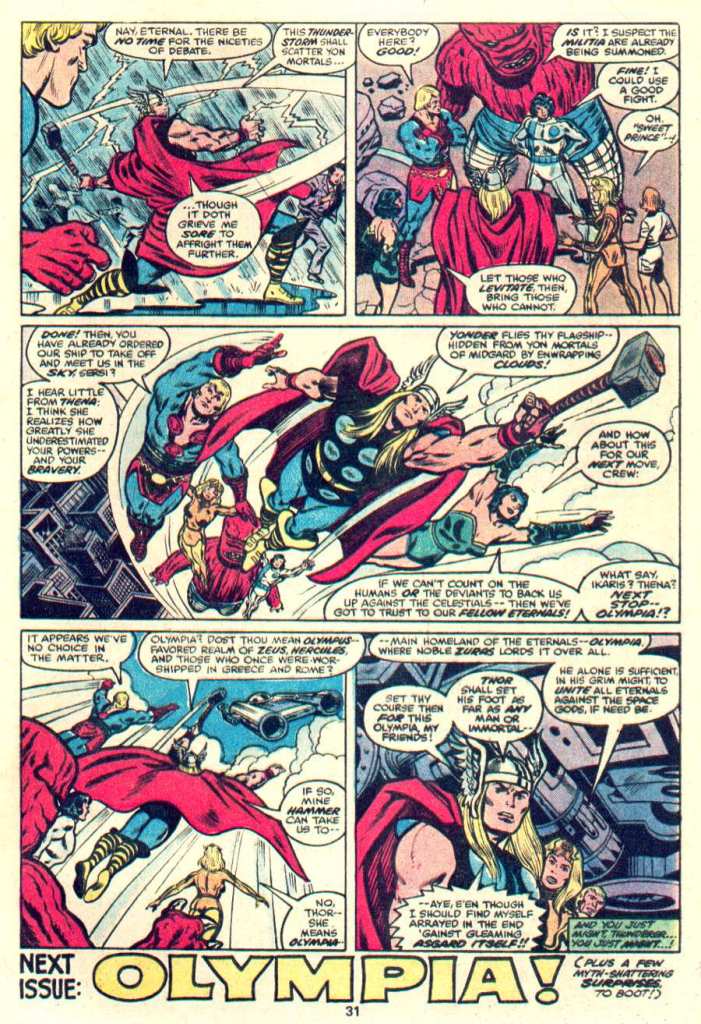
Tode also decides to detonate that particular Deviant outpost on his way out the door. Thor and the Eternals escape with their lives, of course, but the underground detonation feels like an earthquake to the people of Manhattan above. And the issue wraps up with Thor and the Eternals deciding that their next move should be to petition aid from the larger Eternals civilization under the leadership of Zuras. Now, why that wasn’t the first move in this campaign doesn’t make a whole lot of sense to me, but that’s where the story is going, so that’s where we’ll be going next issue as well. But not me, not immediately at least. Because by this point, I’d had enough, and I stopped buying THOR for a month or two. Eventually, and I’m not sure why–either because I had more disposable income to spend on comics or a light week happened and I still had more funds to spend, I wound up buying the next two issues in one go–a copy of #287 was still on the stands by the time that #288 had come out. So I didn’t actually miss any issues of this story. But I did stop cold at this point, only to begin again.


When this mag came out, I had been collecting Thor regularly for about 5 years and would continue to do just a bit past Walt Simonson’s classic run. But in 1979, I was getting Thor more out of habit than enthusiasm for the latest stories. I’d only gotten a few issues of Kirby’s Eternals, which really didn’t do all that much for me either. I usually liked Thomas’ writing, but, yeah, he had been getting rather too carried away with trying to get everything connected together. To my understanding, Kirby really intended for the Eternals to be in its own thing, separate from the mainstream Marvel Universe but that wasn’t really the Marvel way in the Silver or Bronze ages. They more or less let Kirby write The Eternals own mag that way, and actually every other mag Kirby wrote/drew for Marvel upon his grand return, even Captain America and the Black Panther, all were treated as in worlds apart from the rest of Marvel. But, naturally, once Kirby was gone and the Eternals own series having been cancelled even before that, they were still Marvel property and just the sort of thing that Thomas couldn’t help but want to play with and properly incorporate into the Marvel universe even if it didn’t make much sense to do so.
As to the artwork, although neither Pollard nor Stone were the sort to get me excited about the art, it didn’t bother me all that much.
LikeLike
Kirby did indeed want to keep Eternals in its own world; Marvel insisted on details like working in SHIELD agents (Kirby countered by having several people refer to the Hulk as a comic-book character in one issue).
I agree, Thomas’s efforts to incorporate them fell flat. Not as bad as when he decided to work in Wagner a few issues down the road, and then we got the explanation for why the Asgardians don’t look like the Norse myth Asgardians …
LikeLiked by 1 person
Thor became a showcase for Thomas to highlight his love of explaining away things that bothered him and only him. It would pop up in horrible arcs and single issues over and over but I think his Thor run is this habit at its most egregious. At least in all Star Squadron they weren’t arcs, just silliness like finally solving the mystery of Sandman and Tarantula wearing the same costume/what happened to Dian. At least Thomas at worst only endangered sales. Gruenwald would take it to another level later and retcon good stories away and hobble characters.
LikeLiked by 3 people
Glad I’m not the only one indifferent to the Eternals. Never understood why we needed faux Greek Gods when the real ones were running around. The sad news here is that there is worse to come for Thor before it got better.
LikeLiked by 3 people
I like the Eternals (my review here). The series had flaws (so the Celestials have wiped out world after world, does that make them bad people?) but overall that and Kamandi were Kirby’s only outstanding works after the Fourth World ended. I was initially interested to see how they’d fit into the MU proper … but they didn’t.
LikeLiked by 1 person
I like the Eternals, too — but don’t think they should be in the main Marvel Universe. I think they, Machine Man and a few others should be off on Earth-Elsewhere, where they wouldn’t feel redundant in a world that already has characters like that.
I like Kamandi a lot, too, but for post-Fourth World Kirby I wouldn’t want to miss out on the Demon, OMAC, Devil Dinosaur or Silver Star, either.
LikeLiked by 1 person
Whereas I found most of those … okay. Kirby in the later Bronze Age didn’t do much for me.
OMAC was a real disappointment. It started as such an interestingly odd future (the crying rooms and stabbing rooms in the corporate HQ are an inspired idea) but relied too heavily on Brother Eye as a deus ex machina.
LikeLiked by 1 person
I thought OMAC suffered from the problem that it was canceled so soon. So many Kirby projects get stronger and stronger as he settles into them and figures out what he’s doing and where he’s going and starts introducing new things. FF, THOR and KAMANDI all show this, and it makes me wish the others had lasted to the point where he really got cooking — I’m especially curious as to what X-MEN would have been like it he’d done 50-100 issues rather than the relative handful he did. Even when he was only plotting and doing layouts, the material was getting stronger and stronger.
With OMAC, I thought the foundations were all there, and I wanted to see it blossom.
LikeLike
A fair point. Kamandi did get increasingly imaginative after the first year or so.
LikeLike
I wasn’t impressed with this issue, but I kept buying. Even when the dreadful Wagner adaptation started, I kept buying. All the way up through #300, which I disliked so much I actually threw it across the room, and even then I stuck around for a couple more issues before giving up.
I didn’t mind the Chic Stone inks so much. I mean, I preferred his predecessor on the book, Tom Palmer, but Stone’s inks never chased me away from anything. But I thought Pollard showed very little interest in the story he was telling.
Sersi, for instance, was still being treated as the immortal party planner and hedonist of the Kirby series (which I highly approve of), but despite Roy writing her dialogue along those lines, Pollard doesn’t do a thing to make her look or act coquettish or sexy. She’s just Generic Female Figure in a skimpy outfit that doesn’t look like she chose it because it was skimpy but maybe because her regular clothes are all in the wash.
The Reject, too, is just Generic Male Figure — no particular body language that’d communicate his personality. And the more characters who showed up, the less distinctive they became.
LikeLiked by 2 people
“Master, don’t leave me! I have served you well!”
Sounds an awful lot like the whinny Toad calling after Magneto a time or two, doesn’t it?
LikeLiked by 1 person
It’s been years since I read The Eternals 1985 series or The Eternals trade paperbacks that reprinted the original 1976 series, so maybe my memory of what Kro is like is all wrong but I could have sworn he wasn’t whinny like Toad but more like the character who would become amalgamated with Timely Comics Pluto in Marvel Universe#4 ( September 1998 ) – 7 ( December 1998 ).
LikeLike
Plus I hate the bland outfit Kro is wearing here, he should have been put in his cool first outfit with the dark glasses seen in The Eternals#1 ( July 1976 ), the original Official Handbook ( Deluxe too and I think the A-Z Handbooks drawn by Paul Smith ) and Marvel: The Lost Generation#10 ( May 2000 ) by John Byrne. Maybe the glasses given abilities like Power Man & Iron Fist foe Shades glasses or the Monocle’s monocle.
LikeLike
I know I read a couple issues of THOR around this time, but I don’t think this was one of them. But it’s typical of the era — too much exposition, some decent action scenes, but the plot hasn’t moved forward one iota by the time it’s over. The Pollard/Stone art is the definition of “middle of the road” — nothing really “wrong” with it, but nothing especially memorable about it either.I know Thomas liked to tie up loose ends just for the sake of doing it. But this almost reads like he’s angling for the chance to write an ETERNALS revival. “See? I can do it better than Kirby!” No, sir, you cannot.
LikeLiked by 1 person
Reading Thor from the mid 280s-300 was a slow trudge up a mountain of sludge. Both as small child and now it was pretty much an unintelligible slog.
I agree Stone did not pair well with Pollard although I’m a huge fan of Stone inks on Sal Buscema’s Hulk.
Marcos and Pollard were a great match IMHO love the art in Thor 281-282 for example.
LikeLike
Another slight clue that wasn’t the real Thor is the dialogue “Who art thee?” rather than “…thou?”. Roy Thomas knew quite well how to use the archaic second person singular, so I’m sure that was deliberate.
LikeLiked by 1 person
METABO ( four armed Deviant created to absorb the power of Eternals — page 27 panel 1 ) and over at DC Comics’ we have the more powerful FOUR-ARMED TERROR [ Superman’s Pal Jimmy Olsen#136-138 ( March- June 1971 ) ] who can absorb radioactive energy. I liked when Senator Ben “Rocky” Grimm was turned into an amalgamation of The THING & The FOUR-ARMED TERROR a.k.a. the FOUR-ARMED THING, that was a cool look [ Challengers of the Fantastic#1 ( June 1997 ).
LikeLike
I liked Thor as a member of the Avengers but I found his solo adventures during this period a bit of a slog especially if they happened off earth. I don’t think I dug back in until just before Simonson took over and then I stuck around for a long time.
I don’t think the art would have put me off… I liked Pollard on every other title he was doing… and he still looks pretty good here on the action… in his defense it seems like a stuffed issue.
LikeLike
I liked the Eternals but as has been stated by others they don’t really fit in the Marvel Universe. (Or the MCU, for that matter.)
LikeLike
I liked a few aspects of the Eternals Saga, like finally getting a purpose for The Destroyer’s existence as a last-ditch superweapon, which isn’t ever explained by Lee and Kirby. And I buy RT’s rationale for working the Eternals into mainstream Marvel, where he said something like, “sooner or later someone’s gonna stick the Eternals in one of the team-up books” (though actually no one ever did) and that he Thomas thought it was better to shoehorn the concept into the main universe, so as to not shortchange the breadth of Kirby’s concept. The most I can say for RT’s handling of the characters is that no one else has managed to rework them either, to make them compelling in any way. And man– those villains! “Warlord Kro?” “Brother Tode?” Yeah, some of the New Gods villains have wonky names, but they have enough fighting moxie that you can roll with “The Deep Six” or “Devilance.” Kirbys ETERNALS does have his usual sense of grandeur but with the Celestials he set up a conflict that couldn’t really be resolved.
LikeLike