

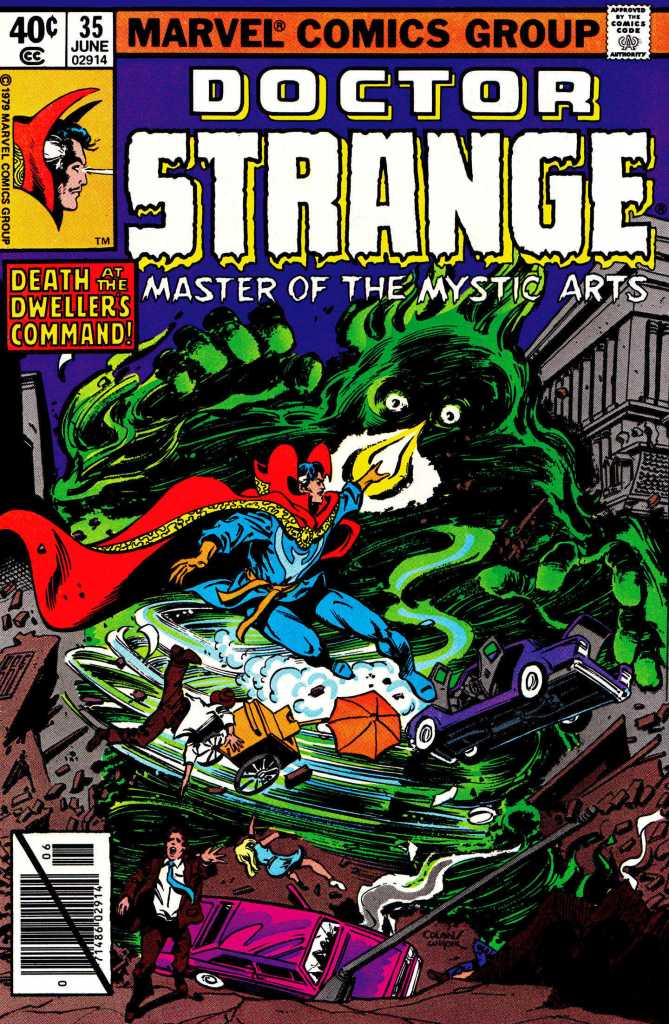
Having purchased DOCTOR STRANGE the previous issue, and being a relatively simple-minded kid, I went ahead and scooped up this issues well. This despite the fact that I’d only been lukewarm on that prior issue. But it was easy to get me into the habit of following titles, and even when I’d drop something–THOR on occasion, say–that undercurrent throughout the promotional efforts that indicated that the Marvel Universe was a single intertwined entity in which all of the stories were important would draw me back time and time again. Part of that was that the buy-in was relatively easy, only 40 cents at this point. But I was also taken with that narrative, and really I wanted it to be true, even when it clearly really wasn’t.
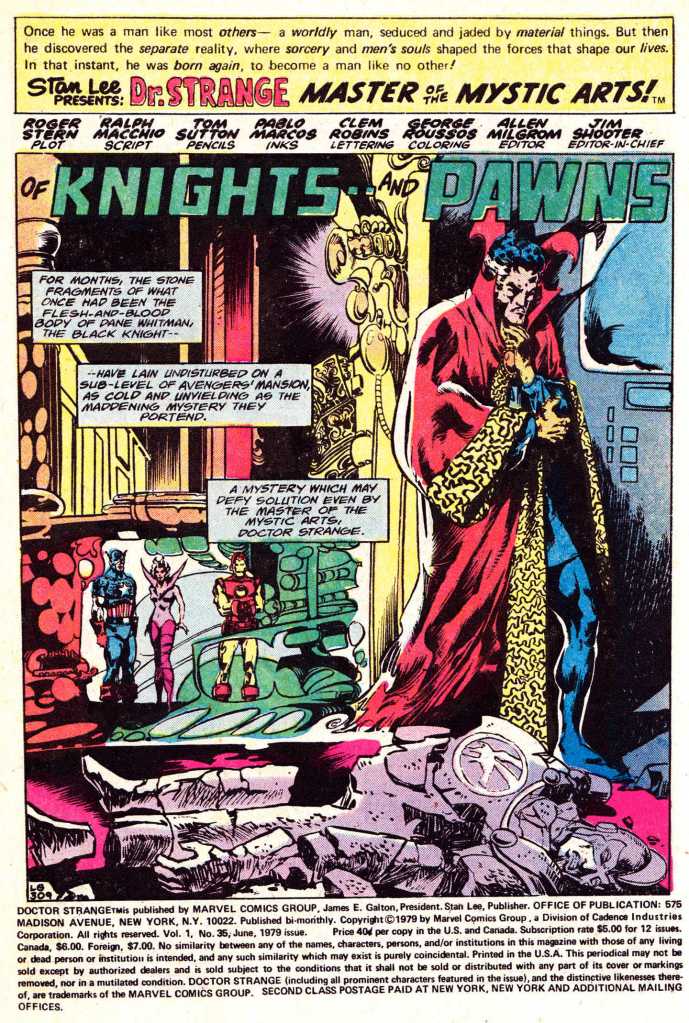
I’d imagine that part of what may have drawn me into picking up this issue was this opening sequence where the mystery of the destruction of the Black Knight’s petrified form was picked up on again. I had seen bits of that plotline bouncing around in AVENGERS and other books previously (though not the specific issue where Dane Whitman’s stony form came to life and was destroyed–not until my friend David Steckel lent me that AVENGERS back issue) so it particularly seemed as though this story was going to be relevant to the larger Marvel-reading experience. I also liked the look of the artwork by Tom Sutton and Pablo Marcos, as brushy and rococo as it was.
DOCTOR STRANGE was a title that had been adrift for some time at this moment, ever since the sudden departure of writer Steve Englehart many, many issues ago. There had been a couple of attempts to bring a steady creative team onto the series to guide it in some specific direction, but none of those efforts had panned out, and so the book continued to glide about relatively aimlessly. This particular story was plotted by Roger Stern who would eventually produce a classic run on the character, and dialogued by Ralph Macchio, who was often something of a pinch-hitter at moments when a deadline was fast approaching. It’s clear that Roger and Ralph are trying to get something going in this issue, but it winds up not quite taking flight, and the book bounces around some more for the next year or so.
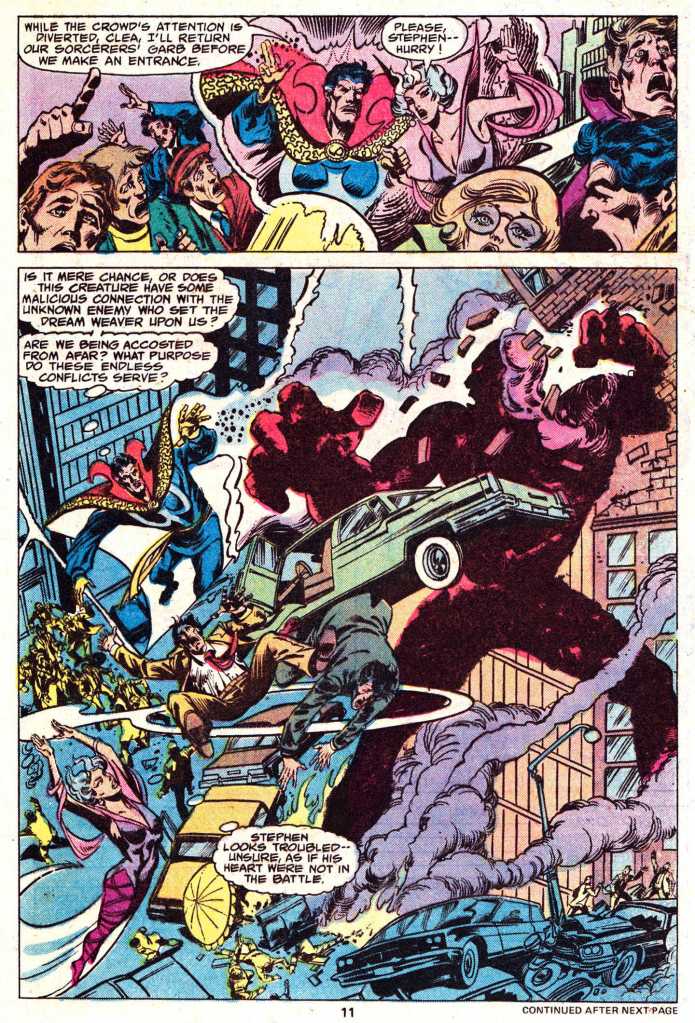
As it turns out, the opening with the Black Knight’s statue is merely stage-setting for the story to follow. Strange manages to reconstruct the shattered statue, and is astonished to discover that it somehow has the Knight’s Ebony Blade. The Avengers permit him to take the Blade back to his Sanctum for study. But the malevolent Dweller In Darkness is watching these events from elsewhere, and he’s concerned that Strange is going to tumble to his ongoing machinations if some obstacle isn’t thrown in the sorcerer’s path. Accordingly, the Dweller enchants a nearby pedestrian, transforming him into a huge monster that begins to aimlessly terrorize the city. Strange and his apprentice Clea are forced to doff their illusion of civilian garb in order to engage the creature in mystic combat to protect the imperiled people.
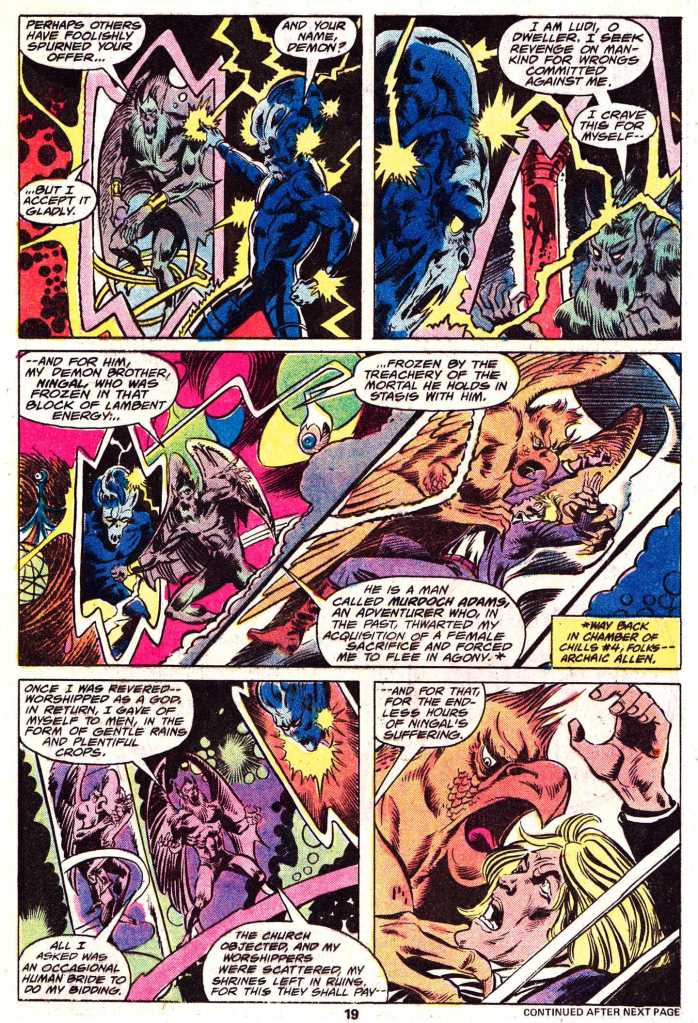
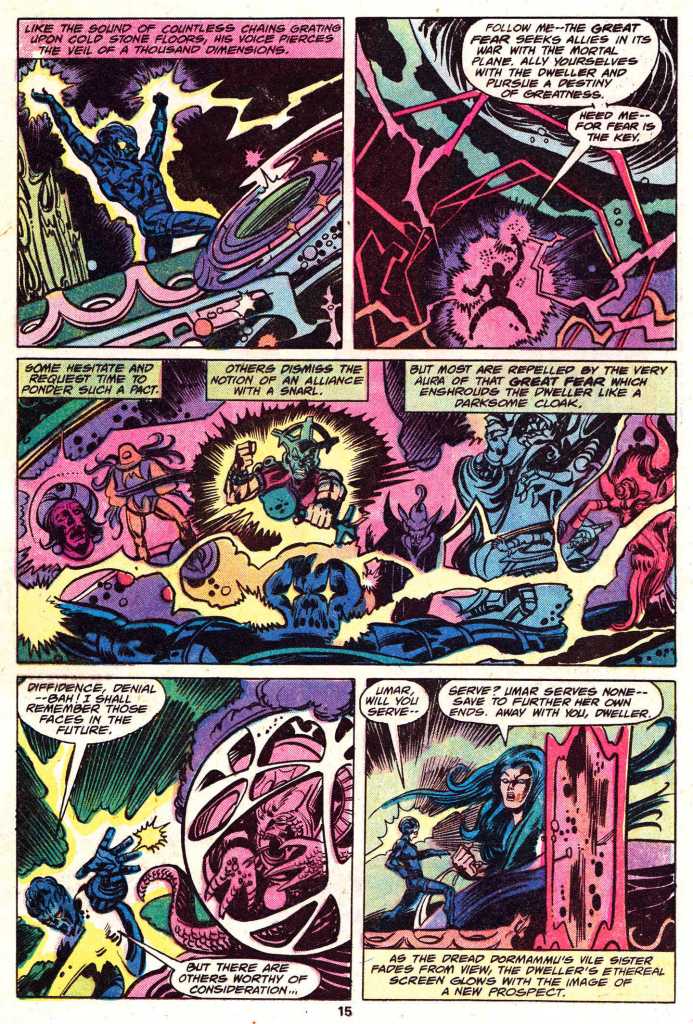
The Dweller, realizing that his makeshift menace isn’t going to be able to stand up against the Sorcerer Supreme for very long, goes seeking allies, and this gives Roger and Ralph a chance to check in on assorted previously-introduced foes of Doctor Strange momentarily, all of whom turn down the Dweller’s offer of an alliance. But he does find one willing catspaw among those his message reaches. This is Ludi, the demon-brother of Ningal, a creature who was frozen in stasis in a self-contained story in one of the old mystery/supernatural series. Stern must have liked that story and seen it as a good source of a character, as he also includes Murdoch Adams, who had been the lead character in that one-off tale.
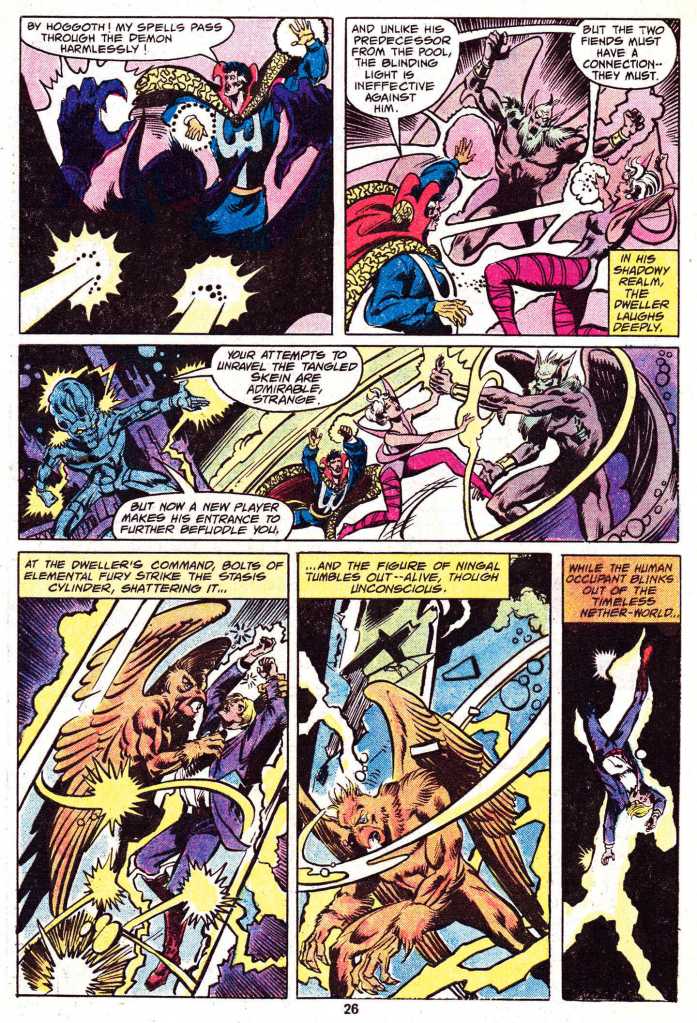
So even as Strange and Clea take care of the menace of the first transformed pedestrian, they find themselves suddenly set upon also by Ludi, whom the Dweller In Darkness has transported to the battlefield. Meanwhile, the Dweller turns his attention to the time-frozen form of Ningal. He produces a spell to shatter Ningal’s prison, but doing so also frees Murdoch, who winds up falling through a mystic portal and arriving back in Earth. Ludi, it turns out, is a more formidable opponent than the earlier monster, and Strange and Clea are decidedly on the back foot. Ludi prepares to tear Strange’s soul from his body when Clea gets an idea.

Remembering the Ebony Blade that they were transporting, she throws it to the beleaguered Strange, who proceeds to dispatch Ludi quite handily with it. What’s more, his attack also shatters the enchantment that turned the pedestrian into a monster in the first place, thus saving that guy’s life as well. So the fighting is done for this issue. In the meantime, Murdock Adams has arrived at Strange’s Sanctum, where he tells Wong that he’s come in desperate need of Dr. Stephen Sanders–which was once a conjured identity of Strange’s from a point where Marvel was trying to make the strip more overtly super-heroic, and which had been dispensed with in the past. So it’s sort of an odd bit of continuity to go out on as a cliffhanger. But I suppose if you’d been following the character for a couple of years, this invocation of Stephen Sanders may have been exciting to you. Me, it meant nothing to, and the rest of the issue hadn’t been especially enthralling either. So this was the last issue I bought of the book for a little bit.
 The Tom Brevoort Experience
I remember picking up this issue as a new reader because of the Cap and Iron Man appearance. I loved both the Colon cover and the Sutton/Marcos interior artwork, but to my younger self, the story felt like it was all potatoes and no meat. Like Tom, it would be quite a while before I picked up the title again.
For me, the main reason was the price. At that age, .40 was a lot of money. The then recent jump from .35 to .40 meant 1 less comics per week 😦 , so I had to be very selective about what I bought.
LikeLike
Any mention of Stephen Sanders is always going to fascinate me, ever since reading the letters page of Defenders #38 – a letter from Peter Sanderson protested that they’d forgotten Doc’s secret identity was still Sanders, even though it hadn’t been mentioned for years. And the editorial reply said that Steve Gerber had assumed the whole Stephen Sanders thing had just disappeared when they stopped trying to make Doc into a superhero, and he just liked the idea that Doctor Strange’s real name is just Doctor Strange.
I thought that answer was a shockingly wrong thing for Marvel’s official editorial voice to be saying! Like continuity doesn’t matter to these people, and we can just sweep old abandoned plotlines under the rug and forget about them! … I mean, it actually made me MORE interested in reading the old comics and finding out about them, and seeing anything else ever published that referenced Stephen Sanders, but I still fiercely disapproved of that whole letters-page response!
LikeLike
It’s too bad the series was so unfocused at this time, since Doc was having a bit of a moment. There was the failed tv pilot in 1978, the Pocket Books collections of the Lee/Ditko stories in ’78-’79, and the solo Doc Marvel Calendar in 1980, all of which got me more interested in a character I otherwise hadn’t paid much attention to (although I liked him well enough in DEFENDERS). I finally started picking up the book regularly when Chris Claremont came on board with #38.
LikeLike
and the 1979 Fireside Book with an Amazing Bob Larkin cover.
LikeLike
If I remember correctly, I was buying this book by habit, too — money was tighter at the time, since I was in college and the days of having an income from three paper routes was over, but heck, it was bi-monthly, and I wanted to “keep up,” since I’d need to know what was going on in the book when and if I wrote for Marvel.
[I have never needed to know what happened in this story in the decades of Marvel writing I’ve done, but hey, you never know.]
In any case, nothing much of this issue stuck with me, not even the Black Knight stuff. I do remember the “man who remembered Stephen Sanders” bit, but that was just an excuse for continuity cleanup. And I remember feeling cheated when there was a cool-looking Colan cover with no Colan interiors.
LikeLiked by 1 person
So Doctor Strange got his cool costume in Doctor Strange Vol.1#177 ( February 1969 ) and his Stephen Sanders ( Eternity changed it ) name in Doctor Strange Vol.1#182 ( September 1969 — great cover ) the same issue he fought the Juggernaut in. Earth-982 ( MC2 )’s Doc Magnus got a version of that costume [ A-Next#3 ( December 1998 ) — ME, team MC2 not team Ultimate Universe or New Universe ]. The costume change and name change was all to make Doctor Strange more super heroic? I don’t get it, the Hulk wears torn pants not a costume and Marvel didn’t consider him not super heroic. let’s not forget Ka-Zar or Sub-Mariner ( scaley swim trunks ). Is not protecting the world from mystical threats super heroic?
LikeLike
What does and doesn’t count as a superhero has been the subject of endless debate. But the fact is, aside from the Hulk, the characters you cite have often struggled to find an audience. And the fact that they are somewhat outside the norm of the superhero genre (both visually and in terms of storylines) is likely at least part of the reason. On the other hand, popping them into a spandex uniform ultimately didn’t help either Dr. Strange OR Sub-Mariner avoid cancellation (Over at DC, The Sandman and Crimson Avenger had better luck making that transition).
LikeLike
Murdoch Adams: The first time I read about the character was in Marvel Super Hero Contest of Champions#3 ( August 1982 ) under Quasi-Heroes at the back of the book with his occupation listed as Monster Hunter ( Which caught my attention ). I checked comics.org and the more helpful marvel.fandom.com to help me with Tiboro’s name ( seen on page 15 panel 3 of this issue ) and to see if those other beings had names ( which would have meant they appeared before, but first appearance for them ).
LikeLike
The Hulk’s (usually) green skin is his “costume”. Same as the Thing’s orange rocky hide. Ka-Zar is a knockoff of Tarzan, from a related genre which doesn’t exist anymore (jungle stories). Swim trunks Sub-Mariner is also a holdover from sea tales. It’s kind of sad to realize how much some of those old subgenres have fallen by the wayside over the decades.
LikeLike
There were too many comics then as now. I wasn’t into magic/sorcery so Strange wasn’t a loss.
Having said that I certainly bought a few titles for years and was lukewarm about them. I escaped the cage for many years but it is something of a bizarre adventure to think about all that time and money expended on blah. And ‘blah’ of course is relative, but it’s extreme. I would rate this art say in the 50s and then a few artists in the 90s. There’s a chasm. If I had never seen the 90s artists, I would think that this art was actually pretty good.
Excepting Ditko, I think I initially went to about 250 or so with Amazing and the art was generally consistent. I would see Spectacular and think no this isn’t.
I would choose Avengers say Byrne/Perez before 200 and then all the stinking art around their issues that still makes me mad after all these years 🙂 as a more extreme example.
LikeLike