


This issue of DETECTIVE COMICS was another that I borrowed from my grade school friend Donald Sims to read. I wasn’t a big Batman reader particularly, but something about this issue evidently made me want to take a closer look at it. I had no idea that it was significant, containing the first appearance of Talia Al Ghul, who beat her father Ra’s to the printed page by a month or two. It may simply have been that this Neal Adams cover looked cool. I really liked that logo set-up with both Batman and batgirl’s names contained within the large bat-emblem. Plus, it bore a 15 cent price tag, marking it to my child’s eyes as an old comic book, an artifact of some unimaginably long-ago time–that time being 1971.
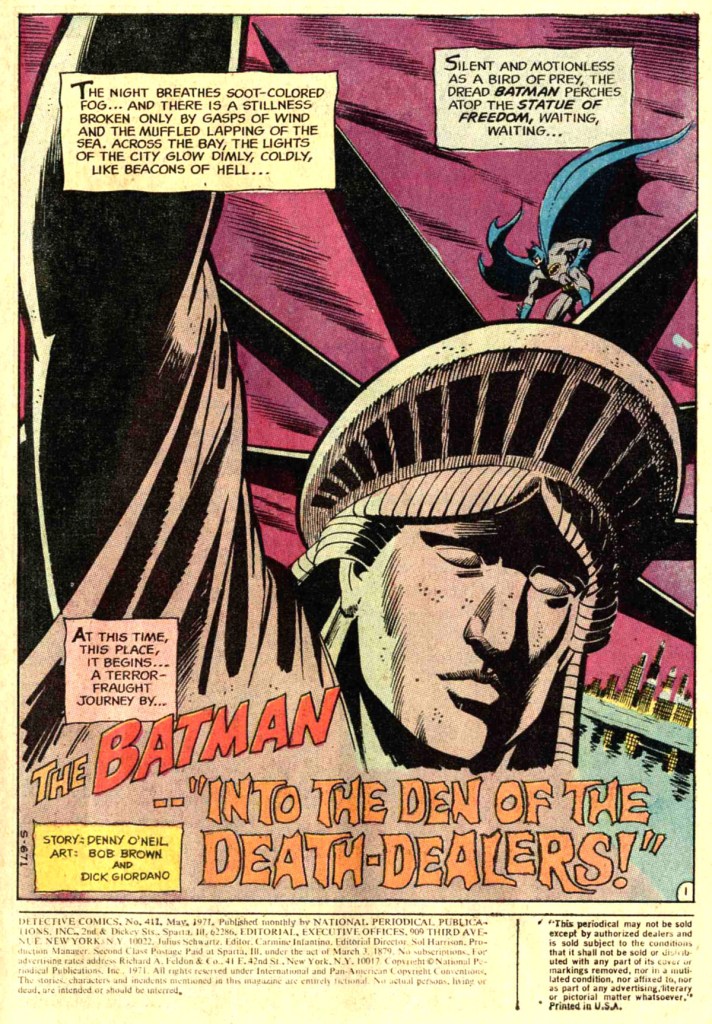
This story was produced during the period where editor Julie Schwartz was attempting to rehabilitate the character of Batman following a several-year stint in which the comics fell into lockstep with the approach and tone of the 1966 live action BATMAN television show. To this end, more of an emphasis was placed on Batman as a detective who worked by night, a grim figure of justice and a moody, formidable presence. The costumed villains of years past were gone, replaced mainly by more pedestrian antagonists. Writer Denny O’Neil was beginning to built up some new foes for the Darknight Detective, having laid the groundwork in previous issues with the creation of the League of Assassins and their operative, the awkwardly-named Dr. Darrk. This was a vein that he was about to tap into more concretely.
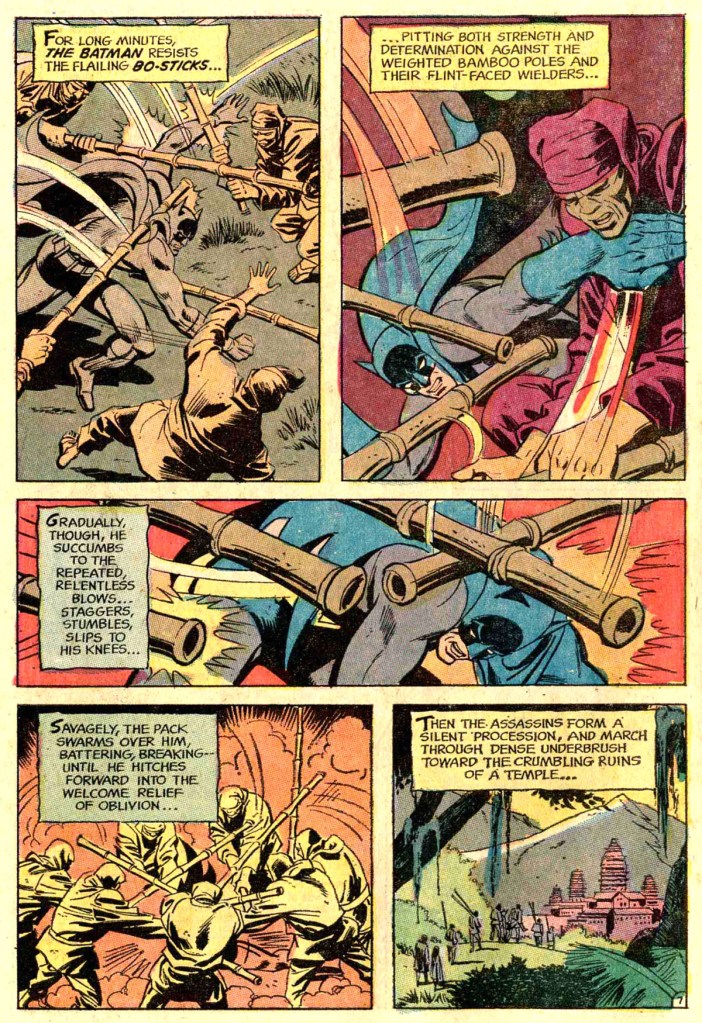
Following up on their earlier encounters, Batman is on the trail of the fleeing Dr. Darrk. He meets an underworld informant at Gotham’s Statue of Freedom, its equivalent of the Statue of Liberty. But the pair are assaulted by assassins from the League, and while Batman is able to drive them off, they complete their objective and kill the informant. But before he perishes, the man mutters to the Caped Crusader that his prey will be on the Soom Express next Tuesday, an ancient railway in an unnamed Asian country. So Batman goes undercover in disguise, and locates Darrk and his companion. He follows the pair as they leap off the train between stations, but before he can capture his quarry, he’s again set upon by members of the League of Assassins. Despite his prowess, the Masked Manhunter is beaten half to death by a group of seven assailants with Bo Sticks.

When Batman recovers his senses, he’s a prisoner along with the woman, who introduces herself as Talia Al Ghul, daughter of Ra’s. Darrk has taken her prisoner so as to coerce Ra’s to do his bidding. Batman also finds himself unmasked–but his face is a bloody mess from the beating he took, and Talia claims to not be able to recognize him. In any event, while Darrk holds the upper hand, he chooses to be sporting, and he had Batman and Talia taken to an arena, where they will be set upon by a dangerous bull and fight for their lives as an entertainment. But Batman, of course, turns the tables and he and Talia escape from danger, ready to take the fight back to Darrk and his minions. Artist Bob Brown tries his best to deliver the sort of dark intensity that Neal Adams gave his Batman pages, but he’s simply not that adept at delivering darkness or ambiance. Still, his storytelling is solid.
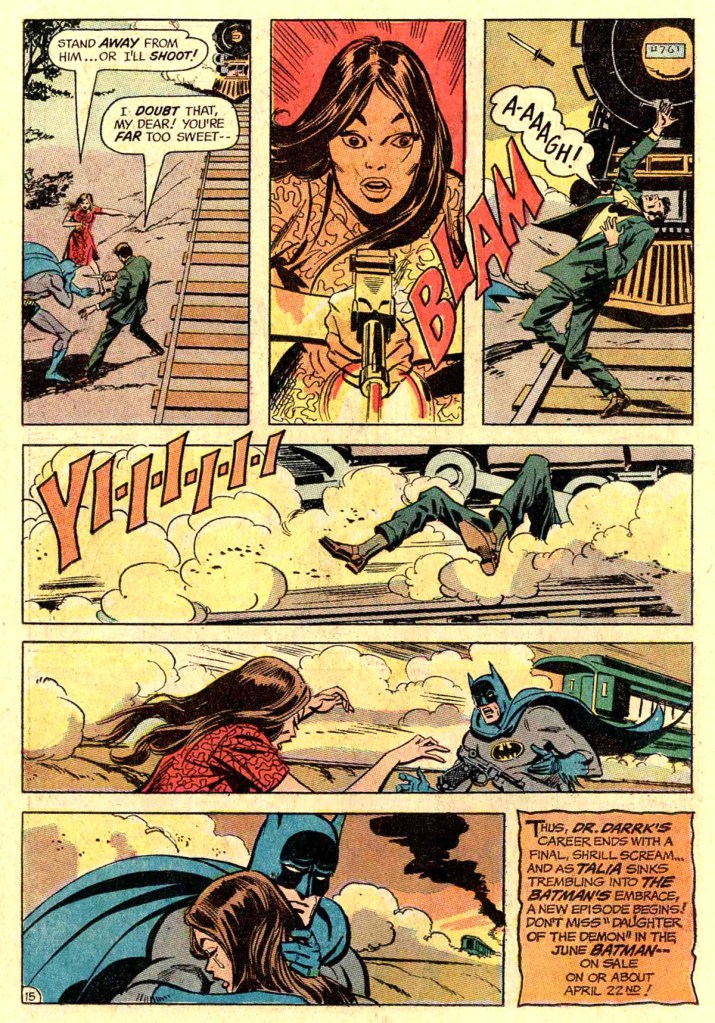
Batman and Talia capture Darrk and the Manhunter proposes to deliver him back to the authorities in Gotham City for his past crimes. So the trio leaves the Assassin’s citadel and heads back towards the train line. But at an opportune moment, Darrk attempts to gain his freedom by zapping Batman with a concealed gas projector concealed in his tie clip, and he thereafter pulls out a hidden knife and tries to stab his foe. Talia tells him to stand back or she’ll shoot him, but Darrk doesn’t think she’s got it in her. Bad analysis, as Talia plugs Darrk and he falls back onto the tracks, just as the Soom Express train comes through again. Darrk is finished, clearly, and Batman comforts the stricken Talia as the story ends. But there’s a tag indicating that these events will be picked up the following month in the next issue of BATMAN, the classic story that introduced Ra’s Al Ghul.
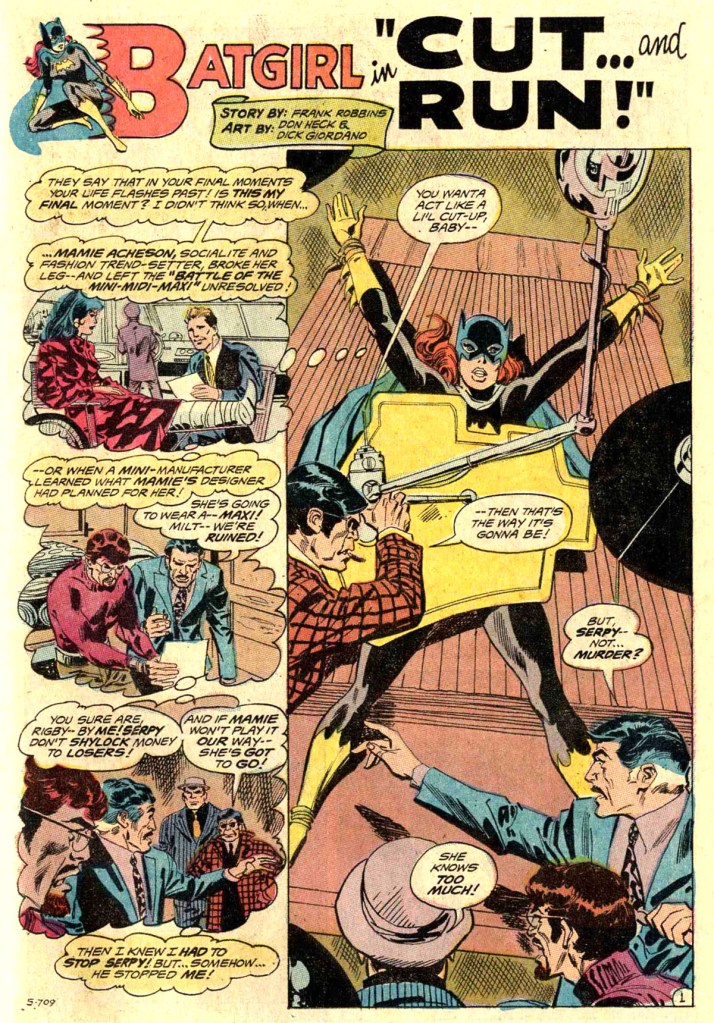
The back-up Batgirl story was written by Frank Robbins, whom I knew primarily as an artist but who had performed all jobs for many years on newspaper strips. At this time, Julie Schwartz was attempting to expand his stable of Batman writers, and Robbins got a decent amount of work writing for the character and his extended family. It’s the second part of a two-part tale and it opens up with Batgirl in a death trap much like the ones that had been featured weekly on the live action television show: she’s strapped under a dress-cutting apparatus that threatens to slice her to bits. Her way out is also only marginally more plausible than what the TV series might have been done: gripping the edge of the device with her mouth, she’s able to constantly turn it, keeping the cutting blade away from her prone body until it runs the entire pattern.
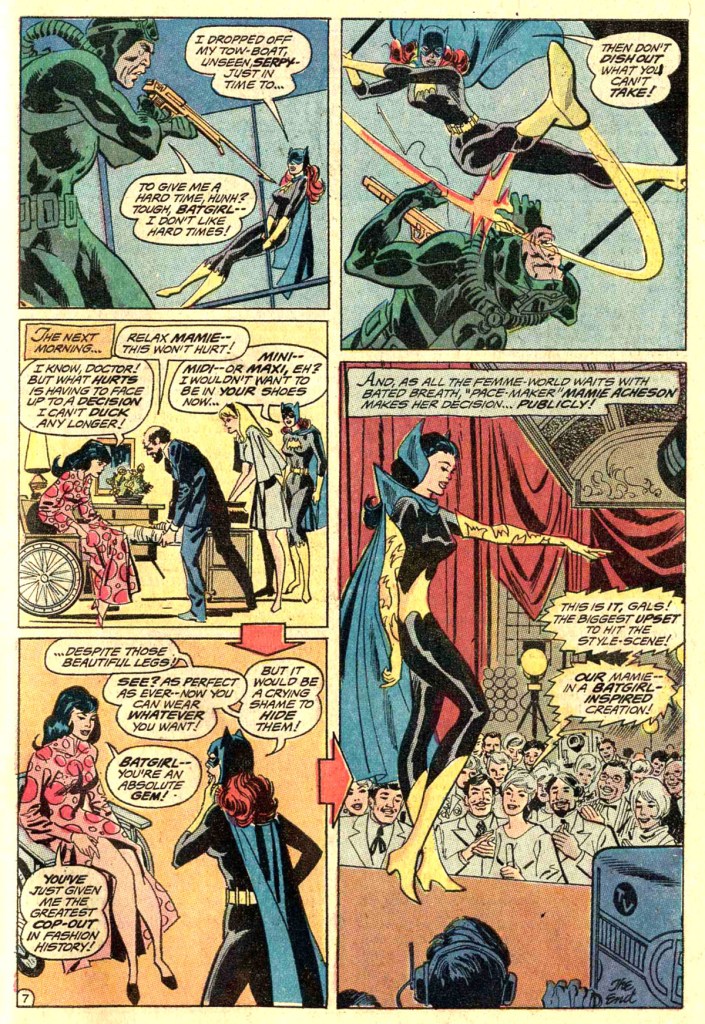
The artwork on this story was by Don Heck, who is aided here by the fine inking of Dick Giordano (who also inked Bob Brown on the lead feature). Heck was recommended to DC’s editorial director Carmine Infantino by Jack Kirby, who told him that Heck did the most beautiful women in comics. The story isn’t much, focusing on a conflict between fashion designers and an attempt to kill off a rival, and Batgirls’ escape from the death trap takes up most of its seven pages. But it looks nice, and is competently presented (though the Arrow of Shame is employed on the final page to help readers make sense of the panel sequence, an unfortunate but also not uncommon occurrence in these years as artists attempted to bring a bit more visual pizzazz to their presentation. )So all in all, you could have done a lot worse in 1971 for your fifteen cents.
 The Tom Brevoort Experience
Hourman fights a Dr. Darrk, way back in Adventure Comics #65, 1941. Strange re-use of an obscure villain name, or just coincidence?
LikeLike
I remember reading Talia’s first appearance when DC collected her and her father’s early stories in The Saga of Ra’s Al Ghul ( 1988 ) — had to remember the title on my own since comics.org wasn’t helping me with the series this issue was reprinted in. I like Talia especial drawn by Neal Adams ( and later Jim Lee ). Fah Lo Suee & Dr. Fu Manchu clearly the inspiration for the non-Chinese Talia & Ra’s al Ghul.
LikeLike
I have no memory of this issue. I know I’ve read it — I put together a full run of the Bat-books from the time right after the Bob Kane imitations stopped up through the end of Len Wein’s editorial run at one point, but I read them all in a row and I expect they all blurred together.
Never did like the name Dr. Darrk. I think there was a Valiant character whose name looked like a similar typo, and I could never get into that, either.
Not that my retroactive disapproval slowed Denny down any, of course.
LikeLike
I guess you weren’t the only one to hate the name Doctor Darrk cause apparently his real name is Ebeneezer Darcel ( wikipedia.org/wiki/League_of_Assassins — I was looking up when the League of Assassins got renamed the League of Shadows like their Young Justice cartoon counterparts. In Deadpool/Batman — Daredevil fought the League of Shadows and Green Arrow fought The Hand which I thought was cool ( As I did Green Arrow putting Matt’s father’s boxing glove on the end of one of his arrows ) ).
LikeLike
I’ve read this and the following issue and have to honestly admit I prefer Brown’s Batman to Adams. We all like what we like. One thing I’ve always thought though is it seems Talia being the femme fatale daughter of a Bond villain type was an idea that came up after this story was written. Neither this story’s art or writing hints that Talia is anywhere near the femme fatale she would become very shortly.
LikeLike
Denny may have intended it — and intended to foreshadow it, with the bit where she just shoots the guy at the end — but didn’t describe it in the script in a way that would have Brown draw it as anything but a generic damsel in danger.
Or maybe he did describe it and Brown went for a generic portrayal anyway; that’s happened to me often enough.
LikeLiked by 1 person
Denny might also have originally meant for Talia to be more of a hothouse flower, and not a plotter like Fah Lo Suee. Darrk knows who Talia is, so one would think he would know if she had a rep for being the martially trained daughter of The Demon. Over time, Denny made Talia more of a femme formidable, though I think SON OF THE DEMON is the first time (in terms of publication chronology) she becomes a kung fu mistress.
LikeLike
Talia isn’t the only one to change from her earlier self to ruthless, so did Yellow Claw’s great-great-grand-niece Suwan in Agents of Atlas series.
LikeLike
Which one did Claw kill in Captain America?
LikeLike
The Claw killed two, two, two femmes in one. In CA #166 he claims to have got tired of his soft-hearted niece betraying him, so he conjures up the spirit of a long dead Egyptian princess to take over Suwan’s body and to become his new partner. Yet in #167, And whats the first thing the princess does? Tha-at’s right. But the Claw sucks out the life force of “Princess Suwan” and so kills both entities.
LikeLike
Well Suwan turned up alive in Agents of Atlas#8 ( September 2009 — to #11 ( November 2009 ) as the Jade Claw. Maybe Yellow Claw got his hands on one of those Duplication Machines seen in 2 or 3 Atlas Age stories [ Uncanny Tales#54 ( April 1957 ) 5th story – Hubert Wren ][ Strange Tales of the Unusual#10 ( June 1957 ) 4th story ] — ( see marvunapp.com for Mr. Wren ).
LikeLike
“Heck was recommended to DC’s editorial director Carmine Infantino by Jack Kirby, who told him that Heck did the most beautiful women in comics.”
Don Heck was an artist whose work succeeded or failed depending on who was inking him. Dick Giordano was a good match for him. I never liked Heck’s inking of his own work. The line work was too scratchy and tentative. But Giordano gives Heck’s work a bolder and more confident line.
LikeLike
“Her way out is also only marginally more plausible than what the TV series might have been done” Not an issue with me if it’s done with panache.
While the story is minor it would have had some topical cachet at the time. The plot centers on whether a celebrated model will embrace with miniskirt, maxiskirt or the new fashion item, the midi-skirt (i.e., midlength). Fashion designers picked the midiskirt and pronounced the mini dead (I’m guessing from the ending that happened after Robbins wrote this); American women didn’t listen and kept showing their thighs. That surprised lots of people (an early 1970s crime novel, The Nixon Recession Caper, involves among others a guy who went broke betting on the midiskirt).
LikeLike
I remember reading this, although I remember the Batgirl story more than the main feature. Dr. Darrk? My mind must have blanked out the trauma! 😉 And I completely forget that that’s Talia in the story.
Bob Brown was okay, but never much to get excited about. Don Heck was more interesting, that jigsaw cutter was memorable, and the Batgirl-inspired outfit a the end of the story could have been a possible alternate outfit for Batgirl.
LikeLike