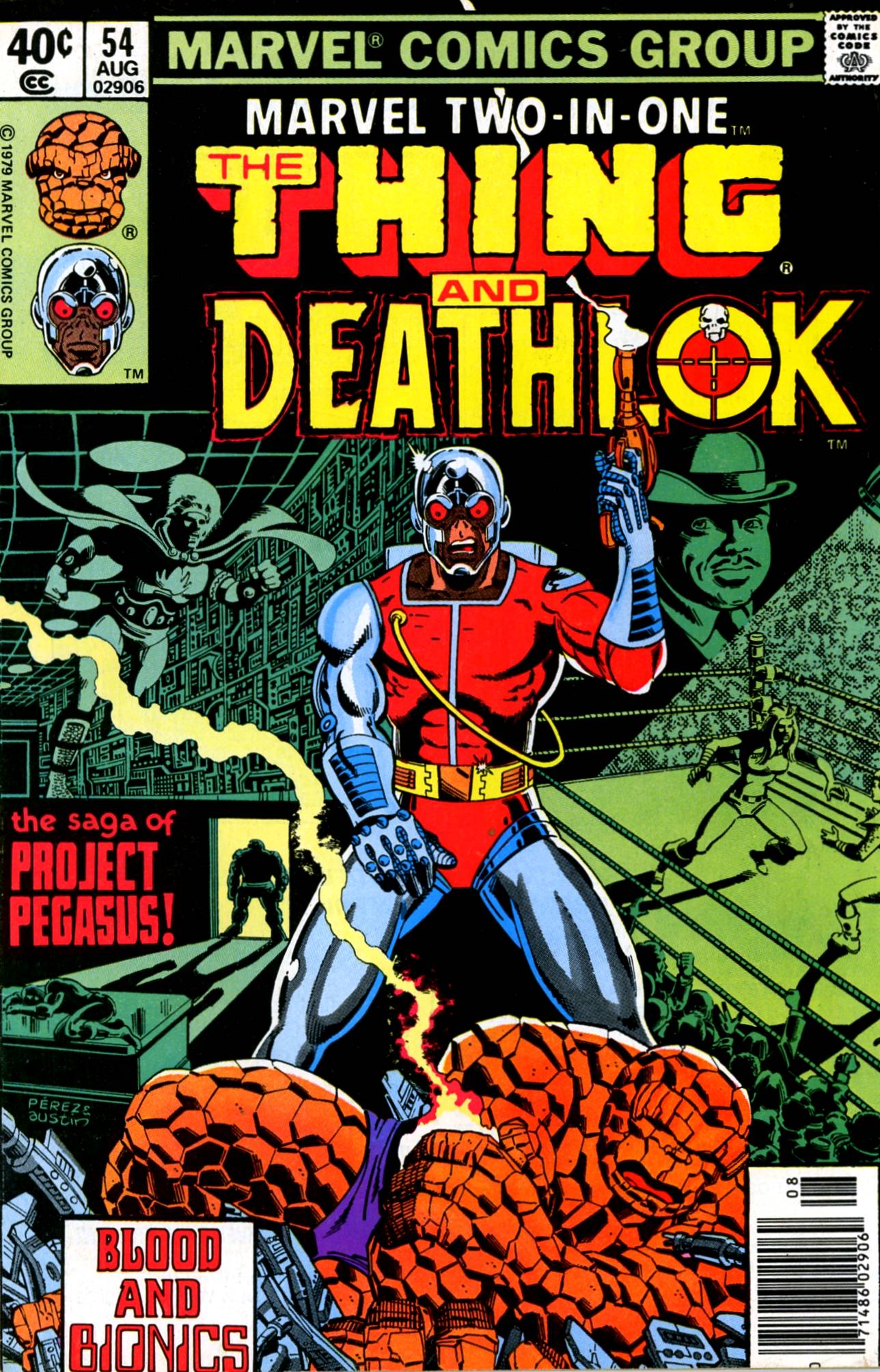


The Project: P.E.G.A.S.U.S. is rightly remembered as a high-water mark in the 100-issue run of MARVEL TWO-IN-ONE. And yet, it wasn’t a perfect story. There was a choice or two made that is perhaps a bit regrettable. And for one of those story decisions, this issue tells the tale. That said, it was still the best extended thing done in the series, illustrated by top-flight artists all the way through and remembered fondly by those who read it at the time, myself included. So let’s see if we can’t square that circle a little bit as we look over this issue.
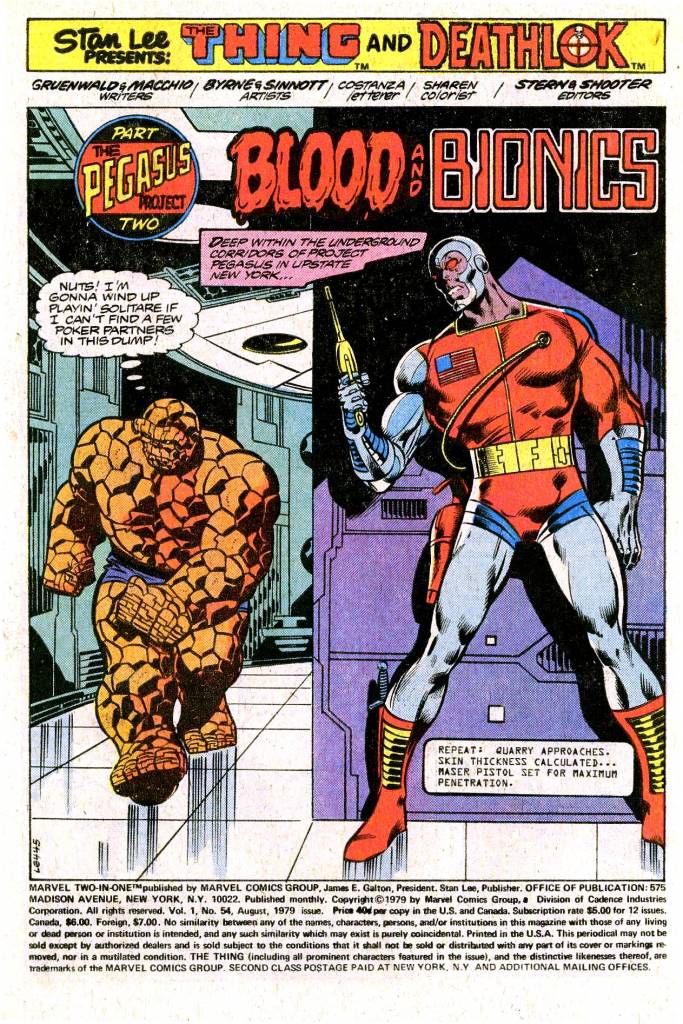
MARVEL TWO-IN-ONE was being written at the time by the team of Ralph Macchio and Mark Gruenwald, both of whom were on staff editorially at the time. Assistant Editor Jim Salicrup gave them the nickname the “Two-In-One Twins” as they did their work together. Of the pair, Mark was the one more interested in pursuing writing. But Ralph was a good idea man and sounding board, and helped to keep some of Mark’s excesses in check. One of Mark’s driving considerations story-wise was always continuity and maintaining a consistent Marvel Universe. He’d made a name for himself as a fan publishing OMNIVERSE, a magazine dedicated to studying and documenting the consistency of fictional universes. Mark would also occasionally get bothered by elements of assorted series being left at loose ends; years later, this led him to do a QUASAR storyline in which dozens of half-remembered characters from the past are seen as having been captured by the extraterrestrial Stranger and exiled to his laboratory planet. On the one hand, this provided a little bit of closure for those characters. On the other hand, it intrinsically meant that nothing interesting could have happened with any of them in the interim. Mark similarly did the Scourge storyline in CAPTAIN AMERICA that eliminated a score of obscure super-villains that Gruenwald felt were surplus to requirement.
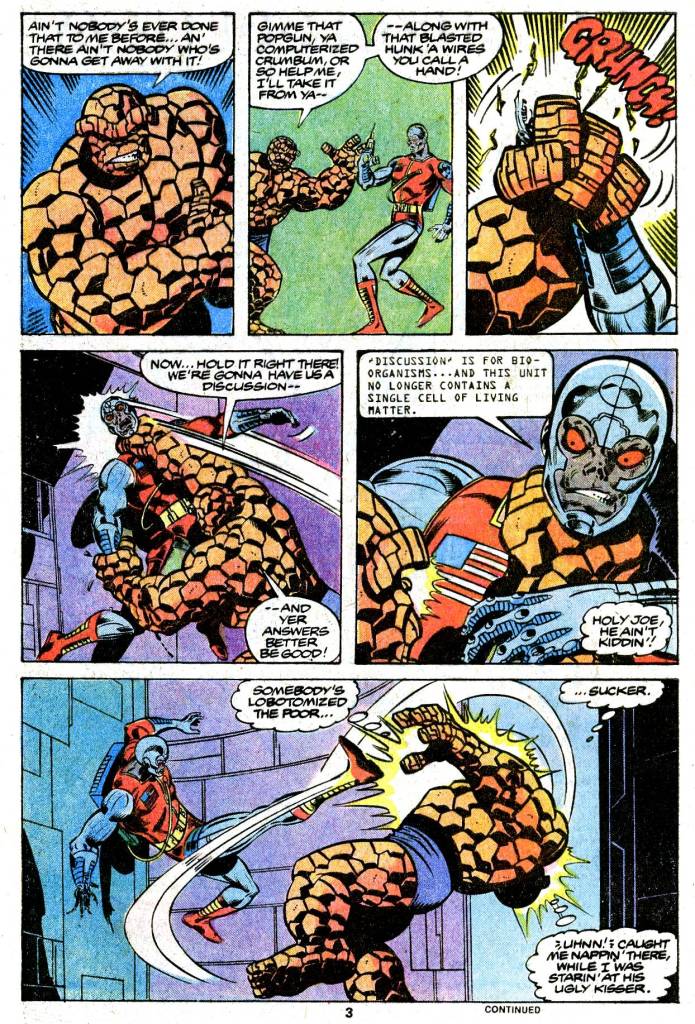
What does this have to d with this issue of MARVEL TWO-IN-ONE? Well, within the first few pages, it is revealed that Luther Manning, the character who had been reanimated as a killer cyborg in the dystopian future had been scraped out of co-star Deathlok, leaving the character as a computer-run drone. For any reader who’d followed the Deathlok series, this had to come as a bit of a kick in the teeth to them. While it’s true that the character had been stranded in the present at the close of his series in ASTONISHING TALES and didn’t really have a place or a purpose here, this smacks of fixing a problem that really isn’t a problem. That said, Marvel was pretty good–sometimes too good–in wrapping up the storylines of cancelled series in other still-running titles in the 1970s and 1980s, so this was likely thought of as more of the same. It’s just an ignominious finale for a character who had once been a headliner (and a final fate that would eventually be undone years later.)
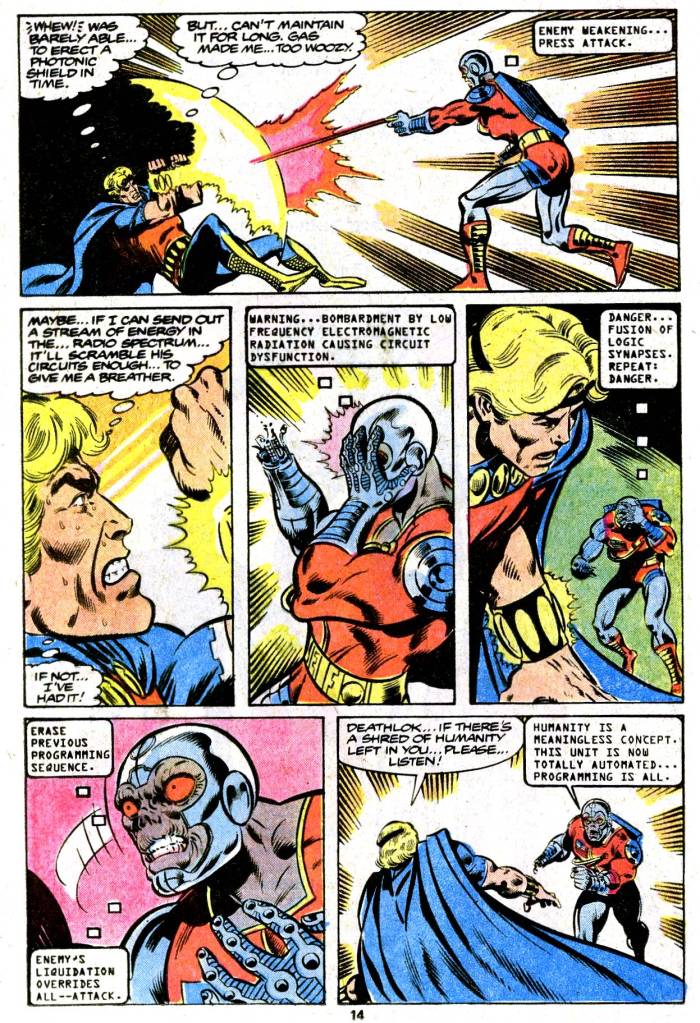
Anyway, here’s what’s going on in the story. The Thing had come to Project: P.E.G.A.S.U.S., a government alternate energy research center, to check in on his ward Wundarr, another cast-off of a cancelled series, who had been left there for study. He was welcomed by Quasar, the head of security who had previously gone by the code-name Marvel Man as a Super Agent of SHIELD. But there were clearly sinister goings-on happening in Project: PEGASUS, and while wandering around in the dead of night hoping to get to the root of the problem, the Thing finds himself attacked by Deathlok. There’s a big “first” moment here that’s in its way kind of cool: Deathlok’s laser pistol is able to penetrate the Thing’s rocky hide, causing him to bleed for the first time in comic book history.

A brief pause here for the above house ad illustrated by the great Marie Severin that ran in only the Roger Stern-edited series this month. There were a couple of ads such as this one done–Fred Hembeck did one for the editorial office of Al Milgrom, for example–though I’m not sure what the specific goal of them was. Perhaps it was an attempt to make the individual Marvel editors more known and recognized by the readership. Either way, this one, which was a take-off on the American Express credit card ads that were then airing on television, is pretty fun.
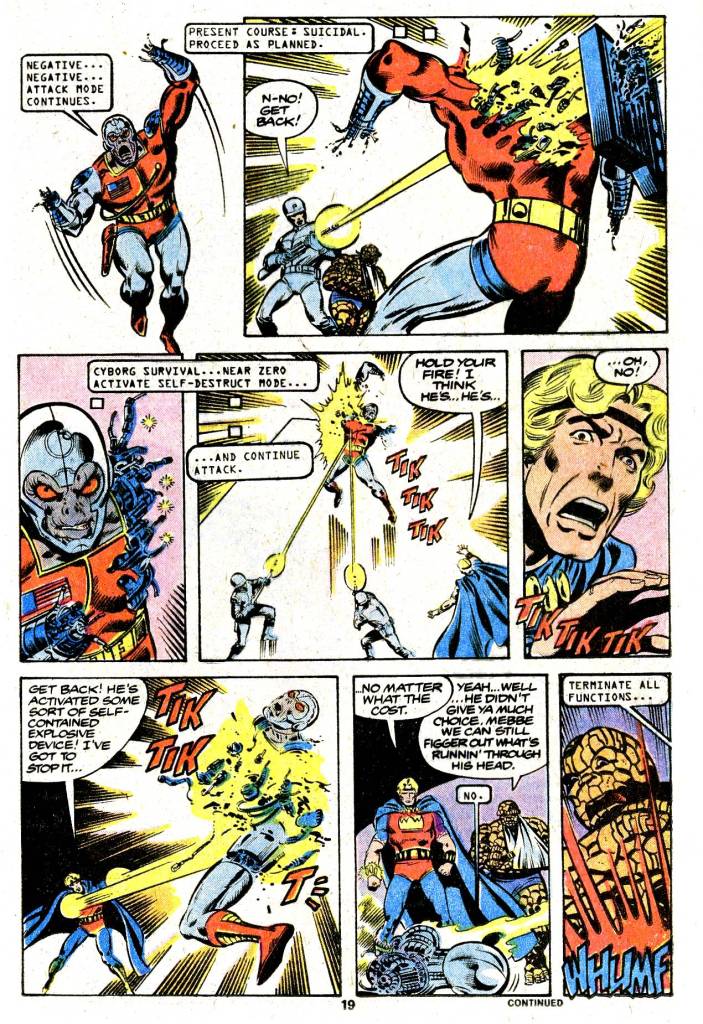
When Quasar and the PEGASUS guards come to the Thing’s aid, Deathlok retreats, making his way deeper into the complex in an attempt to carry out his mission objective in the most extreme way possible: by destroying the entire facility. However, Quasar catches up with him, and while the one-day-Cosmic Avenger isn’t able to defeat the killer cyborg on his own, he is able to hold him off long enough for the recovered Thing and the rest of his security detail to make their way to the fight. Outnumbered and outgunned, Deathlok attempts to execute his self-destruct protocol to take out as many of his targets as he can, but even that is stymied by Quasar’s powers. Consequently, he’s trashed and utterly destroyed–an ignominious end for a character who had begun with such potential.
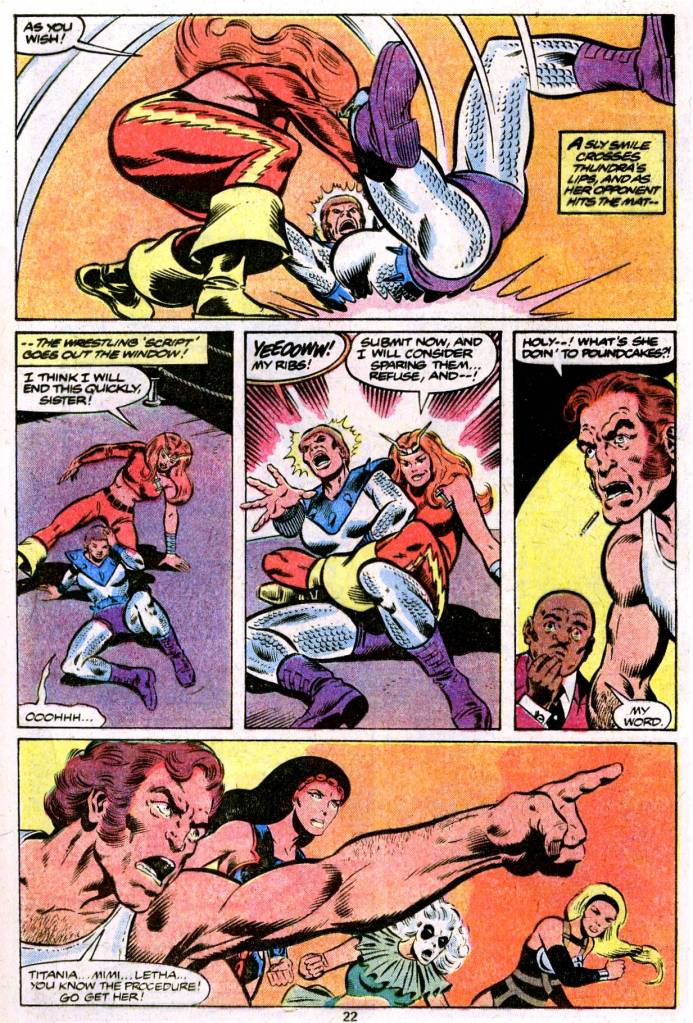
Elsewhere, another character who’s been hanging on around the periphery of the Marvel Universe, Thundra, has been recruited as a fighter in a lady wrestling league. Her opponents, the Grapplers, all of whom are super-powered themselves, were actually based upon four women who worked in the Marvel offices of the time. Decades later, of course, Kurt Busiek and Mark Bagley would reinvent one of them, Screaming Mimi, as Songbird of the Thunderbolts. Here, though, in their first appearance, Thundra puts paid to the entire quartet with her voluminous strength.
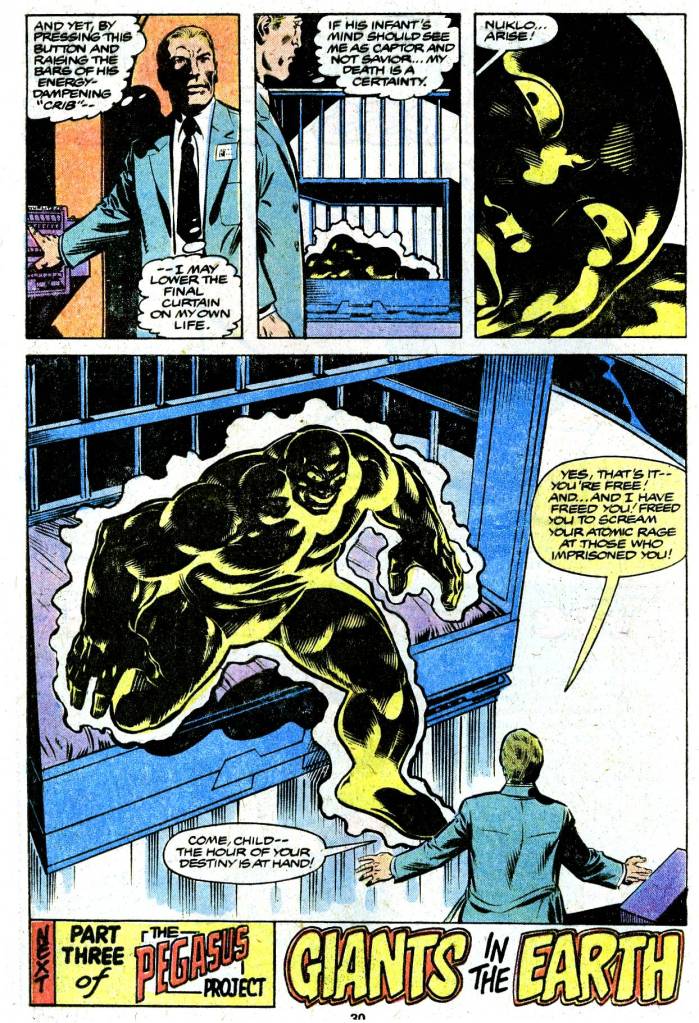
And as the issue draws to a close, back at Project: PEGASUS, Dr. Felix Lightner, who was previously the MTIO-villain Black Sun and who is now working for the same shadowy figures who sent Deathlok, continues his efforts to put together an Nth Projector. In order to conceal his work, now that Deathlok has been destroyed before he could accomplish his goal of eliminating the Thing, Lightner releases yet another character from the Marvel Universe’s past. This is Nuklo, the radioactive mutant son of Golden Age super heroes the Whizzer and Miss America, and who like Wundarr is being incarcerated at the facility in the hopes of finding a way to use his powers beneficially. Nuklo has the mind of a child, and Lightner releases him from confinement, hoping that he’ll cause chaos within Project: PEGASUS. And that’s where this issue is To Be Continued!
 The Tom Brevoort Experience
As well as being based on four Marvel employees, the Grapplers were also clearly based on Jack Kirby’s Female Furies in Mister Miracle.
LikeLike
The writers were indeed a godsend that went away too soon. 2In1 before and after made MTU look like Watchmen in comparison. I didn’t mind the end of Luther Manning sine I’d grown to hate the character of Deathlok by the time it was cancelled. The only flaw for me in this multi-parter was making one of Gerber’s most fun characters super boring and very hard to use in a comic. Next up: Let’s ruin Counter Earth!
LikeLike
Mark had a bad habit of wrapping things up that just didn’t need to be wrapped up — it took him a while to get the idea that you could just ignore things, that if they weren’t on the page, they weren’t bothering anything.
At one point, I think he’d edited or written (or spurred to be written) more pages about the Cat-People than anyone else in Marvel history, mainly in the service of writing the Cat-People out, because he (and Ralph) didn’t like them. So he kept dragging something he didn’t like on stage, rather than using the space for things he did like.
He also turned Skull the Slayer into an uninteresting superhero character no one wanted to use, rather than leave him as a (to be fair, not all that interesting) sword-and-sorcery character who might be useful if sword-and-sorcery got hot again. It just wasn’t necessary to keep tying off threads that could have just been left alone for writers who liked them to pick them up (if ever).
But the Project: Pegasus Saga was still a huge breath of fresh air for MTIO.
LikeLiked by 1 person
A while ago I was thinking that Skull the Slayer would have made a great Pulp hero had he either been created back then or been written to be active back then. He kind of reminded me of John Carter of Mars ( Both soldiers and super-strong on a different world ). I hated Skull the Slayer being turned into the new non-Blazing Skull ( Glowing Skeleton is more like it, Sorry Mark ).
LikeLike
I found it amusing that during the height of the popularity of X-FILES, Marvel had a former government-employee hero named Scully dealing with the stuff of conspiracy theory on an ongoing basis, and they didn’t do anything with him.
Similarly, they didn’t do much with Hercules when the HERCULES TV show was popular, but then, DC didn’t do a HERCULES UNBOUND mini-series, either.
Used to be, comics publishers would jump on whatever’s popular to try to ride its coattails — and then later, they’d jump on it right after it had died as a fad. But then they seemed to decide they didn’t want to reach out to general audiences much at all, and gave up.
LikeLike
Skull The Slayer did deserve better than it got. What I always wanted to know what was up with the one issue being ‘everything you thought you knew was wrong’ followed immediately by the ‘just kidding last issue’ installment.
LikeLike
It’s because (a) they didn’t have a consistent creative team on the book, and (b) business decisions were being made without much warning, in part because back then they had one guy trying to be the editor of the whole line — or by then, the whole color line, at least.
So the book bounced from editors Len to Marv to Archie and from writers Marv to Englehart to Mantlo, and by the time Mantlo had been around for long enough to formulate a plan and do an issue setting it up, the sales were in the toilet and the book got canceled. Maybe Bill wouldn’t have done that issue if he knew it was too late, but he didn’t get that information.
Marv has told me what the original plan was for SKULL — and it didn’t involve Jim Scully or the Bermuda Triangle. But the initial concept got developed into what the Powers that Be (which at the time I guess were Len and Stan) thought would be commercial, and it wound up having very little of what Marv originally intended in it. So SKULL was something of a train wreck even before the first issue came out.
If I remember correctly, one or two of the initial SKULL ideas turned up in NIGHT FORCE, years later…
LikeLiked by 2 people
i would just like to add that Fabian Nicieza used Jim Scully to great effect in his highly under-rated “Hawkeye” series of the turn of the century.
LikeLike
Was that before or after he was sent off to another dimension with Lee Forrester?
LikeLike
I’m pretty sure it was before – this would have been around 2003, I think?
LikeLike
You could add Lilith, Daughter of Dracula not being used after the Underworld movie came out or even Buffy the Vampire Slayer or its spin-off Angel ( Either Lilith or Hannibal King could have been used for answer to Angel — Hannibal is a vampire detective like Angel. Atlas Age has a vampire P.I. who team-up with Nosferatu to feed on his client ( Who I would reveal was someone evil so he could be used as a good guy ) ). Lilith was created to kill her father Dracula and should have been stalking him trying to kill him or prevent him from feeding or making sure his victims never rise as a vampire.
LikeLike
I always thought ANGEL was the answer to Hannibal King.
I used to call the BUFFY/ANGEL block THE BLADE/HANNIBAL KING HOUR.
Even though it was two hours, and BUFFY was more Spider-Man than Blade. Still, it had stakes.
LikeLike
Elsewhere on line I was just discussing Steve Gerber killing off Bloodstone when his backup strip in Rampaging Hulk bit the dust. That was the same sort of waste.
LikeLike
If Ulysses were revived we could even have a family like Clan Destine but without the whimsy.
LikeLike
The whimsy was one of the Destine clan’s best traits.
LikeLiked by 1 person
That one made a little more sense. Bloodstone’s series was ending, and he was unlikely to appear anywhere anytime soon. So you might as well give him a dramatic send-off. It reminded me a little of how Goodwin and Simonson wrapped up their Manhunter series.
That’s a little different than Gruenwald pulling out villains who hadn’t appeared in years and then splashily killing them off, ironically reminding readers of the very things he wanted them to forget. The classic “Streisand Effect” in action.
LikeLike
“Bloodstone’s series was ending, and he was unlikely to appear anywhere anytime soon.” So? There’s nothing wrong with leaving a character out there having unchronicled adventures until someone gets a good idea what to do with them. The Big Two’s fondness for killing or humiliating them (“That team we created in the 1990s got its ass kicked! Good thing the Avengers showed up!”) endlessly annoys me. If that attitude had been in place in the Bronze Age, they’d probably have killed off the X-Men well before Giant-Size X-Men #1.
LikeLike
Oh, I agree, and I would’ve been ok with Bloodstone living to fight another day. But I also think it’s fine, once in a while, to allow a character’s story to just end. Not everything is destined to be a “forever franchise”. I’m more bothered by the fact that John Warner wasn’t the one who got to bring the series to a conclusion, than I am by the details of the conclusion itself.
LikeLiked by 1 person
yes, if he’d wrapped it up I’d be more inclined to class it with Manhunter (see also: Omega the Unknown)
LikeLike
I fully agree that once in a while, it’s fine to let a character’s story end.
Just not when the character is an immortal Doc Savage-like monster hunter with a safari jacket and a shotgun.
If you have one of those, keep him rolling.
LikeLiked by 2 people
I fully agree. Ulysses Bloodstone would have been a great character to have kicking around the Marvel Universe. popping up here and there.
LikeLike
The Official Handbook of the Marvel Universe Book of the Dead was the first time I saw Ulysses Bloodstone ( The evil High Evolutionary — Centurius ( Dr. Noah Black ) was killed off/wasted too. He should have been in all those evil High Evolutionary stories ). Ulysses Bloodstone definitely should have been around when BUFFY THE VAMPIRE SLAYER, ANGEL and SUPERNATURAL were on TV.
LikeLike
I’ll throw in kudos to Roger Stern for turning Bloodstone, Dr. Druid and Makarri of the Eternals into a memorable retcon team in the Monster Hunters story in Marvel Universe.
LikeLiked by 1 person
I enjoyed the Marvel Universe’s Monster Hunters stories and years later I would discover their Explorers’ Club HQ had Atlas Page appearance and members that could have taken their place as authentic Atlas Age heroes, minus female members ( I collected those Atlas Age stories on a USB. Marvunapp.com has a profile on the Explorers’ Club ).
LikeLike
Thanks, bookmarking that page for when I have a moment.
LikeLike
I’m somewhat embarrassed to admit that the woman who became my wife tried the same move Thundra made in panel 3 on page 22… the result being cracked cartilage in my chest. Never again!
LikeLiked by 2 people