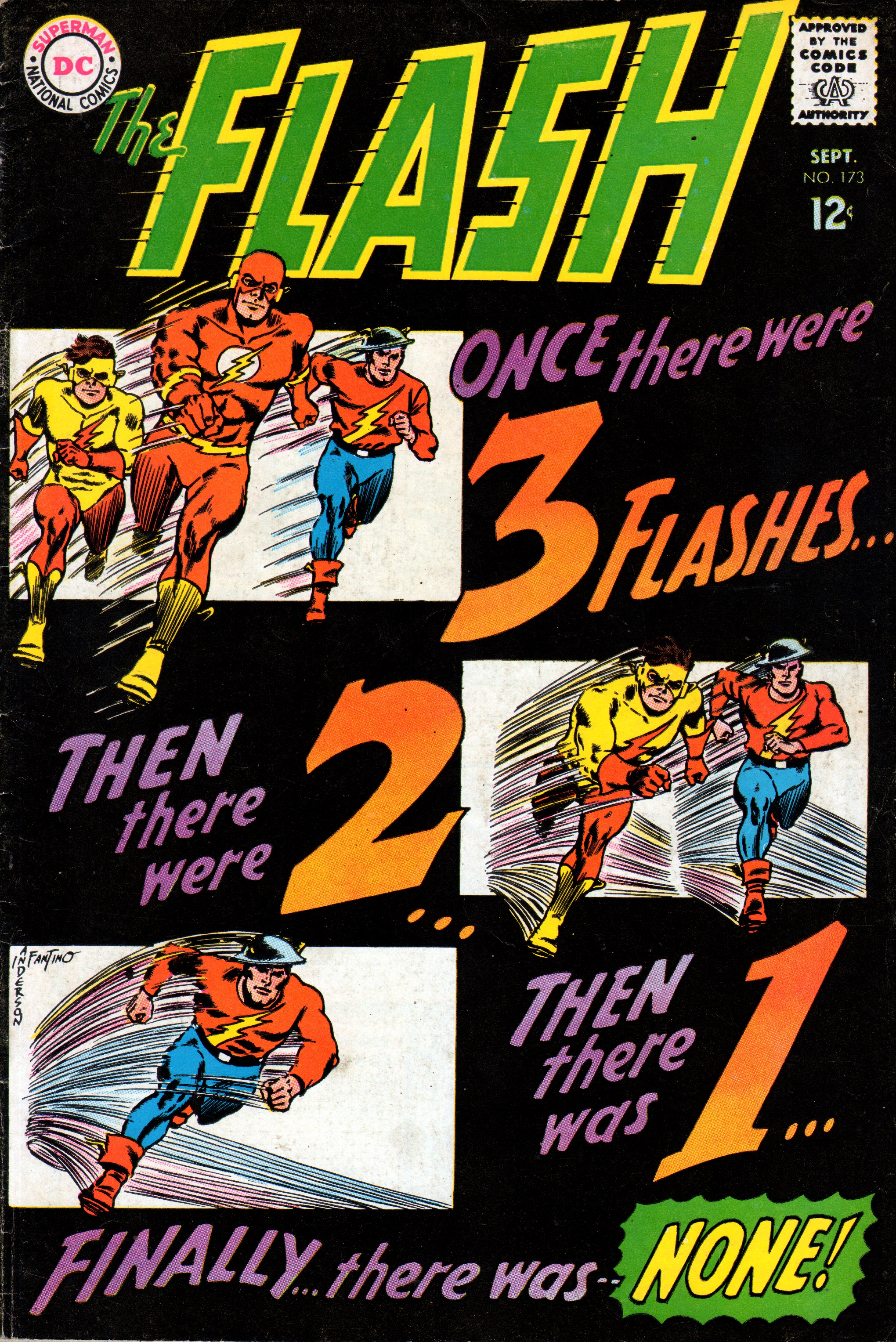


On that same trip to Ed’s Coins and Stamps in the Sun-Vet Mall courtesy of my accommodating grandparents, I also purchased a back issue of THE FLASH, one of my favorite series. Ed had a decent stock of back issues of the title at reasonable prices, so I flipped through them and landed on this one. It promised a team-up between the three primary Flash characters, which is what made me pick it up. The panel-oriented cover was also eye-catching. Laying out innovative covers such as this one was one of the attributes that got artist Carmine Infantino noticed by the brass, and he’d very shortly be made Editorial Director of DC’s comic book division. He’d only draw one more issue of FLASH after this one, at least until the 1980s.
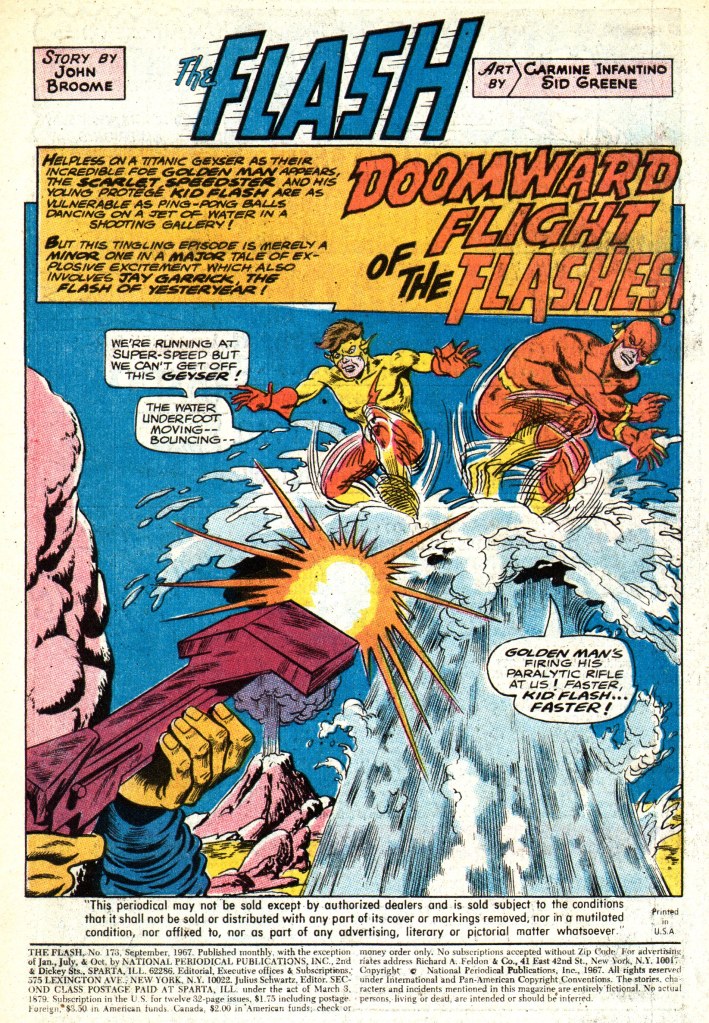
In this period, Carmine’s artwork had begin to take on a different, more stylized look. There were two reasons for this. The first is that, as mentioned previously, DC had moved to having their artwork done at 1 1/2 size rather than the previous twice-up. Carmine’s work had before that change been known for its expansive vistas and its use of open, negative space. But the smaller page size baffled him for a time, and so his compositions became more crowded and claustrophobic as a result. The other big change was the arrival of inker Sid Greene. Prior to this, editor Julie Schwartz had liked Carmine’s storytelling but thought that his visuals were a bit sketchy and unfinished-looking. He most often used Joe Giella to ink Carmine, smoothing out his rough edges into an approximation of DC’s preferred house style. By 1967, though, feeling the competition from Marvel Comics, DC began to mess around with the look of its comics. Greene was brought on board and his approach to inking carmine let more of the penciler’s idiosyncrasies come through in the final product. As a kid, I didn’t like this look as much, preferring the more polished feel that Carmine had under Giella or Murphy Anderson.
The story was written by John Broome, who had produced the lion’s share of Flash stories over the preceding years. Broome’s time on the title was growing short as well, and in a few months, he’d relocate to Japan and leave comic book writing behind. Broome’s story aesthetic is synonymous in my mind with the Silver Age Scarlet Speedster. This story opens up on the parallel world of Earth-2, where Golden Age Flash’s wife Joan Garrick is flabbergasted to learn from her husband that their friend Barry Allen of Earth-1 has been married to Iris West for close to a year and still hasn’t revealed his double-life to her. Joan resolves to go to Earth-1 with Jay and give Barry a piece of her mind. But when the pair arrive, Barry is missing–but Iris’s nephew Wally West, secretly Kid Flash, recognizes Jay from Barry’s descriptions and can fill the older man in on what has happened.
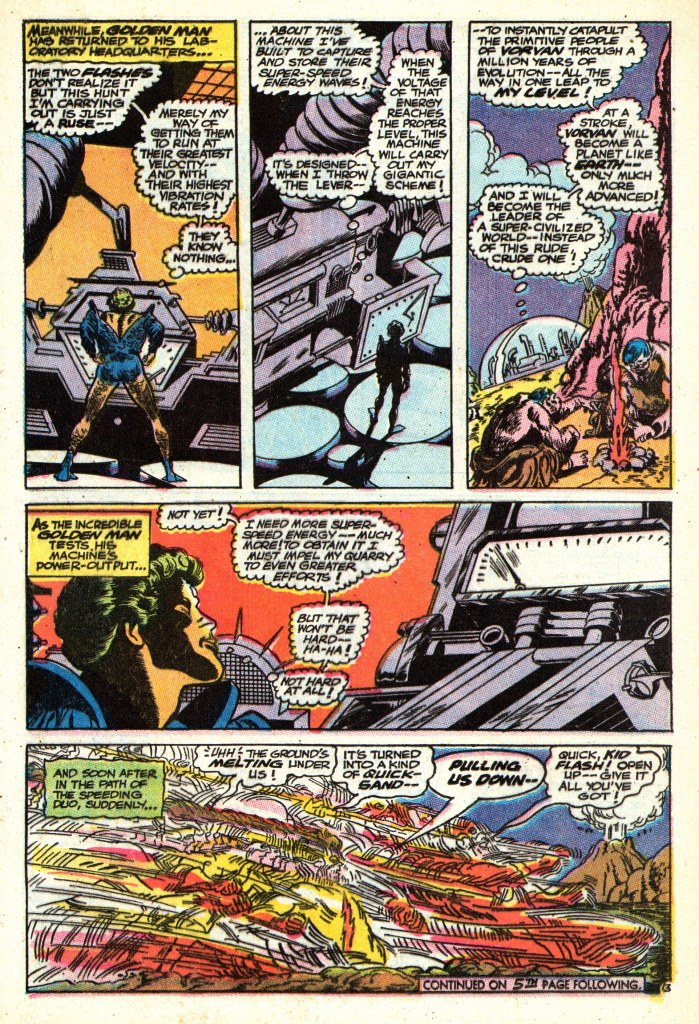
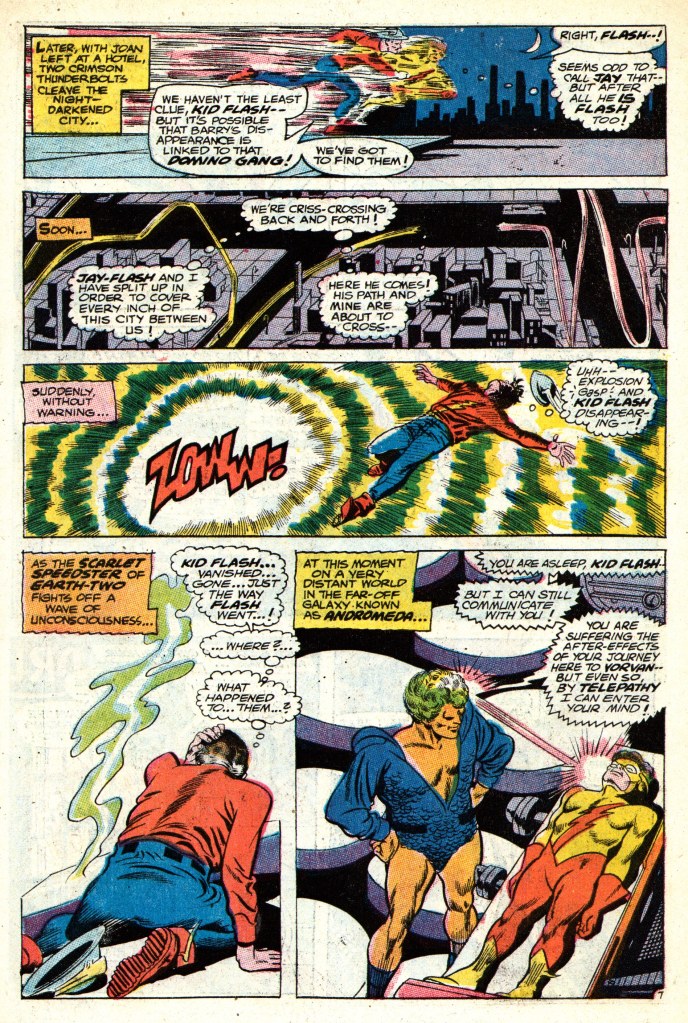
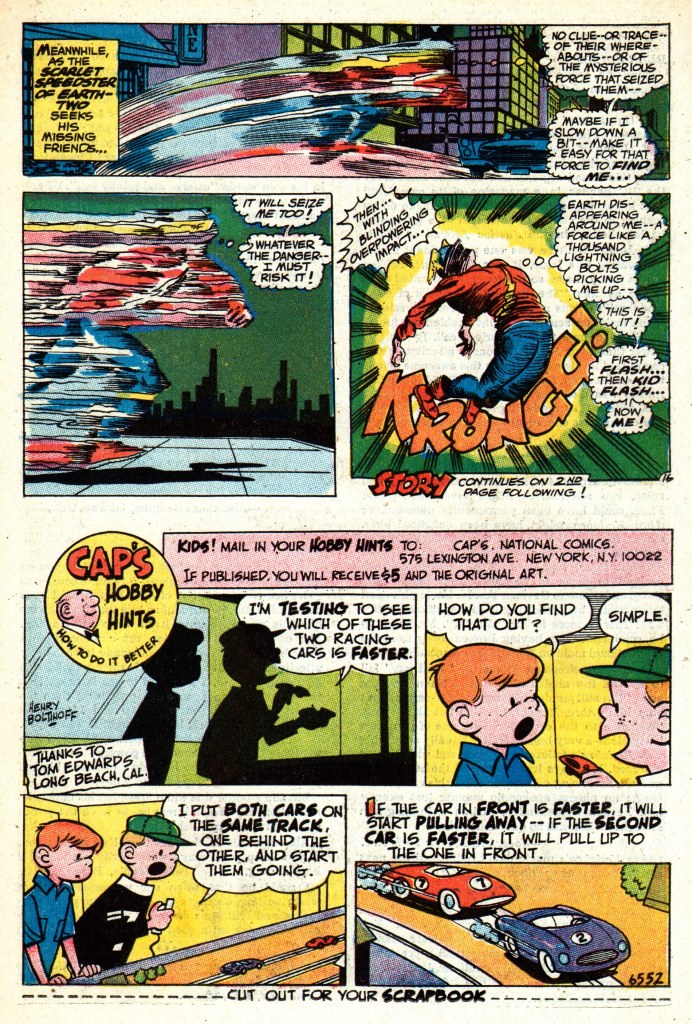
Wally tells Jay that he and his Uncle Barry were out in Central City when they happened to come across the Domino Gang pulling a heist. Swiftly donning their compressed costumes, the pair moved to prevent the crime. But suddenly, Barry disappeared in an explosion of energy. Wally doesn’t know what caused this, only that the Flash is missing. Jay suggests that the two of them try to locate the Domino Gang to see if they can work out what happened to Barry. But as they criss-cross Central City, Wally similarly disappears in an explosive display, stunning Jay. Wally awakens to find himself on a world in the far-off Andromeda Galaxy, having been teleported there by the Golden Man.
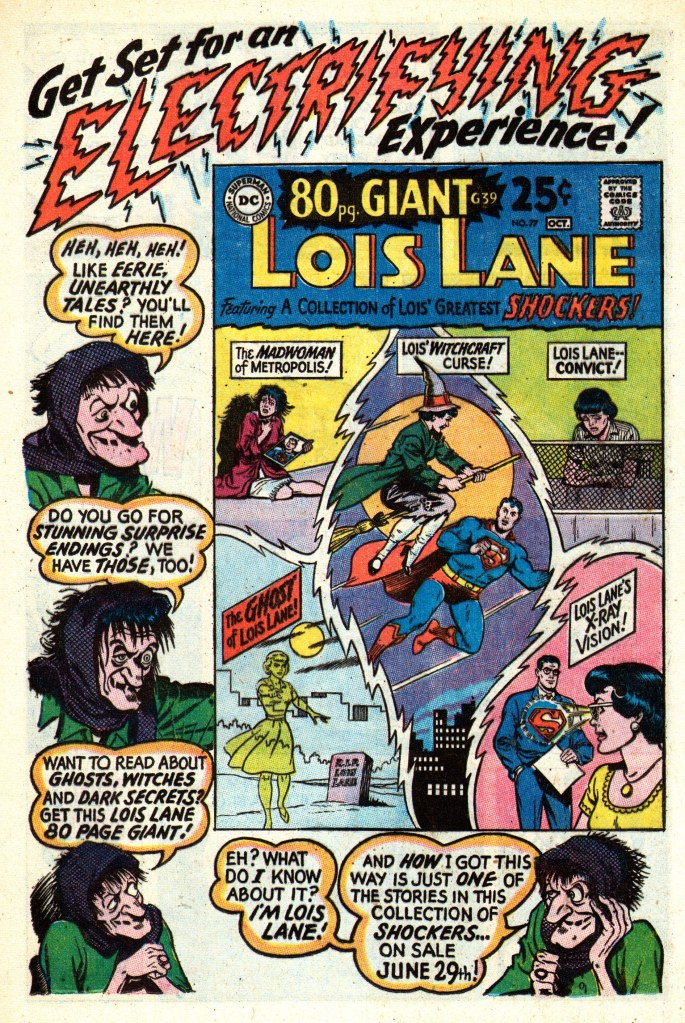
A pause here for a full page house ad promoting the latest 80-Page Giant issue of SUPERMAN’S GIRL FRIEND LOIS LANE, this one dedicated to the girl reporter’s most shocking stories. Which turned out to be something of a loose guiding principle, but it still allowed for another conglomeration of cool Lois stories from the past.
The Golden Man is a mutant born on a primitive world with telepathic and telekinetic powers a thousand years more advanced than his own kind. He tells the Flashes that he’s grown bored being the only intelligent being on his homeworld of Vorvan. So, to entertain himself, he wants to play out a Most Dangerous Game hunt where he’ll pursue the two speedsters across the planet, attempting to kill them. If they can remain alive for the equivalent of four hours, he’ll relent and return them to Earth. Unbeknownst to the Flashes, what the Golden Man is really trying to do is to capture their super-speed energy, which he believes he can use to hyper-evolve the rest of his primitive people. Now, why the Golden Man doesn’t just tell the Flashes this and ask for their help is a mystery–for a hyper-evolved being, he doesn’t really seem all that smart. So the Flashes run a mad race across Vorvan, encountering danger from the local flora and fauna and pursued by the Golden Man. Trapped in quicksand, the Flash appears to sacrifice himself to get Kid Flash to safety. But the Golden Man still needs more super-speed energy.
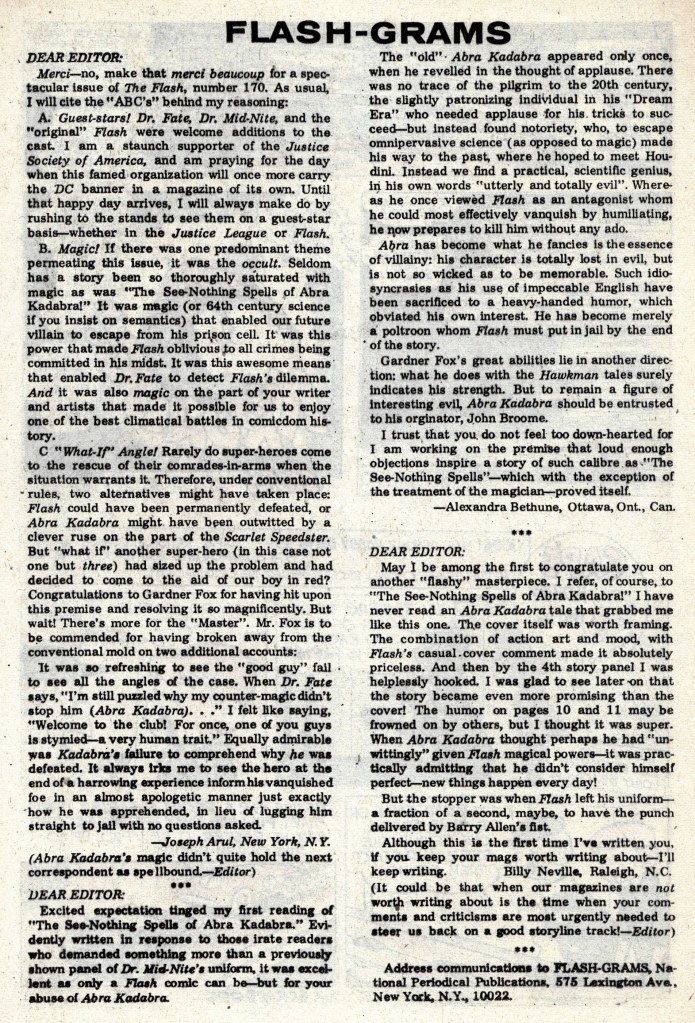
The issue’s Flash-Grams letters page appears at this point. As these things go, it’s a relatively sedate version of the feature, with editor Schwartz keeping his replies to a minimum.
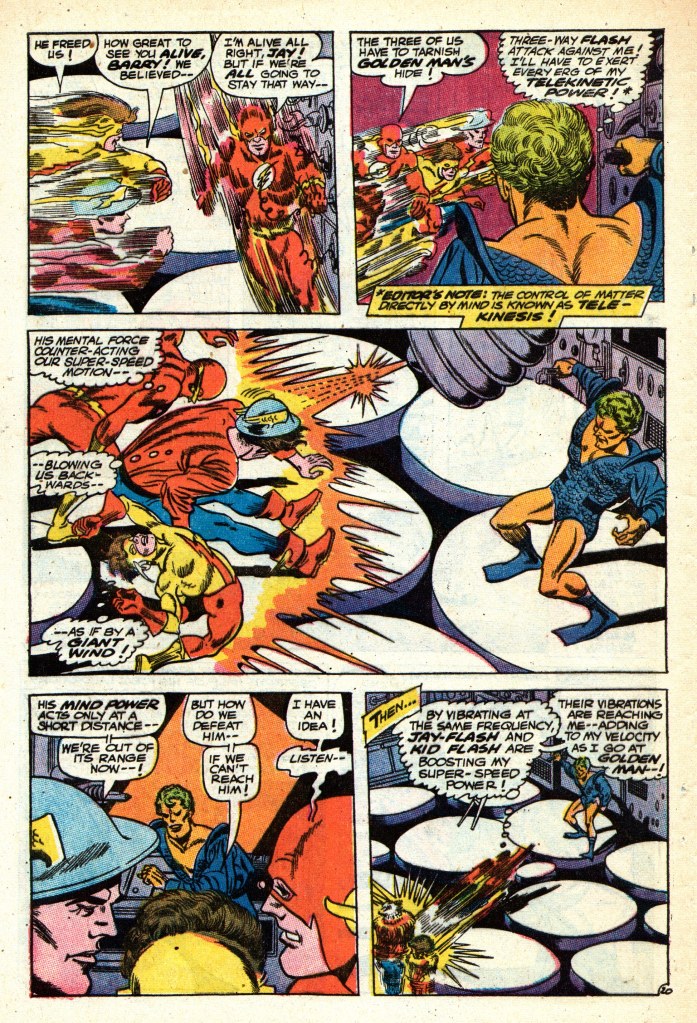
Fortunately for the Golden Man, he detects the activity of another speedster on Earth: Jay Garrick, who is attempting to duplicate what happened to Barry and Wally previously. The Golden Man zaps Jay to Vorvan, then after a quick tussle, sets him and Kid Flash up in a sub-zero field, requiring them to vibrate themselves at super-speed to keep from freezing solid. In this way, he hopes to harness the energies he needs. But his scheme is foiled by the arrival of Barry Allen, who had escaped the quicksand by vibrating himself downward, through the whole planet. Barry is able to free the others, and now the three Flashes assault the Golden Man in tandem, overwhelming his mind over matter powers.
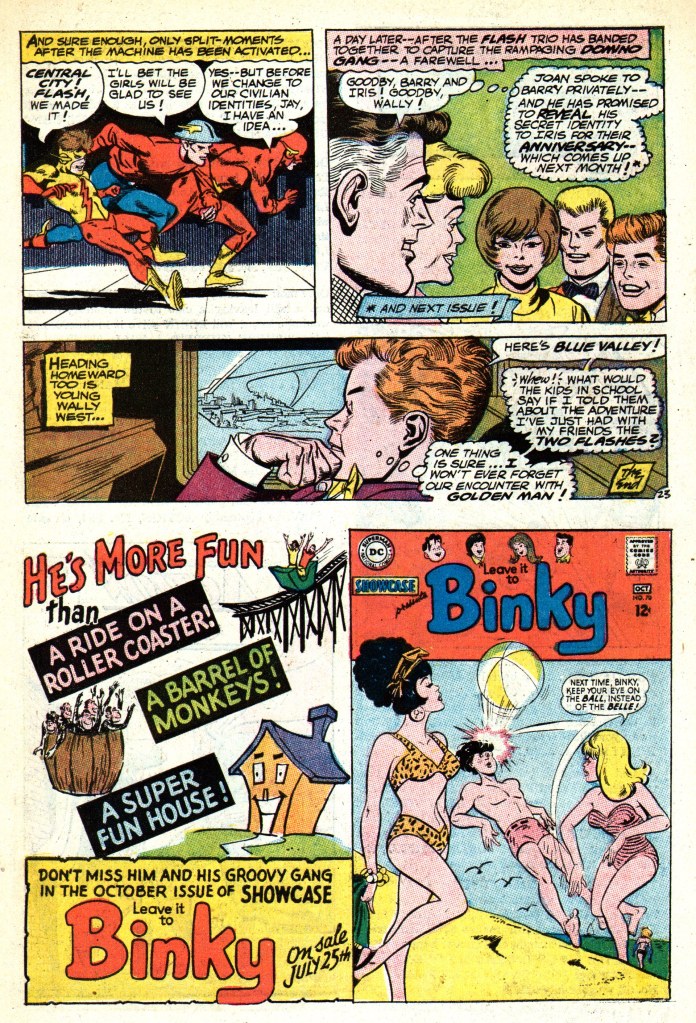
In desperation, the Golden Man activates his device–but rather than evolving the rest of his race into beings like himself, it instead devolves him into a primitive like his fellow Vorvans. The three Flashes see this as fitting, in that now the planet can evolve at its own natural speed. They’re able to hot-wire the Golden Man’s teleporter to get them back home to Earth, where Joan Garrick extracts a promise from Barry to reveal his secret to his wife Iris before their first anniversary next issue.
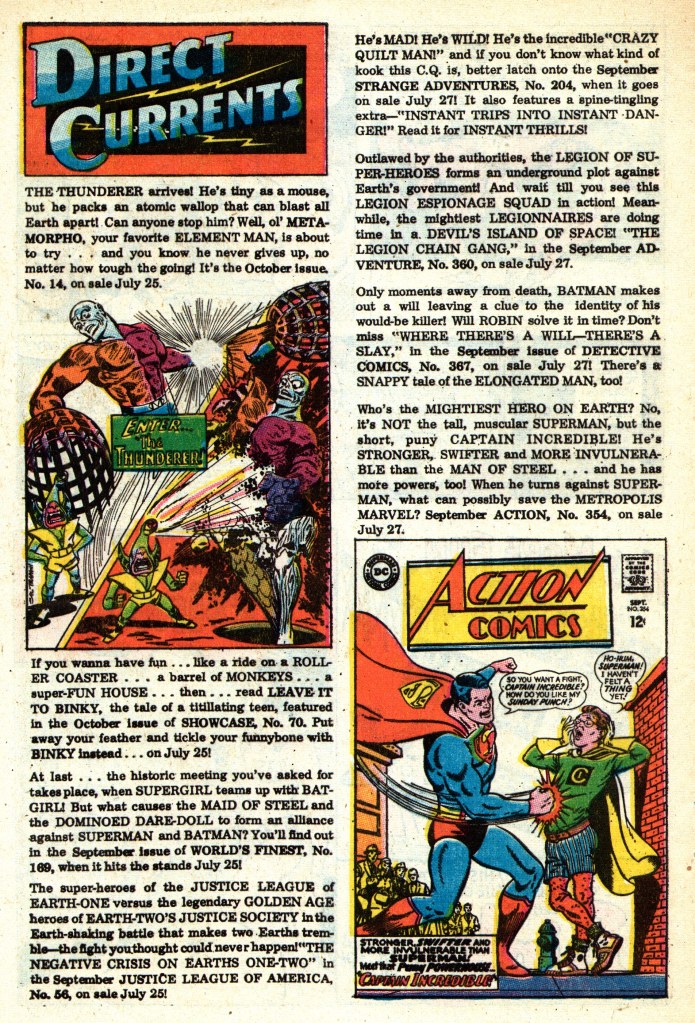
The issue concludes with one of the company’s Direct Currents pages, their equivalent to the Mighty Marvel Checklist spotlighting titles that are about to go on sale. At this moment ,DC was in a period of transition, starting to move to respond to the energy of the Marvel books of the era and updating their approach, however haphazardly. These sorts of teases of long-ago comics were so mysterious and fascinating to me as a kid, earmarking assorted titles and issues that I really wanted to read at some time in the future.


I didn’t like Infantinos’s art upon his return to just penciling at first, thinking it had devolved with time. I eventually noticed the inkers weren’t as heavy handed as what I’d seen in reprints and about the same time grew to love this more pure art of his more than the older stuff!
LikeLiked by 1 person
I liked Golden Man as a one shot and am glad I did not see him revived in the time I kept regularly following DC. Don’t know if he was brought back afterward.
LikeLiked by 1 person
Golden Man remains a one off, probably due his resemblance to Adam Warlock.
LikeLiked by 1 person
Golden Man looks like an in between step of Him and Adam Warlock.
LikeLike
I like Greene more than I do Giella, but that’s because I really, really don’t like Giella. Still, this art is more attractive to me than a lot of what came before it.
“…another conglomeration of cool Lois stories from the past.”
Ahh, who are you kidding? There are no cool Lois stories from the past.
Freaky stories, yes. Funny, weird, baffling, compelling, wildly entertaining, sure.
But not a one of them is “cool.” Not even when Pat Boone showed up.
LikeLike
I think you meant especially when Pat Boone showed up. The guy creeped me out big time even before he let his true self show.
LikeLike
Well, Mort Weisinger thought it was cool…
LikeLike
Interesting divergence– are there things that are both freaky AND cool?
First thing I thought of was FASTER PUSSYCAT KILL KILL.
Of Lois stories, I might confer coolness on “The Catwoman’s Black Magic,” partly because it brought the feline felon back out of her DC exile. Batman ’66, which abetted that return, might be considered freaky and cool at the same time…
LikeLike
It is entirely possible to be freaky and cool at the same time.
The Silver Age LOIS LANE never did it, mind you. But that doesn’t make it impossible.
LikeLike
It’s astonishing that DC didn’t jump on Catwoman when she was on TV — the next story with her facing off against the Dynamic Duo isn’t out until after the show was halfway through its feeble third season. I know DC in the 1950s had concerns about how the comics code would treat Catwoman but it’s hard to imagine they were still freaking out.
LikeLiked by 1 person
By 1966 I doubt anyone was still scared of the Wertham boogieman, except *maybe* on the general topic of sex and violence. And since the TV Batman had validated Catwoman to some extent, I doubt any editor feared bringing her back on the comics page. Indeed, I remember her being licensed to a coloring book (in the purple-and-green outfit) around 66 or 67, and DC allowed “The Sleeping Beauties of Gotham City” to get reprinted in one of those paperback collections, as well as reprinting a couple more oldies in their own comics.
My guess is that CW’s enemy was creative HABIT. Nobody had done a new CW in thirteen years, though Bill Finger, her creator, had recycled some of her gimmicks into Cat-Man. So Fox and Broome and Kanigher and the rest stayed in their comfort zone. However, it sure looks like DC editorial started pushing Batgirl big-time once she was on TV, and her appearance in #197 was probably mandated by Schwartz. Maybe he suggested to Fox bringing in CW to establish BG’s lack of romantic interest in Batman, or it could’ve been Fox’s own idea.
For what little it’s worth, a PHONY Catwoman appears in another Weisinger book a month or two before BATMAN 197: World’s Finest 169, in which Mr Mxyxptlk and Bat-Mite pose first as Supergirl and Batgirl, and then as Black Flame and Catwoman, in order to work out their deeply conflicted masculinity issues. Well, that might’ve been a better story, anyway.
The only thing I’ll add about the “cool” thing is that one normally thinks of the word as connoting (in its positive context) both self-control and nonchalance. Weisinger’s tendency to use extreme ballyhoo as his selling point for most of the Superman Family books would seem the opposite of cool. And so it was, MOST of the time– but not ALL the time.
LikeLike
I thought of the fake Catwoman; there’s also a scene in “Nightmare Dreams of Superman” where we see a photo of Catwoman in Batman’s crime files.
As for just not being used to her, the same could be said of the Riddler but they had no trouble reviving him, or the Scarecrow (whom Fox considerably rebooted), and they were bar-trivia level obscurities at that point.
LikeLiked by 1 person
To frasersherman’s ct:
Sure, and in addition to Scarecrow and Riddler, Schwsrtz was the editor who brought back Killer Moth and (rather late in the game) “Mister Zero.” But before that, under Jack Schiff’s tenure, either Schiff or Finger initiated new versions of Mad Hatter and Clayface– whose original versions, admittedly, weren’t well-remembered. Point being that both of the “JSs” knew that fans in the Silver Age particularly liked bizarre villains in Batman– but I think the writers knew that editors called the shots as to what villains, or iterations of villains, got greenlighted. If they didn’t get an explicit order from Schwartz to revive Catwoman, then the writers probably didn’t bother stumping for her. In those days it might’ve been easier to pitch Schwartz some story with a promising cover-gimmick than just to pitch bringing back an old villain.
btw, I don’t know Schwartz’s precise motive for killing off Alfred, outside of the obvious shock value. But I’m sure it had nothing to do with the old chestnut of injecting a feminine presence to allay fears about two males living together. I did a survey of all the Bat-stories from Alfred’s death to his revival, and Auntie is barely in the stories! Some watchful nanny she was. I think there’s one story in which she plays Vicky Vale, suspecting the secret IDs of her charges. IMO Schwartz had zero interest in using Auntie to run cover, or to do anything else– nor, prior to the TV show, did he promote many supporting femmes. There was one possible romantic interest for Bruce, a lady cop, and she disappeared after two stories with no follow up. Oh, yeah, and there was a “crime solvers club” that had one female on it. IMO Schwartz wanted to distance himself from Schiff in a lot of ways, and that included getting rid of Schiff’s romantic subplots.
LikeLike
Commander Benson makes a good case that was indeed Schwartz’s intention, just ineptly executed. Batman at the time had a supporting cast that consisted of Alfred and Commissioner Gordon and that was it. Expanding or adding to it apparently didn’t interest him or anyone on the writing team. And Schwartz admitted Alfred turned out to be more important to the series than he thought at first.
I was always fond of Clayface II. The Mad Hatter was a weird one (I wonder if Schiff even knew about the earlier version) — he’s not out for money, only to ease his collecting itch, so how does he convince a gang to work for him? Having the original off him off-stage during Gerry Conway’s run was a good move.
LikeLike
I wonder if any of the Japanese kids, to whom John Broome taught English, asked him about the origins of the word “doomward.”
LikeLike
Tom you probably answered your own question about why the Golden Man didn’t just ask the Flashes to help him evolve his own people when you wrote now the planet can evolve at its own natural speed. Over at Marvel the Golden Man would have followed Him [ Fantastic Four#67 ( October 1967 ) ], Alpha the Ultimate Mutant [ The Defenders#16 ( October 1974 ) ], the Lords of Light and Darkness ( Yama Dharma, Brahma, Shiva, Mara, Kali, Vishnu & Agni ) [ Marvel Team-up Annual#1 ( 1976 ) ], the Ethicals [ Machine Man#12 ( December 1979 ) ] and the Futurist [ Fantastic Four#216 ( March 1980 )] — leave the planet for the stars/the final frontier ( Temporarily the High Evolutionary [ Thor#135 ( December 1966 ) ] ).
LikeLiked by 1 person
For anyone interested in another take on this issue — here’s the review I posted on the occasion of its 50th anniversary, back in 2017: https://50yearoldcomics.com/2017/07/16/flash-173-september-1967/
LikeLike
I think Sid Greene may have been the worst mainstream inker during the Silver Age. Even worse than Vince Colletta (and that’s saying a lot). To me, he was like the inking equivalent of a color-blind colorist. He had no sensitivity to line. Everything he drew was over-rendered and turgid. If an image could be conveyed with one or two lines, he drew it with 35. His inks feel so heavy on the page, which was just a terrible match for more streamlined and linear artists like Infantino, Gil Kane, and Mike Sekowsky.
LikeLike
I really liked Sid Greene on Dick Dillin in Justice League. But not, I recall, over Gil Kane on Green Lantern.
LikeLike
Off the top of my head, I put him behind Giella then Abel. Colletta actually improved some artists. I liked him on Kirby and early Perez a lot.
LikeLike
I liked Sid Greene’s work over Gil Kane on Green Lantern. I thought some of his specialized ink effects were perfect for the book. I liked what he did with Sekowsky on JLA. I liked his pencils and inks on Star Rovers and some of his non-series Julius Schwartz-edited Strange Adventures and Mystery in Space stories. I also liked his inks on Dick Dillan’s pencils of JLA and Atom/Hawkman.
I mostly didn’t like his work over Infantino’s pencils.
I thought he did fine work on Flash # 174 (Infantino’s last issue with Broome). I liked some of their Elongated Man stories (which were supposed to be humorous and exaggerated). Other than that, I thought he brought out a lot of Infantino’s weaknesses as a draftsman.
While people are thinking of Him. I wonder if this is not the more likely source for the Golden Man?
LikeLike
https://lostinspace.fandom.com/wiki/The_Golden_Man
LikeLike
I was good friends with Joe giella and he told me he had to correct the anatomy all the time that carmines art was very sketchy. Joe was a very good artist on his own but could make more money inking pumping out more pages..
For artists of that era, making money to support the family was number one. Not being an artiste…so many of the inkers were italian american..taking care of big families..they all were good pencillers, but had to make good incomes.
I was friends with most of my paisans..
Mike Esposito, vinnie colletta, frank giacoia,dick giordano,Joe Orlando, john tartaglione, to name a few.. I miss those guys…
Get Outlook for Androidhttps://aka.ms/AAb9ysg
LikeLike
Giella was particularly good with Infantino; i thought he understood how Infantino told a story. i never thought he had the same feeling fr Gil Kane’s art (although there were pages and panels that looked great).
Giella never ruined a job and he (and Mike Esposito) helped a lot of slower artists stay in the business.
LikeLike