

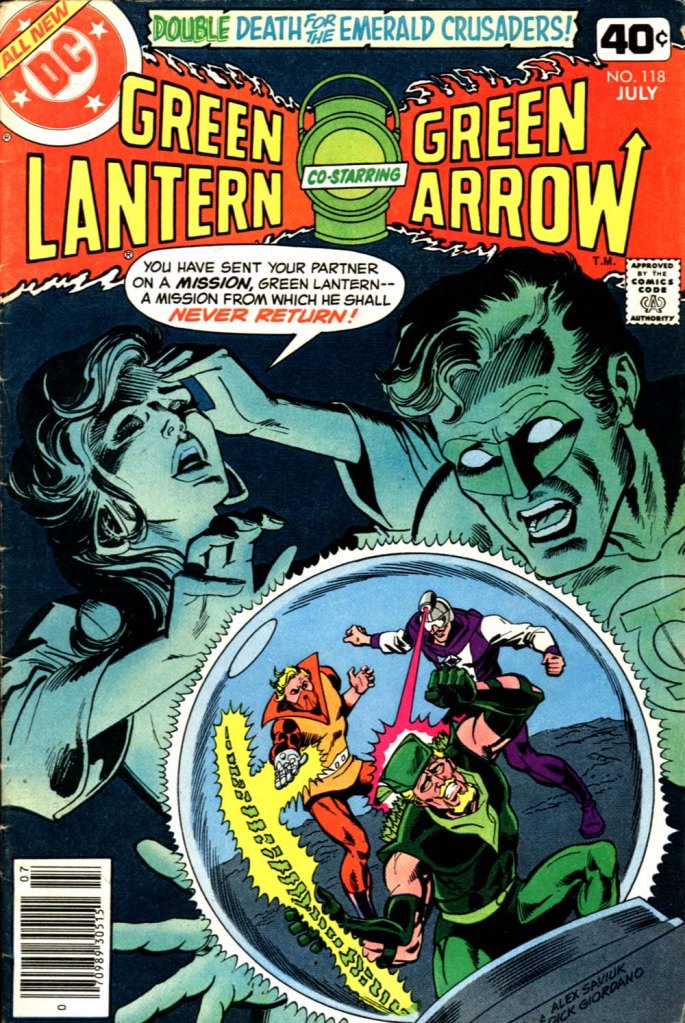
It speaks to the essential appeal of Green Lantern as a character that I continued to follow his series for long stretches of tie even when I wasn’t really enjoying it all that much. And this period that we’re in right now is something of a nadir. Hal was still paired up with Green Arrow in emulation of the impactful relevance issues of several years prior, but this wound up meaning in practice that Green Lantern became almost a spectator in his own series, as writer Denny O’Neil was clearly more comfortable working with Green Arrow and his girlfriend the Black Canary. Denny was a more down-to-Earth writer, and so whenever he’d have to get into more galactic situation of the sort that Green Lantern almost demanded, he had a tendency to whiff it a lot of the time.

One of the big missteps of this run was the introduction of Kari Limbo as a love interest for Hal Jordan. Not only was she an attempt to cash in on the public’s recent interest in ESP, but she was introduced as Guy Gardner’s fiancé. And yet, within a day of being told that Guy has been killed, she and Hal are already making eyes at one another. This was off-putting, it just didn’t work and it didn’t speak well of either character. And yet, clearly Kari was a character that Denny was invested in, as he continued to make her more and more important to the narrative.
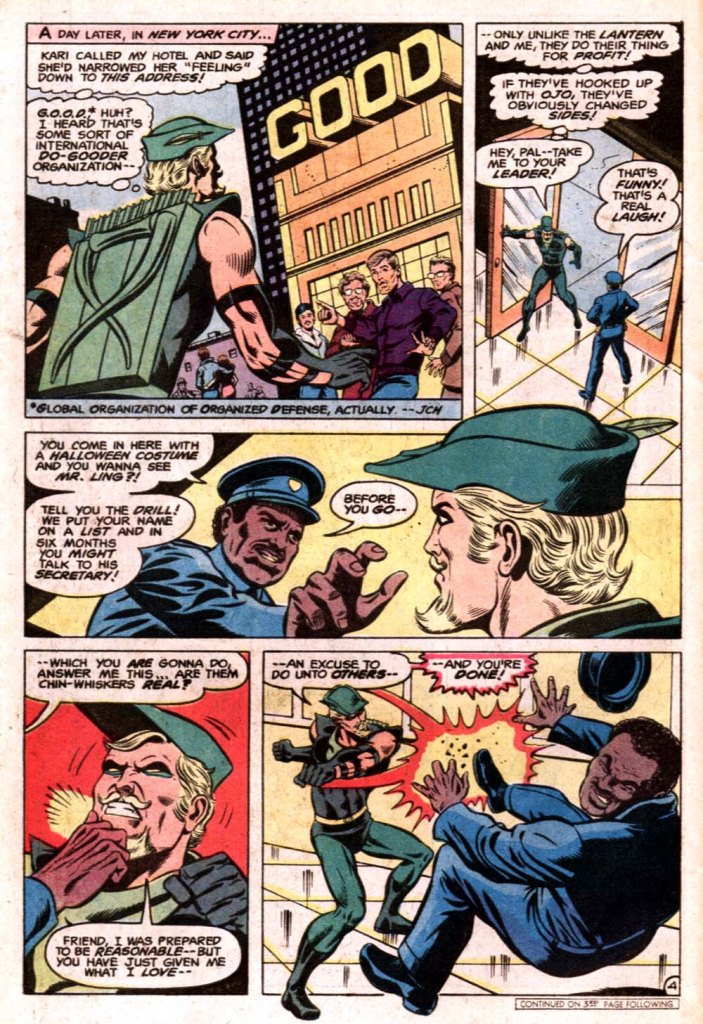
So this issue opens with Kari trying to get a psychic bead on the Crumbler and Professor Ojo, a pair of villains who has escaped the green team last issue. So as to not make things too easy, kari comes up with two possible locations, and so Lantern and Arrow split forces, with GA heading to New York while the Lantern accompanies Ms. Limbo to a wilderness area near Star City. Now, given that Star City is Green Arrow’s usual stomping grounds, you’d figure it’d maybe be smarter for him to go there, but no such luck. Instead, he heads to the Big Apple, where he interfaces with a bunch of characters that Denny had created for the KUNG FU FIGHTER series, the operatives of G.O.O.D.

This, at least, provides an excuse for some action, as the Arrow needs to fight his way into the building to meet with top dog Barney Ling. I suppose if it had been Green Lantern who had gone here, this sequence would have been over too quickly. Anyway, Ling tells GA that Professor Ojo doesn’t work with G.O.O.D. but he does have a handy electronic dossier on the Professor that can bring the archer and the readers up to speed on the eyeless villain’s backstory. Meanwhile, Green Lantern and Kari have followed their own trail to an atomic energy plant of exactly the sort that Ling theorized might be Professor Ojo’s next target.

Hal’s attention is drawn to the scene where the Crumbler is destroying a car that’s being driven at him, sending it careening off a rocky cliffside. When Hal moves to save the driver, this somehow gives the Crumbler enough time to get away again–clearly GL isn’t really working up a sweat here looking for him or anything. The driver turns out to be the Crumbler’s fat cat dad Tuttle, whose company is working on constructing the atomic plant. He deliberately tried to run down his son, believing the Crumbler to be an irredeemable menace. Once the Arrow returns from New York, though, Tuttle shows off the plant’s security to the heroes, saying that there’s no way that Ojo or his son would be able to penetrate these defenses.
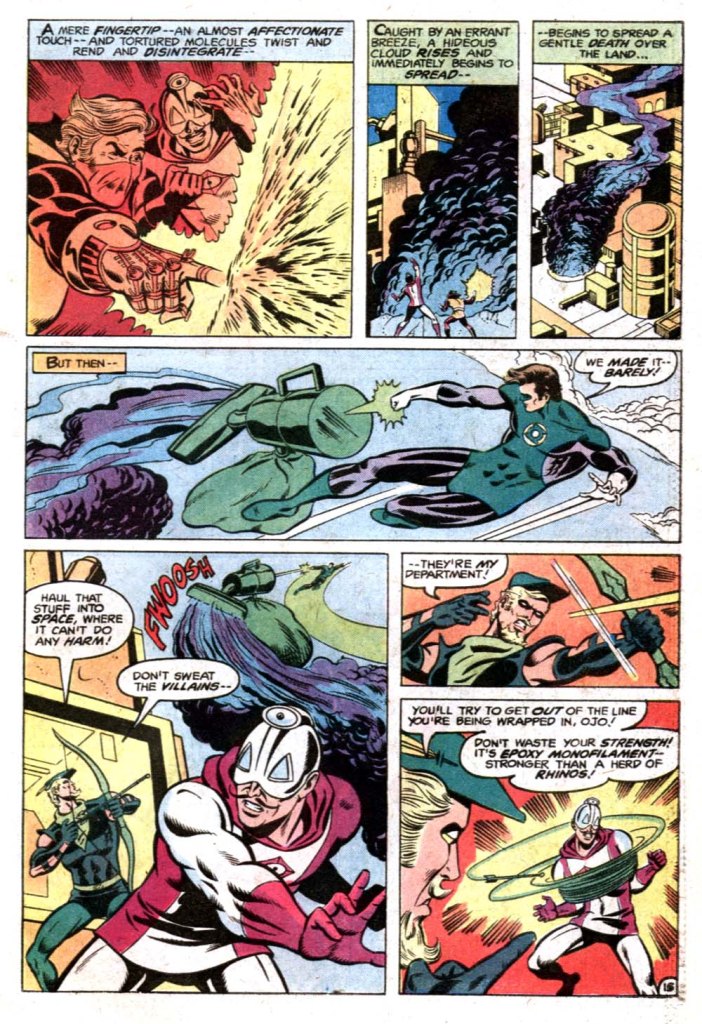
While having lunch afterwards and complaining about the quality of the chili served in the local diner, Green Arrow has a realization: Ojo and the Crumbler aren’t going after the plant itself, but rather the unguarded tanks that hold all of the radioactive waste that the plant produces. And he’s right–the villains have been tunneling towards their objective using the Crumbler’s power to disintegrate matter to carve themselves an underground pathway. They then begin to release the toxic waste in a deadly cloud that will blanket the area, killing everybody (including them, presumably–not the best-thought-through villain plan of the week here.) But Green Lantern arrives in time to suck up all of the deadly toxins in a power ring-generated vacuum cleaner and ferry them off-world where they can’t do any harm.

This leaves it to Green Arrow to do the heavy work of clobbering the two bad guys, which I’d imagine is how Denny prefers things. and that’s the ballgame, except for a final page wrap-up that sees Kari watching Hal recharge his power ring and coming on to him, and him reciprocating. What a tool. Remember, Hal only told Kari about Guy’s death maybe two, three days ago, even though it’s been a month for readers. So this just feels icky all around, a bad moment that wasn’t truly thought through enough–especially as Kari’s feelings for Guy Gardner were and will be treated as genuine and lasting.
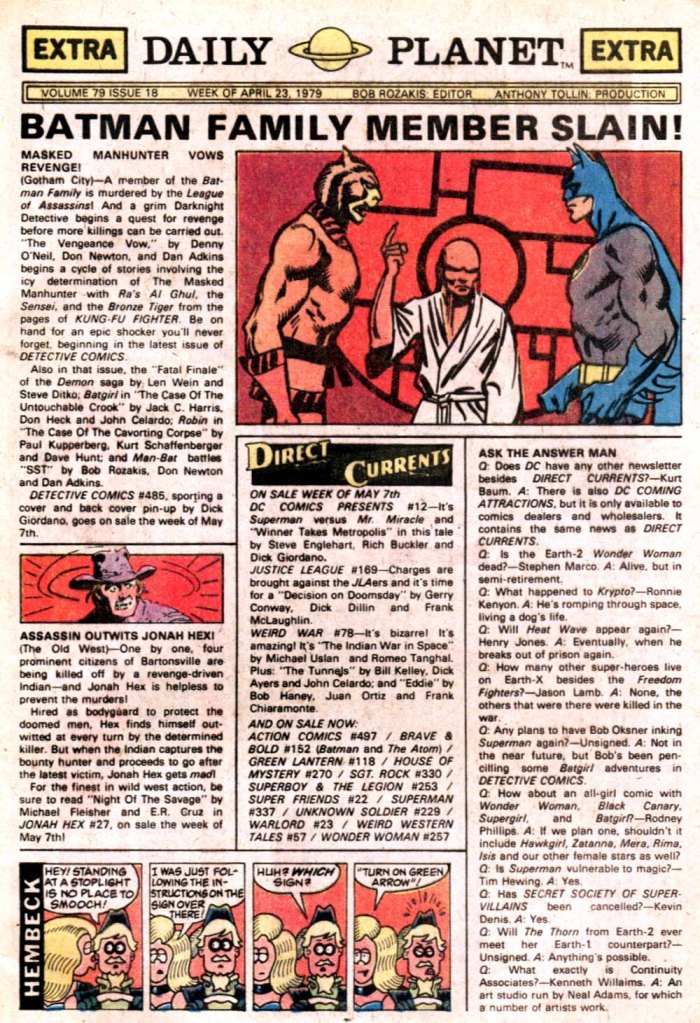
Still, I did get a new installment of the Daily Planet promotional page in this issue, which once again included Bob Rozakis’ Ask the Answer man column as well as another short comic strip by Fred Hembeck. This joke stuck with me, and I’ll still occasionally think of it when driving around and I come across one of the signs mentioned.
 The Tom Brevoort Experience
Hembeck: Yeah that was funny.
LikeLike
I’ve enjoyed a number of O’Neil’s Batman and Spider-man stories, but with respect to O’Neil’s stature as a writer he often delivered dialogue that sounded clunky and unnatural….. to my ear anyway.
“and you make me feel as Guy did… Like a woman.” Yikes…. is that’s the kind of talk that revs GL’s engine?
LikeLike
“Direct Currents” on sale list, Batman vs the Bronze Tiger & the League of Assassins. Writer Denny O’Neil, drawn by Don Newton, inked by Dan Adkins. Three celebrated pros. I’ve gained a huge appreciation for Don Newton’s work and never had the chance to get the best comics he drew while he was alive.
I was 15 when I 1st went to a comics show. Don had passed away 2 years before. And the back issue dealers were talking about how much they liked his work. The few issues I’d seen of his art were smothered by Alfredo Alcala’s inking. It’d be years before I found some back issues with Adkins’ & Bab Smith’s inking. Which was more compatible with Don’s style, to me.
But the events if that story were referenced in the original DC “Who’s Who”, in Bronze Tiger’s entry, and in the League of Assassins’ entry. I finally got to read it maybe 10 years ago.
LikeLike
While it doesn’t make the story any better, or the rushed intro of Kari Limbo — who was clearly intended to be a romantic interest for Hal, Denny just moved things along too fast — it’s probably worth noting that this is when Denny was either in the trough of his drinking or starting to climb out of it; he’s made reference to his editorial days at DC as times he’d be bringing a Thermos full of vodka to his desk every day.
So he was struggling, and that may help to explain the writing problems, even if it doesn’t excuse them.
Interesting that he was bringing back stuff from KUNG-FU FIGHTER both here and in ‘TEC, as alluded to in the Daily Planet feature. Since I’d never read KFF, I had no real idea where G.O.O.D. and the Bronze Tiger came from (I was not giving these stories a lot of attention, I think), but that he was reaching back to that well in two books at once is notable. Maybe it was easier than cooking up something new. Or maybe he liked writing these characters and just wanted to do it some more.
LikeLike
It does seem like O’Neil was struggling on Green Lantern. On the other hand, I think his Batman stories during the same period are solid. Bronze Tiger works really well as a Batman villain, whereas Professor Ojo doesn’t have much going for him in any context.
To be fair, Green Lantern is a character a lot of otherwise great writers have struggled with, going all the way back to his original ’60s run.
LikeLike
I think Denny was more suited to Batman (and to Green Arrow) than to Green Lantern, but I never thought his late-70s Batman stories were a particularly high point.
The late-60s/early-70s stuff, absolutely. But by the late-70s we were getting things like the Great Gotham City Kangaroo Race and, if I remember correctly, Maxie Zeus.
LikeLike
One of my all-time favorite Batman moments comes from a Maxie Zeus story: Zeus steals a rare item to give as a birthday present to his young daughter. Batman arrives to confiscate the stolen property and take Zeus in, but he takes special care to not humiliate him in front of his kid. He brings the girl a doll so she doesn’t go without a birthday gift, and simply tells her, “Your Daddy has to go away for a little while” before he hauls him back to Arkham. Because Batman knows better than anyone how fragile a kid’s psyche is, and he’ll be damned if he does anything to traumatize her. Zeus is so grateful, and impressed, that he goes without a fight. O’Neil was really good at highlighting Batman’s compassion, which is something that sometimes gets lost under other writers.
LikeLike
I just hate Maxie Zeus.
LikeLiked by 1 person
The Richard Dragon book was based on novels he had written under a pseudonym (“Jim Dennis”) with a writer named Jim Berry. I’d guess he felt comfortable with them.
I also wonder if this block of stories were not intended to harken back to Dick Giordano’s “action heroes” period at Charlton with more “street-level” antagonists?
I will admit I prefer Green Lantern in more of the mode of the John Broome Stories (or derivatives of that like Marv Wolfman’s. run). However, this had more direction than a lot of Mr. O’Neil’s work on the strip.
LikeLike
In addition to the bad romance, Kari was a painful Roma stereotype.
Me buying GL during this period was a textbook example of, as Mr. Brevoort puts it, subsidizing mediocrity.
LikeLike
Roma people in the US have an interesting experience that is a lot broader than things in comics like Kari Limbo, Madam Xanadu and Gypsy.
Or things in other parts pf pop culture like (and I suspect this was a direct inspiration for Kari Limbo) The King of the Gypsies (https://www.imdb.com/title/tt0077807/).
LikeLike
Yep, like most minorities they’re more complex than the stereotypical images.
LikeLike
Kari Limbo, Arisia, honestly, Hal should’ve stuck with Eve Doremus and her Mxy hat.
I was about 12 when this run was coming out and while recognising that the likes of Replikon, the Crumnlee, Ojo and bleeding Itty were pants, I enjoyed it, probably mainly for Dinah and Ollie.
LikeLike
I know, you should better say nothing than anything bad, but Alex Saviuk and Dave hunt are to artists I could never get warm with. I didn’t like Alex’s pencils ever nor Dave’s inks. PArticularly the inking of the eyes. For me those two are the low bottom of Pre-Crisis, especially when they were working on Superman.
LikeLike
Saviuk had a bit of a Gil Kane influence with the elongated figures, so I saw why Julie Schwartz used him on GL (and The Atom and Marvel used him on Spider-Man.
I liked this run, but preferred Wolman/Staton .
LikeLike
It’s about comparison. I rarely saw a GL comic on the spinner rack.
I did get to read some of the classic Adams/O’Neal issues though.
There is no comparison. Based on the cover, I would have never bought the comic and the interior art doesn’t help either.
As for the writing…do you really have to resort to a bottle to try and explain it away? I recall some earlier JLA issues that were far worse.
It’s sort of like myself. I have a few really good ideas but then nothing. It would be something to script thousands of pages at that earlier Adams/O’Neal level. The artist can go on and on. All one has to do is compare Adams’ art with this issue.
Just imagine taking this artwork (not the Adams) and sticking it on say the Byrne FF run. I think it would have punched out the sails and the sales.
LikeLike