

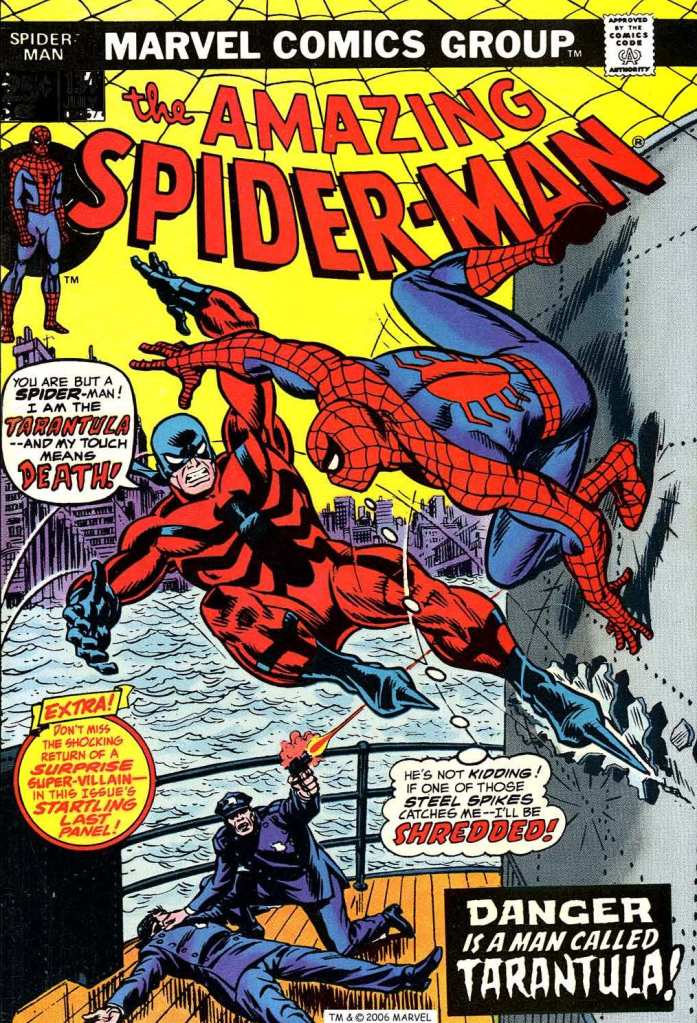
AMAZING SPIDER-MAN continued to be Marvel’s most popular and consistently best-selling title throughout the 1970s, as the character began to have a larger footprint across popular culture. So it wasn’t any surprise that my grade school buddy Donald Sims had a number of issues in his comic book collection. Like the couple of Fourth World books he had, my understanding is that these were all given to him by some older cousin or other family member who had outgrown them (or whose parents felt that they had at least). So this allowed me to increase my knowledge of the web-spinner’s history by borrowing these books from Don and educating myself further. This particular issue introduces one of writer Gerry Conway’s favorite recurring villains, the Tarantula, he of the pointy shoes. Gerry used the guy a lot, and even created a successor for him after future ASM author Roger Stern, who didn’t love the character quite so much, transformed him into a massive monster spider before killing him off. But that was all ahead in years to come at this point.
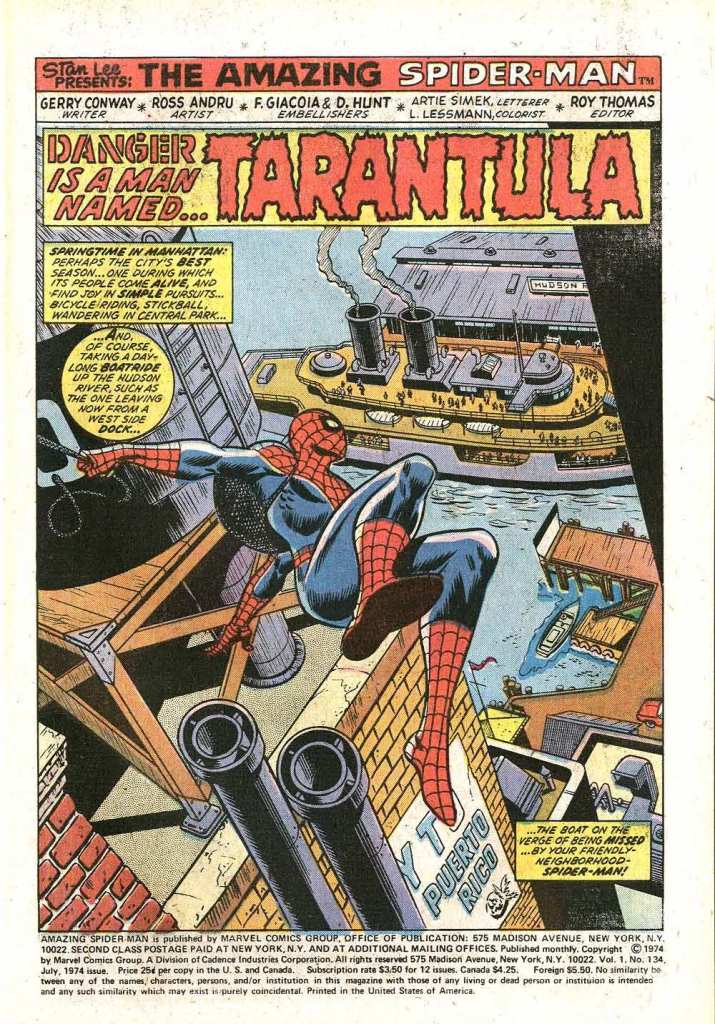
A moment here to talk about Ross Andru, the artist whose work came to define the look of the wall-crawler throughout most of the decade. Ross was a little bit of an acquired taste, not always the prettiest artist, but he got and kept his job on AMAZING thanks to a recommendation from John Romita, who’d been a big fan of his work, and due to the fact that he could always tell an exciting story. Ross was also the first artist to truly make New York City a character in Spider-Man’s world. Prior to this, Romita and others would tend to depict a relatively generic Manhattan. But Ross did the work, venturing into the city and taking reference photos of the places the story would be taking Spidey to. this splash page is a good example of that. Ross shot a photograph of the Hudson River docks from a nearby building, then used it as reference, placing Spidey into the image. I don’t know that most readers cared all that much, but it’s still something to appreciate.
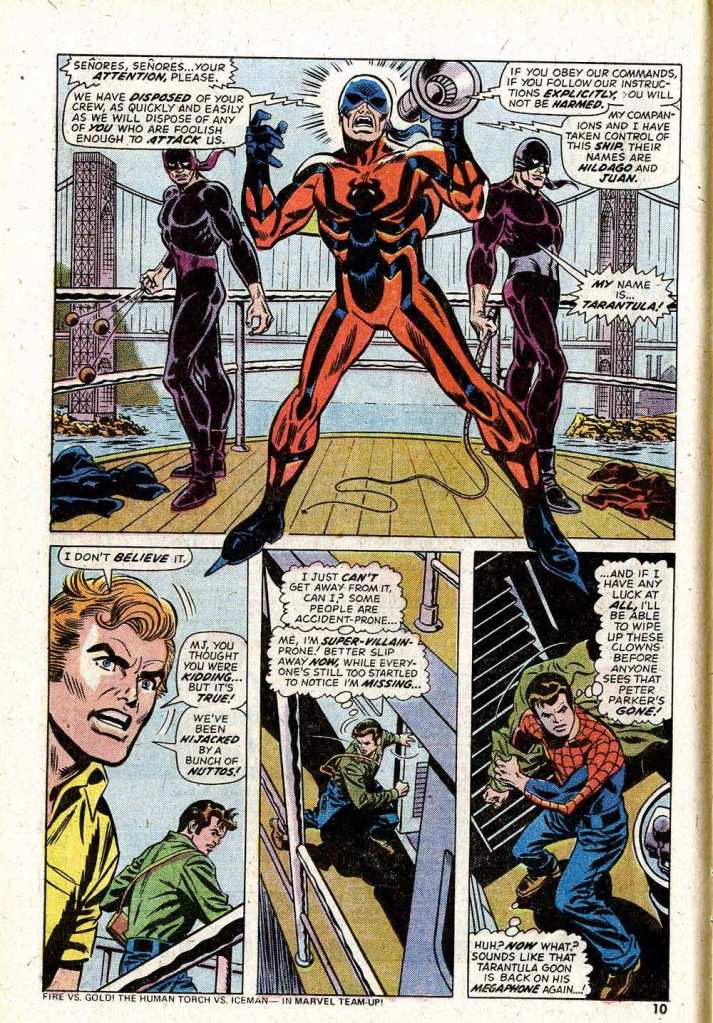
Writer Gerry Conway’s Spider-Man always came across as a bit more stressed and manic than the Spidey of Stan Lee, in part due to the manner in which Ross would cartoon the expressions of his characters. Gerry’s Spidey always seemed one bad day away from losing it completely–he was tightly wound, and that feeling of anxiety and tension permeated most of the stories. Of course, Peter Parker had some good reason to feel this way, his longtime girlfriend Gwen Stacy having been offed right at the start of Conway’s tenure by his old enemy the Green Goblin. All of this is to say that the Gerry and Ross Spider-Man had a particular flavor all its own. It wasn’t quite the Spider-Man from before it, nor the one that was to come. But it was distinctive. No other character in comics reacted the way that Conway’s Spider-Man did. You either liked it or you didn’t, and while it didn’t immediately click with me, I do have to say that I like it for the most part.
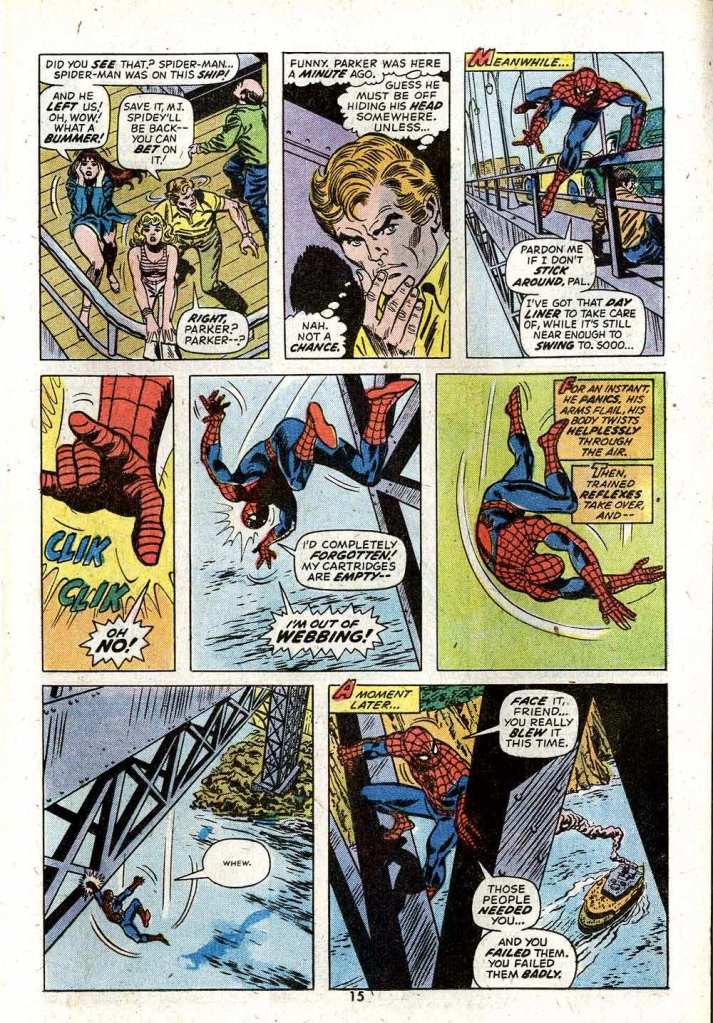
Gerry’s Spider-Man was also often something of a klutz, as on this page where, having saved a man thrown overboard by the Tarantula, he attempts to get back to the boat, forgetting that his web-shooters have discharged all of their contents. This was an extension of Lee’s version of Spidey as a hard luck hero, but somehow Conway dialed it all up to eleven. His Spidey wasn’t incompetent, but he was so tightly-wound that he’d occasionally do something exceedingly foolish or stupid.
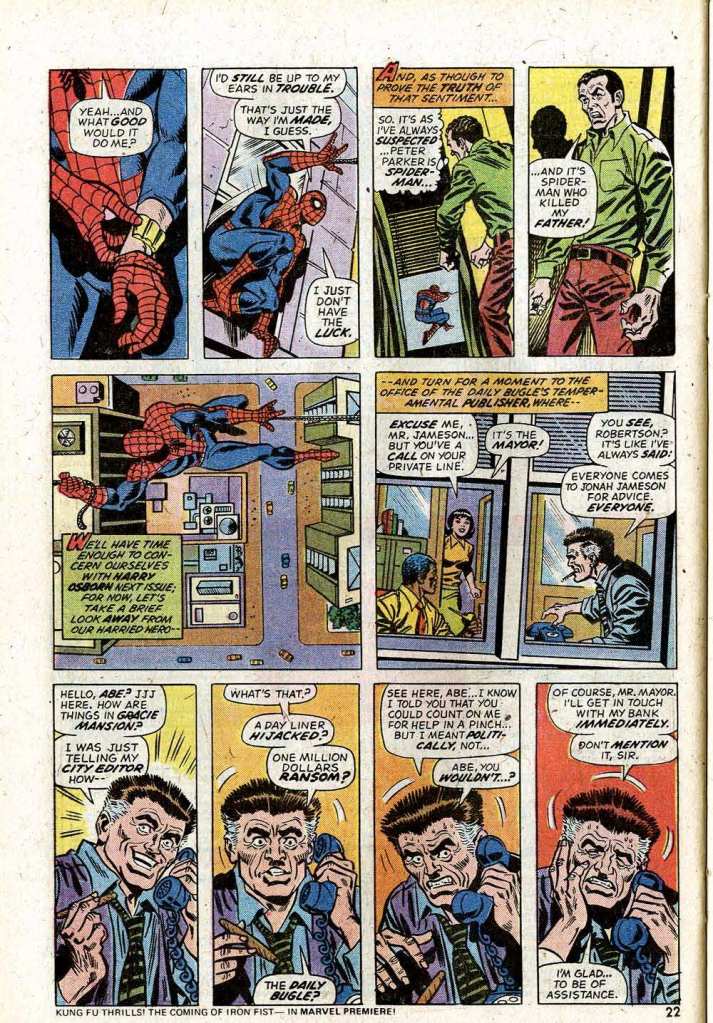
Conway and Andru also continued to use Daily Bugle publisher J. Jonah Jameson as a comedic foil for Spidey, as on this page here. And in fact, this page is a good example of the kind of thing that AMAZING SPIDER-MAN had to offer. In addition to the central action of the issue, in which the cruise that Peter Parker and his friends are taking around Manhattan Island is hijacked by the Tarantula and his goons, we also get on-the-fly subplot shenanigans, such as Peter’s roommate Harry Osborn confirming once and for all that Peter is really Spider-Man when Pete returns to their apartment to score some more web-fluid. And then we drive-by Jonah for a fun bit of comedy, as New York mayor Abe Beame calls Jonah up hoping to convince him to put up the ransom money that the Tarantula is demanding. Jonah would rather die than part with a nickel, but Beame has him right where he needs him to be, on the spot. Ross’s Jameson, inked here with a harsh line by Frank Giacoia, looks a bit more like a gargoyle than a human being. On a separate note, they didn’t do it for all that long, but I have fond memories of those little ad lines plugging other Marvel books that ran at the bottom of the pages in this period. They were crass, but also memorable, and for somebody like me who was coming to this book as a back issue, invaluable for becoming intrigued by what else was on sale at the time.
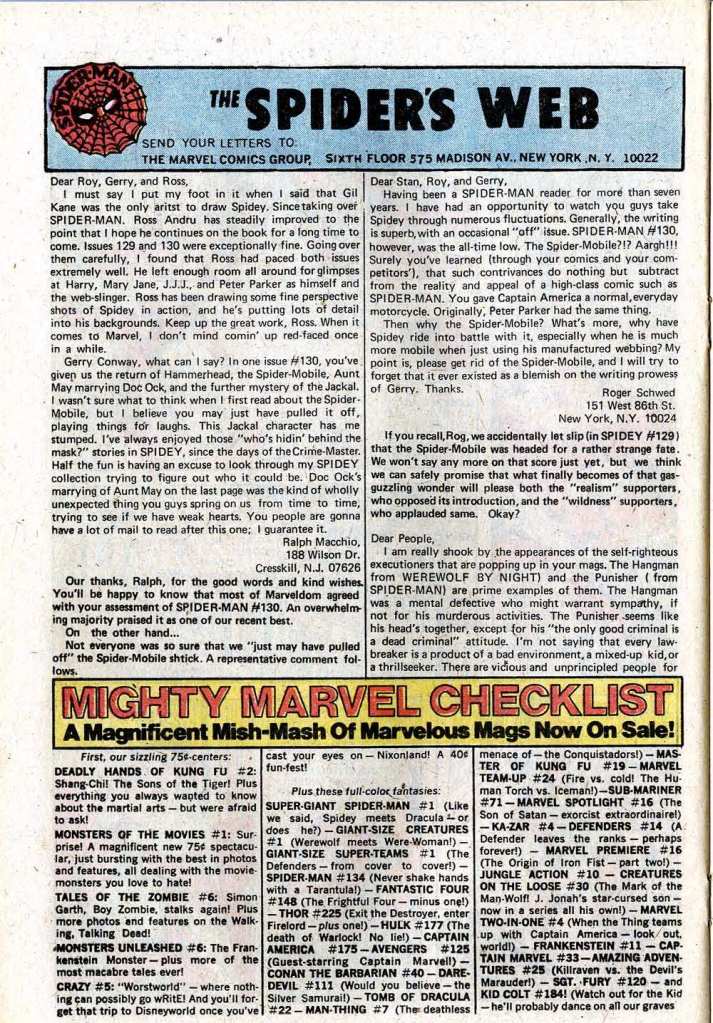
This issue’s two-page letters page is plopped right in the middle of the story, and includes a missive from future Marvel editor and writer Ralph Macchio. Ralph seemed to be enjoying what Gerry and Ross had been doing recently. This spread also included the bane of 1970s comic book collectors, the Marvel Value Stamp. This issue’s was #3, Conan the Barbarian. The idea was, in the manner of a coupon booklet of the period, you would collect all of the comics with the 100 stamps in them, cut them out and paste them into a stamp book that you could get from Mighty Marvel, and in doing so win some manner of prize. Who can say how many 1970s comic books were mutilated by this promotion? It’s a lot of them, for certain. The Marvel checklist was also jammed in here, with more titles than could ever possibly be properly listed, so it feels like it’s under pressure too.

So after a bunch of mad scrambling, Spidey winds up making his way back to the captive ship thanks to a lift from a helpful helicopter, and he’s able to get into it with the Tarantula and his men just moments before Flash Thompson, who put up a show of resistance, can get himself perforated. But the nimble Tarantula is able to score a hit on his web-attired enemy with his drugged shoe-talons, causing Spidey to start to trip out and lose his faculties. And that leads into the big cliffhanger of the isue.
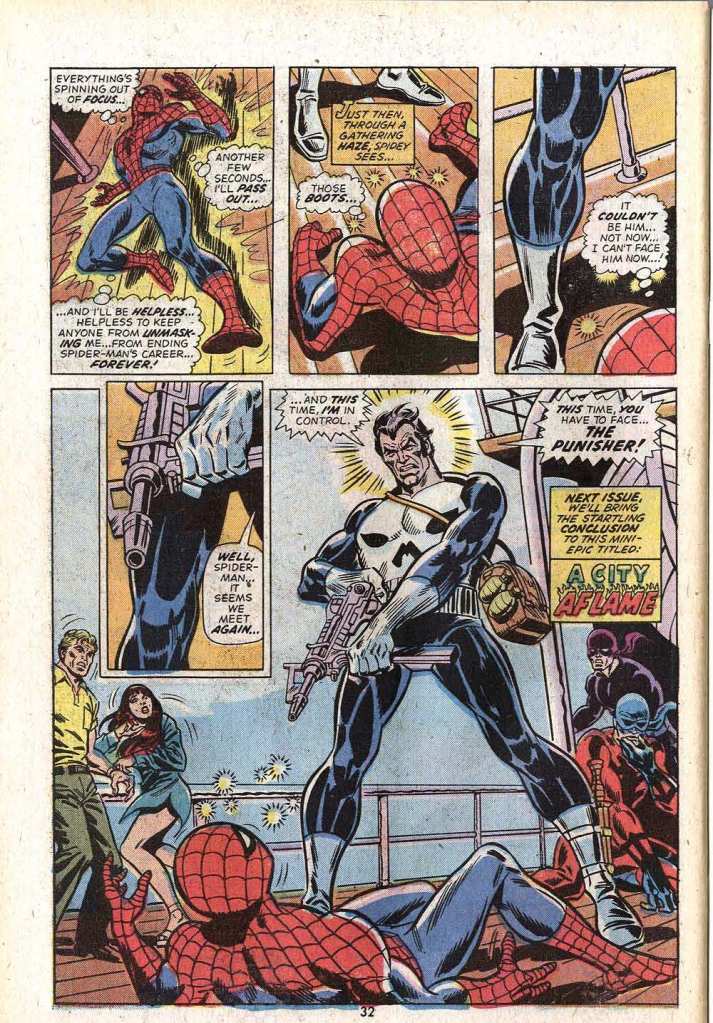
In his delirium, Spidey looks up and sees, in only his second appearance, the Punisher pointing a somewhat teched-out looking firearm at him. This was before anything had yet been revealed about the Punisher’s origin, his real dame wasn’t even known yet. He’d just had one misguided battle with Spider-Man at the prompting of the Jackal, and called it off when he realized that Spidey wasn’t the murderer he thought he was. But his appearance here is framed as bad news for the wall-crawler, and definitely makes it feel like the stakes in the story have been suddenly raised. How this would all work out I’d have to wait literally years to find out, as Don didn’t own the second part to this story and I wouldn’t read it until it was reprinted years later in MARVEL TALES.
 The Tom Brevoort Experience
This issue is not just important for featuring the second-ever appearance of the Punisher, it also has a place in ska punk history! The Spider-Man figure on the Mike Zeck cover of the Marvel Tales reprint of this story (#210) was repurposed as the logo for seminal ska punk band Operation Ivy.
LikeLike
His Spidey wasn’t incompetent, but he was so tightly-wound that he’d occasionally do something exceedingly foolish or stupid: Like forgetting that it isn’t the fall that kills you but the sudden stop ( Gwen Stacy ) or here making sure your web-shooters and belt have web-fluid cartridges in them just in case you need to go do some saving. Question, shouldn’t the Tarantula’s boots leave big holes in people he stabs with them. Those spikes are wicked.
LikeLiked by 1 person
I was for one was excited when it looked like the Brand Corporation was going to give the Tarantula spider-powers [ The Amazing Spider-Man#234 ( November 1982 ) ] only to see him get turned into a spider-creature [#235-236 ( December-January 1982-1983 ) ] instead. With Spider-Man’s strength, speed, agility, durability & spider-sense the Tarantula was always outclassed ( Only the help of the writer made it seem he was any kind of threat ).
LikeLike
I suppose Tarantula’s feet-spikes are like Wolverine’s claws (at least in that era). They don’t seem to make the sort of big gashes one would expect when used on people. How is he apparently shredding metal plates on that cover, anyway? He only has human strength, and the spikes aren’t stated to have special disintegrating ability.
As you note, he really shouldn’t be a Spider-Man threat if he’s just a top-human athlete with drugged spikes. Wrap him in some webbing and he’s not jumping anywhere.
LikeLiked by 1 person
I like Tarantula a darn sight more than the Punisher. At least Tarantula owns his villainy.
LikeLiked by 1 person
Ahh, Andru/Giacoia. So much better than Andru/Esposito.
And that splash page, with Giacoia and Hunt preserving the depth implied by the pencils rather than flattening out out like Espo would have, is a prime reason.
Plus, JJJ is a gargoyle. So that’s nice too.
LikeLiked by 1 person
I’ll take Conway & Andru’s tightly wound Spider-Man any day over the tortured man-child we currently have.
LikeLiked by 2 people
Am I crazy, or does that splash page act as an interesting twist on the idea that new comics writers should never show more than one action in a comic panel? Here, Spidey is grabbing onto Hidalgo’s wrist and talking to him, but then gets jabbed by Tarantula. It shouldn’t work, but because the reader’s eye flow is forced to follow the circle from the first word balloon to Hildalgo to Tarantula to the foot stabbing Spidey to the last word balloon, it sort of works (the middle word balloon might have been placed better). It’s definitely a “kids, don’t try this at home” moment for comics art, but it’s effective.
LikeLiked by 1 person
It’s not “one action per panel,” but “one action by a character per panel.” You can draw a panel where MJ is pouring coffee while Spidey comes in through the window, but you can’t draw a panel where Spidey comes in through the window and drinks some coffee. People who think like screenwriters while trying to write comics make this mistake all the time.
In this case, what’s going on is that Tarantula is succeeding at jabbing Spidey because he’s busy punching the guy, so the two actions are taking place simultaneously. And Andru has arranged this so the reader takes in the punch first and sees the jab second, after the balloon.
He needed a big panel to do that. But a lot of times, even in smaller panels, artists show “the bit you’re supposed to notice first” at the top or left part of a panel, and “the bit you’re supposed to take in second” lower or to the right.
It becomes a problem when an artist draws a panel like that but gets the bits graphically in the wrong order, or doesn’t leave space for dialogue to appear above or to the left of a bit the reader should take in after the dialogue.
It’s like drawing the guy who speaks last in the panel in the top left; it makes it a problem of reading order more than of simultaneity.
In this case, though, Andru does it perfectly. We get the punch and the word ballon and then see the jab. He knew how to make the story flow smoothly.
LikeLiked by 2 people
I read this at the time and found what Conway was doing original.
More than 50 years later, I see the influences on this (Pendleton’s The Executioner, for example). The Tarantula is)a Latino stereotype. but Conway did tie his origin to unrest in Central America, areal part of the Latino in the: EEUA” experience, then and now,
As young as Conway was, it wasn’t bad. He grew from there.
I also laced how Andru drew the City. Ditko did some of that, but it was less systematic and more impressionistic (the Vulture out in a barn on Staten Island in an early issue, for example).
LikeLiked by 1 person
I responded then and now to the coloring and the color choices. Red and blue and black…on that newsprint.
The digital color on the shiny paper just doesn’t grab me.
Also the characters have “weight” and the placement is really good. Andru will show Spider-Man in all these weird angles but it still has a realism to it.
As to the story telling, there’s been over a hundred issues and there got to be a sense of well here’s Harry and this is what’s going to happen and so on with the other characters.
And that’s the challenge do you give readers that familiar if Parker, then Aunt May = . and so on with the other characters.
I could tell this really intense story with the Rhino and JJJ, but to some extent it’s already been done before. I freely admit that I’ve only read about the first 250 or so issues so I don’t know that I would be breaking any new ground — Slott did when he body swapped. But then some stories like Spider clone, Gwen clone or whatever she was, just killed it.
A lot of the rogue’s gallery are blah, but somehow they ran off with Daredevil. But it comes down to what is done with them and the art. So encase Spider-Man and hang him upside down from the Statue of Liberty which gives Paste Pot Pete a new found respect 🙂
LikeLike
The Tarantula, as other commenters have said, was ludicrously outside his weight class here. However I do love the Punisher’s amused, cynical reaction to Peter’s idealistic speech in the next issue.
LikeLiked by 1 person
I enjoyed this run a lot. I always felt Tarantula would have been better suited fighting Daredevil, but I suppose if you’re named after a spider, you belong in old web heads Rouges gallery.
LikeLike
70s Spider-Man is seriously underpowered in so many stories. Roger Stern, years later, made it painfully clear that Tarantula stood no chance against an experienced (and angry) Spider-Man.
LikeLike
Speaking of under-powered what’s with Spider-man just standing there on the cover? Did he just take a Zoloft or something?
Was there some pacifist grass lasses that really dug the Spider-man hands down?
LikeLike