

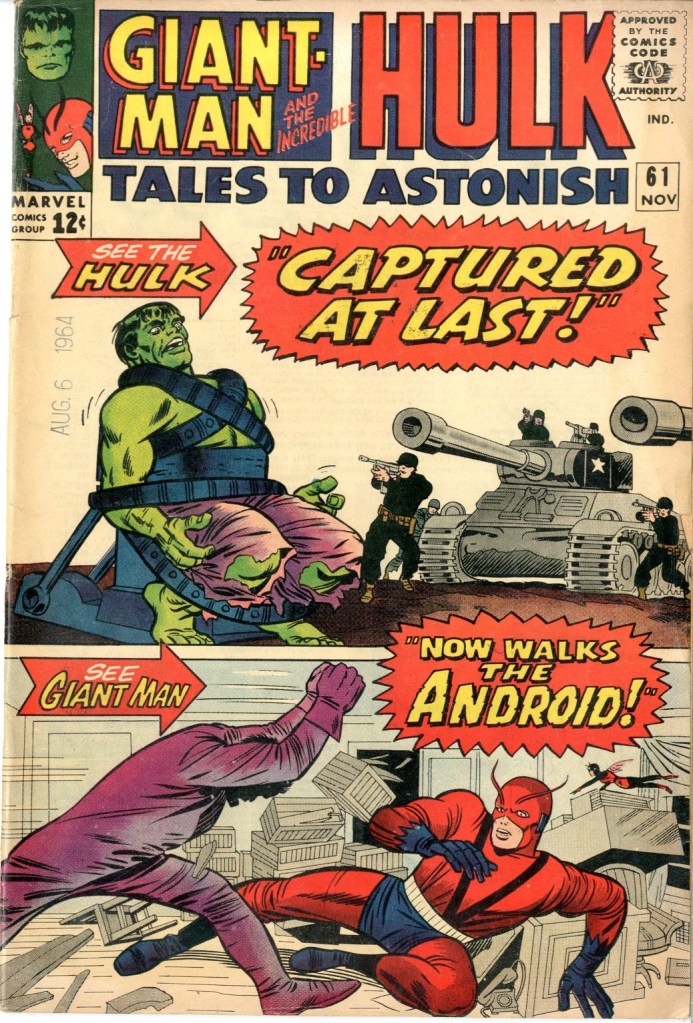
Here’s some more new business building on old business that has just cropped up. It’s been a number of years now since I first wrote about the catastrophic journey of getting the Giant-Man story that saw print in TALES TO ASTONISH #61 to print:
And also a few years since Dick Rockwell’s unused splash page showed up at auction, giving us some new insight into the making of this story:
And now, we’ve got another piece of new evidence, one that provides a bit of important context while simply being cool in and of itself.
But before we dive into that, to recap for anybody who doesn’t want to wade through the preceding two pieces: the Giant-Man story in TALES TO ASTONISH #61 had been promoted as featuring artwork by Dick Rockwell, an artist who had worked for the company in its pre-super hero days and who was best known within the field as a newspaper cartoonist. Instead, the story that finally saw print was a mess, with several hands in evidence–attributed primarily by editor Stan Lee to Steve Ditko and George Roussos, but which had mostly been penciled by Joe Orlando before extensive revisions were made. Or at least, that’s what we believed until the appearance of that splash page made us rethink. And now we’ve got another page to consider as well
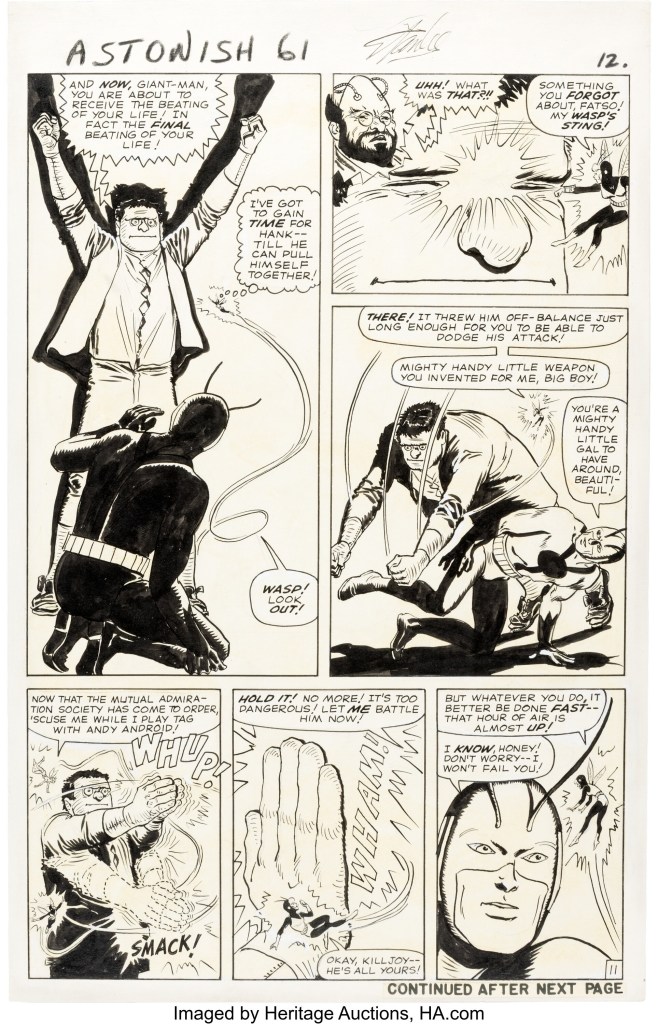
What we see here above is an unused page from the story in question. Here’s what Heritage Auctions has to say about it in their listing for the page:
Joe Orlando was tasked with providing the art for the story after the planned artist backed out of the project, but when Stan Lee didn’t like what Orlando had done and wanted things redrawn for no additional pay, Orlando quit! Stan was forced to bring in Steve Ditko and George Roussos to redraw much of the story, with the art being pasted over Orlando’s original pages and openings cut to expose the text underneath for production. Some time after production, it appears major restoration occurred to preserve both Ditko and Orlando’s original art for the page. This is what we believe happened to create the two pages: stats of the front and back of the published page with Ditko’s art were made and the art paste-up was removed, exposing Orlando’s art; Orlando’s art was cut from the original board (just the top art layer) and stripped-in to a replacement board, and the back stat was adhered to that board; the front stat of Ditko’s published page was stripped-in to the original board and the Ditko original art paste-up was placed on top of the stat (so the text would be shown); in the end, the two separate pieces of original art were salvaged.
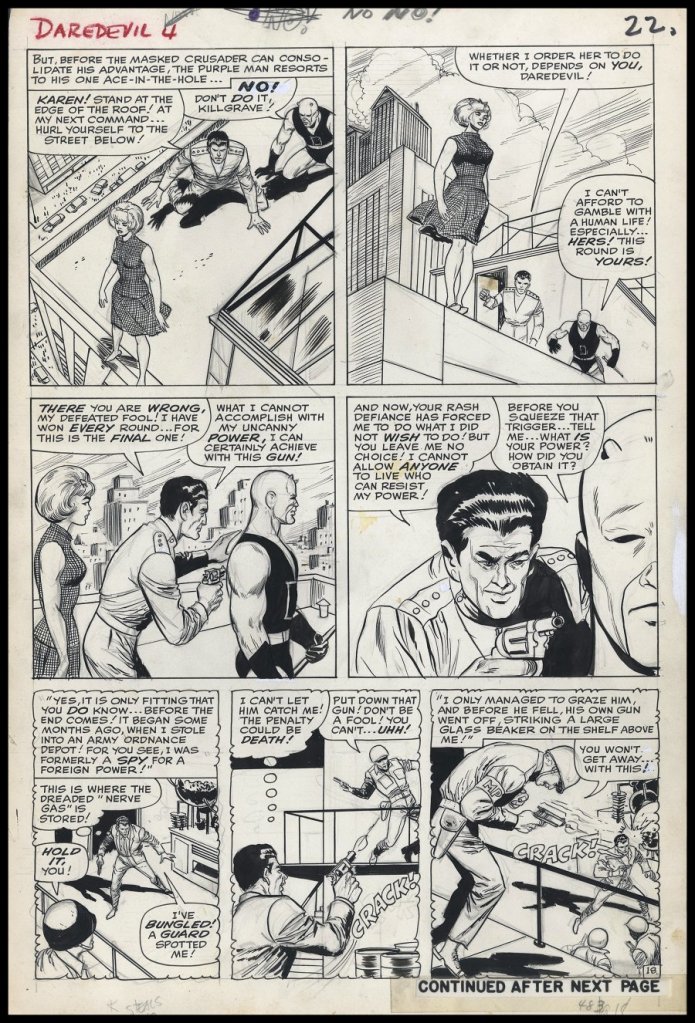
Here’s the thing: looking at this page, I’m not 100% certain it’s the work of Joe Orlando. It doesn’t strike me as looking especially like his handiwork. By way of comparison, below is a contemporaneous page that Joe Orlando drew for DAREDEVIL #4, inked by Vince Colletta. While there is something of a similarity, I don’t know that I’d peg these two pages as coming from the same hand.
No, what I think this really shows is another completed page by Dick Rockwell, the artist who was initially going to be drawing the story and who supposedly quit the story before doing any work on it. And if it is Rockwell’s work, then that brings Orlando’s involvement in the job into question completely. Looking back at the original artwork for the story, it’s clear that the job was all penciled, Stan Lee scripted it and Art Simek lettered it. then, at some point in the inking process, Stan decided that he didn’t like the artwork at all. Maybe it was seeing these inks that did the trick (a thought: is it possible that Orlando was brougth in to ink the job, and thus save it, and that’s where his involvement began? And then when Stan wanted further unpaid alterations, Joe balked and quit as well?) But with time at a premium, Stan brought in Ditko and Roussos to jam out new artwork in short order. And they did so by pasting new boards atop the existing pages and then cutting through them to retain the lettering that had already been done. I’m assuming that even though this would have been labor-intensive for Ditko, it would have taken less time than sending the pages out to Simek to letter a second time.
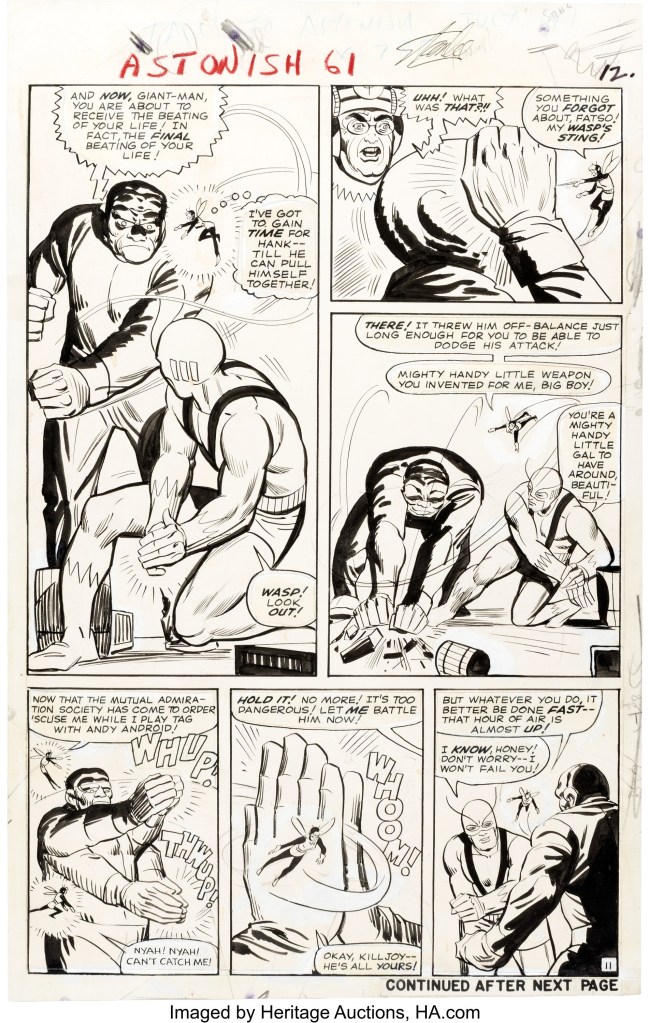
Here’s the page as it saw print, also from the same Heritage listing. Because of the need to maintain the original lettering, Ditko was forced to follow Rockwell/Orlando’s panel breakdowns, if not the specific compositions of the characters within those panel shapes. But the story would have been rigid in terms of its events, Steve and George wouldn’t be able to add in any additional actions or stage anything all that differently. Lee does add a new balloon to Panel 4 where the Wasp taunts the android she’s eluding, a bit of fun to help spice up the moment.
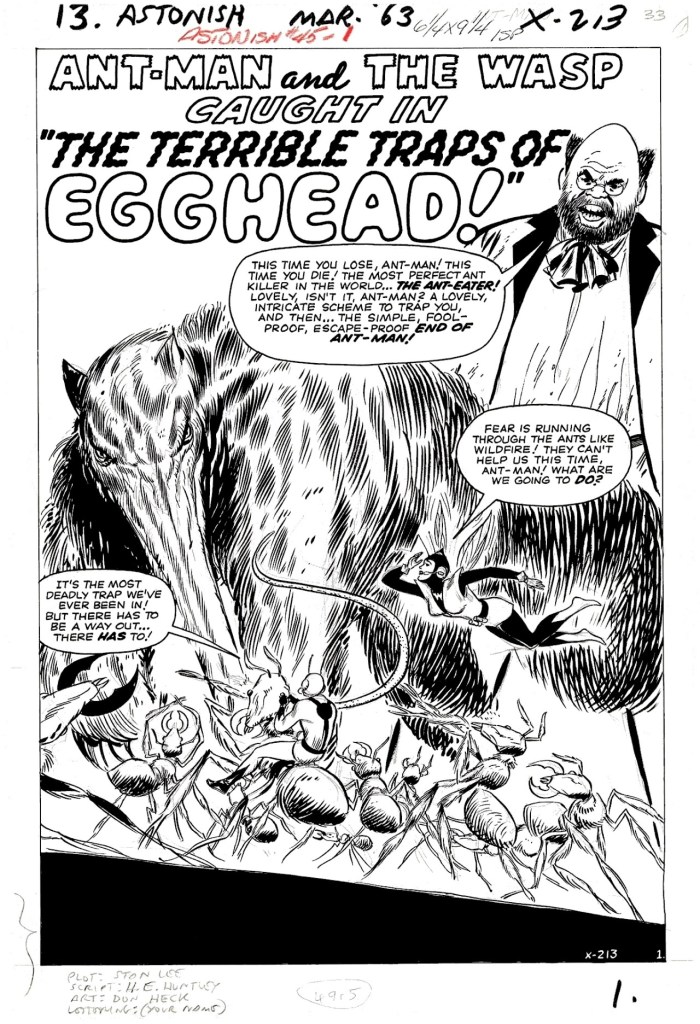
One interesting minor thing is that, on the Rockwell/Orlando page, the artist draws the villainous Egghead in the disguise that he used in TALES TO ASTONISH #45, not realizing that he’d been seen since that time. I assume that Lee or somebody else in the office passed Rockwell/Orlando that incorrect reference and only figured out the mistake when it was time to go over the inked story. Ditko clearly draws the properly established Egghead all throughout the story.
Ditko’s design for the android is also a lot more menacing than the Rockwell/Orlando interpretation. This as much as anything may have been the reason why Lee decided the story needed a redo. The blank stare on that android comes across positively comical, undercutting the drama of its attack on Giant-Man and the Wasp considerably. It’s a stiff, goofy-looking thing. That said, as weird as the artwork on this page is, I kinda like it. It’s got an undeniable charm to it, and the bold use of blacks is pretty cool.
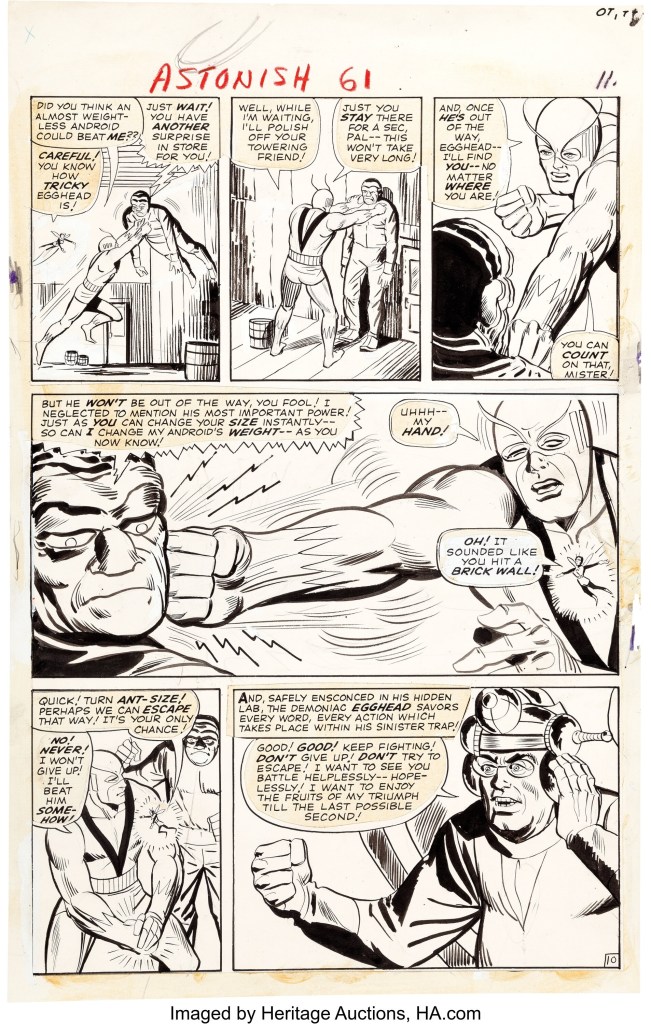
Heritage also still had scans available of two other pages from this job, so I’m posting those as well. One of these was shown in one of the earlier articles on this issue, but it’s nice to have the larger image of it available. It’s easy to see all of the cutting and pasting that went into redoing this page. I’d bet that more Rockwell/Orlando art is buried under these paste-ups.
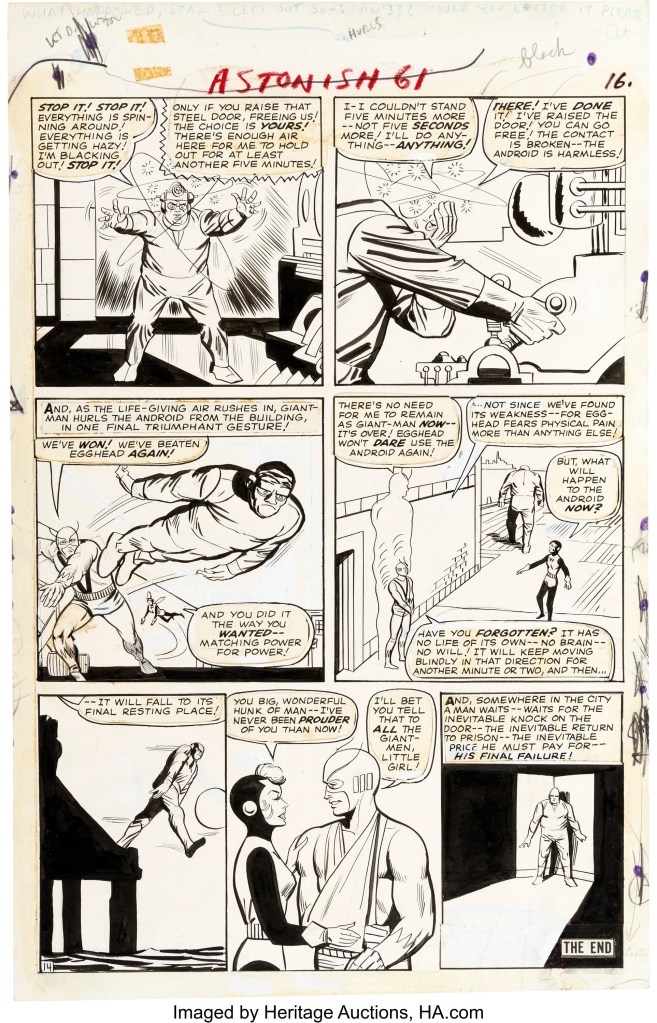
This final page carries a fun note from letterer Art Simek to editor Lee written at the top in non-repro blue pencils. Referring to Panel 3, it says: WHAT HAPPENED, STAN? LEFT OUT SOMETHIN’ 3? ? COULD YOU LETTER IT PLEASE? ART. The final caption in Panel 3 is in fact a paste-up, correcting that mistake. It’s also clear that the Ditko Giant-Man figure has been cut out and repositioned as well, meaning Stan was still tinkering with things even as Ditko and Roussos struggled to wrap up the job. Never before was so much effort by so many hands involved in the creation of a single mediocre Giant-Man story!
 The Tom Brevoort Experience
I like the rejected art well enough. It’s a little “itchy” looking which I like, but not much stranger or “off brand” than some of the other stuff that was coming out of Marvel in those days. The android’s face looks like something that would appear in a Bob Hope or Jerry Lewis comic and isn’t at all threatening. Ditko’s published version is somewhat better in that regard, but one would think that just redrawing the android’s noggin to make it less silly and giving Egghead a shave would have been the better call than a total redo ….. assuming that what was on Rockwell’s pages is more or less what Ditko followed anyway.
LikeLike
Honestly? I like the Rockwell art better than Ditko’s but then I’ve never been a big Ditko fan. I know he’s foundational for most of what came after him. His art is just not to my taste.
LikeLike
I’d always heard that Joe stormed out over a Daredevil issue, not this one, but with everyone gone, who knows for sure? Is there a world in which Orlando never had anything to do with this story at all–just Rockwell replaced by Ditko and Roussos?
LikeLike
“Is there a world in which Orlando never had anything to do with this story at all–just Rockwell replaced by Ditko and Roussos?”
Certainly, in the Many Worlds Interpretation of Comic Books!
LikeLike
For what it’s worth: Dick Rockwell told me he never did any work for Stan Lee during this period. Now, he told me this quite a bit later and from what he said, it sounded like he’d agreed to do the job, Stan sent him a plot (not a script) and he turned the job back because he couldn’t work from a plot. I’m not sure if that’s how he really remembered it or how he preferred to spin the story. It’s obvious to me though that he did some drawing and not just a page or two.
Joe Orlando told me he was assigned to the job and did some drawing. Joe was already unhappy with Stan for requiring so many unpaid redraws on DAREDEVIL that when he told Joe to do unpaid redraws on this story, Joe refused. He recalled it as his resignation from any work for Marvel and why he did not do any more DAREDEVIL after that.
So the question remains as to whether any of what Orlando drew got into the finished story at all. There is also a sub-question there as to whether the work that Joe did do for Marvel then was all done by him. Joe often used ghosts and assistants and I think the DAREDEVIL stories he did look like they were penciled by more than one person…though under Colletta inks, it’s hard to be certain.
To make matters even weirder, there are folks who’ve told me they’ve seen an unpublished page from this story that was by Don Heck. I can’t even imagine a scenario that would account for that.
Your guess is as good as mine…
LikeLike
“To make matters even weirder, there are folks who’ve told me they’ve seen an unpublished page from this story that was by Don Heck. I can’t even imagine a scenario that would account for that.”
I can imagine someone mistaking Rockwell pencils for Heck, at least. Not if they had a real good eye, but then, lots of people don’t.
LikeLike
All that cutting up and redrawing doesn’t seem like a good use of anyone’s time, does it? Ditko’s pages are better, but I don’t think the Rockwell/Orlando/Whoever pages are so terrible that they couldn’t have been used. Maybe touch up that goofy android’s face a little bit and run with it.
Speaking of which, I couldn’t help but notice that Kirby’s cover has the android’s face in shadow. Did Kirby see the first version of the story and think, “I ain’t drawing that stupid-looking mug!”?
LikeLike
It’s possible Kirby drew the cover before the interior story was even drawn, or was in progress — that often happened in those days. If so, he may have put the android in shadow because he didn’t know what the character was going to look like.
LikeLike
As was often the case… the Kirby half cover oversells what happens inside. The shadowy cover android looks relentless, and scarier than the Ditko/Roussos fix.
LikeLike
The original version of that android looks kind of endearingly like a Muppet.
LikeLike
Gotta say, looking at the shadows and wrinkles and hands and such, this looks more like Rockwell’s inking than it does like Orlando’s.
I’m also not surprised Orlando felt free to walk away. In 1964, he was almost entirely working for MAD, so he was getting better rates than he’d have gotten elsewhere in the industry, and if he’d agreed to do something for Stan it was likely as a favor.
Maybe we have the story backwards — maybe it was Orlando who turned back the story without drawing anything, and Rockwell penciled and inked, and then refused to make changes…
LikeLike
I agree, Tom. It’s Rockwell, not Orlando.
LikeLike
Orlando didn’t do that much for MAD. For issues that came out in ’64, he only drew an average of three pages an issue. MAD’s rates were high but not high enough that every single artist working for them wasn’t looking for non-MAD work.
I’ve been trying to figure out the most likely scenario here. It looks like Rockwell not only penciled an entire story but inked it as well. If Stan didn’t like the pencils, why did he have those pages lettered and send them back to Rockwell to ink? If he only disliked the art after it was inked, why didn’t he have some other artist retouch the inked version or paste over some of the figures the way they did when Johnny Craig penciled and inked that story in TOWER OF SHADOWS #1 and then had Romita reink or pasteover most of what Craig drew?
But he didn’t. He discarded Rockwell’s layouts and tried to expunge Rockwell’s complete contribution. That sounds to me like some sort of personal or business dispute to the point where Stan got mad and decided to erase Rockwell completely.
Then I would guess he turned to Orlando, Joe penciled some pages, Stan demanded many changes on them, Orlando refused and those pages were never redone by Joe, whereupon Stan turned to Ditko. They might have been able to incorporate some of what Orlando drew because there are figures in the finished story that don’t look like Ditko penciled them. But the key to figure this out — and we may never be able to — is to know how many finished pages Rockwell did, why he didn’t finish the splash but did apparently finish later pages…and what prompted Lee to try and eliminate Rockwell’s work so completely from the published version.
LikeLiked by 1 person
In an earlier post on this topic Tom said:
“What does it all mean? Well, if nothing else, it demonstrates the inherent inequities of the Marvel methodology, especially when practiced as loosely as Lee was using it here. Later writers such as Roy Thomas would provide written plots that were much more detailed–they didn’t leave anywhere near as much of the plotting in the hands of their artistic collaborators. But Lee, working with Kirby and Ditko and eventually Wally Wood and John Romita, was happy to let the artists carry the ball.”
There might be this or that writer/artist issue that I might argue back and forth. But I would unstintingly agree that asking artists to redraw pages without pay on whims– even if the whim leads to better storytelling– is not a good thing. It’s one thing if the artist has a full script, or even a partial script, and actually get something wrong, or uses an inappropriate short cut, etc– then redrawing should be his responsibility. But in the loose setup of The Marvel Method, if the artist substantially draws what the editor/writer advocated, the artist should be paid for alterations.
Orlando was right to walk, then. I might further speculate that Orlando didn’t know how secure work would be from MAD, and that he started trying out both Marvel and DC as possible regular accounts. Fortunately for him, DC found a place for him, at least partly because of Carmine Infantino. Infantino believed that the second superhero boom might decline– which it did, to some extent– and so he tried to hedge the company’s bets by giving a lot of books a more horror-friendly, “Gothic” ambience, even before the Code was revised. But as discussed earlier, Infantino didn’t profit quite as well as others, like Orlando, from a long association with DC Comics.
LikeLike
It was the start of a new relationship and some artists couldn’t give Lee what he wanted. To some extent you don’t know until you try and then it either works out or it doesn’t.
Yeah, it’s a hassle to redraw but I’ve never seen it suggested that Lee was making those requests out of malice. The goal would have been to give Lee what he wanted which would lead to less redrawing.
But yeah it’s inefficient at first as the artist and Lee/etc. are taking extra time to get it right. I don’t think that Lee/Romita/etc were any more excited about art changes than the artist being asked to make them or having them made to his art.
LikeLike
What a lot of work for what I agree is a mediocre story. If that original page is a Rockwell page, I don’t see anything wrong with it, per se, although I can easily see that it doesn’t fit the “Marvel Style” of the time. Ditko’s redrawing of the android does look more threatening, but that blank stare of the android in the original page, while it might seem comic, also seems more “android-like” and alien. And thus, more threatening in a subtle way. The only thing that would make it more surreal is if the android had a static, smiling face!
LikeLike