

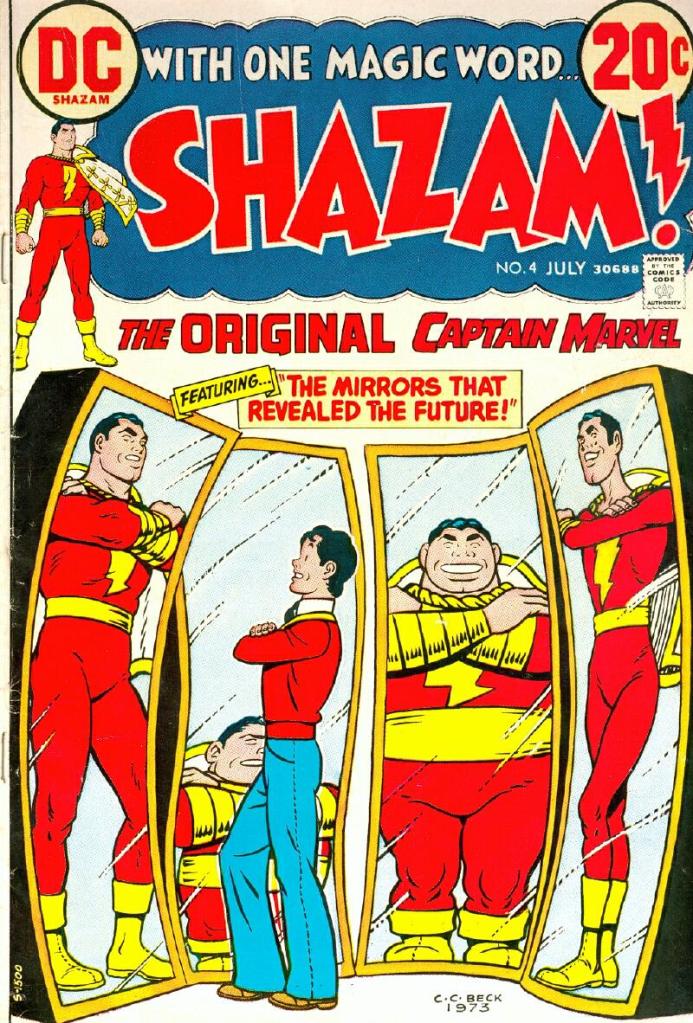
I had continued to read through the accumulated run of SHAZAM that I had borrowed from my grade school pal Donald Sims across the course of a couple of days. The stories never quite captured the flavor of the character’s original run, and there was an undercurrent that the creators involved simply didn’t buy into what they were producing. So the stories simply functioned as standard super hero adventures (albeit ones that seemed to be aimed at a more youthful audience than the rest of DC’s costumed line in 1973.) The fun cover to this issue wouldn’t have looked out of place on a copy of WHIZ COMICS in the 1940s.
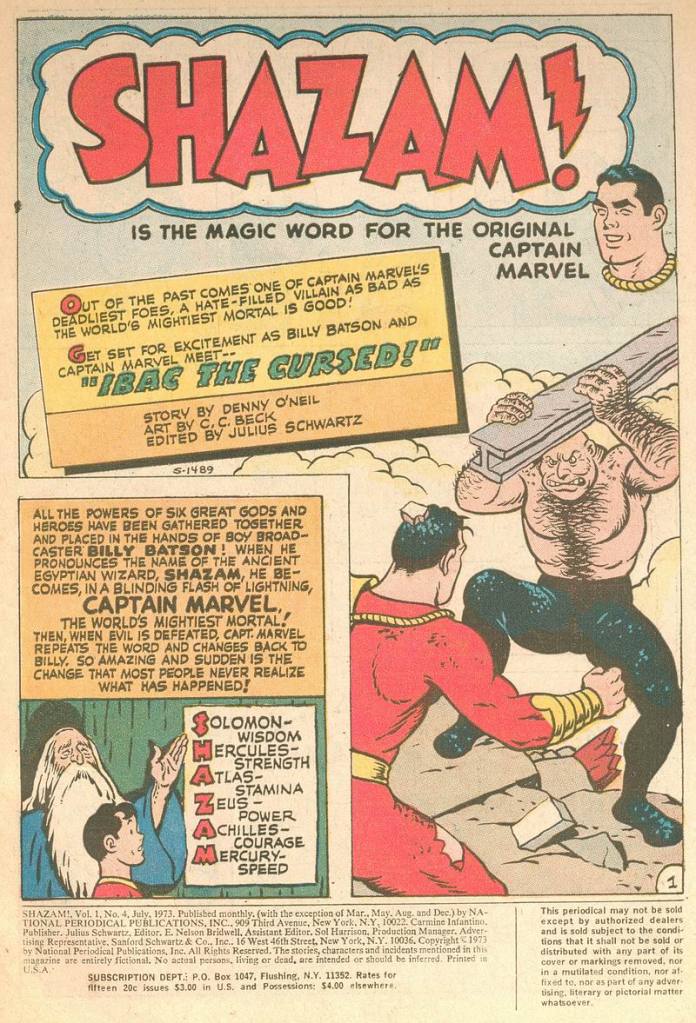
As with most of their other comics of this period, DC chose not to produce book-length stories of Captain Marvel. But in this instance, it wasn’t a lead story and a back-up story that was featured but rather three tales of more-or-less the same length, the final of which was always a reprint from the Captain’s glory days of decades before. This opening tale, written by Denny O’Neil, brings back one of the feature’s more memorable villains, Ibac. Ibac was a small-time criminal who had sold his soul to Lucifer in exchange for the power to defeat Captain Marvel. His name, Ibac, was his own magic word, which gave him the attributes of the worst villains of history. And because he hadn’t ever been able to defeat Captain Marvel, he didn’t have to give up his soul to Lucifer, and eventually reformed. Which is where this story picks up, with Billy Batson running into Stinky Printwhistle, Ibac’s civilian identity, who now works as a street sweeper.
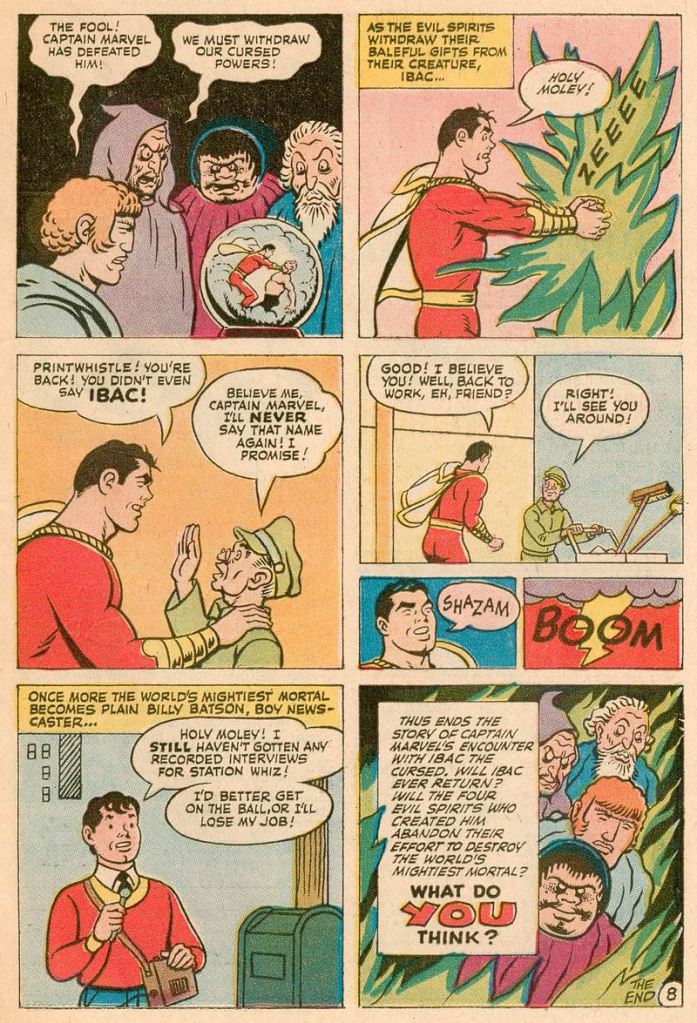
But Ibac’s four patrons, Ivan the terrible, Borgia, Attila the Hun and Caligula decide that with Captain Marvel back in the picture, so too must their agent, and they coerce Printwhistle into saying Ibac and resuming his life of evil. At the command of his four patrons, Ibac clobbers Billy Batson and leaves him in a building set for demolition, but Billy is able to become Captain Marvel and escape death. And though it’s now years later, Ibac is still no match for the Captain one on one. their ambitions thwarted, the four evil patrons withdraw their backing, causing Ibac to resume his mortal form as Printwhistle, and the reformed street sweeper promises never to speak that terrible word again. Of course, that promise would only last for so long since a good villain was hard to find. But it allowed for a wrap-up to this adventure.
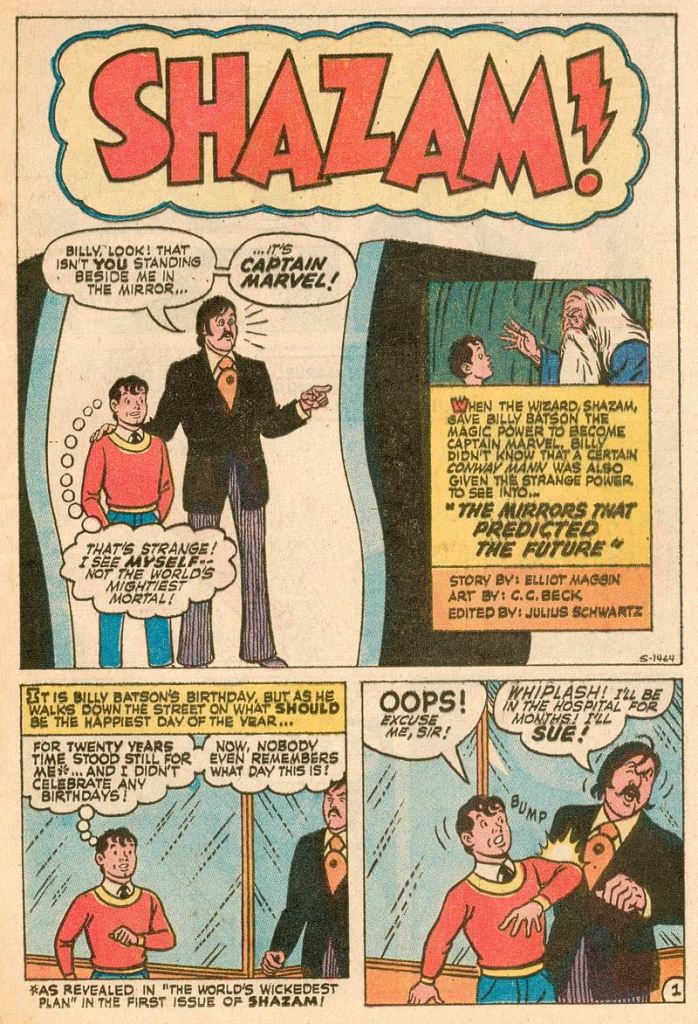
The second story in the issue was written by Elliot S! Maggin and also illustrated, as the opener was, by C. C. Beck. It’s about Billy Batson celebrating his birthday and inadvertently running into a conman named appropriately enough Conway Mann. The interesting thing is that Conway was born on the same day as Billy, and in some strange manner he has gained the ability to see the future whenever he looks into a reflective surface like a mirror–but only when he is touching Billy. Accordingly, Mann decides to make Batson his new partner in scams. Because of the time-skip that transported most of Captain marvel’s cast to the 1970s, Mann is twenty years older than Billy despite the fact that they were born on the same day.
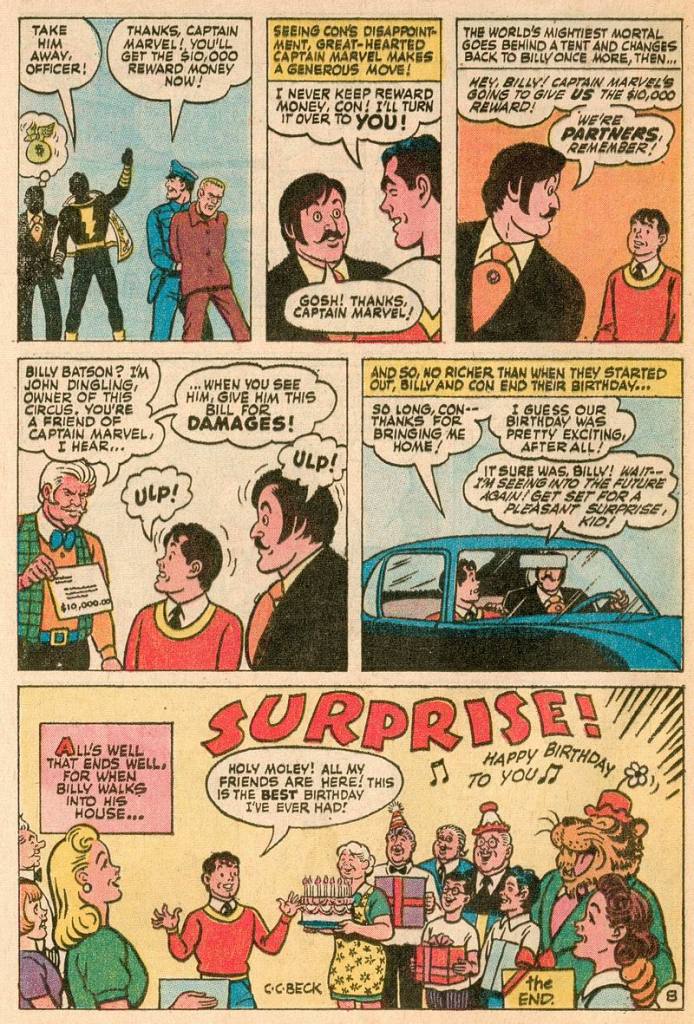
It turns out that for all that he’s a professional grifter, Mann isn’t really such a bad guy, and his future visions show the whereabouts of an escaped convict that Captain Marvel is able to round up. Conway and Billy earn the reward for the capture, but it’s all used up in making repairs to the circus that was damaged when Captain Marvel chased down the escapee. Still, in the end, it was an exciting birthday for the two of them, and Billy gets a surprise party thrown by all of his old friends by the time the story ends. These stories are all very simple, and with little in the way of stakes of genuine jeopardy. It feels as though editor Julie Schwartz and his writers aren’t exactly certain how young to pitch their efforts, and so are overcompensating a bit.
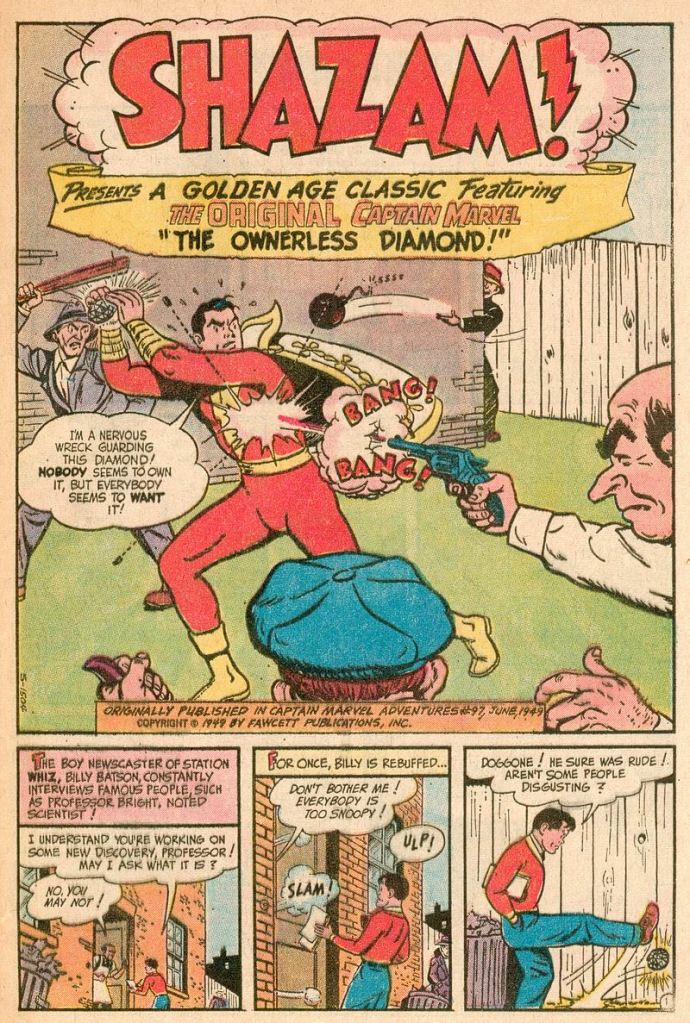
As had been the case in prior issues, the best thing in SHAZAM #4 is the reprinted story, which first saw print in CAPTAIN MARVEL ADVENTURES back in 1949. As was much of the Marvel Family canon, it was written by Otto Binder and illustrated by C. C. Beck with inks by Pete Costanza. The older artwork, having been produced on larger art boards, reproduces more tightly and feels more complete and solidly-rendered than what Beck was able to produce on the new stories, charming though his work was there.
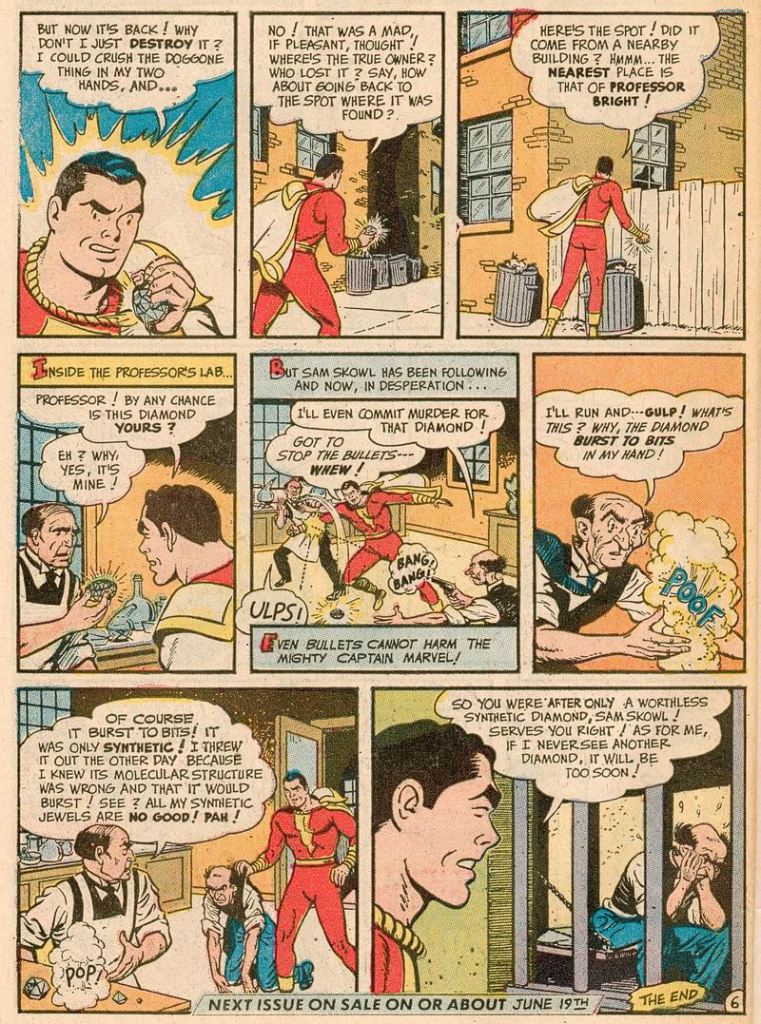
The story is a fun confection about Captain Marvel having to safeguard an enormous diamond he’s come across from the many greedy people who want it until he can locate its rightful owner. After a series of misadventures, it turns out that the diamond is the property of a grumpy scientist that Billy had attempted to interview at the outset of the story, and being synthetic, it’s flawed and ultimately crumbles into worthless dust. So it’s a story that’s really as simple as what Schwartz and his crew were turning out, but it’s somehow more genuine in its approach and with more finely-crafted artwork.
 The Tom Brevoort Experience
Was Conway Mann meant to be Gerry Conway? (It would not have been his first comic appearance, remember JLA #103, Thor #207 (?) and Amazing Adventures # 16 (?) and even “Night of the Reaper?
The fact they used IBAC (a John Broome character) makes me suspect that John Broome got asked for input (along with Binder and Wellman) but might have been less positive (since he and Schwartz were good friends–he had been Schwartz’s best man).
Maggin wrote the last Schwartz-edited new issue (#20) and almost seemed to be finding the range and deflection by that point. Bridwell knew how to write it but Maggin showed some insight, not least in this issue and in the Thomas Kilowatt story from the issue before, although that needed more pages than it got.
Too bad Broome had left by that time, he was an old Cap writer for Fawcett and might have made it fun and satirical.
LikeLike
Conway Mann doesn’t look or act anything like Gerry Conway, so the only thing linking him to Gerry is the name. And the name, since people call him “Con,” is just an on-the-nose way to say he’s a con man.
I doubt they asked Broome for input. It seems more likely they used Ibac because Bridwell remembered him — Bridwell remembered everything — and thought it’d be a good idea to use a villain with a similar empowerment system.
LikeLike
Tom wrote: “The older artwork, having been produced on larger art boards, reproduces more tightly and feels more complete and solidly-rendered than what Beck was able to produce on the new stories, charming though his work was there.”
The board size might have been a factor, but it wouldn’t have stopped him from varying the weight of his line and eliminating almost all background details. I think he was more likely making a conscious choice to simplify the art for other reasons which could come down to the passage of time or pay rate. Beck seems like an artist would want to get a story down to the essentials and eliminate noodling or extraneous detail.
The bolder less rendered approach happens less drastically, but still noticeably with Ditko’s Spiderman… 28 issues in he’s doing a lot less detail on faces and using the pen less and the brush more.
LikeLike
Kind of the old Shelly Mayer apocryphall (?) advise to his artists on the All-American comics line: “Draw less.”
Toth and Infantino took it to heart. Beck probably had other sauces for that advice.
It was not bad, I wonder if an inker, like Bob Oksner or Kurt Scharffenberger, might have helped? Just to give it a little more surface sheen?
LikeLike
This issue was my first encounter with Captain Marvel, a character my mother had often talked about reading when she was a girl (I’d previously picked up a couple of issues of Marvel’s Captain Marvel title, which left both me and Mom confused when he bore little resemblance to the character she remembered). I liked it immediately — it felt different from the other superhero comics I was reading, but in a good way. I liked the “human interest” element that many of the stories had: Stanley Printwhistle is genuinely trying to reform. Conway Mann is a rogue, but not an irredeemable one. Even grumpy Professor Bright in the reprint story is not really a bad guy, just frustrated by his failed experiments. And Cap’s aggravation at his inability to get rid of that darn diamond is both funny and relatable…”No good deed goes unpunished”. There’s a humane subtext to all of this that I found (and still find) very appealing.
And Beck’s art might be simple, but it’s also very striking and memorable. I love his character designs, like Ibac’s four creepy patrons…yikes, no trouble telling who the bad guys are in this tale! SHAZAM! quickly became one of my favorite titles.
LikeLike
Interesting point of view. It;s interesting to see what People who liked the book thought of it and why they liked it,
Maybe, they needed to emphasize human interest, in a whimsical way to have reached a broader audience?
LikeLike
I liked Captain Marvel as a character back in the 70’s, but even as a kid around six years of age, I just couldn’t get into these new stories. I didn’t always understand what I was reading in Superman and Spider Man, but I knew even at a young age that those comics had a sophistication that was lacking in the SHAZAM comics. I really started liking the newer SHAZAM stories when they became a feature in the World’s Finest anthology comics a few years later.
LikeLike
You stated that this cover could have been from a Golden Age issue of Whiz Comics. It is in fact a swipe of the cover of Captain Marvel Adventures 45.
LikeLike