

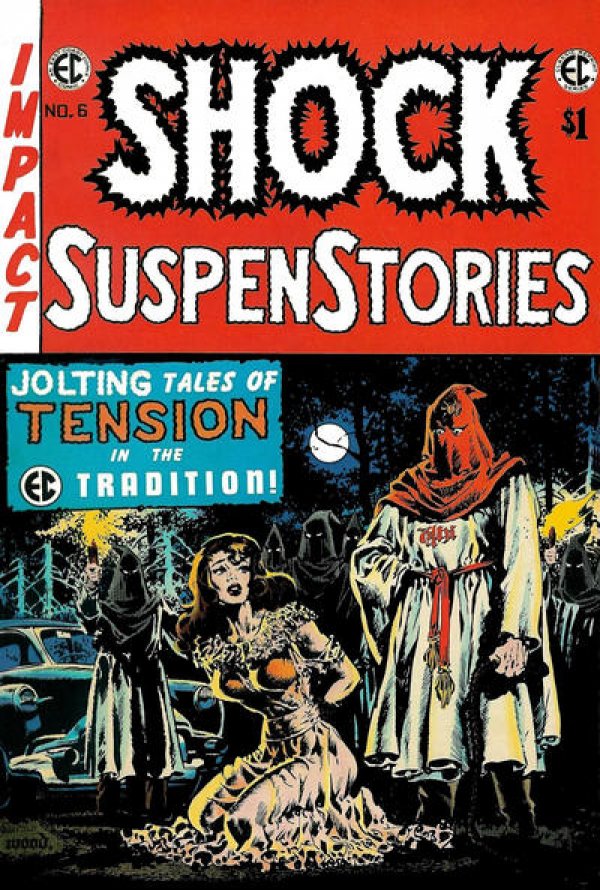
When the title was launched by EC in the 1950s, SHOCK SUSPENSTORIES was intended to be something of a sampler series for the line’s variety of offerings. So each issue would present an assortment of tales in the horror, science fiction and crime genres. But the stories that gave the series its identity inevitably ran in the second slot in the magazine–as with almost all of EC’s books, each issue contained four stories of between 6 and 8 pages. Those stories became known colloquially among EC fans as the “preachies” and they were all stories that in some way dealt with then-current societal ills, while still delivering the required EC twist ending that brought readers back. For the early 1950s, EC was pretty brave to feature stories dealing with a number of these topics. And if you had asked me after going through all eight of these EC reprints when I first got them, I’d have told you that SHOCK SUSPENSTORIES was my favorite title of the batch, though my opinion has changed over time.
Time and repetition has caused many of the shock endings in these stories to have lost some of their punch in the intervening years–most readers of today can suss out the twist that’s coming in the initial couple of pages. But at the time, before there was so much media, they often delivered. I know that as a young reader experiencing these stories as a kid, I wasn’t yet aware enough to routinely be able to predict where the stories were going ahead of time. That twist ending thrill was what EC delivered more than pretty much anybody else in the field in the early 1950s.
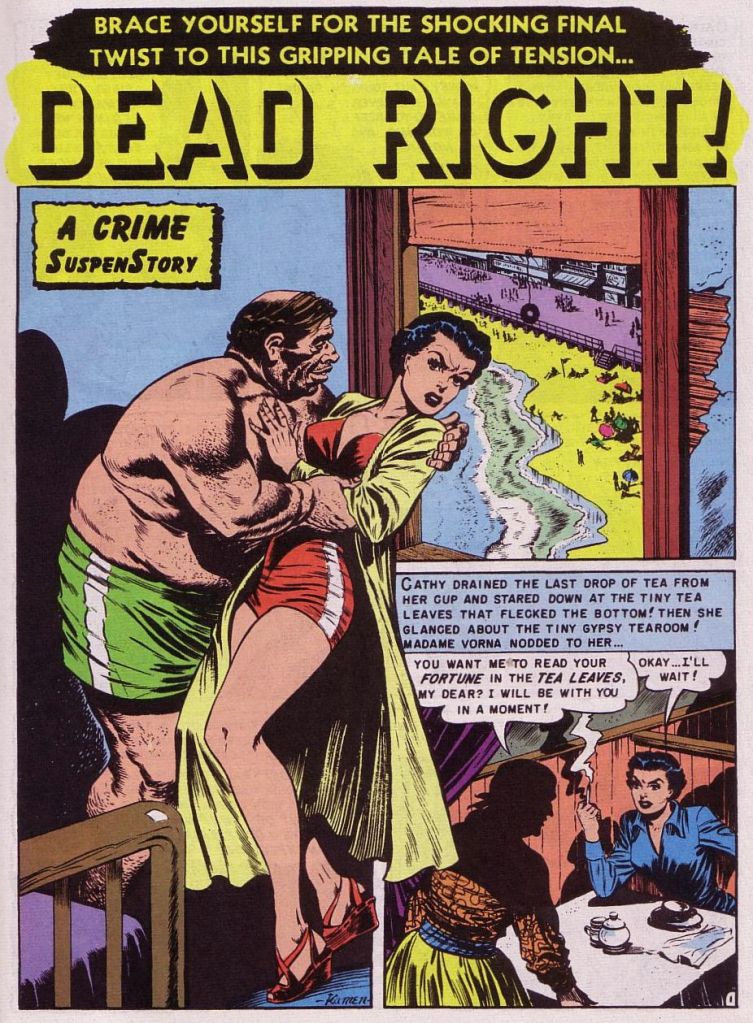
The first story in the issue was illustrated by Jack Kamen, and written (as all of the stories in this issue were) by editor Al Feldstein with contributions from publisher Bill Gaines. It’s a crime story, and it concerns a golddigging woman whose fortune teller predicts that she’ll marry a man who will come into a small fortune of $25,000 and then die violently shortly thereafter. The woman finds the man in question, and even though she finds him repulsive, she marries him in order to inherit the wealth that he’s going to inherit. But events take a turn when the woman herself wins a contest as the one millionth customer at a local cafeteria and takes home $25,000. Disgusted by her husband and with cash in hand, she berates him and tries to leave him–and he murders her, thus inheriting the $25,000. And thereafter, he’s given the death penalty, thus fulfilling the prophesy. It’s a bit by-the-numbers, but Feldstein and especially Kamen are excellent at making the husband truly repulsive and the woman morally bankrupt and loathsome so that you cheer when she gets her comeuppance.
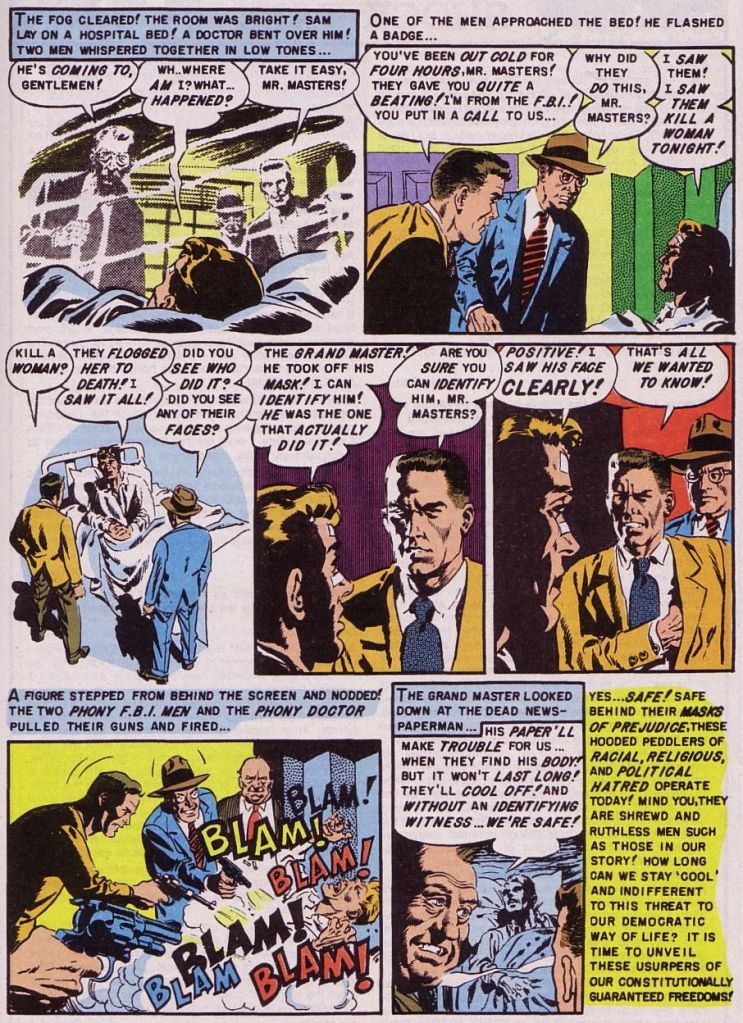
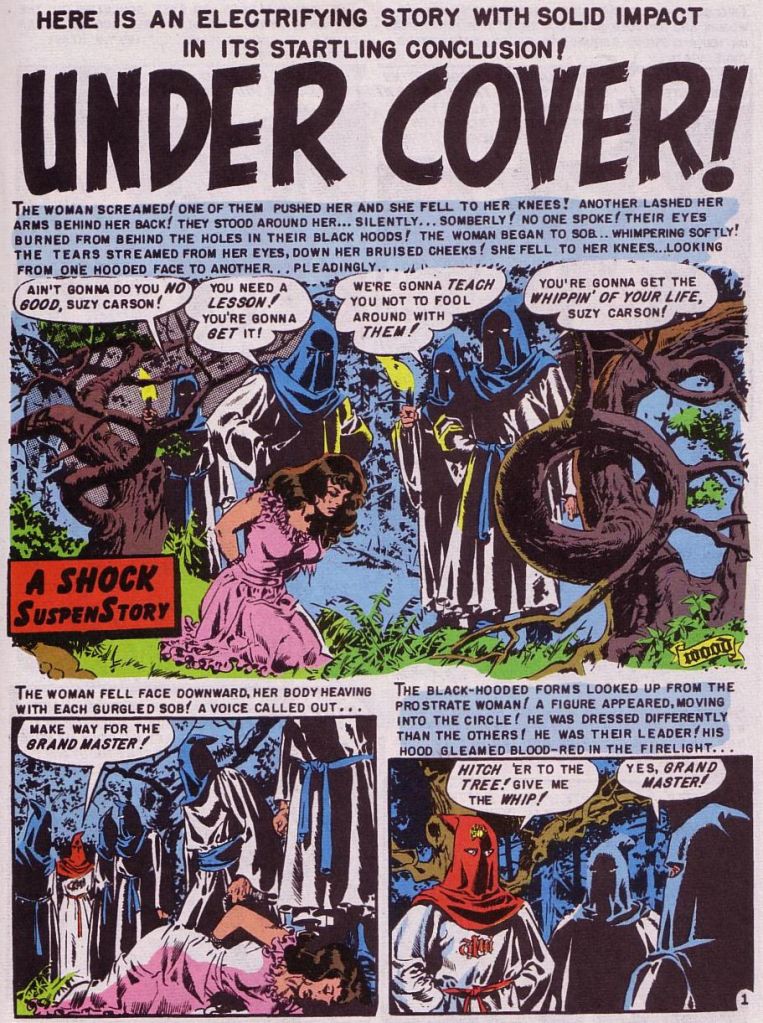
The second story was beautifully illustrated by Wally Wood, who also contributed this issue’s cover, and it’s one of the best remembered of the “preachies.” It’s about the Black Vigilante Society, a thinly disguised version of the Ku Klux Klan, who is meting out punishments to those in their community who are consorting with the “trash elements”–black people, though the text never states that explicitly. A reporter who is investigating the Vigilantes sees them accidentally kill a woman they were flogging and gets a glimpse of the unmasked face of the group’s Grand Master. Intending to expose them to the FBI, the reporter is discovered instead by the Klan members, who beat him into unconsciousness. When he comes to, he’s in a hospital bed, and the FBI agents he called before getting struck down are there. He tells them that he knows who the Grand Master is–and then the men pull their guns and execute the reporter. The text makes it very clear that these guys are all fake FBI men, though the subtext of what’s being shown is the idea that such bigots can be hiding anywhere, even within the ranks of law enforcement. So this one is hard-hitting and remains relevant even today.
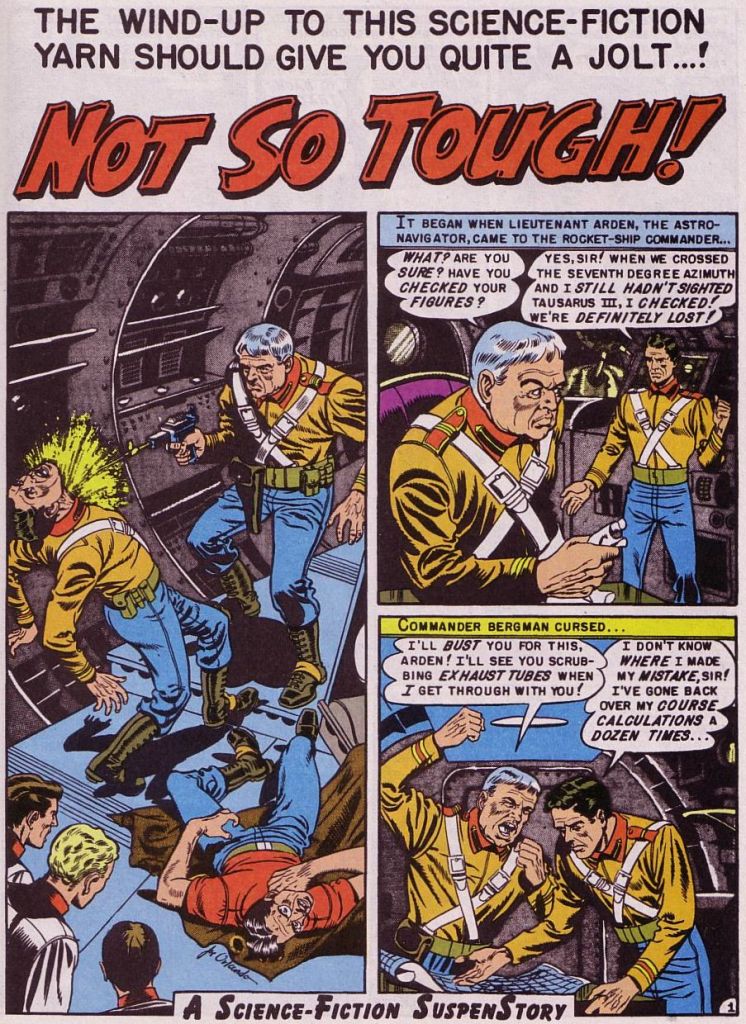
The third story in this issue was a science fiction tale illustrated by Joe Orlando, though it’s climax turns a bit more on horror than actual science fiction. It’s about the hard-ass commander of a rocket ship that drifts off course and gets lost. The commander busts the ship’s navigator down to a regular crewman, and installs a replacement navigator who isn’t up to the job. As the situation grows worse and essential supplies such as food and oxygen begin to dwindle, the commander remains hard and inflexible, enforcing his tough military discipline despite the fact that the crew is all suffering.
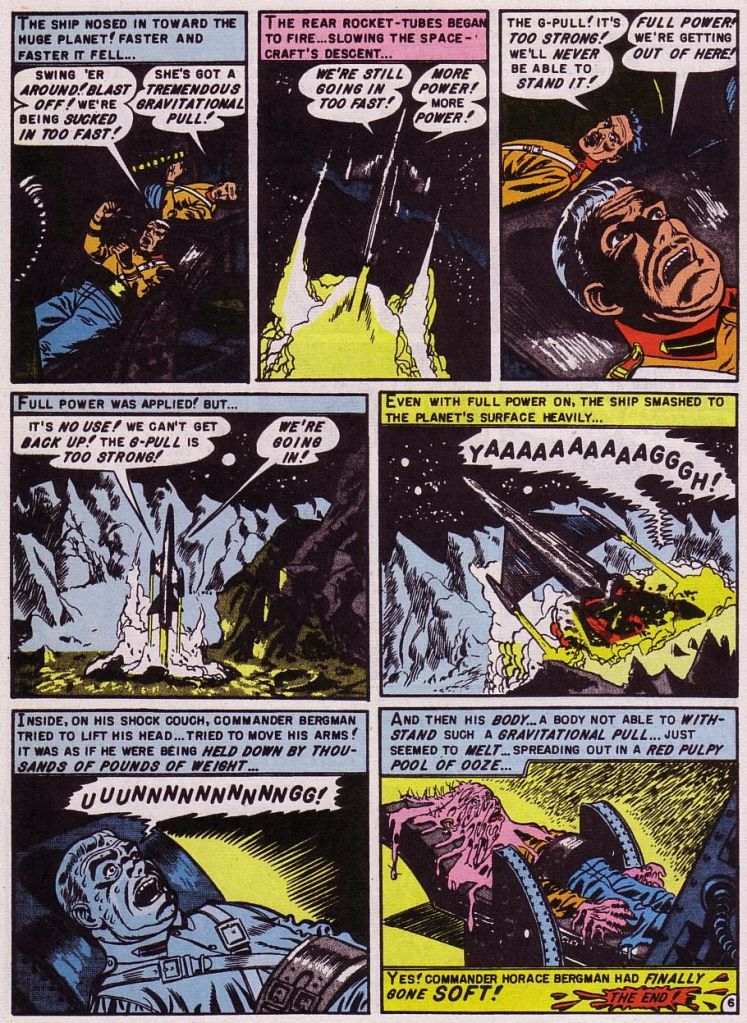
When the commander lets the replacement navigator die rather that give him vital oxygen, the navigator snaps and begins what looks like it will grow into a full mutiny. But the commander coldly guns the navigator down and ejects both of the bodies into space. But thereafter, when the ship comes across a planet that has the oxygen and supplies the crew needs in order to survive, it doesn’t have a competent navigator to realize that the gravity on this planet is more than their ship can handle. And in the closing page of the story, the ship crash-lands on the planet, and the intense gravity liquifies the intractable commander, reducing his body to a gory ooze. The whole story is built around the final punch line gag: the commander has finally gone soft. It’s a groaner, but the story does convey a decent sense of suspense.
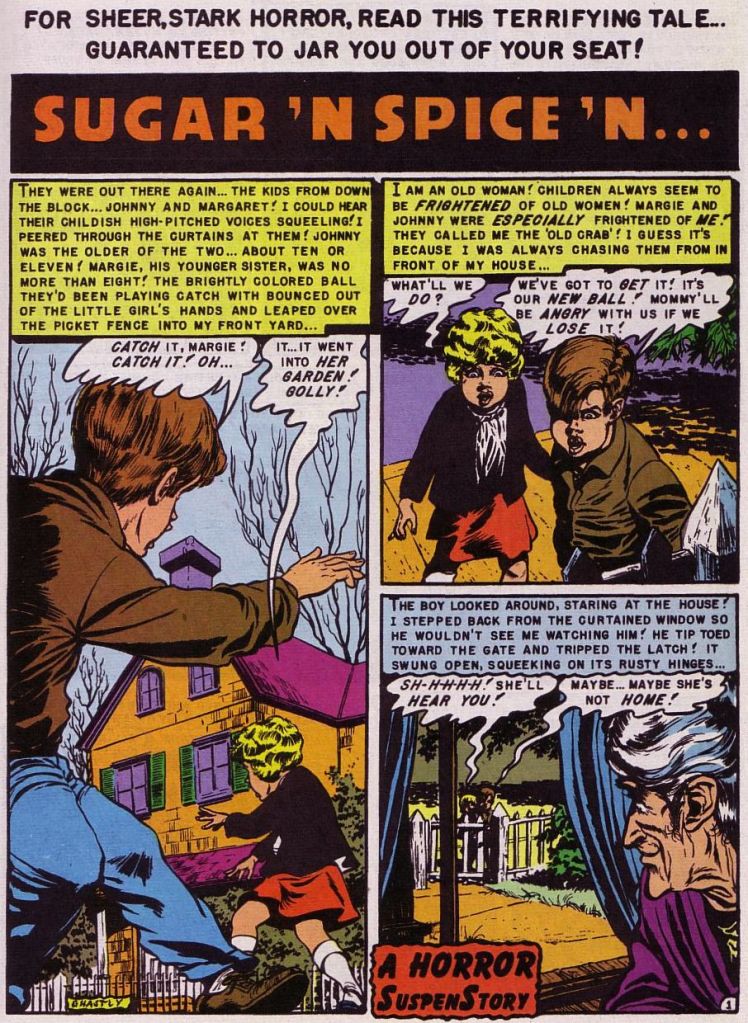
The final story in the issue was the horror outing, illustrated by “Ghastly” Graham Ingles. And as EC did on a couple of occasions, the punch line here is that the story is a modern day retelling of a classic fairy tale couched in horror terms. This one is Hansel and Gretel, in this case John and Margaret, who are tormented by and who in turn torment a strange old woman who lives in a house on their street. On Halloween, though, they’re lured into the house, which it turns out is made of candy. And the old woman is actually a witch, who winds up cooking them. It’s a very basic outing, and not as extreme as it might have been in an actual EC horror comic–there isn’t any real gore or anything shown, the horror is entirely psychological. The preceding science fiction story is more graphic in what it depicts. But it’s got the essential EC combination of horror and humor.
 The Tom Brevoort Experience
That Wood story is both gorgeous and powerful — not just for the 50s, but for today, too.
The rest of the issue, ehh, it’s competently done formula.
LikeLiked by 1 person
I remember a TV movie, “Brotherhood of the Bell” that was the first time I encountered “OMG, he went to the authorities — AND THEY’RE IN ON IT!”
Even not as the first time, this one is a shocker.
LikeLike
Although I grew up with the “relevant” comics of the ’70s, “Under Cover” left a strong impression on me because even though Marvel and DC had their share of faux Klan groups I wasn’t used to seeing the racists win so definitively in a story. “Not So Tough” also struck me because of its dark humor – one of the many reasons those EC reprints were catnip for teen-aged me – but I have no memory of the other two stories.
LikeLiked by 1 person
There was an episode of the television anthology series Tales of the Unexpected titled “In the Cards” that was broadcast in 1985 featuring Susan Strasberg that has a very similar premise to “Dead Right.” “In the Cards” was based on a short story written by John Collier, and I’m curious if Al Feldstein “borrowed” from it to produce “Dead Right.”
LikeLike