

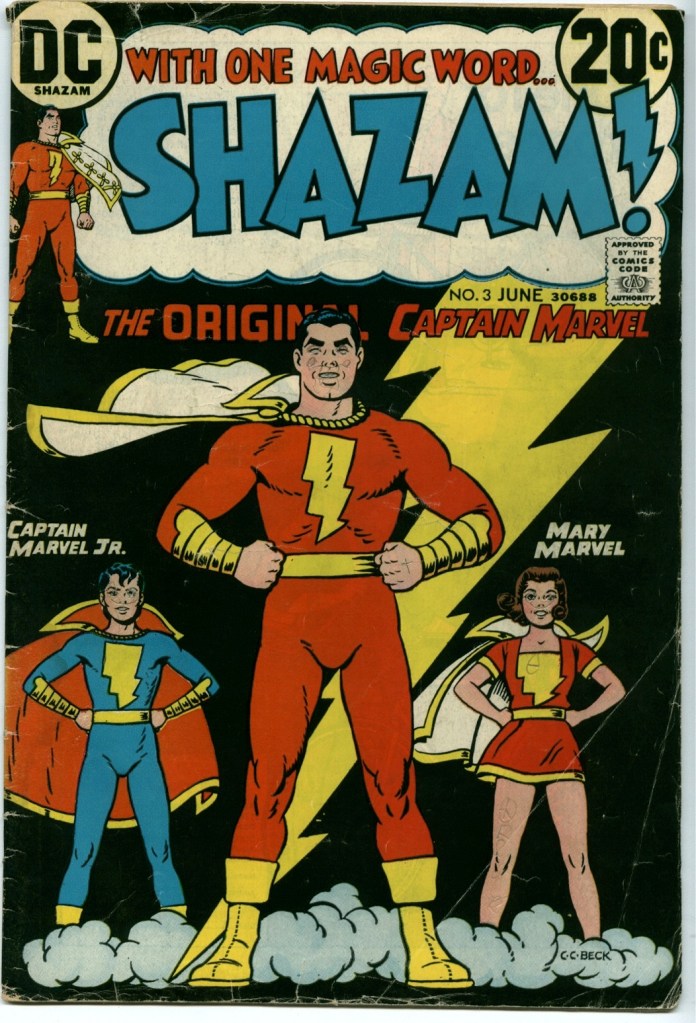
SHAZAM #3 was another issue in the complete run of the title that I had borrowed to read from my grade school friend Donald Sims. That’s a nice cover in the spirit of a number of Fawcett pieces spotlighting the Marvel Family. It’s only undone by how chunky all of the linework seems to be. Illustrator C.C. Beck had previously worked at twice-up size, as was then industry standard. The switch-over to 1 1/2 size coupled with his own aging meant that his work became a bit less crisp and sharp.
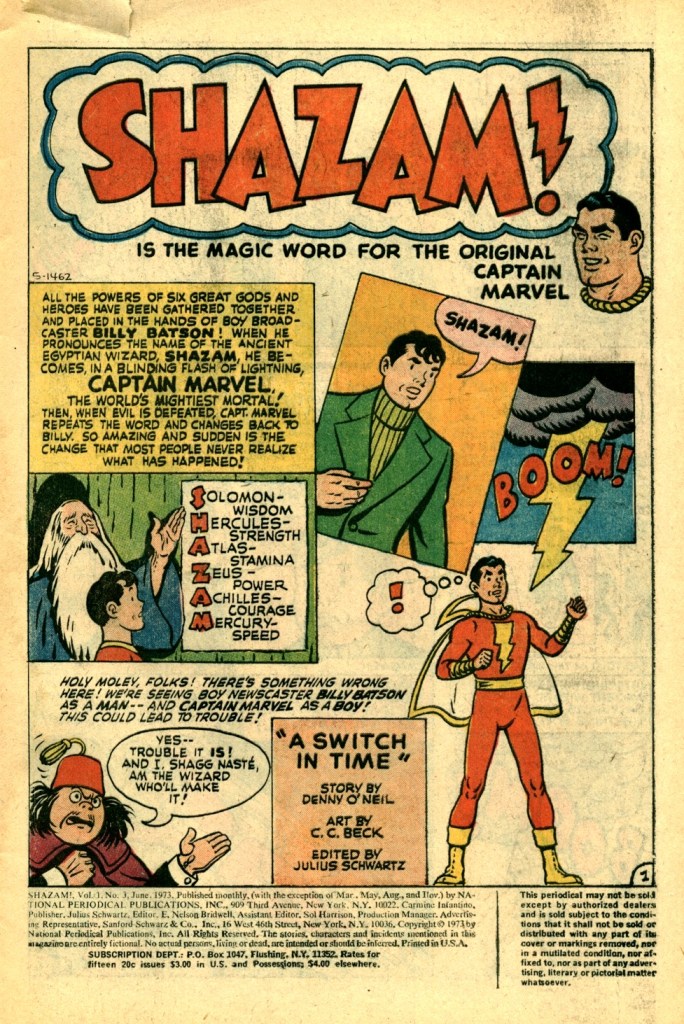
The lead story by writer Denny O’Neil is one of the last times that the idea that the Marvels had all been bumped forward in time from the early 1950s would be mentioned going forward. But here, Billy Batson is still having difficulty acclimatizing to the world of the 1970s that he suddenly finds himself in. He even tries dressing in a 70s-style turtleneck and jacket in order to better fit in. But to no avail. Sensing his other self’s plight, Captain Marvel petitions the wizard Shazam to do something to help Billy, and shazam casts an enchantment that ages Billy to his proper chronological age had he never been frozen in time. How this is meant to deal with Billy feeling disaffected and out of place in the 1970s is never disclosed. But suddenly, Billy is a full-grown man.
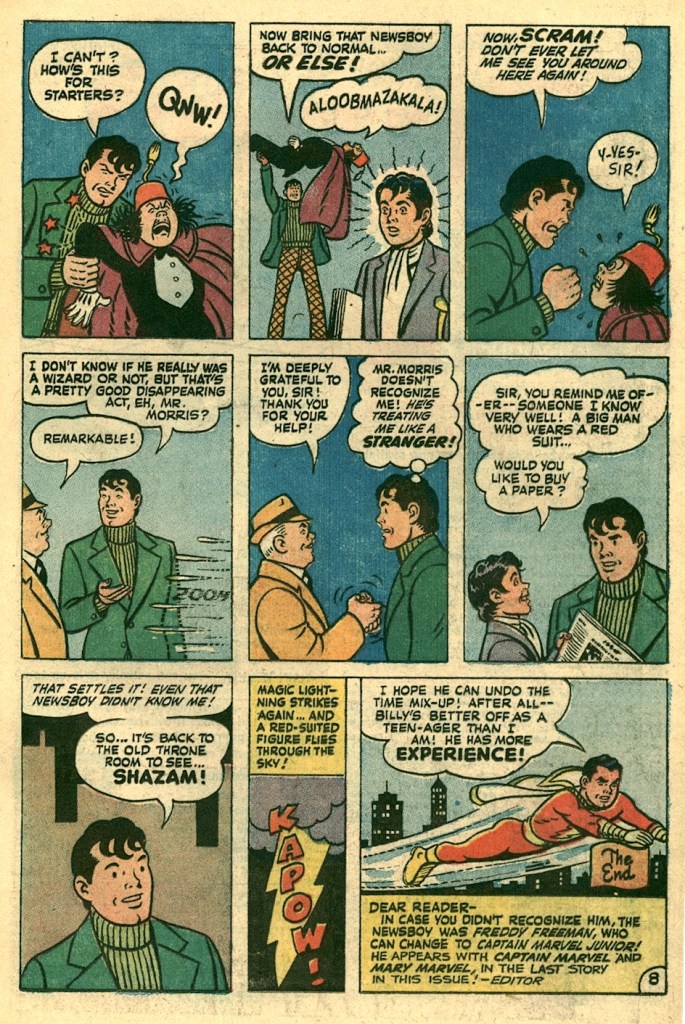
Unfortunately, the price for this evolution is that when Billy calls upon Captain Marvel, the version that appears is only a boy, as Billy had once been. And even with the wisdom of Solomon, without his life experience, captain Marvel can’t control his powers well, and he’s an easy target for the malevolent would-be wizard Shagg Naste. So it falls to the adult Billy to deal with the problem himself. At the end of the tale, in an abrupt fashion, Captain Marvel indicates that he’ll get Shazam to put everything back the way it was. It’s a pretty flat ending that doesn’t address any of the issues that the story brought up. Possibly this was a result of O’Neil only having eight pages to work with. But it isn’t great.
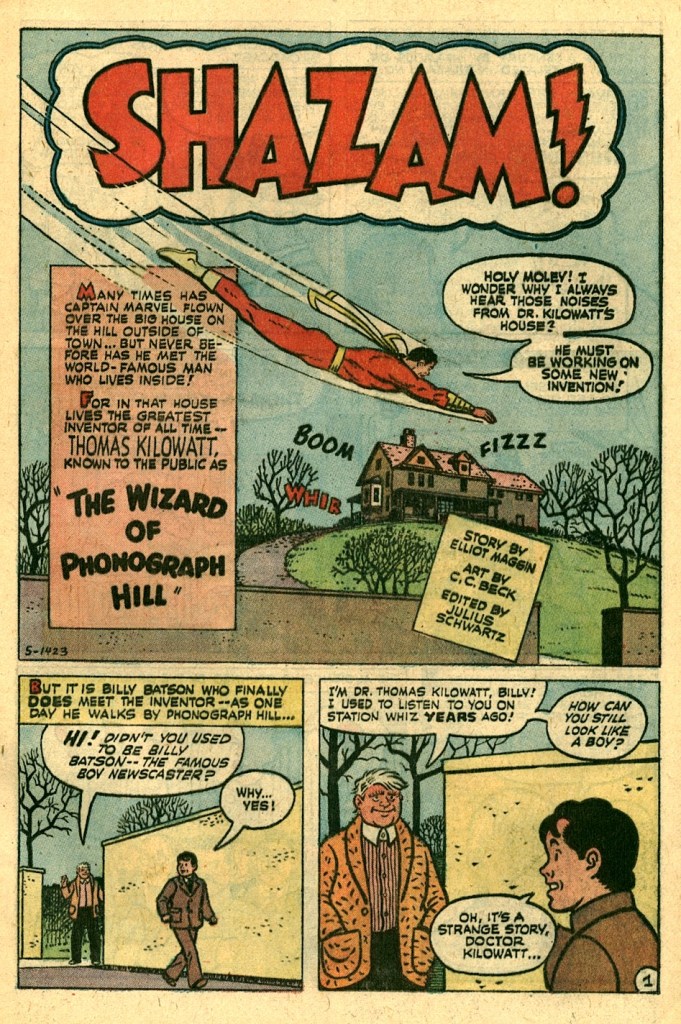
Not much better is the second short story, written this time by Elloit S! Maggin. In it, Billy meets the famous Doctor Kilowatt, who has devised the most important invention known to mankind since the wheel–though he won’t reveal what it is. This doesn’t stop Billy and Mr. Morris from putting him on television station WHIZ to announce his discovery, which brings unfortunate caricature agents of assorted foreign powers out of the woodwork to attempt to steal Kilowatt’s device.
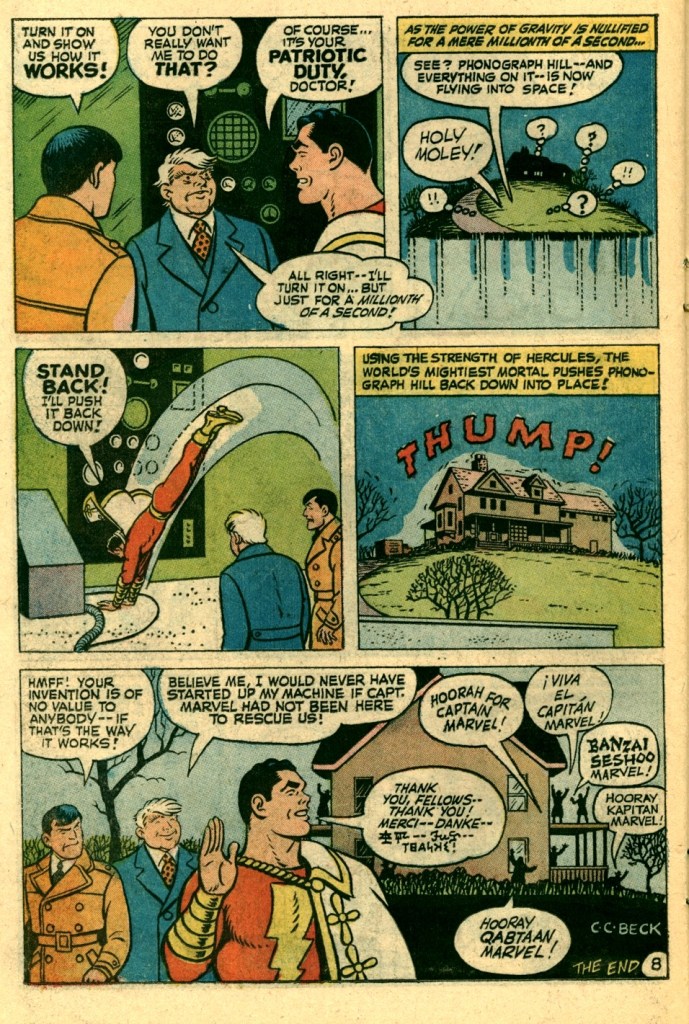
Of course, the United States Government would also like Kilowatt’s machine, and he’s convinced to give them a demonstration of what it can do. Turns out it’s an Anti-Gravity Device that makes things fall up rather than down. When it’s activated, the house and the surrounding hillside are all propelled high up in the air. It falls to Captain Marvel to get it all back down safely again. Everybody decides that Kilowatt’s device is of no practical use, which seems a bit facile, and the story wraps up. You can almost feel Maggin and O’Neil working to try to capture the essence of the classic Captain Marvel stories of the Golden Age but not being able to quite get there. I do think the short length of these tales is part of what makes them so perfunctory.
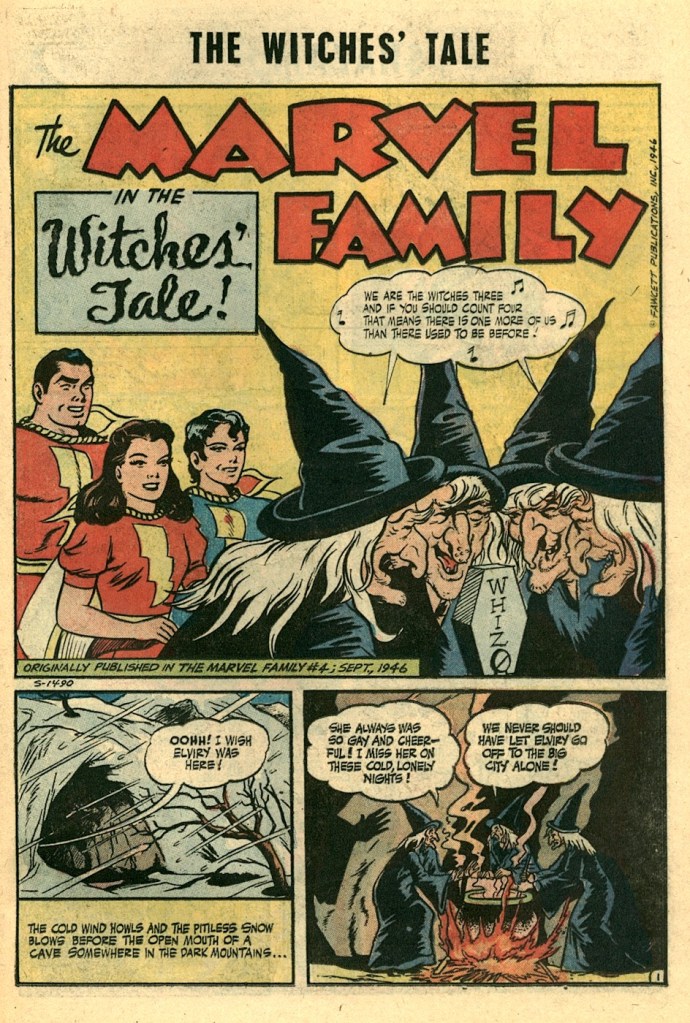
As in the previous two issues, the best story in the magazine is this last one, a vintage Fawcett reprint from the Golden Age. It was written by Otto Binder, who was the Marvel Family’s main scribe for the character’s most influential period, and illustrated by Pete Costanza. And for all that it’s an older entry, the artwork feels much sharper and more detailed than what was on display in the new features.
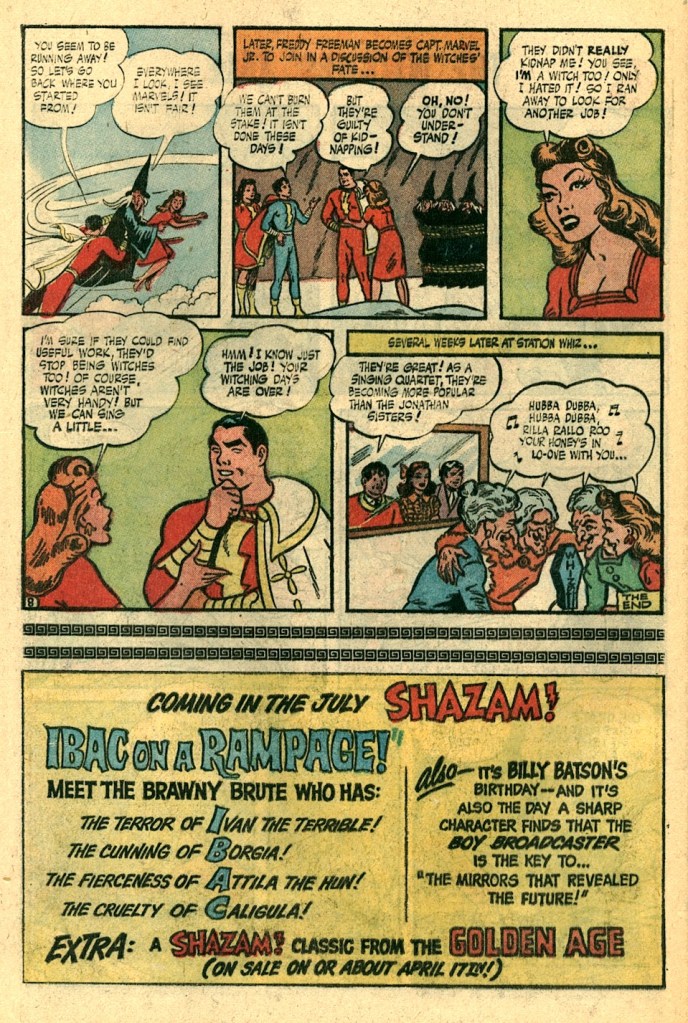
The story concerns a quartet of witches who are a bit out of step with modern times. One of their number abandons their coven to get a job in the big city, causing her three sisters to attempt to bring her back. This brings them into conflict with the Marvel Family, who don’t understand the nuance of the circumstances and look at it as a kidnapping plot. The witches are no match for the World’s Mightiest Family, but in the end they’re all given jobs at radio station WHIZ as an Andrew Sisters-style singing quartet. It honestly isn’t much of a story, but it’s better realized and executed than the new entries–a state of affairs that would continue to be the case moving forward.
 The Tom Brevoort Experience
Shag nasty?
That’s quite a name, that Shag Nasty.
LikeLike
Wait, aren’t the witches in fact guilty of kidnapping? If someone’s a mentally competent adult, they have every right to leave home and go to a big city. Their relatives can’t just go and grab them, that’s indeed kidnapping. I suppose she might be forgiving and not press charges, but that’s merely not prosecuting the crime.
Note second panel on the last page; “Freddy Freeman becomes Capt. Marvel Jr. to join in a discussion of the witches’ fate”. The Marvels are different people from their alter egos, not just physically, but mentally (i.e. like a purely-positive Hulk transformation – strength/toughness and wisdom).
Witches aren’t very handy? You can fly on your own ultralite air vehicle! That was an even bigger deal in 1946 than it would be today. I know, they needed an ending, but I think that’s one which must have been of its time (something like the Purple People Eater’s “I wanna get a job in a rock and roll band”?)
LikeLike
Well. it makes out the elements of Kidnapping in the Second Degree under NYS Penal Law Section 135.20, although it might be dismissed in the interest of justice or adjourned in contemplation of dismissal under the circumstances.
The victim does not want to prosecute her family members, important people in the community (The Marvels) recommend dismissal and there are cultural issues at play within a misunderstood and mistreated subculture (Salem/Halloween-type witches).
I wonder why Schwartz and his writers didn’t follow up on these characters? They would have a consistent reason for not being obviously older in a story appearing 28 years later. It would have been retro urban fantasy 18 years before things like Cast a Deadly Spell (1991)
I remember liking the Thomas Kilowatt story. The lab floor full of punch-clock scientists and engineers trying to realize Dr. Kilowatt’s clever concepts is very much within the 1972 conception of Edison by the general public and Ortega y Gasset’s idea of him in Revolt of the Masses (1937).
Unfortunately, the public has learned that scientific progress is less regular and predictable than it probably seemed in the early to mid-20th Century . . . .
LikeLike
I’ve seen O’Neil quoted as saying he didn’t think much of classic Captain Marvel — sure, nice for the day, but way too simplistic for the modern comics industry. If true, he was not the person to be working on it.
LikeLike
Denny was a working stiff writer. How many series he wrote did he espouse a deep feeling for? I only remember his love of Batman and his take on the Question. Whatever he thought of a property assigned him, he’d generally do it. Shazam proves he should have rejected some assignments. If they weren’t ready to consider Bridwell for the job, it’s moo anyways. I can’t think of anyone I read back then being much more suited than Denny.
LikeLike
Denny, at the time, was considered the hot new(ish) young guy who Julie — and others, but mostly Julie — went to for new directions. That Julie apparently-reflexively tapped him for SHAZAM seems to indicate that Julie didn’t understand Denny’s strengths or SHAZAM’s needs. The book might have been better off if Denny had been handed it and told to make it cutting-edge, but to give it to him and then ask him to write it like the Fawcett book was just a mismatch.
As for who else would have been more suited than Denny or Elliot Maggin — if they were going to go for a Fawcett-like feel, my top choice would have been Leo Dorfman, who was doing a very nice job on JIMMY OLSEN at the time. He wouldn’t have lasted, since he died a year and a half later, but DC didn’t know that, and he’d have gotten the book launched with solid craftsmanship and an ability to do straight-faced whimsy.
As far as I know, though, Dorfman never worked with Schwartz, so maybe there was an issue there.
Aside from Dorfman, I think Cary Bates would have been a much more appropriate choice than Denny or Maggin. Len Wein was better known for darker stuff, but his work for Schwartz showed he could do lighter material well. Steve Skeates was never a favorite of mine, but he had that lighter touch, when asked for it. Arnold Drake was doing some work for DC, and while his brand of light adventure was sillier than the Fawcett model, I think he’d have been more appropriate than Denny. Jack Oleck might have done well, too.
Heck, Frank Robbins or Bob Haney would have been interesting and fun, but going pretty far afield of what seemed like the target for Schwartz at the time.
Other than Bates, Wein or Robbins, though, any of those would involve Julie looking beyond his usual talent pool, which sadly wasn’t likely to happen.
LikeLiked by 2 people
“A Switch In Time”: To bad no one thought to have the story title be — “The Adventures of Captain Marvel as a Boy”. A Switch In Time could have been the title of the second half where he ends up on Earth-1 in Superboy’s time.
LikeLike