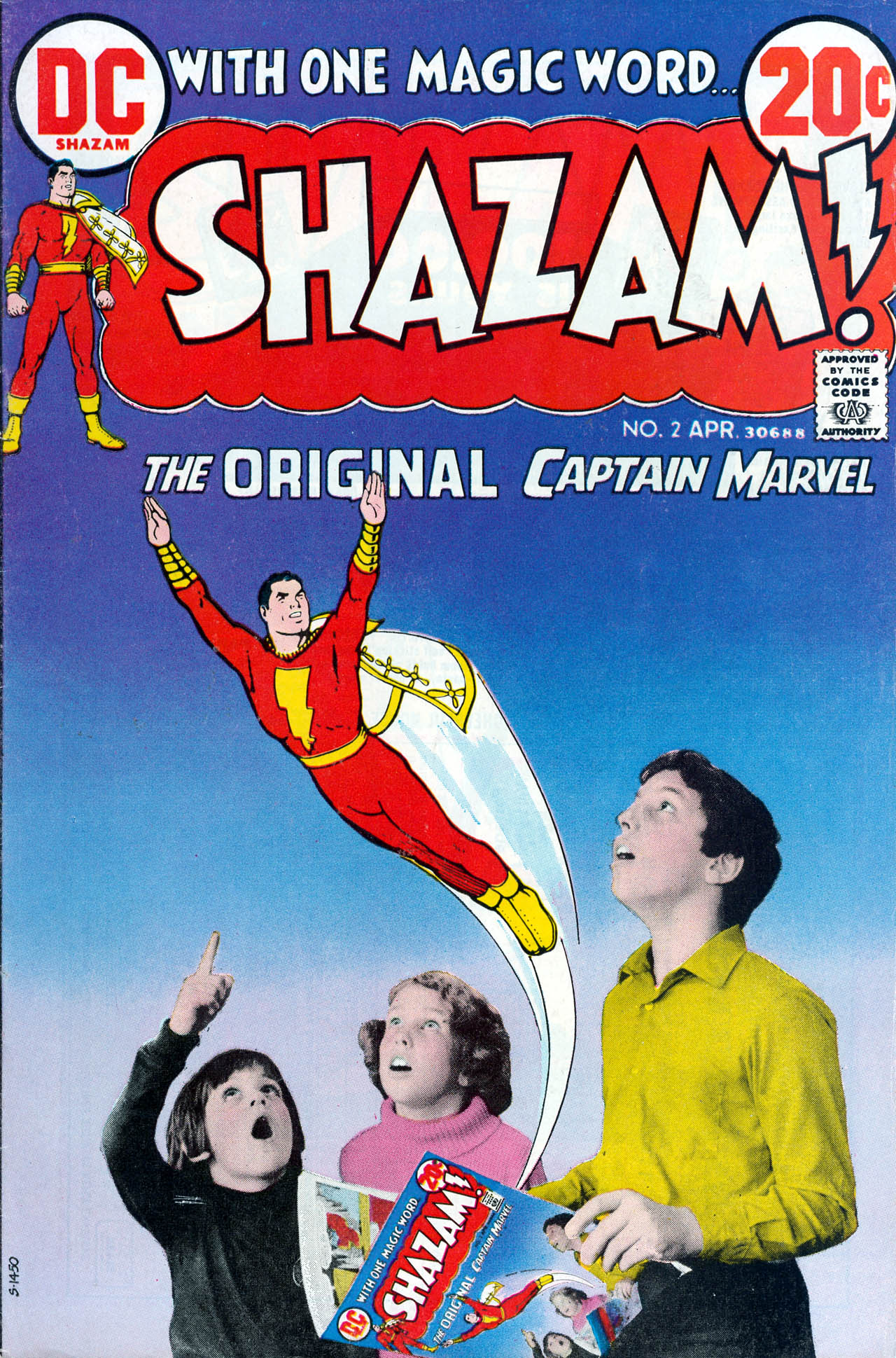


As I mentioned previously, my grade school friend Donald Sims possessed a complete 35 issue run of SHAZAM, the DC Comics revival of the original Captain Marvel of the Golden Age of Comics published in the 1970s. At one point, I convinced Don to let me borrow the run so that I could read it all, and that’s what I did over the course of about a week or so. I’m going to continue to jump around in terms of other borrowed comics that I read in my early days as we go, but don’t be surprised to see SHAZAM well-represented in this feature. The cover above was a very cool phot image by DC production man Jack Adler combined with a Captain Marvel figure by artist C. C. Beck. I’m sure it stood out as something different on the nation’s newsstands. I’d read a bit about the making of this cover in AMAZING WORLD OF DC COMICS #10, DC’s in-house fanzine, so it was cool to be able to study the finished effect up close. Even today, though, I can’t help but notice that the Captain Marvel figure isn’t positioned at the point where the three live action kids’ gaze is intersecting, which impacts on the illusion a little bit.

SHAZAM was a big deal project for DC in the early 1970s, and so expectations for the character and the series were high. The firm had assigned its super hero revival superstar editor Julie Schwartz to head up the efforts. But Schwartz didn’t really have the right sensibility for the material, and so his Captain Marvel stories tended to be more overtly silly and cutesy and lacking in verisimilitude. Some of that was the doing of writers Denny O’Neil and Elliot S! Maggin, both of whom gave off a sense like they were better than the material they were working on. And that might have been the case, but it’s no excuse for producing sub-standard work. Artist C. C. Beck had helped originate Captain Marvel back in late 1939, but his clean and open art style was very much the antithesis of what was popular at that moment. So on a certain level, it feels as though the SHAZAM revival was always foredoomed to failure, the wrong property with the wrong approach at the wrong time.

Having revived the Marvel Family and the Sivana Family in modern times in the previous story, writer Denny O’Neil wasted no time in bringing back one of the Big Red Cheese’s other most notable foes, Mister Mind. Mind had been the villain behind the uber-popular 25-part serial “The Monster Society of Evil” in the Golden Age. At the end of that story, Mind was executed and stuffed. Here, O’Neil brings him back but pointedly doesn’t reveal how he survived. Eventually, in a few years, continuity-minded E. Nelson Bridwell would fill in those details. For the first few stories, Billy Batson was struggling to fit into the strange world of the present, but this angle was dropped relatively early and the Marvels’ time-skip was thereafter never mentioned again.

For all that they wanted to control the property thanks to its established popularity and merchandising potential among audiences who had grown up with the character, there’s a sense in these early issues of SHAZAM that the DC team had disdain for the character and his world. They didn’t quite grasp the delicate balance of whimsey, adventure, satire and color that had made the strip so popular in its heyday. Accordingly, many of the stories in this period are pretty dopey. This one, about Sunny Sparkle, a person so nice that everybody gives him anything he wants, falls into that trap. The premise sounds like something that could work in a Captain Marvel story. But the writing just doesn’t take itself seriously enough.

The story isn’t without its appeal or its fun moments–such as when a criminal gang give sll of their ill-gotten goods to Sunny, and then their boss tracks Sunny down to bump him off but instead winds up giving the kid even more money. But the whole adventure really has no meaningful stakes, it just lopes along until the conclusion seven pages later. It doesn’t possess the entertainment value of the classic Captain Marvel stories of the same length. Elliot S! Maggin is a good writer, but he came into the field after being intrigued by Denny and Neal Adams’ relevance stories in GREEN LANTERN/GREEN ARROW. So I can’t help but feel that his efforts were miscast on SHAZAM the same way Denny’s were.

The one bright spot in the early SHAZAM issues was that each one included a classic reprint from the 1940s and 1950s. These inevitably were the most entertaining pieces in the magazine, for all that they were likely included as a cost-saving measure by publisher Carmine Infantino. After all, they had to offset the moneys laid out to acquire the rights to do SHAZAM in the first place. This particular story is also illustrated by C. C. Beck but from his prime, and it’s easy to see the difference. The linework is crisper and tighter (due to having been drawn twice up rather than 1 & 1/2 times as had become industry standard by 1973) and the story, written by Otto Binder, was taken seriously on its own terms. Binder was the key writer in the Captain Marvel saga, having written more than 50% of all Marvel stories produced in the Golden Age.

The story involves an evil wizard, Wizzo, who manifests a reverse duplicate of Captain Marvel from the World’s Mightiest Mortal’s reflection, using him to perform criminal deeds. The real Captain Marvel is stymied in his efforts to defeat this Niaptac Levram by Wizzo’s magic hat, which continues to disgorge a plague of rabbits and which Marvel can only keep bottled up by wearing the hat on his head. Along the way, there’s jeopardy for Billy Batson, and even though the story in question is only six pages long, it feels fully realized in that space (if perhaps a bit rushed at the climax.) These reprints drew the quality of the new stories into sharp relief.
 The Tom Brevoort Experience
I for one am glad decades later that Jerry Ordway never tried to do that kind of Captain Marvel story in The Power of Shazam ( I like the more mainstream super-hero stores ( which the character started out with ) and realistic Mister Mind ). Last time around there was question about what if Jack Kirby did Captain Marvel and what it would have been like: Jack Kirby did 64 Pages of New Captain Marvel Adventures#1 ( March 1941 — Manly Wade Wellman did the script and Jack Kirby pencils ( question is did he plot it ) ). My speculation of Jack Kirby on Captain Marvel in the 1970s would be to look at the News Boy Legion in Superman’s Pal Jimmy Olsen and throw in the Forever People and add Thor’s non-Asgard stories ( If he did Wonder Woman too then add Thor’s Asgard stories with the Marvel Family and Wonder Woman interacting )
LikeLike
Wellman wouldn’t have been working plot-style, so he’d have written full scripts for that issue. And Simon & Kirby probably wouldn’t have taken as free a hand with the scripts as they did at publishers who they were familiar with (and vice versa), but could have changed things here and there.
As I understand it, though, they did the issue in a big rush, so they would have been more likely to make changes (if any) to make the job go faster, not to make the story better, in their eyes. They didn’t have time for that.
LikeLike
DC never did figure out how to make Captain Marvel work. They’ve tried for over 50 years and at best it’s been an issue or two where it’s in the ballpark. But then–not everything from the Fawcett years was outstanding either. The first few issues of Captain Marvel Adventures were uniformly awful. It wasn’t until C.C. Beck oversaw that book and Otto Binder came onboard that it really started clicking.
LikeLike
I loved this original run of Captain Marvel, my first exposure to the characters. I was never a fan of those “relevant” stories of the 70s. Green Arrow abandons his underage ward to go show Green Lantern what “Real America” was? So “Real America” was child neglect? I’ve never really liked Green Arrow from that point on.
Loved the reprints probably more than the new stuff but it was still fun to read. I think they should of had Scott Shaw write the series and the ones that came after. His Captain Carrot and His Amazing Zoo Crew made me like funny animal comics. Really wished that had become a cartoon.
Wonder if DC is smart enough to ask Scott Shaw to try his hand at the Big Red Cheese? And maybe bring back Hoppy the Marvel Bunny too?
LikeLiked by 1 person
Hoppy the Marvel Bunny meets Captain Carrot. 😉
LikeLike
YES!! And Super Turtle too!!
LikeLike
@dmcmahon9ca4cd0e60 🙂
LikeLike
I like Beck’s art in the new stories, particularly his depiction of “1970s people.” But he needed a very different kind of script…
…and commercially, Captain Marvel probably needed a different kind of art, for that matter. But since I don’t have to worry about that, I can just like the way it looks and wish he’d been doing a newspaper strip of something, with these amiable cartoony hippie-types.
LikeLike
It’s hard to imagine a version of Captain Marvel that would’ve been a success in the ’70s. Maybe if he’d landed at a more kid-friendly publisher like Harvey or Gold Key…
LikeLike
Yep. Cap in the 40’s and 50’s exists in a cynicism-free zone… if he had been continually published through the 60’s and 70’s he might have likely remained somewhat frozen, but he wouldn’t have been frozen and forgotten.
That said.. I suspect that Harvey or Gold Key would have still struggled with getting the right sensibility in terms of art and writing.
LikeLike
Hmm … now I’m wondering about what “Relevance” Captain Marvel might look like:
Billy Batson gets assigned to cover the Youth Movement, much to his dismay.
Tawky Tawny thinks about assimilation and that he’s denying his tiger identity.
The Old Wizard rants about kids today, and what he’d do to them if he was alive.
And Cap himself feels lost, since he just wants to do the right thing … is that even beyond the wisdom of Solomon?
Well, at least that wouldn’t be trying to redo the 1940’s in the 1970’s.
LikeLike
Well, another take, one used by a CPT Marvel writer (Manly Wade Wellman) in his own prose stories in the 1970s and short novels in the 1980s,is the heroes just continue to do the right thing with no expectation of reward but the villains can be both a bit worse and even as bit more sympathetic . . . .
The writer from earlier in Schwartz’s career who might have pulled it off was John Broome and the ones from later in his career might have been Giffen or Mishkin and Cohn,
LikeLike
Or chart the changes and eras of Superman and then apply it to Cap. Like some of the sillier stuff by later standards would have gone away the same time as the Superman robots. Sixteen or seventeen year old Billy would host a show like AM America. The villains would stay but have more ‘realistic’ goals and weaponry. If they had done that for the lead stories and kept doing the classic reprints in the back, the first DC volume of Shazam would have had a better chance of success.
LikeLike
Absolutely loved the first issue, but it was obvious by issue two that Denny and then Maggin just didn’t have their hearts in it. The reprints brought me back each issue. Would have loved more issues like #9.
Loved all the attempts at revivals, especially Ordway’s. I bought a copy for Jim Hammon, who liked everything about it but Cap threatening Shazam, which I filtered from my own reading.
I loved the two new movies, mostly because of the superb casting. Wish Jim had lived to see it.
LikeLiked by 1 person
I liked what Maggin did for the most part, By #26, I thought he had found the range. perhaps Brid well should have done more earlier , , , , I’m not sure O’Neil ever got it, but it was not a good time in his life.
LikeLike
#25
LikeLike
I was too young for these, but have seen reprints. I was the right age not long after for Cap to show up on my superhero bed spread. Similar CC Beck figure, along a Swan Superman and Aquaman, and I think a Murphy Anderson Batman & Robin. Wonder Woman was one there, but I can’t remember which image they used. I think I was 4. 😉
The Shazam stuff I thought looked best was by Don Newton, in Adventure Comics, and World’s Finest. The Dollar Comics anthologies. I actually didn’t see them until years after Don passed. 😦
Jerry Bingham’s Cap in the mid-1980’s “Secret Origins” # 3 (I think) was dynamite. Holy Moley, it looked great.
Tom Mandrake’s “Shazam” miniseries seemed an odd fit. I’d really liked his Batman, but Shazam was a different tone. Though again, Bingham was able to pull off both Cap and the later “Son of the Demon” Batman story, so maybe it’s just the art style.
Jeff Smith did some Shazam that was good. Dan McDaid, too.
I can’t help but wonder how a Mike Allred “Shazam” would be received. His Savana would be appropriately ugly.
One by Dan Mora would likely be a safer bet for higher sales. Jorge Jiminez, too. Both would maintain that sense of awe & wonder that Shazam should inspire.
LikeLike
I love Shazam/Captain Marvel. He’s probably my favorite super-hero character. And while I don’t particularly like these ’70 stories, I do have a lot of nostalgic affection for them (I was born in 1973, so I was a few years too young to have read them in real time, but I discovered them as back issues about a decade later, and I have the three hardcover collections on my shelf). I’ve never really understood those who described the “value proposition” of the original Fawcett Shazam stories as being “whimsical.” While they are lighthearted and goofy and, yes, whimsical, they don’t stand out (at least to me anyway) as being any more or less “whimsical” than any of the other super-hero material being published back then (e.g., Bat-Mite, Mr. Mxyzptlk, Ace the Bat-Hound, Krypto, Comet the Super-Horse, Wonder Tot, etc.). The only difference was that the other super-hero characters were allowed to evolve naturally over time to meet the changing tastes of their audience, while the Shazam characters were encased in amber (or “Suspendium”) for 20 years.
For me, the defining trait of the Shazam characters was their Dickensian nature. Young boy is orphaned as a baby and is raised by his miserly uncle Ebenezer who steals his trust fund money and kicks the boy out of the house forcing him to live on the streets and fend for himself. He’s eventually approached by a mysterious stranger who introduces him to an old man who gives the boy his rightful inheritance (his super powers). He eventually meets a young girl who he discovers is his long lost twin sister who was secretly raised by a wealthy couple after a nurse switched the boy’s sister with the wealthy mother’s stillborn baby. He also meets another boy who was crippled after he and his grandfather were brutally attacked. Soon after the boy meets a Magwitch-type character (Black Adam) who has been imprisoned for a long time only to escape and wreak havoc on the boy.
To me, that’s what makes the Shazam characters interesting and what sets them apart from other super-heroes. That careful mix of dark pathos and over-the-top ridiculousness that was emblematic of Dickens’ work. Ironically, the only time that DC really embraced that approach was with the Roy Thomas/Tom Mandrake “Shazam! The New Beginning” post-Crisis mini-series from the late 1980s which I actually think is the best version of the character that DC has done (not sure how popular it was with the rest of the public–Roy Thomas said it sold well, but it seems much maligned now). Had they gone in a similar direction in 1973, I think it likely would have connected more with the then-contemporaneous audience of the time.
LikeLike
I think you raise a good point. However, I think Fawcett got away from that by the mid 1940s at the latest, around the time Black Adam appeared.
Later Cap stories were more about “Super Science” (Silvana and Cap dualling by creating elements in reactors) and kind of “Quaint Horror” (spell books and witches in post-WWII America). Perhaps by 1956 or so more “homogenized” than “Dickensian.”
Thomas being Thomas, he may have gone back to this (to get to :first principles?) but readers and *other pros) may not have liked it since it was not what was being widely reprinted.
The first Super-Spectacular Issue and the Treasury Edition of Whiz #2 are the only really old material reprinted in the 1970s.
LikeLike
1946 , , , ,
LikeLike
I’d say aspects such as Billy and Cap’s good friend being an intelligent talking tiger who has assimilated into human culture, puts the Fawcett setting more into places like Wonderland or Oz (fairy-tale city) than Gotham (dirty city) or Metropolis (clean city). Note Wonderland or Oz are not “Care Bear” worlds, they have evil and death – but, I’m not sure of the best word, something like abstracted. It’s kind of hard to get that tone right – too many writers just think it means simplistic.
LikeLike
May be “Whimsical:” would be the word.
Tawky, for example, exists to drive story development and say something about the human condition from outside .Initially he is presented as a tiger who was mutated into having human intelligence and the power of speech by a hermit/scientist in the Binder/Beck stories, than Post-Crisis, as a mystical being.
There is a very post-modern “Magic Realism” thing going on here . . . .
LikeLike
I can’t even tell which of DC’s Shazam comics are off-model anymore. Billy mostly still live with the Vasquezes, except in “The Magical Mysteries of Shazam!”, which is set in an entirely different universe in which humans live alongside sentient animals, and Billy is sent to live with Mr. Tawny. He usually has five foster siblings, except in “Superman: The Kryptonite Spectrum” no. 3, where he seems to only have Mary and Freddy, and “Magical Mysteries,” where Mary and Eugene (the Asian kid) are missing. The details of his costume vary a lot, and so does his name. (Is he Captain Marvel again? Or “Shazam”? Or still “the Captain”?) More generally, nobody seems to be aiming for Fawcett-style whimsy, but several series have a Harry Potter-meets-Power Rangers vibe.
LikeLike
I have always wondered if “Conway Mann” in Shazam #4 is intended to be Gerry Conway?
Odd thought but the drawing looks like how he was drawn in JLA #103 in a C.C, Beck kind of way.
LikeLike
Worth noting here:
This issue contains an homage of sorts to Captain Marvel’s Golden Age. In the first story Captain Marvel visits St.Louis. This is reminiscent of a series of stories from Captain Marvel Adventures where Billy/CM would have an adventure in different cities. The stories included sites and landmarks from the cities.
LikeLike