


The Sandman was introduced in NEW YORK WORLD’S FAIR COMICS #1 and immediately became the featured player in ADVENTURE COMICS staring with #40. He was a character steeped in an old formula and clearly influenced by the radio hero the Green Hornet. Like the Hornet, his main weapon was a gas gun, and he battled crime in a nondescript green suit with a purple cape thrown over the top of it. A broad-brimmed hat and a gas mask completed the ensemble. This was enough to get the character inducted as a founding member of the Justice Society of America, but his popularity was fleeting, and he swiftly found himself displaced on the covers of ADVENTURE COMICS first by the more overtly-costumed Hour-Man and then Starman. His strip ticked along in the back pages, but clearly something had to be done.

That something took place in ADVENTURE COMICS #69 in 1941. Suddenly, without warning or explanation, the Sandman is now sporting a traditional super hero costume comprised of yellow tights with purple trunks, gloves, boots, cowl and cape. It was standard super hero fare. In face, it was so standard that a different DC character, the Tarantula, had been wearing the exact same ensemble for three issues of STAR-SPANGLED COMICS at the time this story came out. A bit of a faux pas on the part of the Sandman, but his series wound up outlasting that of the Tarantula, so while he may have ripped it off, it became more associated with him over time.
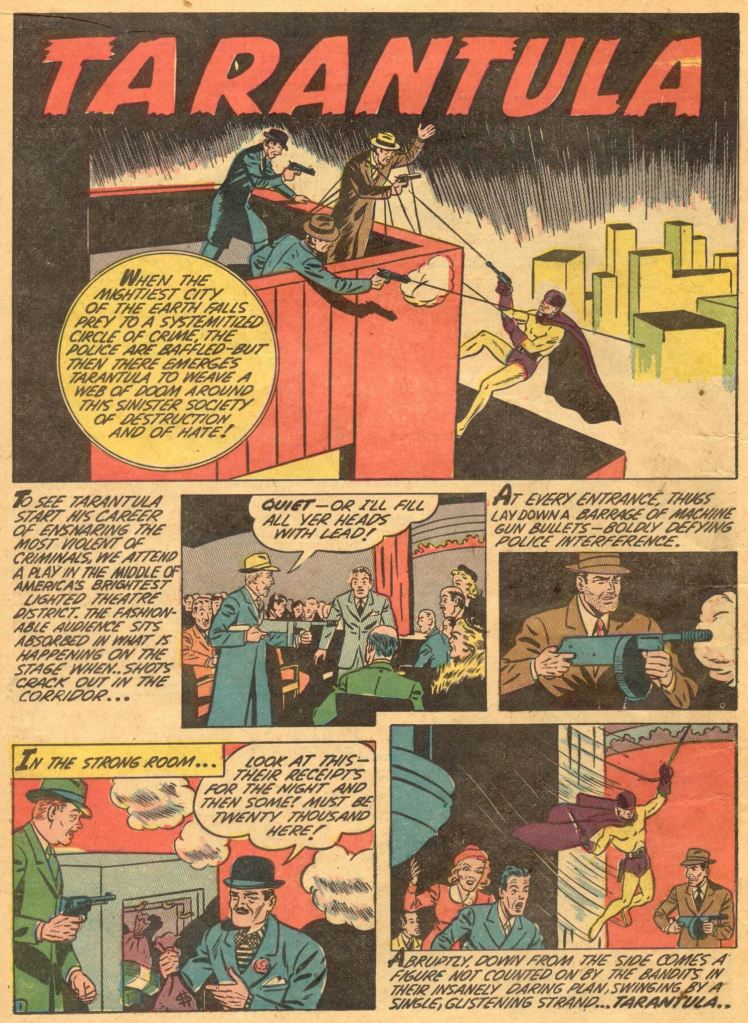
The Tarantula used a web-gun rather than a gas gun. So imagine the character’s upset when the Sandman also traded in his gas gun for a line-firing wirepoon pistol. The Tarantula was secretly barristerJohn Law–he should have sued!
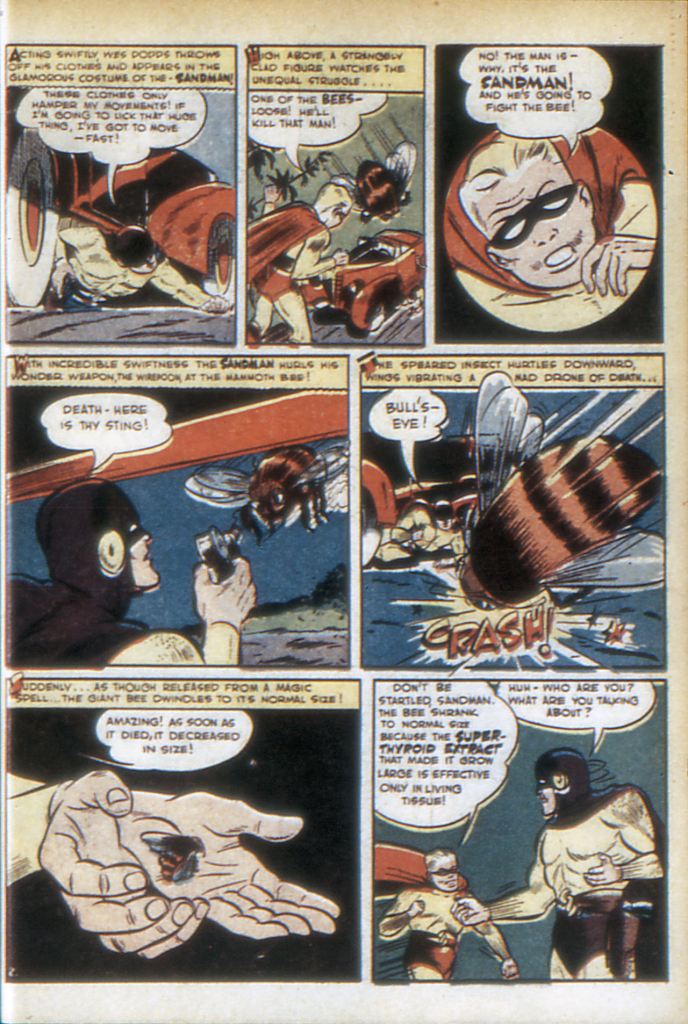
Anyway, back in ADVENTURE COMICS #69, the Sandman also picked up a new sidekick in this story, one who was obviously inspired by Robin the Boy Wonder over in the Batman feature. This was Sandy the Golden Boy, who made a habit of dressing up like his idol the Sandman and who threw in with him when the two chanced to meet. The Sandman’s longtime confidant and girlfriend Dian Belmont disappeared without a trace or a mention.

This transformation was the work of new DC transplant Mort Weisinger. Weisinger had been hired on as an editor, but he wrote and refashioned a number of series in his early days with the company. This typically meant knocking off other more popular features. Artist Paul Norris, who is best remembered today for having co-created Aquaman with Mort, handled the art chores on this job. He remembered being instructed by Mort to draw it “in a Bob Kane style”. Given how much of Kane’s work was being ghosted by other artists, that might have meant anything. But Mort was clearly looking towards Batman as the pattern for how to re-craft the Sandman. Chad Grothkopf inked the feature.

Weisinger and Norris would produce three Sandman stories in this fashion in total. Then with ADVENTURE COMICS #72, the character’s fortunes improved again. Recently emigrated from rival publisher Timely Comics, Joe Simon and Jack Kirby took over the Sandman strip (as well as Paul Kirk, Manhunter, which was also running in ADVENTURE COMICS at that time.) They immediately improved the strip on all fronts, introducing the recurring motif of dreams (inspired by the Sandman’s code-name) and improving both the writing and the artwork tremendously. Before long, the Sandman was being showcased in the main cover spot once again, a position he would hold until the entire magazine was overhauled, integrating most of the heroic series that had been running in MORE FUN COMICS up to that point.

When Simon and Kirby took over, Sandy McGann got a name-change, becoming Sandy Hawkins. In all likelihood, nobody remembered that the kid had been given a last name previously. They also discarded the Sandman and Sandy’s capes, preferring a more streamlined approach to their super heroes.


The first Simon & Kirby Sandman splash page, from ADVENTURE COMICS #72.
 The Tom Brevoort Experience
“Friend or Faux Pas” Dept. Roy Thomas used the Sandman copying Tarantula”s suit in an issue of “All-Star Squadron”. I think Ms. Belmont gave the designs to Jon Kaw.
That opening splash panel and the lettering for Sandman’s name above it were pretty striking.
LikeLiked by 1 person
Yes, meant to be “Jon Law”. Phone screen is tiny…
LikeLike
Belmont showed up in “Sanman Mystery Theater”. Steven T.Seagle, Matt Wagner, Guy Davis & company.
LikeLiked by 1 person
You forgot that All-Star Squadron#18 ( February 1983 ) explained Dian Belmont’s disappearance from the golden age Sandman stories and why Sandman stopped wearing his pulp hero style Sandman outfit for a more super-hero one: That she died wearing Sandman’s original outfit during an encounter with Nazi saboteurs that led to a car crash which killed her ( or apparent death — dc.fandom.com ). Dian apparently dying in that original outfit was why he stopped wearing it. Also MLJ/Archie’s Black Hood [ Top-Notch Comics#9 ( October 1940 ) 100+ appearances ( 1940-1947 ) ] wore a similar costume to Simon & Kirby’s Sandman costume.
LikeLiked by 1 person
I’ll admit these days I’m more worried about remembering everything I should buy at the grocery, and often forget story details in a comic book from over 40 years ago. 😉
I’m not sure why Roy retold Tarantula’s origin in “All-Star Squadron” # 66. The scene of the night he met the Sandman were more succinct than in # 18, including the dialog between Law & Dodds. He left out Dian Belmont’s thought balloons that had been in # 18. I mean, Law was telling the story to the All-Stars in # 18, so it’s weird he’d know what Belmont was thinking. And she died soon after, so how’d he know? I know, Roy was “letting us in on what really happened”. 🙂
So, did Roy change John Law’s profession from being a lawyer, as Tom listed here, to a being writer “Jonathan Law”?
Sandman traded in his gas gun for a grappling line (or harpoon?) gun. Not sure what that has anything to do with sleeping, as the “Sandman” name had. I guess he’d “put’em to sleep” w/ his fists…?
And Tarantula had a “web gun”, even though tarantulas don’t spin webs. Roy’s article in A-S.S. # 60 mentions he was almost called “Spider Man”. Somebody overruled that for “Tarantula”, I guess not knowing about those spiders being webless.
Tom wrote that Sandman wore the “exact same ensemble” as Tarantula’s. But Tarantula’s didn’t show any dark colored boots. And Sandman’s didn’t have gloves (it did have some off yellow colored ear coverings.). You’d think he’d want to avoid leaving fingerprints. Simon & Kirby’s included gloves, besides ditching the cape. And they changed the head mask to go over the bridge of the nose. Sandman’s mask was also over the nose in A-S.S. # 18 and # 66.
Good call on the Simon & Kirby’s 1941 Sandman looking like the 1940 Black Hood.
I know the limited production coloring in the funny books didn’t always match the written or intended costume color schemes. Even Black Panther often looked dark blue in many issues. Tarantula’s clearly looked purple & yellow. Sandman;s looked like it was intended to appear black. Same with the Black Hood’s. Maybe in the subsequent Golden Age Sandman stories, his suit looked more overtly purple.
LikeLike
I recollect in James Robinson’s Starman run that when our hero meets a now-elderly Wesley and Dian she’s the one he’s star struck over.
LikeLiked by 1 person
Robinson’s “Statman” was a personal fave.
LikeLike
Thankfully, in the modern era, both Sandman and Tarantula dumped the gold-and-purple spandex. Sandman returned to his original suit-and-gasmask look, which has a certain ineffable cool that the tights could never match. And Tarantula got a major glow-up in All-Star Squadron, courtesy of Jerry Ordway.
LikeLiked by 1 person
When I made a previous statement that the backup features hardy ever got upgraded to cover-featured status, I hadn’t known or recalled that the Sandman lost his cover spot for a while because he fell out of popularity. Of course Sandman had enjoyed cover status before getting downgraded, and maybe that made Weisinger think the character could be “Batman-ized” into a success for DC (and thus for MW too). I don’t think, based on this sample, that Sandman would have prospered in this form, but S&K had a superior formula, that of “Captain America-izing” the sleep-themed superhero. Gerard Jones cited a remark from either Simon or Kirby to the effect that MW kept trying to ride herd on S&K even when they were making money for DC. Maybe he nurtured some animosity for the duo, since they made his efforts to upgrade Wesley Dodds look rather paltry. Till now I just thought MW was a control freak– though he was almost certainly that too.
If you haven’t got S&K in the equation, you’re probably better off with Gas-Gun Sandman. When Gardner Fox brought the character back in the 60s the writer tried to give Sandman an upgrade a few times: he could throw sand in the air and change it into concrete and glass and stuff. Without such powers he’s a pretty minor player, which is why he probably works better in mystery-themed tales.
LikeLiked by 1 person
I don’t think Weisinger had any specific animosity for S&K for making a character DC wanted to make more successful more successful. But he was the editor of ADVENTURE COMICS, and was a fairly controlling guy, so I’m sure he had opinions on what to do. And Simon & Kirby were used to doing their own thing, even changing scripts by other writers when they were handed them. So they probably didn’t react well to an editor with opinions — they just wanted to be left alone.
LikeLike
“The world is in danger of being flooded with a race of bee monsters!” is the most wonderfully dramatic line!
Even though it’s the first time the readers have seen it, Sandman seems to have been wearing this costume long enough for Sandy to have had time to save up his money, buy the cloth and make himself a Sandman’s-sidekick outfit based on it. The same thing happens to Hawkman and Hawkgirl when they ditch the bird-helmets in favour of simple cowls. The first story with the new look involves them going to a costume party in them and being universally recognised as Hawkman and Hawkgirl.
LikeLiked by 1 person
Clearly, there are UNTOLD TALES OF THE SANDMAN, where he wears that suit for a number of adventures, long enough for the public to get used to it.
When it was clear that it was going to stick, young Sandy was thrilled, because he’d been trying to save up enough money for a tailored suit and a gas mask, and it was taking forever.
LikeLiked by 3 people
It’d be a nice coda to the story where Thoms killed off Dian.
LikeLike
Like “Jumping the shark” there should be a comics-related shorthand phrase when something weird, cool, and interesting (like Hawkman’s bird helmet) is discarded for something bland and generic (Hawkman’s yellow cowl). It happened to DC characters more frequently in the 40’s… Hawkman, Dr. Fate, and Sandman all received makeovers that smoothed over their visual quirks to make them fit a super-hero norm. Sansbirdhelmed?
It happened kind of sort of at Marvel in the 60’s where Kirby characters would lose some “pointiness” as time rolled by. Ant man and Ironman get pretty retooled to be more standard looking… in the case of Ant man… he becomes more generic, and Ironman becomes less monstrous though it’s a visual upgrade ala Daredevil. Your mileage will vary I suppose
LikeLiked by 1 person
It actually makes sense from a story perspective in the DC universe. Here are all these guys doing what had never been done before, dressing up in costume and fighting crime. Initially they pull the more creative ideas from their own imagination, but after they’ve been hanging around together in the Justice Society, a more defined ‘norm’ starts to emerge, and they change their outfits to conform to it.
Other examples include the Atom dropping the full head covering and adopting a more standard superhero look, and Hourman (this one never gets mentioned, because it’s very subtle) modifying his distinctive hood to become a normal superhero headpiece in his last few stories in 1942. Jay Garrick really should be admired for sticking with the tin-helmet-with-wings look while everyone else was normalizing!
LikeLike
What I wouldn’t give for a run of Sandman in his original togs by Steve Ditko… a character he obviously loved or at least admired. We sort of got to see his villainous version killed by cops in Spider-man I guess. Ditko could have made the Sandman click at least for the lovers of pulpy weirdness. I love the schlumpy Guy Davis version.
I’m not sure if I found out about the character first in the Famous First Editions All-Star reprint or his appearance in the 100 pager Justice League 113. “Creature in a Velvet Cage” is a rare tragic back story for a DC character that doesn’t involve dead parents or planet… and maybe the first time that a super-hero with a sidekick beat Batman to a recurring trope.
LikeLike
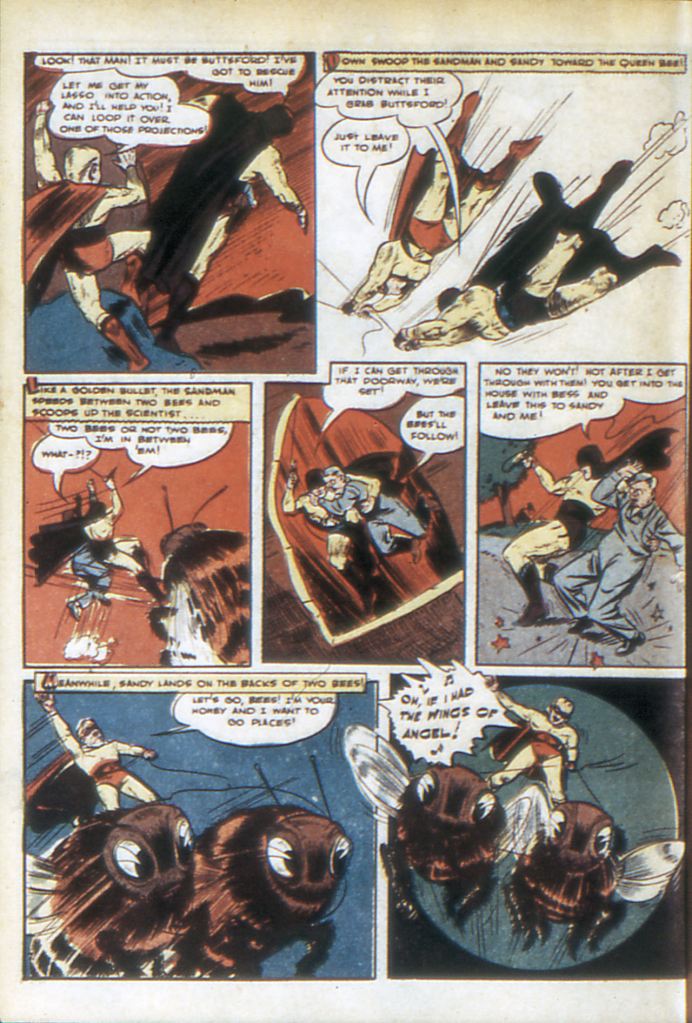
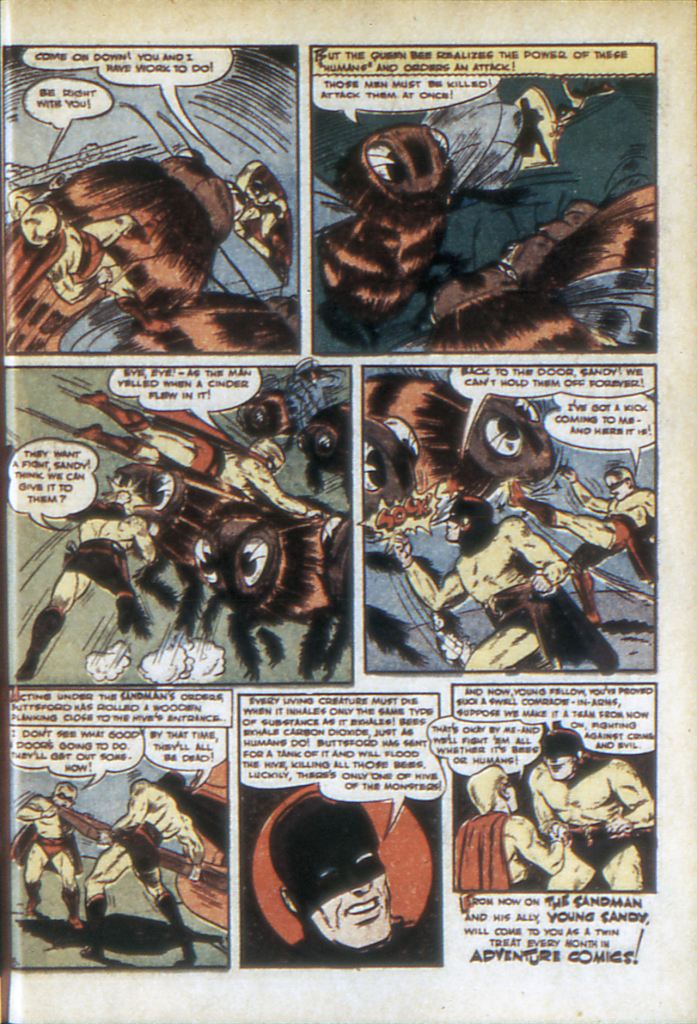
This has more (plot) holes than a beehive, but it’s charmingly insane. The panel of Sandy riding the two bees and singing is some sort of minor comics masterpiece. The scripting is amusing, e.g. “Death – here is thy sting” “Two bees or not to bees”. I get the sense that Sandy is making pop-culture wisecracks, unfortunately lost to time now – “I’m your honey and I want to go places” sounds like it’s alluding to something which readers back then would recognize.
It’s not deep. But it’s fun fluff.
LikeLike
“I know that must have meant something back then but I don’t get it” is always a fascinating thing in old comics/movies/TV. And even with the Internet to search it can be elusive.
Brian Cronin had a whole series of columns about stuff like that. I contributed a couple (like Metamorpho making a reference to Hathaway shirt ads).
LikeLike
I’d always assumed Simon and Kirby rebooted the costume and added Sandy. Thanks for enlightening me.
LikeLike
Re Weisinger– I judge him to have been a grudge-holder type, but there’s no point in arguing the point because most of our fan-knowledge is based in circumstantial evidence.
I see that the S&K Sandman didn’t immediately take over the cover spot in #72 but it did get a “New Sandman” banner to draw in kids to the fact that something new had been added.
LikeLike