

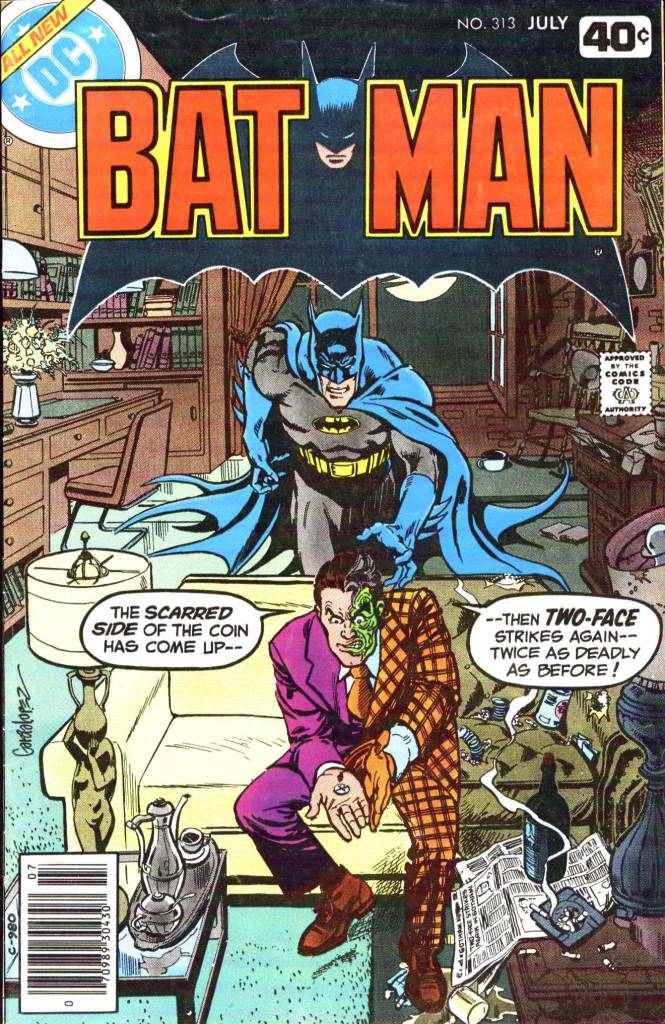
I’m not certain what compelled me to pick up this issue of BATMAN on my weekly trip to my local 7-11 for comics. It could simply have been a function of me having a bit more change to my name than usual and deciding to branch out a bit further. At some point during this period, I had begun skipping the school lunches that my parents gave me a dollar a day to purchase and instead keeping that money to finance my comic-buying habit. Every once in a while over the years, my father would ask if i was doing this, and while I’d deny it, he was clearly skeptical. But he was trapped and he knew it–he couldn’t cut me off from the lunch financing, nor was there any way to enforce that I was eating those lunches as proscribed. So I had a nice little steady income most weeks with which to buy my comics.
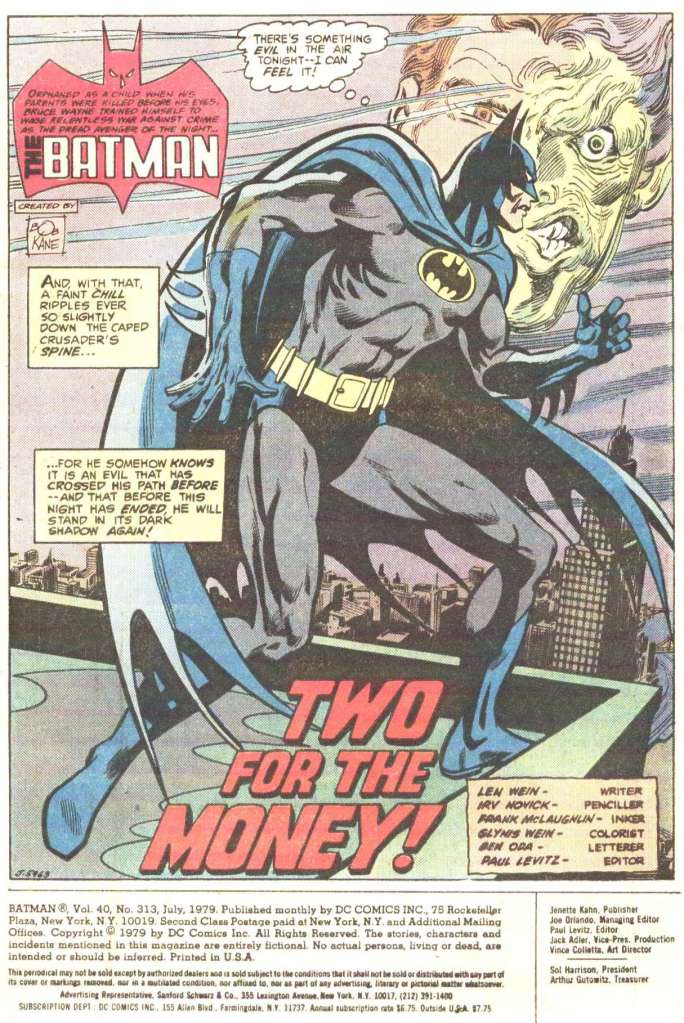
Even to this day, while I like Batman just fine as a character, he’s not really a huge favorite of mine. I think there was a basic disconnect in the power fantasy for me, one that Jules Feiffer talked a bit about in his book THE GREAT COMIC BOOK HEROES. If you gave me an origin, if I was rocketed from a doomed planet or given a magic ring or struck by lightning and chemicals, I might have been able to become a super hero. But there was clearly no way that I was getting there through hard work and discipline alone, not with my lousy physical prowess. So the fantasy of Batman didn’t resonate for me. Also, I tended to want optimism in my fiction, and while Batman wasn’t devoid of such, the core premise of the character is more about revenge than anything, for all that people over the years have tried to spin it differently. So that didn’t work for me either. I tended to prefer the more benign Batman of the 40s, 50s and 60s over the version we were getting by 1979–and that version is positively uplifting by today’s standards.
I may have bought this issue simply because I liked the central idea of Two-Face, one of the Masked Manhunter’s most outlandish foes (and one who never got lampooned on the BATMAN TV series of 1966.) And I always had a fondness for the work of Irv Novick, who had been a mainstay of THE FLASH all during my childhood when the character became my favorite. And I wasn’t paying enough attention to the credits yet, but Len Wein, who had written a huge number of comics that I had liked, was at this point writing the series. So it wasn’t a bad place to come in. Len was starting to bring in some Marvel style continuity and soap opera, as well as beginning to call back to events in the short-lived but very popular Steve Englehart run on DETECTIVE COMICS. But more on that as we get to those.
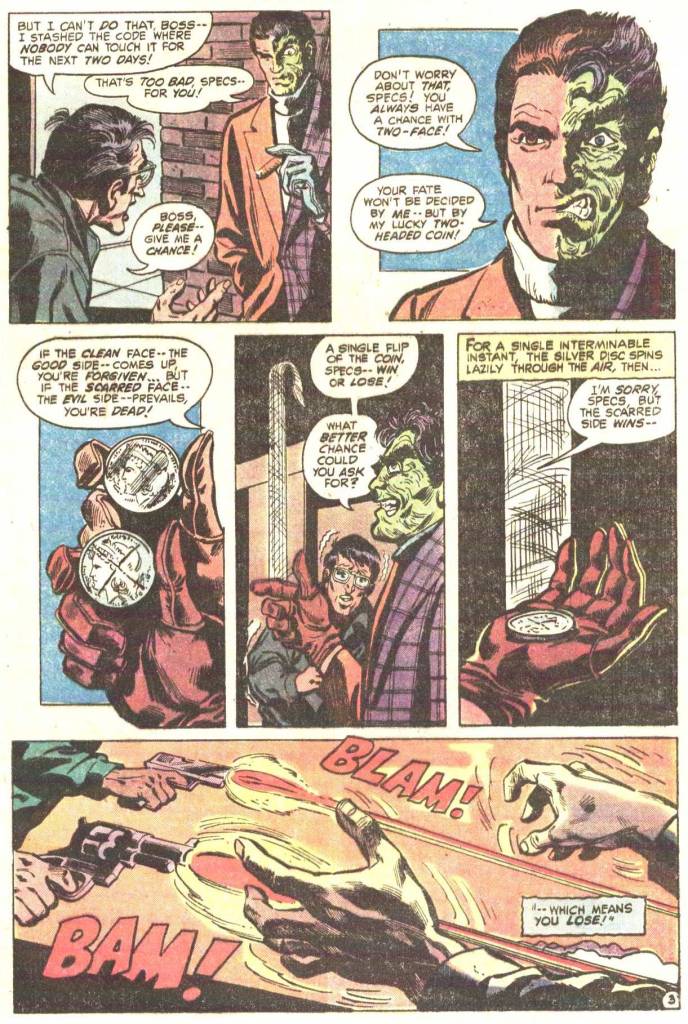
The issue opens with a small-time Hood named Specs (for obvious reasons) calling in a tip on the whereabouts of a stolen Binary code that provides access to America’s missile defense system. But before he can complete his call, he’s interrupted by Two-Face and the rest of the gang. Specs was on board with this heist when the objective was to sell the code back to the Government, but now that Two-Face is considering selling it to an enemy nation instead, Specs wants no part of it. Specs has stashed the code in a place he can’t immediately access, and he loses a coin toss, so Two-Face guns him down, putting two bullets into him. Meanwhile, Bruce Wayne is getting to know his date Selina Kyle, once the Catwoman, better. But the Bat-Signal appears in the sky and consequently their date is cut short so that Bruce can find out what the Commissioner needs Batman for.
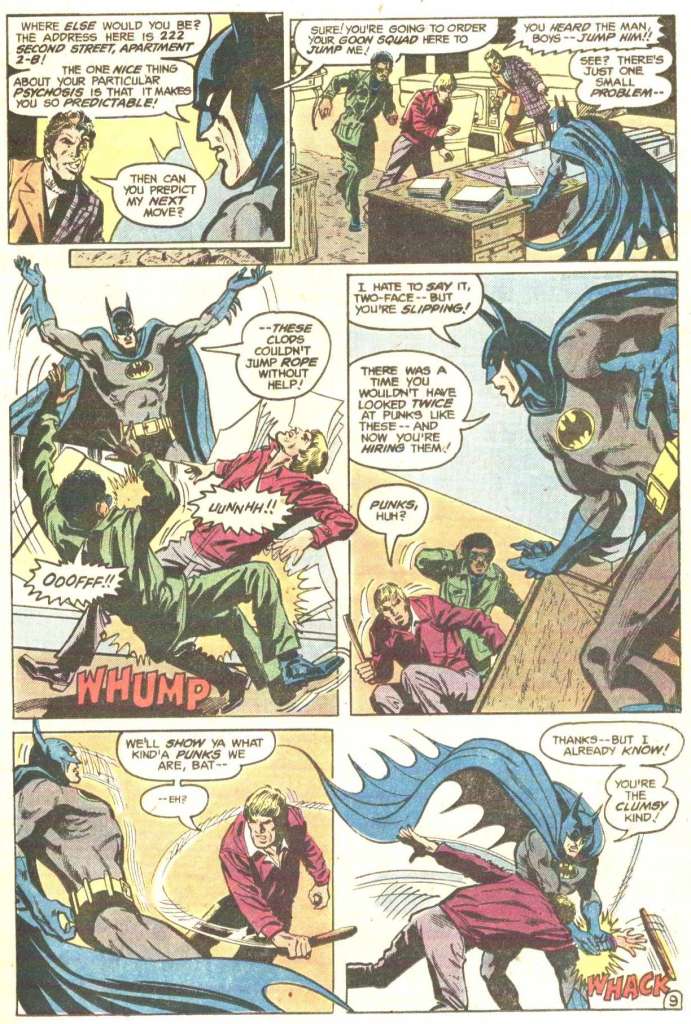
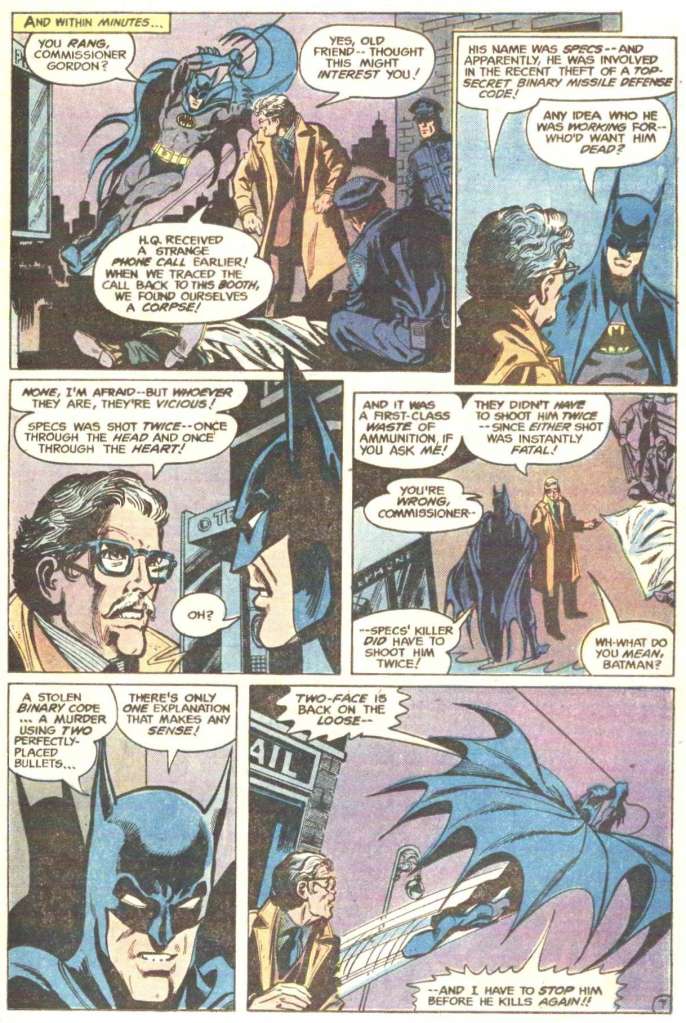
After the commissioner gives Batman the lowdown on what’s been happening in the rest of the issue, the Caped Crusader goes in search of his quarry Two-Face. he finds the malefactor and his gang holed up in–of course–222 Second Street, Apartment 2-B. This leads to a pretty one-sided fight where Batman clobbers his way through Two-Face’s goons in pursuit of the main villain. At a certain point, the battle is interrupted by a gun-wielding lawman who utters that everybody is under arrest. This gives Two-Face the opportunity to drop a steel barrier that bisects the room, and he’s able to escape while Batman and the lawman attempt to get through it. In the aftermath, the lawman introduces himself as King Faraday, a government agent and a character from DC’s past who had headlined in DANGER TRAIL back in the 1950s. Faraday is ready to do anything to recover the stolen binary code, but Batman owes a debt to Harvey Dent, and that means he wants to bring in Two-Face alive and unharmed.
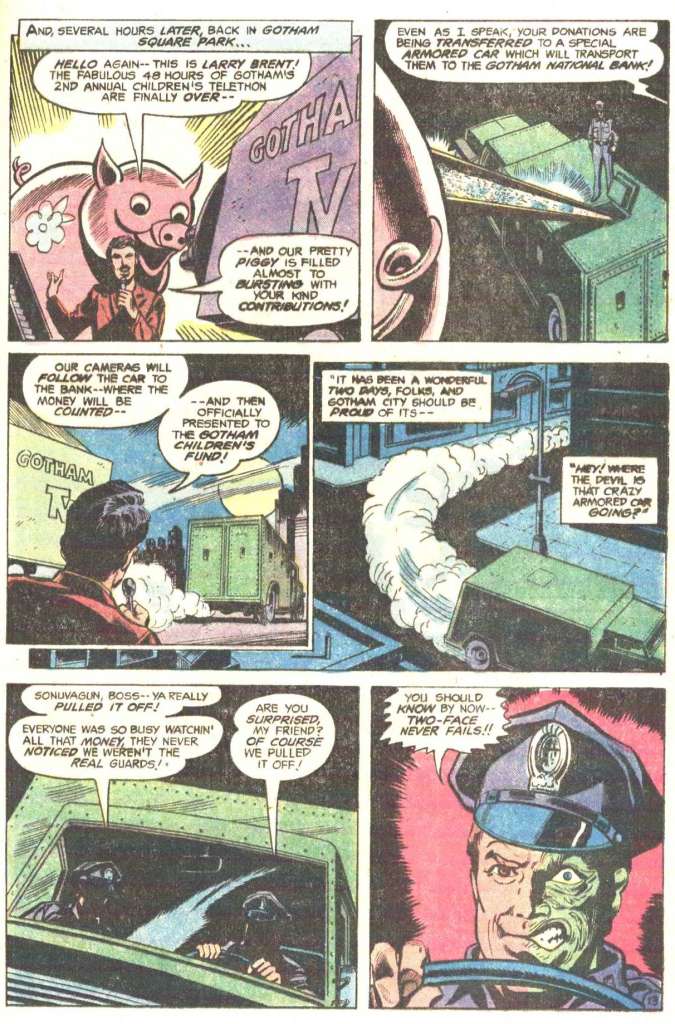
All throughout the issue, there have been asides and cut-aways to a multi-day charity drive that’s been going on with a Bill Finger-sized giant piggy bank full of money. It’s clear that this is where Specs hid the purloined code, since it wouldn’t be opened for two days. Accordingly, Two-Face and his remaining gang pose as armored car guards and make off with the proceeds from the charity, assuming that the missing Code must be in among it. But Batman and faraday have deduced the location of the Code as well, and the pair pursues in the Batmobile. Batman uses the vehicles lasers to destroy Two-Face’s tires, causing the escaping armored car to crash.
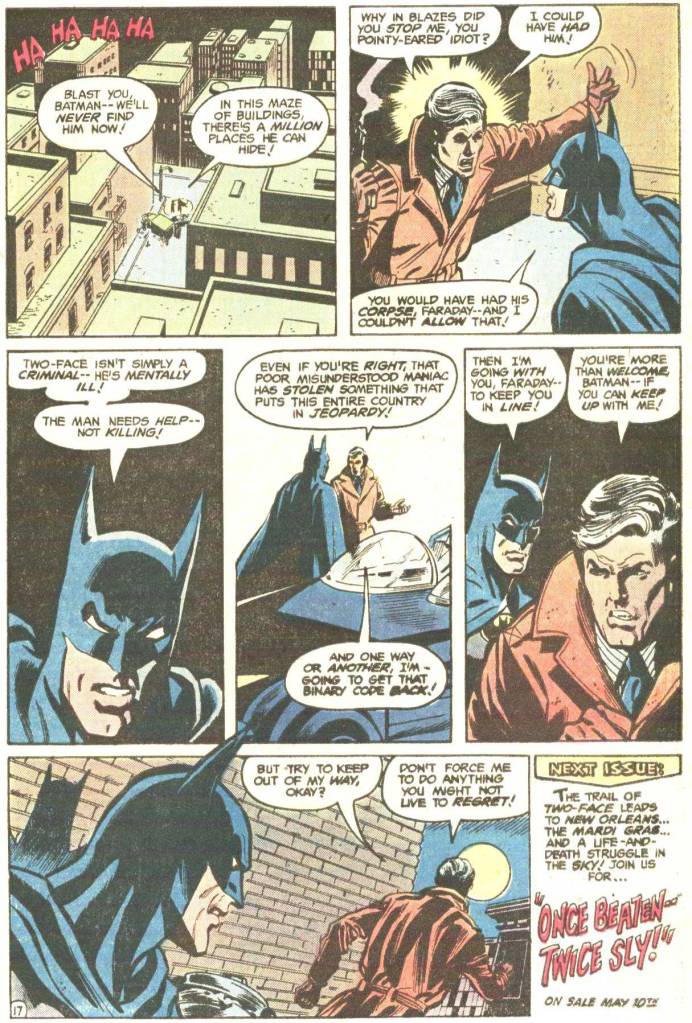
So the issue ends in a run-and-gun, as Two-Face has recovered the Code and attempt to make his getaway. Climbing a fire escape, Dent kicks Batman to the ground below, but then is squarely targeted by Faraday who intends to shoot the fleeing felon stone-cold dead. But before he can, batman knocks his gun aside, spoiling his shot. As a result, Two-Face gets away with the Code, and Faraday angrily tells Batman that he’d better stay out of his way from here on in. And that’s where this story is To Be Continued. It was a perfectly fine adventure, but nothing great. Probably the best part of it was the stylish cover by Jose Luis Garcia Lopez.
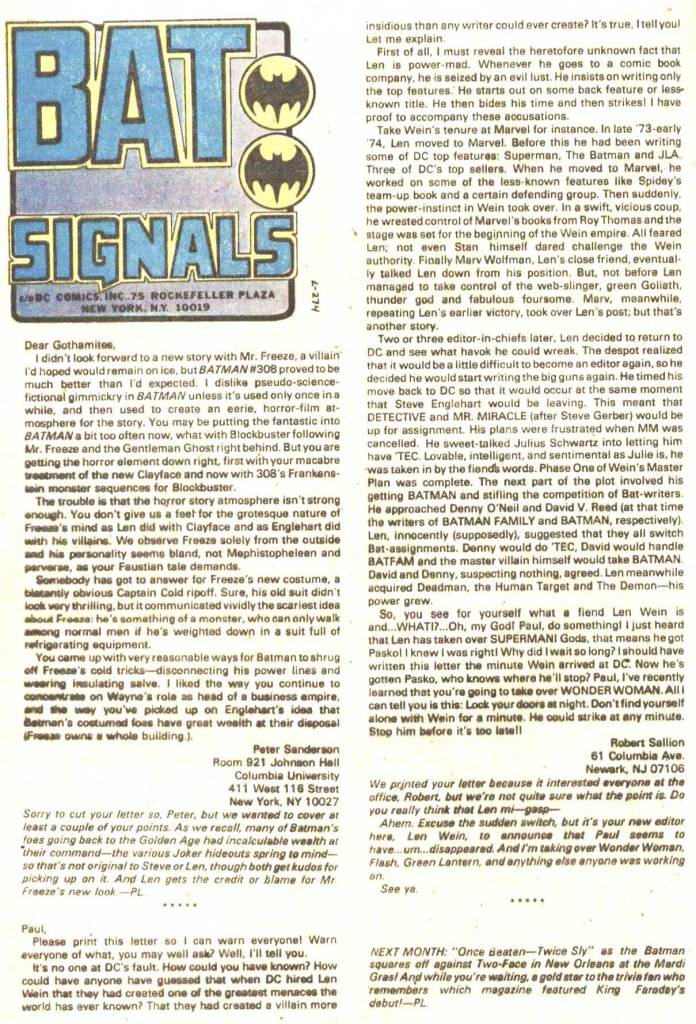
The Bat-Signals letters page in this issue includes a letter from future comic book historian Peter Sanderson, who was a frequent contributor to such pages across both companies, Marvel and DC. There’s also a fun and witty tongue-in-cheek letter about how Len Wein inevitably takes over all of the top features at whatever company he’s at, which editor Paul Levitz responds to in kind.
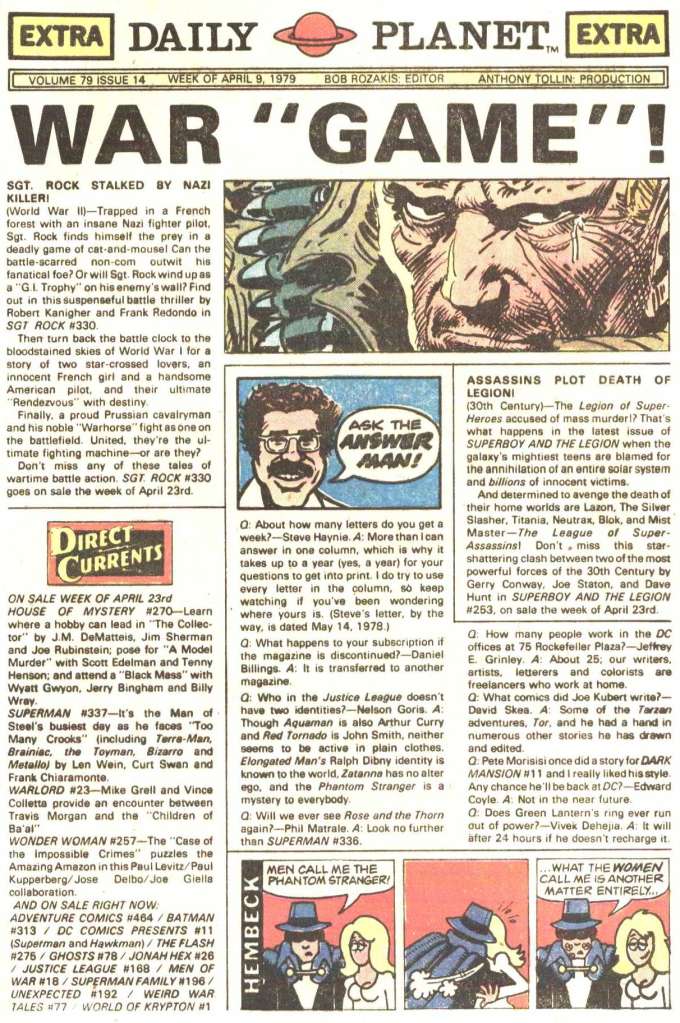
And of course, a new week meant a new edition of the Daily Planet page, DC’s answer to Marvel’s Bullpen Bulletins. As usual, it included an installment of Bob Rozakis’ long-running Ask The answer Man column as well as another goofy comic strip by fan cartoonist Fred Hembeck
 The Tom Brevoort Experience
As you referenced the current iteration of being kind of a big bummer (my words, don’t think i’m overstating your inference though) here’s to hoping that matt fraction and jorge jimenez will purge some of that punishingly overwrought basking in ever-present trauma action from their book. leaving behind all the jim lee-isms that have been burned into the visuals of that character is a good start (the better weather in gotham/no rain making its way into the promo campaign for that book is pretty funny)
LikeLiked by 2 people
I didn’t get anything out of Wein’s run on BATMAN. Found it much too formulaic. I can’t remember him creating any memorable new villains for the Caped Crusader, compared to the two or three he invented for Spider-Man. There was some silver-fetish guy called Sterling Silversmith, right? Anyone else?
LikeLiked by 1 person
There was Gregorian Falstaff, who was…not terribly memorable, the new Clayface, who was, and Firebug. And I liked how Len brought in the Gentleman Ghost as a recurring Bat-foe. But I don’t think Len really wanted to create new Batman villains so much as bring back (and modernize, where needed) the classics.
Perhaps his most significant creation of that era wasn’t a villain at all, but Lucius Fox.
LikeLiked by 1 person
The cybernetic suited Preston Payne Clayface? The Clayface Alan Moore used in the lead story in Batman Annual #11, drawn by George Freeman? GREAT STORY.
Lucius Fox is significant!
LikeLike
Lucius is indeed significant. And yes, that selfsame Clayface.
LikeLiked by 1 person
I wasn’t that wild about the Novick art on this run — it was an improvement on John Calnan, but after getting Marshall Rogers in ‘TEC and seeing Golden, Aparo and others elsewhere, it just seemed kind of bland. But I enjoyed Len’s take on Batman more than I did Denny’s or Haney’s in the other books, and the subplot stuff definitely hooked me into being a regular reader.
LikeLiked by 2 people
McLaughlin might be flattening him out here. I typically like Novick just fine when he’s inked by Giordano.
LikeLiked by 2 people
McLaughlin flattened him out a lot, for a long time. But on the other hand, if I penciled a comic it’d probably look good if Dick Giordano inked it. Dick made stuff look better, so he might not be the best yardstick for what’s in the pencils.
That said, Novick’s a perfectly-good storyteller, but I think the problems with his BATMAN are that he doesn’t do much to make the action seem moody and dark — he nods a bit in that direction, but it mainly concerned with making the storytelling as direct and clear as he did in FLASH. And as a result, it’s not shadowy/scary/dangerous…it’s just superhero action. I’m not sure an inker could have done much to correct that — even if you put Tom Palmer or Klaus Janson all over it, the camera angles and body language would have been the same: Clear, distanced and not-spooky.
LikeLiked by 1 person
I appreciate Novick and Giordano as a team because they did “Night of the Shadow” in Batman #259 which I hold in high regard as a comic I really loved as a kid.
LikeLike
I tried to guess who the inker was from that first full splash page. I was wrong. The softer inks made me think of Jack Abel first. Like pumice stone. Jack had softer detail lines. The differences with Frank’s inks were evident with each page. I never warmed up to Irv’s style. The heads and bodies seemed oblong. Maybe good for Elongated Man. I didn’t like the bat-ears Irv drew. Seemed to flare our a bit. But it was also the torsos. The definition in the abdomen just looks weird to me. I do like how older, longtime artists did reflect the times in current hairstyles & clothing.
I think Giordano could sharpen/tighten up other artists’ drawings he inked. I love Janson’s inking, especially on Batman. But he was mismatched on Pat Broderick. It was still an improvement, but some quirks of Pat’s were still there. The oblong faces & figures (noses & chins), the disjointed anatomy. I can’t clearly imagine Klaus inking Irv’s Batman. I’d be curious to see it. I like Kurt’s suggestion of Tom Palmer more for inking Novick.
LikeLike
I wasn’t suggesting Palmer or Novick; I was saying that putting a moodier inker on the book wouldn’t have helped much, because the problem wasn’t the surface drawing but the layouts, the storytelling.
That said, I wouldn’t have minded seeing either of them ink a Novick story, though since Palmer was Marvel-exclusive until after Novick retired, that particular pairing would have been very unlikely.
LikeLike
I probably like Novick for the same reason Mister Brevoort does, his tenure on Flash. His doing Batman also didn’t bother me because Batman was a four color adventurer-hero mostly then. Dark Knight and O’Neil’s editorship would seal the deal for good on Batman being a dickish creature of the night.
LikeLike
I think Novick’s Batman was fine — better in the late 60s/early 70s, in part because Dick inked most of those, in part because they felt more like pulp adventure and less like plain superhero stories — but he was a very capable artist.
He just wasn’t Marshall Rogers or Michael Golden or Jim Starlin or Jim Aparo or Michael Netzer/Nasser, who were doing Batman stories around then. So I couldn’t help but wish Len had been working with guys like that.
LikeLike
I enjoyed Wein’s run on the book, which i believe was the first time Bruce and Selina had been anything close to an actual couple.
As a kid I had the same reaction to Batman you did: an ordinary guy in costume just wasn’t cool enough. Somewhere along the way, that changed, as witness I have archive/omnibus editions of every Bat-story up through 1957. I suspect I’ll buy the next Silver Age Omnibus if/when it comes out, even though we’re getting into the Bad SF Era of the Caped Crusader.
LikeLiked by 1 person
Batman in the 21st century is largely unreadable. I might still be “subsidizing mediocrity” in the words of an earlier post but DC’s endless universal reboots have broken me of the feeling this is the same Batman I used to read, which makes it easy to quit.
LikeLiked by 1 person
I’m reading very few new comics these days. But among them are “Batman”, “Detective”, Phillip Kennedy Johnson’s “Batman & Robin” (I miss artist Javier Fernandez, maybe it didn’t sell well enough to keep him interested), and “Batman: Dar Patterns”. “Dark Patterns” reads like an early 90’s book, or if we went straight from “B:Y1”, to Milligan’s “Dark City”, to “LotDK”, to “Dark Patterns”.
I already love Jorge Jimenez’s Batman, so I’m looking forward to him returning to the “Batman” regular series. I’m not liking the lighter shade of blue in the costume. The deeper blue hit a sweet spot in my brain. I have enough of the light blue in the 1970’s & most of the 1980’s. Even the first issue of “DKR” had that lighter blue, because that had been the norm for so long.
LikeLike
I’ve heard Dark Patterns is great. I have the first issue cued up on the app but I keep getting distracted by everything else on the app.
LikeLiked by 1 person
I hope you like it. The art looks to me like a cross between Mazzucchelli and Tim Sale. But it’s its own thing.
LikeLike
That cover has stuck in my mind as one of my favorite Two-Face images. I can believe that he’d make sure to sit on the couch just so, on the exact dividing line between “good” and “bad” room halves. The bottom part of the couch isn’t split properly though, that’s an art flaw (did whoever altered the couch justify being lazy as a half-done job?). And does Two-Face actually smoke at all, or does he have the cigarette burning as a prop for decoration?
LikeLiked by 2 people
Too many writers confuse Batman’s mission as vengeance instead of justice. “Batman Begins” worked that out in the first act. Matt Reeves “The Batman” flubbed it. (With his last name, maybe Reeves should try a different super hero.) My favorite Bat-comic writers know it, too. Bruce isn’t Frank Castle. Even Chuck Dixon, who’s views outside of comics conflict with my own, knew the distinction, and was faithful in that way to both characters. Though I’d take Garth Ennis’s Punisher over anyone else’s any day, and also Steven Grant’s over Chuck’s.
Some writers, including new ones, keep making that mistake. Maybe they think that vengeance is more dramatic or appealing. Not to me. And the best Bat-writers (even the ones who may have only written a few stories but they were so good) knew it, too. Grant Morrisson. Steve Englehart. Doug Moench. Mike Barr. The aforementioned Len Wein. Peter Milligan. Matt Wagner (“Faces”, “Batman/Grendel”). Kelley Puckett (not just his “G-rated” “Adventures”, but his too-few mainstream DCU Bat-stories). Darwyn Cooke (“Ego”). Paul Pope. Alan Grant. John Wagner. Devin Grayson. Mariko Tamaki. And yes, Alan Moore, and Frank Miller (“DKR” & “B:Y1”, not that “All-Star” stuff). All of them showed a compassionate side that rejected or would forgo vengeance. Like Chris Nolan’s Rachel Dawes said, justice is about harmony and healing.
I liked Len’s stories’ construction and characterizations very much. I don’t think I read one of his stories where I thought he was mismatched with the character. Considering how many characters he wrote, and wide-ranging they were, that’s pretty amazing. From Deadman to the Hulk. My only complaint, against the volume of brilliance found in his huge catalog, is the constant use of exclamation points in his dialog. As if everyone was shouting, all the time. 😉 I realize the audience leaned younger in the 1970’s. But by the late ’80’s it seemed out of place. Still, Len’s an industry legend, and deserves to be. I also think he was a terrific editor, just judging by the comics he was responsible for.
Like Tom, there’s no way I could ever do the stuff Batman can do. I’m not that smart, not that strong, dedicated, disciplined, or naturally physically gifted. When I work out extensively for weeks at a time, I get hurt. And lose whatever progress I thought I’ve made. I don’t have the drive that Batman has. And I don’t have the money for the independence and far reach that Batman has.
But I really like thinking there’s a .01% chance that SOMEBODY could somehow have all those factors fall into place, and become that stalwart, relentless dark knight for justice. And compassion to those who really need it. The odds are against it. But it might be nice to actually have someone like that. But people aren’t that infallible. It’s best to keep it to fiction. An inspiration, an ideal, with Bat-warts and all.
Giving him super powers, as Roy Thomas suggested, maybe even thinking it was long overdue, would ruin a part of the essence of the character. He’s even more amazing because he does what he does without the benefit of super powers. He has more to risk than someone with super powers. He’s more vulnerable. And subsequently more guarded.
No, he shouldn’t always win. Defeat brings its own lessons. And compassion should always be somewhere not too far from him. He knows what damage and suffering crime can bring. That’s part of his mission, or obsession. I disliked it when Ton Taylor wrote him as being distant/awkward with and aloof from young children. Taylor wrote that to contrast Batman with Nightwing, Taylor’s then-lead character. But since Taylor’s been writing “Detective Comics”, he’s been showing Batman’s compassionate side. Maybe having his own obsessive son as his partner helps to reinforce it, to set an example for Damien. The innocent shouldn’t fear Batman.
Anyway, it makes me a little sad that you don’t get that about the character.
LikeLike
Batman is already now inhumanly good at just about anything he tries. Does he really need more super powers when he’s effectively superhuman already?
LikeLiked by 3 people
I hear ya. Like I wrote above, I’m against giving Batman super powers.
LikeLike
I an see that I didn’t make it clear that I consider Batman’s being inhumanly good at anything possible to be a super-power already. The dude created an alternate personality in himself for a slim eventuality. He might not be a meta like Geo-Force but he is in no way a baseline human no matter what DC tries to claim.
LikeLike
I disagree. We know no one can fly, but we accept Superman can for the sake of the story. So I’m OK with Bruce Wayne’s “super” subterfuge as Batman without being a “superhuman”. Enjoy the comics however you want, & I’ll do the same. .
LikeLike
I think Two-Face’s creators got Acid Burns ( Varying from RED and swollen for minor burns to blisters, BLACKENED, or WHITE dead skin for more severe cases ) confused with Gangrene ( Gangrene is a dangerous and potentially deadly health problem. It happens when the blood flow to an are of tissue is cut off. This cause the tissue to break down and die. Gangrene often turns the affected skin a GREENISH-BLACK Colour )–Googled.
LikeLiked by 2 people
Dammit, John, take a hint from a 40 yr old Talking Heads concert movie and Stop Making Sense. 😉 Maybe green scars was easier on the production and contrasted better with 2-Face’s wardrobe. 😉 Seriously, Matt Wagner wrote about this in the collected version of his LotDK 3-part “Faces” arc. Matt insisted on red facial scars. Made much more sense, worked visually, & became the new normal.
LikeLiked by 1 person