

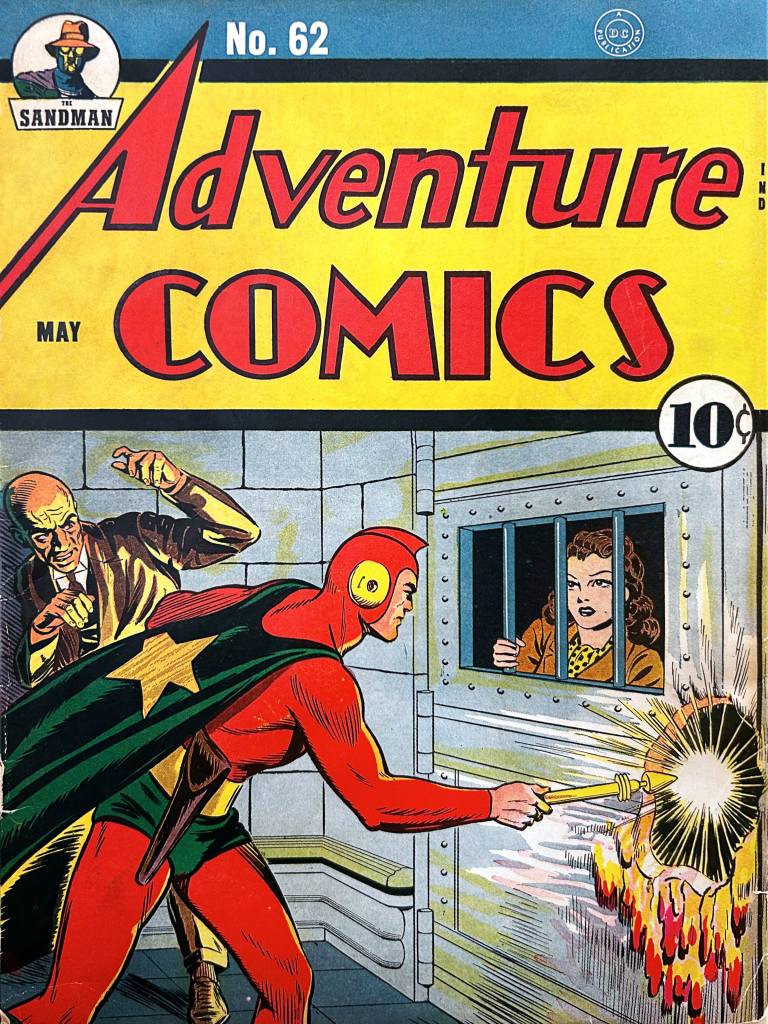
By 1941, ADVENTURE COMICS was lagging a bit behind DC’s other anthology titles, in particular ACTION COMICS which held the popular feature Superman and DETECTIVE COMICS with Batman and Robin. ADVENTURE’s headliner Hour-Man clearly wasn’t getting the job done, nor was the gas-mask-wearing Sandman. Clearly what was needed was a new feature with popular appeal. Studying the field and synthesizing what were considered the best elements from it, DC’s editorial staff came up with a character that they felt was a lock-solid contender to become ultra popular: Starman. And such is the hubris of publishing executives of every era.
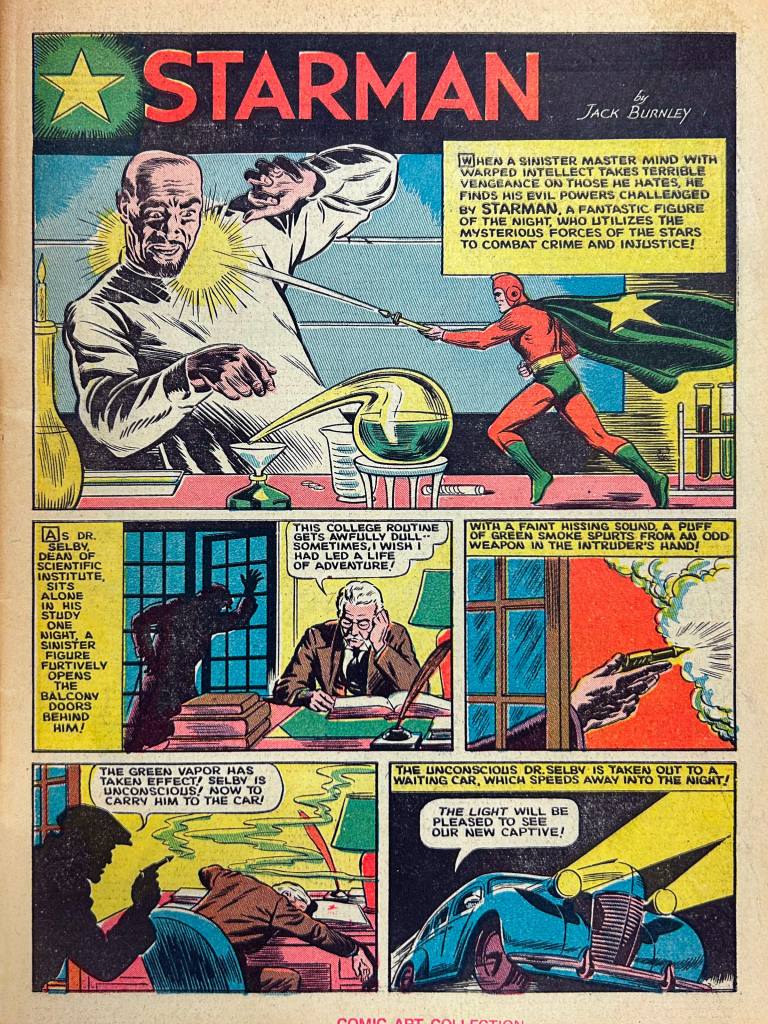
The big draw to Starman was the artwork by Jack Burnley. Burnley was technically the most accomplished draftsman and illustrator in the place, light years ahead of Joe Shuster and his studio or Bob Kane and his many ghosting helpmates in terms of pure drawing ability. It was felt that with Burnley at the helm, the character couldn’t help but become a huge success. Writing on teh series was given over to Gardner Fox, who had proven himself a reliable writer of super hero adventure stories. It was, in the vernacular of the Hollywood industry, a “total package.”
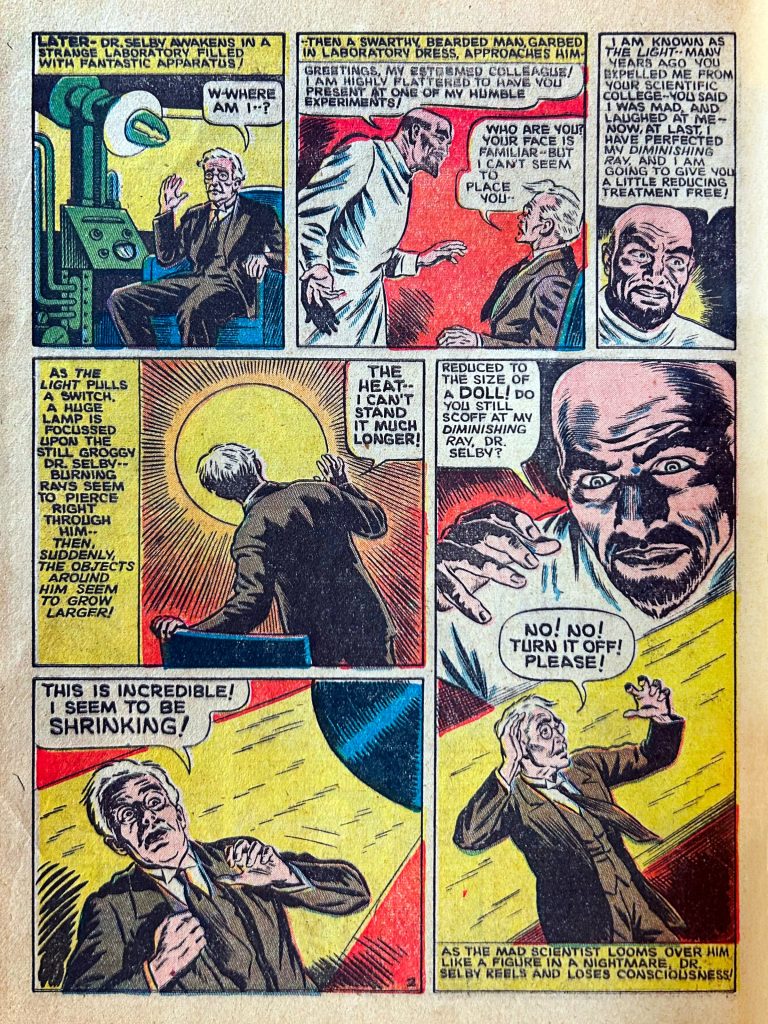
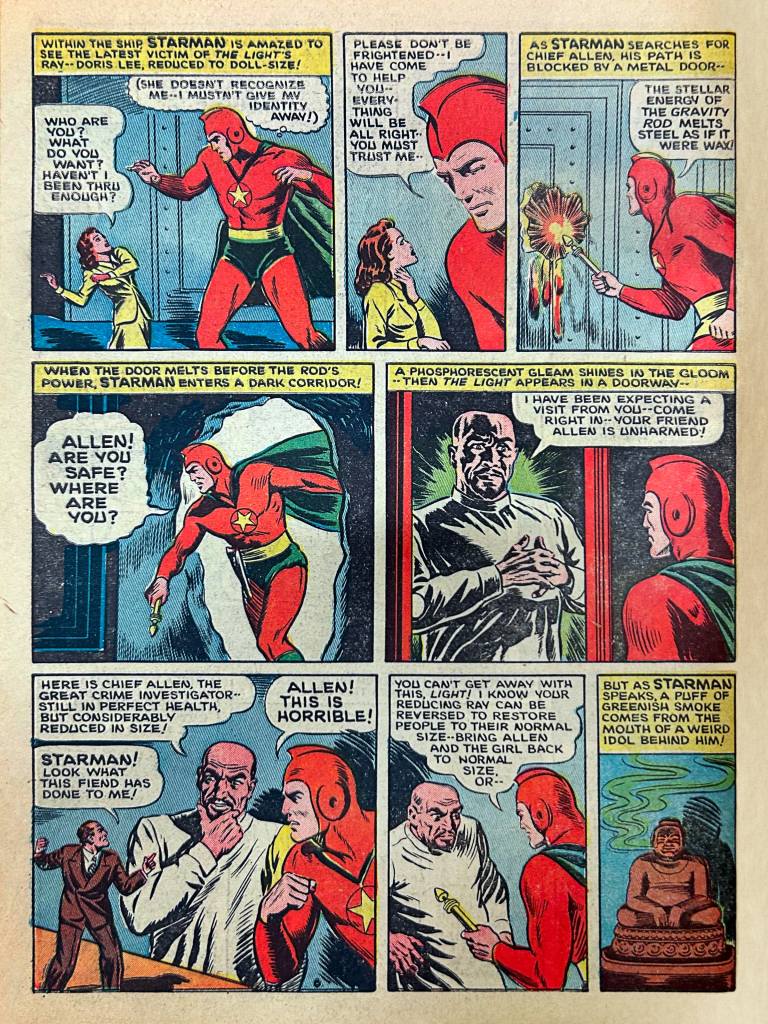
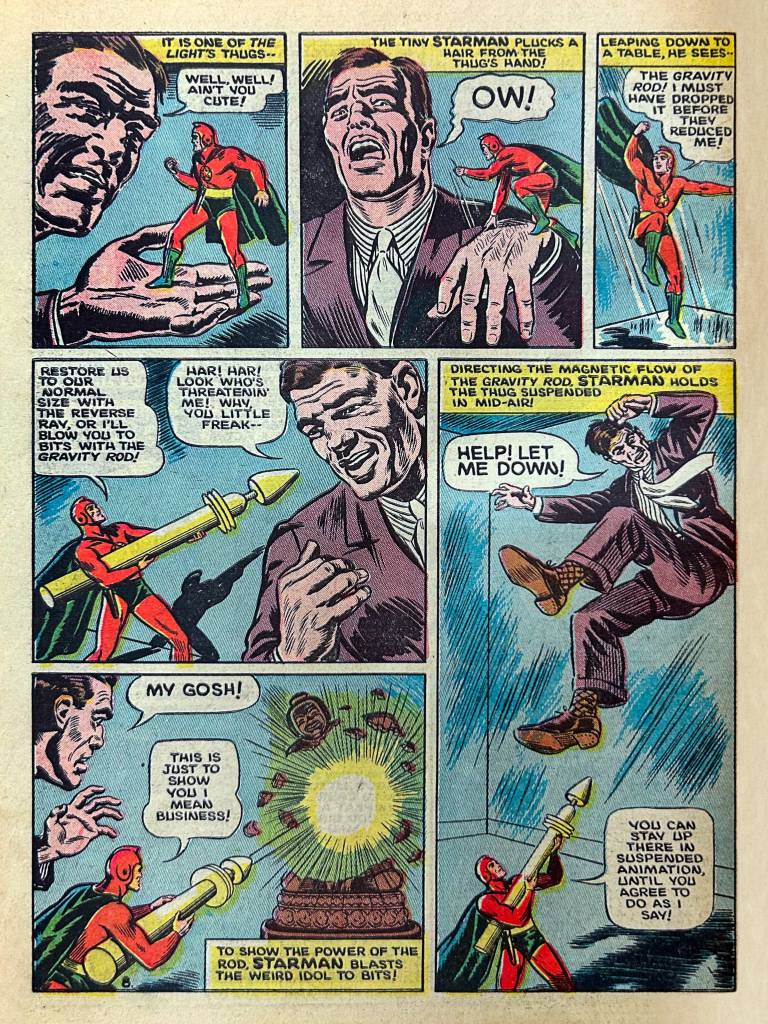
But as we know now, Starman failed to connect with the audience at large, despite his pedigree. I think there are any number of reasons for that. The first is Burnley’s work. It is undoubtedly beautifully drawn, but it also feels a bit stiff and lifeless, like a collection of beautiful photographs that fail to capture the living essence of the subject matter. As you can see on this page, there isn’t a whole lot of animation to what Burnley is doing.
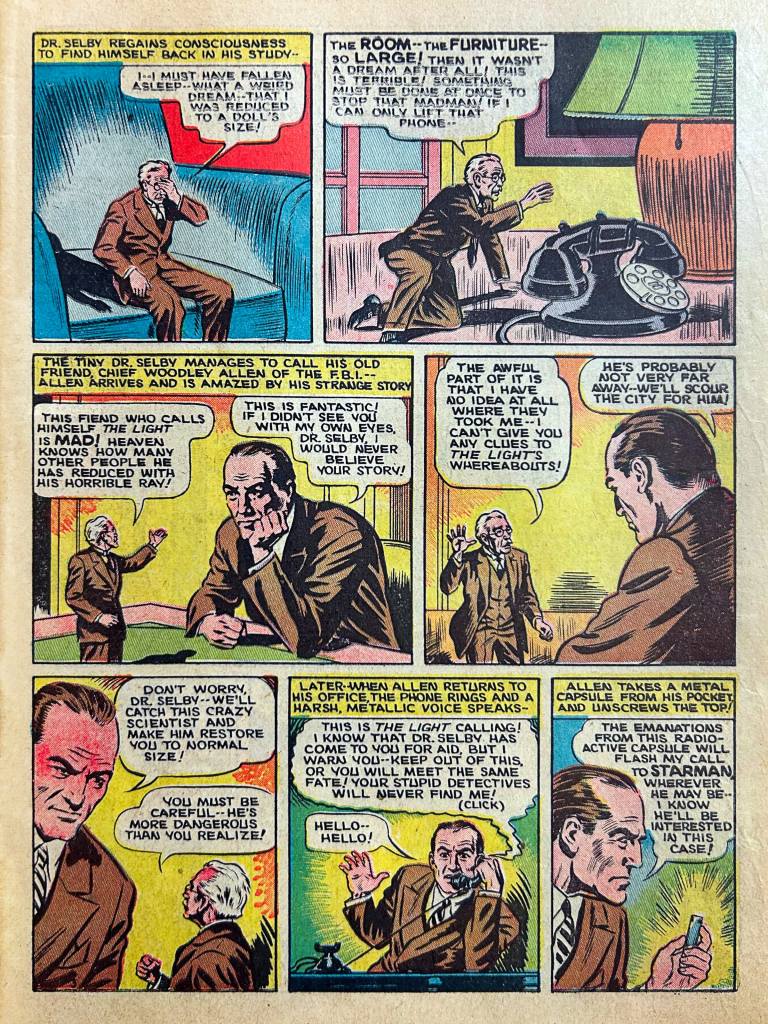
Secondly, Starman was perhaps too made up of Frankensteined parts from other popular series, without any distinctive spark of his own. Like Superman, he wore no mask and a typical costume with trunks and cape and boots, as was the fashion. Like Bruce Wayne and so many others, he posed in daily life as a bored wealthy playboy-type. He was never given an origin, so his battle against evil lacked any psychological component in the manner that Batman’s did. And like the Green Lantern, his special abilities all came from his Gravity Rod, a wandlike device that he had invented that channeled the power of the stars to a variety of effects.
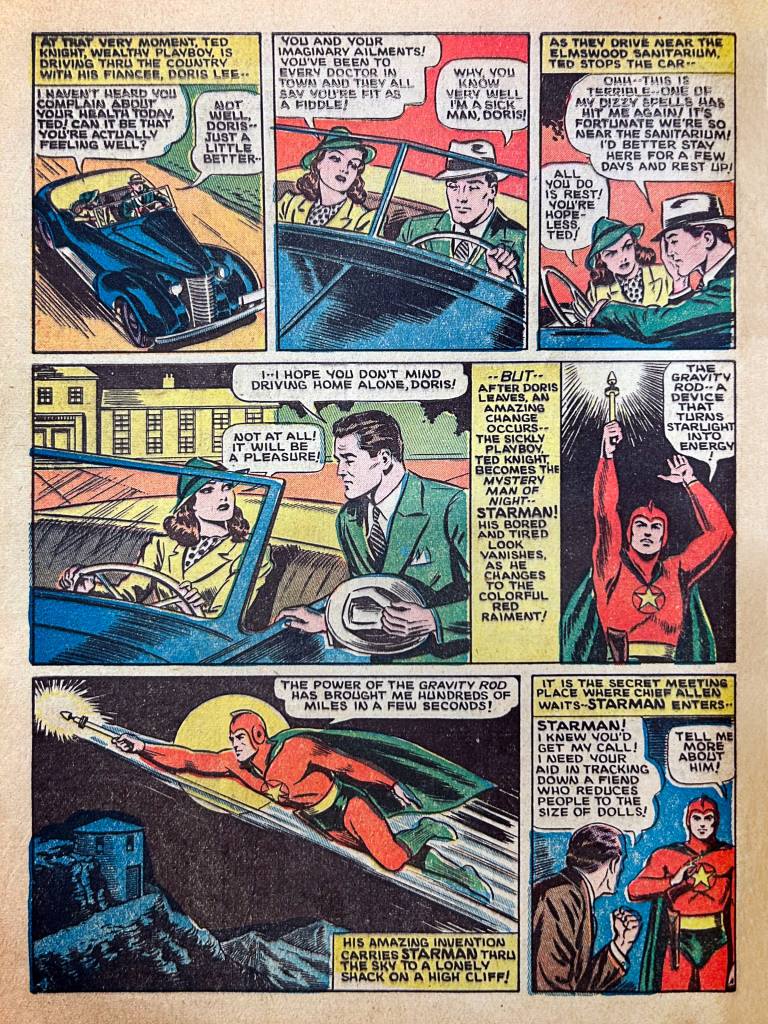
In essence, Starman was generic, a piece of product rather than the end result of innovation and inspiration. His stories were all competently crafted by Fox and others, but none of them really stood out from the pack. His feature did have largely excellent artwork, with the fabulous Mort Meskin doing some work on it once Burnley had run his course. But none of it made a great deal of difference.
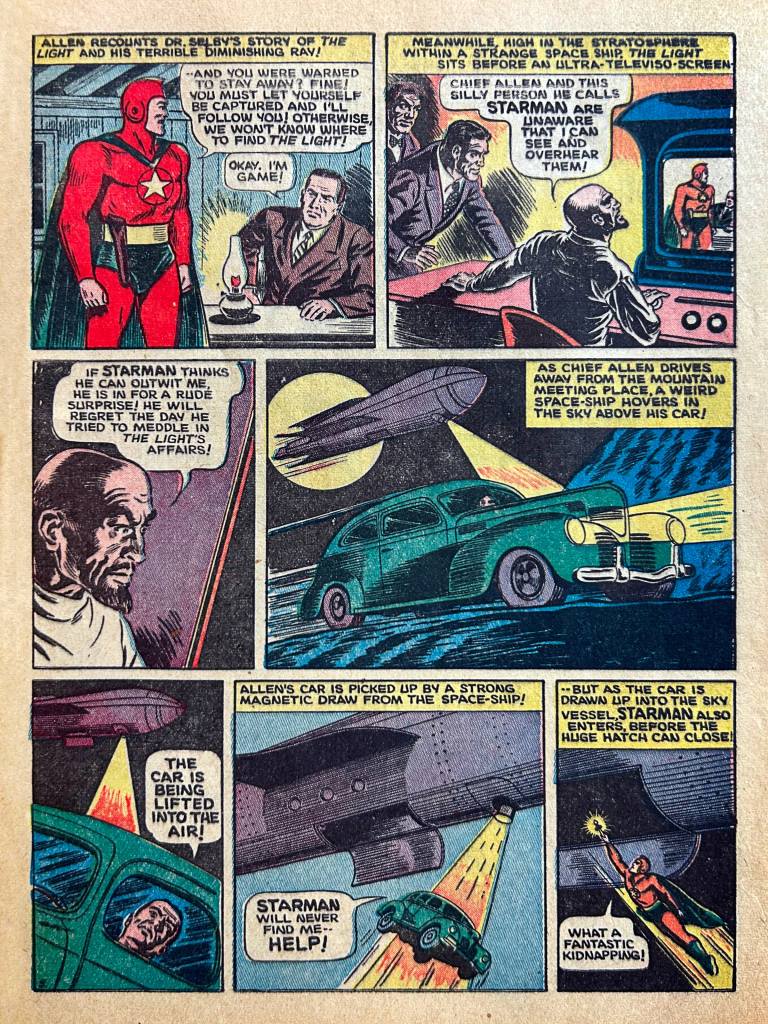
Only a year later in 1942, Starman lost his cover positioning in favor of first Manhunter and then the rejuvenated Sandman series, both of which were being handled by the popular creative team of Joe Simon and Jack Kirby. Starman would continue to run as a feature in ADVENTURE COMICS until #102 as a secondary character, at which point the exodus of features from MORE FUN COMICS including Superboy, Johnny Quick, Green Arrow and Aquaman crowded him out of ADVENTURE COMICS and into limbo.
 The Tom Brevoort Experience
Plus, when you were playing Super Heroes outside with your friends, being Starman meant you just ran around waving a stick.
LikeLiked by 1 person
Or a flashlight. They had those in the 1940’s.
LikeLike
If only they’d made a TV series with Ted Knight as Ted Knight and Woody Allen as Woodley Allen… 🙂
LikeLiked by 2 people
Or Bob Crane ( Hogan’s Heroes ) as Bob Crane ( Golden age Robotman ).
LikeLiked by 1 person
It’s pretty blah.
I think the Burnley art has potential — the characters are expressive and show emotion convincingly. They just don’t have much to express, beyond the formula.
Just one improvement — better scripts, art that transcended the limitations of the scripts or a more compelling lead with stronger motivations — could have tipped the scales. I tend to think the writing was the real culprit, and that a better writer than Fox would have provided the motivation for the character and the material for Burnley to work with.
I mean, it’s a dull costume, too. But better scripts would have helped a lot.
LikeLiked by 1 person
I loved James Robinson’s Starman series. I wasn’t even familiar with the character before I happened to read some discussion of the series online then found a couple of TBCs in a used book store. After that, I got the entire run. It was rather fascinating to see how many times DC tried out different variations of characters named Starman, which Robinson managed to work into the series very well, IMO. And I loved that eerie beginning, with David Knight, son and heir of the original Starman and his powers, high up on a rooftop, overlooking the city he felt called upon to protect, to continue his father’s legacy, and took off in flight — only to be shot down, and fall to the pavement, dead. And then Jack Knight, Ted’s seemingly ne’er do well younger son, who looks upon his father’s legacy as a joke, still feels compelled to take up the power wand – to protect himself and his father as well as to avenge his brother, but in his own way and with his own pretty much plain clothes “costume”. Robinson and his artistic collaborators, finally realized the potential of the character in the modern era, and without discarding what had come before but putting it all in a new light.
One aspect of the series that struck as rather sad, however, was the realization that although Superman and Batman were the alpha-beta of colorfully costumed comicbook superheroes, the first and second in terms of publication history, they could no longer be acknowledged as such within the “current” DC universe, whether 40 years ago or now. Unlike the Big Three Timely heroes, Namor, the original Human Torch and Captain America, who in modern continuity (as best as I can tell) are still recognized as veterans of World War II, heroes around since 1939 or 1940, they can’t do any such thing with Supes or Bats. Having remained in continuous publication since the late 1930s, and Superman’s most popular supporting cast being ordinary humans and Batman himself being physically human himself, they can’t be acknowledged to have been around as superheroes within the world they inhabit for well over 80 years now. And so the lesser costumed heroes, those whose comicbook exploits did not last continuously into the 1950s and beyond, are now the “original” superheroes who inspired all those who came after them and while they lived, looked upon Superman and Batman as the “new kids”.
Ted Knight’s star may not have shined so brightly in the Golden Age of Comics, but at least he became a memorable supporting character in the long series starring his son Jack Knight.
LikeLiked by 1 person
And the sliding time scale wreaks havoc on comics history. Fantastic Four established that Lee and Kirby were writing and drawing an FF comic in the 1960s; now it would have to be the First Line or the Blue Marvel.
LikeLiked by 1 person
Amen. Well said, Fred. Robinson’s “Starman” was one of my faves & best reads of the 1990’s. So much in there about personal relationships with family & friends, & significant others. About valor & heroism. And @ least one Gen-Xer’s nostalgia for “times past”, as those story interludes were called. That sort of Buster Crabb-era sci-fi serial charm, retooled as rehabilitation for a recovering slacker. I mean Jack, as much as myself. 😉 That’s a series that exited “ad astra”, leaving the bittersweet glow of it’s dust trail behind.
LikeLiked by 1 person
I’m kind of curious about your “it’s a dull costume”. I mean, it’s exactly the same as Superman’s costume except red and green instead of blue and red, right down to the chest emblem being reproduced on the cape. I don’t think most people would call Superman’s costume dull.
Honestly I agree that the costume doesn’t work as well as Superman’s, but I’m not sure I can articulate exactly why and I’m curious to know what you’d say about it. Perhaps the red and green are too dark, with a helmet that’s goofy-looking and subtracts visual interest instead of adding it.
LikeLiked by 1 person
Superman’s red, yellow and blue pop nicely on the page, and his S-emblem is more engaging than a plain star. Stars can work, but, say, Captain America adds stripes and chainmail to it; this one’s just a yellow star in a circle that’s colored the same red as the long johns.
Green doesn’t pop as well as blue, and the cowl continues the plain red. The cape, which on Superman fastens across the collarbones so it expands on the triangular emblem, just fastens at the sternum and doesn’t pick up on the color of the emblem at all.
Superman’s got hair, and a costume that creates a series of wedges that make him look powerful. Starman’s less vibrant, and the costume elements don’t work with each other much. They’re just there, not combining is a way that amplifies anything.
LikeLiked by 1 person
@Kurt Busiek
I’ll try to figure out how to paste a pic here. I should be home again in another 12 hours.
But I used the Genis-Vell costume template from your & the great Carlos Pacheco’s “Avengers Forever”.Except with a mask.
imagine the dark blue parts if that suit changed to dark green. Or “midnight green, as anyPhiladelphia Eagles fans might recognize. 😉
Red is such a strong color that it doesn’t need to go beyond arms & midsection
That chest star would be the familiar traditional upright 5-pointer, upper half on the green chest, lower part on the red midsection.
the wrist bands (“starbands”) would be the same Ditko used for his Gavyn Starman. Similar to Marvel’s Wendell Vaughn’.
The neck & head mask would be red. The upper torose would still be dark green. The mask would be open at the top, borrowing again from Ditko’s 1970’s re-design.
I thought about a red domino mask (green would be too “GL”) But I liked using more of Ditko’s re-design.
I’d prefer yellow lenses (Hal GL or “Batman eyes”) instead of goggles.
This might draw comparisons to Booster Gold. But there’s no collar. And below the waist would be one color.
I guess red boots would be an option, but as with Genis-Vell, keeping one color below the wait gives it a more streamlined look. Treads could still be drawn on the soles of his feet.
This Starman would be Black. The mask could go over the bridge of the nose. He’d be physically tough, dense enough, not to need any armor. Maybe it’s cliched to have a Black hero wearing green, red, & gold. Doesn’t mean ut wouldn’t look good.
I see him associated with S.T.A.R. Labs. An engineer or scientist.
Contractually, I don’t know if his origins would be allowed to be tied to Robinson’s work. If not, maybe he’s related to Tont, Mikail’s partner.
Or maybe he fets recruited by John Stewart. Jon Stewart? One’s a real life comedian. But we’d need the Green Lantern.
GL Stewart helps save Gavyn’s Throneworld. Gavyn is a translucent being. Having taken on a human appearance when it was to his advantage.. .
As a reward, Gavyn offers Stewart a set of Starbands. Stewart doesn’t want to leave the GL Corps.
After a night of deliberation (maybe he uses Hal as a remote sounding board), he asks Gavyn if he’d ket Stewart choose the new Starman.
LikeLike
I was just answering David’s question about why I think that Starman costume is dull. I don’t actually want to figure out how to make it more interesting; the character’s dead, and his costume is historical at this point.
And please, I don’t want to see unsold ideas for character designs and origins and such — I wouldn’t want to be unconsciously influenced by them (or, conversely, to already have a similar idea that now I can’t do without opening myself to plagiarism charges). I think it’s fine to make up all the characters you like — I just need to avoid them, for legal reasons.
Thanks.
LikeLiked by 1 person
Suspect Starman’s more monotonous than standard color scheme didn’t help… The helmet didn’t make any real sense, especially with the fauxhawk. He just looked… kinda generic…
Tho’ my own first response to it, care of Brave & The Bold, was pretty positive, but that was likely largely to do with Murphy Anderson’s art & the presence of The Black Canary…
LikeLike
Black Canary can liven things up, for sure…
LikeLike
Is she still dead? It seemed a waste since second gen hero dealing with her successor was tons more interesting than mom’s mind in a body conceived with her husband. I also liked that ‘boring’ Ted was the only fellow JSAer she cheated on her husband with. That we know of…
LikeLike
I have no idea what her current status is. If she’s been dead, I missed it. But then, I’ve missed almost everything in the last few years.
LikeLike
The original Black Canary costume remains my vote for Best Heroine Costume Ever – which Trina Robbins once, not incorrectly, chewed me a new one over. I agree with every single one of her complaints, including how impractical spiked heels are for an action lifestyle – but emotionally my vote remains unchanged. Probably my 2nd favorite comics heroine ever, despite all the stupid shit she, like most other comics characters, have been put through… (When Dan Brereton & I did a never-to-be-published Birds Of Prey story, though the cover was eventually molested & used, it centered around a teenage girl adopting the original Black Canary costume AND motivation, robbing criminals…)
LikeLiked by 1 person
he spiked heels just mean that she’s SO good that with impractical heels she can still outfight anyone. 😉
LikeLike
Impracticality has never really been a consideration for superhero costumes, and really shouldn’t be — unless it’s a character or story point you want to emphasize.
I don’t know if I’d say the OG Black Canary’s the best super heroine costume out there, but it’s certainly way up there. And I can absolutely see why Trina would have criticized it, and like you say, she’s not wrong.
But fishnets, a bolero jacket, a velvet choker…it absolutely hits a lot of the right notes for me.
LikeLike
There was a miniseries recently concluded called Black Canary: Best of the Best that had the current BC a second-gen hero and her mom old and ill. The thing with BC’s mind in her daughter’s body I think has fallen by the wayside. (And rightly so.)
LikeLike
I checked online and post-Crisis the elder Dinah was kille doff at one point. The good thing about DC’s ever changing continuity is mistakes like that can be corrected.
LikeLike
“The thing with BC’s mind in her daughter’s body I think has fallen by the wayside.”
That’s been gone since CRISIS ON INFINITE EARTHS
LikeLiked by 1 person
That outfit is sort of derivative of Buck Rogers and was perhaps an inspiration for Adam Strange (along with Buck Rogers, which Anderson had been drawing right before his Adam Strange work). .
The cape might be a problem. It works against the futuristic elements.
But, in any case, it is clear why the character and the design fit Murphy Anderson’s art in the B&B try-out issues.
LikeLike
Well, there’s “impractical” as in Robin’s bare legs. And there’s “impractical” as in getting close to the line of being a dominatrix in fetish gear. These aren’t quite the same sense of the word. Black Canary is one of those characters where the pulp roots behind them has gotten very obscure. Her name actually meant something like “Femme-Fatale Blond”, but it’s now read as a typical Color-Noun superhero name. But that pulpishness still clings to character somewhat, maybe a key part of the character’s appeal.
LikeLike
While there are plenty of characters in comics who could be described as wearing fetish gear, or something like it, the OG Black Canary isn’t one of them.
She’s a slightly superhero-ized take on a lounge singer — the sensibility is “sultry,” not fetish. Change the boots to slippers and give her a skirt, and you’d have a completely conventional late-40s lounge singer. And the costume wasn’t originally skintight around her pelvis, it flared out into a kind of skort, that suggested a skirt.
It’s a period look now, but not a fetish look.
Unless one has a fetish for 1940s glamour, I suppose.
LikeLiked by 1 person
The gravity control rod has got to be the most phallic object a super-hero ever waved around. No one in the office noticed?
LikeLiked by 1 person
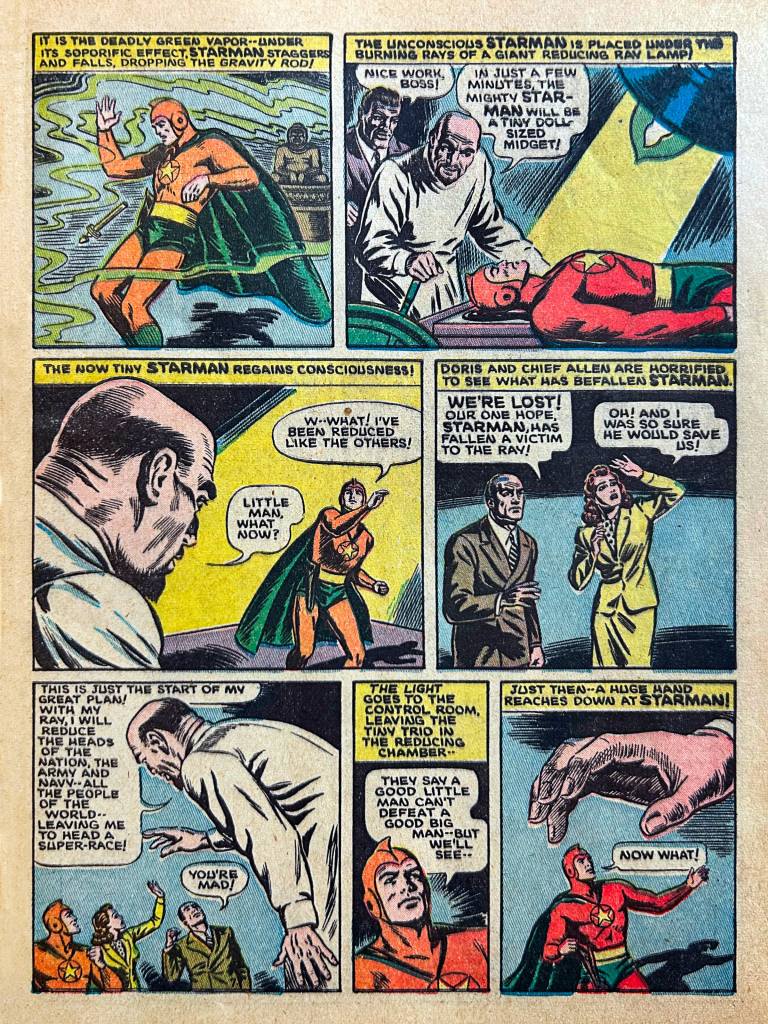
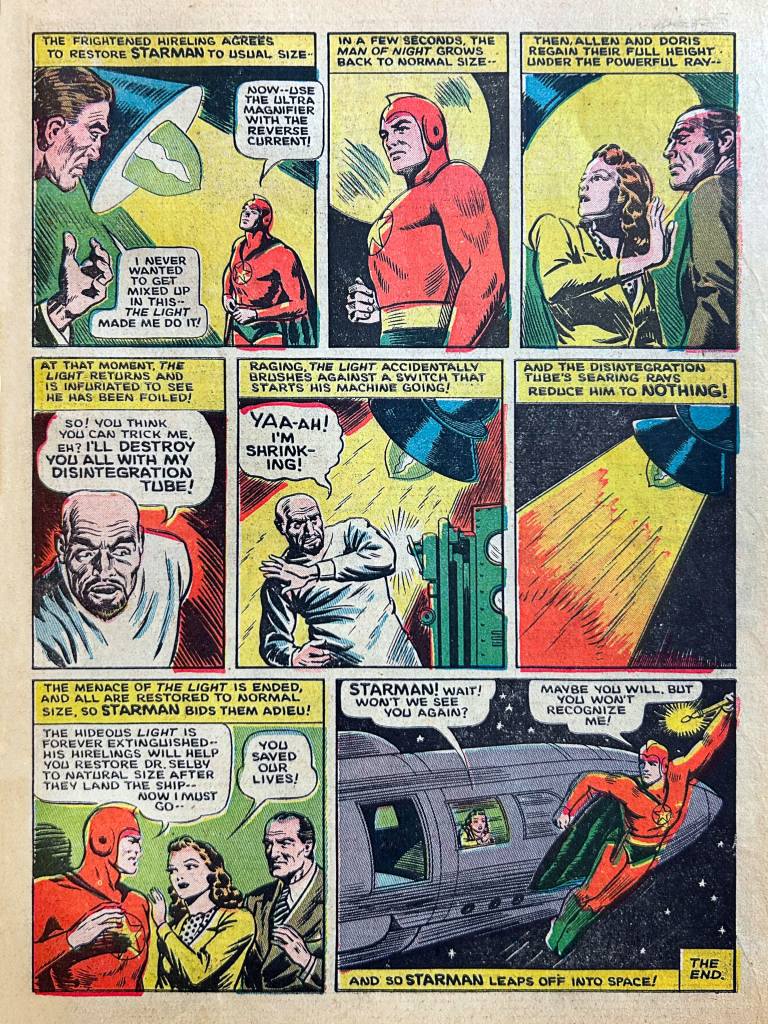
Stories where the villain clumsily (& rather conveniently) defeats himself right before the good guys’ luck seems to have run out, instead of being categorically defeated by Starman himself, probably didn’t help secure Starman’s place as a threat-busting legend…
LikeLiked by 1 person
Or a villain who defeats himself fatally before anyone ever got to know he existed: Professor Vic Chalker [ X-Factor#72 ( November 1991 ) see marvunapp.com profile ].
LikeLiked by 1 person
Thanks for your editorial insights on matters like this, Tom–in that Golden Age of multi-feature titles like ADVENTURE and MORE FUN, the constant chess-game guesses that editors had to make to promote and demote features depending on sales and reader support. Most important in titles that didn’t have a clear Blockbuster like Batman or Superman to support the lesser features. Of course popularity and sales became more obvious when the story pages reduced to the point only one or two features could fit per issue.
LikeLiked by 1 person
There was another villain called The Light ( Luthor )[ Superman#13 ( November-December 1941 ) 1st story ] a criminal who kidnaps prominent men from many different fields, hypnotizes them with coloured lights, and makes them do his bidding ( comics.org ). I would rather be Green Lantern or Quasar whose weapon/source of their powers can’t be knocked out of their hands. I know in the All-Star Squadron series the Gravity Rod had a lanyard ( I googled the the strap at the end of Thor’s hammer was called ) attached to it, I would still be worried about falling to my death if I some how became separated from it. Do bad when Captain Britain had his Star Sceptre it didn’t live up to the Star part of its name.
LikeLiked by 2 people
Funny, “lanyard” is still used for the strap that an ID badge is clipped onto. Can’t wait for the French-Canadian character called “Jacques Lanyard” (“Jock Strap”, sort of).
Wasn’t there a villain for the Shadow called “The Light”? I don’t know about his early appearances, but I remember the name from the excellent 1980’s Shadow series written by Andy Helfer; art by Bill Sienkiewicz, 1st, then by another heavyweight/legend Kyle Baker.
LikeLike
He had that holster-type thing on his belt. That seems less than practical.
I wonder if it started from a “Buck Rogers Swipe” with a ray gun holster?
In Silver and Bronze Age stories, Starman could control it from a distance, when did that start?
Not a practical design . . . and a bit disturbing
Wally Wood’s Star Spangled Kid design with the Cosmic Converter Belt made more sense (if it seemed derivative of Dynamo‘s Thunderbelt..
James Robinson’s Starman (with the big, ungainly prototype, broomstick-like Cosmic Rod fight that book,
LikeLike
Starman’s enemy the Light returns in Adventure Comics#65 ( August 1941 ) leading the dread League of the Octopus, #71 ( February 1942 ) as The Unknown ( The Light — steals Professor Juniper Grimm’s steel time-sphere ), . He did give DC Comics the Mist [ Adventure Comics#67 ( October 1941 ), #77 ( August 1942 ) ] — according to the Jack Kirby Museum the Fighting American foe Invisible Irving story was based of the Starman story in Adventure Comics#77 ( the compare the panels in both stories ). Gravity Rod is also called a Star Energy Rod [ Adventure Comics#84 ( March 1984 ) ]. Starman fought a Moonman ( Dennis Towns ) [ Adventure Comics#86 ( June-July 1943 ) — not to confused with the Superman & Batman foe in World’s Finest Comics#98 ( December 1958 ) ] and a villain named Moonface [ Adventure Comics#96 ( February-March 1945 ) ] who shares the name with original Human Torch & Toro Nazi foe Moonface [ Marvel Mystery Comics#46 ( August 1943 ) ]
LikeLike
“Like Bruce Wayne and so many others, he posed in daily life as a bored wealthy playboy-type.”
Roy Thomas had an inspired idea in All-Star Squadron to assume Ted Knight really was a bored playboy who stumbled into superheroics and wasn’t up for the job. Eclipsed, of course, by Robinson making Ted into one of the titans in Starman, but I still like it.
LikeLiked by 1 person
Nothing against the esteemed Mr. Thomas. But I like how James Robinson really dug into Ted Knight’s scientific background more. Roy did give pharmacist Rex Tyler (Hour-Man) a credible & disturbing addiction to “Miraclo”, or @ least an addiction to the effects it caused (also a “black light” solution. Which Phantom Lady would later use to help free Rex, in order to fight Baron Blitzkrieg to avenge the Red Bee (yeah, man, COMICS 😉 ). Good stuff for a 12 yr old @ the time.
Anyway, Robinson went further with Ted Knight in “The Golden Age”, having him go into a deep, destructive depression after some of his research was used as part of the Manhattan Project. Decades later, he was a great resource for Jack, and us. And he had one of THE best send-offs I’ve ever read or seen in fiction.
LikeLiked by 1 person
Oh, I’m not disputing Robinson’s great work on Starman, including that final scene for Ted. I reread the whole run a couple of years back and if anything it improves.
LikeLiked by 2 people
One of the reasons Hourman is a great favourite of mine is that the earliest golden age stories present him as someone who actually is meek and mild, cowardly and unheroic, except when he’s taken his Miraclo. It’s a different twist on the secret identity idea, which still hasn’t been used much over the years.
LikeLiked by 1 person
“Tick Tock” Tyler, the docile clockpuncher, right. Thomas’ telling his origin in Secret Origins made it believable he’d choose the cool life of a masked mysteryman over simply marketing his drug.
LikeLiked by 1 person
@ Zoomy, maybe because the storytelling needs to be careful when it comes to taking meds or drugs (even for medicinal purposes) so as not to suggest they be abused or used outside of their intended purposes. Not the same as using a magic ring or wand. Though there are likely tragic stories there, similar to kids with towels worn as capes who try to fly out of 2nd story windows.
LikeLiked by 2 people
Then there was the pill-popping Henry Pym engaged in to make himself smaller or bigger in the early years. Reminiscent of Alice in Wonderland, not to mention the Jefferson Airplane’s “White Rabbit”.
LikeLiked by 1 person
Otto Binder and Frank Giacoia created Captain Wonder ( Professor Jordan ) & Tim Mulrooney [ Kid Komics#1 ( February 1943 ) – 2 appearance ( last in issue 2 ) ] and Professor Jordan created the Wonder Fluid that empowered him and Tim when Tim drops the vial it was in and they were exposed to its fumes. Their mutation ( super-strength ) was stable, but Professor Jordan must have shared Professor Lawson ( Miss America’s origin ) and Henry Peter Gyrich’s dislike of super-powered beings so he creates an antidote to the Wonder Fluid to depower them both. So in their 2 appearances the yo-yo between super-powered and normal ( inject themselves before they go into action and depower after the bad guys are defeated ) — that can not be good for the human body to yo-yo like that ( if it was the real world ). Was the point to make Captain Wonder like Hour Man and not the Black Terror or Doc Strange? Cause it seems like a stupid thing to have your character do.
LikeLiked by 2 people
Originally a topically-applied ointment (which somehow affected his whole body immediately, without distortion), then a gas. The first story (“The Man in the Ant Hill”) seems inspired by “The (Incredible) Shrinking Man,” whose protagonist is exposed to a strange radioactive mist (combined with an earlier exposure to pesticide, because bugs or something). Ant-Man proper owes something to the Silver Age Atom, who shrinks by means of a meteorite from a dwarf star that he has ground into a lens (I feel I should apologize to any astronomers who may be reading this), but the important thing is that he controls the shrinking and growing from his belt, as Ant-Man initially does. Pill-popping had a better reputation back then, and is famously instantiated by Hour-Man. In-universe, Pym might have wanted to avoid shrinking bystanders by accident, like Spider-Man that one time.
LikeLiked by 2 people
I think Ant-Man and Silver Age Atom are both drawing a lot from Golden Age Doll Man. Doll Man is obscure today, but he had a long series run in his time.
There’s probably a good academic paper to be written about when pills became a bad idea for heroes. Maybe when the audience got a bit older, so that it became a little too close to athletes taking uppers and similar doping.
“The secret compartment of my ring I fill, with an Underdog Super Energy Pill.”
LikeLiked by 3 people
The Atom originally WAS Doll Man. Having his western work (Hopalong Cassidy, Johnny Thunder, Matt Savage Trail Boss) cancelled out from under him as interest in western comics waned, Gil wanted to keep his DC income flowing & approached Julie Schwarz about doing a new version of Doll Man, since DC had years earlier bought the rights to the Quality characters, eliminating most of them except Robin Hood & Blackhawk, & a romance comic or two. (I feel like I’m forgetting one.) Julie liked the idea but thought the name Doll Man wouldn’t have enough appeal for all the butch male 9 years olds out there. I think it was Julie (might’ve been Gil, I’m a bit fuzzy on the point) who suggest merging the concept with DC’s old Atom character as a full-on Silver Age revamp, to fit better with both the Atomic Age & with the other DC superhero reconceptions, complete w/Strange Adventures-level sci-fi origin & named after science fiction magazine editor Ray Palmer, a friend since their sf fanzine days & Julie’s earlier incarnation as an agent for science fiction writers…
LikeLiked by 2 people
It’s the same cultural drift that turned Professor X and the Chief into more or less bad guys. We as a society don’ trust authority figures and have seen way too many bad things associated with pill popping.
LikeLiked by 1 person
Steven:
“DC had years earlier bought the rights to the Quality characters, eliminating most of them except Robin Hood & Blackhawk, & a romance comic or two. (I feel like I’m forgetting one.)”
G.I. COMBAT was the Quality title DC had the longest success with. And of course there’s Plastic Man, but they didn’t introduce him into the DCU for a while…
LikeLike
Yeah, Plastic Man (also Gil-connected, tho’ I don’t know if he had any input into the resurrection or just signed on to draw the first issue) & GI Combat were the ones that just weren’t coming to mind.. Thanks.
LikeLike
I always liked the Golden Age Starman’s uniform, probably because he looked like he sprang out of a Buck Rogers comic strip.
LikeLiked by 1 person
The fin-head. Buck Rogers is a good call. The Crimson Avenger got one after ditching his Shadow-like suit, cloak, & hat. The GA Atom would wear one, too, after changing from his full head/face covering mask. I dont know what year Al Pratt made that costume change, but it’s 5:30AM as I write this, so I dont really care.
There were other companies ‘ characters with head fins. Can only think of Target right now. Roy Thomas used had the fin-head Patriot in Marvel’s “Invaders”.
Then in DC’s early 1980’s “All-Star Squadron”, Roy and Jerry Ordway gave us two new ones. Deathbolt, and Cyclotron. Cyclotron looked like an obvious retro-faux-shadowing (I just made “faux-shadowing” up) Al Pratt’s later Atom fin-head suit. Deathbolt showed up in Robinson’s “Starman”. The similarities to Ted Knight’s design seemed appropriate for fighting Jack Knight.
LikeLike
And Deathbolt was inspired by Kirby’s Blue Bolt, if I recall correctly, head-fin and all.
LikeLiked by 1 person
Marvel’s Red Guardian was another finead.
LikeLike
*Marvel’s Red Guardian was another fin head!
LikeLike
@J.Kevin Carrier Nice!
LikeLike
Looking at this again, I find myself wondering just why Doris was in the later part of the story. The Light was motivated by revenge against Dr. Selby, and extortion against police detective Allen who was trying to help Selby. Fine. So why did he kidnap and shrink a random woman?
LikeLiked by 1 person
Doris is Allen’s niece – a fact that doesn’t seem to have been mentioned until the third Starman story, but does sort of explain why The Light might have kidnapped her in order to threaten him. I assume the relationship was always part of the original character concept, but they carelessly forgot to state it in the first two stories…
LikeLike
That does make things make a little more sense, but a big failure of storytelling not to make that explicit.
LikeLike
Unfortunately Jack Burnley’s artwork was about all the golden age Starman had going for him. Too bad the writing wasn’t on par with the art. It wasn’t until the 1960s when Starman became a part of the JLA/JSA team ups that he was involved in interesting adventures.
LikeLike