

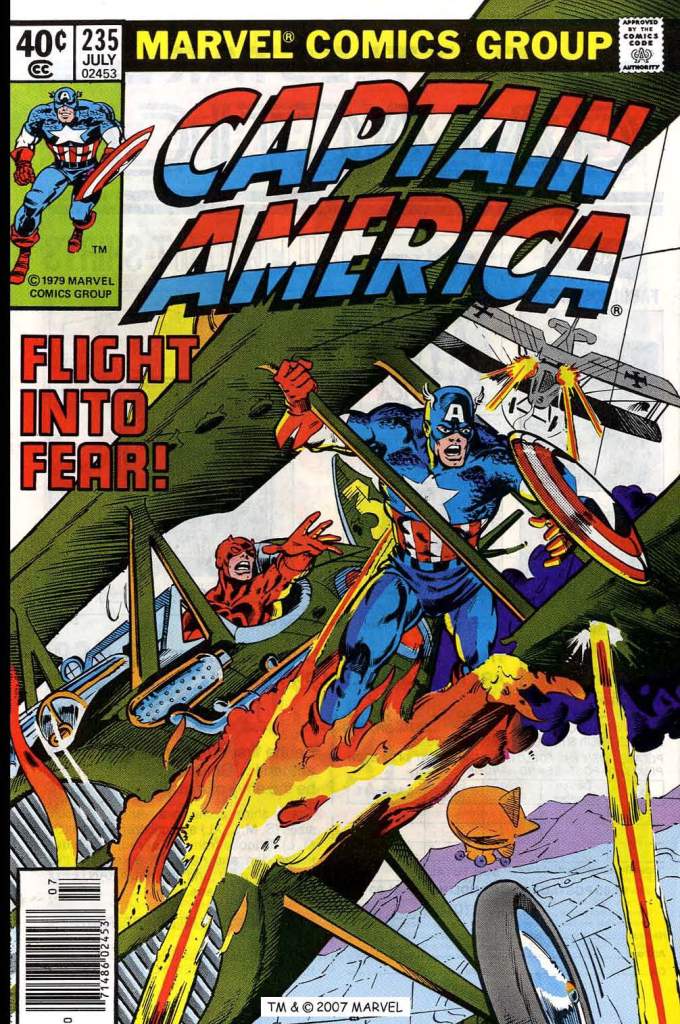
The ongoing CAPTAIN AMERICA storyline had turned into an epic while I wasn’t looking. This was the fifth chapter of a storyline that was still going on at issue’s end, one that had begun in such an understated manner that I would never have guessed it would run so long. During this time, even a long story would typically only span maybe four issues, so this was something. I get the impression, looking back at it now, that this was simply a function of writer Roger McKenzie not having everything tightly worked out ahead of time and pretty much improvising as he went along. Either way, it was entertaining enough, even if the overall structure and pacing across the many issues is a bit haphazard.
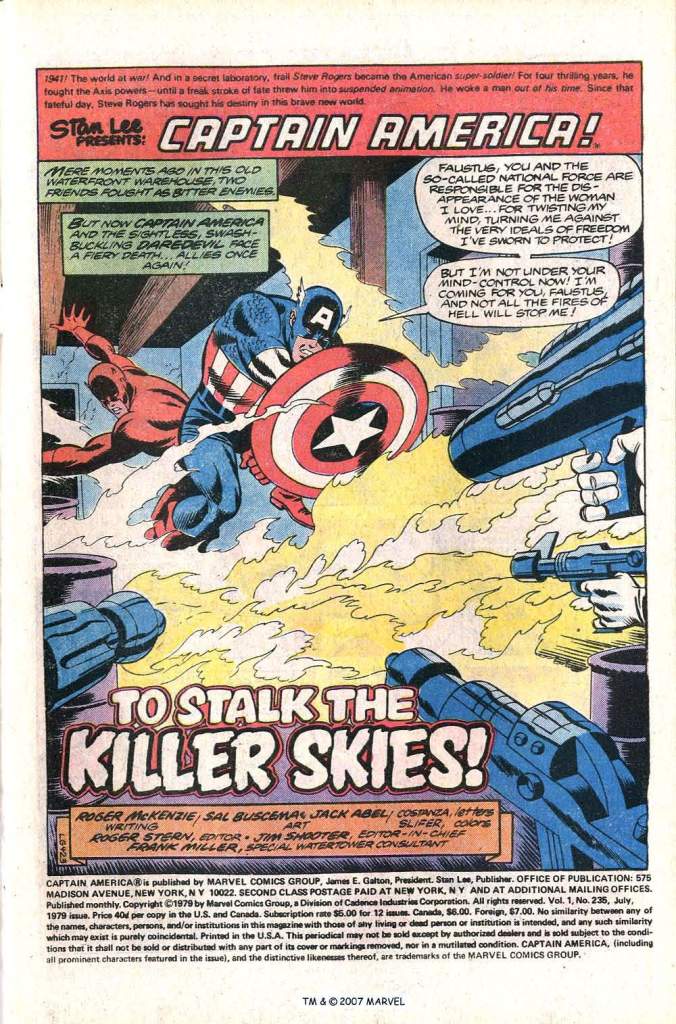
Frank Miller is given an outlandish credit on this issue as special watertower consultant. Which makes a certain amount of sense, as a watertower does factor into the opening action sequence in a big way. And Miller later became known, among other things, for having watertowers dot the New York landscape in his DAREDEVIL work. He and Roger McKenzie were at the time working on that series together, and so I assume Frank must have provided Roger with some information or reference photographs concerning those structures to earn this credit.
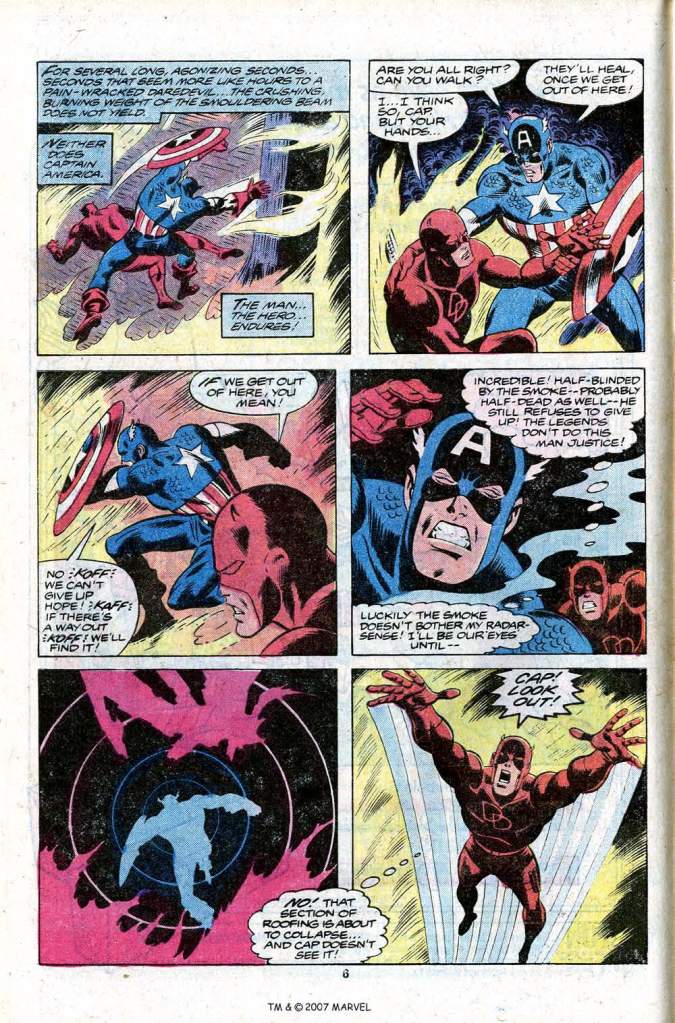
So this issue opens where the last one left off: special guest star Daredevil has broken Captain America free from Dr. Faustus’ insidious mind control that had him running around spouting National Force propaganda and carrying a shield adorned with a swastika. But before the two heroes can unite to bring Faustus and the National Force down, the villain sets fire to the oil-covered structure in which the heroes are standing, trapping them within a deadly inferno. Cap and Daredevil wind up relying on DD’s radar-sense to keep them one step ahead of the roaring flames until the sightless crusader can find them a way out. The Man Without Fear tells Cap to strike out at a certain spot, and doing so cracks a water pipe, dumping gallons of life-saving water onto them in the midst of the blaze.
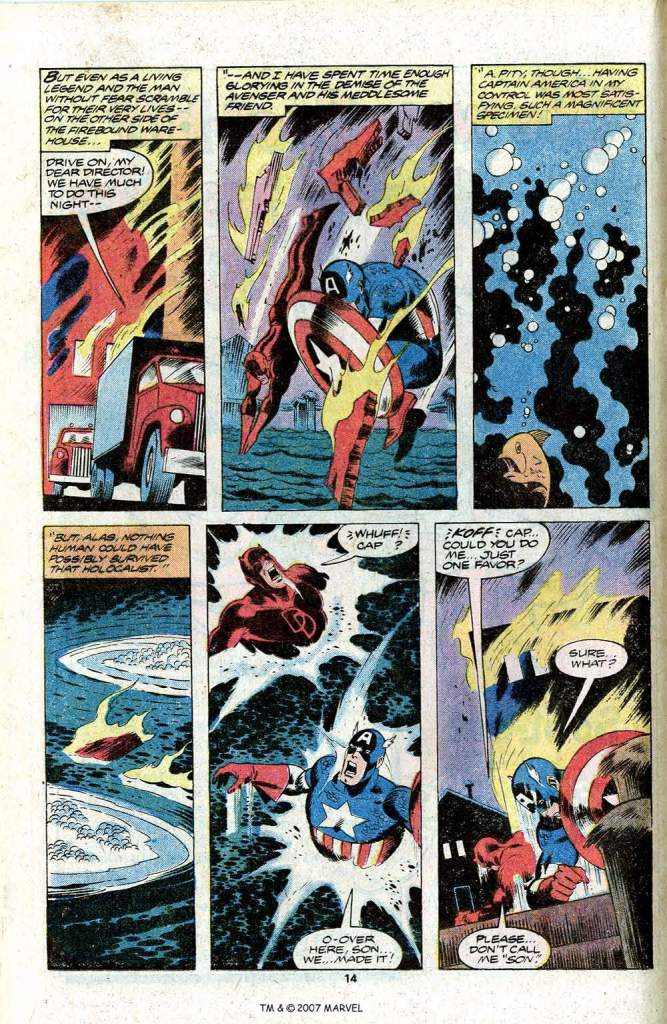
A crack in the ceiling lets the heroes spot the watertower atop the place, and Cap is able to climb Daredevil’s billy club line to the roof once DD snags the watertower with it, then pull the Man Without Fear up to safety after him. Unfortunately, at that point the roof gives way, toppling the water tower practically on top of the heroes, who are able to scutter to safety by the skin of their teeth. They plunge into the nearby river, exhausted but otherwise unharmed. All throughout this sequence, Cap has been referring to Daredevil as “Son”, one of my personal bugaboos for the character. Given when Cap got his powers and when he was frozen in ice, he’s no older than Daredevil (and may even be a year or two younger.) So Daredevil asks Cap nicely to stop calling him Son. Good on you, DD.
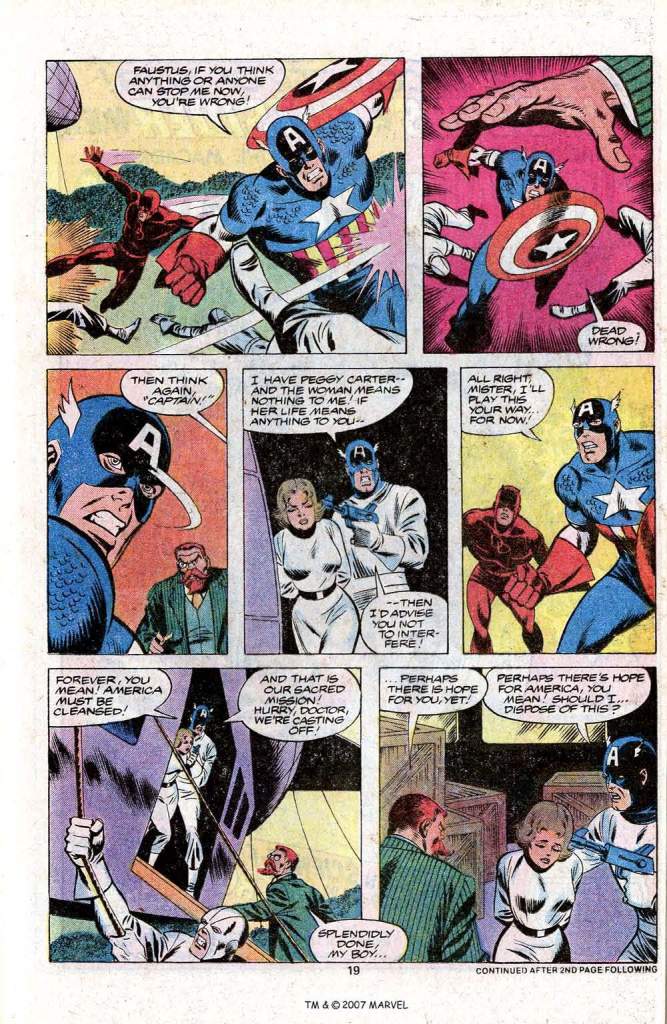
In the aftermath of the blaze, Cap and DD paw through the wreckage. Cap finds a badly-charred crate with an address sored into it, and Daredevil’s heightened sense of touch allows him to still decipher it even though it’s been badly burned. This clue takes them to a nearby airfield, where Faustus and the Grand Director, wearing a Captain America cowl (which is meant as a clue to his true identity) are loading cannisters of Faustus’ mind control gas onto a dirigible, intending to spray the stuff throughout Manhattan and take over the city for the National Force. Cap and Daredevil show up in time to prevent the villains’ takeoff, but their efforts are stymied when the grand Director uses the captive Peggy Carter as a hostage.
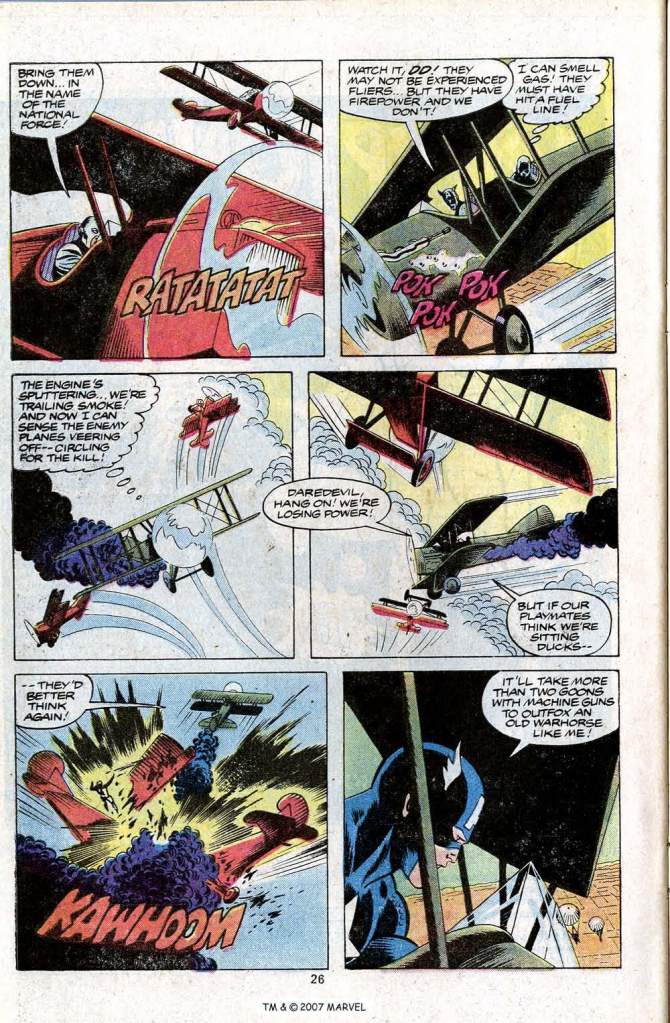
So Cap and Daredevil are forced to watch as Faustus’ dirigible takes off. The pair swiftly commandeers an old fashioned World War One-style prop plane, intending to give chase. They in turn are pursued by National Force soldiers who had been left behind and who similarly stole some biplanes. The difference s that their planes are armed while the one Cap and DD are in is not. But cap is able to use some deft flying to not only keep the heroes from being shot, but also to maneuver the two enemy planes into colliding with one another. Now all that’s left is to catch up with the dirigible.
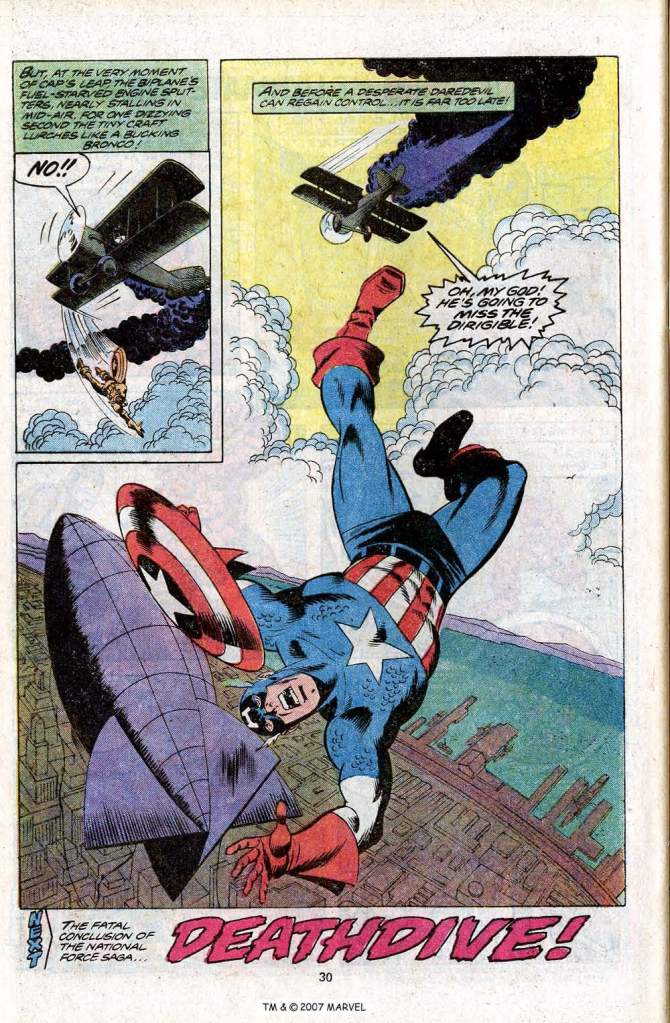
Cap turns the controls of their plane over to Daredevil (clearly not realizing that DD is blind) and climbs out onto the wing, intending to leap to the dirigible below as their plane passes overhead. But at the moment Cap leaps, the heroes’ plane, which had been shot up by the National Force fliers, stalls out and lurches, sending the Star-Spangled Avenger falling to his death as he’s going to miss landing on the dirigible completely. To Be Continued! I remember feeling like this was a pretty good cliffhanger at the time.
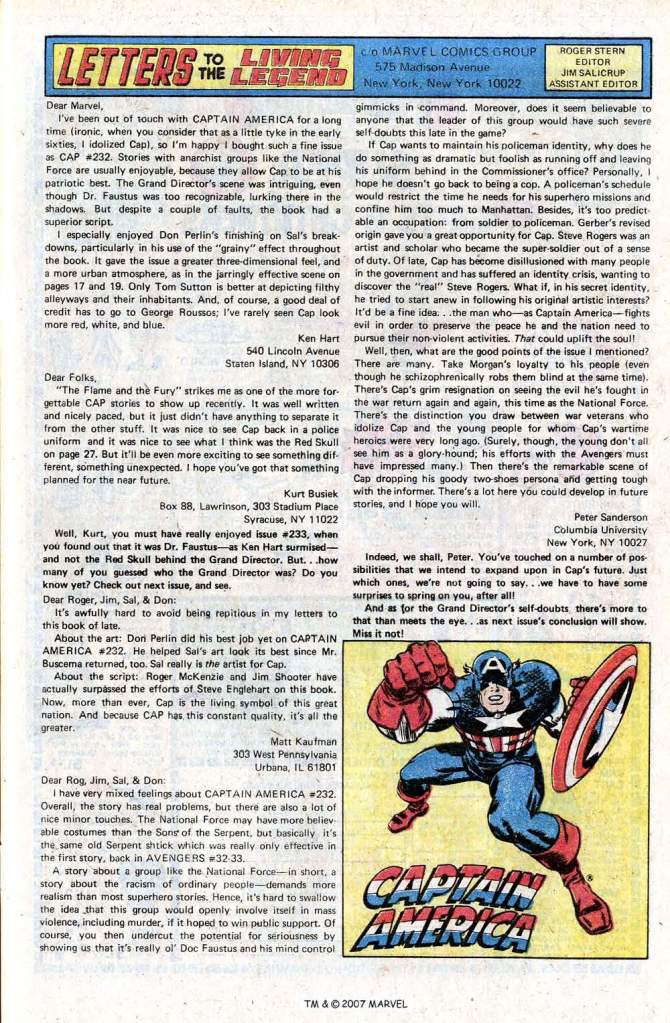
This month’s Letters to a Living Legend letters page includes correspondence from future Marvel writer Kurt Busiek (who found the start of this multi-part story pretty forgettable) and historian Peter Sanderson (who has problems with the plotting of that same earlier issue.)
 The Tom Brevoort Experience
According to Jim Shooter, Frank Miller would often venture out onto rooftops to draw the water towers. It apparently had become an in-office joke.
LikeLiked by 1 person
Bi-Planes and a Dirigible, if the last page had been the first or just going by the cover a new reader might think Cap and DD traveled back to World War 1. Yeah, Cap calling DD “son” makes it sound like the writer forgot Cap was in suspended animation for decades.
LikeLiked by 1 person
Hell, Stan Lee forgot often enough (https://atomicjunkshop.com/captain-america-young-punk/)
LikeLike
I’m a longtime Cap fan, and I agree, it always annoyed me back in the day when he’d call other guys “son.” It just made Steve Rogers seem too much like an old fogey.
According to the GCD, this issue’s dynamic cover is penciled by Ed Hannigan and inker by Josef Rubinstein.
LikeLike
Sal Buscema’s a legend in his own right. Especially in the storytelling & pacing. But an inker had a big impact. Jack Abel had a dull, diminishing finishing style. Compare this to Sal’s “Defenders”, with another legend, inker Klaus Janson. Huge difference, for the better.
Cool to see the notes from Kurt & Peter..
LikeLiked by 2 people
Jack Abel’s inking has always fascinated me…but not in a good way. Those tiny, delicate feathered edges he puts on every surface seem like a lot of labor for not much return. Everything looks like it’s made out of marshmallows.
LikeLiked by 2 people
He doesn’t look like a particularly good fit on Sal here… I do recall a couple of Ironman issues where Abel inked Tuska that I thought were very nice.
Marvel editorial seemed to hold him in high regard in the late 70’s. I remember an Abel pencilled pinup that announced he was going to pencil an issue of Ironman and then he passed away unexpectedly.
LikeLike
Jack didn’t pass away until 1996, so you may be thinking of someone else.
He was a much-liked guy, a lot of fun to talk to. I think his inking was better in the 50s and 60s, but he was someone people liked to work with, and even after he wasn’t doing much art any more, he was Marvel’s proofreader, as a way to keep him working and keep him in the industry.
LikeLiked by 1 person
I think Gary Martin said in an interview he tried to give the great Steve Lightle’s Cliff Steele a softer, copperish finish when they were both on “Doom Patrol” in the mid-1980’s. And I see that look in a lot of Jack Abel’s inking.
Obviously Jack’s career started long before Gary’s. I’m not suggesting Gary influenced Jack. Just possibly similar approaches.
Sometimes I liked Jack’s stark spotted blacks. Other times the feathering didn’t seem to fit the drawings. Depended on who he was inking. I realize deadlines & availability often took priority over visual compatibility.
I could see Jack’s style of inking working well enough, adding depth to Tuska’s open, clean, “interpretive”, expressive, &: dynamic drawings. Especially on Iron-Man’s armor. Not gleaming, like Layton’s gloss. But darker, duller, and just as tough.
LikeLike
Doctor Faustus aka Jollyon West of CIA fame
LikeLike
Given how detailed and specific the water tower is compared to the rest of the background drawing, I’d assume Frank did a reference sketch, either for Sal (who did not live in NYC and didn’t have ready access to watertowers) or Jack so they could deliver what the story needed.
LikeLiked by 1 person
Thanks for the correction KB.
A little bit of digging revealed that Abel suffered a serious stroke in 81 which might have been a contributing factor to his fill-in not happening. This might have been explained to some degree on a letters page and I misremembered it as his passing.
Incidentally, the pin-up announcing his fill-in appeared in Ironman 157 and was inked by Layton. Cover date was Jan 82.
LikeLike