

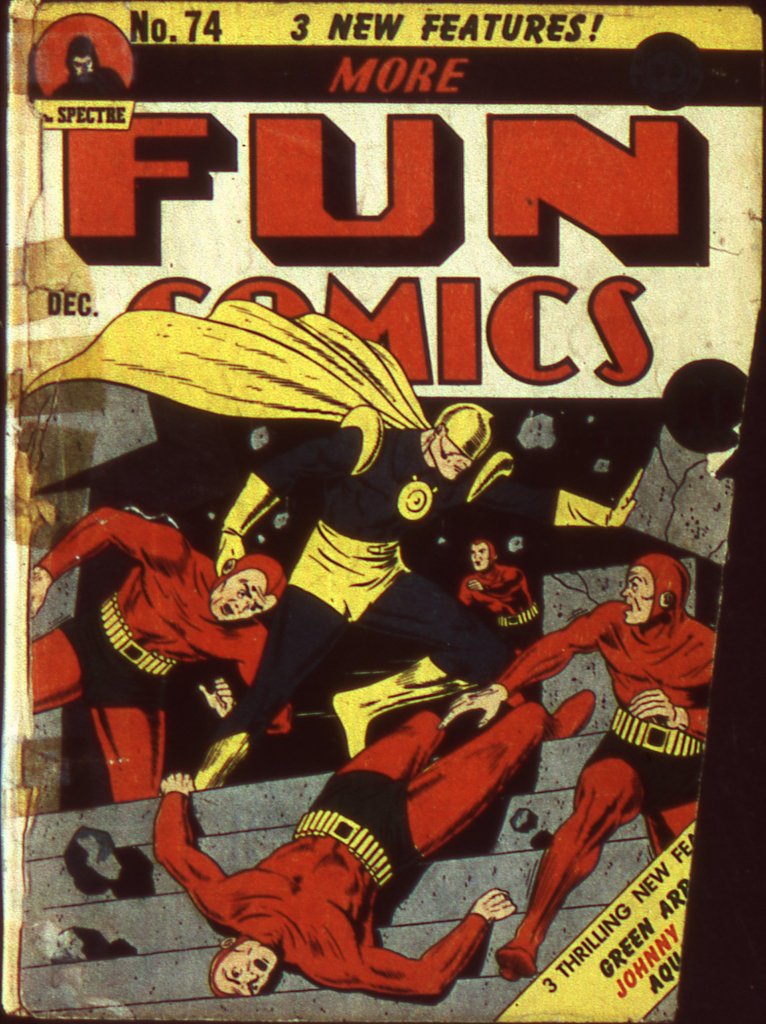

Like the Green Arrow who we talked about last week, Aquaman was another of three features created to fill the back pages of the ailing MORE FUN COMICS and hopefully reverse its fortunes by creating some additional reader interest. The Sea King was the brainchild of newly-hired editor Mort Weisinger, who collaborated with artist Paul Norris on the earliest Aquaman strips. Like Green Arrow, Mort appears to have maintained a fondness for Aquaman, and so he kept the strip alive as a back-up feature in other titles even after MORE FUN had given up the ghost. And like Green Arrow, Aquaman was one of the very few super hero characters to survive from the Golden Age into the Silver Age without any gap in publication.
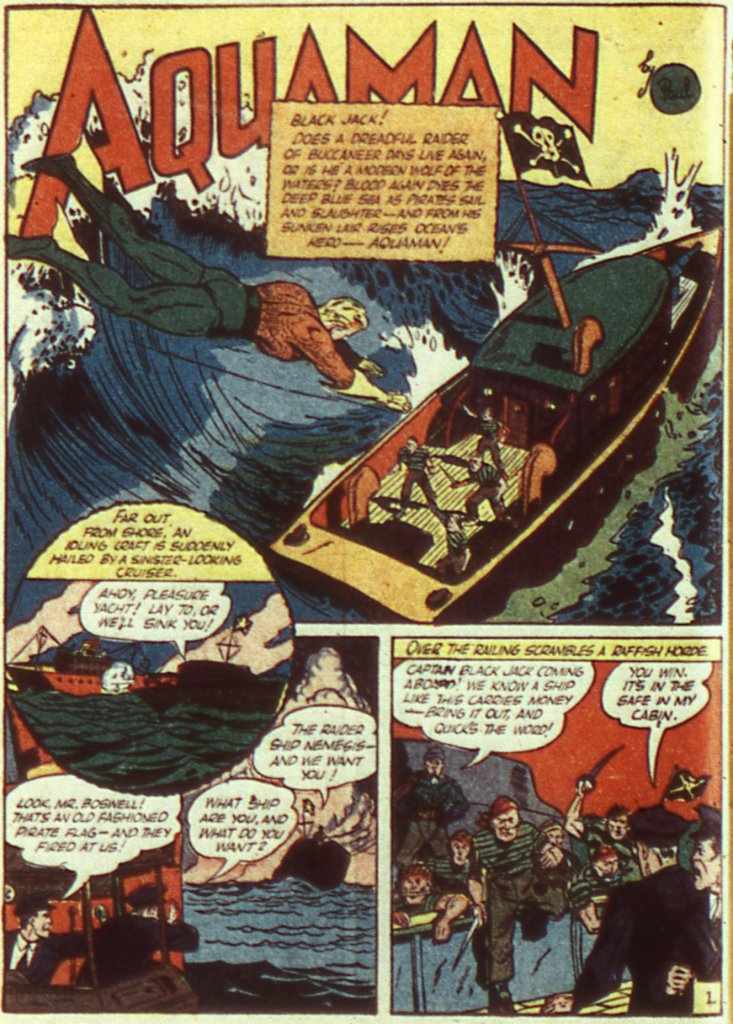
It seems pretty clear that the creation of Aquaman was highly influenced by the popularity of Namor, the Sub-Mariner at rival publisher Timely Publications. But Namor and Aquaman, while they evidenced similar powers, were a study in contrasts. Namor was a firebrand, an anti-hero who followed his own sense of right and wrong, whereas Aquaman was more, well, domesticated, and clearly a card-carrying good guy. In fact, Aquaman didn’t appear to have much personality at all. In the manner of most Golden Age strips, it was enough for him to be able to swim underwater and communicate with and command sea life.
For all that he was pretty vanilla, Aquaman kept right on going in a series of short stories of around 8 pages a shot, patrolling the seven seas and taking on all manner of evil-doers and problems. He never got promoted even as much as Green Arrow did–he wasn’t a member of the Seven Soldiers of Victory nor did he even warrant appearing on a cover until 1960 and the first appearance of the Justice League of America in BRAVE AND THE BOLD #28. So his success was based on reliability and longevity, and not making too many waves. Aquaman was acceptable, he was inoffensive and omnipresent.
The character got his biggest push in the 1960s, when he starred in a series of SHOWCASE tryouts that sold well enough to grant him his own title to headline. In that same decade, he was adapted into animation, appearing as a co-headliner in the SUPERMAN/AQUAMAN HOUR OF ADVENTURE. If not for that appearance, it’s doubtful that he’d have become a charter member of the SUPER FRIENDS, and even more doubtful that he’d be much remembered today. But Aquaman has had two pretty successful live action films in recent years, which is a hell of an accomplishment for a character whose greatest claim to fame for so many years was that he was simply there.
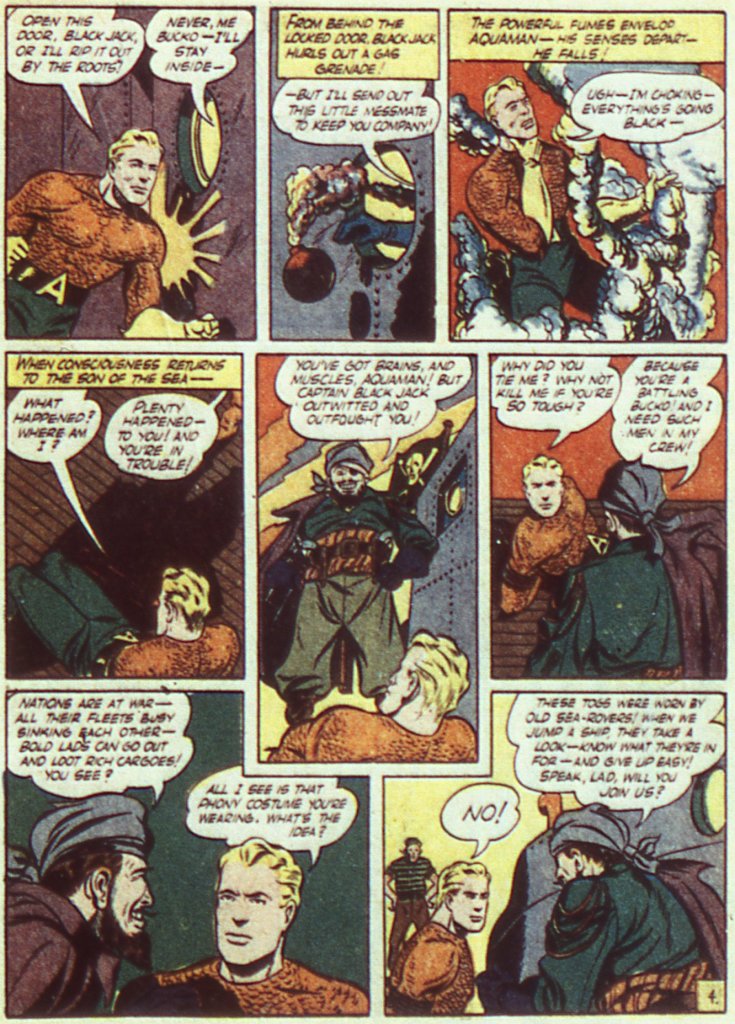
The early Aquaman didn’t have any civilian identity–he wasn’t Arthur Curry–nor was he connected to the mythology of Atlantis. Those were developments that only came about in the 1960s. The formative Aquaman was simply Aquaman all the time, and was rarely given any sense of a life outside of the plots of his assorted short stories. There really wasn’t much of anything to him apart from his powers and his costume. Even there, the notion that he could command sea life telepathically to do his bidding didn’t come along for a number of years, even though it became his primary shtick over time.
 The Tom Brevoort Experience
Thanks for the good overview and art clips. I was lucky enough to first encounter the character near the end of the back-up strip runs in Adventure Comics and World’s Finest Comics, with art by the incomparable Ramona Fradon. The bittersweet aspect of Aquaman’s successful solo try-outs and the title to which they led was that, except for the magnificent first Showcase issue, they coincided with Fradon’s (thankfully temporary) retirement from the medium to concentrate on childcare, as she’s stated in many interviews. Still, that laid the groundwork for the DC ascent of Nick Cardy, another of the field’s brightest lights.
LikeLike
Aquaman got his silver age origin in Adventure Comics#260 ( May 1959 ).
LikeLiked by 1 person
And strangely enough, the letters page to #256 recaps his golden age origin, which hadn’t been mentioned for many years, just four months before his all-new silver age origin was presented. That same issue of Adventure gives us the Green Arrow’s silver age origin, so obviously they were planning to do the same kind of thing with Aquaman, but just hadn’t decided how different it was going to be… 🙂
LikeLiked by 2 people
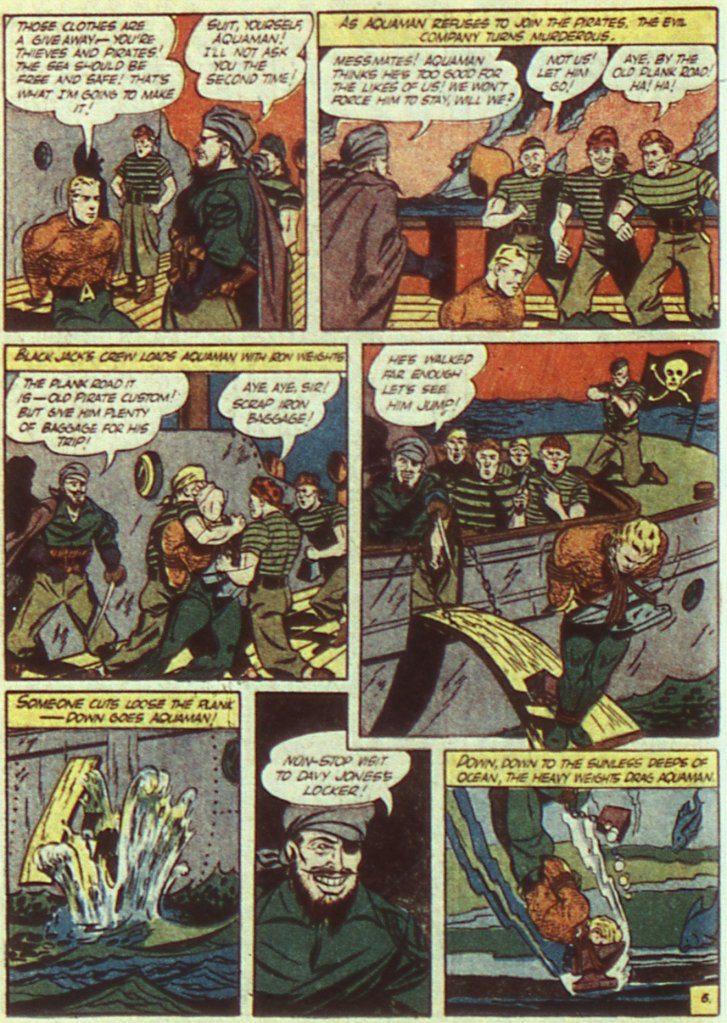
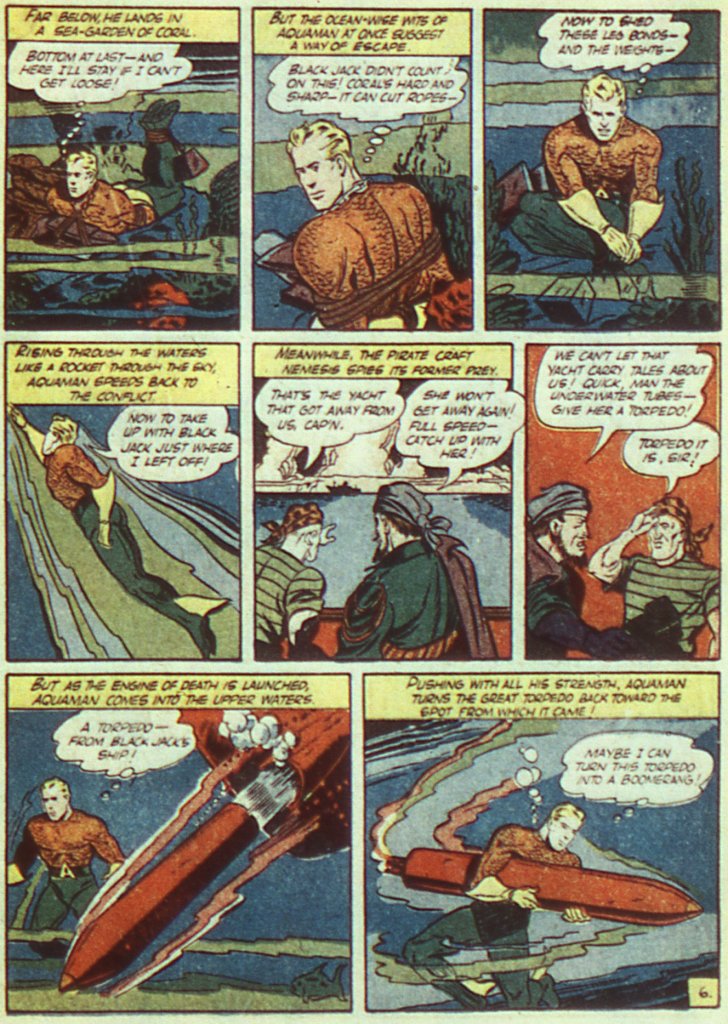
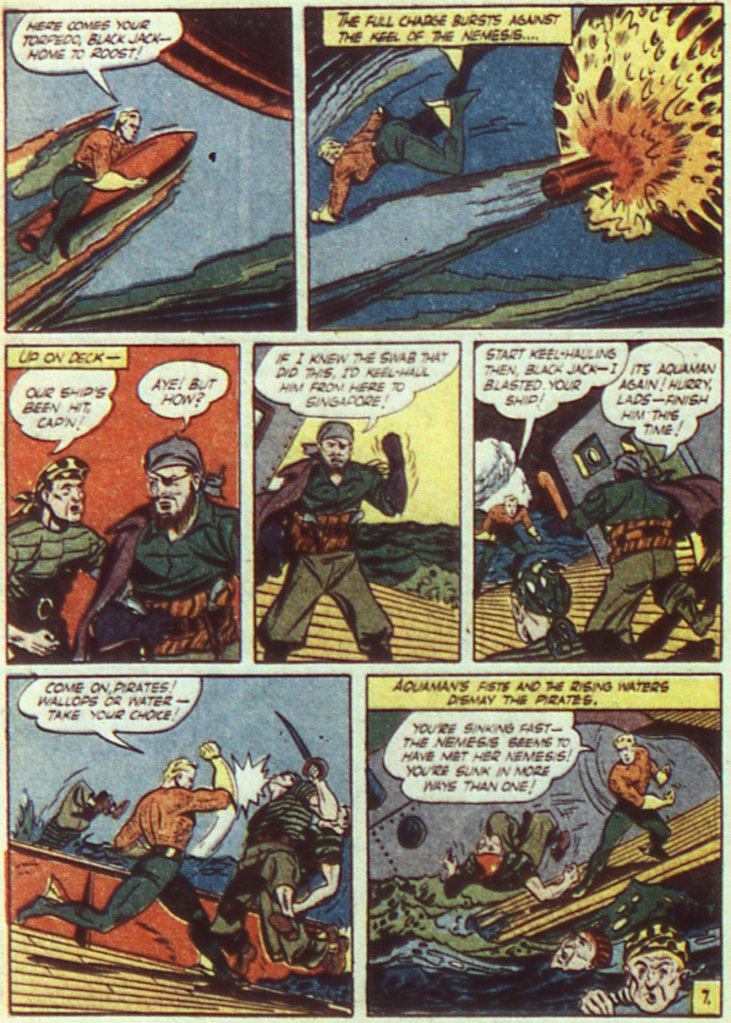
In his first appearance on page 3 panel 5 he addresses friendly porpoises in their own language – and they obey. On page 5 panel 4-5 he sunk a U-Boat with one punch. Yet on pages 6 -7 he wasn’t strong enough to snap the ropes binding while underwater. On page 6 panel 3 he did get knocked out by hammer that would have made a cool looking Mjolnir.
LikeLike
Tom left out that Aquaman became so some the butt of the jokes: Wikipedia — Jokes about his wholesome, weak portrayal in Super Friends and perceived feeble powers and abilities have been stables of comedy programs and stand-up routines, leading DC several times to attempt to make Aquaman edgier or more powerful in the comic books. I know I enjoyed Ivan Reis’ work on his 2011 Aquaman series, this version of Aquaman was cool. He made Hulk/John Carter leaps in that series and was a lot stronger than the silver age or golden age version ( not counting in his first appearance when he sank a U-Boat with one punch, like Triton sank a commie sub in FF#61 ( April 1967 ) with one punch ).
LikeLiked by 1 person
FAKE ICEBERGS: A Nazi Submarine hidden inside a phony Iceberg [ Military Comics#7 ( February 1942 ) Blue Tracer story ], Krutz and the Nazis have a battleship disgused as an iceberg [ More Fun Comics#79 ( May 1942 ) Aquaman story – Aquaman Rules the Waves! ], Captain Tsaki’s Iceberg is a cover Japanese Destroyers [ Sub-Mariner Comics#9 ( Spring 1943 ) Sub-Mariner 1st story -Terror of the Floating Fortresses ] and Iceberg with Nazi Aircraft Carrier & Planes inside [ Captain America Comics#26 ( May 1943 ) Captain America 3rd story -The Russian Hell-Hole ] — comics.org & marvel.fandom.com.
LikeLike
I’ve enjoyed stories with both Aquaman and Namor but neither enough to follow the character consistently once I kicked the completism bug well into adulthood. I’ll pick up a title out of curiosity at times (like the recent Aquaman book I dropped after one issue) or go years without reading any book they star in (the current status with Namor). My three biggest complaints start with the fact each seem stuck in a story cycle where one volume/writer will lead with an arc where they are deposed and the next volume/writer starts with them being forced to take the throne again in its first arc. Second too often repeated trop is ‘Atlantis is destroyed’. It’s a big yawn when it happens anymore. The biggest obstacle to my interest though is I cannot suspend disbelief anymore that you can be a fulltime adventurer and ruler of a country. Royal figurehead like Great Britain, yes but no way could they do anything more than that. It’s a negative for me with Black Panther too. The only time it worked in a comic for me was when Geo-Force did it because he turned out to be rubbish at it.
LikeLiked by 2 people
At least they never had Black Bolt abandon Attilan to play superhero, but they made it just as unstable a kingdom as Atlantis ( Marvel & DC ) and Wakanda. I too hated the constant destroying of Atlantis. She never had her own series but they made Agatha Harkness the leader of her people too.
LikeLiked by 1 person
I can understand the logic of making Wakanda a failing state after all the crap that had hammered the nation in various big events, but that ain’t my Wakanda.
LikeLiked by 2 people
My pet theory is that Namor is really very bad at being king. Impulsive, won’t take advice, doesn’t study the issues, etc. His ministers all know this, so they actively work to have him go off adventuring, in order to get him away so that they can do their jobs without having to cope with him. They have one guy who reads the New York media. When sees an item with Sue Storm-Richards in it, he mentions to Namor “That old flame of yours is in some trouble – maybe you’d like to go check it out?”. They have another guy who keeps tabs on various super-battles. He says “It’d be great for us if you reminded the surface world how powerful you are, why not settle this?”. And so on.
Maybe Aquaman can run his Atlantis more like he’s a hands-off Chair of the Board of Directors. He appoints good people, doesn’t micromanage them, and goes off to do what he really cares about as “foreign policy”. Every once in a while he parachutes, err, swims in, to rubber-stamp it all and make a rare executive decision. It’s more than a ceremonial role, but he’s not bogged down in the day-to-day details.
LikeLiked by 2 people
I like that.
Namor is probably more useful as part of Atlantis’s national defense strategy than as King and Aquaman. who is widely respected as a JLA member. is part of his Atlantis’s Public Diplomacy more than a King.
I have to imagine that Vulko and Vashti have to go out for plankton and compare notes at times . . . .
LikeLiked by 1 person
As a kid I was only familiar with Aquaman through Justice League reprints, the Superman/ Aquaman hour and the Super Friends cartoons. I didn’t know much about him otherwise, but I keenly remember a moment where he and Superman are tossing around excavating equipment in the Super Friends and I thought it was cool that he could hang with Superman.
Kind of interesting and odd that he’s more widely known than his precursor Namor… who’s arguably a much more interesting character with very a long career that just didn’t include a chunk of the 50’s or 70’s cartoons. Namor has more in common with Wolverine and Tarzan than he does with the blonde and sometimes bland wasp of the deep….but Aquaman had the benefit of DC…the Budweiser of comics… might not always be as good as the competition but it’s reliable and found everywhere I quess.
LikeLiked by 2 people
Subby did appear in the very primitive Marvel Super-Heroes cartoons of the mid-60s, along with Cap, Iron Man & Hulk. But, yeah, Aquaman was much more prominent in Saturday morning cartoons, especially in the 1970s, making him almost as famous on tv as Superman, Batman, Robin and Wonder Woman were.
LikeLike
The idea of Aquaman surviving by not making many waves is pretty funny…
LikeLiked by 3 people
I was thinking recently while rereading the Search for Mera that for a minor backup feature turned B-list Silver Age series, Aquaman had great fortune in his artists: Ramona Fradon, Nicholas Cardy, then Jim Aparo.
LikeLiked by 2 people
And Don Newton! I think the final 3 issues of his solo series, then in short stories in “Adventure Comics” ,& 1 by Don in “World’s Finest”.
LikeLiked by 1 person
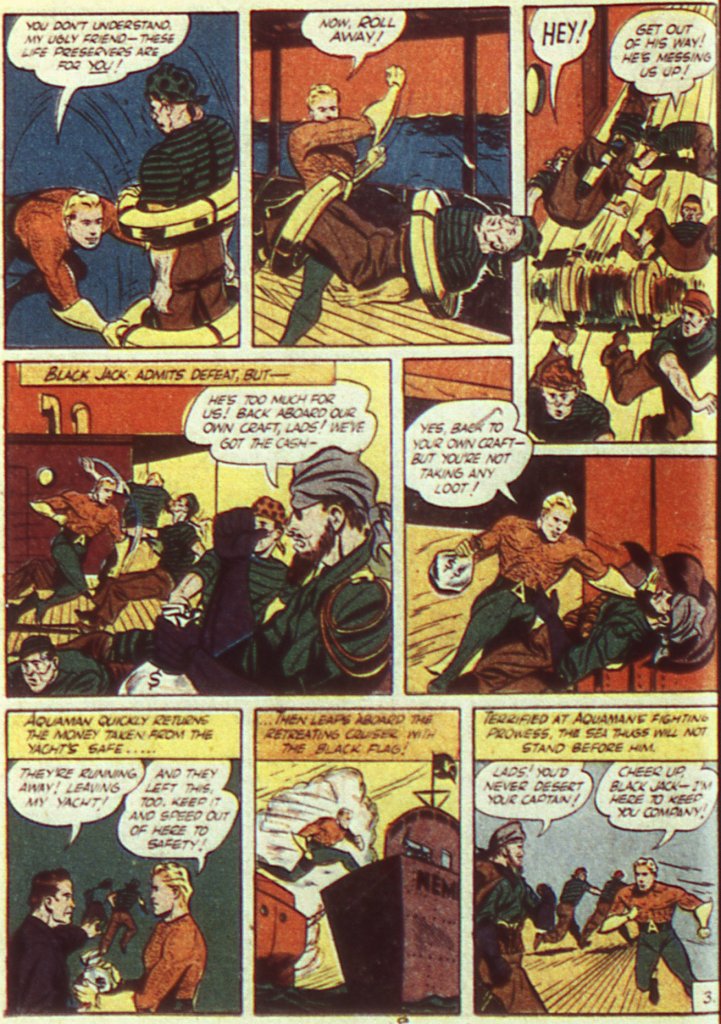
Tom’s line about not making waves, cited by former life guard Steven Grant (kidding) wasn’t lost on me. Neither were a couple of others in the story. The obligatory. “Davey Jones’ Locker” reference. Did I miss any of “a watery grave”? Maybe the pirates didnt know he could breathe underwater?
I wonder if Bronze Age Aquaman stories copped Tessio’s remark from “The Godfather” movie, about how Luca Brazzi “sleeps with the Fishes”… Hook, line, & sinker
My fave from this issue is “Wallops or water, take your choice!”. So glad it never developed into “It’s walloping time!”
Roy Thomas had Aquaman show up towards the end if his “All-Star Squadron” run, with those yellow gloves. I didn’t realize until now, though, that he ever had yellow fins on the back of his calves.
I think in the late, great Peter David’s “Time & Tide” “re-origin” story, the fins were part of if his body. I just saw Peter’s remembrance in this past week’s Marvel releases. Great, innovative writer, with the talent, intelligence, & wit to write smart, believable dialog, even in “amazing”, “spectacular”, & “incredible” scenarios. Underappreciated towards the end if his life & career. But certainly one if the best & best selling in multiple, previous decades.
“But I digress”. 😞. So, Aquaman’s yellow gloves were an eyesore for me. Same for those yellow calf-fins. He was a work in progress. Interesting to note all the changes made to try to enhance him. Even today, adding Mera’s “hydrokenesis” to his other abilities. I hope it doesn’t mean Mera lost that power.
I tried the current (get it? No? Yeah, the pull was weak, washed right over, like drops off a duck’s back) “Aquaman” series. Mostly for the clean, sharp art. But the writing was too crowded for me. Aquaman works best as an adventuring superhero free from being water logged by ruling a city or nation.
Maybe if he was just a ceremonial figurehead, with Mera or Vulko as head of stare, with a publicly elected representative legislative council.
He’s still a (sea)worthy character, soaked in history. The first I came across w/ the supervillain brother problem, which has been copied since. Maybe it was borrowed from outside comicbooks. Even for Batman. Grant Morrisson’s take on the old Earth 3 Owlman Grant’s “Earth 2” story, but then Scott Snyder introduced a brother in the main DCU during the “New 52”.
Peter’s run needed more alluring art. Not that artists Medina, Shum & Califore dont have their own considerable appeals. Ivan Reis’s rendition was the biggest crest for me. When he left that series, Geoff Johns’s stories couldn’t keep me. Jim Aparo drew a fine version. With memorable stories. But I think of Don Newton’s drawings of if DC’s Sea King as even even more compelling. Craig Hamilton’s, too. Reis’s remains the highest watermark.
LikeLiked by 1 person
Remember Aquaduck? From the “JLA” (“Just’a Lotta Animals”) team “comicbook-within-a-comicbook” in “Captain Carrot”? 😉🤞🙏
LikeLike
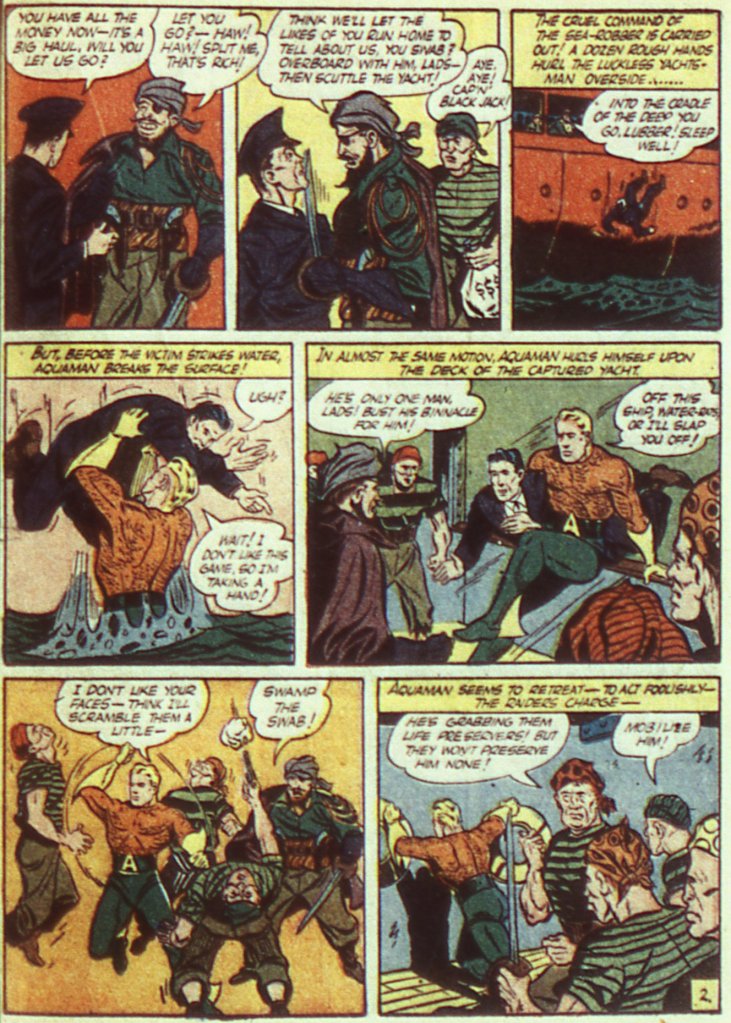
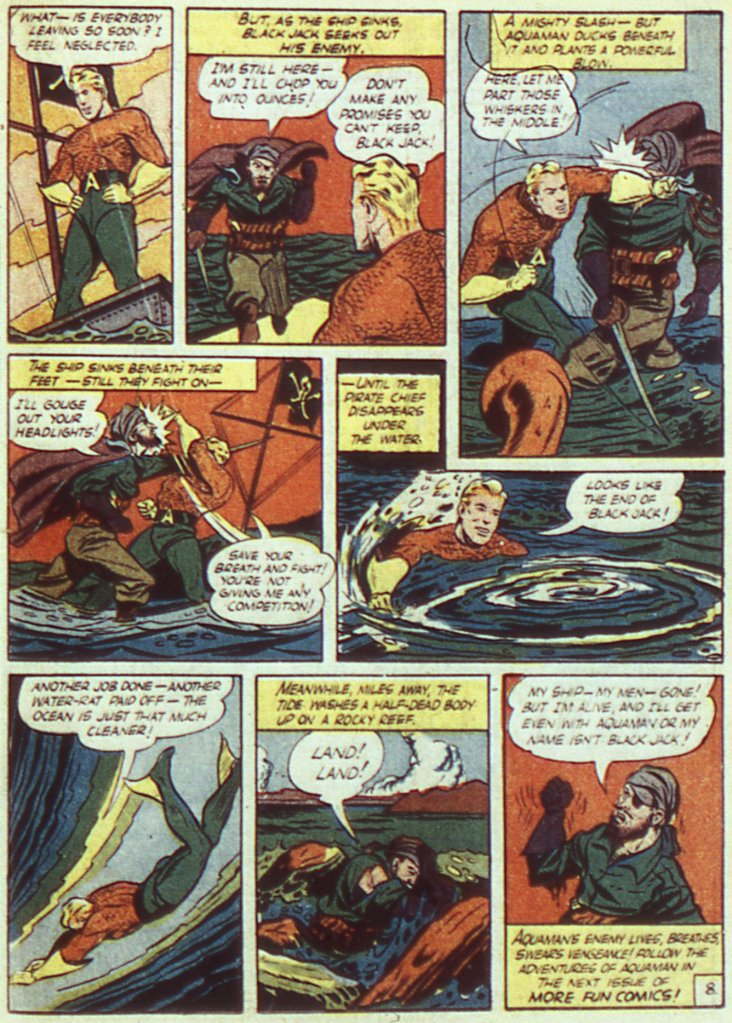
This isn’t great, but it’s not horrible. It’s hard to go wrong with a pirate story. The bit in the last panel of page 4, where Black Jack proclaims outright that he does the cosplay because he thinks it’s intimidating, makes the story for me. It’s a believable in-universe reason for their visuals, and not too far from what some real pirates have done (tried to look intimidating). He had potential as a villain. I can accept that they all don’t know Aquaman can breathe underwater, so they’re essentially leaving him tied up to work himself free.
I’d conjecture Aquaman had some staying power because of the sea setting and later the sea-animal antics (which are very appealing to kids). It made him different enough from all the other guys who were running around a city punching crooks.
I wish “talking to fish” – really, commanding marine life – got more respect as a superpower. Someone who can have an escort of sharks should be taken seriously.
LikeLiked by 2 people
Captain Black Jack/Black Jack does appear in issues 75, 80, 83, 86 ( Aquaman plans to swim around the world in 7 days for Navy Relief ) and 89. People of Atlantis appear in issue 86 ( January 1943 ).
LikeLiked by 1 person
Edward (“Blackbeard”) Teach was known to tie slow matches (used to fire cannons) into his hair and under his hat to frighten his quarry during boardings.
Piracy in its Golden Age in the late 17th and early 18th Centuries had an element of Psyops to it . . . .
LikeLiked by 1 person
It’s interesting to speculate on why a given backup hero lasts a long time. We know that occasionally the big companies got feedback from juvenile fans, but would many fans have bothered to write about a character like Aquaman, who was never on the covers? I wonder if one reason Weisinger kept gimmick-types like Green Arrow and Aquaman around was not because they helped sell the comics, but because he as editor wanted the backups to be simple to execute and thus not demanding for artists to finish, turn in, and be edited for publication. Most editors probably spent most of their effort getting the starring features to seem appealing, coming up with weird cover-ideas or other gimmicks. Sometimes you can get a sense of a heel-turn with the lead features: “Hey, mysterioso Doctor Fate with the full helmet isn’t selling MORE FUN, let’s try cutting his helmet in half to make him more personable.” In contrast, I don’t know that most of the backup features even bothered changing up their act, or if they did, I’m not sure it was ever to impress an audience. Sometimes they just may’ve made changes to keep from being bored themselves.
LikeLiked by 2 people
As Superman and Batman took off, they seemed to become the template that every other character had to follow. Sandman and the Crimson Avenger both switched from pulp-inspired business suits to trendy spandex. Plainclothes adventurer Tex Thompson became the costumed Mr America. etc. etc.
LikeLiked by 2 people
Tex Thompson is definitely one of the few backup guys who was significantly retooled even though he never got to be a headliner. It’s not impossible that someone at DC suggested giving one of Thompson’s costumed identities a shot at starring status, but the editors just said no. As patriotic heroes went, he wasn’t any better or worse than the Star-Spangled Kid. Come to think of it, the Kid got downgraded to backup status, and in the end even his subordinate strip got pushed out by “Merry the Gimmick Girl”– though that’s not so much changing a backup strip as launching a new one, just like Johnny Thunder/Black Canary.
LikeLiked by 2 people
Tex Thompson also ended up with arguably the greatest bad superhero name of Golden Age DC, & maybe the whole Golden Age tho’ there are plenty of challengers for the honor:
Americommando.
I wanted to do a total Americommando revamp for DC in the ’90s SO badly, b/c the name is simultaneously SO great & SO awful, but it never got off the ground… (It sort of did… but that’s another story…)
LikeLiked by 2 people
Hey Tom! I love reading your insights into these old books, and it occurs to me that I happen to have recently scanned a second appearance that you’ve yet to cover: Starman’s in Adventure Comics #62!
If you ever cover that one, and would rather not use those old microfiche scans, my scan of that issue (as well as scans of many other issues of the title) are available for both in-browser reading and download over on the Internet Archive. Here’s the link: https://archive.org/details/adventure-comics-32-to-102/Adventure%20Comics%20062%20%28DC%29%20%281941%29%20%28c2c%29%20%28Randall%20Dietz%2BMark%20Bowen%29%20%28preferred%20version%29
LikeLiked by 4 people
Looks like your advice was followed.
LikeLike