

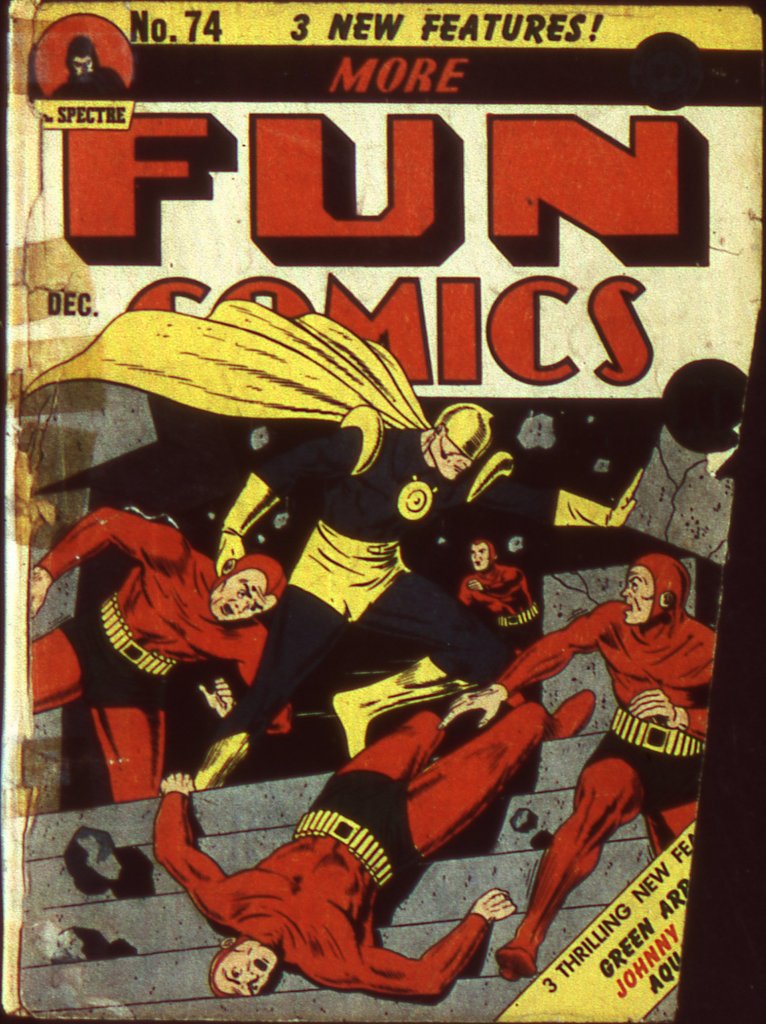

When editor Mort Weisinger was first hired by DC Comics (then Detective Comics Inc) in 1941, one of the first tasks he was given was to improve the fortunes of one of the firm’s longest-running titles, MORE FUN COMICS. The popularity of headliner characters Doctor Fate and Jerry Siegel’s The Spectre were lagging behind the heroes featured in other comic magazines, both at DC and elsewhere. The title needed some new features to attract more eyeballs and dimes. Weisinger, along with his artistic collaborators, wound up creating three characters who would go on to have long lives in publication and elsewhere: Aquaman, Johnny Quick, and today’s subject, Green Arrow.
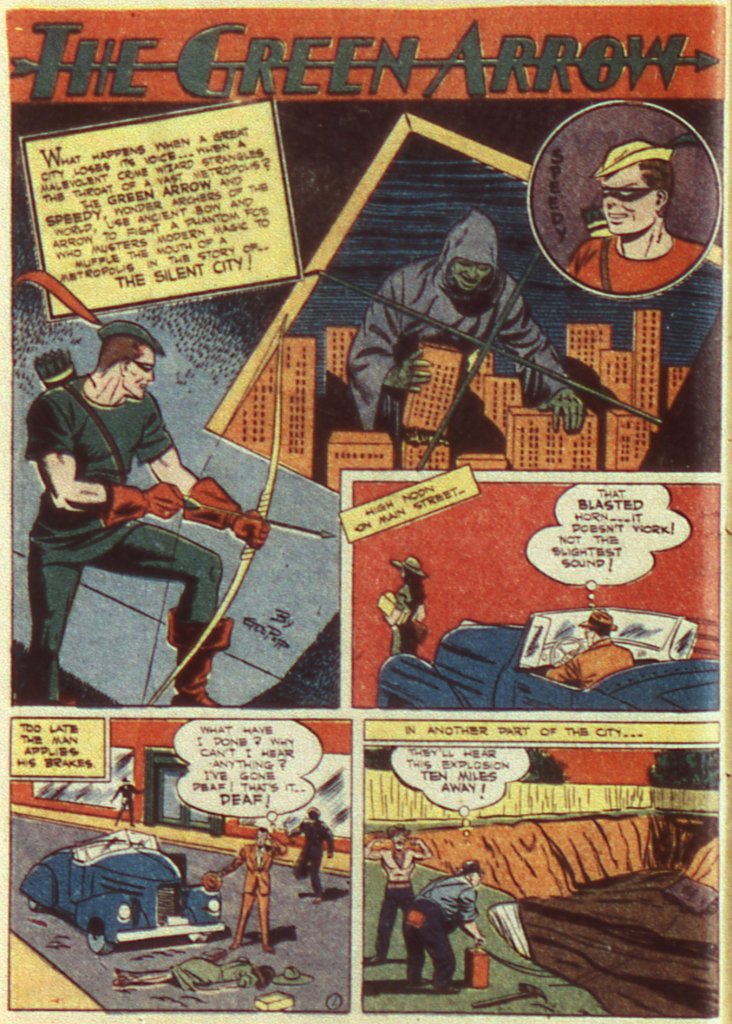
In later years, Weisinger denied that the Green Arrow was in any way influenced by the popular Batman, claiming instead that he obviously drew from Robin Hood and films such as the Green Archer. But this would appear to be a relatively transparent lie, as the Emerald Archer operated out of an Arrow Cave and drove an Arrowcar (initially called an Arrowplane despite the fact that it didn’t fly) and palled around with an obligatory Robin-like kid sidekick, Speedy. That said, Mort was far from the only person in the field who adapted and adopted the particulars of the most popular features for their own use.
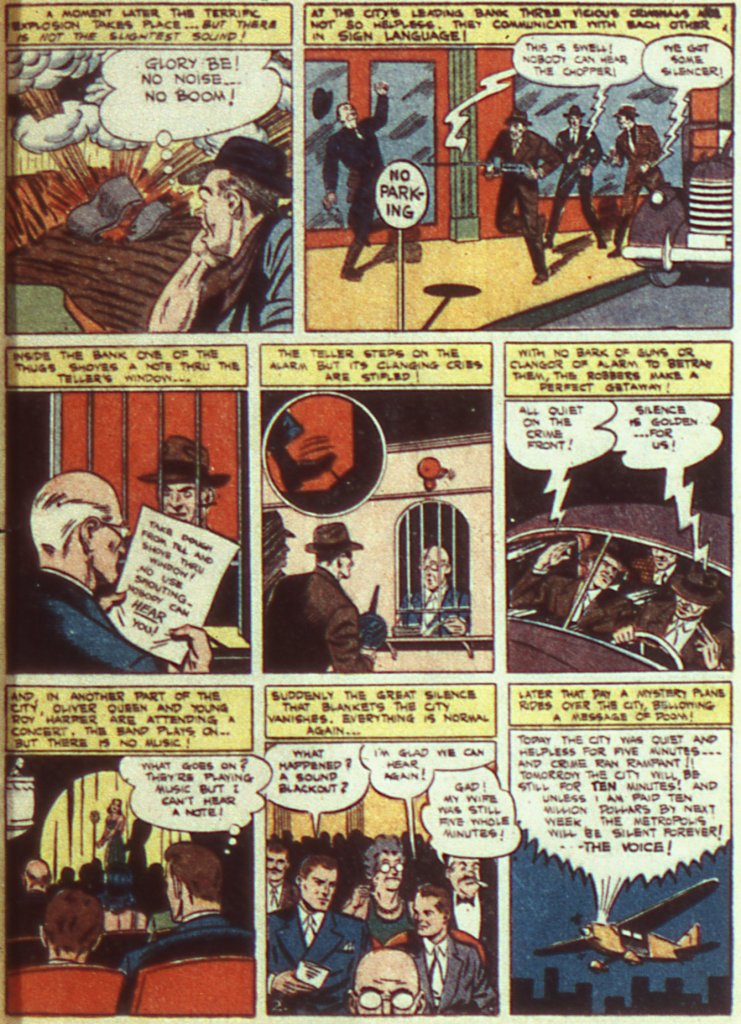
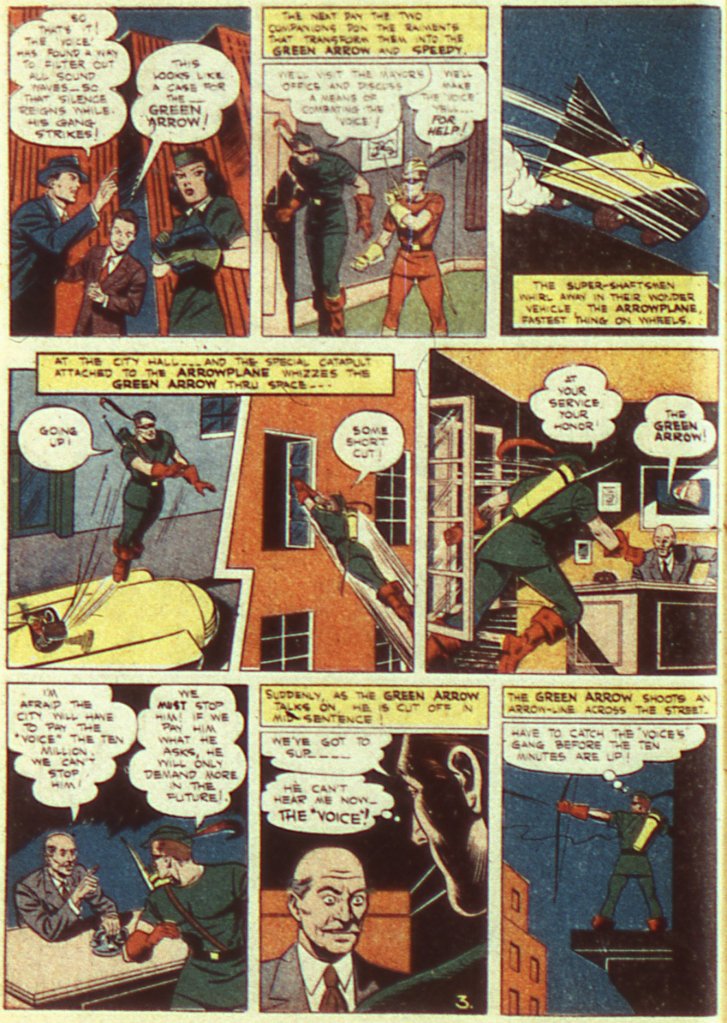
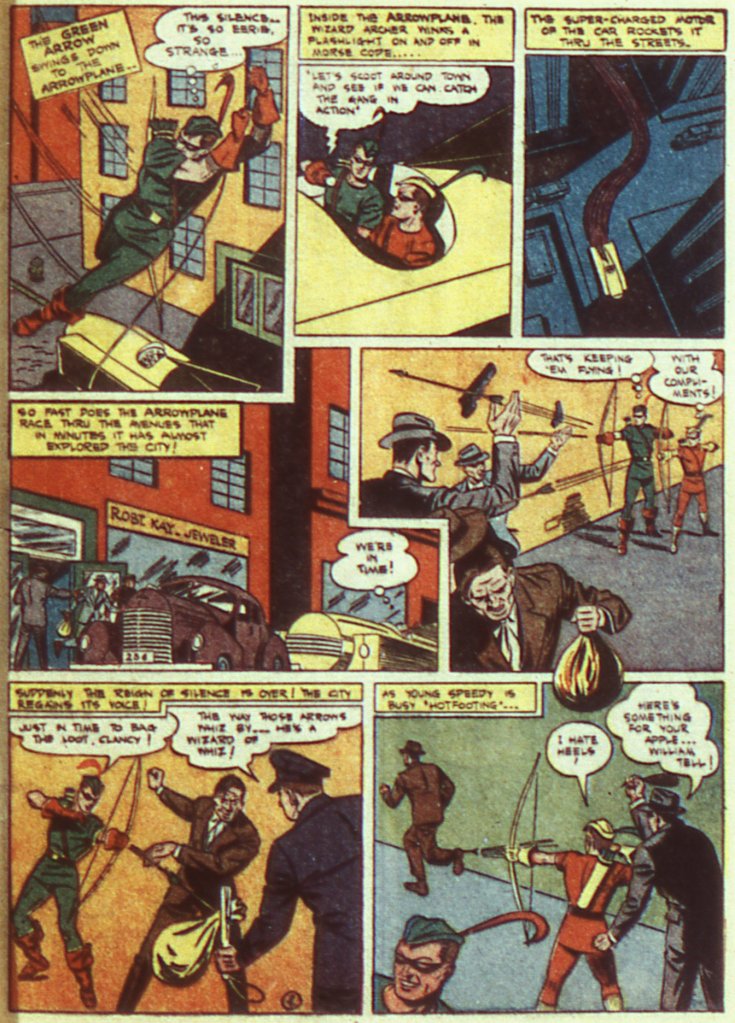
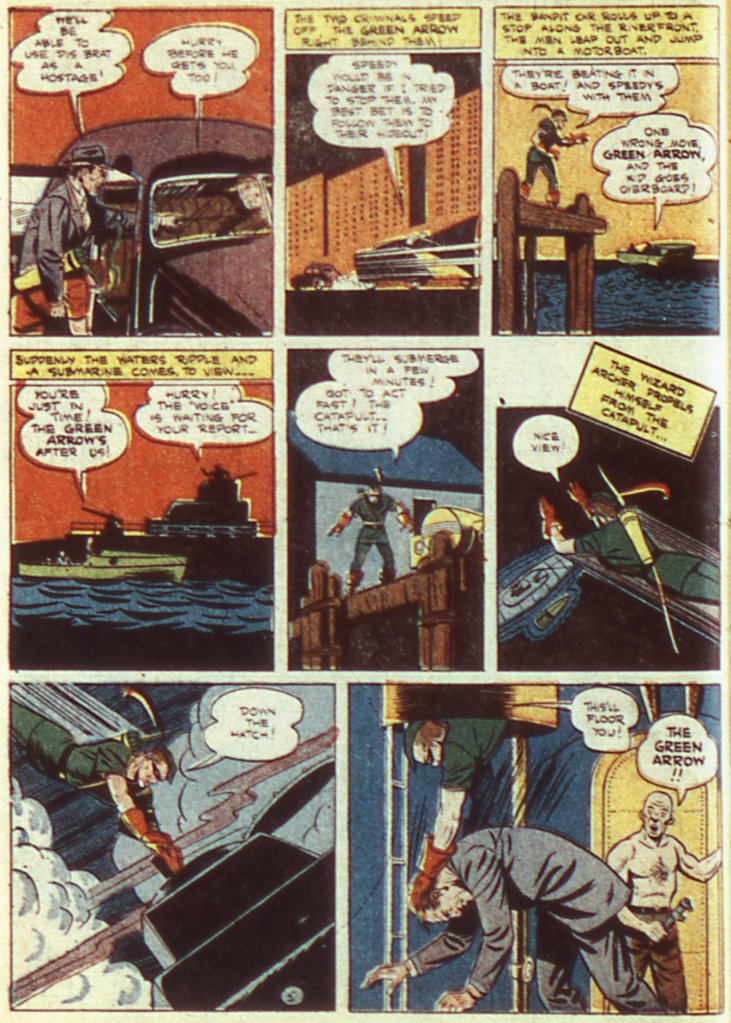
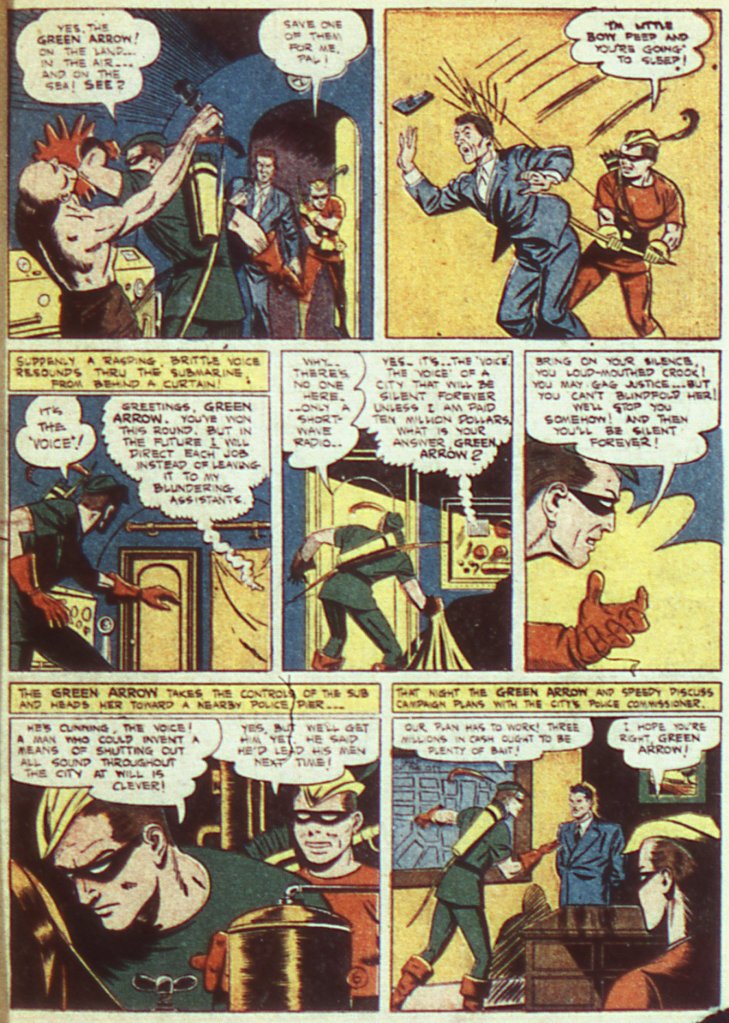
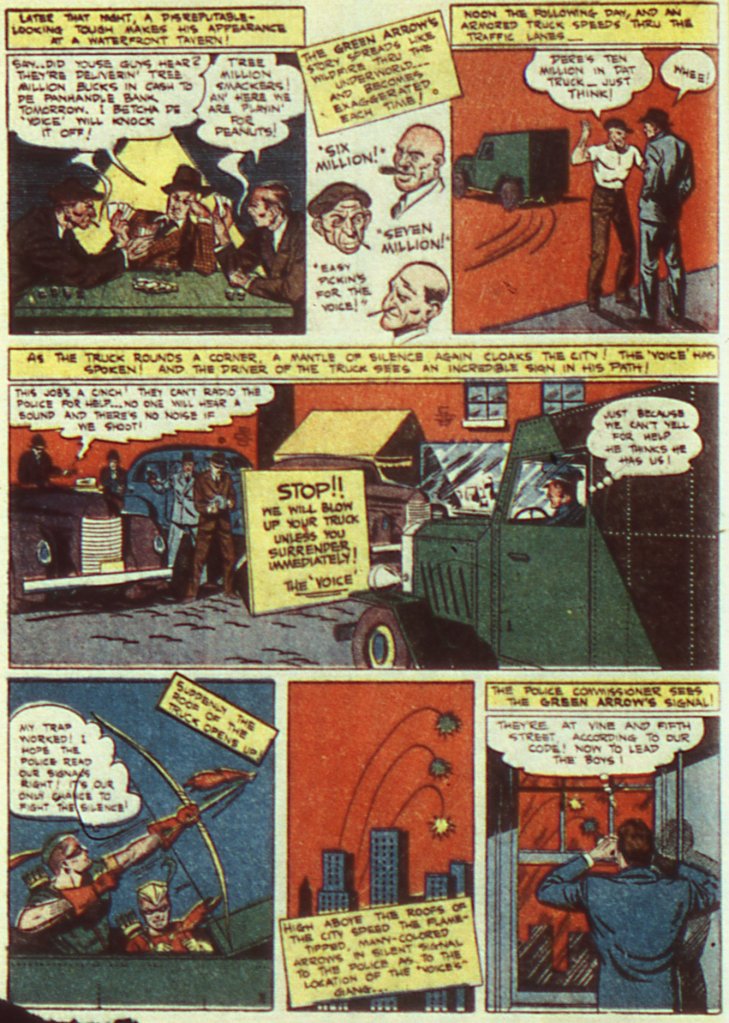
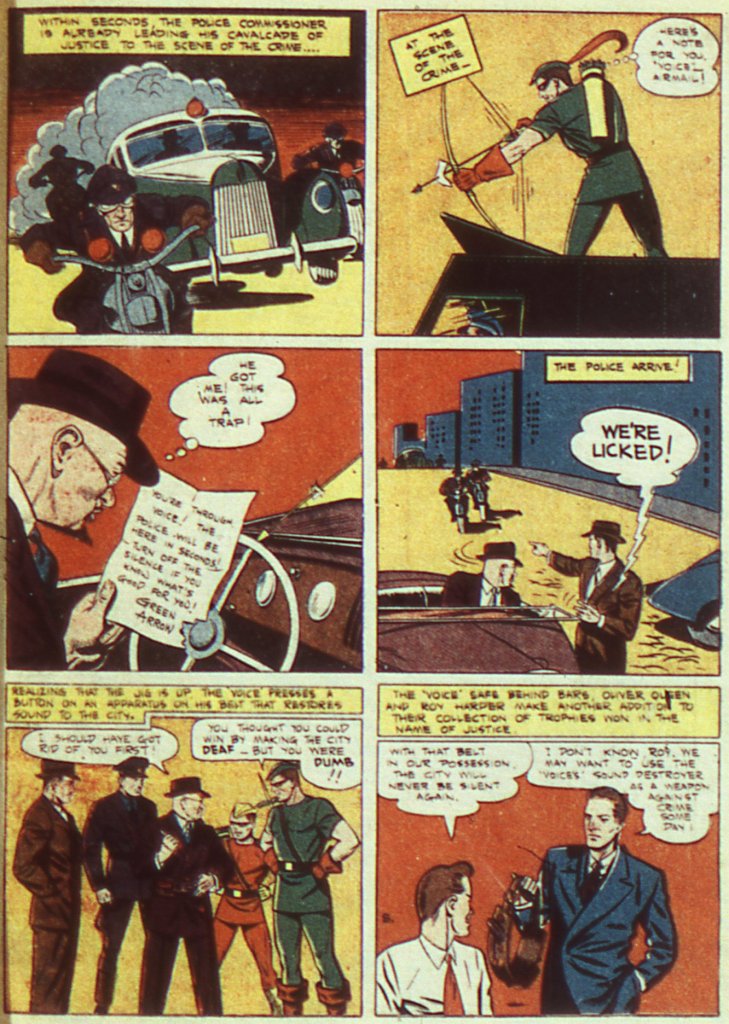
This second story, like the first one, was illustrated by George Papp, who would have a long career at DC. These days, he’s likely better remembered for all of the Superboy stories that he drew (for editor Weisinger) rather than the fact that he co-originated Green Arrow. His work here is relatively basic and stiff, lacking in energy and excitement. But it’s well-drawn and the storytelling is overall straightforward and easy to follow. Papp seems as though he was doing his best not to be noticed while delivering his visuals.
Green Arrow was immediately more popular with readers than the Spectre or Doctor Fate, and he wound up inheriting the cover position in not too long a time. But he wouldn’t keep it; eventually, it would be ceded to Superboy just before both strips (along with Aquaman and Johnny Quick) migrated over to ADVENTURE COMICS in 1945 when the decision was made to shift MORE FUN COMICS over to being a vehicle for comedy strips, as it’s name implies.
As a second banana feature, Green Arrow continued to run even as other more popular super hero series folded along the way. He’s one of the tiny list of such characters to have reached the Silver Age from the Golden Age without any break in publication, a feat that can be chalked up, as much as anything else, to Weisinger keeping his strip running in the back pages of his magazines rather than swapping him out for a feature created by somebody else.
 The Tom Brevoort Experience
Aquaman, Johnny Quick, and Green Arrow are all knockoffs of other heroes.
LikeLike
Popular heroes.
Weisinger knew what he was doing.
LikeLiked by 1 person
Johnny Quick & Green Arrow were knockoffs of fellow DC Comics heroes ( National Allied Publications ( Batman ) & All-American Publications ( Flash ) ), but Aquaman a knockoff of the Sub-Mariner who’s origin DC would borrow in the 1950s ( his 1940’s origin was a full blooded surface dweller, who as a baby was given Atlantean abilities by his scientist father ). Namor pre-dates Centaur’s Shark [ Amazing-Man Comics#6 ( October 1939 ) ] — Motion Pictures Funnies#1 ( April 1939 ).
LikeLiked by 1 person
But Aquaman got his ties to Atlantis several years before Namor’s subsea civilization was associated with it.
LikeLike
I like Golden age Green arrow almost as much as I dislike the current version, one I’ve disliked since I started reading comics around 1973. There’s a thought experiment I do sometimes where I try to think of how the modern versions of Batman and Green Arrow would look today had their success gone he opposite way. Batman as a perennial back up with a New Look in the 70’s and GA with multiple titles and appearing in other media, etc…
LikeLiked by 1 person
While not exactly the same thing, that is similar to the premise for an alternate history that Bob Rozakis wrote about a decade ago, THE SECRET HISTORY OF AA COMICS.
I really enjoyed it.
Here’s the Amazon description:
“In the 1940s, M.C. Gaines sold his All-American Comics line to his partners at DC Comics. But what if, instead, he had bought out DC? And suppose Green Lantern and The Flash had become the surviving heroes of the Golden Age, with new versions of Superman and Batman launching the Silver Age of Comics? Comic book industry veteran Bob Rozakis delivers a fascinating tale of what might have been, complete with art from the Earth-AA archives!”
LikeLiked by 1 person
At best (As with the original version of Green Arrow he was a second string Batman; not a headliner but a team player in JLA and The Seven Soldiers Of Victory.) At worst (The modern version, he is a second string Batman with a smart mouth.)
LikeLiked by 1 person
Obviously copying the superheroes the kids loved most was the sensible thing to do, but I can’t help wishing the Spectre and Dr Fate had kept doing what they did at the start, when they were something different from Superman-in-different-colours. By this point they’d both been watered down heavily – Fate had a day job as a doctor, forsaking his mysterious magical adventures, and the Spectre was settling into his new role as spooky sidekick to Percival Popp (the Super Cop). But was there really no market for the kind of thing that made their earliest stories so cool? Even if More Fun didn’t sell as well as Action (or even Adventure), surely it was still bringing in a fair bit of cash, and maybe a more diverse range of heroes would have brought in more long-term stability to the range?
Modern-day thinking, obviously, but I’d love to see more omnipotent and magical golden age fables!
LikeLike
Yes the half-helmet as a cowl and Fate wisecracking as he punches out hoods was a poor substitute. But he ran longer that way than he did as the helmeted mystic.
LikeLike
This is interesting for the odd bits and rough edges. That first splash panel is nice, quite pulpish with a man-vs-monster motif.
I think it works for a car which is the “fastest thing on wheels” to be called “The Arrowplane”, even though it’s not literally an airplane. The naming idea seems to be a pun of “this car flies down the road”. That strikes me as a much better defining characteristic than “Arrowmobile”, meaning “this car is Green Arrow’s vehicle”. It probably sounded better in that era when airplanes were new, so it wouldn’t immediately seem literal, rather more obviously being hyperbole about how fast it is.
The car-catapult is amazingly goofy.
The ending scene is a bit silly, like the crooks haven’t ever heard of distress flares.
While GA’s a Batman knockoff, there was enough different here to show some promise of eventually evolving into something else. The basic problem I see with him in those days is that trick-arrows is a gimmick which is can quickly wear out over the years.
LikeLiked by 1 person
The Terraplane was a well-known model of car in those days. I suppose that’s what led to the Arrowplane; it’s just that it sounds more and more strange the more you move into the time when ‘plane’ can only mean something that flies. 🙂
LikeLiked by 1 person
Yeah, none of this is true. Weisinger created Green Arrow and the Vigilante simultaneously as a modernization of Cowboy movies. He swiped a lot from the really popular Green Archer movie serials. The trick arrows didn’t come along for another 5 or six years and the Arrow Cave doesn’t actually show up until the late fifties. Some actual facts are here: https://dccomicsartists.com/goldage/GreenArrow.htm
Also, I think DC (National Allied disappeared along with the Major) knew which of their books were the most popular and knew why. It would have been really weird for Joe Samachson and Mort Meskin to start drawing the Flash in the back of Adventure Comics when his titles tanked at the end of the forties. Ditto with Hawkman and Green Lantern by George Papp. After the Superman tV show started, Weisinger concentrated solely on that character leaving Green Arrow to the third string of Boltinoff and Kashdan. It was easier to just swipe old Batman stories than think up anything new so the two characters became more and more alike despite vastly different origins.
LikeLike
Both Green Arrow & Speedy have blond hair in [ More Fun Comics#79 ( May 1942 ) The Boomerang! ] & Speedy is blond in [ More Fun Comics#78 ( April 1942 ) The Black Raider! ]. Green Arrow is blond and Speedy has red hair [ More Fun Comics#81 ( July 1942 ) The Adventures of the Bankrupt Heroes! ]. Speedy has red hair [ More Fun Comics#87 ( January 1943 ) The case of the Confident Crooks ] and Green Arrow clamps an Arrow lamp on to the pack of a crook so he can follow him and also uses magnesium flare arrows ( First trick arrows asks comics.org ).
LikeLike
When Green Arrow ditched his trick arrows in the 1987 Green Arrow: The Longbow Hunters#1-3 series Mike Grell brought him back to his early golden age roots.
LikeLike
The biggest problem with these perennial back-up characters like Green Arrow and Aquaman, is that 8 pages just doesn’t give you much room for development. You barely have time to introduce and resolve a plot, never mind doing any characterization or world-building. These strips ran for a couple of decades without ever developing any significant supporting cast or recurring villains. Compare that to the depth of lore that Superman and Batman accumulated during that time. Most of what we think of as “essential Aquaman lore” didn’t come about until he got his solo title in the ’60s. And the fact that Green Arrow was such a blank slate was why Denny O’Neil could get away with completely reinventing him (for better or worse) in JLA.
LikeLiked by 1 person
Definitely worse.
LikeLiked by 1 person
. . . . and Bob Haney and (particularly) Neal Adams in B&B . . . . .
I wonder if a film called Operation Kid Brother with a goateed Neil Connery playing a plastic surgeon who dabbles in archery and trade craft and is the younger sib of a famous Intel Op influenced Adams on the Visuals?
LikeLike
Green Arrow may have also been influenced by Fawcett’s Golden Arrow. Weisinger would never admit to copying anything. He insisted that Supergirl was not influenced by Mary Marvel. Bur Otto Binder and Kurt Schaffenberger who worked on both characters knew otherwise. Not that there’s anything wrong with imitation. Captain Marvel was influenced by Superman. And Hawkeye was certainly a Green Arrow knockoff.
LikeLike