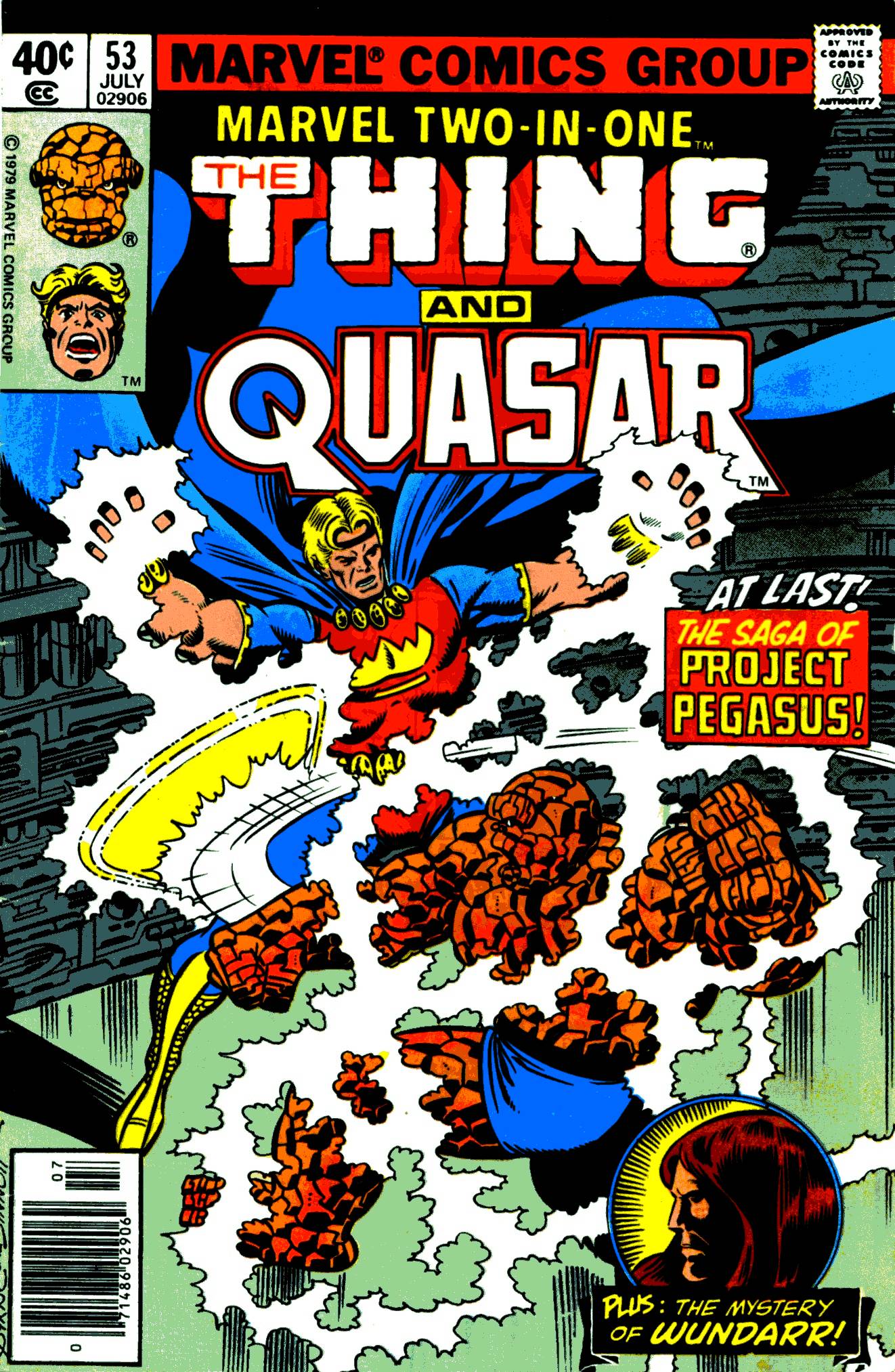


And now we come to what is generally regarded as the strongest period in the 100-issue run of MARVEL TWO-IN-ONE’s history. With this newest issue, #53, the six-part Project: PEGASUS Saga kicked off, signaling the arrival of the writing team of Mark Gruenwald and Ralph Macchio. Macchio had created the titular Project; PEGASUS for an earlier MTIO story as an energy research facility, and the events of the next several issues would be set in and around this establishment, priming it to be a recurring locale within the Marvel Universe for decades to come. Mark and Ralph were big fans of the Fantastic Four and felt that the main series hadn’t been all that wonderful for many years. So given this assignment, they set out with the stated goal of making MTIO a superior series to the Thing’s home title FANTASTIC FOUR. I don’t know that they ever entirely got there, but their run is held in strong regard by the fans who experienced it firsthand.
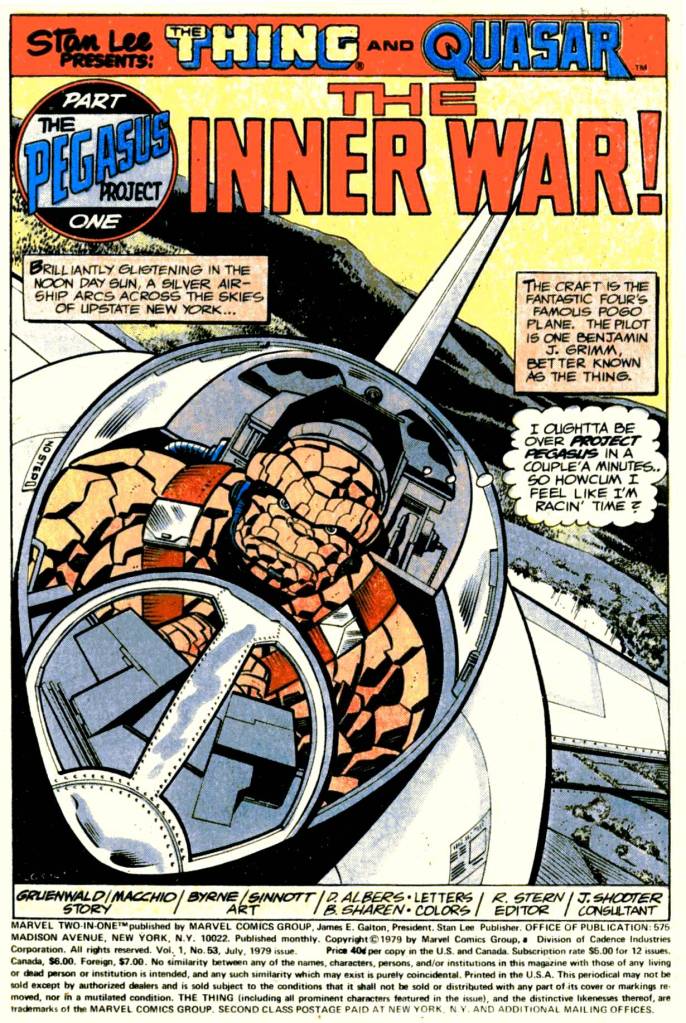
One of the things that benefitted this run immeasurably was the fact that Gruenwald and Macchio and editor Roger Stern were able to attract and keep a better grade of artist than had typically been seen in these pages before this. This issue and the next two were the work of the popular John Byrne, inked and embellished by FANTASTIC FOUR mainstay Joe Sinnott. And even after Byrne was forced to give up the assignment, he was replaced by George Perez. These were two of the most popular artists of the era, and both had blossomed into the fullness of their powers by this time, so the book always looked sharp and the storytelling was strong and on point.

The issue opens by picking up on a plot thread that had been seemingly dropped several years earlier; the Thing is on his way to Project: PEGASUS to check in on Wundarr, the alien child whom ben has sort of adopted for a while earlier on in the series. Wundarr had been turned over the Project so as to help to figure out his uncontrollable powers and to provide him with the living assistance that he needed. As ben checks in, we learn a bit more about the scope of the project’s efforts into alternative energy sources, and then we’re introduced to the place’s new chief of security, a hero calling himself Quasar.
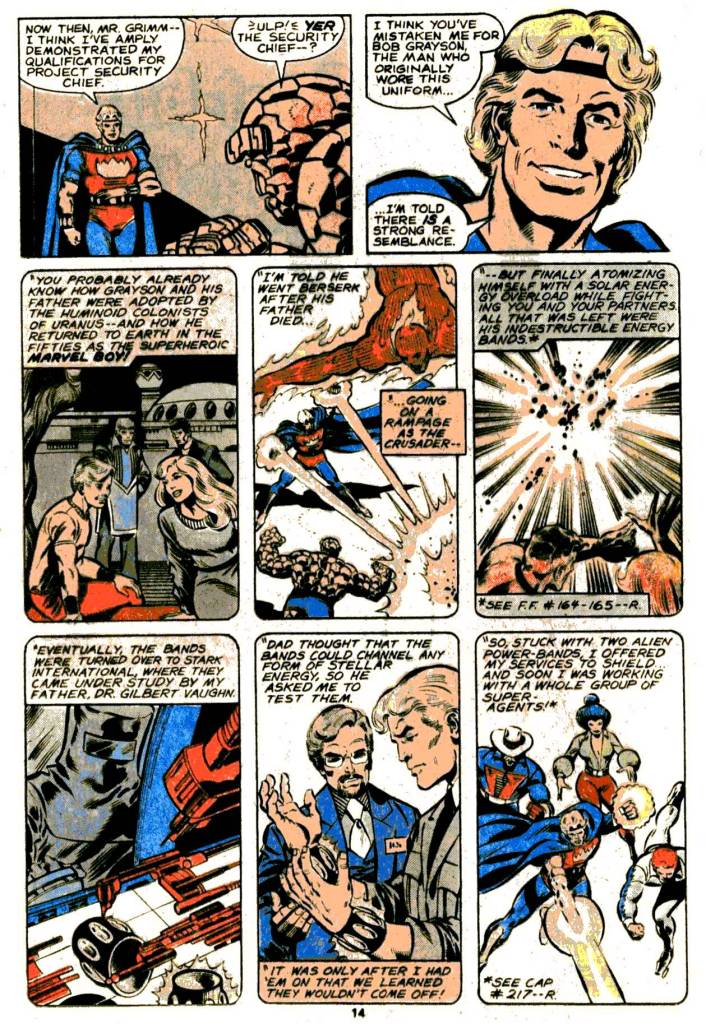
Quasar wears the costume and wields the Quantum Bands that previously belonged to the golden age character Marvel Boy, who had gone crazy and fought the Fantastic Four as the crusader. So when Ben first sees Quasar, the two men immediately break into an obligatory fight, Ben mistaking Wendell Vaughn for his old sparring partner. Mark Gruenwald has kind of adopted Quasar as a pet character of his, picking him up from a run in CAPTAIN AMERICA where, as Marvel Man, he served as one of the short-lived Super Agents of SHIELD. As a huge Silver Age DC fan, mark saw the opportunity to craft the hero into a Marvel-style equivalent to Green Lantern, and he set about doing so over the course of several years, culminating in the character gaining his own series. But in 1979, he was a headliner that nobody had particularly asked for.

We’re also reintroduced to Dr. Lightner, who had previously fought the Thing as Black Sun but who in the interim has become a trusted department head at the Project. Unfortunately, Lightner is secretly a spy for the villainous Nth Command, and he immediately warns his higher-ups about the Thing’s presence as soon as ben leaves his lab. Meanwhile, we cut away to establish a subplot with Thundra, the super-strong future Femizon who had been a recurring romantic foil for the Thing. Here, at loose ends, she winds up securing herself a position as a wrestler after she rescues a promoter who is being mugged. This would set off her ongoing plotline for this story, which would eventually intersect with the Thing’s.
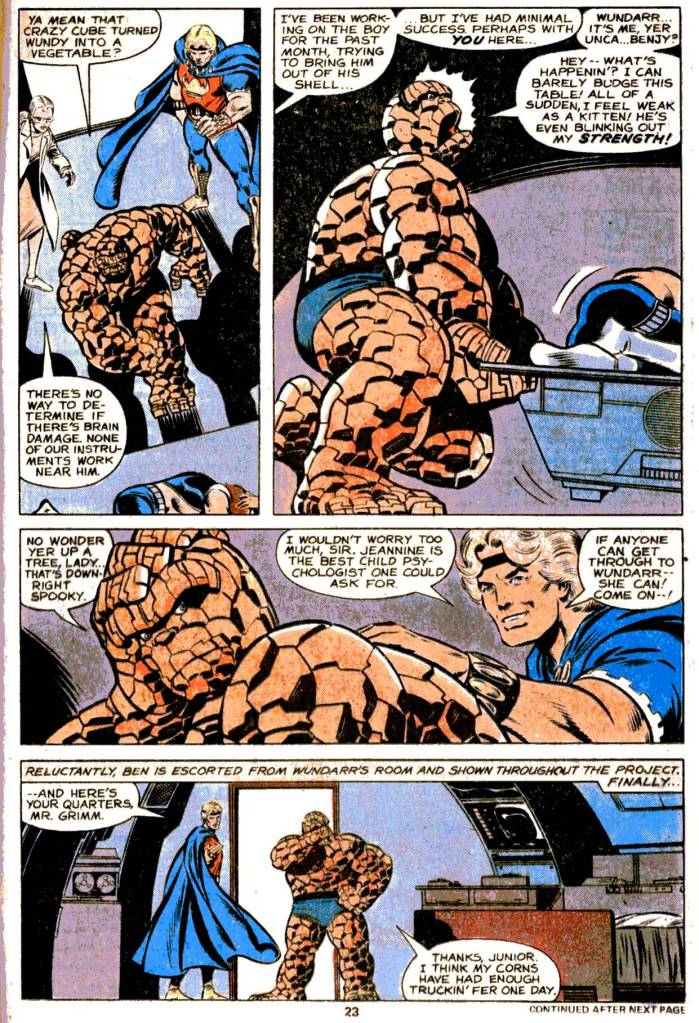
Back at the Project, Ben completes his tour and we get to the heart of the matter, as Quasar escorts him to where Wundarr is kept. It turns out that ever since becoming embroiled with the Cosmic Cube in the earlier Project; PEGASUS story, Wundarr has been comatose. What’s more, his ability to leech the motive energy for anything and everything around him has been reflexively running ever since, meaning that the room he’s kept in can’t be lit, and the Thing can’t even garner enough strength to lift his ward’s bed. Nobody quite knows how to rouse Wundarr, but the hope is that Ben’s presence will help to draw him back out of his comatose state.
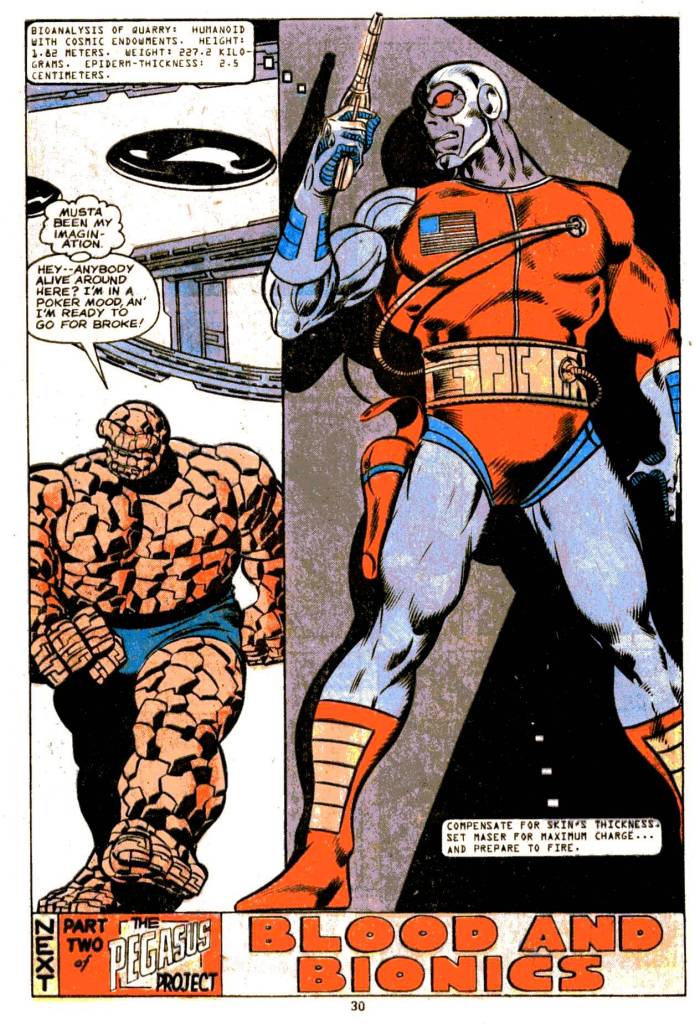
But that’s tomorrow’s problem, and for now, the Thing returns to his quarters as night falls. However, an intruder is making his way into the Project on behalf of the Nth Command. This is Deathlok, who had last been seen in the book many years earlier, also in a vegetative state. Unable to sleep, Ben gets up and prowls around looking for a midnight snack or a floating poker game–and as the story reaches its climax, he’s about to walk into an ambush set up by Deathlok. To Be Continued!

Rather than a typical letters page, this issue includes a technical schematic of the layout of the Project: PEGASUS facility. There aren’t any credits on it, so I can’t say this for certain, but it certainly looks to have been the work of Eliot Brown, who a few years later would contribute technical specifications drawings such as this one to Gruenwald’s OFFICIAL HANDBOOK OF THE MARVEL UNIVERSE. If nothing else, this handy reference map gave readers the chance to understand where each of the events of the storyline were taking place relative to one another.
ADDITION: Michael Higgins confirms in the comments that he and Mark Gruenwald did this page, rather than Eliot Brown.


Two-In-One was better than Team-up. There I said it.
LikeLike
OMNIUM STEEL ( WALLS — mentioned under Magnetic-Gravitic Research – page 31’s layout of Project: PEGASUS ): I have always wondered if this was the first appearance or mention of it. Plus were it ranks in Earth alloys hardness. I checked marvel.fandom.com and got nothing. I know I saw it in another series.
LikeLike
Moses Magnum’s Mandroids’ armour was made of omnium steel [ X-Men#118-119 ( February-March 1979 )]. The Mark 2-4,6 & 7 Mandroids are also made of Omnium steel ( marvunapp.com ). Project: PEGASUS is up there with Starcore One [ Incredible Hulk Vol. II#148 ( February 1972 ) ], High Evolutionary’s Citadel of Science [ Thor#134 ( November 1966 ), the Enclave’s Citadel of Science/Beehive [ Fantastic Four#66 ( September 1967 )], the SHIELD Helicarrier(s) and the SHIELD Spacestation in the Kree-Skrull War [ Avengers#96( February 1972 ) ] .
LikeLike
I had been buying Two-in-One off and on over the years. Before this run it had a few recent stand-out issues like 42, 43, and 50 that I enjoyed as much as this, but it really got cooking with this issue as an enjoyable ongoing title.
The Thing is such a great character normally, but he has particular gravitas as a lead during this run until the title falls back into single story mode around issue 67. The guest stars feel important and are prominently featured with their own troubles, and Ben plays as well off of the second-stringers as he does the A-listers. The Project Pegasus issues in particular read like super heroes meeting at summer camp forming their own mini-Avengers. Good stuff. Might be my favorite Gruenwald work.
As you mention… the Byrne and later Perez with Sinnott and Day help sell the whole Thing. Pun intended.
LikeLike
This was the single best run of stories in the series, followed by the Counter Earth story that introduced us to Gruenwald’s tic about removing what he considered unnecessary clutter from the Marvel cosmos.
LikeLiked by 1 person
Gruenwald (much like Byrne when he took over a new series) more all about “fixing” things than telling an entertaining story. IMHO it’s what kept him from being a truly great writer.
LikeLike
I wonder if one reason Squadron Supreme was so good was that it took place in an alternate universe – no clutter to clean up, nothing to fix.
LikeLike
That and nothing having to return everything to Square One at the end. He could have real change happen.
LikeLike
Back then, if Byrne or Perez were drawing Millie the Model I would have bought the book!
LikeLiked by 2 people
Mark Gruenwald changed Quasar’s origin seen on page 14 of this issue ( Dr. Gilbert Vaughn asking his son Wendell to test the bands ) to SHIELD choosing an agent William Wesley to test them, resulting in his death and much later during an A.I.M. attack Wendall put them on to protect them[ Quasar#1 ].
LikeLike
SHIELD Super Agents ( page 14 ): Marvel Man ( Quasar )/Green Lantern, Texas Twister/Red Tornado, Blue Streak/Flash II & Vamp/Wonder Woman ( ? or Queen Hippolyta and her Golden Girdle of Gaea ).
LikeLiked by 1 person
The Vamp and Wonder Woman ( TV series version – 1975-1979 ) who Queen Hippolyta gave a golden belt that would be the source of her strength and power while away from Paradise Island ( wikipedia.org ) — Vamp loses the duplicated physical skills and strength of anyone around her the absorbo-belt grants her.
LikeLike
This was a pretty momentous arc, and I enjoyed it at the time.
But they ruined Wundarr. Just ruined him.
The bums. I do not forgive.
LikeLike
They totally didn’t get what Gerber did, which sadly is not that unusual.
LikeLike
I know Wundarr has his fans. I read him in Man-Thing and I don’t see any depth beyond “LooK! A Superman riff!”
LikeLike
Does anyone have a link to an account of the minor trouble the Superman riff caused? I can’t recall details offhand.
LikeLike
https://www.cbr.com/dc-marvel-lawsuit-superman-wundarr/
LikeLike
I liked Wundarr the way he originally was. It was today that it dawned on me that 2 of Project: PEGASUS’ occupants have something in common: Both adults with the minds of children because they grew up in some kind of containment unit that did not provide them with any formal education or any — Wundarr & Nuklo. I like Nuklo too, especially his ability to split into 3 identical bodies.
LikeLiked by 1 person
The Aquarian just seemed so instantly out of date. I remember thinking (in 1979) that he was the best new character of 1969.
LikeLiked by 2 people
Also, he was dull.
He’d gone from a dynamic, active, destructive childlike hero to a passive, inactive, long-winded philosopher whose very presence makes things stop happening. Bo-ring.
He appeared 13 times over 6 years as Wundarr — not a huge amount, but he kept turning up — and 24 times in the 46 years since, usually in cameos, because no one was interested in him any more.
LikeLiked by 2 people
The Project Pegasus page wasn’t by Eliot Brown, It was by Mark Gruenwald and myself.
–M. Higgins
LikeLiked by 1 person
It even says so in the bottom right corner!
LikeLike