

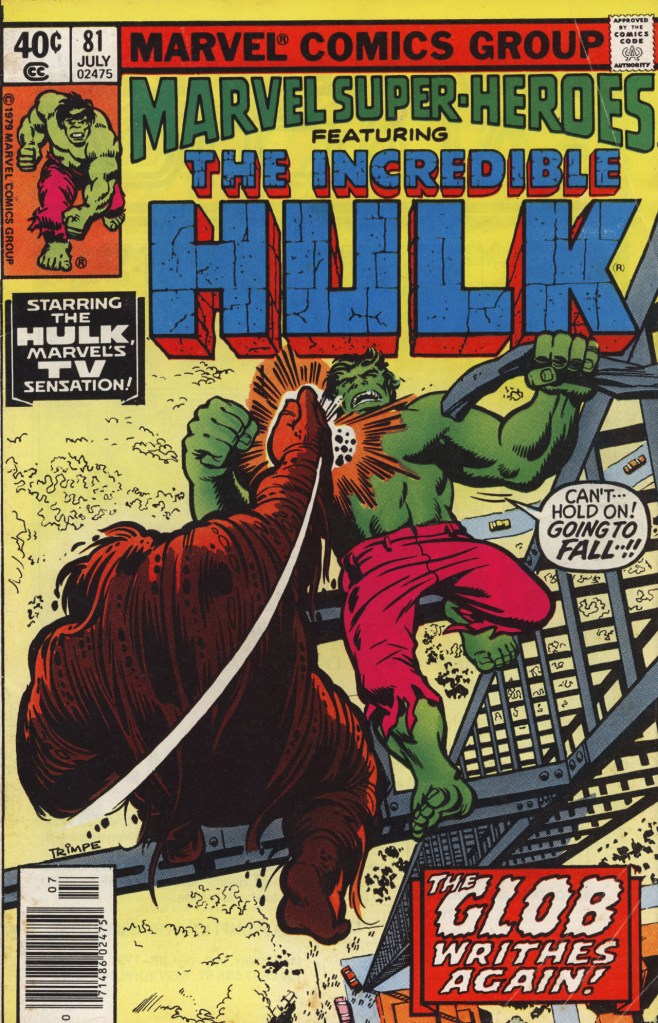
There was something in the air in the late 1960s and early 1970s that made the idea of a swampy muck-monster a thing that several different people were simultaneously thinking about. This sort of thing tends to point to some influence from the mainstream media, but I’m not sure just what that might have been this many years after the fact. But regardless, assorted comic book companies all unleashed a variety of such creatures in the span of only a few years: Man-Thing, Swamp Thing, a revival of the golden age Heap, and the villainous entity of this reprinted INCREDIBLE HULK story, the Glob. They were all extrapolations on Theodore Sturgeon’s creature from his story IT!, originally published in 1940.
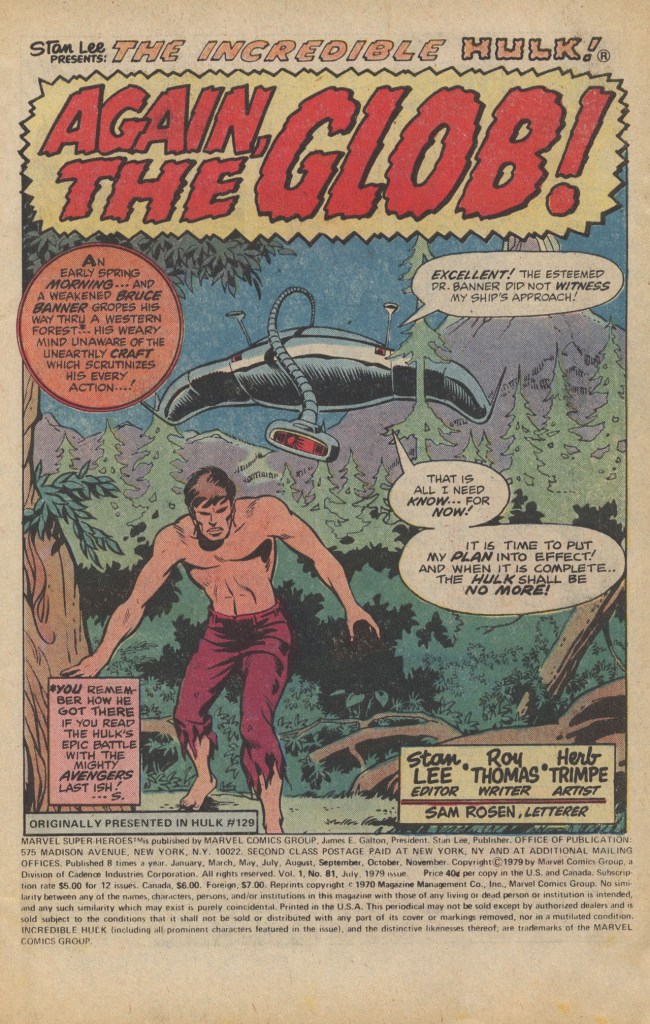
Writer Roy Thomas was certainly aware of Sturgeon’s tale when he created the Glob as a nemesis for the virtually-indestructible Hulk several issues before this one. Roy would later commission an adaptation of Sturgeon’s epic for the first issue of SUPERNATURAL THRILLERS as Marvel expanded. Regardless, the Hulk needed antagonists that could stand up to him, and the Glob fit the bill, in that he was physically powerful, hard to get a grip on, and could regenerate or reabsorb his scattered parts if destroyed. Otherwise, there wasn’t a whole lot more to the character. But there really didn’t need to be.
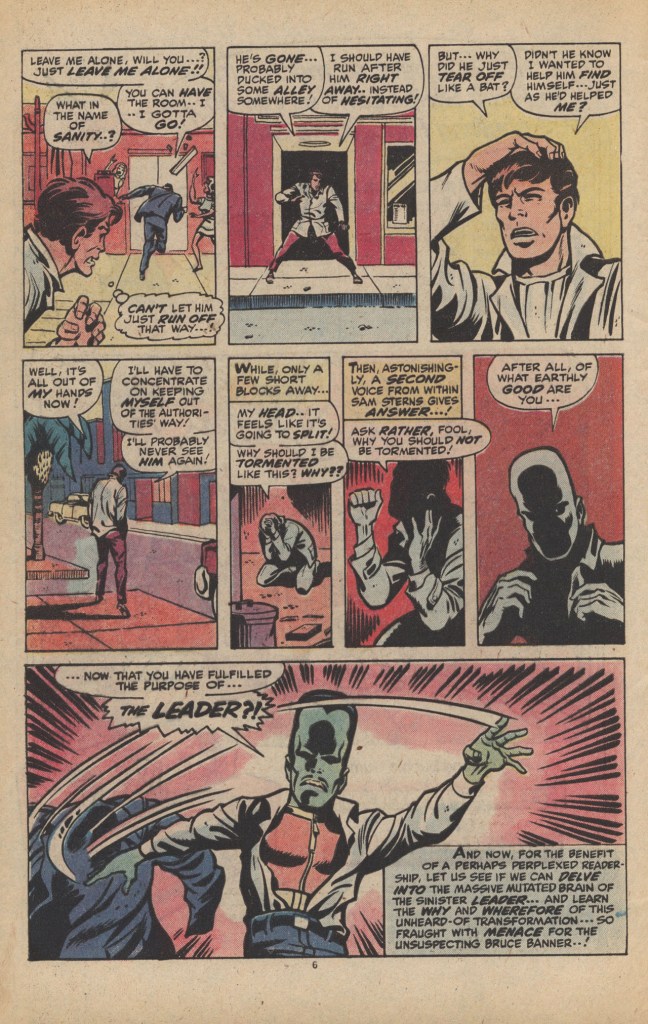
The story opens up with Bruce Banner staggering out of a forest, unaware that he’s being observed by a mechanical flying craft. Bruce promptly flags down a passing motorist to get a ride into town. But wouldn’t you know it, the driver has amnesia himself and has no memory of where he’s going or why. Either way, Banner could use a friend, and the two men spend a bunch of time together. Gossiping about his alter ego as one does, banner winds up telling the truck driver about the Hulk’s recent encounter with the Glob, who might almost have been a friend to the Hulk. At that point, the driver gets a sudden headache and races off–only for the camera to follow him as he transforms into the persona of the Hulk’s recurring enemy, the Leader.
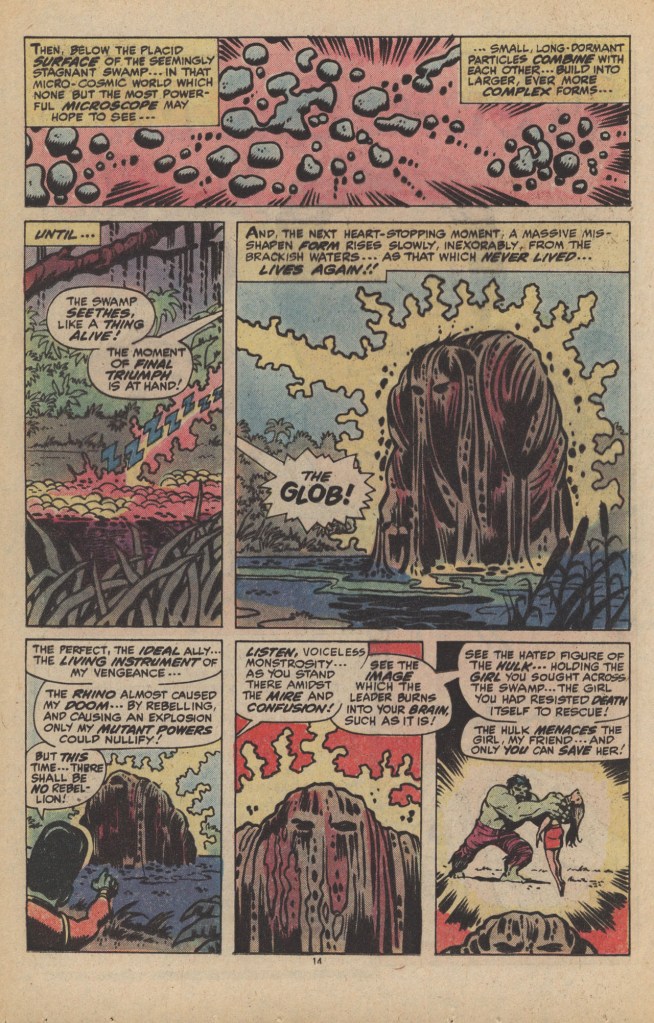
Seeking a way in which he might defeat his long-vexing enemy, and not worrying about running the unsuspecting Banner down with his truck, the Leader directed his super-mentality inward, concealing his true nature even from himself until he could learn of a way in which the Hulk might be destroyed. Having heard banner’s tale of the Glob, the Leader then pilots his craft to the area in which the confrontation took place and uses his super-science to cause the disparate bits of the Glob to reassemble themselves, restoring the creature. For a villain who claimed to be so smart, the Leader was typically awfully dumb, not really thinking through his plans. In this case, he implants an image in the Glob’s head of the Hulk threatening a girl the Glob’s human incarnation had feelings for, and lets nature take its course.
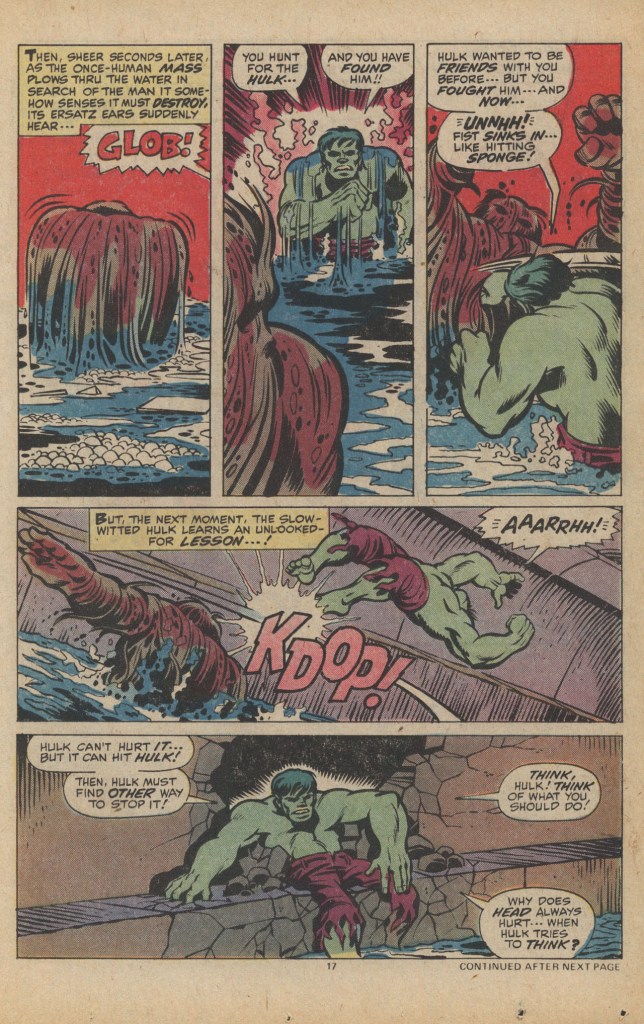
During this era, INCREDIBLE HULK was pretty much a fight comic, with much of every story dedicated to extended fight sequences as the Green Goliath took on monsters and super-villains and robots and armies, and this issue is no different. The remainder of the book is an extended fight sequence in which the Glob seeks out Banner to destroy him, and Banner transforms into his brutish alter ego so that the battle can be joined. This gave artist Herb Trimpe an opportunity to shine. Trimpe wasn’t quite on the level of a Jack Kirby when it came to choreographing action sequences, but he was called upon to do so with such regularity that his skill level grew accordingly.
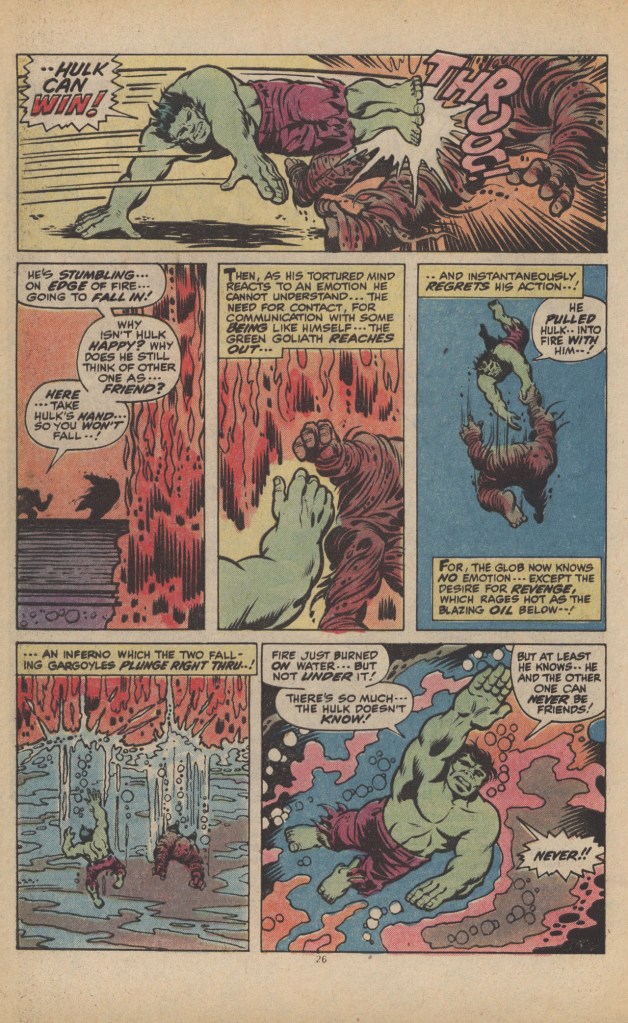
Character-wise, the Hulk picks up on the thoughts that banner had expressed at the beginning of the issue: that the Glob is very similar to the Hulk himself and that they might have become friends under other circumstances. This little bit of melancholy helps to humanize the emerald behemoth despite the fact that his efforts are focused on destroying his opponent just as much as the Glob is set on destroying him. The pair battle across the city and into the sewers, leaving carnage and destruction in their wake.
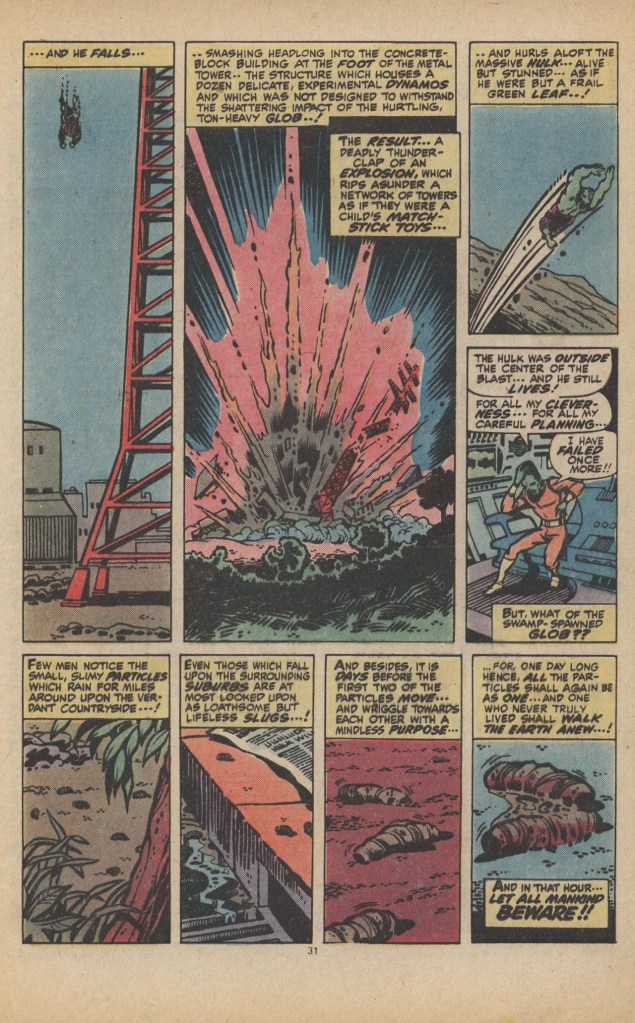
Eventually, though, the issue is out of pages. And so in an overstuffed sequence, the Hulk climbs a high tension power line tower, pursued by the Glob. the Hulk remembers electricity, though, and he tears away a power line, zapping the Glob with it. The muck-monster is jolted by the shock and falls into a nearby building containing several “experimental dynamos”. The place explodes, ending the Glob’s menace for the moment–though at the end, we see his scattered particles begin to draw closer to one another. For his part, the hulk simply leaps away once again, while the dopey Leader fumes that his intricate planning resulted in another zero. So it went for the Hulk in the 1970s.
 The Tom Brevoort Experience
As John Byrne once put it, how do you keep losing when you’re supposed to be as smart as the Hulk is strong?
The endless Hulk Smash! stories were tedious, even when executed well. Around this time it seemed like half the stories ended with the Hulk passing out and turning to Banner leaving his enemy walking by (“Huh, nobody here but some human wearing the same pants as the Hulk. Guess the green guy left.”). I know it wasn’t 50 percent of stories but it was too many.
LikeLike
From Crazy #65:
The Hulk squashes buildings like ants I’ll buy, but I do look askance At this fact alone:
That Bruce doesn’t own A pair of non-lavender pants.
LikeLike
I like Herb’s inks over his drawings. I think Perlin was a good inker. There’s gotta be examples of Don inking Herb, somewhere.
LikeLike
Perlin inked Trimpe on SUPER-VILLAIN TEAM-UP 5 and the cover to DEFENDERS 73, and finished Trimpe layouts on GHOST RIDER 60.
It looks fine. Not as good as Trimpe inking Trimpe, though, or as good as either Severin, Joe Staton, Dan Green or various others, but it’s fine, completely workable comics.
LikeLiked by 2 people
It could be the wave of Bigfoot and Swamp Ape sightings, building up around the hotspots.
LikeLiked by 1 person
What are the chances all or some of them either came across IT! or the Heap stories before they decided to create their own?
LikeLiked by 1 person
I personally feel it was both. A lot of people cresting their adult productive years at that time grew up on both Bigfoot folklore popularized in the press and with the pulps and 1940s comics. Airboy, The Heap, Theodore Sturgeon’s short story – this is a genuine example of Charles Fort’s “Steam Engine Time” or what is sometimes called the zeitgeist. It all boiled over to produce the swamp slobs of revered Bronze Age memory.
And of course when Man-Thing appeared his face was a dead ringer for The Heap.
How funny and weird.
LikeLiked by 1 person
I wonder why ( other than the Glob name ) Marvel chose to go with then new creation Man-Thing? I Googled IT! ( short story –Unknown of August 1940 volume 3, number 6 ) The story deals with a much-monster ( like the Glob & Man-Thing ) that emerges from a swamp, and terrorizes a family who lives nearby. The creature has no emotions, and is simply curious about things that it observes ( like Man-Thing ). Its terrifying strength allows it to grab animals and people and tear them apart, to see how they work ( this part sounds like Adam in Buffy the Vampire Slayer ). Ultimately, the creature is revealed to have formed around a human skeleton ( like Solomon Grundy ).
LikeLiked by 1 person
[ Captain America’s Weird Tales#74 ( October 1949 ) 3rd story – The Thing in the Swamp! ] John tells Townsless of his family curse: 100 years earlier his ancestor lured Peter into marshland and let him die in quicksand. Peter cursed John and his descendants to become the Marsh Monster, a hideous creature, once they turned 20. Soon after talking to Tomnsleee., John becomes 30 and transforms into the Marsh Monster. As he was the last Vandiver, Peter’s ghost is finally satisfied ( comics.org ).
LikeLiked by 1 person
Ordinarily, I’m a big proponent of “it must have been something going on in other media or the news,” but it’s possible that the inciting event of all these swamp monsters was the Glob. All it would take is for Len and Gerry (and Sol Brodsky) to have seen the Glob’s 1969 debut and thought it was cool, and consciously or unconsciously got the inspiration to do their own Heap-based characters. Len and Gerry were both probably aware if “It,” as well.
The Glob was consciously based on the Heap (Roy had wanted to call him The Shape, but Stan overruled him), so it all comes from the same place in the end. But it may be that Roy didn’t need an other-media inspiration, just a need for monsters — and the others all reacted to Roy.
LikeLiked by 1 person
As a guy who was 12 at the beginning of the Marvel Age of Comics, I grew up reading and re-reading the Balantine Books Mad when it was a comic book reprint paperbacks. Those books included a satire of the Inner Sanctum radio show, Outer Sanctum, and not only satirized the radio show but included a lampoon of the old Heap comics. Golden Age strips began being reprinted in the 70’s and that’s when I got where the inspiration for Mad’s Heap satire came from. I suspect I was not alone. So I blame Harvey Kurtzman and Will Elder for the 70’s muck monster craze.
LikeLike
“Outer Sanctum” was published in 1953, though, so it wouldn’t explain why there was a sudden burst of swamp monster-i-tude starting 16 years later.
It got reprinted a few times, but we know Roy was directly inspired by the Heap, not MAD, because he said so. There are things Roy said I don’t believe, but when he says he was inspired by comics he read as a kid, I’m plenty willing to believe that, since it happened over and over.
So it’s possible to assume that Roy was inspired by the Heap, and everyone else who came up with swamp monsters in the next three years were all inspired by reprints from MAD Magazine…but since Roy plotted the first Man-Thing story it seems unlikely in that case, at least. And Len was keeping up on Marvel, since he was a Marvel fan and was picking up work there, so it’s unlikely he wouldn’t have been reading HULK in 1969.
It’s certainly possible that any or all of them could have been reading MAD reprints (or even had the original comics). But that HULK issue seems like a more obvious proximate cause.
LikeLike
‘It’ got reprinted a *lot* Here’s its isfdb entry:
https://www.isfdb.org/cgi-bin/title.cgi?41269
LikeLike
Alien space craft courtesy of George Pal’s, “War of the Worlds”.
LikeLike
We can rule out a connection with “Sigmund and the Sea Monsters” (from 1973), whose inspiration came “when Sid Krofft spotted some sea life among the kelp on a San Diego beach.”
https://www.saturdaymorningsforever.com/2023/10/sigmund-and-sea-monsters.html
LikeLike