


I was only a casual buyer of BRAVE AND THE BOLD, the long-running Batman team-up title. And that’s really down to the scripting work of Bob Haney more than anything else. Haney had a different perspective on super hero stories than I did as a young reader, he was interested in different things. And so his stories always struck my sensibilities as being weird or off in some inexplicable fashion. So I would buy B & B from time to time, but it was also an easy series to drop whenever funds got tight. But an issue like this one, featuring my favorite super hero The Flash, I was going to pick up regardless. And it’s a very different sort of story than you were likely to find in the Scarlet Speedster’s own comic at this point,
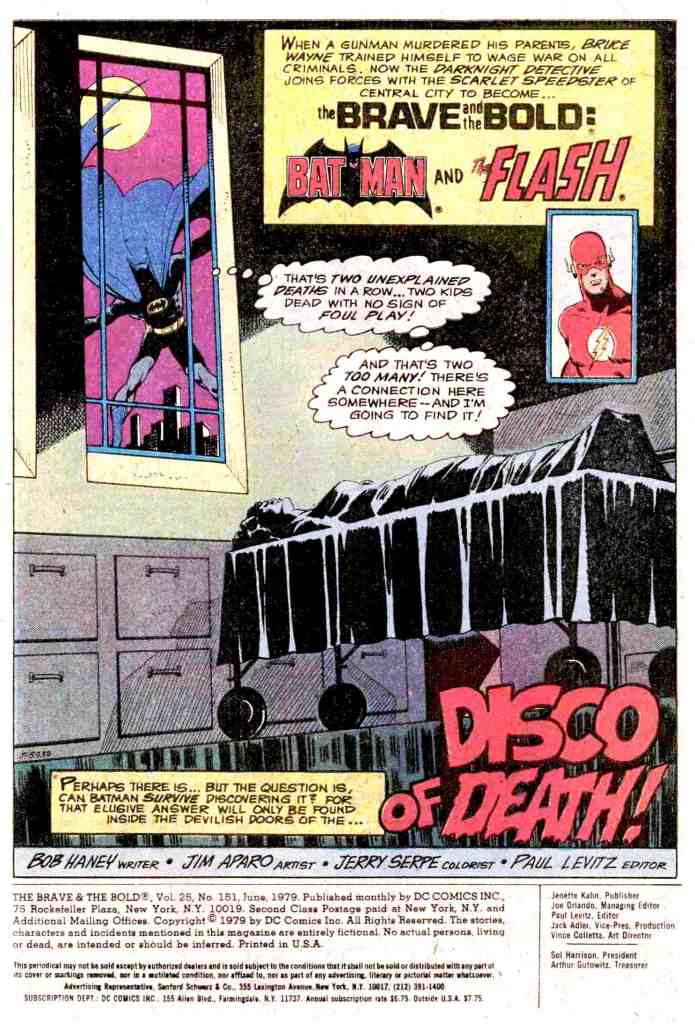
Editor Paul Levitz, who cared a lot more about continuity than Haney did, attempted during this period to get Bob to color within the lines a bit more consistently, but his efforts were hit-or-miss. And so long as the book continued to sell well (it was consistently the best-selling batman title throughout the 1970s) there was only so much that anybody was going to mess with it. After all, it would be easier than you think to fix the series right into the ground. One element of the book’s success had to be the attractive artwork of Jim Aparo, who was a mainstay of the series throughout the decade. No matter who might be guest-starring, Aparo was always able to make them both look good and to make them fit into Batman’s world.
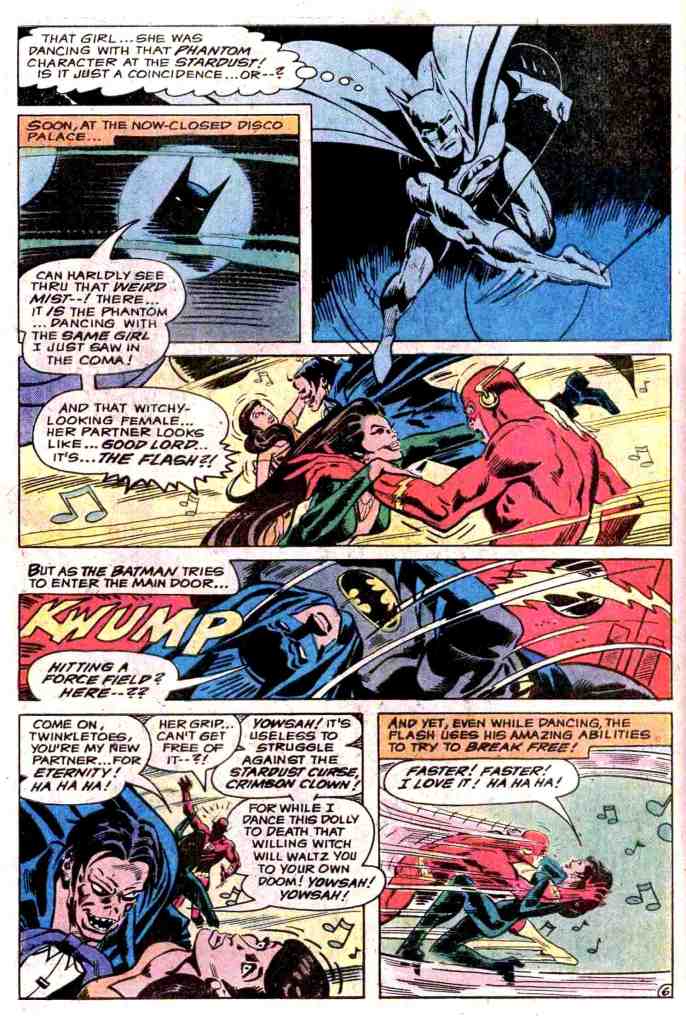
Story-wise, this is a very 1970s style tale. it opens with Batman investigating the mysterious deaths of two young patrons of the Stardust Ballroom, a hip Studio 54-style disco in Gotham City. The two victims expired under mysterious circumstances, and Batman can’t make heads or tails of it. So for some reason, he chooses to invite Barry and Iris Allen to come to Gotham City as his guests, and along with Bruce Wayne’s date Rhonda, the foursome heads out to the Stardust Ballroom for a night of dancing and covert poking around. One of the attractions of the place is the Phantom of the Stardust, a creepy figure who shows up, dances with a patron for a while, then vanishes mysteriously. The Phantom is the connection point–all of the women with whom he has danced have lapsed into comas and perished. You’d think that this connection would have been enough to get the Gotham PD to question the Phantom, but no such luck. So it’s up to the Caped Crusader.
While Batman investigates the latest victim to have fallen comatose, the Flash has gone back to the Starlight after hours, only to find himself trapped in a death-dance with the Phantom’s female partner–who will later turn out to have been his first victim. Batman gets back to the Disco and sees this all playing out through the window, but a force-field prevents him from entering. Fortunately, the Flash is able to escape in a manner that doesn’t really make any sense, even with his super-speed: he leaves behind an after-image of himself which taps his dance partner on the shoulder as if to cut in for the dance. When she turns to grab onto the newcomer, he fades away, having been only an after-image, and the Flash is free. This doesn’t work at all, but it’s a Haney world, so there’s nothing to do but roll with it. Anyway, the Flash vibrates himself out of the building a links back up with Batman outside.
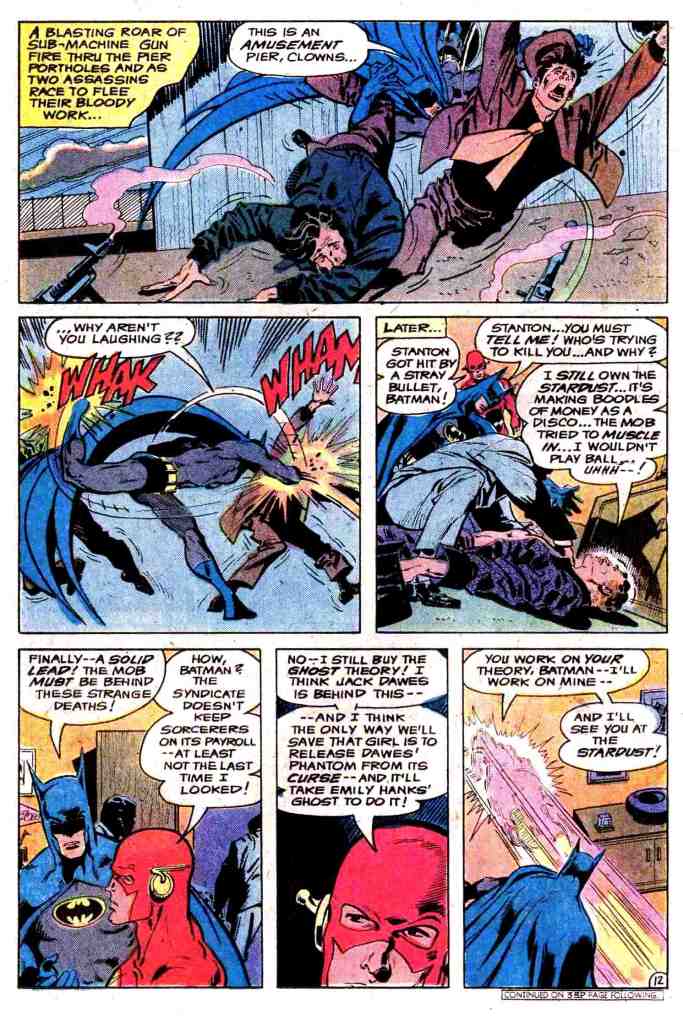
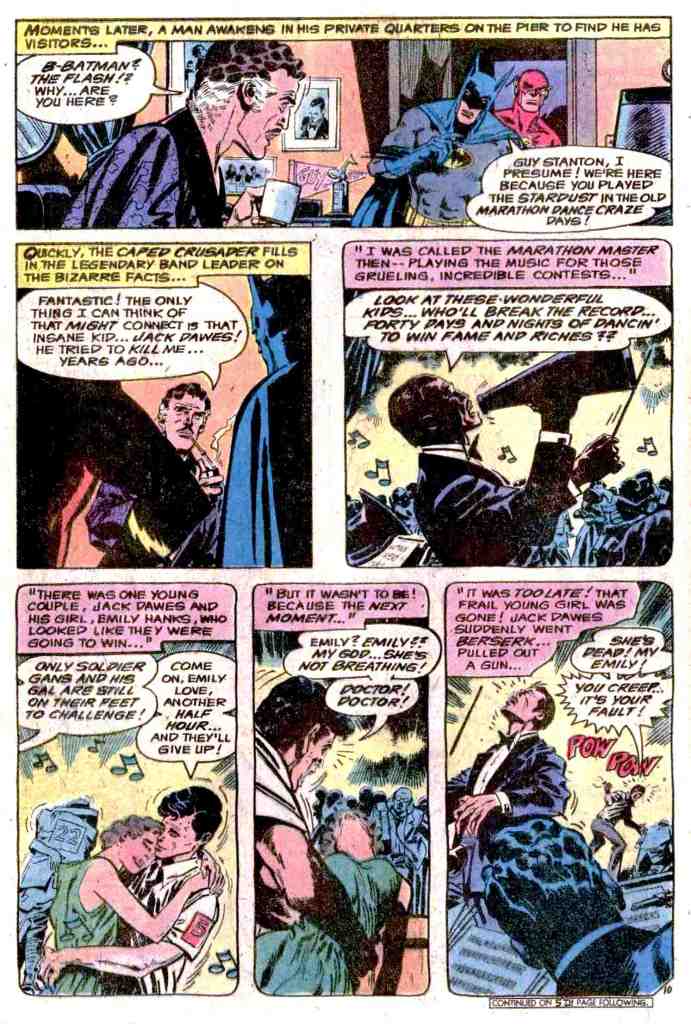
The two heroes combine their efforts at working out what is going on at the Disco, as they have only a few hours to save the Phantom’s latest comatose victim before she too expires. They seek out Guy Stanton, an old big band leader who played the Starlight back in the days of marathon dancing. he tells them the story of Jack Dawes, who had attempted to win a marathon dance contest with his girlfriend Emily Hanks. But the stress of prolonged dancing caused Emily to die right there on the dance floor in Dawes’ arms, and he subsequently tried to shoot Stanton, holding him somehow responsible for Hanks’ demise. But at that point, gunsels working for the Mob show up to try to kill Stanton as he wouldn’t pay them a cut of the proceeds he’s raking in from the Starlight Disco. Despite both Flash and Batman being present, they’re successful in cutting down Stanton. So now, Batman figures that the Mob is behind the series of strange deaths, whereas the Flash is convinced that it must somehow be the angry spirit of Jack Dawes.
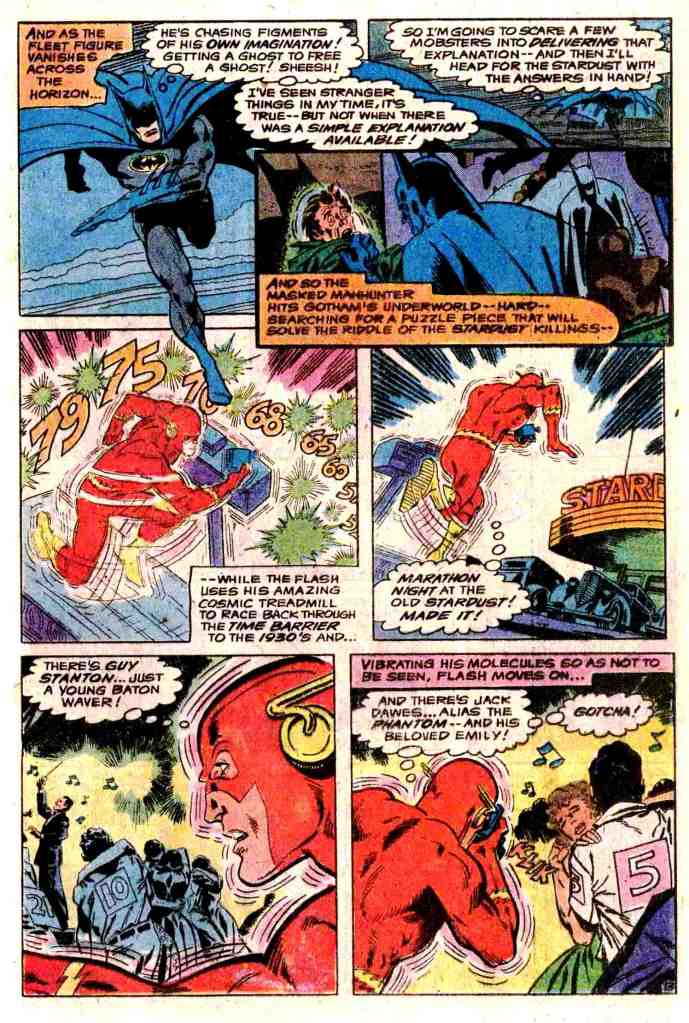
If you feel as though this plot has gone wildly off the rails, you are far from alone. Anyway, while batman thinks to himself how delusional the Scarlet Speedster must be to believe in ghosts, despite having teamed up with Deadman multiple times in this series, the Flash zips off to his Cosmic Treadmill and goes back into the past to the night of Emily’s death. Rather than stepping in and preventing her needless death, he instead ghoulishly takes a Polaroid snapshot of her, so that he can rig up a hologram of her in the present that can implore Dawes’ spirit to relent. Batman, meanwhile, has corralled the whole of the Simpson Gang who were behind the hit on Stanton, but has found nothing to link them to the deaths at the Starlight. So he’s forced to concede that maybe the Flash has a point.
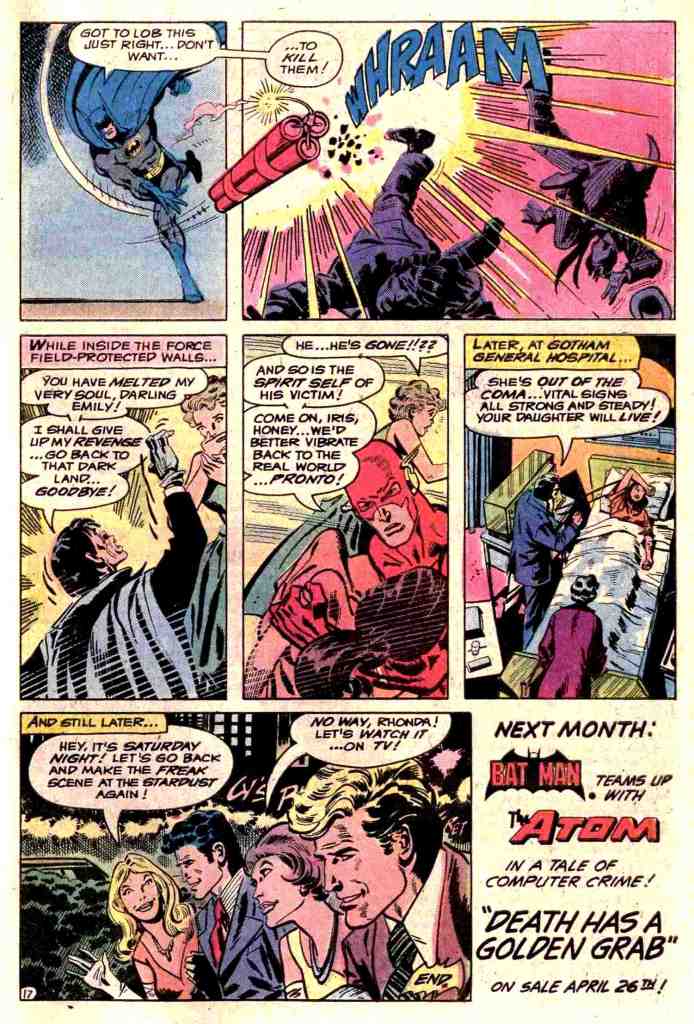
Rather than a hologram, Batman suggests that they make up Iris Allen to look like Emily Hanks and fool the spirit of Dawes. So the Flash vibrates both himself and Iris into the still-sealed Disco. Outside, though, so that he has something to contribute to the climax, Batman discovers the last of Simpson’s men planting explosives to destroy the Disco if they can’t profit from it. The Masked Manhunter is able to accomplish this in about two panels, and inside the place, the spirit of Dawes fades away, having given up his quest for vengeance. No explanation whatsoever is given for how he’s manifested so many decades after his death nor why his revenge took the form of killing other girls in the same manner that his girlfriend perished. But, hey, the final victim wakes up and is still alive, so that’s a win as far as this story is concerned. The entire story is a real mess, even by Haney standards, and doesn’t hold up to the slightest bit of scrutiny. But it looked good, and it was memorable in just how slipshod it all was, so that’s not nothing.
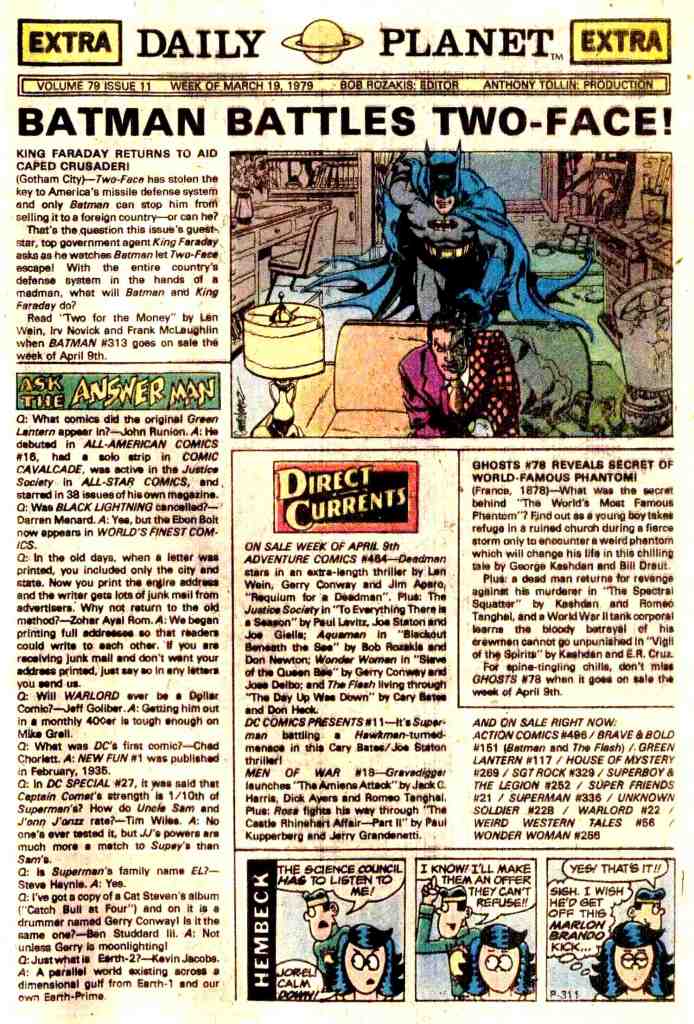
In addition to the letters page, this issue also includes the latest edition of the weekly Daily Planet plug page, spotlighting the books that would be arriving in a week’s time. As usual, it also included Bob Rozakis’ fun Answer Man column and another dippy comic strip by cartoonist Fred Hembeck–this one referencing the fact that Marlon Brando would be playing Superman’s father Jor-El in the upcoming SUPERMAN THE MOVIE.
 The Tom Brevoort Experience
Aparo’s the artist I most associated with Batman in the 1970’s. And I agree he made just about every character he drew look good back then. Wonder Woman might be the one exception, for me. But Jim’s art was still at peak potency up until the early 80’s. Late 70’s was prime Aparo time.
He’d have done a fine run on the Flash’s solo series. A lean, not overly muscular figure who looks believable as a superhero speedster. (As believable as it could be. 😉 ) He was a great storyteller. He drew great facial expressions. He’d have drawn some fine versions of Flash’s Rogues, too.
His Aquaman’s still in my top 4, after those by Reis, Newton, and Hamilton.
As we’ve said elsewhere before, Aparo would’ve drawn a fun Spidey run. Cap and likely the FF, too.
LikeLike
Jack Dawes killing other women in imitation of his girlfriend Emily Hanks only makes sense if he is trapped in the same kind of loop as the Sunnydale High teacher and student ( who had an a tragic affair in the past – James killing Grace ) [ Buffy the Vampire Slayer – Season 2 – episode 19 – ” I Only Have Eyes for You” — loop was only able to end because Grace possessed Angelus ( Angel ) and James possessed Buffy who shot Angelus who could survive being shot and was able to stop James/Buffy from suicide by forgiving him ]. As for why The Flash didn’t save Emily Hanks in the past, because of the need to keep the timeline intact ( See decades later Flashpoint ).
LikeLiked by 1 person
I wouldn’t reference Flashpoint as an example of time travel logic. How does restoring the timeline where Barry’s mother was alive result in a distopian world that hadn’t happened when she was alive originally?
LikeLike
I couldn’t on the fly think of or remember a better DC example, but I guess the TV series Timeless is a better example of butterflies. Or maybe the Crisis on Infinite Earths is an example since the Kryptonian Supergirl was erased as a result of changed timelines ( not to forget Wonder Women getting removed as a founding member of the Justice League of America or getting rid of the inspiration for the Legion of Super Heroes — Superboy ( Kal-El as a teen ) ).
LikeLiked by 2 people
Maybe this story was operating under time-travel rules where the past can’t be changed, only observed.
In general, it wouldn’t be the worst excuse for a team-up if Batman asked a fellow-leaguer who is a police scientist for an assist in finding the cause of mysterious deaths.
LikeLike
I was one of the readers who knew Haney was bug effing nuts when it came to continuity and logic but still loved his stories. I’m far from the only one because it was the loss of Haney and bringing the book into a more ‘acceptable’ continuity that wound up killing it. All these years later and I still want a maxi-series set on Earth-Haney.
LikeLiked by 1 person
You can usually tell what movies Haney has been watching — here he seems to draw from the 1969 film “They Shoot Horses, Don’t They?”, which also features a Depression-era dance marathon that ends in death.
How many comics did disco-themed stories? They seemed to be all the rage for a hot minute. Gathering them all in a trade paperback would be an interesting cultural snapshot of the era. Get John Travolta to write the intro!
LikeLiked by 2 people
“The Disco of Death!” Talk about irony…
Marvel had a bunch of these. I remember the Thing doing the John Travolta pose in an issue of Marvel Two-in-One, and then there’s the whole thing with the (Disco) Dazzler. (I guess she’s more like Taylor Swift now.) They did a bunch of disco / Dazzler tribute variants last year, but of course those were done through the lens of nostalgia (and maybe a bit of self-mocking humor).
LikeLike
Not long ago I reread the MTIO disco-story, with the goony title “Discos and Dungeons,” and all I remember is that it teamed Thing and Angel against some forgettable menace. I haven’t read the Batman/Flash story in a long time but it’s got to be better than that one.
LikeLike
“[The Brave and the Bold] was consistently the best-selling Batman title throughout the 1970s.”
Not according to DC. Here are the average issue sales per Statement of Ownership filings:
1969-1970: Batman–293,897; Brave and the Bold–211,266; Detective Comics–209,630.
1970-1971: Batman–244,488; Brave and the Bold–210,708; Detective Comics–199,112.
1971-1972: Batman–185,283; Brave and the Bold–179,819; Detective Comics–158,638.
1972-1973: Batman–200,574; Brave and the Bold–190,047; Detective Comics–153,942.
1973-1974: Batman–193,323; Brave and the Bold–191,722; Detective Comics–145,832.
1974-1975: Brave and the Bold–160,000; Batman–154,000; Detective Comics–146,000.
1975-1976: Batman–178,000; Brave and the Bold–153,000; Detective Comics–148,000.
1976-1977: Batman–150,853; Brave and the Bold–150,191; Detective Comics–126,143.
1977-1978: Detective Comics–129,901; Batman–125.421; Brave and the Bold–121,668.
1978-1979: Batman–166,640; Brave and the Bold–153,034; Detective Comics–79,872.
1979-1980: Batman–129,299; Brave and the Bold–109,397; Detective Comics–64,672.
The Brave and the Bold was the top-seller one year, but Detective Comics (during the Englehart/Rogers run) also had a year as the top-seller. Otherwise, the eponymous Batman title reigned. That said, The Brave and the Bold was competitive with the eponymous Batman title in terms of sales during most of the decade. Perhaps that’s where the misunderstanding comes from.
LikeLiked by 1 person
Haney seemed to see The Flash as more of a supernatural hero than Schwartz’s writers did except on are occasions (Broome’s Doorway to the Unknown or The Bride Cast Two Shadows or Bates’s The Fastest Man Dead.
LikeLiked by 1 person
Only Bob Haney would decide to do a story about a disco and immediately make it about stuff modern kids didn’t care about, but he remembered from his youth (and the movie THEY SHOOT HORSES, DON’T THEY?). Maybe Paul suggested a disco, since they were trendy at the time, and this is what Haney came back with?
Anyway, here in 2025, that cover copy builds up to such a goofy denouement that when I read it I just said, “For fuck’s sake, Haney!” Though I will admit that (a) Haney didn’t write the cover copy and it would have played differently then.
I had started buying B&B regularly when the Human Target backups started, but I must have quit again by this point, because I did not get this issue.
LikeLiked by 1 person
Hmmm. In a “For Mature Readers” labelled version, I wonder who’d say, “For fuck’s sake, Batman!”, first; Gordon or the B&B guest hero? 😉
LikeLike
Decades ago, I heard some talk (probably nonsense) of a Batman 1966 adaptation with Bill Murray and Eddie Murphy. The joke was that Murphy’s Robin would exclaim, “Holy fuck, Batman!”
LikeLiked by 1 person
@Bei Dawei I’m glad it didn’t happen.
LikeLike
Like you, I was hit or miss with the Brave and the Bold back then. It really depended on who the co-star was for that issue. And this issue was either a miss or I don’t remember reading it.
LikeLiked by 1 person
My Brave and the Bold history was spotty around this period, but I was a little young to be choosing runs on titles, or really following creators closely. Aparo was so distinctive I recognized his art though I wasn’t a huge fan as a kid, (similar to Swan & Infantino). I acknowledge the steady style and workmanship now, but it didn’t grab me then.
I did like the team-up books because “more heroes”! And the Flash was a favorite. But I barely followed the recap of the story here. I’m sure I would have been lost back in 79.
LikeLike
“After all, it would be easier than you think to fix the series right into the ground.” Truer words were never spoken.
I imagine Batman’s comment that Maxie Zeus could pull off a stunt like this reflects Paul Levitz’ push for continuity.
While I agree it’s a mess, Batman’s “it could be supernatural, but let’s assume it’s a scam first” works as an attitude (as opposed to stories where Batman insists the supernatural can’t be real).
LikeLike
“While I agree it’s a mess, Batman’s ‘it could be supernatural, but let’s assume it’s a scam first” works as an attitude (as opposed to stories where Batman insists the supernatural can’t be real).
That’s sort of like, “When you hear the sound of hooves, think horses, not zebras.” The old TV show House had fun with that a few times.)
LikeLike
just dont let Xatanna hear him say that. 🙂
LikeLike