

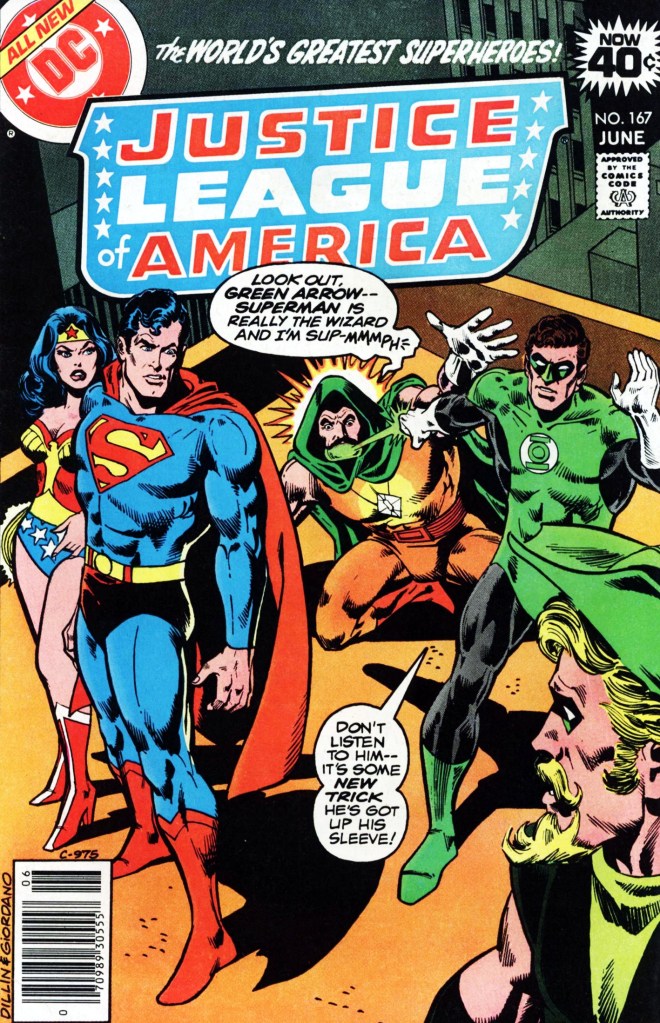
The change in JUSTICE LEAGUE OF AMERICA wasn’t quite so pronounced as what I was experiencing over on THE FLASH, but it was there as well if one were to look for it–which I didn’t at the age of twelve. As with FLASH, the book had moved into the hands of a new editor, its first new editor ever, Ross Andru, and that meant that the steady plot-based construction of outgoing editor Julie Schwartz weren’t the book’s typical mode of operation any longer. Still, the fact that penciler Dick Dillin remained as the series artist meant that those changes were masked a bit more than on FLASH, where the artist switchover only accentuated how differently the stories were behaving.
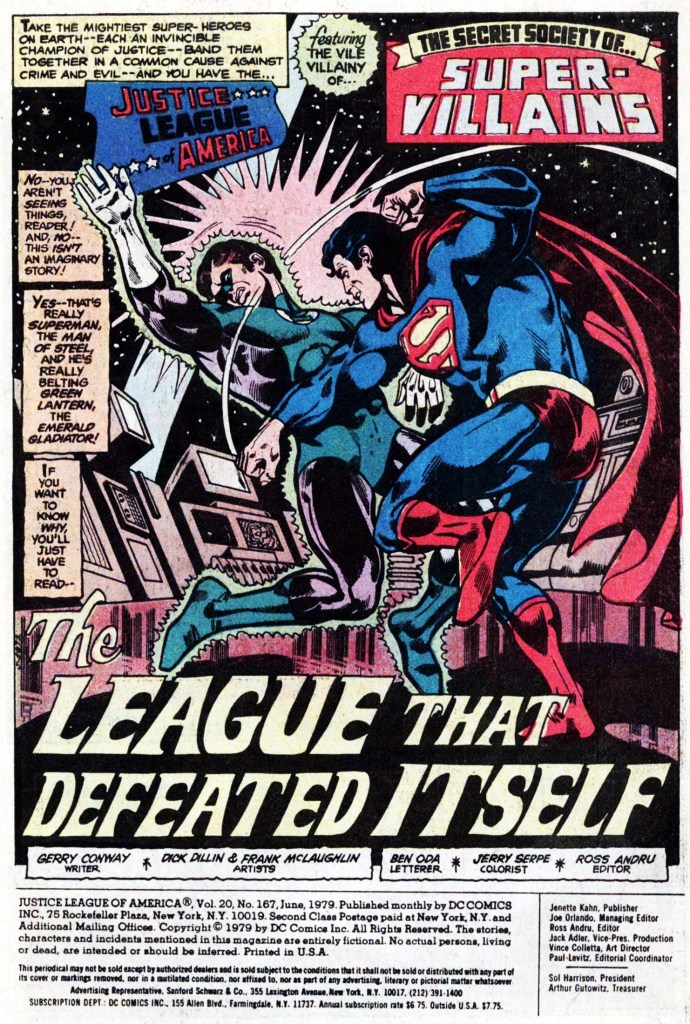
This three-part adventure, of which this was the second chapter, was exciting to me as a young reader, primarily because it picked up on story threads left over from one of my favorite demised series, SECRET SOCIETY OF SUPER-VILLAINS. I had loved that book, uneven as it was, and I was forelorn that it had been discontinued. So having writer Gerry Conway bring in the Society as a foe for the League was a success in my eyes. If nothing else, it was more of what I wanted out of the title than Schwartz’s last couple of efforts had been. So I was down for this three-parter in a big way. Another person who was similarly on board was future author Brad Meltzer, who would use the events of this story as the basis for his own later series IDENTITY CRISIS.
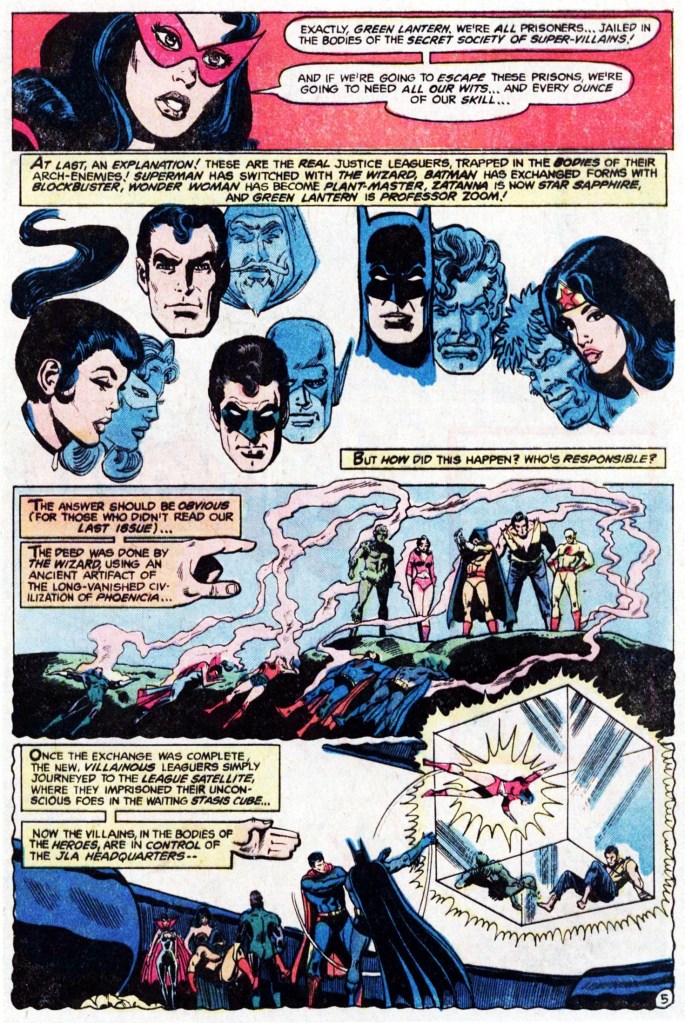
As is handily recapped for us a few pages in, having escaped from Earth-2 where they had failed to destroy the Justice Society, the Secret Society members had returned to Earth-1, where they used the Wizard’s sorcery to trade bodies with their foes in the Justice League. This included a swapping of powers as well, including those powers that functioned through equipment such as Star Sapphire’s gem or Professor Zoom’s speed-granting costume. Let’s assume that the Society members weren’t thinking straight after being reincarnated in the bodies of their foes, because they imprison the villain-looking Leaguers within their own holding cell, power devices and all. Sloppy, Wizard. But I guess when a guy finds himself suddenly in the body of Superman, he feels pretty bulletproof.
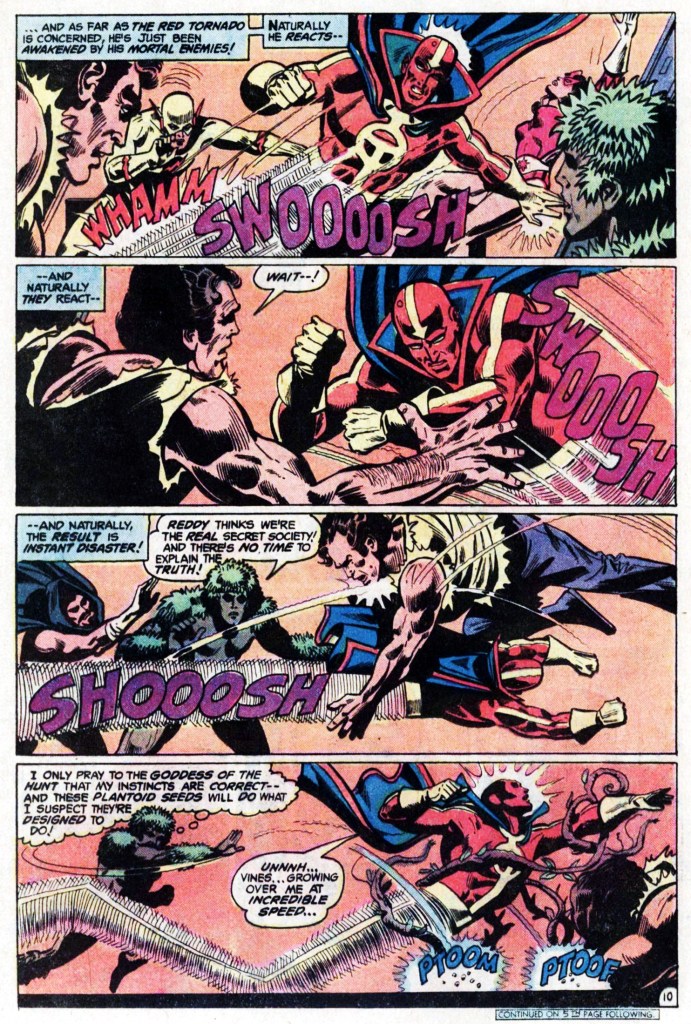
Anyway, as the Villain-League departs the JLA satellite in order to work out how best to use their new powers and appearances to effect, the Bodyswapped Leaguers work n tandem to escape their prison cell. Having done so, they quickly locate the deactivated body of their android teammate, the Red Tornado, and work to get him back online. Unfortunately, once Reddy awakens, he identifies those responsible as villains and moves to attack them. The heroes in villain mufti have no choice but to fight back to defend themselves, practically rendering their efforts to repair Reddy pointless.
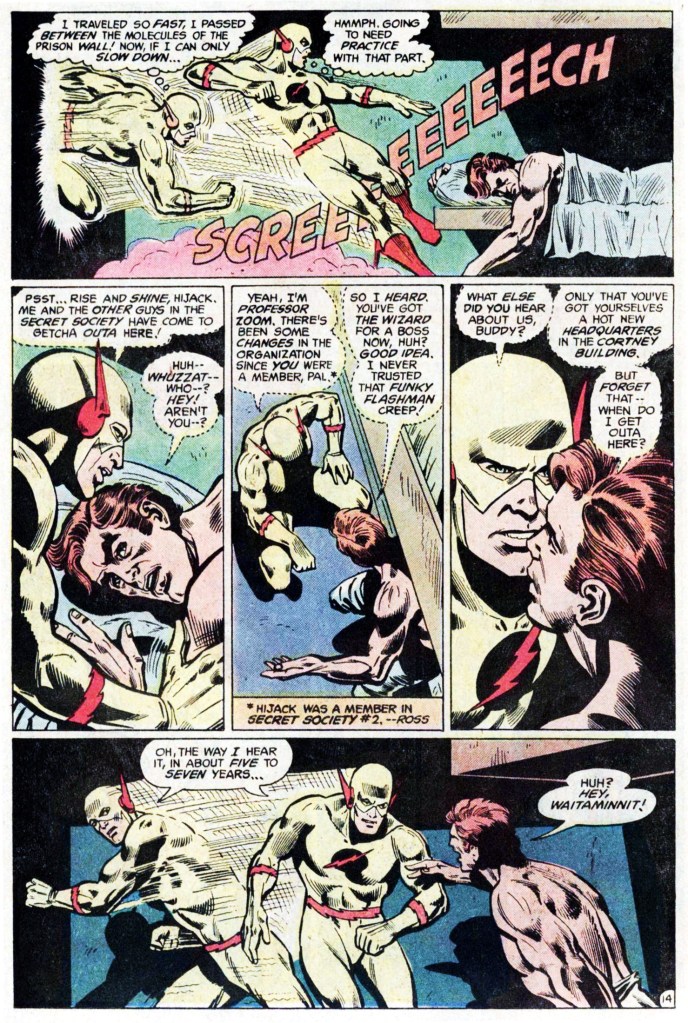
Realizing that they’ll need to capture the villains who’ve made off with their bodies in order to reverse the transference spell, the League members set out to locate the Secret Society. Green Lantern in the body of the Reverse-Flash races to a nearby prison in which Hijack, a former member of that criminal organization, is imprisoned. Entering Hijack’s cell, Hal Jordan pumps him for information while he promises to help liberate him–then leaves a bewildered Hijack behind when he makes his own escape, having learned the location of the Society’s headquarters.
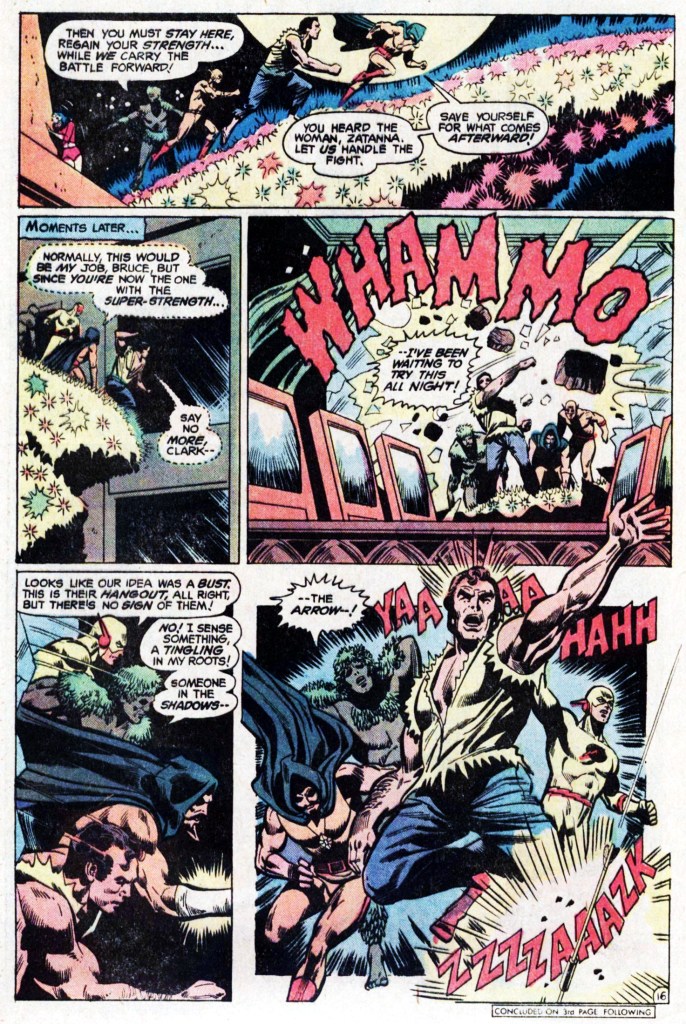
So the heroes head for the Cortney Building hoping to catch their foes by surprise. Zatanna in Star sapphire’s body is able to conjure the team an access bridge to the skyscraper, but the effort wipes her out so she is left behind by the others. This turns out to be a good thing, in as soon as they set foot in the Society’s headquarters, the rest of the team is smashed into unconsciousness by a shock arrow launched at them by Green Arrow.
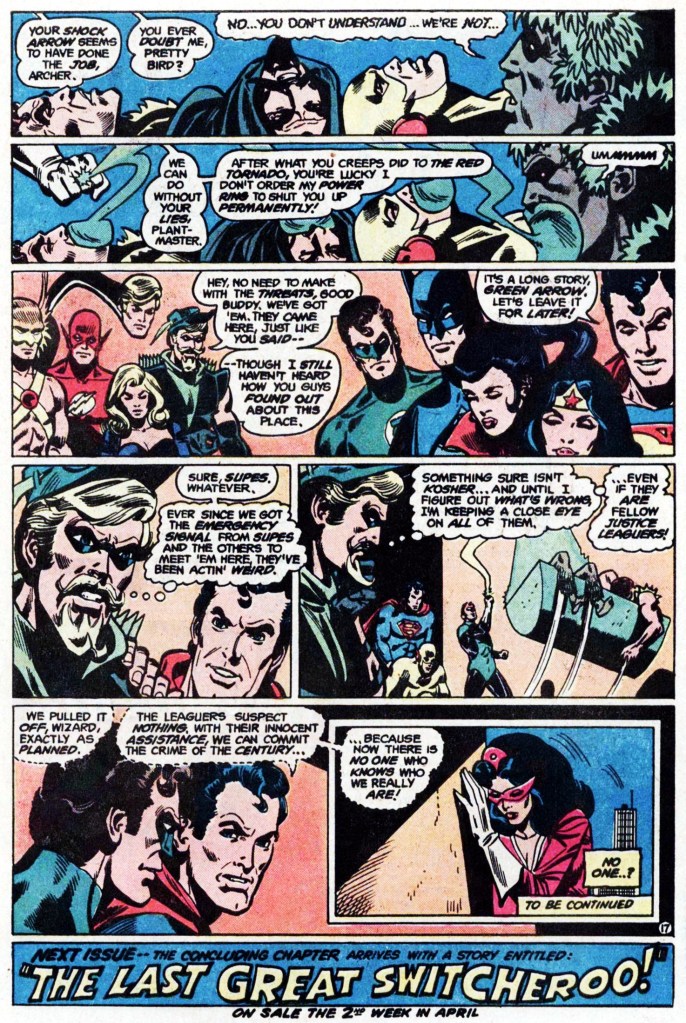
And as the issue draws to a close, we see that the body-swapped Leaguers have been recaptured by the rest of the League–including the five villains-in-heroes’-clothing. Green Arrow’s suspicions are raised, however, by the disguised villains’ behavior. It isn’t enough to get him to act on it, but it is enough to make him start paying attention to their behavior. Left to their own, the Wizard and Professor Zoom speak about how they’ll be able to use the duped League members to help them pull off the crime of the century. And elsewhere, the still-at-liberty Zatanna seems to be the captured heroes’ only hope to turn the situation around. To Be Continued!
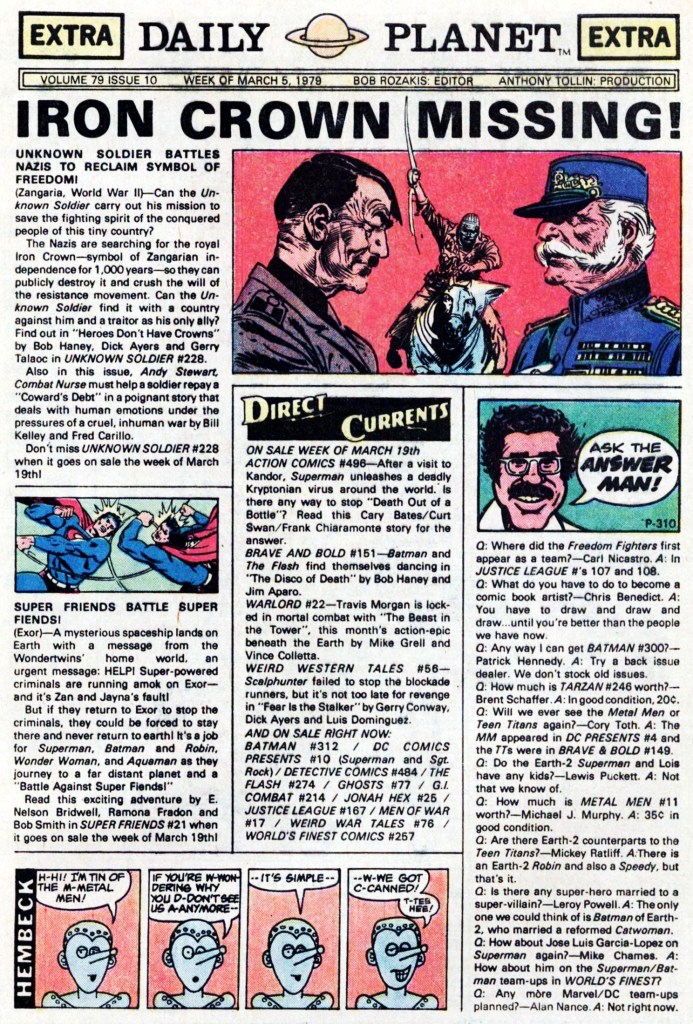
In addition to the standard JLA Mail Room letters page, this issue also carried another installment of the weekly daily Planet plug sheet, which promoted the comic books that would be showing up on Newsstands in a week’s time. As usual, it included another dopey little comic strip by fan cartoonist Fred Hembeck and another of Bob Rozakis’ Answer Man columns in which he responded to assorted questions put to him.
 The Tom Brevoort Experience
I Loved the SSoSV as well, much more than I ever had other villain teams, even the Legion of Doom. The latter had a set membership and the Society rotated its cast, created new villains, and introduced me to my favorite third string DC hero, Captain Comet. I preferred it even the bastardization of Secret Six, which purported to be a villain team but came off more as antiheroes or mercenaries.
LikeLike
The “Freaky Friday” body-swap plot is always a fun time. One of my favorite JLA stories is #61’s “Operation: Jail the Justice League”, and Mark Waid and co. later did an enjoyable riff on it in the SILVER AGE miniseries.
It was definitely nice to see the Secret Society again. Like Tom, I’ve got a soft spot for the team, even though the concept was usually better than the execution. The callback to Hi-Jack’s brief membership was a nice little easter egg.
LikeLike
The body-swap was done in Star Trek ( “Turnabout Intruder” – Season 3 Episode 24 – June 3, 1969 a woman switches bodies with Captain Kirk and then tries to take over command of the Enterprise ) first then Freaky Friday ( 1976 ). But the Star Trek and Buffy the Vampire Slayer ( “This Year’s Girl” & “Who Are You?” – February 22 & 29, 2000 – Season 4 Episodes 15-16 Faith switching bodies with Buffy ) have more in common with the Justice League 3-Parter because of the stakes involved ( Plus I have found it scary when it happens even though I know they will get their bodies back ). A Mother & Daughter switching bodies doesn’t exactly endanger anyone unless one of them is dying.
LikeLike
Body swaps on film predate Star Trek. In fact that episode was named for ‘Turnabout’ (1940) featuring another male/female swap.
LikeLike
I Googled the film Turnabout ( based on the 1931 novel of the same name by Thorne Smith ) and Rob Hansen left out that there was an Indian Idol the couple ( Tim & Sally Willows ) had that they nicknamed Mr. Ram granted their wish to switch places — so I wonder if the 3 part Justice League story involving a Griffin statue was inspired by the movie or book. Marvel Mystery Comics#9 ( July 1940 ) Angel story -The Mad Doctor of Carlburg ( in Europe ) created a device to swap the minds of humans with that of large apes( marvel.fandom.com ) — wonder if this was inspired ( mind swapping ) by the film or book.
LikeLike
The novel Turnabout (which became a short-lived TV series with Sharon Gless and John Schuck) is more in the Freaky Friday zone of “walk a mile in that other person’s shoes” than threats — though having read it last year, it’s also heavy on satirizing suburban lifestyles and morals, something Thorne Smith loved to take pot-shots at. Not his best work but he’s almost always fun.
LikeLike
I remember that, it came during the period when Fred Silverman was trying (unsuccessfully . . . and . . . . it seemed increasingly desperately) to reaped his success at keeping (CBS) or making (ABC) a Network #1,
Sharon Gless and John Schuck were both solid performers and deserved better . . . but at least it was not Pink Lady & Jeff.
LikeLike
My first JLA ! I love everything about this issue but I’m biased.
LikeLike
This was a book that could have used an artistic shakeup, too — and Dillin was an artist who seemed, like Sekowsky, to be more energetic and effective on solo books than when he had to draw an army of heroes all the time. Which is ironic, because BLACKHAWK and JLA were the bulk of his career.
Maybe Dillin should have done FLASH and someone else should have taken over on JLA…
LikeLike
Unfortunately, Dick Dillin only had about a year left at the time this was published.
And, in addition to JLA and Blackhawks, he also drew a Team-up Book (World’s Finest) for about 6 years . . . .
Also, a lot of the solo hero work he did involved another hero who often guest-starred: Atom (often with Hqwkman); and Green Arrow (often guest-staring Black Canary).
But, he might have been good on The Flash.
LikeLike
A year of Dillin FLASH might have been just the thing, since it’d have made a break from Novick with a more assured artist — and it’d have give JLA a jolt, too, though I don’t know who’d have taken over. Who knows, JLA being available might have brought George Pérez over sooner, since the chance to do JLA was one of the strong inducements that pulled him to DC.
And yeah, Dillin did a fair number of duo stories — but two heroes still leave a lot more room on the page to work with than seven or eight (or more).
LikeLike
I wouldn’t have minded Dillin on Wonder Woman. I always liked his take on Diana.
LikeLike
I had forgotten that Conway revealed that Hijack “got better” after apparently getting shunted off into limbo by someone or other. I get the impression no one ever bothered to invite this jack-of-no-trades to later iterations of the Royal Flush Gang, though I could be wrong. I definitely liked the re-design of the Wizard’s outfit from his Golden Age magician’s tux and top hat. One of the few bits of Gerry Conway dialogue that I liked came from SSOSV, where Grodd talks the other villains into joining the Society out of “enlightened self interest.”
LikeLike
The Wizard was put back in his original outfit in America vs. the Justice Society#2-3 ( February-March 1985 ) and Crisis on Infinite Earths#12 ( March 1986 ).
LikeLike
And I don’t think any of the later Royal Flush Gang gatherings invited him back. Somehow I doubt he brought much to the table.
That’s a great line, agreed, though my memory was the Manhunter clone delivered it.
LikeLike
a shame this story is now linked with identity crisis.
LikeLiked by 1 person
In some alternate universe, Brad Meltzer simply wrote a straightforwardly entertaining sequel to this JLA body-swap story — ‘Identity Crisis’ would still be a fine title — instead of the exploitative and misogynist claptrap we actually got.
LikeLike
Sometimes I feel like the only person out here who liked Identity Crisis. I could have done without Slade’s implausible fight with the League but considering what Jean went through immediately before her wedding and then her uncharacteristic infidelity, her madness made perfect sense to me.
LikeLike
I know there are a number Atlas Age stories with body-swapping using either technology or magic, but was the first super-villain to super-hero body-swapping by Doctor Doom with Mr. Fantastic [ Fantastic Four#10 ( January 1963 ) ]?
LikeLike
Joining in the fondness for SSOV. While changing creative teams and directions was a common problem in Bronze Age books, it didn’t bother me here — it seemed to fit that a gang of supervillains had adventures going in random directions.
LikeLike
“Dopey”. Tsk.
LikeLike
A fun story that was ruined for me forever by Identity Crisis.
LikeLike
I wondered if there was another Pre-Crisis story with a body-swap plot and accidently found one this week — [ DC Comics Presents#81 ( May 1985 ) Superman & Ambush Bug vs. Kobra ] While golfing Ambush Bug finds a red stone that he takes to jeweler to turn into a necklace to give to Superman as an apology gift. He teleports to the Fortress of Solitude and once in range of Superman the Red Kryptonite cause the 2 to switch bodies.
LikeLike
Another Body-Swap: Jimmy Olsen with a gorilla [ Superman’s Pal Jimmy Olsen#24 ( October 1957 ) 2nd story “The Gorilla Reporter” – comics.org ].
LikeLike