

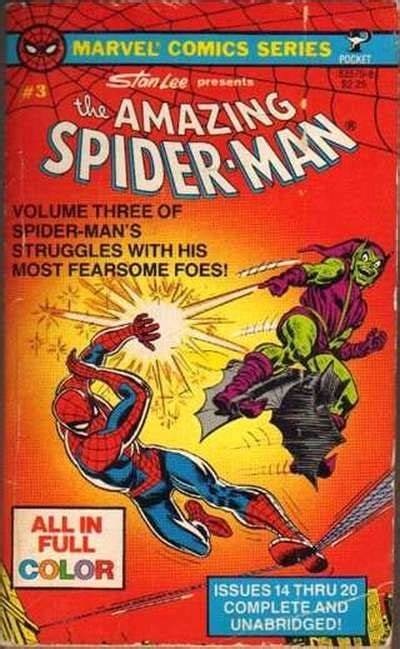
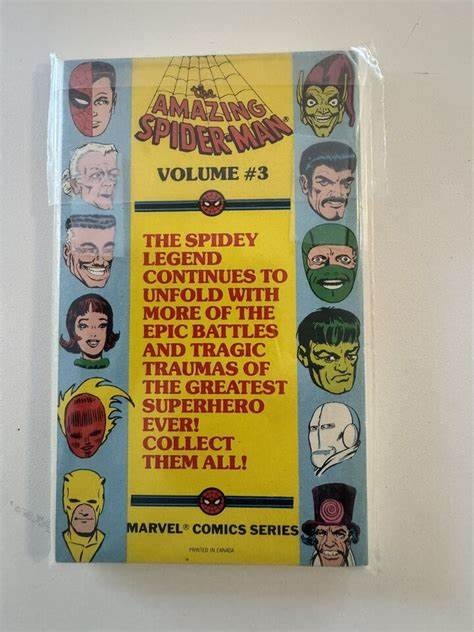
As a kid, I didn’t really have any way to get information about what new comic books and related publications would be coming out when. I was dimly aware of fanzines, but I never tried to purchase any on the regular–my meager funds were needed to buy actual comics, after all. So I had no idea that the Pocket Books series of paperback-sized collections of early AMAZING SPIDER-MAN stories would be continuing into a third volume until I saw said volume on a shelf in the bookstore during a shopping visit. I’m pretty certain that I talked my Mom into laying out the required $2.25 for it, a feat that I was getting better at managing.

This volume continued the run of AMAZING SPIDER-MAN sequentially, containing the stories originally published in issues #14-20. Due to the limited page count, however, the covers to those issues weren’t included, so I was puzzled by the note on the splash page indicating that the Hulk would be along before long. Not having seen the cover, I had no idea that he’d be showing up in that story. Missing from this collection with the first AMAZING SPIDER-MAN ANNUAL, but its events are recapped in part in issue #18. This just frustrated me as a reader, though. I felt as though something important had been left out.
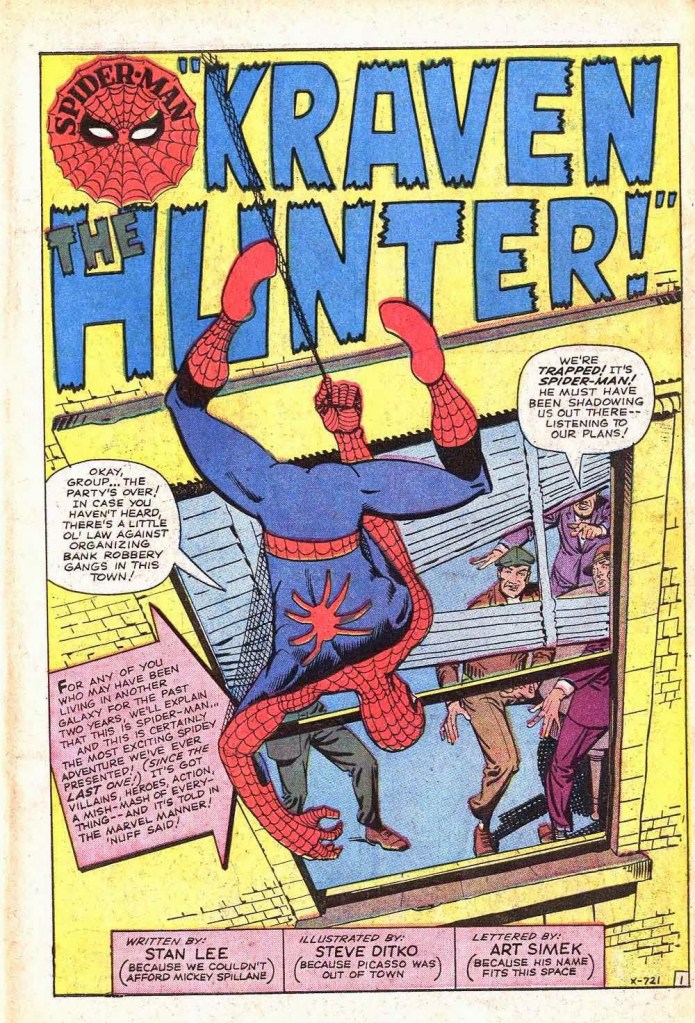
By this point, Stan Lee and Steve Ditko had shook out all of the false starts and boondoggles of the earliest issues of the series and were confidently crafting new adventures for the teenaged wall-crawler. Ditko became a more prominent force in the plotting of every issue (though he wouldn’t overtly get credited for it until issue #25, beyond the scope of this volume.) The storytelling is confident, and even at the relatively tiny size of this paperback volume it was clear that Ditko’s artwork was growing more polished and dynamic as well. He’d found a good groove that incorporated the elements of everyday discordance that had typified his suspense story work with a confidence in depicting frantic action. His Spider-Man moved and fought like no other character in comics at that time.
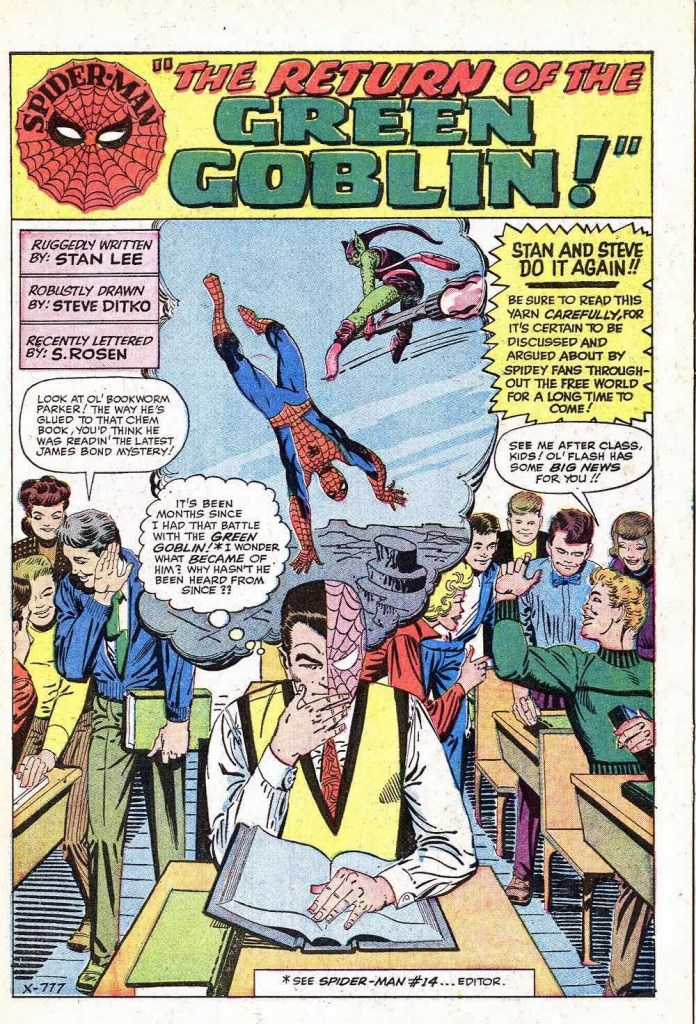
Ditko and Lee also continued to introduce new foes for Spider-Man issue after issue, building up a rogue’s gallery of enemies that was just about the best one in the field. In this volume alone, we meet the Green Goblin (whose true identity is kept a mystery–a mystery that doesn’t even have any real viable suspects this early on), Kraven the Hunter and the Scorpion. The team balanced that by bringing back established foes as well, including this time out the Enforcers (twice!), the Chameleon, the Ringmaster and his Circus of Crime (from an INCREDIBLE HULK appearance) and the Sandman.

The soap opera elements of the strip continued to evolve as well during this run. Having definitively paired off Peter Parker and Daily Bugle publisher J. Jonah Jameson’s secretary Betty Brant, Lee and Ditko introduce a new complication: Liz Allen, Peter’s classmate who earlier wanted nothing to do with him, has come around after Peter did something foolish and heroic in an earlier issue, and pursues him at full tilt, much to the consternation of bully Flash Thompson–to say nothing of Betty herself. This triangle, while it never quite became an Archie-Betty-Veronica thing (because Peter pretty much never evidences any interest in Liz) helped to keep things interesting and provide for humorous complications in Spider-Man’s civilian life. Additionally, Jameson himself begins to take on a broader role as a foil for Parker in both his costumed and civilian identities. In Ditko’s hands, Jameson is a full-on caricature; venal, petty, self-aggrandizing, manipulative, egotistical, weasley, opinionated and just plain funny. It’s really no wonder he became so popular as a figure readers loved to hate.
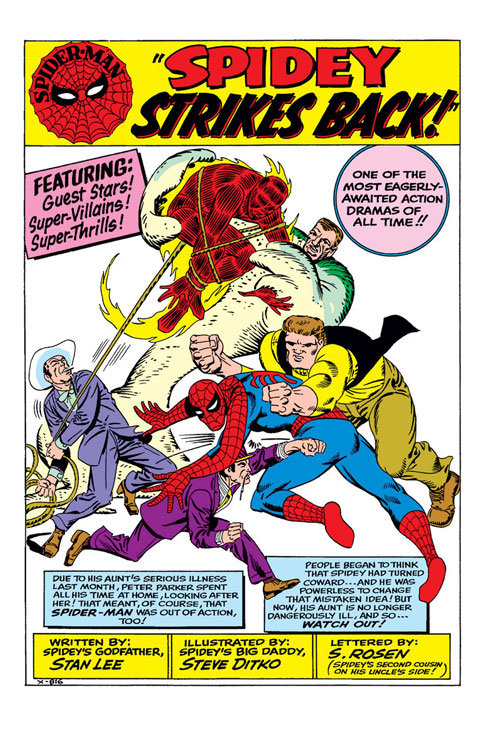
This volume also includes a famous sequence that shifted the direction of not just this series but in a way of Marvel’s output as a whole. Lee and Ditko has been experimenting with serialized storylines in their Hulk strip in TALES TO ASTONISH, and here they produce the book’s first true multi-part adventure–one that hinges upon personal drama more than super hero conflict. In the middle of a pitched battle with the Green Goblin, Spider-Man learns that his Aunt May has suffered a near-fatal heart attack and he rushes to her side, appearing to all assembled as a coward. For the entirety of the next issue, Peter refrains from going into action, fearful that he could get hurt and leave his Aunt with nobody to look after her. Jameson, meanwhile, is in his ascent, making hay out of the wall-crawler’s seeming cowardice. It’s only when Aunt May herself gives Peter a pep speech about showing gumption that he gets back on the horse and vows to redeem himself as Spider-Man, tackling the Sandman whom he’d also earlier run from. On the letters page, Stan indicated that the story plot was entirely Ditko’s–he seems like he wasn’t confident that this would work, and so he was surprised by the positive reaction to the story, and it pushed him to do more things like it going forward.

This was the Spider-Man that I loved, the Spider-Man that wasn’t much in evidence in the current titles, where he’d mostly gotten his life together and become quasi-cool and confident. So I ate these stories up with a spoon, and they only made me love the character more. Unfortunately, this would be the final volume in the AMAZING SPIDER-MAN Pocket Books library. I’m guessing that while the initial volumes performed well, the later ones that focused on later issues didn’t have quite teh same sales draw, and so the line wound up discontinued. Again, without any way to get news about such things, I was oblivious to its fate, and so I haunted our assorted local booksellers hoping to find the nonexistent Volume 4 there at some point.
 The Tom Brevoort Experience
had all of the Spidey and FF MM PB as a kid.
LikeLiked by 1 person
These books were an excellent introduction to the Ditko-Lee Spider-Man, even though I was only able to get the second one. It certainly set the stage for me becoming a reader of Marvel Tales a few years later, when Marvel began reprinting the Ditko-Lee issues from the beginning.
LikeLiked by 2 people
While this format worked so well for comic strips, I was not a fan of it for comic books, even as the only option.
LikeLike
There has never been and may never be a better picture of JJJ than on that splash page. I referred to it all the time in my scripts.
LikeLike
Even as a teenager, I thought these books were reduced to just too darn small to be satisfying reading.I can understand why they were stuck with it, and I bought them when I saw them, but I didn’t like the format. When I went to England for a semester of college, I found their small-sized Marvel reprints, and liked them much better.
Still, these were the books that exposed me to a Spider-Man I found much more compelling than the one in the regular monthlies, and hooked me as a fan.
LikeLike
Got all three of these miniature collections at the Navy Exchange at NAS Lemoore, CA, in the late ’70s and other than the reprint of the very first Spider-Man story from Amazing Fantasy in Origins of Marvel Comics and reprints in Giant-Size Super-Heroes of the villains gallery and the humorous take on Lee & Ditko co-creating an issue of Spider-Man from the first Annual, this was my first broad exposure to Ditko-era ASM (and fortunately, my teen-aged eye-sight was a lot better than my 60-something eyesight! Even with my glasses on, I can barely make out the tiny print anymore. But anyhow, they were fun reads and I began to have a greater appreciation for Ditko’s talents as an artist and story teller. Previously, from the few samplings of his Spidey & Dr. Strange work and a variety of his weird/suspense/horror tales from the very early Marvel era, his style seemed very odd to me, with strange faces, gestures, etc. And at least up through ASM #33, Ditko’s story-telling skills kept getting better, but even with those first few stories, I could easily tell why Amazing Spider-Man took comicdom by storm in 1963. IMO, it’s only real rival in that era was the Lee-Kirby Fantastic Four, wherein Kirby likewise was creating ever more spectacular stories (of course, I know Kirby had over 20 years of experience even before he knocked out Fantastic Four #1).
LikeLike
I bought all three Spiderman volumes, Doctor Strange, Hulk, and Captain America new off the stands at the Woolco Department store. As a kid I don’t recall being bothered by the size because it was so many comic pages for a pretty low price. I was a somewhat tepid Spiderman fan in the 70’s, but these books made me a fan of the Ditko Spider-man… and Ditko as well.
Compared to other Marvel books of that era I think Spider-man found his storytelling legs pretty quickly. New elements are added after the origin but they happen way more organically than in the FF and other titles. Ditko does so many novel things throughout… it’s a shame he didn’t last longer….though the 38 issues plus origin, and 2 annuals we got are all pretty great.
I shared them with my kids when they were growing up as well. I didn’t need reading glasses to read them 15 years ago but I do now.
LikeLike