

It was clear early on that the most important and successful new super hero character introduced during the Silver Age of Comics was Spider-Man. The work that Stan Lee, Steve Ditko and John Romita had put into the series had paid dividends, and the wall-crawler was soon a worldwide icon able to stand shoulder-to-shoulder against more established characters such as Superman, Batman and Wonder Woman. And of course, what that meant is that those that followed attempted more than once to create their own characters cast in the image of the web-slinger in some manner. Typically, this meant making the lead hero a teenager beset by real-world problems who operated in a more grounded reality than the average costumed crime-fighter. None of these characters would quite reach the heights scaled by Peter Parker, though. Here then are Five Attempts to Replicate Spider-Man

1) ROBIN: With the demise of the BATMAN television program, something had to be done to combat the Caped Crusader’s flagging sales fortunes. Accordingly, editor Julie Schwartz began to overhaul the series, casting Batman more as a creature of the night as he’d been originally, and doing away with the colorful costumed villains of the era. Also excised was Robin, who severed his partnership with his mentor when he went off to attend Hudson University. But this didn’t mean that Robin was going to stop being a super hero, he carried on his double life while in college in the manner of Spider-Man. Unfortunately for the now-Teen Wonder, his stories lacked the existential angst and soap opera dramatics of the web-spinner, being devoted to Robin solving mysterious crimes and contending with lots of run-of-the-mill criminals. He never quite felt like a grown up adventurer as Spider-Man did, despite his many victories, and his somewhat-colorless girlfriend Lori Elton lacked the iconic staying power of a Gwen Stacy or a Mary Jane Watson. So he never quite achieved the staying power to be a lead character on his own, at least not during this period.

2) THE DESTRUCTOR: Atlas Comics was former Marvel owner Martin Goodman’s attempt to knock off his own former company, so it’s no surprise that one of his initial releases was intended to be the firm’s answer to the popular Spider-Man. The Destructor was cast to be the opposite of Peter Parker: Jay Hunter was a small-time teenaged hood whose scientist father had perfected a serum that would give a man the ability to heal from any injury. When his father was gunned down by criminals out to get his invention, Jay risked his life to save him–and was seriously injured in teh process. With his dying breath, his father gave him the healing formula which allowed Jay to survive his wounds. Dedicating himself to the destruction of the sorts of criminals who had wronged his family, Hunter became the destructor, using his underworld connections to clean up on crime. The Destructor was created by Archie Goodwin and Spider-Man’s co-creator Steve Ditko, but even their great talents couldn’t lift the character up out of the mess that was Atlas Comics’ shlock-oriented publishing strategy.
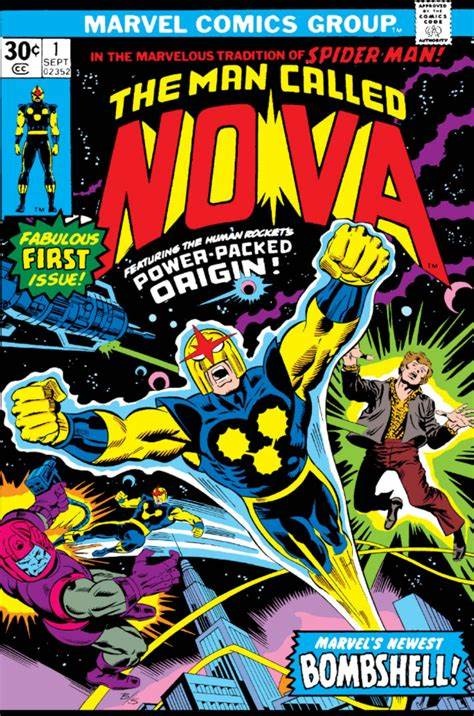
3) NOVA: Based in part on a character he had created during his days as a fan, Nova was writer Marv Wolfman’s attempt to construct the kind of series that Spider-Man had been at its outset, one dedicated to super hero daring-do and fun. Teenager Richard Rider wasn’t a picked-on genius like Peter Parker, though he had his own tormentor in the person of Mike Burley. he was otherwise a thoroughly unspectacular kid, albeit one who felt a bit like he belonged to an earlier age. Nevertheless, when he was struck by a power beam from space, he was gifted the abilities of a Xandarian Nova Centurion and began a career as a super hero. Despite some solid artwork from John Buscema and Sal Buscema, Nova’s adventures never quite rose above being pedestrian, and his life as Rich Rider was a bit generic and lifeless as well, not possessing the driving tragedy that lay at the center of Spider-Man’s persona. His series ran its course after 25 issues though he’s been brought back time and again for another go-around in the years since then.

4) FIRESTORM: The creation of writer Gerry Conway, who had been Stan Lee’s replacement on AMAZING SPIDER-MAN years before, Firestorm was Gerry’s attempt to give rival DC Comics a viable young Spider-Manlike hero of their own. Gerry chose to reverse the Spider-Man formula, making his lead character jock Ronald Raymond, who was teased and tormented by the class intellect, Cliff Carmichael. (This was a serious miscalculation in my book, as the relationship between Raymond and Carmichael didn’t reflect a single thing that I saw in my day-to-day school like.) Ronnie winds up getting caught in an accident at a nuclear power plant along with Professor Raymond Stein, and the pair are fused together to form Firestorm, the Nuclear Man. Raymond is the lead, with Professor Stein unaware of their double identity until they combine and acting as a wizened mentor figure when they are. But the DC Implosion put an abrupt end to Firestorm’s burgeoning career. He got another change half a decade later when market conditions had improved, but by that time the novelty of the character had worn off and he was just another solid B-list super hero.

5) SPEEDBALL: Originally conceived as a property for the ill-fated New Universe, Speedball (initially called The Blue Bouncer) was the brainchild of Marvel editor in chief Tom DeFalco, who hoped to capture some of the magic of the early Spider-Man with the character. He debuted in an AMAZING SPIDER_MAN ANNUAL and then was spun off into his own series, where former Spidey writer Roger Stern and Spidey co-creator Steve Ditko crafted his adventures, often two to an issue. Teenager Robbie Baldwin’s life was changed when he was caught in a scientific experiment that endowed him with a kinetic field that allowed him to ricochet around from surface to surface and which materialized a costume that concealed his true identity. Living in the one town in Connecticut where super heroes had been outlawed, Baldwin haphazardly used his abilities to become teh Masked Marvel and protect the citizens from crime and crazy villains. In his civilian life, he was stuck between his law-loving father and his artist mother. He was also somewhat limited by the viewpoint of Ditko, who preferred his heroes without flaws or hang-ups. To say nothing of sharing a name with a prominent drug cocktail.
 The Tom Brevoort Experience
The only one of those I ever collected or read was Nova. I got the 1st issue while my family was on a cross-country trip from San Francisco to the small town of Mineola, Texas, east of Dallas, where my mother’s sister, my Aunt Connie lived and my cousin David was getting married. Somewhere along the way, we stopped at a gas station/diner/convenience store, which had a batch of comics and I got a few, including Nova #1. Yeah, I could tell right away it was an attempted knock off of Spider-Man, and I believe author Marv Wolfman even admitted as much in the his introductory editorial. Still, it was a reasonably fun read, even if Richard Rider made for a rather boring character. But it was different in that Rich was living with two parents and a kid brother, who just happened to be a techno genius akin to a Junior Reed Richards. And eventually, Richard’s family found out about his alter ego. So at least Marv tried to do things a bit differently than Lee & Ditko and I think it had some promise. But like most of Marvel’s (and DC’s) efforts to try out new concepts and characters on the marketplace in the mid to late ’70s, it eventually fizzled out. The (not quite) All New, All Different X-Men was one of the few with mostly new characters to really take off. And, of course, Marvel also launched yet another title starring Spider-Man in 1976 that did pretty well but certainly wasn’t anything new.
LikeLike
I liked NOVA a lot, too, and I think Marv was building up a rogues gallery fairly nicely, though some more-distinctive character designs would have helped.
But I think bringing Carmine Infantino is as penciler pretty much killed the book. Marv was doing his best, bringing in villains from popular series and setting up crossovers with popular books — but Carmine’s work didn’t suit the book much at all, where it seemed to work better on SPIDER-WOMAN. With another artist, that whole FF-crossover the book was heading into when it died might have boosted it to a more-secure sales level, but I just don’t think the average Marvel reader of the time wanted the Infantino version.
LikeLiked by 2 people
Yep. When Infantino started working for Marvel, I knew practically nothing about him other than that he formally worked at DC. In other words, I didn’t know then that he had been one of their key artists for decades and had been promoted to publisher in the late ’60s and held that position until he was fired and wound up working at Marvel in desperation for decent paying work in the comics field. As with a few other old pro artists who started working at Marvel in the mid-to late ’70s, such as Frank Robbins and Lee Elias, I found Infantino’s art to be rather weird and didn’t particularly like it but didn’t dislike it enough to stop getting mags I otherwise enjoyed for the stories. I eventually came to appreciate Infantino’s style and sense of design, but I can understand other Marvelites in the ’70s being as aghast at the transition from even Sal Buscema to Infantino (or to Robbins over in Captain America & the Falcon). And apparently many of them didn’t stick with Nova.
LikeLike
It took me a while to get into Robbins, but once I did, I really did — and I was never chased off a book by him. Even during the times I would have been very critical of his work, I was always compelled by the storytelling, even if I didn’t understand what the artist was bringing to it.
And I liked Lee Elias on POWER MAN.
Infantino was absolutely fine on STAR WARS (where Archie Goodwin was doing rough layouts), and he seemed interested in the subject material on SPIDER-WOMAN, or at least it worked reasonably well with his style. He also seemed suited for Star-Lord, John Carter, an adaptation of the movie The Deep…he even did a couple of stories with characters like Iron Man and Dr. Strange that worked fine.
So maybe he needed to be handed SF, “realistic” movie stuff, exotic women and characters Don Heck and Steve Ditko were foundational to. But the more you got into the Kirby/Buscema brand of superheroes, the less he seemed to grok the approach. And he wasn’t suited to team books at all.
Maybe DC should have brought more alluring women with flowing clothing and hair into FLASH, given him the Huntress when Staton left and maybe a Creeper project. They did give him V. I wonder how he’d have done on SGT. ROCK or “O.S.S. Spies at War”?
LikeLiked by 1 person
Infantino on Huntress would’ve been great! I loved those early Batgirl stories he worked on. I wouldn’t have minded seeing him take over Warlord, after Mike Grell left. Or Green Arrow, for that matter (with Black Canary, natch).
LikeLike
I don’t know that Carmine on the post-Grell WARLORD or the Grell-written GREEN ARROW would have worked, but it’d have been interesting to see for an issue or two, at least.
LikeLiked by 1 person
Agreed on Carmine maybe being appropriate for a character like the Creeper. His later, eratz, angular, distorted faces & figures wouldn’t have have seemed as out of place on similarly fringy chatacters.
Metamorpho. Elongated Man. E-Man (another Joe Staton signature character, like the Huntress).Maybe even Blue Beetle. Black Orchid. The Demon (I’d want Klaus Janson’s inks, ideally).
And the stories would mostly need to be lighter in tone.
I know Tom gas said “no one is owed work”. But I think if an artist will such a great & industry significant career & impact is is still capable of good storytelling, is still dependable, & not a prick, then yeah, I’d FIND something to keep them from going destitute.
Back-up stories featuring the characters above. Or even teal B & C listers like Angel & the Ape. Detective Chimp. The Metal Men.
LikeLiked by 1 person
in the middle of NYC. What?
LikeLike
I was a big fan of Nova and The Destructor. The Destructor was especially interesting to me as his civilian identity was the polar opposite of Peter Parker. By his last issue, however, Archie Goodwin was no longer writing the series and the character got mixed up with an underground race of mutants which was far less interesting.
LikeLiked by 1 person
Robin had the staying power, but not the magnitude, to be a main character.
The Destructor was a head-on collision between the “street level superhero” comics Marvel started in the 1969s with Spider-Man and Daredevil and the Hardboiled “bad guy caper novels” Donald E. Westlake started with his Parker novels that evolved int paperback novels like The Executioner.
Heroes with limited, conceivable powers, evil bad guys living in any town USA, the big local business man selling dope to kids as “cash flow,” kinds of things. It had an attraction. Atlas did not last long enough for it to catch on and Goodwin, and Wood (if not Ditko, got out before the checks didn’t clear anymore.
It could have c aught on. The interesting thing is what does Jay Hunter learn from his crusade? That what separates him from “The Organization” is he cares about the by-standers (like his dad or the kids who OD, maybe. Maybe he learns, he can’t save the World . . . but he can do something for these people here.
There might have been something there . . . . ”
LikeLike
I never thought Julie Schwartz was trying to emulate Spider-Man in those Robin backup stories. That was just straight-up Schwartz stuff, without much of an attempt to make it interesting in any specific direction. No Flash Thompson-like antagonist, no JJJ-figure, no parade of interesting supervillains. Even Lori Elton was a de riguer romantic interest in the mold of Schwartzian romantic foils like Iris West, Carol Ferris, Jean Loring and crew, though much blander.
Years later, Chuck Dixon and collaborators would make another Robin much more like Spider-Man, and it was a fairly strong commercial success, for a while.
I didn’t think The Destructor was very Spider-Man-like, either. I’d argue that Archie was trying to create a pulp-inspired character, but I’m not sure he put all that much thought into it — DESTRUCTOR was craftsmanlike in the writing, but it read to me like Archie didn’t care, that he was doing a favor for someone. Every now and then he’d work on something that was…okay, but he was just servicing the interests of someone else (his SECRET AGENT CORRIGAN reads like this, too). DESTRUCTOR feels to me like a slapped-together mess of discordant cliches, and the energy it has comes from Ditko and Wood.
I knew a guy in college who wanted to be a comics writer, and one of the things I suggested to him was to pick a writer he admired and study their work, see what craft they could glean from it. So he wrote a sample that was based on how Archie wrote DESTRUCTOR. I told him that the idea was to emulate what the guy did best, not to pick their least-distinguished work and try to match that low bar.
Another Spidey type I’d throw in would be Darkhawk, who was described in the pitch as having something like, “…the ideals of Captain America, the angst of Spider-Man and the edge of Wolverine!”
And Neil Vokes’ and my NINJAK, was very consciously and deliberately meant to be evocative of Spider-Man, though we too gave our guy an intact and happy family inspired in part by Madeleine L’Engle’s Austin family in THE YOUNG UNICORNS, albeit with sisters with all of my sisters’ middle names…
LikeLiked by 2 people
I have always suspected that Goodwin’s base concept was “The Executioner with limited superpowers” fighting The Organization from Point Blank with enforcers with limited superpowers.”
He handled it professionally until something opened up at Marvel.
Given the nostalgia that exists for the Westlake stuff (Gibson’s Payback [1999, Statham’s Parker [2013]) something like this might have worked, particularly in the early 2000.
LikeLike
That description feels about right, along with some other pulp tropes pasted on to help the superpowers fit in.
I don’t think it’d have developed well with Ditko on it, since with Ditko (at that stage, at least) there was no such thing as moral relativity. And in the early 200s, he’d need a different costume, at least.
I keep thinking the Destructor would fit well enough into the New Universe, alongside various other series concepts Archie came up with at the last minute to get the line launched on schedule…
LikeLiked by 1 person
It might have , since it was more of a “work for hire” thing for Ditko, rather than something he was doing on his own.
LikeLike
Ditko refused to draw WFH stuff that he felt violated his sense of heroism.
LikeLiked by 1 person
Neil Vokes! Terrific artist. Cool guy.
“The Destructor” is just a flat out cool name.
Today I’d go with a darker costume color scheme. .But it was an imitation of the times, so…
LikeLike
They did in 1975, (with no explanation) with issue #3.. It went from Infantry Blue to Navy Blue.
LikeLiked by 1 person
I’ve never seen the cover of the first issue of Speedball before, and wow, what an odd choice to feature the title character with his back to the reader. I know he’d been cover featured on the Spider-Man Annual where he debuted, but still, there’s not much of anything there to persuade a reader to pick up this new book. The main hero is turned away and a bunch of unrecognizable villains. It makes me think that not even Steve Ditko or the book’s editor was very interested in Speedball. It’s a cover that screams “…Who cares?”
LikeLiked by 1 person
My introduction to Firestorm was in Justice League of America#192 ( July 1981 ) and Pat Broderick was the reason I picked up the The Fury of Firestorm#1 ( June 1982 ) and issues here and there; I liked the Firestorm too.
LikeLike
Cliff Carmichael teasing and tormenting Ronnie would have worked had the city Firestorm operated in was like the town of Eureka ( series name too; 2006 )–I looked that series. I like Speedball in the New Warriors series ( I do have his first appearance and the first issue of his series ) and off course the Human Rocket/The Man Called Nova ( originally suppose to be named The Star — a name a Timely Comics character was suppose to be named too ( see ad in Captain America Comics#1 ( March 1941 ) right before Hurricane’s story ) ).
LikeLike
I don’t know where my mind went, I meant I loved that series ( Eureka ).
LikeLike
Love Firestorm but sadly he never reached his potential under Conway. John Ostrander was much bolder when he took over. The iteration in V. 3 was bolder still.
LikeLiked by 2 people
The only thing I see in common between the solo Robins and the Spider-Man stories of the period was the attempt to spin some plots out of the campus setting. But Lee and the other Spider-writers used the campus setting sparingly, whereas it seemed that Dick Grayson had no real life beyond going to classes. He did have a slightly less boring girlfriend named Terri Bergstrom, who was a sometime psychic. But the psychic stuff was just meant to lead to a climax where Terri had to be released from some sort of demonic (psuedo-demonic?) force, and once that storyline was done, she was gone.
LikeLiked by 1 person
Just my opinion but I can’t even think of a Spider-Man imitation that was even an interesting failure. This stands in contrast to Golden Age Captain Marvel, who had a number of somewhat screwball imitators (Fatman, the Human Saucer Of course, none of those knockoffs exceeded the original– including what we’ve all seen of the rough spec story for Spidey’s silvery predecessor.
LikeLiked by 1 person
The Fury by Image comics for the 1963 series is a spider-man knockoff through and through… though given the nature of the series I don’t think the intentions were to replicate spider-man’s success as much as have a character that was recognizably a stand-in for Spider-man within a mini-series.
LikeLiked by 1 person
The whole 1963 “line” of comics were an homage to the Marvel books that year. They were done in that spirit. It was intentional.
LikeLike
Also, oddly, Daredevil and the notion of legacy characters broadly. I was one of the least successful executions of the 1963 concept in my opinion,
LikeLiked by 1 person
Tim’s comment that Infantino’s style was best for quirky concepts (which definitely included Spider-Woman) suggests to me that his “showy” style worked best for serials that emphasized “stylistic storytelling.” Even Silver Age Flash sometimes departed from DC’s version of “The Invisible Style” with things like those little hands emerging from the captions to guide the readers’ attention. I haven’t read any Firestorms in years (though I too liked the Ostrander run, in which he shed most of the Spidey-tropes as I recall). But it seems like the sort of series that benefits from the Invisible Style. I know Silver Age Ditko had his stylistic embellishments just like Silver Age Infantino, but I’d also argue Ditko was much stronger at basic storytelling that any reader could follow from panel to panel. Romita Sr also had the knack for strong storytelling with basic melodrama. Of course when you pair an artist who’s maybe getting too wrapped up in his style-tropes with a writer who’s just knocking out filler, you get– most of the Bates-Infantino FLASH.
LikeLiked by 1 person
I don’t think Bates was “knocking out filler” during his and Carmine’s period on FLASH.
Early on, he was doing some very nicely-crafted stories in a more classic mold — which I think his editors, Len Wein and Mike Barr, wanted, but as a reader I liked them quite a bit. And then under Ernie Colon and Cary’s own editorial aegis, he was enchanted by the TV series HILL STREET BLUES, and wanted to emulate that kind of storytelling, including the idea of doing a murder trial in “real time” (aka, slooooow). It didn’t work, partly because Carmine was ill-suited to that kind of story, but it wasn’t filler — it was a creative vision he committed to, however much someone should have told him not to.
LikeLiked by 1 person
Maybe Cary Bates was aiming for HILL STREET BLUES but what he produced was more like a more painful version of LAW AND ORDER. Oddly (from my POV only), he came closer to the HSB mark before there was a HSB in existence, when Bates worked with editor Ross Andru on the 1979-80 storyline I tend to denote as “The Death of Iris.” I don’t know how much of that continuity came from Andru, but that storyline was slightly ahead of the “grim and gritty” movement, in that “Death” mixed grotesque characters and some degree of police procedural work with the super-villains. But to be forthcoming, the only reason I even mentioned the late Infantino FLASH was because I was thinking to myself, “okay, I’m praising Infantino for his stylistic elements, and saying that they were better suited to quirky features– which Silver Age FLASH was, in a limited way– but I don’t get the sense that any of his later stylistic touches helped the Bronze Age FLASH.” My explanation was that neither Bates nor Infantino were doing their best work together. But everyone’s mileage varies.
LikeLiked by 1 person
I don’t think either of them was doing their best work, but I don’t think Bates was producing filler.
He was watching the industry turn away from what he’d been making a living doing, and he wanted to show that he could playin the new styles. Unfortunately, it’s hard to show you can be modern and edgy when you’re working with Julie Schwartz, Curt Swan, Kurt Schaffenberger and Carmine Infantino.
Bates wasn’t naturally a Schwartzian writer — he wanted to write James Bond. But he got early work from Weisinger, and when Julie took over the Super-books, he became a Schwartz workhorse, and then when the Schwartz approach faded out, Cary wanted to do other things, but was dependent on his steady assignments to keep making a living, and they were almost all coming from Julie. Except for FLASH, which he swung for the fences on, but was hampered by having an artist who was not interested (and perhaps not capable) of going after the mid-80s zeitgeist.
Later, Cary did V (with Carmine again) and CAPTAIN ATOM, which got good readers response and lasted a while. But the immediately pre-Crisis years must have been frustrating…
LikeLiked by 1 person
His True Believers from Marvel was amazing.
LikeLiked by 1 person
All I can add is that to me as a reader, the Trial story was filler because it felt cranked out. Maybe I would see something else in it if I reread it. But it was so unpleasant I’m not likely to do so.
LikeLike
I’m not saying you’d like it if you reread it. Or even that you’d like it if someone else drew it, though that’s more possible.
Just that “filler” is a description of purpose, not quality, and no matter how much you didn’t like it, Bates was engaged in doing something purposeful, not treading water. It didn’t work for you (and many, many other readers), but that’s not the same thing.
LikeLiked by 2 people
Bates’ Superman stories hold up, & still have some charm. Kurt said it well; hard to be edgy when working with longtime pros that started decades earlier.
Still, the Master Jailer & the Spellbinder issues were very tight & felt urgent. He also helped reinforce the illusion of Clark not resembling Superman, using a Daily Planet staff artist’s renderings
Not to sidetrack too far, but if most people living in the DCU never see Superman up close, if the comic book editors were thoughtful enough to never let him be photographed (Dan Jurgens put him on a friggin talk show for cryin out loud), the illusion at large would stick. The harder to art is Clark’s circle of friends who also interact with Superman… Lois &:Jimmy. Perry
Anyway, I can only imagine if someone like Don Newton had joined Cary on one of the Superman monthlies, it would’ve been a huge improvement, & maybe a sales success.
I really enjoyed Cary’s post Superman stuff on “Silverblade” & “Captain Atom”. “Captain Atom” #1 is one of my fave #1’s ever.
There’s also an issue of “DC Comics Presents” he wrote, drawn & colored by Klaus Janson, maybe the second or even final pairing in that series with Adam Strange. To me, it’s one of “the greatest Superman stories ever told”.
LikeLike
Yeah, Cary was (and I expect, still is), a terrific writer).
I’m not sure Cary ever was told that the Flash was being killed off, at least not before he’d finished the series. He was perfectly capable of writing an ending where Barry raced off to his heroic end rather than a “happy ever after” that would immediately be undone by others.
And I’d argue that while, maybe, “seems like filler” is a subjective judgement, “filler” isn’t — if the material was written to be something other than filler, it isn’t filler. And Cary was open about his purpose in the letter columns and in other public statements; I had never spoken to him at the time this stuff was coming out, and I didn’t enjoy the issues, but I knew what he was doing because he’d said so publicly and repeatedly. I just didn’t think it worked.
LikeLiked by 2 people
But a reader cannot know the author’s purpose unless he succeeds in communicating it. Thus even if “filler” is a subjective judgment, as I’ve already said, it’s justified in that the author appears to have been marking time with a pointless sequence.
LikeLike
He kinda was. Does anyone know when Bates was told Flash was being cancelled and if he knew Barry was being killed off? If he had a heads up there was no point but to time the end of the trial and Iris’s resurrection for the bitter end.
LikeLike
I feel like I was aware of that cancellation contingency at some point; whether it was before or after FLASH wound down, I cannot say.
LikeLike
Personally, Ditko’s stuff was more of a turn off than Infantino’s to me. While not a favorite, Infantino’s art never turned me off of a book. Ditko, with the exception of truly awful Legion work, would have me skip a book and I was a completist!
LikeLike
Though I totally get why his work (most notably his later work) would turn off readers and not be considered a good fit for a lot of material… I would often buy books I didn’t normally purchase if Ditko had worked on them. I think his approach to storytelling and various shorthand graphic techniques were very distinct and generally effective. It doesn’t speak to the quality as “good” or “bad” but only Ditko was ever Ditko, and he worked counter to an industry that became very visually homogenized in terms of rendering and how art conveyed information.
He was his own best inker and I tended not to prefer inkers that tried to “slick” him up to modern standards in the 80’s and beyond. Bill Reinhold and P. Craig Russell seemed to understand what made his work tick though. Dan Green was good fit as well. Wally Wood buried him a bit but the overall effect was still very appealing.
Different strokes!
LikeLiked by 2 people
I liked Infantino best on Batman, those daring covers, and the way he could add noir drama to the TV-inspired campy dynamic duo of the time, I was much less impressed by his silver age Flash, and simply could not stand his bronze-age return on the Scarlet Speedster. Never read him on the Firestorm, the only Firestorm story I remember was a backup/team-up in Flash drawn by George Pérez, and of course it was amazing.
I’ve always liked Cary Bates’s Flash, loved the Novick era, quite liked Saviuk, and even got to appreciate Don Heck in the end, but the Infantino phase just did not click, I just could not go past the art and “recognise” the characters, and that was a pity.
LikeLiked by 1 person
AT the time I blamed Infantino’s art for the cancellation. Later I realized they had kept him Scwartzian too long and Schwartz’s successors made the wrong editorial decisions. I never disliked any Bates story and finally saw Infantino’s art for how good it was in its bones when I was objective. Took me longer to appreciate Heck TBH but I now enjoy art he did that I didn’t at the time too.
LikeLiked by 1 person
I would prefer to believe that Bates was informed well in advance of The Flash’s fate and, sadly aware of the character’s lack of a future, simply chose the path of least resistance by dragging out the trial until the Crisis. I’d hate to think he did it because he thought the interminable storyline was engaging!
LikeLiked by 3 people
In the early days of Miles Morales, I remember telling people at my LCS at the time “There’s been a Black Spider-Man since the 90s. His name’s Static!” I found those early Milestone STATIC issues by Dwayne McDuffie, Robert Washington III and John Paul Leon to have a genuine classic Spidey feel. YMMV.
LikeLiked by 1 person
I remember the Milestone Static issues. They were okay, but I didn’t think they were great. I preferred Steve Ditko’s Static, an entirely different character and series.
LikeLike
I rather liked those Robin solo stories in the early 70s, especially the detective angle. I wasn’t aware of it at the time, but it did some like an attempt to capture the Robin solo series from Star Spangled comics much earlier, which really was a good series.
I talk about Speedball in the later article on Speedball, so I won’t repeat myself here.
I liked the original Firestorm. I can’t say I cared much for the high school cast like Carmichael, but Firestorm had an interesting premise with the shared personality, a cool costume, and some good villains to fight.
As for Nova, I got the last few issues before cancellation, and it was fun with all the guest characters and going into space. They could have continued that as an sf series. I picked up some back issues, but like Firestorm, I didn’t really care for the high school cast. I liked Carmine Infantino’s 70s artwork, and that wasn’t what put me off the earlier Nova issues.
I’ve read The Destructor, but even now, I still don’t know what to make of it. It was just one of those things that happened! 😉
LikeLike