

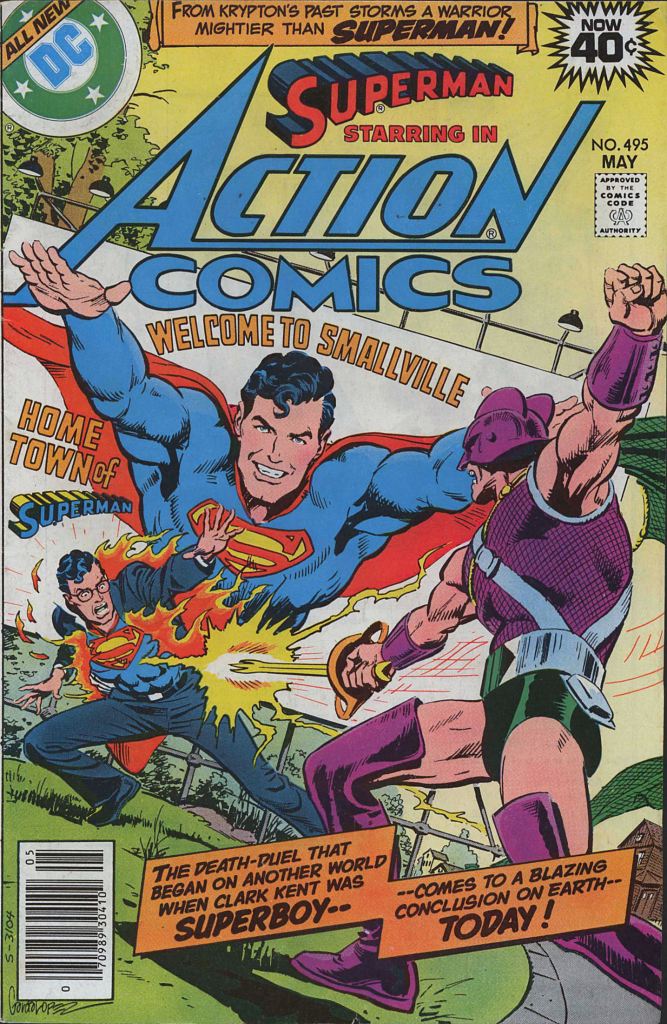
By this point in time, I was still mostly following SUPERMAN and ACTION COMICS, but I wasn’t paying a whole lot of attention to them. Under editor Julie Schwartz, they both continued to do exactly what they’d been doing since I first started reading comics years earlier–they were utterly dependable to deliver a certain experience, like getting a Big Mac at a McDonalds. And like that Big Mac, the stories were mostly forgettable fare, a few minutes’ worth of entertainment before moving on to the next thing. Accordingly, there are a bunch of issues during this period about which I have only scant recollections. This is one of them. I definitely would have bought this issue at my local 7-11, likely along with other comics for that week. Beyond that, nothing.
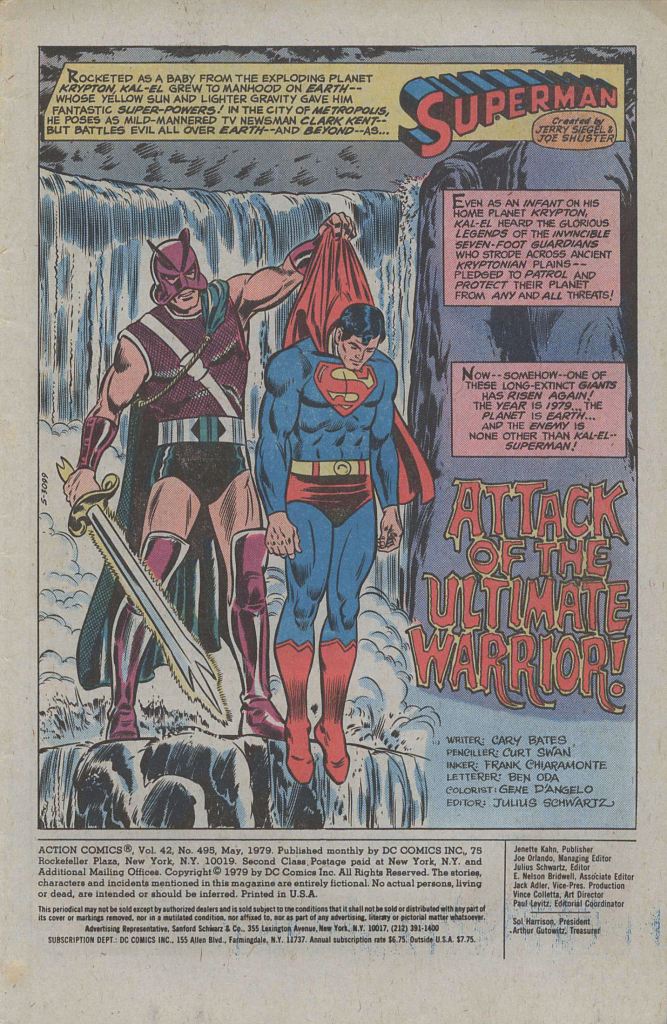
And I do have to say, I quite like the work of both write Cary Bates and artist Curt Swan. Cary was my first favorite writer and the first comic book creator that I recognized, which was down to him appearing as a character in early issues of FLASH and JUSTICE LEAGUE OF AMERICA that I had read. But as the Flash was my favorite, I gravitated towards Cary’s work and that included his Superman fare. And Curt Swan had a naturalness and a gentleness to his line that I find very attractive. It isn’t the energy and pyrotechnics of a Jack Kirby or the illustrative realism of Neal Adams. But Swan told an attractive story in a straightforward manner and his characters were always appealing.
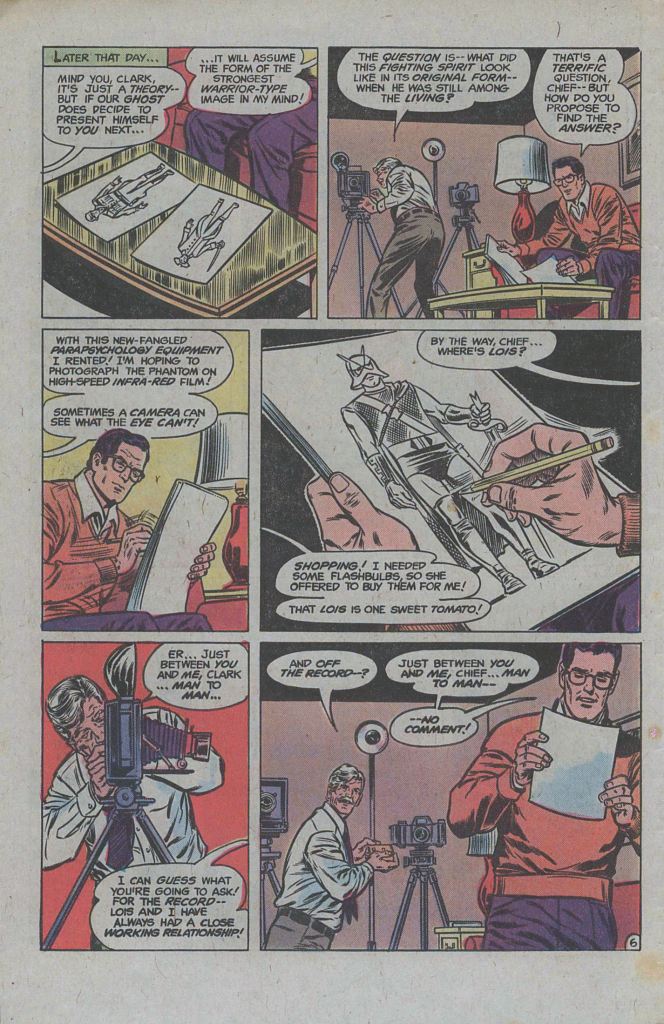
The story continues from the previous issue, in which Clark Kent and Lois Lane journeyed out to the former’s childhood home in Smallville in response to a strange letter whose author claimed to be ready to reveal several secrets about the Man of Steel. The letter included an alternate design for Superman’s emblem that had been drawn up years before by Ma Kent, so Clark knows that this is on the level. What’s more, a bunch of people have been bedeviled by an apparition that seems to take on the persona and appearance of different soldiers from the past related to its target. At the end of last issue, the spirit became a Kryptonian Guardsman and kayoed Superman. And that’s where things pick up here.
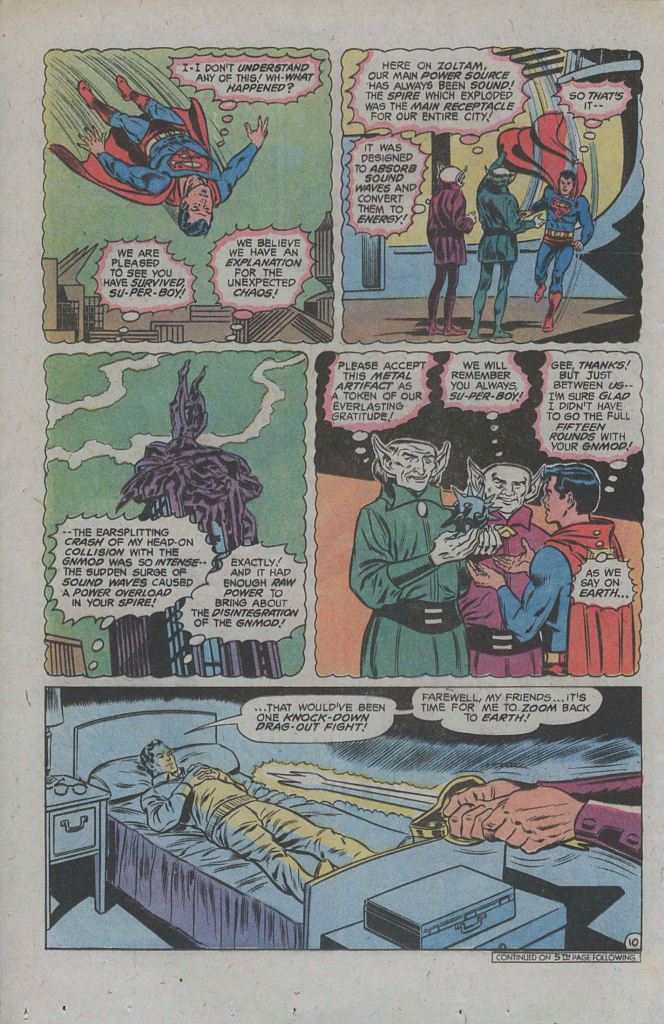
Superman of course survives, but he’s perplexed by the thing he just fought and he heads back to his childhood home to rest and recover. That evening, he dreams of an adventure he had back when he was Superboy years earlier. In that encounter, Superboy had gone to an alien world to help its people against a creature that was bedeviling it, the Gnmod. Superboy wound up slamming into the Gnmod so powerfully that the sound waves from their crash disintegrated the entity, and the grateful citizens of Zoltam gave him an award for his bravery. Unknown to Superboy, however, the essence of the Gnmod entity had survived in incorporeal form. It took refuge within the statue gifted to Superboy and has been growing in strength ever since.
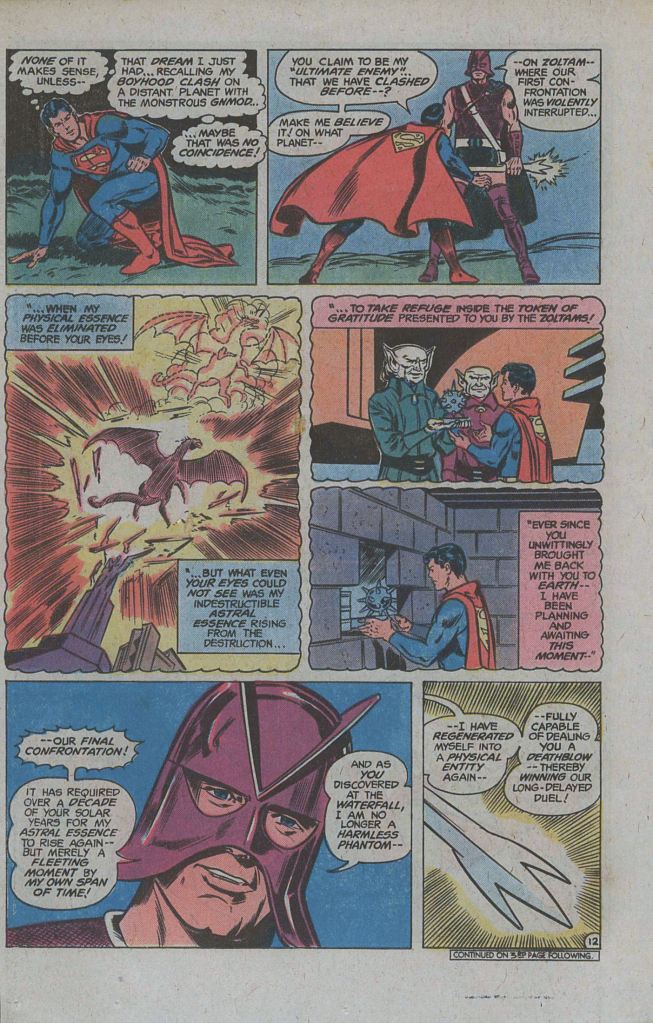
This isn’t simply a harmless dream or a memory either, it’s a psychic projection that the Gnmod is projecting into Superman’s mind as it prepares to get its long-delayed revenge on the enemy that defeated it. Awakening, Superman finds himself confronted by the Gnmod, still in the form of a Kryptonian Dwalu Warrior. The Gnmod helpfully fills in the last details of the plot behind this story before he lunges forward, attempting to finish off the Man of Steel.
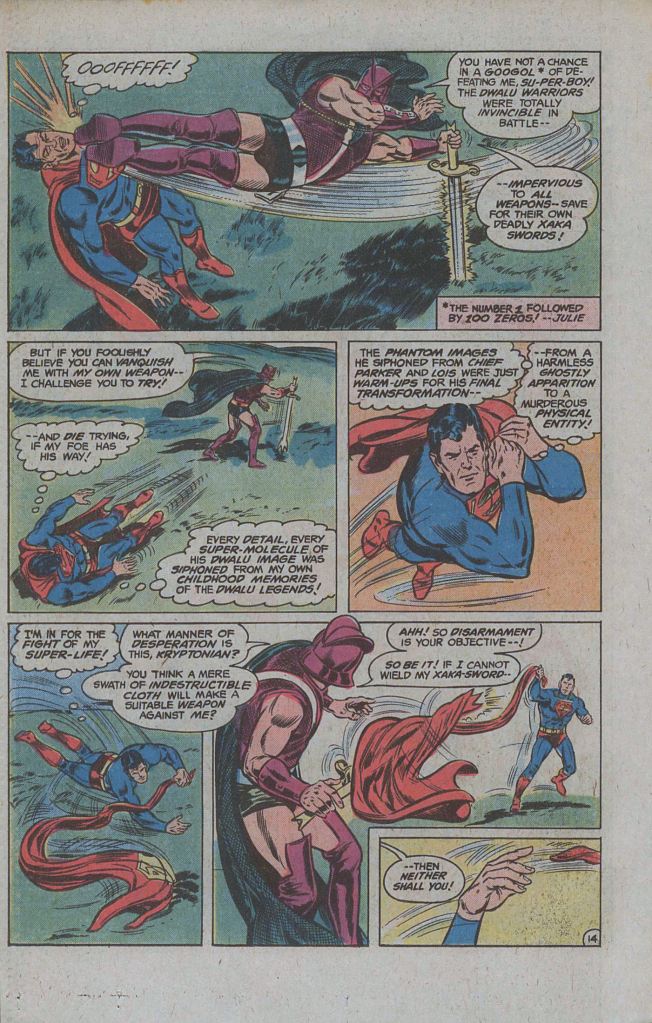
If this were a marvel book from the same period, you’d expect the rest of the story to simply be a protracted fight scene. And don’t look now, but Bates and Swan do pretty much exactly that. In the course of the fight, Superman laments that the Gnmod is even more powerful in this form that he had been on Zoltam. But we also learn that the Dwalu Warriors were only vulnerable to their own weapons. So Superman works to disarm his opponent, grabbing his sword with his cape and then hurling it far away from the conflict. So far away, in fact, that it circumnavigates the globe, returning to Superman’s hand on cue like Thor’s hammer so that he can strike down his enemy, releasing the Gnmod back into its astral form.
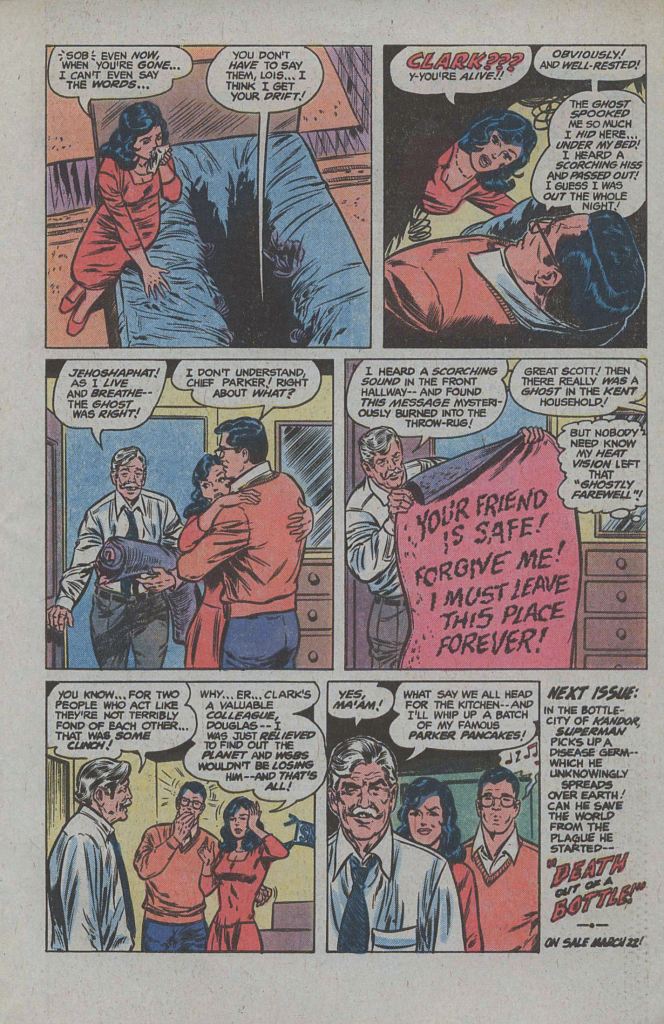
Unexpectedly, the Gnmod is glad for this outcome. It was its unresolved conflict with the Boy of Steel that prevented it from moving on to its next life and next evolution, so it skedaddles happily. And the issue wraps up back at the Kent household with Clark reappearing underneath the bed where he was supposedly disintegrated and having a reunion with Lois–a reunion that both insist isn’t romantic despite the fact that Smallville’s Police Chief Parker sees right through their denials.
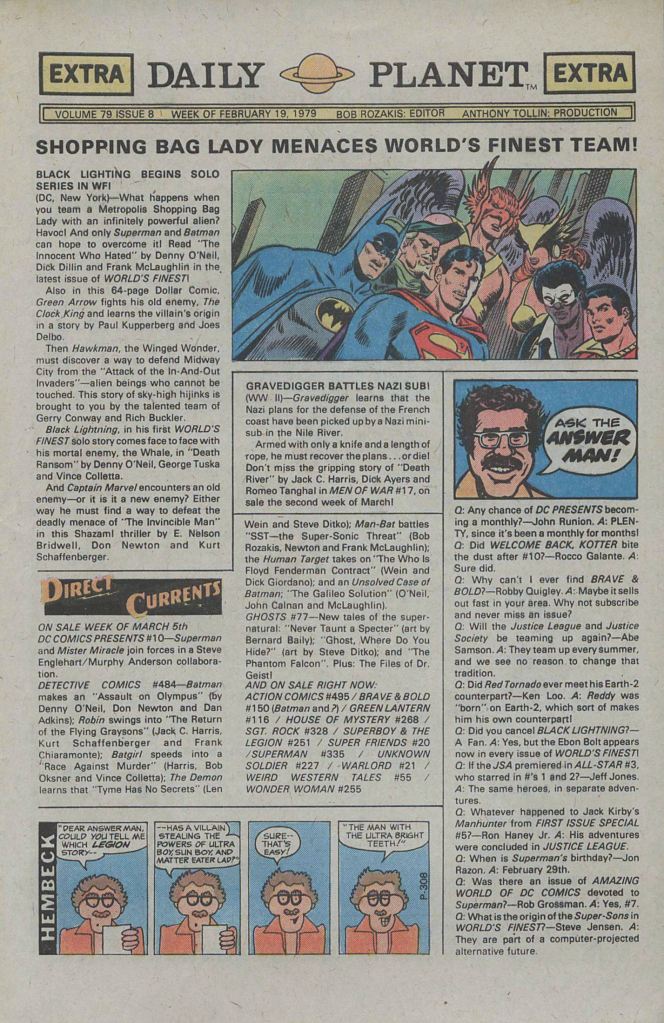
And we got another edition of the weekly promotional page The Daily Planet after the letters page, which included another of Fred Hembeck’s funny little comic strips. This one starred DC’s resident “answer man” Bob Rozakis, who also wrote a regular feature for the page in which he answered readers’ assorted questions.
 The Tom Brevoort Experience
With stories like this, it is one of comics’ greatest mysteries that Superman survived the Bronze Age. Never been a fan of Superboy beyond the Legion and one of those reasons is so little of what happened in/to Superboy had an effect in/to Superman. This story is a perfect example: rather than playing off a previous Superboy story, the plot is instead created from whole cloth, which just emphasized the general pointless of Superboy’s stories.
LikeLiked by 1 person
Some of us really enjoyed Superboy stories back then. The more rural setting, the times when they’d remember that he wasn’t supposed to be as perfect as he’d be when older, and the different supporting cast were all welcome. The Kents especially being featured players was nice and while I still feel writing out his time as Superboy was a mistake, the Kents then being part of Clark’s adult life made up for it a great deal.
LikeLiked by 2 people
While I didn’t start reading Superboy stories for about a year after this, I got a ton of back issues over time, and I’m a big fan of the post-Weisinger Superboy.
I liked the gentle tone of them, and I’m a sucker for stories of young Super-guy learning how to be Super-guy.
LikeLiked by 1 person
Bates was very good at writing an inexperienced Superboy. There’s a line in one of the pages of this story where he tells the aliens not to bother explaining the monster because he doesn’t need any exposition to defeat it — “You’ll understand after you’ve seen me in action.”
Bates stories in the later “New Adventures of Superboy” initially put heavy emphasis on Superboy discovering what he could and couldn’t do.
LikeLiked by 1 person
Maybe they were listening, Tim — since a year later, the very well-received “Miraculous Return of Jonathan Kent,” in ACTION 507-508, was tied into the events of NEW ADVENTURES OF SUPERBOY 5.
That was what got me reading SUPERBOY, after I’d started reading the Bates/Swan Superman in ACTION — which I’d started reading because I liked the Bates/Heck FLASH.
LikeLiked by 3 people
Exactly, Bates started what I think was the best Superboy era ever, with the “New Adventures” he almost fully wrote all by himself, and he took special care in linking them to the main current continuity, which he also was writing. The famous Return of Jonathan Kent was the most noticeable example, but not the only one.
I happened to like a lot Bates approach to Superboy (and the related wonderful Schaffenberger art), but I always felt the Superboy concept to be too out of place in the Superman mythos, with the costume, the name and the public knowledge, somehow diminishing the Man of Steel to a “grown up version of Superboy”. Hence I understood Byrne wanting to get rid of it.
I wonder if this issue was the sparkle for Bates to start the series.
LikeLike
“I wonder if this issue was the sparkle for Bates to start the series.”
I don’t think Bates was the impetus to start a new SUPERBOY series. I think it was that the Superboy stories in SUPERMAN FAMILY (which Bates had written the last few of) were getting a strong enough response that Julie — or someone else — proposed spinning him back out into his own magazine.
DC COMICS PRESENTS was launched in the run-up to SUPERMAN: THE MOVIE, and THE NEW ADVENTURES OF SUPERBOY was launched after the movie turned out to be a big hit. DC was likely reacting to that, too.
And THE DARLING — excuse me, DARING — NEW ADVENTURES OF SUPERGIRL was launched in the run-up to that movie, thought it didn’t work out so well there.
LikeLiked by 3 people
I had though that New Adventures was a part of the disencumbering of Superboy from the Legion and vice versa than anything going on in Superman Family but I can see it. Aside: I think one of the inherent flaws in a continually running Superboy series is that he will never be more than Superboy. He will never truly grown beyond that because he can’t, which limits the stories you can tell. See also: Smallville. Granted, this is the problem will all prequels, so don’t think I am singling him out for it.
LikeLike
Archie’s never going to get out of high school (in his main series, at least), the PEANUTS kids are never going to make it to high school, Nero Wolfe is never going to qualify for Social Security, the Muppet Babies will never…well, you get the idea.
The fact that characters don’t get older in media that are full of characters not getting older doesn’t bother me. What matters is whether there are interesting stories to be told of a teenage Superboy, and I think there are. So I’m good with it.
I’d like a Superboy series that drifted around in time some, though, so while most of the stories are about a 16-year-old Clark, we’d get stories about an 8-year-old Clark, too, or a 12-year-old. I’d love to have seen a stretch where the Legion had somehow managed to cross paths with 10-year-old Superboy, and get to spend time teaching him how to be the hero they were inspired by.
And I suspect that Superboy leaving the Legion was something they did to promote the new SUPERBOY series, rather than doing a new solo series because the Legion team didn’t want him. It was certainly easier for the Legion crew not to have to have Superboy time-travel in from the past every adventure, but that wouldn’t spur DC to launch a new series, not when they’d already had one going in ADVENTURE and then SUPFAM.
I also think it was a mistake, and started the process of siloing off the Legion as disconnected and irrelevant to the main DCU.* All they needed to do was have him not around every issue — and they could have had fun with Superboy showing up mid-adventure, to find Legion HQ damaged and deserted, and having to catch up on what happened fast, that sort of thing.
*I also don’t think it’s coincidental that while the Levitz/Giffen run was a big hit even when Superboy appearances were rare, their biggest hit epic was one with a 20th century villain. The connections were valuable, and it would have been better to do a few more — not to the point that it overwhelmed the book, but enough to keep the awareness there.
LikeLiked by 1 person
A lot to unpack here. I never said anything about getting older. I was talking about growing; On board with a Superboy series that moves around his timeline as that would get around the lack of growth, except absolutely NO Superbaby stories! 😛 ; BTW I am reminded of a story where the Earth-Two Superman ends up on Earth-One and trains Superboy, which apart from tying balloons to Superboy, was pretty good; I think Superboy had to leave the Legion because the Legionaries were actually aging and growing and he wasn’t. Sadly, part of the problem with the Legion is that the Legion would connect with the DCU de jure, then that iteration of DCU would change and then they would have to play catch up to the changes. IMHO a free floating Legion would best. Bendis got close to this, but sadly there were other issues, not that I had any. I might be the only pre existing Legion fan that enjoyed his run, which was strange as I like very little else he has done.
LikeLike
”I never said anything about getting older. I was talking about growing”
I don’t see any reason Superboy can’t grow. There’s a lot of room to grow between there and his adult life. Seeing him learn lessons from his experiences is a big part of the appeal, for me.
LikeLiked by 1 person
You will just eventually hit a wall, which happened in the 80s. The other problem is I’m not sure who will be there for stories set in 2010. 😉
LikeLike
I don’t really know what any of that means. You never need to hit a wall when exploring characters. There’s always more to find. Plus, just like with the adults, eventually you’re telling the stories to largely new enough readers that some story you did in 1956 may have covered something, but you can explore it again — times and styles have changed.
And having Superboy stories set in the past worked fine in other eras, it wouldn’t be a problem if the present is now and the past is 15 years ago, other than to very elderly people, who aren’t the target audience. Me, I’m 64, and Superboy stories set in 2010 wouldn’t bother me a bit — and I haven’t been the target audience for years.
But I gather, from internet chatter, that we may be about to get Clark-as-Superboy back in DC continuity, so we may find out is current readers only want him set in the distant past.
LikeLiked by 2 people
You responded like you understood exactly what I meant. 😉 The Wall is when you run of of new stories to tell and you begin rehashing old ones and that wall is that much closer when multiple somebodies are already telling stories on the other side of it.
As for Superboy stories set in the past, it seems like they were all set in the 40s to me!
Hasn’t Superboy been in continuity since Johns introduced the retro Legion with the Lightning Saga and reaffirmed by Superman Reborn? Granted, plumbing the depths of even recent Superman continuity is not for the faintheart!
LikeLike
“You responded like you understood exactly what I meant. 😉”
Victory!
“The Wall is when you run of of new stories to tell and you begin rehashing old ones and that wall is that much closer when multiple somebodies are already telling stories on the other side of it.”
I don’t think that Wall exists. Running out of new stories to tell is a failure of imagination, not something inherent to a character.
“As for Superboy stories set in the past, it seems like they were all set in the 40s to me!”
By the 1980s stories we’ve been discussing, they were set in the late 1960s/early 1970s, and had the occasional hippie in them. Admittedly, rural farm-town hippies, but such is life.
I don’t think Julie wanted to dwell on it, any more than the editors did when Superboy was set in the late 1950s, and rock & roll was showing up. Aside from an occasional reference, they seemed to feel the appeal of Superboy was that he was young like the readership, so emphasizing what he and the readership had in common was more important than making it clear he’s their parents’ ages.
Today, with a generally older readership for comics, the feeling that he’s their age, encountering the stuff they encountered when they were 16, might work better, or they might downplay it, as we did in UNTOLD TALES OF SPIDER-MAN, when we tried not to specify whether the stories were talking place in the 60s or the 80s.
“Hasn’t Superboy been in continuity since Johns introduced the retro Legion with the Lightning Saga and reaffirmed by Superman Reborn?”
I have no idea. But I’ve been under the impression that, while there have been alternate-timeline and variant versions, Superboy has not been a part of the present-day Superman’s backstory for close to 40 years.
LikeLiked by 2 people
I remember it as he was Superboy only when visiting the Legion i n the future.
LikeLike
I know the animated series worked like that but less sure if that was the case in the comics post Lightning Saga.
LikeLike
Yeah, that was near the beginning of no one using plot points John came up with after they made the page.
LikeLike
I would love to see Superboy through the lens of fifteen years ago from today!
LikeLiked by 1 person
I wouldn’t mind, myself, though I think I’d rather write it.
LikeLiked by 2 people
You’d have my vote!
LikeLike
Again I need a proofreader!
LikeLike
I want to add lettering to that DAILY PLANET image, since it doesn’t show the bag lady. Maybe:
HAWKMAN: …
BATMAN: …what?
LikeLiked by 1 person
Though not identical in plot, Superman and Black Lightning helped a different alien ( Hugh Bryant a Jefferson Pierce student called the De-volver in the title ) able to alter its form [ DC Comics Presents#16 ( December 1979 ) ] but unable to escape Earth’s gravity under his own power so Superman helped him. You would think that TV or Newspapers would have told Hugh that Earth has aliens on it ( plus a Green Lantern ) and he would try to get their attention for help. I was wondering if there was another being like the Gnmod that took the form and abilities of a being in someone’s mind.
LikeLiked by 2 people
As a callow youth I wasn’t a big fan of Curt Swan’s work, with the exception of the “Swanderson” issues inked by Murphy Anderson. Too staid, I thought at the time. It wasn’t until I was much older that I recognized just how skilled a storyteller Swan actually was. I had a similar epiphany with Kurt Schaffenberger…
LikeLike
In my own salad days, I liked Curt Swan inked by almost anyone other than Frank Chiaramonte, which is odd because I didn’t mind Chiaramonte inking other people’s pencils (e.g. Dave Cockrum) but there was just something about Swan/Chiarmonte that set my teeth on edge. He was no Bob Oksner!
LikeLiked by 2 people
I’m sure I’ve commented before on another of Tom’s blog posts that I really dislike Frank Chiaramonte’s inking over Curt Swan.
LikeLiked by 1 person
the disconnect in era “vibe” between the Action Comics covers and the stories inside in the late ’70s/early ’80s still blows my mind.
LikeLiked by 2 people
Agreed. The covers by JLGL, Rich Buckler, or Ross Andru , especially when inked by Dick Giordano, were dynamic stunners.
The interiors were s bit of a letdown. By the 80’s Swans’s Superman could really compete. It still gad its core audi
LikeLike
Comparing that Jose Luis Garcia-Lopez cover to the Curt Swan artwork that follows just perfectly articulates why I had no interest in Superman comics prior to the John Byrne reboot. JLGL’s cover is so beautiful and dynamic (and, for what it’s worth, his current artwork is even better) while Swan’s work is bland and pedestrian. There’s nothing wrong with it, but there’s nothing compelling about it either. It’s journeyman work. The Big Mac analogy is perfect–it’s utterly forgettable. To use another analogy, JLGL’s artwork feels cinematic, whereas Swan’s artwork feels like a sitcom (shot on videotape, to boot). And the fact that DC kept him on their flagship title for so long just utterly baffles me.
LikeLiked by 2 people
I’ll say again: imagine a kid in 1978/9 coming fresh from the Superman movie, excitedly picking up a Superman comic by… Pasko, Swan and Chiaramonte! Sticking with the status quo was certainly a perverse decision by DC.
LikeLiked by 2 people
I liked all the classic Superman artists from Shuster to Swan. They all drew what looked like to me as “Superman” with a capital “S”. I definitely preferred Swan’s take to Boring’s, but both had their charms. I think it worked well for those stories from the 50′-early 70’s. It’s not like Superman is reveling in violence during the Boring/Swan years… he’s almost in a constant state of de-escalation if he’s in a fight at all… and these types of stories are very appealing to younger kids who want to trust adults.
It wasn’t until I became more of a Marvel fan that I would consider most 70’s DC comics very staid by comparison… in both story and art. Maybe Swan’s art is bit less dynamic than other mainstay DC artists of the day, but by and large think its the difference between Pepsi and Coke until the next generation showed up. I’ll give Swan props for everything he drew being drop dead convincing though.
LikeLiked by 1 person
I love Curt Swan and his style, and I already commented somewhere about how DC could have had Garcia-Lopez and Swan share two Superman series. But besides that it’s just unbelievable that DC kept one of the best artists of their generation relegated to covers, ads, merch and fill-ins. Imagine what Marvel could have done with JLGL (X-Men? FF? Spider-Man?). ANYTHING drawn by him would have reached top ten.
LikeLike
The problem with giving JLGL a regular Superman book is threefold:
Basically, the ideal series for JLGL, if you wanted him on a steady gig, would be a bi-monthly pirate book that paid really well. Sadly, those didn’t exist in the US, and I’m not sure they did anywhere.
LikeLiked by 1 person
(Did not know about 1. That pretty much closes the issue.)
They did in Watchmen universe US!! 🙂
LikeLiked by 1 person
Hi, Kurt. I had no idea that JLGL isn’t fast enough to draw a monthly series and doesn’t really like superheroes. Thanks for the info. I guess we’re fortunate that we got the work out of him that we did.
By the way, did you and JLGL ever work together?
LikeLike
Once, on a short “Tales of the Green Lantern Corps” story. It was gorgeous.
LikeLiked by 2 people
I enjoyed JLGL brief stint on The New Teen Titans, after GP left. He also did a miniseries, Cinder and Ashe, in the late 80s that showcased his awesome art.
LikeLike
I read super hero comics solid from 1973 on and despite his obvious talent… I pretty much missed JLGL’s work completely by hopping ship from DC to Marvel around 1976 or so. Though I still occasionally picked up the odd DC book here and there.
The only works of his I remember buying off the rack were the cover of the marriage of Earth-2 Superman and Lois Lane, and the Superman vs Wonder Woman Limited Edition.I remember that particular Limited Edition fondly as a pretty dynamic offering from DC at the time. The WWII setting was a bonus. It was pretty crackling… otherwise I wouldn’t have bothered.
Had he drawn for Marvel I’d probably be a big fan. My loss… not his.
LikeLiked by 1 person
He’s said in interviews that when he was assigned the Superman/Wonder Woman book, he thought he wasn’t right for it because his work wasn’t all that dynamic.
But his editors told him he’d do fine, so he dug into superhero comics he thought were dynamic and studied them, trying to up his game.
I’d say it absolutely worked, and was a big part of his appeal from then on.
LikeLiked by 3 people
I read on Jim Shooter’s blog where Shooter showed some JLGL pages fom the Batman/Hulk crossover to John Buscema. Mr.Buscena reportedly went on about how well drawn they were. Fundamentally, and for storytelling.
For me that’s about as high as praise comes. Another example would be Alex Toth’s writing in to DC to express his admiration for David Mazzcchelli’s “Batman: Year One”.
Sometimes JLGL’s work could be too clean or rigid. But yeah, it was fundamentally sound. Highly skilled
His late 1970’s & early 1980’s covers for “Superman”, “Action Comics”, & other “super books” were among the best out there. Especially inked by Dick Giordano.
LikeLiked by 1 person
“Shooter showed some JLGL pages fom the Batman/Hulk crossover to John Buscema. Mr.Buscena reportedly went on about how well drawn they were”
That reminds me of a similar anecdote from Andrew Helfer. The legendary French artist Moebius was visiting the DC offices, and noticed some of JLGL’s art on display. Studying the piece intently, he asked, “This Garcia-Lopez, he uses models, no?” When informed that no, he did not, an exasperated Mobius hissed, “Son of a bitch!”
Definitely an “artist’s artist”!
LikeLiked by 2 people
I bought the Superman vs Wonder Woman treasury edition recently when DC issued the facsimile edition of it, and I thought the artwork was incredible. JLGL and Dan Adkins did an incredible job on it.
LikeLiked by 1 person
Today is also JLGL’s 77th birthday.
LikeLiked by 1 person
Today is also JLGL’s 77th birthday.
LikeLiked by 1 person