

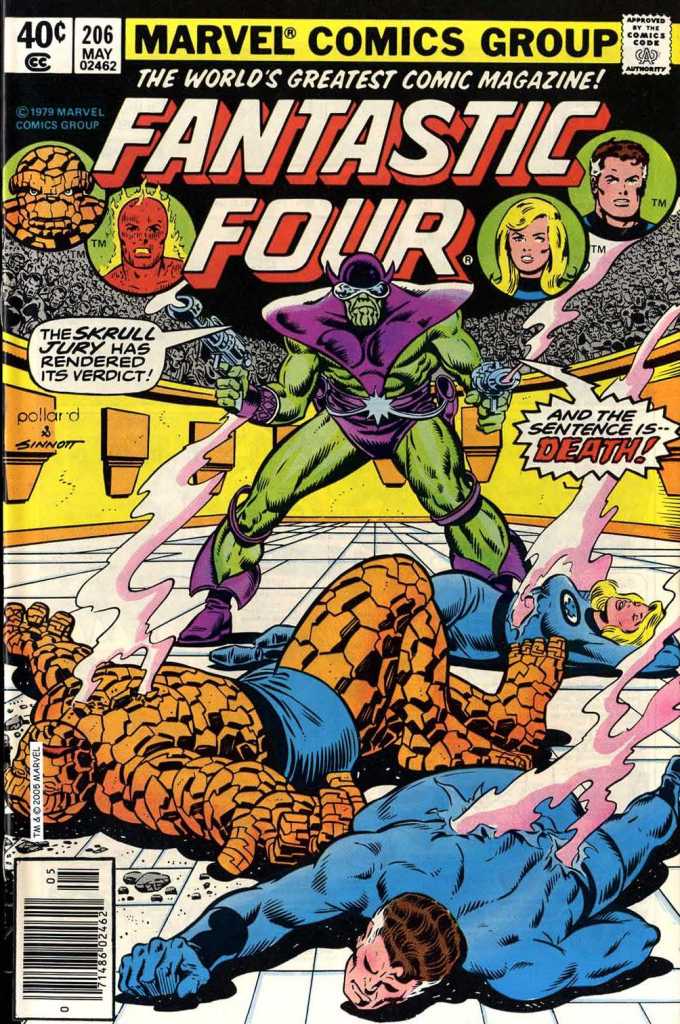
I’m not entirely certain of the circumstances after all of these years, but I believe it happened as a result of my filling out and sending in a survey concerning Marvel’s upcoming ODYSSEY magazine, which eventually reached newsstands as EPIC ILLUSTRATED. Or it may have been some other survey, possibly released through PIZZAZZ magazine or something similar. Either way, I wound up winning a free one-year subscription to the Marvel comic of my choice. Still smarting from having missed the big issue #200 (which I still had not seen), I wound up selecting FANTASTIC FOUR, of course. Which, like my earlier subscriptions, turned out to be a bit of a mixed blessing. Because my subscription copy would always arrive a week or two after the new issue had been available on the stands, and so this drove me absolutely nuts. I didn’t go so far as to buy the book every month twice, but if I’d had the spare cash, i might have. It was a tough year for this reason.
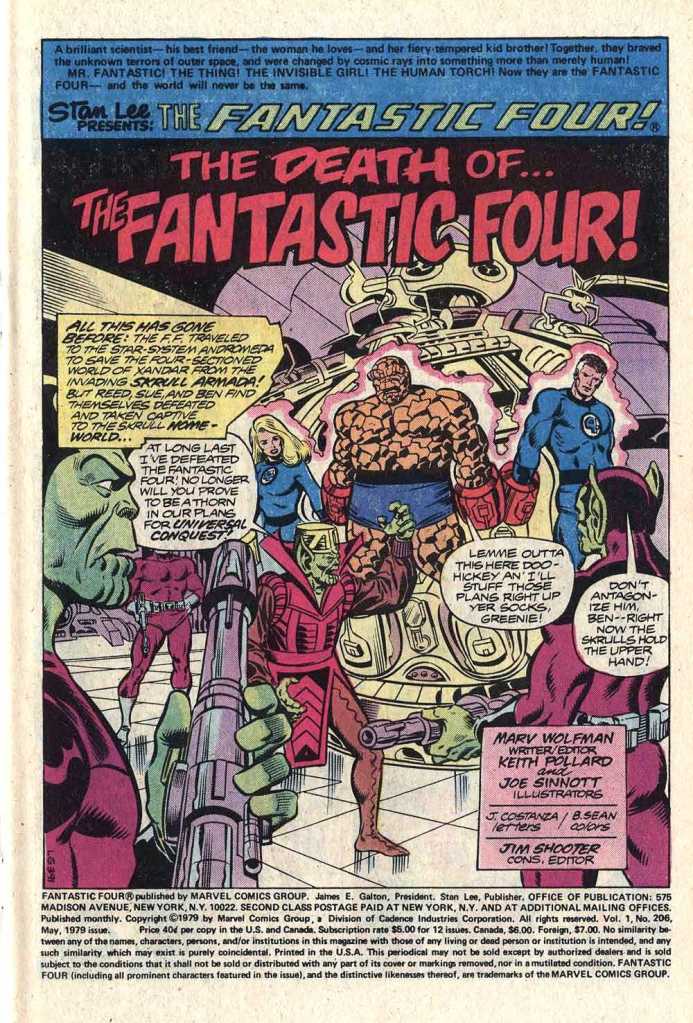
This issue was the first that i received as part of my free subscription (you know, had I thought about it, I might still have bought the books as they came out on the racks, since I hadn’t paid for this subscription. But I didn’t think of that in 1979.) and I was happy to have it. By this point, I had a buddy, David Steckel, who was also a huge FANTASTIC FOUR fan, and so he wound up getting his copy a week or two before mine showed up. It was agonizing not to be able to discuss it (or having its contents in any way spoiled.) Anyway, this was another issue in what wound up being an overlong space storyline by Marv Wolfman and Keith Pollard. It stretched beyond its normal confines in that Marv was forced to incorporate story material that he had intended to be part of his recently-cancelled NOVA series.
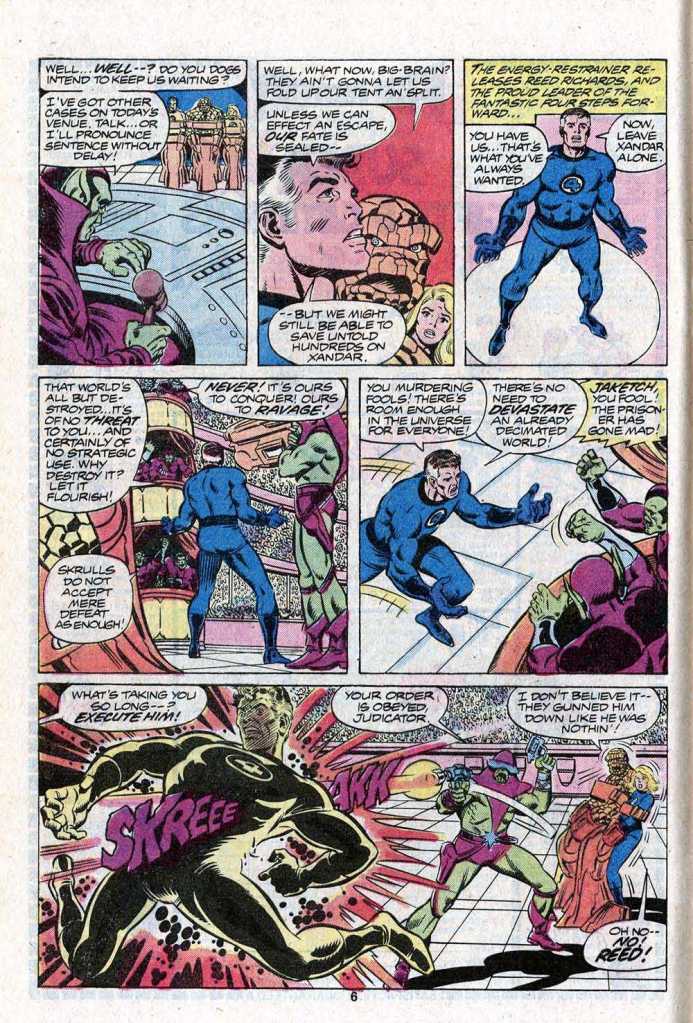
Last issue, while attempting to protect Xandar from the invading Skrulls, the Fantastic Four (well, three of them–the Human Torch had stayed behind on Earth where he’d re-enrolled in college) had been captured by their enemies. As this story opens, the team is being conveyed to the Skrull High Court at the center of their empire, where they will be given a show trial before their execution. That trial makes up much of the opening of the issue, where Reed Richards, assuming that he and his team’s fate has already been sealed, argues for mercy for Xandar. One by one, the three members of the Fantastic Four are zap-gunned down for their trouble. And that’s where you’d expect that the story would end.
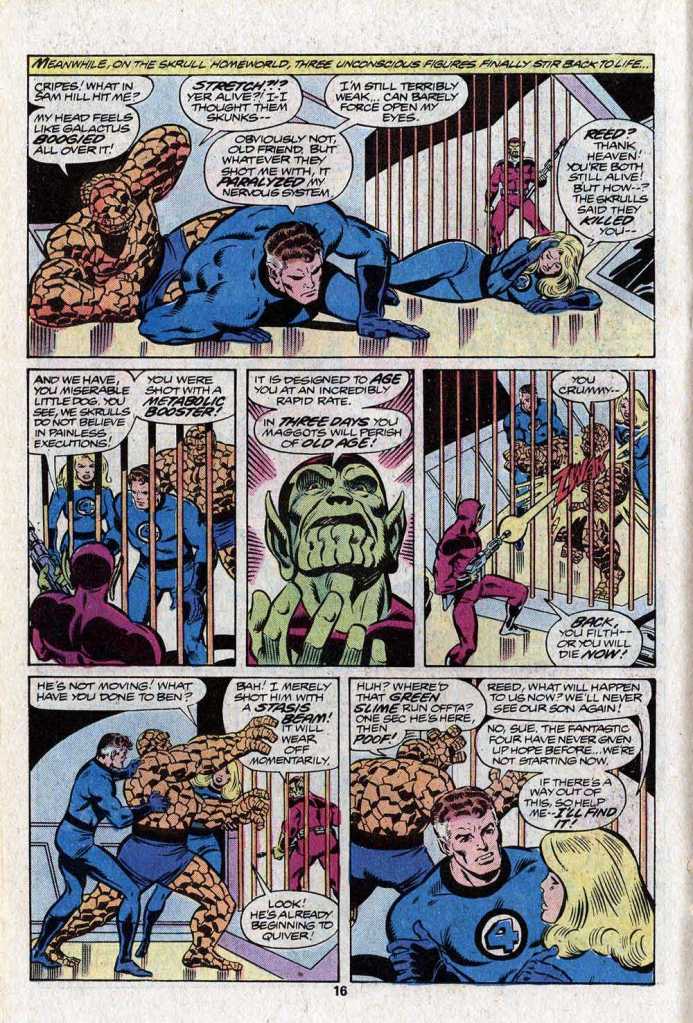
Because after cutting away to some business back at Xandar (business that may have been originally intended for NOVA), the trio of heroes awaken to find themselves not having been perforated, and seemingly no worse for wear. However, they are told that the sentence against them is more horrifying than that. They have all been zapped by a Skrull Metabolic Booster, which will cause them to age rapidly. They each have at most three days of life remaining to them. As this ray was portable enough to be carried by their executioner, it’s a decent question why the Skrulls never used it as a weapon against their enemies. Either way, though, the team is now operating under an inevitable death sentence unless Reed can find a way to reverse this process somehow.
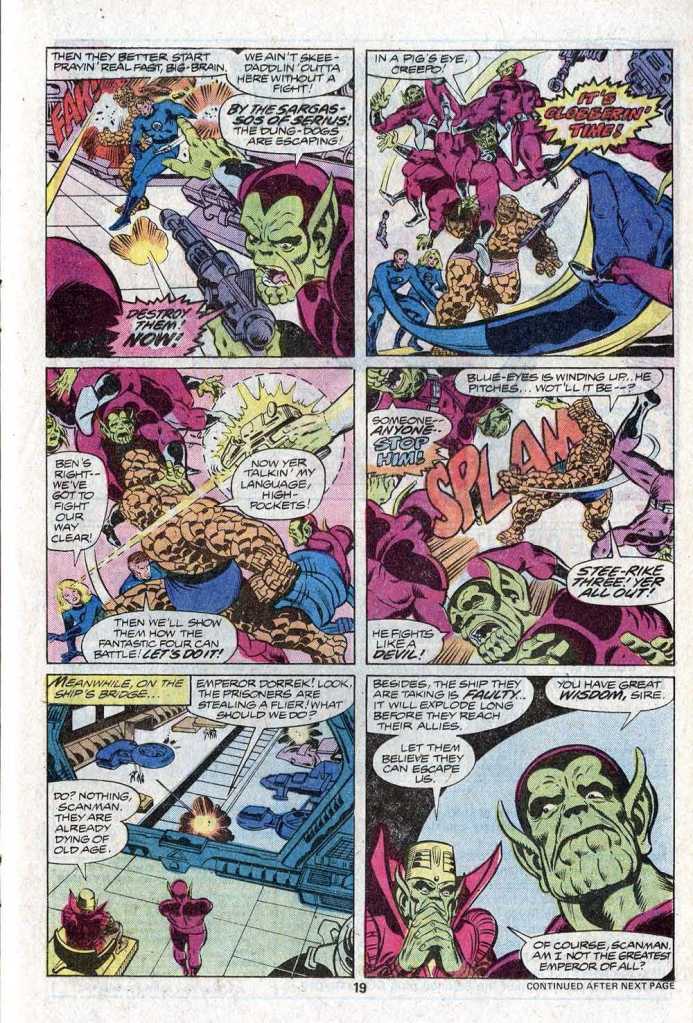
Of course, in no time at all, our heroes stage a jailbreak and fight their way to a landing bay, where they’re able to take off on a Skrull ship that’s being repaired. The Skrull Emperor is unconcerned about this turn of events, though–the team is already rapidly aging, and to make matters worse, the ship they’ve made off with is faulty and will explode before it can reach Xandar. Oops! Of course, Reed Richards is on board, and he can fix pretty much anything with a paper clip, so this feels like a bit of false drama. But it still keeps the stakes high as the FF escape back into space.
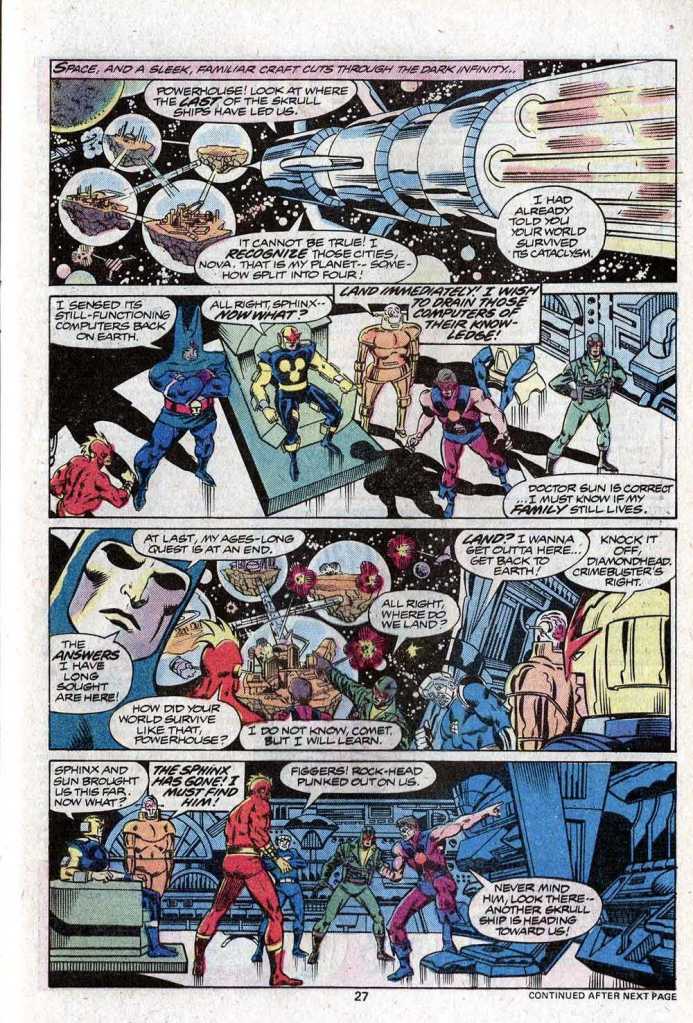
Meanwhile, back on Xandar, there’s some drama playing itself out among characters who don’t really amount to much of anything long-term, and so I’m choosing to skip past it all. But finally, as we get towards the close of the issue, Nova and the New Champions finally arrive in Nova’s spaceship, which we saw them take off in over in NOVA a week or two ago. They’re approaching Xandar, which has become a strange world of disparate chunks of the original planet bridged by enormously long causeways and encased in protective bubbles, like a model of a molecule in space. The Champions have been dodging and battling Skrull warships the whole way out here.
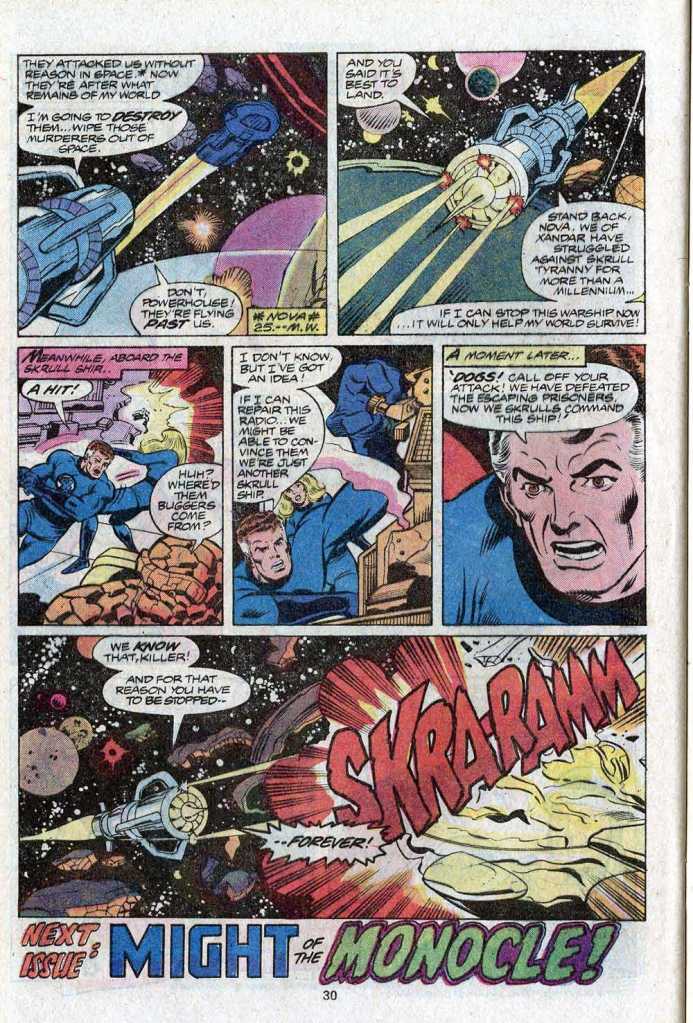
And it’s right at this moment that the Fantastic Four zoom onto the scene in their stolen Skrull spaceship. Not recognizing the Nova craft, Reed chooses to pretend that he’s a legitimate Skrull over the radio in an attempt to gain passage. However, Nova and his crew, especially Powerhouse, have no love for the Skrulls and they open fire, destroying the ship the FF are aboard. To Be continued! Things are not looking good for the good guys here!
 The Tom Brevoort Experience
Was this when Marvel was still folding comics in half and mailing them out in a #10 envelope?
LikeLike
This issue was mailed to me via subscription back in the day. The books were usually creased (ugh!) but otherwise mailed flat in a kraft paper mailing wrap that was open at the top and bottom. You had to open them carefully because the back cover of the book could sometimes be partially glued to the sleeve at the seam.
LikeLiked by 3 people
Poor Xandar. It kept getting revived and rekilled just like the Nova Corps concept. It’s up there with story engines associated with Namor.
LikeLiked by 2 people
It had everything I logically should have really enjoyed in a Fantastic Four story, Nova elements included, but somehow it really bored me. And at this point I was so cosmically sick of Reed Richards and everything about him I genuinely wanted him gone permanently.
Reed Richards morphed early on from a genuinely crazy and in some ways unpleasant and unlikable science hero – and that was all fine, it made him interesting and entertaining – into this weird Superman ethical code with bombastic unpleasant dialog combination. It was symbolic of a tired region of the Marvel universe that needed to be freshened up somehow…
LikeLike
When he’s lambasting the Skrulls in this instance he sounds more like Captain Kirk to me than Superman. I think I prefer the Reed who knows what the right thing to do is over the guy who was in the Illuminati and helped make a Thor clone among other things.
LikeLiked by 2 people
I think under some writers Reed falls victim to the same change in societal attitude that happened to Professor X. People like them were once revered for the way they were universally. Now it’s in zeitgeist to look at them suspiciously and give them shady motives. at least Reed hasn’t had his backstory riddled with unconscionable acts like the professor.
LikeLiked by 1 person
Captain Kirk, yes I see that now, exactly. Great analysis!
Another Outstanding and Powerful Pollard Cover. IMHO from 1978-1980 his covers were as good as anyone in the field. I say that as huge Aparo, Byrne, Perez, Miller fan of that same era.
Like Tom I also missed FF200, #204 was my first FF.
LikeLiked by 1 person
The truly awful and very “un-Marvel” illuminati twaddle was yet another Bendis “borrowing” of course – in this case from the vastly superior CONSPIRACY from the 1990s which left the heroes heroic but contextualized them John Byrne style into a world where many of the “science accidents” were… planned.
“Control
Perhaps the biggest lingering conspiracy out there is Control. As established in 1998’s two-issue CONSPIRACY miniseries, Control is a secretive group that may have played a part in shaping the early Marvel Universe as we know it. If General Edward Harrison can be believed, everything from the creation of the Fantastic Four, the Hulk, Daredevil, Spider-Man, and more can be linked back to one organization.
CONSPIRACY didn’t firmly confirm whether Control is real, so the jury is still out. But someone was willing to kill to keep that information from becoming public.”
https://screenrant.com/marvel-comics-biggest-conspiracy-control-secret-invasion/
LikeLike
You could probably blame Alan Moore’s Watchmen for what happened to Professor X, Reed Richard and if what I saw in the Doom Patrol TV series happened to Dr. Niles Caulder in the comics too ( He caused the “accidents” that gave them their powers ).
LikeLike
I think part of it is that Reed started out as a genius who was also a heroic man of action and in many ways a regular guy. That’s not really how we write genius any more — much like Brainiac Five in some later iterations of the Legion, Reed has to be so brilliant he can’t connect with people and will manipulate them for their own good because He Knows So Much B etter.
LikeLike
It’s especially egregious in the case of Reed Richards since his heroism goes back to World War 2 (OSS agent) and college (warning Victor von Doom not to do a senselessly dangerous experiment). Richards is a classical 1950s science hero, worthy of the mantle of leadership – and mature. He gradually becomes a genuinely erratic and at times hair trigger temper violent abusive “friend” and husband and that is NOT true to his original character. I get the story reasons various people thought justified it but cmon man.
It’s the later period Batman using guns of Marvel comics.
LikeLike
Yes, it’s the demise of “Action Scientist” as a hero. Can you imagine someone today writing a genius at college who likes to watch football, and is glad to be roommates with a star player? Nowadays, it’s all about autists with no typical interests. It’s saddening to reflect how thick on the ground “Action Scientist” was in the early Silver Age. Many teams seemed to be led by a professor-type researcher, not the least because the exploration was an engine for stories. And that’s just gone now.
LikeLiked by 1 person
in comics, STEM now stands for, at best, Strange Thug Emoting Madly
LikeLike
Metabolic Booster: I could see the Skrulls using it if they were genocidal and wanted to wipeout an entire planet’s population with out destroying buildings using a much larger version then waiting 4 days, but on the battle field their foes would still be able to fight for most of their 3 days ( Plus they might have used it in similar “trials” against their enemies in flashback stories yet to be written ). The Organization’s Eon Ray ( a gun )[ Captain Marvel#10 ( February 1969 ) created by Dr. Walter Lawson ] works faster and could be used on the battlefield.
LikeLiked by 1 person
FF 206 would be Keith Pollard’s last issue after being on the series for about a year. He did a fine job, aided of course by Joe Sinnott. In an interview, Keith explained that he was given the opportunity to take on Thor (with 286, and he stayed on that series for about 2 years). He was also drawing Spider-Man, and found it easier to do a single hero series than a team book. He would return to the FF about 100 issues later.
Marv Wolfman later admitted in an interview that while he was pleased with his run on Spider-Man, he was never completely satisfied with his run on the FF, except for issue 200, since he kept comparing it to Lee-Kirby’s work on the FF (not a fair comparison, I think, since no one could compare with that). While I personally liked Marv’s work on FF 195-200, I believe he probably let this particular storyline go on too long. After all it didn’t end until FF 214! I realize that was not completely his fault since he had to fold in the Nova storyline. However I was not reading Nova at the time and found the additional characters confusing and I didn’t care for the Sphinx and never really believed he could stand up to Galactus (and of course he couldn’t). Nevertheless I did stay with Marv’s whole run and still found it generally entertaining (but sometimes confusing). Thanks for the review, Tom.
LikeLiked by 3 people
I don’t remember what I thought of this at the time but throwing in the entire Nova New Champions crew, plus the villains, plus Dr. Sun (who comes across almost like comic relief here) — way overcrowded, even for a Nova fan.
LikeLike
Thomas Syndrome – which I tended to like usually. Continuity becomes a character and a crossword puzzle game in and of itself.
LikeLike
Keith Pollard kept everyone’s appearances on-model. Very consistent.
LikeLiked by 1 person