

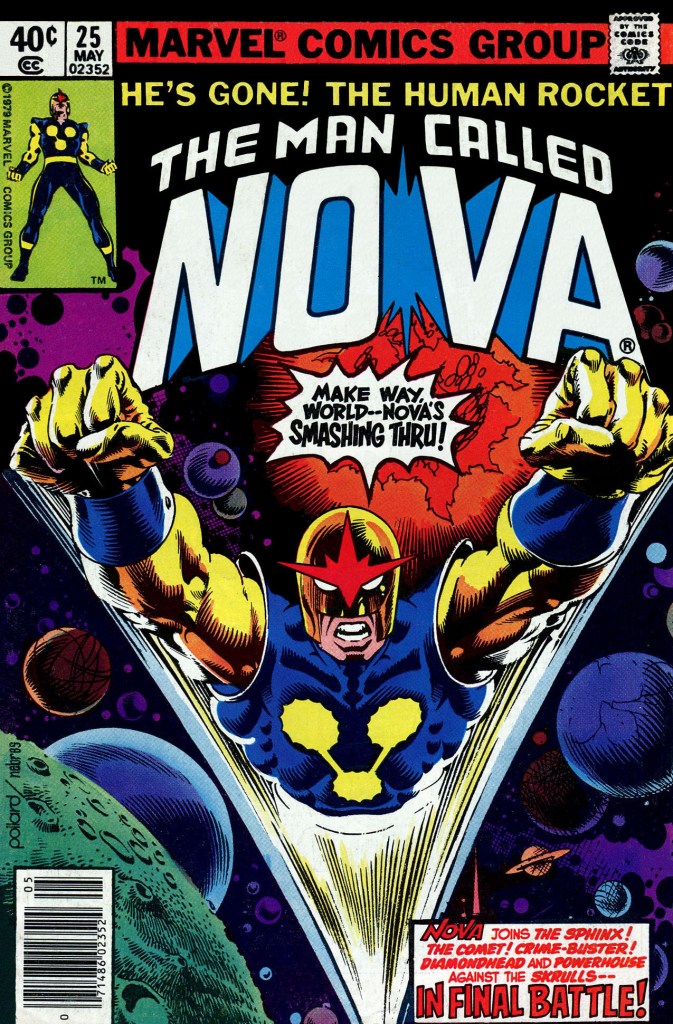
The next issue of NOVA that appeared at my local 7-11 was also the last, a fact that saddened me. I’d only started reading the book a few months earlier once I realized it was a super hero series, and I’d enjoyed it throughout its short run. Especially concerning was the fact that writer Marv Wolfman had embarked on what would turn into an epic joint storyline that was running in both NOVA and Marv’s other book, FANTASTIC FOUR. With NOVA now a thing of the past, certain plot threads were going to need to be shoe-horned into FANTASTIC FOUR. And as it was, we wouldn’t get a proper conclusion for several years, not until Bill Mantlo wrapped Rich Rider’s story up in an issue of ROM in the 1980s.
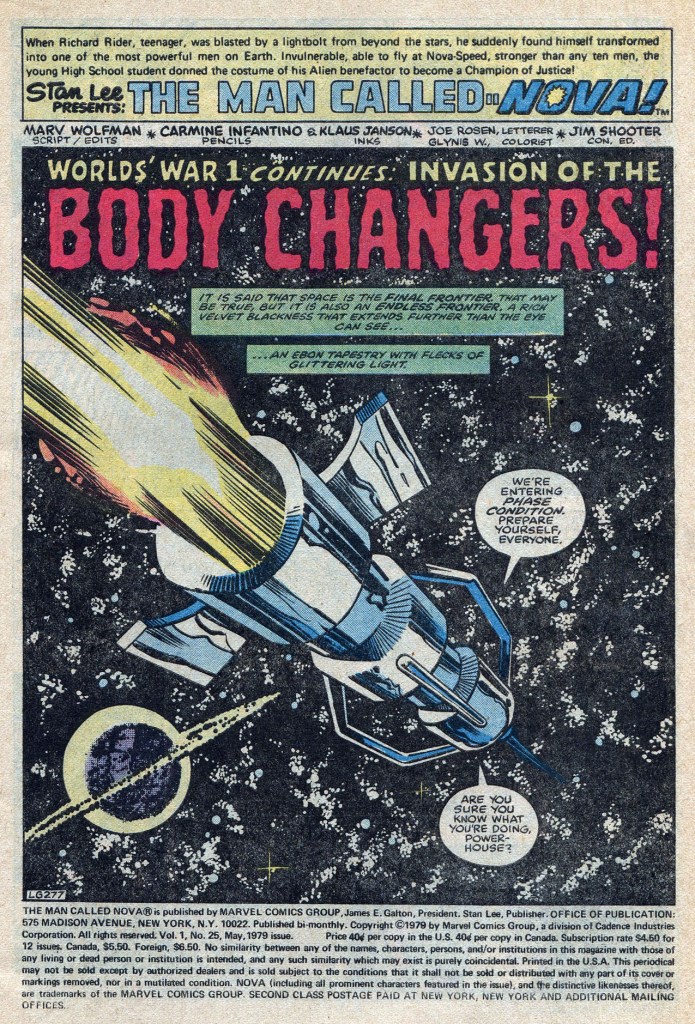
One of the factors that definitely had an impact on NOVA’s longevity was the selection of carmine Infantino as the book’s artist. Carmine had once been just about the most popular penciler in the field before serving as DC/National Periodical Publications’ top editorial executive for close to a decade. In the aftermath of his firing, Carmine was back on the streets as a freelance artist, and he brought a lot of skills to the table. But the expectations of the medium had changed since he stopped drawing regularly, and combined with the shift to smaller-sized original art boards, this tended to accentuate the stylistic quirks of Carmine’s work. Also, not to put too fine a point on it, I don’t know that Carmine was ever all that invested in anything that he was drawing to pay the rent in the latter portion of his career. Accordingly, his angular, impressionistic and quirky style was divisive among the fans of the period–I know that my small circle of comic-reading friends certainly had opinions about his work. His style was definitely not a fan favorite in the late 1970s.
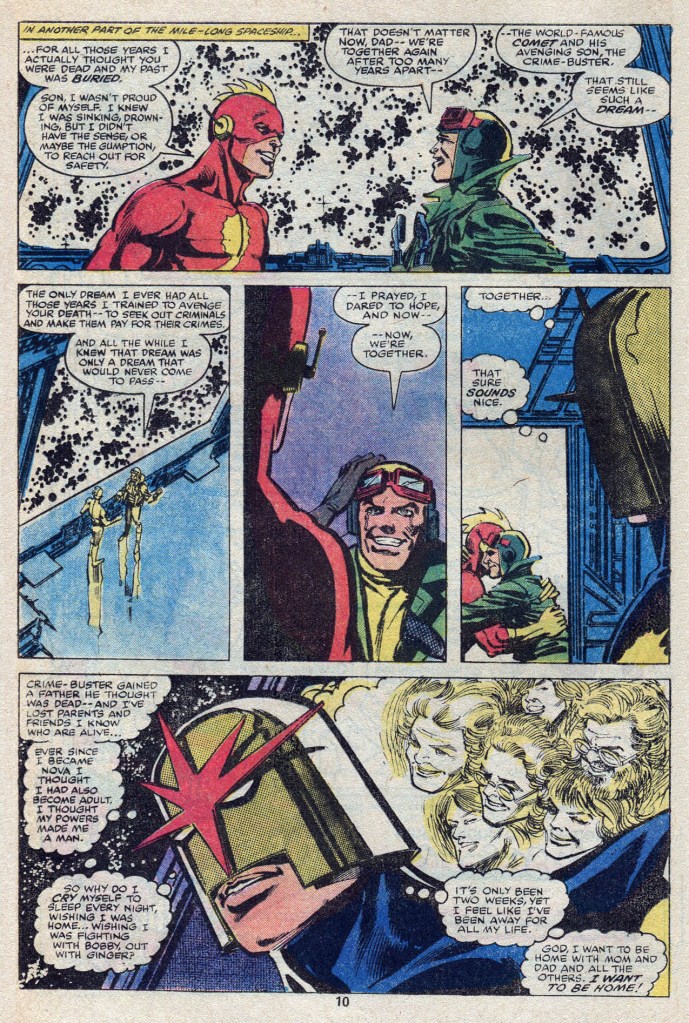
This particular issue, though, benefits from the strong inking of Klaus Janson. Janson was often a strong hand in these days, who added to and embellished any artwork he was working on. Accordingly, he was often paired with older artists whose storytelling skills were good but whose finish was considered a bit old fashioned. He was able to give such pages a nice modern sheen, as can be seen on the example above. It’s still clearly Carmine’s work, but the figures are all solider, the linework more controlled and the textures enhancing the feeling of reality. This was a very nice combination, one that I wish Carmine’s work had benefitted from more often in these days.
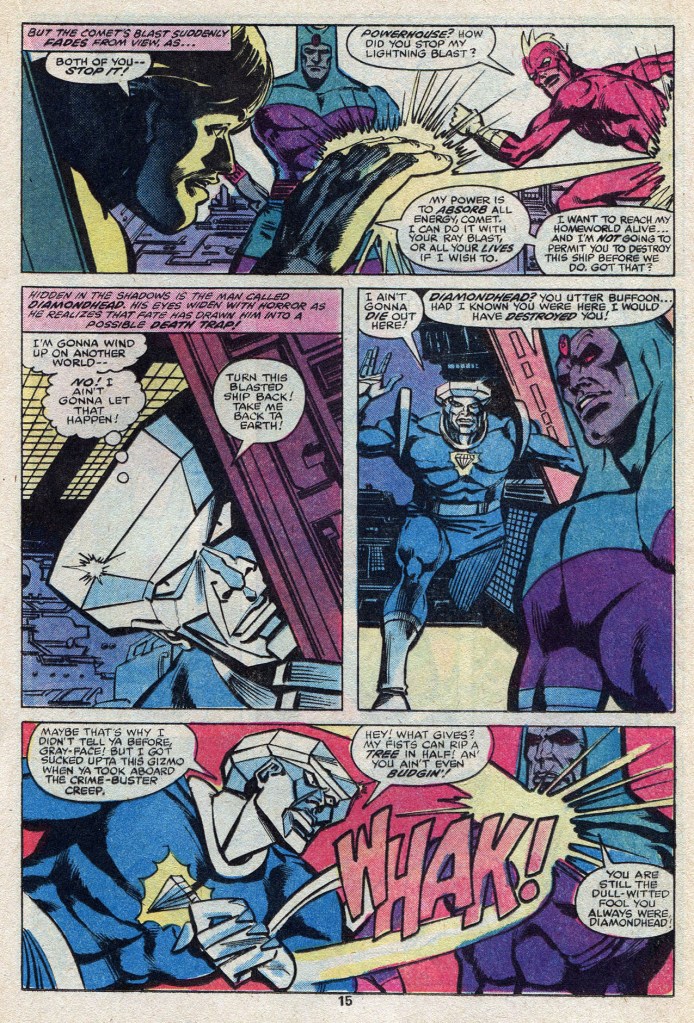
The story opens this issue with Nova and the loose confederation of costumed crazies that was haphazardly referred to occasionally as the New Champions aboard Nova’s starship and making their way towards far-off Xandar, the homeworld of the Nova Centurions. Among those gathered aboard teh ship are the Sphinx, Dracula for Doctor Sun, Powerhouse, 1950s hero the Comet and his sone Crime-Buster, and Diamondhead, an avowed enemy of Nova’s. The opening half of the book is spent in re-establishing all of these characters, who mostly end up engaging in little skirmishes with one another. But it all doesn’t amount to a whole lot more than recapping.
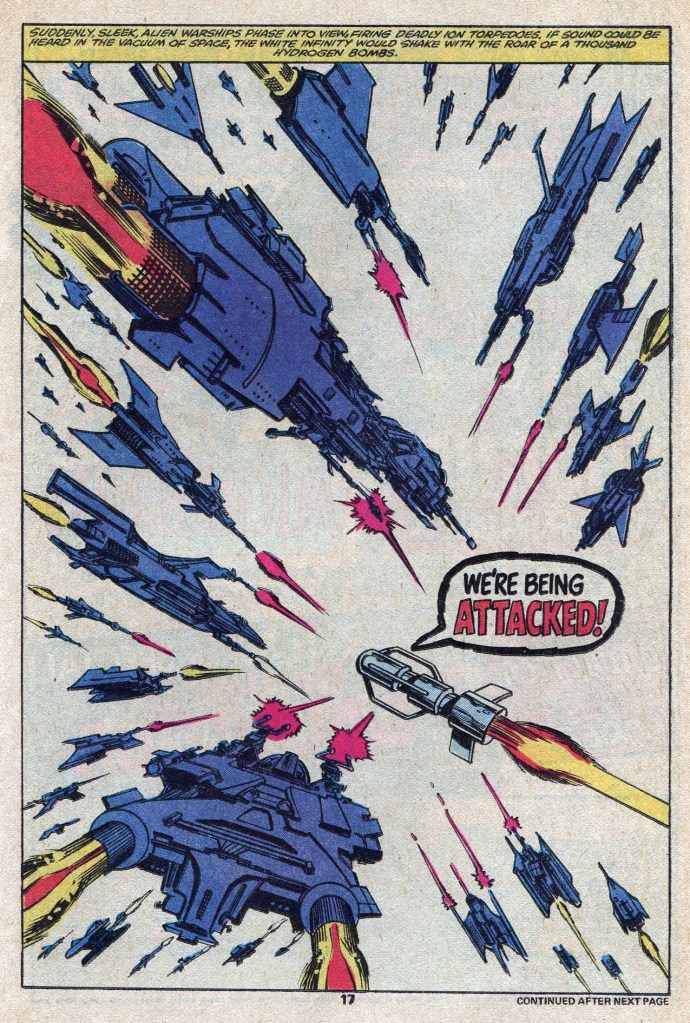
Finally, at the midway point in the issue, we start to move ahead what little actual story there is in this issue. As the Nova ship enters the Andromeda Galaxy, it it set upon by a fleet of enemy warships. Nova and the Comet race outside the ship in order to meet this attack, followed closely thereafter by Powerhouse. This leaves Diamondhead and Crime-Buster, who can’t survive in the vacuum of space, unattended in the control room. Diamondhead, though, simply wants to go back to Earth, and he takes his opportunity to try to turn the ship around. Crime-Buster attempts to stop him, but he’s no match for Diamondhead’s titanic strength. (The story loses all track of Doctor Sun at this point, and he makes no further appearances in the issue. I guess Carmine overlooked him.)
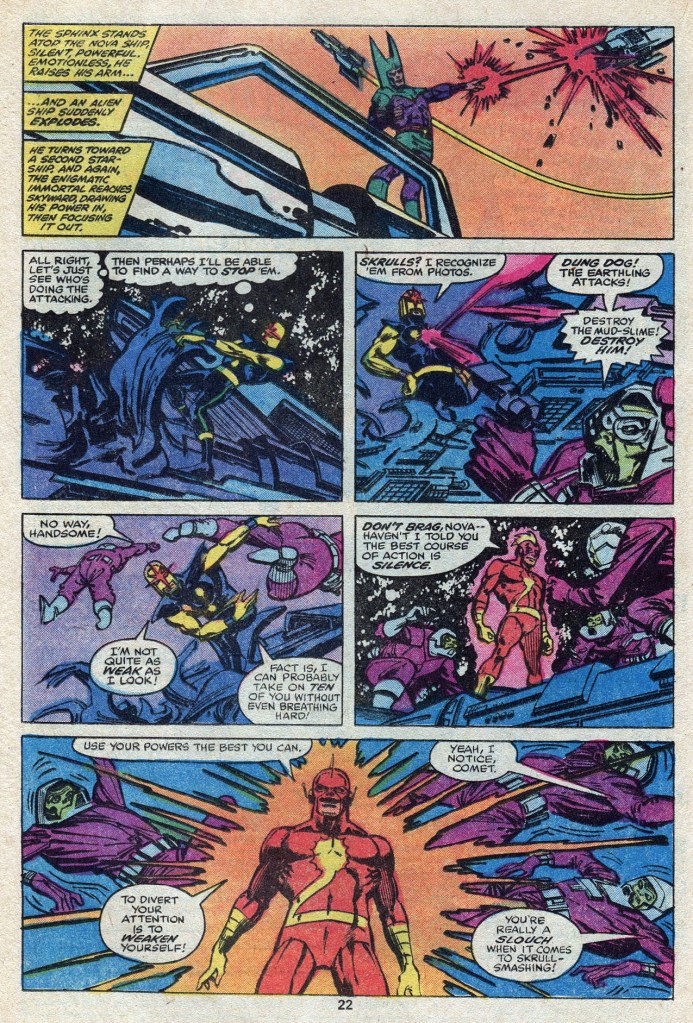
Nova, the Comet and Powerhouse fight their way into several of the attacking ships and learn that the aggressors are Skrulls, members of that shape-shifting alien race. The heroes don’t know why the Skrulls are attacking them, but they also pretty much don’t care, and they go to town on mopping up the shape-shifters with abandon. Meanwhile, sensing what is happening within the Nova ship, the Sphinx uses his Ruby to immobilize Diamondhead before he can change course, incidentally saving Crime-Buster’s life in the process.
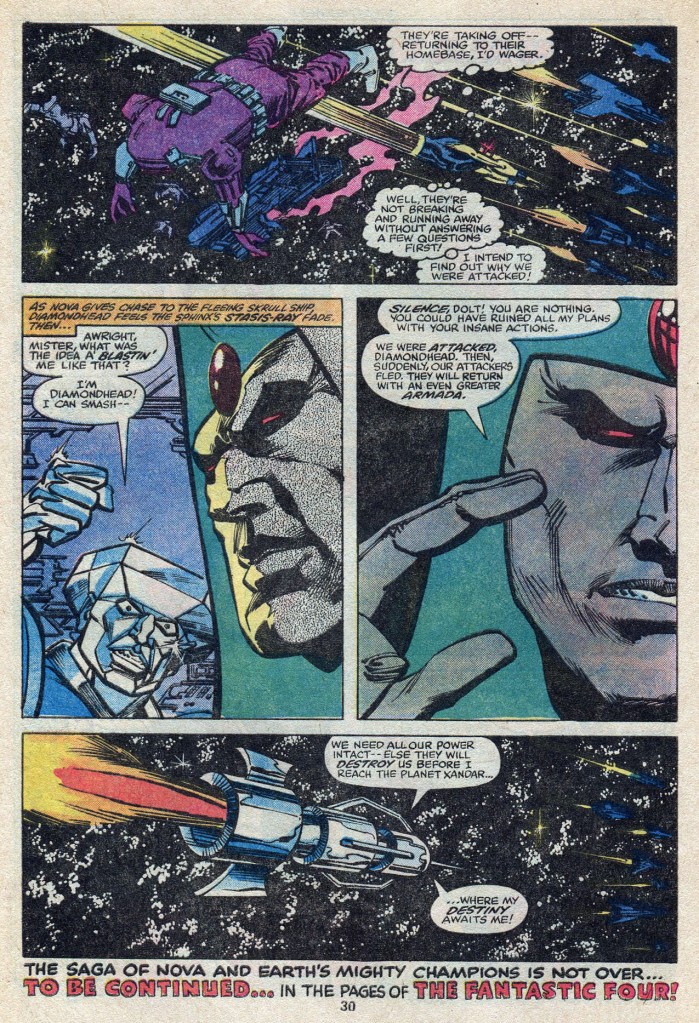
And that’s just about it! After taking a fierce pounding, the remaining Skrull ships skedaddle away, leaving the New Champions free to continue on their journey to Xandar. What would they find there/ That’s a question that would need to wait until future issues of FANTASTIC FOUR. But reading this issue again, I can see why the book was perhaps failing at this point. It’s crowded with characters, there’s relatively little plot, and the title hero, Nova, gets very much lost in the shuffle. NOVA was never a great comic book, but it was a good one, with a down-to-Earth super hero ethos that I really enjoyed when it was clicking. Sadly, it was another victim of the dwindling penetration of comic books in the mainstream, though the character would have better days awaiting ahead of him in the decades to come.
 The Tom Brevoort Experience
I liked Nova as a character, but I noticed something about him and the similar fates of his fellow new heroes of this time period — getting stripped of their powers ( Nova, Ms. Marvel, Black Goliath/Giant-Man II & Spider-Woman ( well a couple of them ). They never got to keep their powers like earlier Heroes whose series failed. Granted they all did eventually either get their original powers back or new ones in Carol Danvers case ( as Binary ). I like the first page of this last issue and Klaus Janson did help Carmine Infantino in this issue.
LikeLike
It’s not shown here but the scene with Powerhouse using his power to commandeer the Skrulls own shape-shifting powers as if he was with his bare hands moulding ( or molding ) them like they were made of clay. Syfon Warriors powers just make Xandar’s multiple downfalls mindboggling.
LikeLike
Bob Wiacek and Bob Layton also did a nice job inking Carmine on 2 separate occasions in Ironman 108 and 122 respectively. Likewise Rudy Nebres on Avengers #178.
I certainly liked Infantino’s work when I encountered it in reprint form on Adam Strange and Flash stories. His 70’s Marvel stuff was fine for the quiet moments, but his action sequences tended to come up short in the power department. That said… I think his newer work had a distinctive, expressive appeal even it lacks the crispness of his earlier less mannered 50’s and 60’s work.
I didn’t follow Nova where he was the regular artist. Since he did so many fill-ins of other titles I wondered if some of the Infantino backlash was due to how jarring his work could be when it popped up in storylines started by other artists like Pollard and Perez.
LikeLike
‘…solider’ ??? Wow. Tom, I have to tell you that you had me stumped briefly. ‘What on Earth did I just read??,’ I said to myself. ‘…soldier’? No. It’s ‘…solider.’ And then I realized! You mean ‘… more solid!’
LikeLike
That’s…what solider means…
LikeLiked by 1 person
Kind sir, I always follow your responses regarding Marvel topics. One question intrigues me: Thor vs. Hulk (current). While Thor seems to have grown in power, Hulk appears to be the same. I wonder if their rivalry will continue once Thor’s power boost diminishes.
I mean, it seems that nowadays Thor can only face the basic Hulk with the addition of the Odin-Force. Without it, they say Thor suffers from a significant physical and power disadvantage.
LikeLike
As always it’s interesting to read this analysis of inking, a part of comics-making my eyes don’t pick up on usually. Overall I enjoyed Infantino on the book.
I enjoyed Nova and didn’t mind the sprawling plotlines though yeah, I can see why this might have worked against the series.
LikeLike
I really only liked Infantino on Spider-Woman (a panel with her in civilian mode with a towel wrapped around her wet hair is permanently burned in my brain) and used to blame him for Barry Allen’s cancellation.
LikeLiked by 1 person
Nova was one of my favorite books when it was introduced but was foundering by the time the 25th issue was published. Although I liked Carmine Infantino on Spider-Woman – and, of course, his Silver Age DC work on Flash, Batman etc. – I found his work on Nova to be a step down from John and Sal Buscema. I wasn’t that crazy about characters like The Comet added to the mix as well.
LikeLiked by 1 person
Nova was the character that made me love comic books. My older brother would take me to our local comic book store (Comic Vendor in Torrance) and would let me pick out a couple of comics. I loved Spider-Man, but so did my brother so that felt more like his character. Nova #1 caught my eye, and I followed it all the way up to this issue. Was heartbroken when it was canceled.
LikeLike
I thought Klaus did a very nice job over Carmine, too. As did Terry Austin, Bob Wiacek, Joe Rubinstein, Bob McLeod, Tom Palmer, Al Gordon, Steve Leialoha, Joe Sinnott, P. Craig Russell…most of Marvel’s classy inkers of the era who knew how to interpret a loose penciler’s work did nicely, and Marvel got a bunch of them to ink him, at one point or another.
I don’t think he was much interested in superheroes, by then.
I did like the above-the-logo tagline on this issue…
LikeLiked by 1 person
Terry Austin’s inks / finishes over Carmine Infantino on Marvel’s Star Wars comic books were incredible.
LikeLiked by 1 person
I remember really loving Rudy Nebres inking Carmine Infantino for Steve Gerber’s “Night of the Beast!” Avengers story. Consulting the GCD I see that Infantino is credited with breakdowns, so perhaps Nebres had an even freer hand than Janson.
LikeLiked by 1 person
I get why Marv Wolfman would stack his New Champions with his co-creations ( Nova, Comet, Powerhouse and later Nova-Prime ( Tanak Valt ) & the Protector ( Prime Thoran ) [ Fantastic Four#208-209 ( July-August 1979 ) ] ), but Crimebuster is more of a Daredevil & Batman type hero whose name just doesn’t fit in a space team. Plus Marv just had Diamondhead try to kill Nova[ The Man Called Nova#23 ( January 1979 ) ], so he is not Hero material.
LikeLike
Amazing Cover from the far too underrated Keith Pollard!
LikeLiked by 1 person