


Marvel had begun to phase out its line of reprint titles, with only MARVEL TALES (starring the ultra-popular Spider-Man) and MARVEL SUPER-HEROES (featuring Marvel’s TV Sensation, the Incredible Hulk) making the eventual cut. I can understand why this was done–the marketplace was changing and there wasn’t the same need to both establish a large beachhead on newsstands to crowd off your competition nor for readers to be made aware of every previous story that the characters had starred in. But as somebody who came to the Marvel Universe seventeen years in, I loved being able to read these earlier stories (even if I and my friend did consider reprint titles “worthless” as back issues, as they would never meaningfully accrue in value.) And as former Editor in Chief Tom DeFalco pointed out on multiple occasions, MARVEL TALES was an easy book to put out and brought in a little bit of money–more than could be made by expending a similar scant amount of effort on something else.

MARVEL TALES had reprinted its way all through the run of AMAZING SPIDER-MAN of the classic 1960s and was now moving into the meat of the 1970s, a time when Spider-Man as a character and a series changed a lot. Some of that was down to the change in creative team. Writer Gerry Conway began to inject more and more of his own personal style into the stories, and this had both benefits and drawbacks. Gerry was around the same age as Peter Parker, so he had a better understanding of the concerns of that generation than Stan Lee could. But Gerry could also be a haphazard plotter. And artist Ross Andru, who had replaced John Romita, was something of an acquired taste as well. He used the environments of New York City like nobody else, but his Spider-Man tended to be thick and chunky, and his web-swinging and wall-crawling poses were always just a little bit strange. This splash page is a good example of what I’m talking about, it’s a weird angle at which to frame this moment, focused primarily on the web-slinger’s ass.
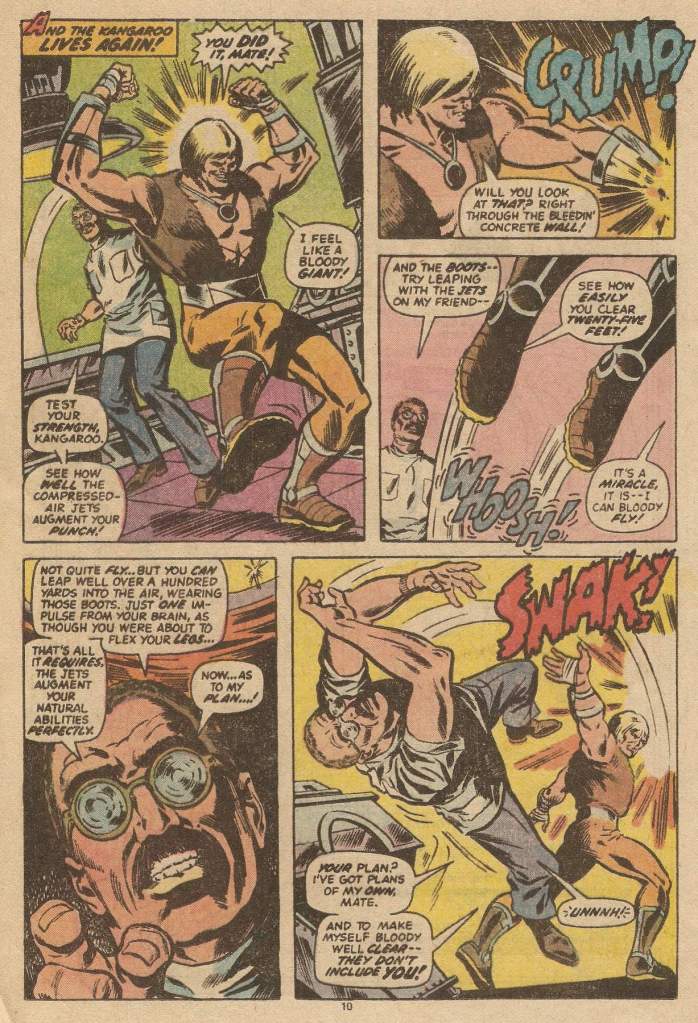
I also found Peter Parker in this period to be both a lot more with-it and plugged in than I liked at the time, and also something of a self-absorbed ass. Some of that can be chalked up to him being messed up in the aftermath of his girlfriend Gwen Stacy’s death, but really it all came down to the way in which Gerry approached scripting him. Anyway, the issue that’s reprinted in this MARVEL TALES release is a noteworthy one, even if it’s kind of a dog of a story. It’s the issue that introduces the Spider-Mobile. Because Spidey was becoming a cash cow for Marvel in licensing, Gerry was prevailed upon to introduce a car for Spider-Man that could thereafter be merchandised. Conway thought that this was crass and cheap (imagine how he must feel about all of the weird Spidey crap that exists today) and so went about doing the storyline under duress. He made the Spider-Mobile a running gag, and Spidey’s inability to properly drive it a recurring bit. Which was probably the best way to get Marvel fans at the time to accept such an outlandish development.
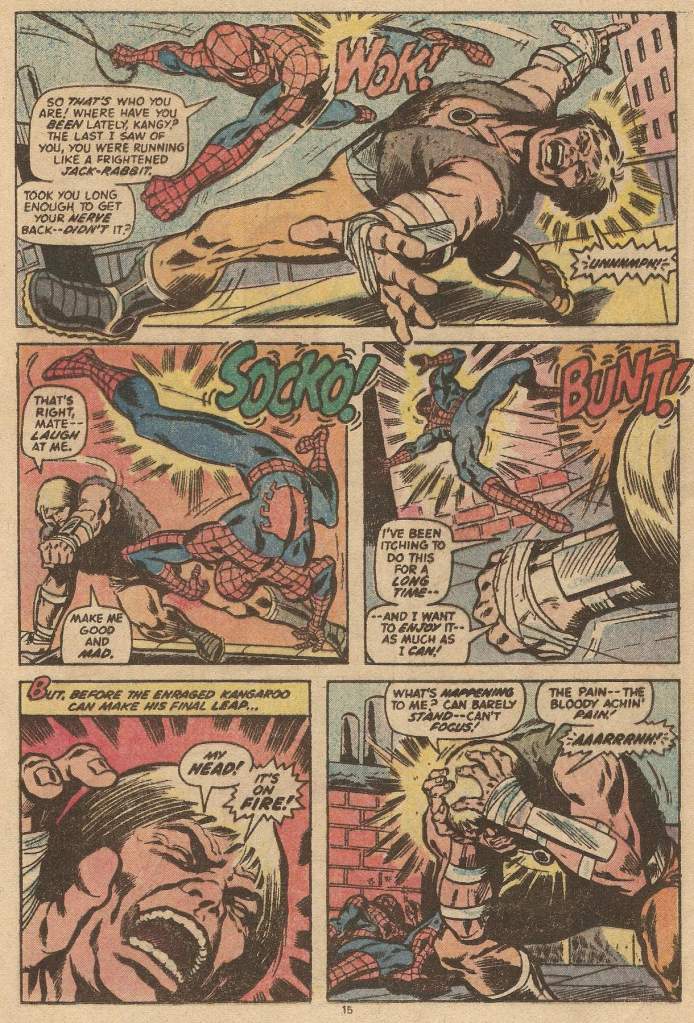
So this story opens up with Spidey being approached by Carter and Lombardo, who are not-quite-disguised caricatures of Stan Lee and Roy Thomas. They own Corona Motors, and want to hire Spidey to build them a car using their new non-polluting engine. After spending a couple of pages resisting this offer, Peter realizes that he needs the money too desperately to turn the opportunity down, and so signs on to craft a Spider-Mobile. Unfortunately, while he’s a science whiz, automotive engineering isn’t really Spidey’s strong suit. Meanwhile, one of Gerry’s recurring background players, mad scientist Jonah Harrow has turned his talents upon a hapless obscure Spidey villain, the laughable Kangaroo, and improved all of his abilities. He was hoping to use the Kangaroo as a minion, but the strong-willed Aussie refuses to fall in line and instead leaps away–swiftly getting into another dust-up with his wall-clinging nemesis.

But mid-fight, the Kangaroo is stricken with intense pain, and he breaks away to follow its signal back to Jonas Harrow, who took the precaution of implanting a control mechanism inside the super-villain before completing his upgrade. So now the Kangaroo has no choice but to carry out Harrow’s orders. Meanwhile, realizing that he’s going to need help to fulfill his contract with Corona Motors, Spider-Man seeks out the help of super hero gearhead Johnny Storm, the Human Torch, enlisting his friendly rival’s help in constructing his Spider-Mobile. But as the two work on the car, an alert comes in over one of the Fantastic Four’s alarms: the Kangaroo is attempting to break into a secret nuclear laboratory. The wall-crawler decides that he needs to face the Kangaroo on his own, and the Torch lets him do this for no really good reason.
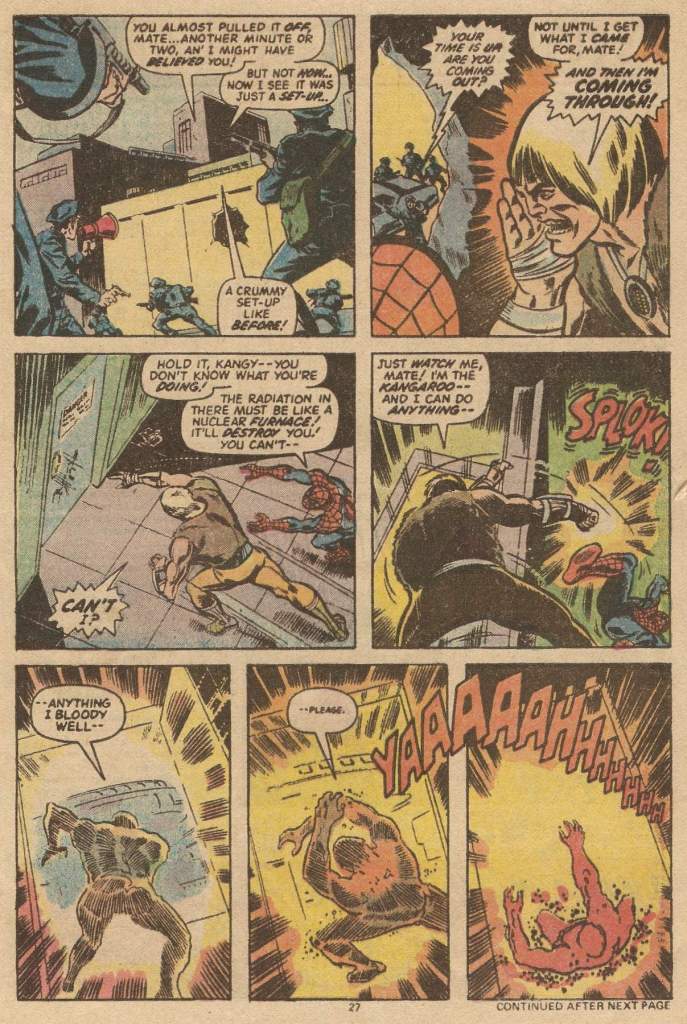
It turns out that what Harrow is after is certain radioactive elements that are stores in the research facility, and so he’s sent the Kangaroo there to break in and steal them for him. Spidey gets to the place before this crime can be completed, and launches into an extended fight scene with his high-leaping foe. But the Kangaroo is single-mindedly working to enter the area of the nuclear pile in order to carry out Harrow’s instructions, and despite Spidey’s repeated warnings that the level of radioactivity in that room would obliterate anybody. By the end of the fight, the heedless Kangaroo has opened the doorway to the chamber and gets fried to a crisp where he stands. How Spidey escapes also absorbing a lethal dose of radiation is anybody’s guess–must be partially proof to the stuff due to his own radioactive blood.
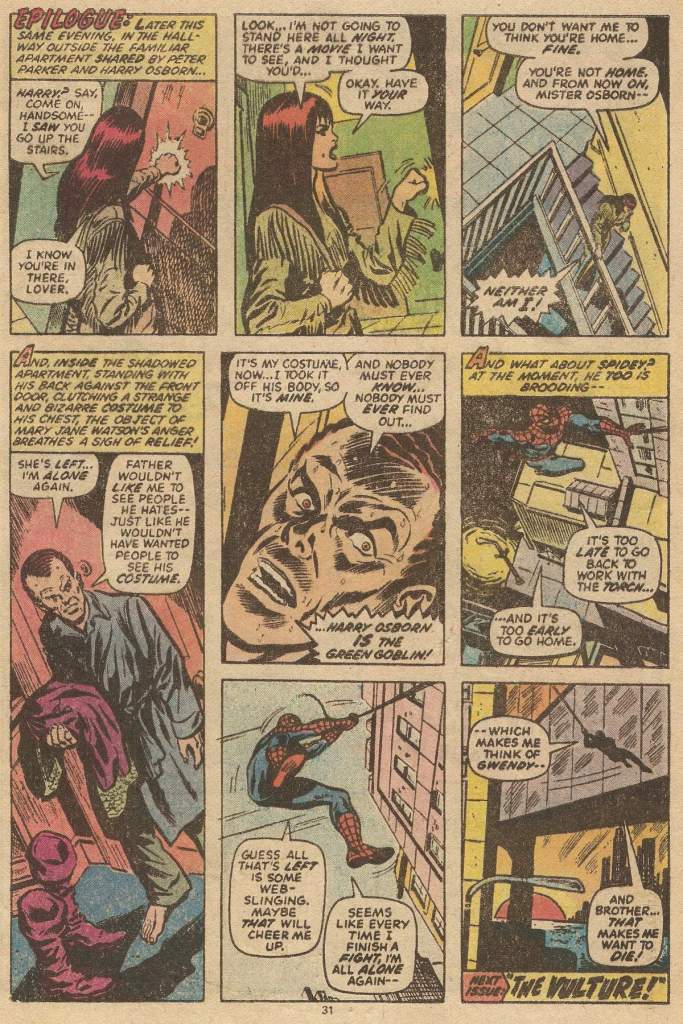
And that’s about it! A disappointed Harrow muses cryptically that he’s once again failed to acquire the power that he’s been after, but he’s determined to try again, which means that we’ll see the good doctor again in the future. And Spidey himself swings away, avoiding the cops who want him in connection with the murder of Norman Osborn. Speaking of Osborn, back at Pete’s apartment, Mary Jane’s knock on the door goes unanswered–but we see that Pete’s roommate Harry Osborn is actually still inside. What’s more, he’s got the costume of his father, the Green Goblin, and he’s clearly intending to take up the family business now that dad is dead. But that’s a problem for a future issue.
 The Tom Brevoort Experience
I remember the Official Marvel Handbook of the Dead under the Kangaroo entry said Spider-Man was shielded by the lead lined door as if maybe the author of the entry felt like they had to explain it.
LikeLiked by 2 people
The Kangaroo looks better the way he was in The Amazing Spider-Man#81 ( February 1970 ) and at least he doesn’t weird me out like the Timely Comics Kangaroo ( Kangaroo Man at comics.org ) [ Marvel Mystery Comics#49 ( November 1943 ) Human Torch story — used boomberangs with bladed edges ( coated with a formula that converts human blood into gasoline ) marvel.fandom.com ] — curious that the modern Human Torch is in this story.
LikeLiked by 1 person
Some fan had recommended bringing back the Kanga in (or about) the issues where Gwen and The Goblin die, so I guess it was fair dinkum the drongo galah wound up getting permanently sunbaked.
Say what you will, Conway was a bit more of a hardman than Stan, he did a few blokes and sheilas over.
LikeLiked by 1 person
The funny thing is, Kangaroo has nothing Aussie about his dialog other than “mate” and his first appearance didn’t have even that much. They’d have written him differently post-Crocodile Dundee.
LikeLike
Fair dinkum, I reckon . . . .
My father spent a fair amount of time passing through Australia as a US Mercanti Mariner during WWII. He was always happy to beat war time censorship by mentioning people in his letters home from his parents extended families who had been sent there on penal servitude from Scotland . . . .
LikeLike
I was never a Marvel Tales reader since I preferred the ones from the point I started reading comics, shortly before Gwen got killed off. I loved Andru so much that he’s still MY Spider-Man artist. TBH, I never have been much of a Ditko fan and Romita was awesome but he didn’t hit my sweet spot like Andru did. The only reprint title I bought religiously was Marvel Triple Action, which was a strange title for a series of Avengers reprints. I did buy the occasional Marvel’s Greatest Comic but Kirby wasn’t a favorite either and then current Fantastic Four never inspired the devotion Avengers and Spider-Man at the time did.
LikeLiked by 1 person
It was during the Gerry/Ross run I started reading SPIDER-MAN, and I had a similar reaction — Peter/Spidey was so brawny and so good-looking (and there were gorgeous women throwing themselves at him or following him around) that I didn’t understand why he was whining about his life being difficult.
After I read the Ditko issues, I got the appeal of the character much more, and when I reread these issues later, in context, I thought they worked quite a bit better than they had as an introduction.
Gotta say, Jim Mooney was not the inker for Andru. He was at his best, for the most part, with inkers with a bold graphic line — Romita, Giacoia, Giordano. Sadly, his inker of choice was his old friend and business partner, Mike Esposito, who didn’t do him any favors as an inker.
LikeLiked by 2 people
Did Mooney mesh well with anyone as an inker? I liked his style so it was never a turn off (Omega The Unknown and Supergirl were the best) but getting inked by Mooney would almost always look as if it were his art, not that of another artist. I guess my liking his art is why I never lumped him in with Chan or Dezuniga whose styles were not my cup of tea.
LikeLike
There are a lot of inkers who put their Owen style on the surface, which is what the publishers hired them to do. So meshing well isn’t a matter of preserving the penciler’s lines, but preserving the storytelling, the impact, etc.
Mooney was fine over Romita, either Buscema and lots of other artists, because their layouts with his finishes came out as solid comics pages that told the story well. It’s not what they’d do on their own, but they’re not doing it on their own; the result is a combination of their baseline and his rendering.
But over Andru, it’s not simply that he puts his own style over it, it’s that the stuff that make Andru good — the depth, the dynamic angles to the figures, the energy — is all softened, less effective. Planes of depth aren’t differentiated as well as they might be, figures are less striking, there’s less tension. The end result is less than the sum of the two parts.
Giacoia or Romita over Andru strengthens what works, maintaining what Andru does well and adding what they do well. But Mooney loses Andru’s strengths in the process of adding his finishes, so, not a great combination.
LikeLike
The word I would use to describe Mooney’s inks in general is “feathery.” I didn’t dislike his work by and large though I think he had a tendency to overwork it. In this particular case of inking Andru he’s toned back the feathering and went heavy on the spotted blacks.
LikeLiked by 2 people
A bloody silly character but a shocking death all the same.
LikeLiked by 3 people
Love the old 35 cent or in this case 40 cent “Starburst” and trade dress used over vintage cover art.
This issue #103 the first Spider-Man reprint I ever had.
LikeLiked by 1 person
Same-ish. Maybe not the first Spidey reprint I had, but definitely among the first 5 or so when I started buying random back issues at a local used bookstore in the mid-1980s.
LikeLike
I remember Wizard making fun of the Kangaroo by saying something along the lines of “Where’s he from? And what does he do?”
LikeLiked by 1 person
This is just as silly as a villain named “The Kangaroo”, but what I notice over and over on these pages is that connected balloons in the same panel EACH have a tail pointed at their speaker. You can see this on Page 1, in MJ’s 2nd Panel on the last page, and throughout the issue. Not every time, but very often. I certainly can understand it when each balloon is separate and distinct— but when their connected? Milton Caniff did this, too, on his STEVE CANYON strip— possibly about the same time as these pages were originally lettered?— and it’s a style that still drives me crazy. I know it was a different time then, but it just seems like over-explaining and not trusting your audience.
LikeLiked by 1 person
“Marvel had begun to phase out its line of reprint titles, with only MARVEL TALES (starring the ultra-popular Spider-Man) and MARVEL SUPER-HEROES (featuring Marvel’s TV Sensation, the Incredible Hulk) making the eventual cut. I can understand why this was done–the marketplace was changing and there wasn’t the same need to both establish a large beachhead on newsstands to crowd off your competition nor for readers to be made aware of every previous story that the characters had starred in.”
The history of Marvel’s reprint titles in the late 1970s and early 1980s is a good deal more complicated than this. In 1978, the previous year, Marvel averaged about five reprint comics a month. In early 1979, it was cut down to the two titles mentioned. But in the fall of 1979, it was increased to seven titles a month, where it stayed for a little over a year. Beginning with the February 1981 cover-dated releases (which reached newsstand vendors in November of 1980), this was cut back to between three and four a month: MARVEL TALES, MARVEL SUPERHEROES, and MARVEL SUPER ACTION (Avengers), which were monthly, and SGT. FURY, which was bimonthly. MARVEL SUPER ACTION was cancelled with the November 1981 issue, which reached newsstands that August. MARVEL SUPERHEROES and SGT. FURY ended the following month.
At this point, Marvel’s early 1980s reprint program(s) begin in earnest. A month after MARVEL SUPERHEROES and SGT. FURY are cancelled, the Baxter reprint line, which was mostly restricted to direct-market-only titles, begins with the STAR-LORD one-shot reprinting the Claremont-Byrne-Austin stories. Also: MARVEL TALES, the only newsstand periodical reprint title still standing, features the last of its 1970s AMAZING SPIDER-MAN reprints. With the next issue, MARVEL TALES reboots with an issue-by-issue reprinting of the Lee-Ditko Spider-Man run. The Baxter line stalls for a year after the STAR-LORD issue. This was most likely due to the launch of the short-lived Marvel Illustrated Books mass-market paperback line. But the Baxter reprints come back in August of 1982 with the Starlin WARLOCK reprint. One generally sees at least one release a month from the line for the next few years.
LikeLike
While the UPC code on the Marvel Tales reprint blocks the view of the TV and/or radio station’s call letters, does anyone know why the original ASM 126 had the station’s call letters begin with a K? I thought since New York is east of the Mississippi River, the broadcast stations there would begin with a W. Yes, I realize that noticing things like that makes me a very sad, nerdy person.
LikeLike
I don’t know about NYC but when I lived outside Pittsburgh ages ago there was one TV station with a K call sign even though it was W territory. Did NYC have a K station too?
LikeLike
KROC in NYC, the station where Howard Stern used to work.
KYW News Radio in Philly.
LikeLike