

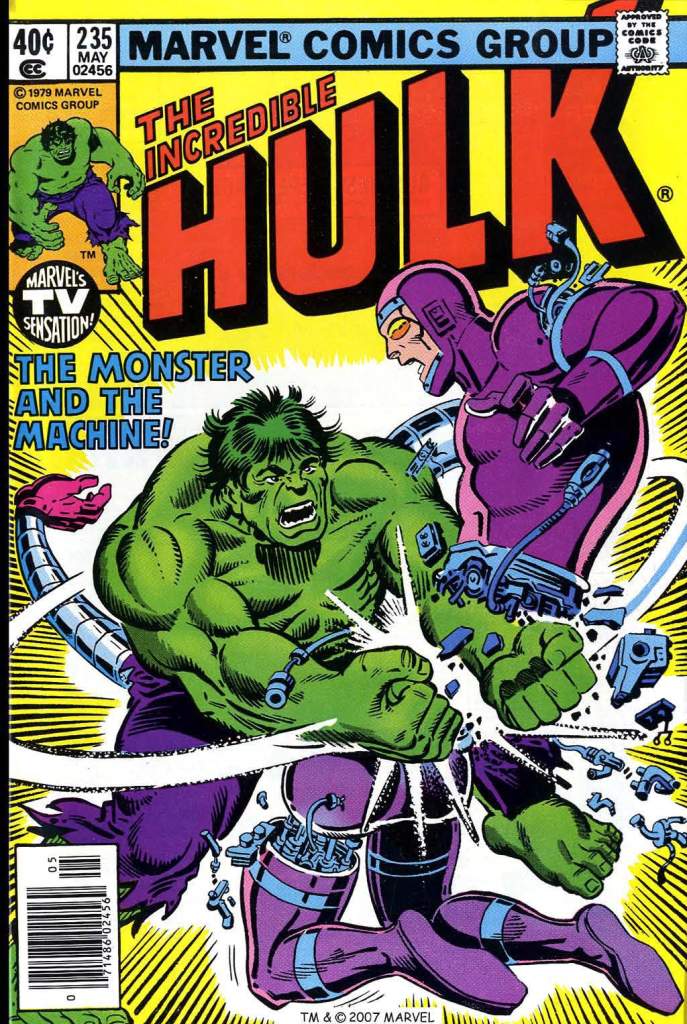
He’d been teased over the course of the previous month, but this issue of INCREDIBLE HULK firmly brought Jack Kirby’s creation Machine Man into the Marvel Universe proper. The character had debuted in the last couple of issues of Kirby’s 2001 and possessed ties to the mythos of that film. But after 2001 had run its course, Machine Man was spun off into his own short-lived series, also produced by Kirby. And like most of Jack’s projects during this time, he gave scant thought to the idea of a larger interconnected Marvel Universe–he just wanted to tell his stories his way. So it was left to those who came after him to integrate his concepts into the established canon (however awkwardly in some instances.)

One person who clearly liked Machine Man was INCREDIBLE HULK writer Roger Stern. Stern had already been one of the writers following up on Kirby’s evil Corporation that had played a role in both MACHINE MAN and CAPTAIN AMERICA. But here, Roger goes the distance and brings both Machine Man himself and his supporting cast into contact with the Incredible Hulk. Of all of Kirby’s later Marvel works, Machine Man may have been the smoothest fit (though any mention of the Monolith or elements of 2001 had to be completely avoided for legal reasons.) Machine Man was about the closest Kirby had come to producing a new regulation super hero during that time, so it’s understandable that creators such as Stern would see further potential in the character.
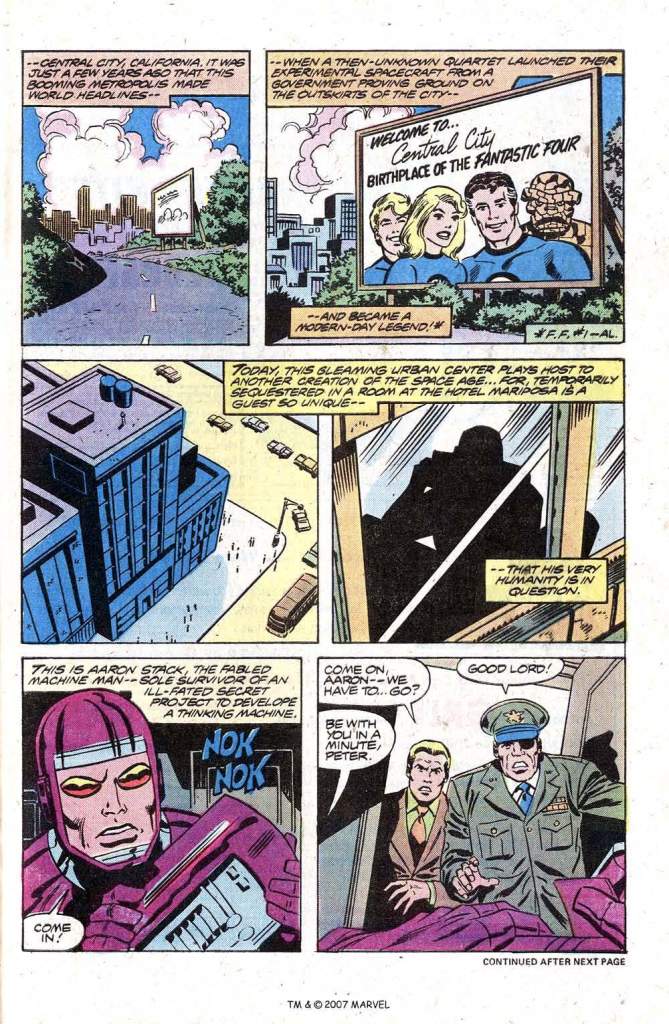
Last issue, seeing an opportunity to neutralize two separate thorns in his side, Senator Jackson, a Corporation head, had one of his men abduct the Hulk’s friend Trish Starr while attired as Machine Man. The intention here was to enrage the Hulk and get him to attack machine Man in the hopes that the pair would wipe one another out. So this issue opens with the Hulk leaping towards Central City–a long-forgotten footnote in Marvel history, the original birthplace of the Fantastic Four–where Stern has decided to situate Machine Man’s past adventures. (Why a town called Central City is situated in California on the West Coast is anybody’s guess.) There, Aaron Stack is on trial to determine his status as a thinking being. But the Hulk doesn’t care about any of that, he just wants to smash the one that stole his friend Trish.

Fortunately for Machine Man, the recent death of Senator Stivak works in his favor, and the inquest is put on indefinite hold, with him remanded into the custody of his friend Peter Spauling. Meanwhile, the Hulk and associate Fred Sloan have made their way to the address that the faux Machine Man had left them with, which turns out to be Peter and Aaron’s place. Fred urges the Hulk not to simply go smashing in for fear that Trish may get hurt–apparently, it’s occurred to neither one of these goofballs that this whole thing may be a trap on the part of the Corporation. Either way, the pair go inside to investigate, just before Peter and Aaron arrive home back from the hearing.
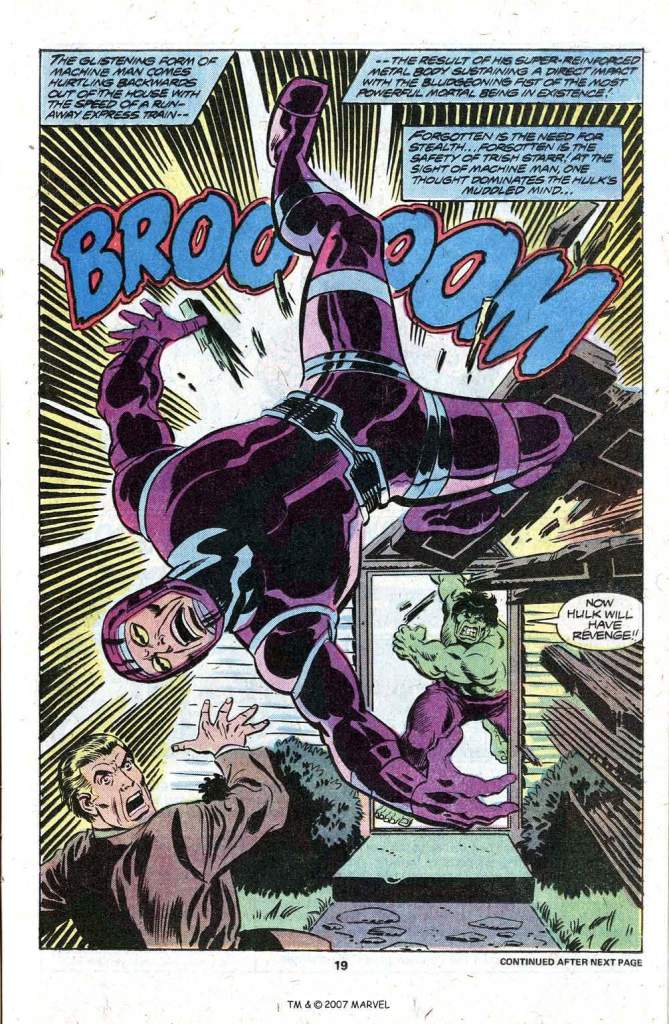
Realizing that somebody has broken into their place, Machine Man urges Peter to wait outside while he investigates, fearing that the corporation may be after Peter once again, as they were in the previous MACHINE MAN series. But of course, it isn’t the Corporation, not directly–and an instant later, Machine Man is sent hurtling back through the doorway, having been propelled by the angry fist of the Incredible Hulk! That’s right, it’s fight scene time! Artist Sal Buscema is about to go to town.

Machine Man tries to convince the Hulk that he’s got no idea what the green goliath is talking about, but this Hulk is simple-minded, and the Corporation’s abductor was dressed up like Machine Man, so he’s not in any head space to listen. Meanwhile, inside the house, Fred Sloan gets the drop on Peter Spaulding with a gun that he found secreted in a drawer. Fred’s an old school hippy who isn’t comfortable with firearms, but he’s got no choice but to keep Spaulding covered. Meanwhile, outside, Machine Man’s many built-in weapons systems prove to be no match for his gamma-powered rampaging foe, and the Hulk winds up smashing Machine Man to pieces. Discovering that his enemy is another “stupid robot”, the Hulk intends to turn his fury on Spaulding.

As the Hulk heads back into the building to confront Peter, he’s unaware of what is transpiring directly behind him. Because Machine Man is able to effect automatic repairs on his damaged frame, and he begins to reassemble his shattered form. But the process is taking too long, and as the issue closes, Aaron stack frets that the Hulk may kill Peter before he can rejoin the battle. To Be Continued!
 The Tom Brevoort Experience
There really IS a Central City in California though. It’s on the old pioneer trail in Northern California. And it’s altitudinous which might explain why it was suitable for an early rocket launch.
LikeLiked by 2 people
I didn’t like much of Kirby’s last era at Marvel but Machine Man and the Eternals were an exception. I even like Machine Man’s take post Warren Ellis so long as it doesn’t devolve too far into bad comedy. I read this and wondered though if Aaron’s cast or Fred Sloane have reappeared since those days? Maybe someone with a surname beginning with H would know?
LikeLiked by 1 person
The Kirby return period I always think of in terms of his fellow animation contributor Steve Gerber – both of them produced …eccentric… final Marvel offerings before going into animation, and neither of their “sub-sets” of Marvel fully work when shoehorned into the usual cyclical pablum.
Machine Man was generic enough to function as a superhero but had a wonderful almost magical aspect that has been bowdlerized pretty much ever since the 1980s – the original romance with Jocasta never turned into a proper love triangle with Ultron, and Machine Man never became a mainstream Avenger for example even though he is a useful analog for Iron Man as well as having the 1000 gadgets type gimmick.
Machine Man’s supporting cast for me are no less important and less interesting than the main character and while they weren’t brutally massacred like ROM’s human supporting characters it is indeed sad to see them fade out. There is an enormous resource of non-powered Marvel characters most of whom would be fascinating to explore. Manga would take the time to do so at some point but modern American comics are still trapped in the chumbucket rehash so I doubt they will ever return, sadly.
A comicbook similar to the old Marvel Two-in-One or Team-Up where it’s only non-powered ex-pals of superbeings could be a lot of fun, sort of an ongoing or graphic novel series like ASTRO CITY or MARVELS.
LikeLiked by 1 person
Fred Sloan apparently wrote a book about the Hulk. He doesn’t have many appearances after Hulk #256, but he has a couple.This is from 2008:Giant-Size Incredible Hulk Vol 1 1 | Marvel Database | Fandom
LikeLiked by 2 people
I suppose Central City could be in the center of California, since none of the other meanings for Central apply ( adjective 2. of the greatest importance, principal or essential. noun . a place with a high concentration of a specified type of person or thing ( Google ) ). OTHER CENTRAL CITYs: Central City [ Yellow Claw#4 ( April 1957 ) 3rd story — see Sleepy Eyes profile at marvunapp.com ], Central City ( near Hannibal, Missouri )[ Captain America Comics#39 ( June 1944 ) “On The Square: text story ] or Central City [ The Human Torch#23 ( Summer 1946 ) Human Torch 1st story “The Amazing Swindle” ].
LikeLiked by 1 person
In its day this was an action packed and fun read. I’m also a fan of Sal’s Hulk so it still holds up very well for me!
LikeLiked by 1 person
I remember picking up Machine Man #1 at a 7/11 when it came out. Machine Man definitely had a “your father’s Oldsmobile” vibe swirling around it. I still thought Kirby’s work had power and was interesting… but Machine Man felt like a somewhat warmed over concept despite it’s old fashioned charm. I liked the character well enough to get the entire run and most of his earlier appearances including this one here.
A lot of folks less durable than MM get through fights with the Hulk without having their arms and legs torn off. Just sayin’
LikeLiked by 1 person
Almost a decade later another character would get his limbs ripped off by the Hulk ( grey version ) [ The Incredible Hulk#334 ( August 1987 ) ] — gamma mutate Half-Life ( Tony Masterson ). Machine Man pulling himself together made me remember Half-Life doing the same thing. In Machine Man’s cast it was probably done in overkill style to hit us over the head that Machine Man was a robot.
LikeLike
Aaron was dismembered probably because he could be and not killed. Do that to a lesser opponent and there’s be blood and guts all over and a pretty big case of dead!
LikeLike
What a terrific splash page. Great expression on Fred.
I didn’t think Machine Man fit the Marvel Universe terribly well, though it wasn’t as bad as ETERNALS. Being the “first intelligent robot” in his own world was interesting and distinctive. In the Marvel U, though, he’s just another superhero, and he’s not even the first intelligent robot any more.
It’d have worked better creatively (if not sales-wise) to set up ETERNALS and MACHINE MAN in their own side-universe. Heck, throw in DEVIL DINOSAUR, “Norton of New York” and some of Kirby’s fantasy/horror shorts that’d suit that kind of purplish world. Not that that would have happened at Marvel in the 70s, but still.
“Why a town called Central City is situated in California on the West Coast is anybody’s guess.”
Well, there are Central Cities in Virginia, Alabama and South Dakota, among others. I figured it was in central California.
And if Midtown High can be in Forest Hills…
LikeLiked by 1 person
Dynamic opening splash page.
LikeLike
I never thought Machine Man fit very well in the Marvel Universe. I mean, in a world where you have Iron Man, The Vision, Ultron, the original Human Torch and Doombots running around what’s so great about another humanoid robot? He really wasn’t all that original in such a setting.
LikeLike
That’s true if he’s not written well; not given a good, likeable, and/or interesting personality; and not given interesting things to do. Superhero comicbooks are full of redundancies. It’s what you do with the characters that counts most. A good enough creative team can elevate almost any character. Machine Man doesn’t have the severe inherent limitations of, say, a Red Bee. The Red Bee would need more of an overhaul. But even still, on a lower level, far below facing Darkseid or a Galactus-level threat, the Red Bee might surprise us.
LikeLike
One thing, Iron Man isn’t a robot ( but Tony has made Iron Man & Tony Stark Robots ), Ultron is a genocidal robot, Vision in his first appearance wasn’t described by Goliath ( Dr. Hank Pym ) as robotic ( but was later during the Kree-Skrull War made robotic ) and the Original Human Torch was at Timely & in the original Invaders series an Android ( Flesh, Tissue, Bones & artificial blood being that could be drugged [ Marvel Mystery Comics#26 ( December 1941 ) chloroform knocked him out ( not the only Timely Comics time he was drugged ][ The Invaders#19-20 ( August-September 1977 ) Drugged by the Nazis along with the rest of The Invaders for their firing squad deaths ]– need an organic brain for that and Human like eyes to be affected by Tear Gas [ All-Winners Comics#2 ( Fall 1941 ) ]). As for Machine Man his is cool like his prototype the Thinker’s so-called Most Powerful “Android” ( in reality Robot ) [ Fantastic Four#70-71 ( January-February 1968 )]. Plus Machine Man has been upgraded so he can do the kind of things we see Iron Man’s armour doing in Avengers: Infinity War & Avengers: Endgame movies.
LikeLike
A form of lingual drift has changed it but the word android originally meant an artificial person created using artificial means to mimic biological processes. Could that be why the OG Human Torch was susceptible to attacks that worked on humans? I’m sure some writers had no clue what being an android entailed originally but their writing fit.
LikeLike
“the word android originally meant an artificial person created using artificial means to mimic biological processes.”
That’s not really true. The word dates back to the 17th century in English, and meant a mechanical automaton in a man-like form.
The idea that androids and robots were different dates to the pulp era, a couple of centuries later, but it’s merely a convention of SF, and not consistently used in SF either. Some androids mimicked biology, some were mechanical. The original Human Torch and the Vision do both.
All “android” means, at core, is “man-shaped,” just as “gynoid” mean “woman-shaped.”
LikeLiked by 2 people
I didn’t know about the deeper past of the word so it’s good I got past my bugaboo about the innards of androids as being shown as purely mechanical, eh?
LikeLike
Mr. Busiek just taught me something interesting. Cool.
LikeLike
Iron Man is not a robot, however there was a storyline where his armor gained sentience and became self aware and was trying to kill Tony Stark. As for all of the others – if you go all “Big Bang Theory” in discussing them, it’s true they all fall under various categories and types and certainly they are different from one another. At the same time they’re all in a similar vein. At the end of the day they were all built or assembled by someone. It’s like Spider-Man said when describing Scarlet Witch’s relationship with Vision: “She married a robot” (Avengers Disassembled #4). I just never saw anything original about Machine Man. To me he seemed like just another robot (yes – I’m using the term loosely). Granted, I only ever read his first series so there may be something I’m missing out on.
LikeLike
But Roy Thomas in the original Invaders series and John Byrne in West Coast Avengers/Avengers West Coast were both using R.U.R. ( Rossum’s Universal Robots ( 1920 ) play by Czech writer Karel Capek ) version of Android [ https://en.wikipedia.org/wiki/R.U.R. –SYNOPSIS: The play begins in a factory that makes artificial workers from synthetic organic matter. ( As living creatures of artificial flesh and blood, that later terminology would call androids, the playwright’s ‘roboti’ differ from later fictional and scientific concepts of inorganic constructs ( Me adding this part — meaning Robots like the Human Torch & Toro robots the Vulture built in Young Men#26 ( March 1954 ) Human Torch first story or the more advanced Baron Strucker robot made by Machinesmith in Captain America#247 ( July 1980 ) ) ] as did the writer Hank Chapman of Young Men#24 ( December 1953 ) Human Torch story ( Torch says he was born in a test tube ). It was why John Byrne liberated the original Human Torch from the Vision and pointed out the difference between an Android and Robot.
LikeLike
John actually had a character lecture Hank Pym on the meaning of the word “synthozoid,” a term Hank made up.
LikeLiked by 1 person
Here is an Atlas Age fan of R.U.R., unnamed writer of [ Astonishing#38 ( April 1955 ) 1st story “The Man Who Didn’t Belong!” — a ship was carrying a number of Androids ( described as synthetic humans grown in tubes. They were taking the androids to an island to educate them ) and went down in a storm, one survivor hung on to a crate carrying one of the androids. On the island he made it to, he opened up the crate and found a beautiful female android ]. To be writers robbing the Original Human Torch & Dynamic Man of being an R.U.R. class Android robs us of a story with either or both of them getting turned into early teens by someone like the Cherub ( Dr. Franz Neunmensch ) [ Miss America Magazine#5 ( December 1944 ) Miss America story — see marvel.fandom.com ] or take a Timely Comics gem and give magical powers to do the same ( Like Roy Thomas did when he took the Hammer Of Thor used by Hawkman in the first appearance of the Justice Society of America and gave it powers in All-Star Squadron#18 ( February 1983 ) ). Plus if the Vision & Machine Man ( Plus any other Robot Hero & none robot Iron Man ) can interface with Computers why the need to make every artificial being robotic or partly robotic. I want BOTH OF THOSE TIMELY COMICS ANDROIDS TO BE R.U.R. CLASS. Roy Thomas also created a R.U.R. Class Android grown like a plant ( seen inside a chemical filled transparent tube ) that they didn’t know how to bring to life created by a Professor or Doctor Rossum [ Young All-Stars#12 ( May 1988 ) At Project M, which held the body of a giant ape that fell off a building and a T-Rex that the Ultra-Humanite put he brain in ].
LikeLike
Always loved that term. I imagined it “Synthezoid”. Very Sci-Fi to me. I like the cornier “mandroid”, too.
LikeLike
“but this Hulk is simple-minded” That you have to specify that shows how much Jade-Jaws has changed since then.
LikeLike
U.S. Government created/funded Robots in the Atlas Age: Charlie ( robot computer human sized )[ Journey into Unknown Worlds#36 ( August 1955 ) 2nd story “Calculated Risk” ], Dillon ( Human looking Robot computer ) [ Strange Tales#36 ( June 1955 ) 5th story “The Secret Weapon” — he was cold to people ], Doctor Rex ( a.k.a. Sgt. Blue ( robot, spoke like a robot as Sgt. Blue but as Dr. Rex like a Human and wore a tight fitting mask over his head to hide his robot nature ) [ Suspense#6 ( January 1951 ) 2nd story “I Deal In Murder! – script/pencils/inks/letters by Bill Everett — Dr. Paul Marco ( inventor ) ], Test X-1 ( Human looking Robot pilot ) [ World of Suspense#4( October 1956 ) 6th story “Brainwash” – Dr. Caruthers — Marla ( attractive Commie Femme Fatale ) ] and there is another one ( need to track it down in the USB ) that was about a Human looking U.S. Robot vs. a Human Looking Commie Assassin Robot.
LikeLike
Iron Man is not a robot, however there was a storyline where his armor gained sentience and became self aware and was trying to kill Tony Stark. As for all of the others – if you go all “Big Bang Theory” in discussing them, it’s true they all fall under various categories and types and certainly they are different from one another. At the same time they’re all in a similar vein. At the end of the day they were all built or assembled by someone. It’s like Spider-Man said when describing Scarlet Witch’s relationship with Vision: “She married a robot” (Avengers Disassembled #4). I just never saw anything original about Machine Man. To me he seemed like just another robot (yes – I’m using the term loosely). Granted, I only ever read his first series so there may be something I’m missing out on.
LikeLike