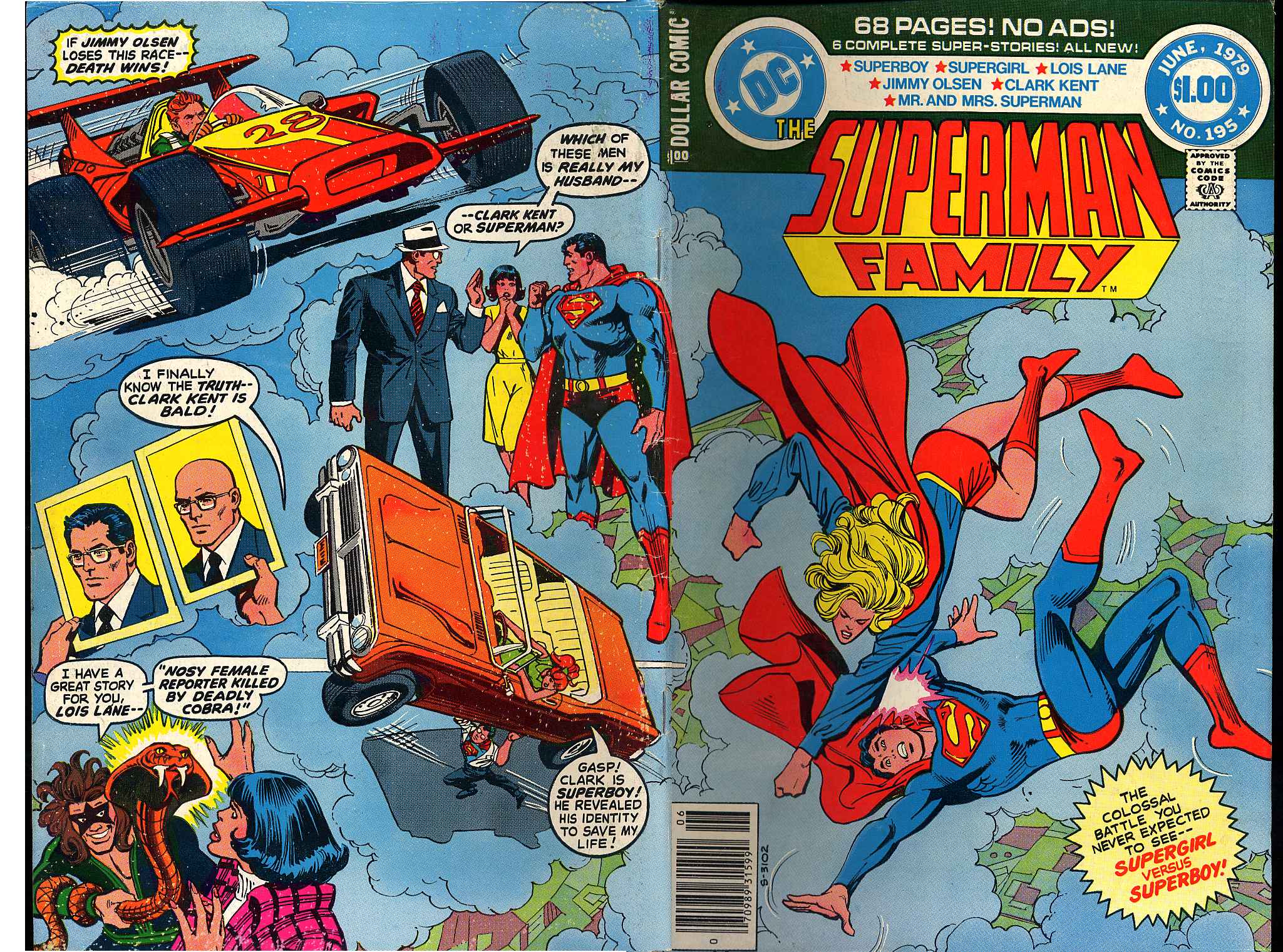


DC’s Dollar Comics program didn’t wind up being the industry game-changer that new publisher Jenette Kahn had hoped it would, but it was a format that the company pursued for several years and resulted in some decently-crafted anthologies. Case in point is SUPERMAN FAMILY, which was never a great comic book but which was a steady and regular purchase of mine all the way to the end of its run. It offered enough variety that there was almost always something worth reading within its pages for a reader who enjoyed the Man of Steel and his extended cast of characters. Comfort food, a bit of inconsequential entertainment, swiftly read and swiftly forgotten. This had been DC’s stock-in-trade for decades at this point, so it was a form they were very experienced in employing.
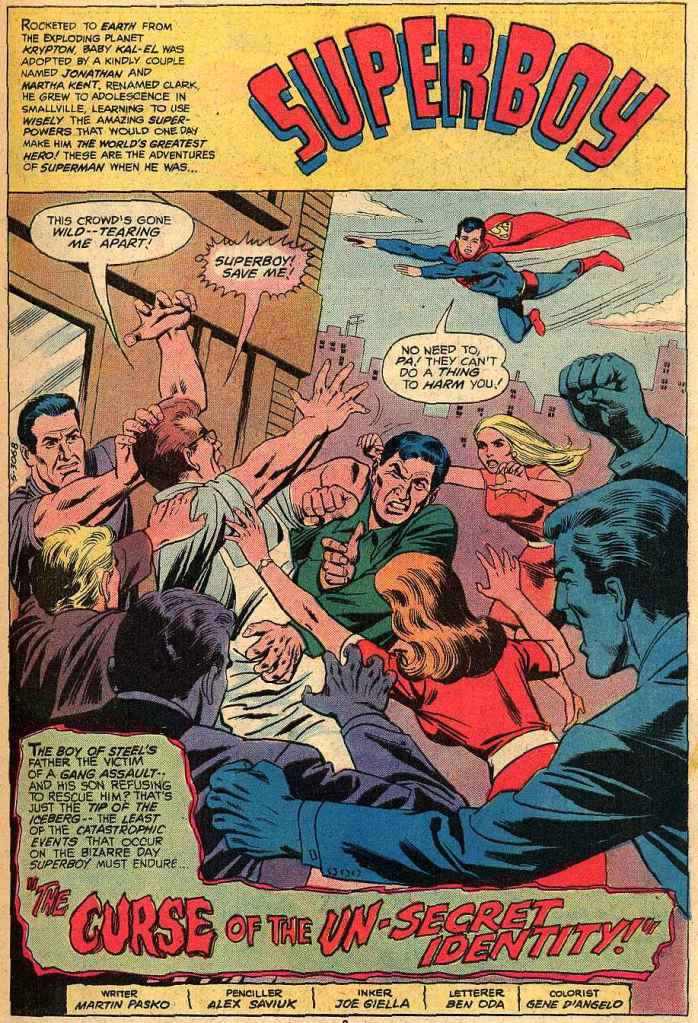
Each issue of SUPERMAN FAMILY presented a half-dozen stories of varying quality. This particular issue kicked off with a Superboy adventure scribed by one of my favorite Man of Tomorrow writers of the period, Marty Pasko. It was illustrated by Alex Saviuk, who had been drawing GREEN LANTERN and who has just taken over FLASH. In this story, Superboy is forced to reveal his alternate identity as Clark Kent in front of Lana Lang in order to save somebody’s life. Thereafter, the Boy of Steel helps out some aliens who offer him a favor in exchange. Rather than the easy and obvious thing, Superboy asks them to make his parents invulnerable to all harm, figuring that if the Kents can’t be injured, there’d be no problem with his secret identity getting out to the world. As you’d expect, once his true nature is revealed, Smallville is inundated with criminals trying to polish off Superboy and the town and its citizens take the brunt of the damage. Superboy is forced to publicly leave Smallville and separate from his parents for the safety of everybody. Fortunately, this was all an illusion the aliens planted in his head to show what the results of their efforts might be, and with that knowledge in hand, Superboy instead asks them to just wipe Lana’s memory, as he should have done from the beginning.

The Lois Lane feature came next, and it was a bit of a strange thing during this era. It typically told stories of the intrepid girl reporter that only featured the Man of Steel in passing, if at all. Lois was presented as being able to cope with danger and hazards on her own–she had been trained in Klukor, the Kryptonian martial art, after all–and so her stories played almost like episodes of a television series, with relatively few larger-than-life elements to them. This made them seem a bit tepid to me as a super hero loving kid. In this issue’s tale by Gerry Conway and John Calnan, Lois is doing a story on the clearly KISS-inspired band Cobra, who similarly perform in outlandish costumes and make-up. Morgan Edge has assigned Lois the job of ferreting out the true identities of the band (hasn’t he been paying attention to how her efforts with Superman have been going all these years) and in doing so, she comes to discover that the real Cobra members have been replaced by criminals who intend to make off with the group’s charity concert proceeds. Lois takes care of the whole matter in a dozen page, in part thanks to a flamethrower lighter gifted to her by blowhard Steve Lombard.
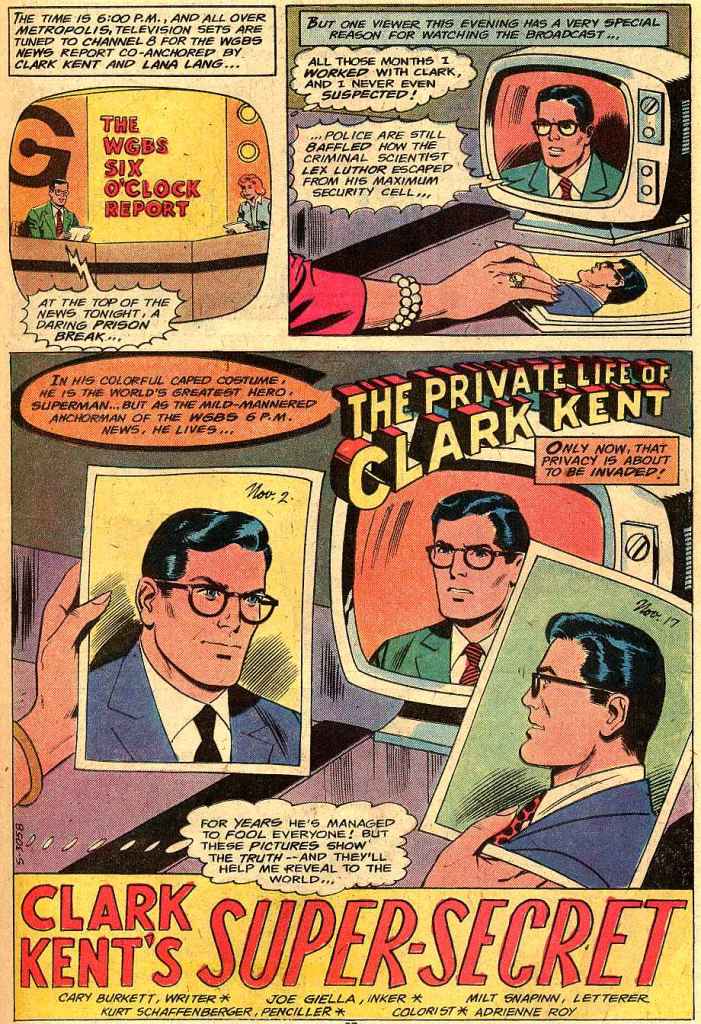
The next story was a Private Life of Clark Kent feature. I don’t know who editor Julie Schwartz thought was the audience for these stories–he produced a bunch of them over the years–but it wasn’t me. Again, as a kid, I wanted super heroes. In this one, rival gossip reporter Lola Barnett realizes that Clark Kent’s hair never seems to grow, but she leaps to the wrong conclusion about it: that the reporter must be bald and wearing a toupee. So she sets out to reveal this secret, causing complications for Clark, who winds up having to come up with an elaborate lie about needing to impersonate Lex Luthor in order to catch a couple of Luthor’s past henchmen in order to explain why he seemingly shaved his head. It was written by Cary Burkett and illustrated in the always-welcome clean, open style of Kurt Schaffenberger.
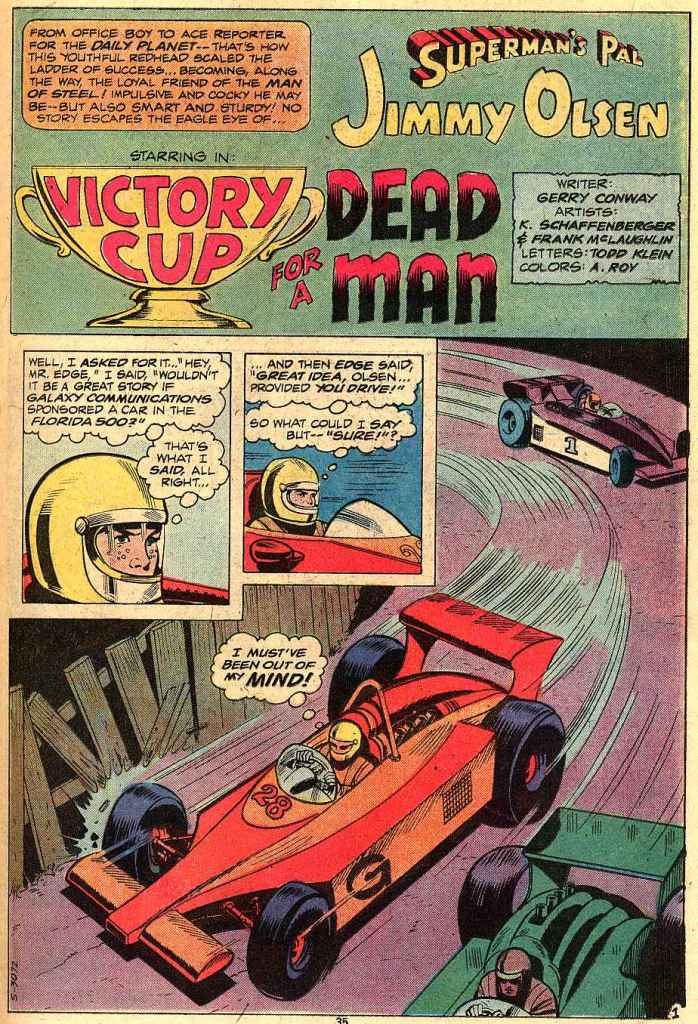
Like the Lois Lane feature, the regular Jimmy Olsen series had undergone some changes since it had been launched as well. For years, it had subsisted on a diet of crazy transformation stories for Jimmy and lots of personal betrayals by Superman and drama with editor Perry White. But by the 1970s, a shift had been made to try to make Jimmy less of a goof and more of a dynamic reporter. He was given the nickname “Mr. Action”–though you almost got the sense that it was a nickname that Jimmy himself had come up with, and only mentioned when he was hitting on girls. This issue, Gerry Conway and Kurt Schaffenberger put Jimmy through his paces driving the WGBS entry in the Florida 500 race–a race whose winner crosses the finish line having been dead for the past three hours! Jimmy gets to the bottom of things, of course, and also saves TV Detective Roy Raymond (who used to have his own feature back in the 1950s) along the way.

The feature that really kept me coming back to SUPERMAN FAMILY, thought, was Mr. and Mrs. Superman, which was set on Earth-2, the home of the Justice Society , where Clark Kent and Lois Lane had gotten married in the 1950s. In this story by the always-reliable Cary Bates as illustrated again by Kurt Schaffenberger, Lois gets saved by a Superman impostor, then spends the issue trying to figure out who the impostor is. Ultimately, it turns out to be the first robot duplicate the Earth-2 Superman had been experimenting with–and Superman himself doesn’t enter the story until the final page, when he flies to the rescue. It’s all very nicely drawn by Schaffenberger.

The final story in the issue was an adventure of Supergirl, who has a quick run-in with a Superboy robot (which is possessed by the disembodied spirit of one-time honorary JLA member Snapper Carr, who has taken a turn towards the dark side that is barely remembered today) that’s just long enough to justify the issue’s cover before she gets down to cases in battling a screaming robot that emits a shattering sonic wave. The robot turns out to be a guy in a suit, and even that guy is a victim of circumstance rather than an actual bad guy. Supergirl works her way through all of these shenanigans under the guidance of writer Jack C. Harris and illustrator Don Heck. While Heck’s super hero work could sometimes be stiff, he was somehow a pretty good fit for Supergirl, where the strengths of what he did would come to the fore.

The dollar Comics at this moment carried no advertising, so the Superman Family Circle letters page ran on the inside back cover. This month, it also included the yearly Statement of Ownership, which can tell us how well the series had been performing around 18 months earlier. According to the data, SUPERMAN FAMILY had been shifting 81,890 copies on a print run of 284,923 , giving it an efficiency rating of under 29%. That’s an absolutely terrible number, and it makes me wonder why DC kept the series around for so long. Possibly, that data reflects the pre-Dollar Comics incarnation of the series, which would have lent it further longevity. Or else, publisher Jenette Kahn really backed her Dollar Comics initiative.


Don’t ask me why, but “Someone notices something strange about Clark Kent and jumps to completely the wrong conclusion” is something I always like to see. I have a strange fondness for the Private Life – it makes Clark feel more human 🙂
LikeLike
I speculate that the “Private Life” stories were an attempt to make Superman “relatable” in his civilian guise, in a kind of DC version of Marvel’s superhero story formula. But note though the hairy conclusion is wrong, it’s quite reasonable. If you notice Clark Kent’s hair doesn’t grow, the obvious thought is indeed he’s wearing a rug, rather than that he’s really Superman. Is it even known to the public in-universe that Superman’s hair doesn’t grow at all? Maybe people just think he’s always impeccably groomed to present an inspiring public image.
Does Clark somehow fake sweating? Because in the summer, him not perspiring at all, ever, is going to be something that Lois or Lana might notice due to prior suspicions.
The secret identity game actually seems more vulnerable to being blown from small, subtle, stuff than big dramatic “you’re never around when Superman’s around” situations.
LikeLike
I don’t think the “Private Life” stories were an attempt to humanize Clark, since they were almost all pocket adventures where he either used his powers privately or used them publicly but it a way that people didn’t realize was him. They’re still Julie Schwartz puzzle stories that are mostly about plot.
I think what they were was an idea Julie came up with to fill a gap. There was a period where DC was doing backup stories, and while some of those stories were easy — Julie ran Batgirl and Robin stories in the back of BATMAN and DETECTIVE — some weren’t. ACTION COMICS was a title that could cover many heroes, so Murray Boltinoff ran his fave Metamorphosis in the back page, and when Julie took over the book, he created a rotating Action-Plus slot with the Human Target, Green Arrow and the Atom.
But SUPERMAN should, by rights, have Superman-related backups. And Lois, Jimmy, Superboy and Supergirl all had their own series at that point, and the Legion had backups in SUPERBOY. So Julie came up with “The World of Krypton,” which explored Krypton’s history, and “The Private Life of Clark Kent,” which promised a look at Superman through a different lens, but didn’t really deliver.
Later on, when they needed backups again, he and Nelson (and maybe their writers) cooked up “Mr. & Mrs. Superman,” “Superman 2020,” “A Night in the Life of Bruce (Superman) Wayne,” and maybe one or two others.
But I think most of them were conceived as just a way to fill space, and when SUPERMAN FAMILY became a Dollar Comic and had a lot of space to fill, they used features they already had. And “Private Life” was a way to get Superman into the book, alongside Lois, Jimmy, Superboy (for a while), Supergirl, Krypto, the Earth-2 Superman, Nightwing and Flamebird and whatever else. Getting Superman in the book was probably seen as good for sales, even if the stories weren’t usually all that good. It’s not as if the Jimmy and Lois stories were barn-burners either.
LikeLiked by 1 person
In the Silver Age, everyone seems to know absolutely everything about Superman, except his secret identity of course. The man on the street could tell you all about how his hair shatters scissors, or the Fortress of Solitude’s contents, or the detailed specifications of the rocket that brought him from Krypton.
There’s actually a good explanation for this in Jimmy Olsen #36 – Lois Lane wrote a book about Superman, some time ago, containing an amazing amount of detail about him. We only see a couple of pages, but the story does reveal that the book contains a ‘how to speak Kryptonese’ section that enables Jimmy to converse fluently with the locals when he ends up travelling back in time and space. Obviously, “his hair doesn’t grow” would be one of the many pieces of trivia Lois collected. 🙂
LikeLike
Agreed. it’s like when Karen Page learns Daredevil’s identity and immediately concludes Matt’s been faking his blindness all along.
LikeLike
I loved this series a lot, mostly because of Superboy, Supergirl, and the married Clark and Lois. Honestly, I could take or leave Jimmy and Lois solo stories no matter what era they’re from.
LikeLike
I mostly read SUPERMAN FAMILY for “Mr. & Mrs. Superman” as well, but I also tended to enjoy what was going on in the Supergirl series, any Cary Bates Superboy, and the occasional gem like “Clark Kent’s Mynah Dilemma.”
An awful lot of the book seemed like filler, often with C-or D-level art — and with Schaffenberger getting terrible inkers too often — but it managed to keep getting my dollar, month after month.
One of the sample scripts that got me in at DC was even a Supergirl story during her soap opera actress period.
LikeLiked by 2 people
Yeah, it was r and Mrs Superman for me, too. I always hoped they’d collect that series – beginning with the issue of Action Comics that saw them married – but I guess DC assumes there wouldn’t be enough interest in such a volume.
LikeLike
And they’re probably right.
But I’d buy it too.
LikeLike
As a fan of Earth-2, count me in as also hoping that one day we get a Mr. and Mrs. Superman collected edition.
LikeLike
“DC’s Dollar Comics program didn’t wind up being the industry game-changer that new publisher Jenette Kahn had hoped it would” — so did Marvel do a wait and see on DC Dollar Comics program or did they see it probably wasn’t going anywhere. Cause I don’t remember seeing a Marvel version of this.
LikeLike
Plus doesn’t the elaborate lie about needing to impersonate Lex Luthor in order to catch a couple of Luthor’s past henchmen, fit more with George Reeves ( Adventures of Superman ) & John Byrne’s Clark Kent? Is not the Clark Kent during this period suppose to be wimpy like the Christopher Reeves’ Clark Kent that would faint? Though the term wasn’t used back then, wouldn’t Clark being a metrosexual ( a usually urban heterosexual male given to enhancing his personal appearance by fastidious grooming, beauty treatments, and fashionable clothes — Google ) or just say he doesn’t like long hair be more believable for his character?
LikeLike
I don’t think Clark would fly as a metrosexual at all. He has no sense of fashion, always wears the same boring blue suit …
LikeLiked by 1 person
I agree with frasersherman, “metrosexual” doesn’t work for Clark. He supposedly wears a suit size that’s badly fitting for him in order to look less buff, though it’s not drawn that way.
Clark could just say something like, as a kid in Kansas he got teased a lot for being a farm hick with dirty fingernails and hay in his hair, so in reaction he keeps his fingernails and hair as professionally neat as possible. That’s not a harebrained scheme, but quite “human”, and fits with the disguise.
LikeLike
I was thinking that his job is TV News, so I don’t know how often real world TV news people get their hair cut, but that could have been an explanation too.
LikeLike
Seth:
“Clark could just say something like, as a kid in Kansas he got teased a lot for being a farm hick with dirty fingernails and hay in his hair…”
Not in this era. Silver/Bronze Age Clark grew up in a small town, and his father was a storekeeper. There were very early stories that showed the Kents as farmers, but they’d been long forgotten by then.
“…so in reaction he keeps his fingernails and hair as professionally neat as possible.”
Even people who keep their hair near have it get longer in between trims. Clark’s didn’t even do that. Lola had photos showing it didn’t get even a millimeter longer — or shorter, as it would if he’d gotten a haircut.
But even if she hadn’t already covered that, the point of the story wasn’t to be realistic, but to tell a little adventure. This was a way to put a quirky little frame around a story about recapturing Lex. Nobody involved in making it wanted to tell a story about Clark being put in a jam and getting out of it with a sensible, boring line of dialogue.
LikeLiked by 1 person
I loved the DC Dollar comics when they first started. The cover art covered both the front and back cover. There were various things printed on the inside covers – table of contents, letters, The Daily Planet – but the entire thing was comics – no ads at all in the comic. Even as a kid I thought that was a great purchase. But it didn’t last long. I collected Superman Family, Batman Family and World’s Finest when they were all in this format. But eventually the ads returned and the price remained a dollar because you were still getting all of the stories. Batman Family was dropped and Detective Comics became Batman Family without the title or numbering change. Eventually they all went back to a more traditional format consisting of the lead story featuring the star(s) of the comic and back up story focusing on a second tier character.
LikeLike
I was a regular reader of Superman Family when it started out as a mostly-reprint book. Once it went all-new, my interest gradually waned. I’d pick it up if I happened to have an extra buck in my pocket, but it was no longer a must-have. As Tom said, it was dependable, but forgettable. As I got older (and the prices got higher), I wanted something a little more ambitious, and this title felt like it was just going through the motions.
LikeLike
Some enterprising DC writer or artist should spearhead a Cobra revival.
LikeLike
Cobra became just another generic bad guy group when they killed off the good twin of its leader. I read somewhere they revived that character years later and made him eeeevil so twice they didn’t understand hpw to best use the original concept.
LikeLike
Maybe call’em somethin else. I prefer the criminal org headed by Cobra.
LikeLike
I’d’ve passed on these. Not total dreck, but mostly uninteresting.
Though @ least it’s all in one, easily avoidable book. Now it seems “families” are crowded in every “solo” book, at both Big 2 companies.
I’m good w/ back-up features. But when I buy “Batman”, I don’t care about the 8 other “members” that take pages away from Batman in the “main” feature.
LikeLiked by 1 person
I own every single issue of Superman Family and I will never part with them.
LikeLike
I agree that Mr. and Mrs. Superman was the star attraction but I enjoyed the rest of these anthologies too. Not every story in every issue, but enough.
“Hasn’t he been paying attention to how her efforts with Superman have been going all these years” I feel obliged to point out Lois has been consistently right about Superman’s secret identity even if she can’t prove it (case in point). Though yeah, nobody else at the Daily Planet or WGBS has the brains to realize it.
LikeLike
As a child during the Superman Family era I seldom had the money for an issue but when i did they sure were fun reads. Not deep reads just plain fun!
LikeLiked by 1 person