

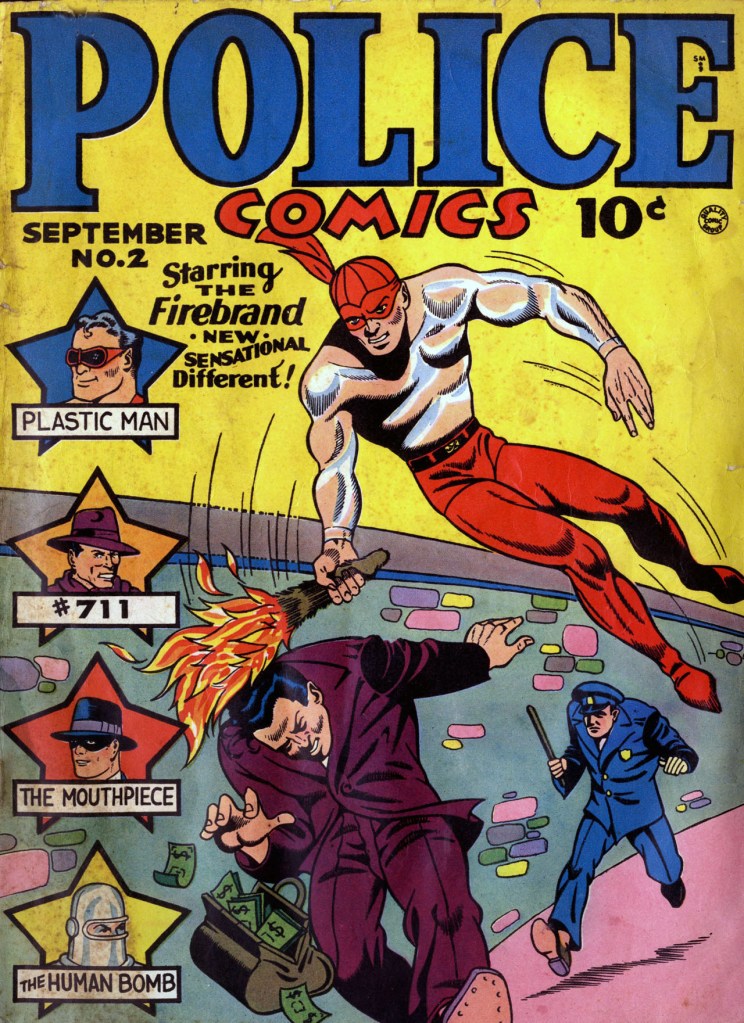
It’s always been something of a mystery to me how the publishers of the Golden Age determined that one of their secondary features was the thing that was driving the circulation of their anthology series. Case in point: when he was first launched, Plastic Man was a secondary character in the pages of Quality’s POLICE COMICS. The headliner for the first batch of issues was Reed Crandall’s FIREBRAND. But at some point, the Quality editors became aware that it was Plastic Man that was driving sales of the book, and they promptly moved him to the cover spot and expanded the length of his stories. But how did they determine this? There were no letters pages (though it’s likely that some fans sent in letters anyway) and certainly no social media to consult. And even checking with the distributor was only likely to tell them how well POLICE COMICS was performing, but not why people were buying it. It’s a bit of a mystery to me, really. Still, they did it.

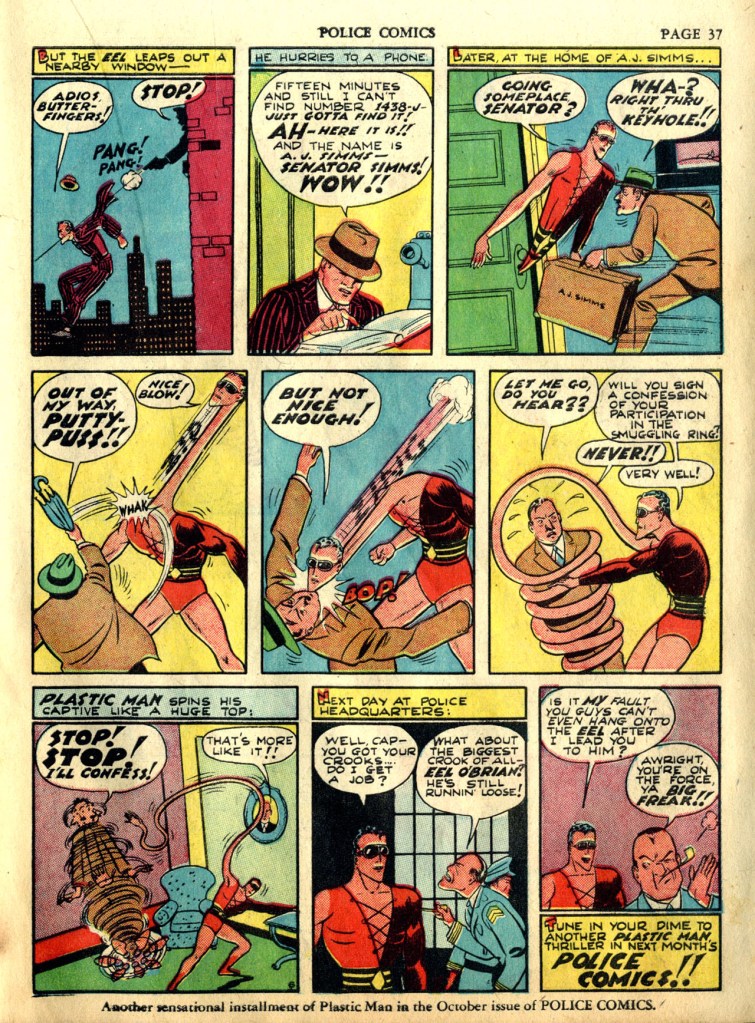
At this early point in the strip’s development, Plastic Man was still a polished product, owing to the skill of the strip’s creator and cartoonist, Jack Cole. Early on, one of the series’ hallmarks was the fact that Plastic Man was a reformed gangster, Eel O’Brien, and he would use his genuine identity to get the lowdown on impending crimes which he could then bust up as Plastic Man. But this also meant that he was genuinely wanted by the law, and for good reason.

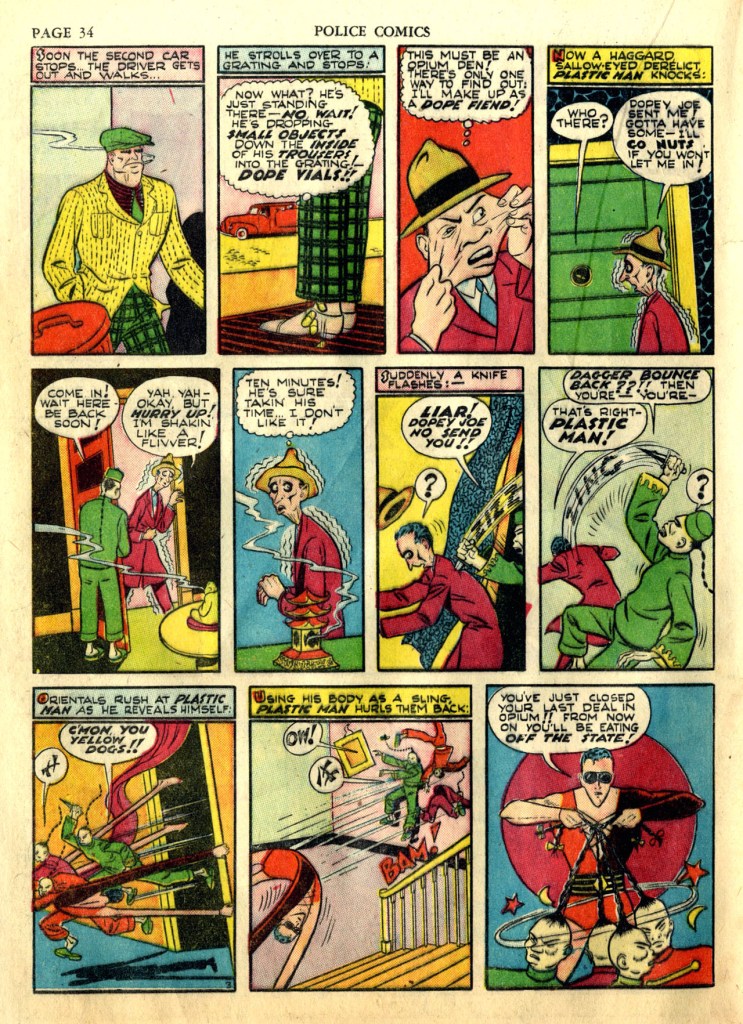
Plastic Man’s costume hadn’t quite standardized yet either. In these early stories, his right arm was bare, and the left side of his uniform was a dark black-red, rather than being uniformly crimson.


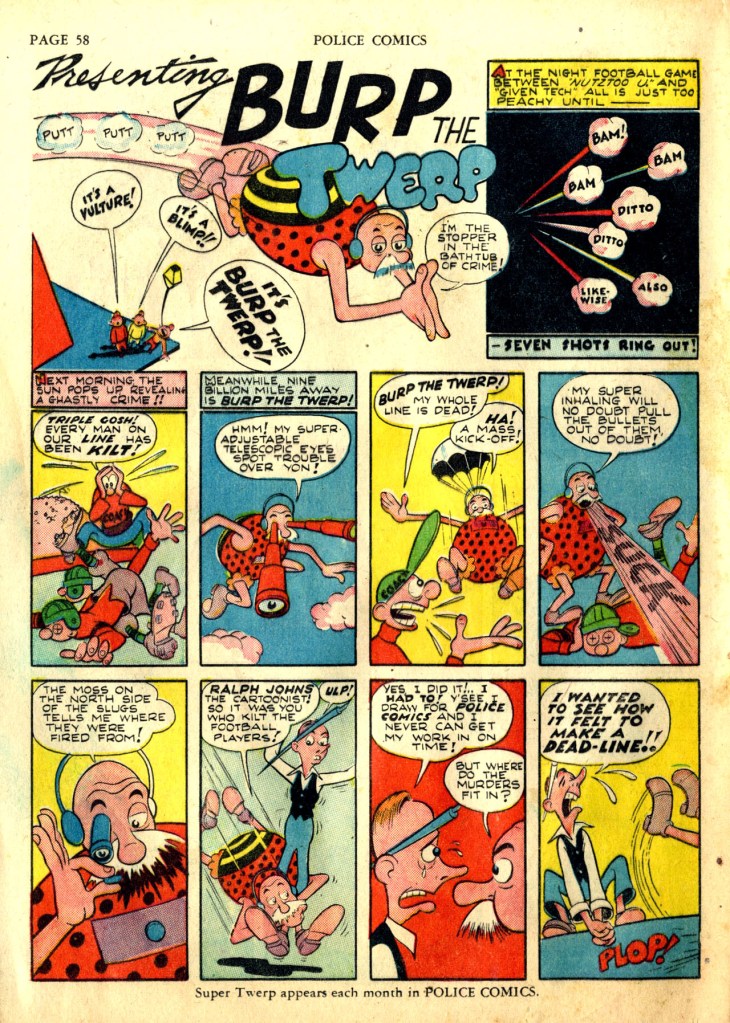
Jack Cole also began his long-running single page filler strip Burp the Twerp in this second issue. It was a zany parody of super hero shenanigans, and quite good. Burp was known as the “Super Son Of A Gun” and he could do pretty much anything. But his powers were always put in service to a gag, like this first one above.
 The Tom Brevoort Experience
I always get the impression the Golden Age publishers heard a lot of word of mouth about which characters the kids were all talking about. And All-Star Comics had been actively encouraging readers to write in and list their favourites for a while by the time Police Comics came along, so maybe a lot of kids were writing to Quality and others too, hoping there might be a free comic or other reward in it for them… 🙂
LikeLike
Great stuff.
LikeLiked by 1 person
As I understand it, generally (as with Superman in Action Comics), ’40s publishers would look at stagnant or slipping sales on anthology titles, &, if the titles lasted long enough, would start cover-highlighting different features to see what made a difference. If the sales on some issue suddenly jumped – as Action Comics did whenever Superman was on the cover, & presumably Police Comics did with Plastic Man there – they’d take note & turn that into the lead feature (or, conversely, plunged; they noted that too). I’ve always assumed Hawkman sold more copies of Flash Comics than The Flash did, though that may be a misassumption b/c DC never published All-Hawkman Comics, But by & large that would seem to be the process. (Unless Busy Arnold’s, oh, 9 year old nephew told him he really liked Plastic Man; that’s how Mort Weisinger made a lot of his editorial decisions…) Some features, like Blackhawk in Military Comics or Captain Marvel in Whiz Comics, were obviously the superstars from jump, but in other titles it was a process of trial & error…
Same as today, really, except now features generally get tested with their own books…
LikeLiked by 1 person
“if the titles lasted long enough, would start cover-highlighting different features to see what made a difference.”
In this case, Plas didn’t get any tryouts — he just took the cover slot in issue 5 and kept it.
Given deadlines of the time, it would seem they got feedback very early on that Plastic Man was the winner character, and by then issue 5 was as soon as they could get him on the cover. So maybe there was more mail than usual for one of their books, or feedback via the distributors that newsdealers wanted “more of that Plastic Man stuff; the kids are going ape for it.”
Whatever it was, Plas got the regular cover spot much faster than Superman, who got the cover 5 times in the first 17 issues, and got it on an ongoing basis as of issue 19. So they got the news fast, however they got it.
Or maybe someone just made a shrewd guess after looking at the first couple of issues. Firebrand, in his translucent pink pirate blouse, may not have been as arresting as the publishers thought before the work started coming in.
LikeLiked by 2 people
I always wondered what was supposed to make Firebrand so special. Then DC reprinted Police #1 and I got to see Reed Crandall’s art … wow. Plas was the better feature but Crandall’s amazing.
LikeLiked by 1 person
I suspect they just thought Firebrand was better drawn & thus would be most appealing. I forget, Lou Fine or Reed Crandall? Or am I misremembering entirely? (Been a bit since I looked.)
But, as you say, he had the cover for 4 issues, by which point I’d guess they figured out something wasn’t working. But whether they got feedback on Plastic Man early on or the cover of #5 really goosed sales, I gather quick early feedback from New York newstands was much easier to come by back in the day…
LikeLiked by 1 person
Lou Fine or not, guy’s in cellophane shirts do not catch on . . . .
LikeLike
I’m far from the average reader but I liked the costume just Fine on him the few times the male Firebrand was drawn in All Star Squadron.
LikeLike
Plastic Man went from 7th story in Police Comics#8 ( March 1942 ) to first story in #9 ( May 1942 ).
LikeLike
I had the impression – don’t know where I got it – that All-American couldn’t add more titles during the War. By the time paper rationing was over, Hawkman was no longer a big draw. The kids were making kids of their own and few of the veterans were enamored by costumed heroes anymore.
Anyone with a better memory than mine? Might have picked up this info from my mom (Who fascinated me with her descriptions of Captain America) or her younger brother (who told me that the Batman of the 1950s was a sissy compared to the 1940 Batman)
LikeLiked by 1 person
Probably true. DC/All American seemed to have a fairly good business model for wat to spin-off into a solo title. Hawkman probably was the next solo book to come out absent WWII . . . .
LikeLike
I noticed that on several panels showing Plaz’s bare arm, there’s an inked line around his wrist, indicating that Cole meant for there to be a sleave on that arm as well but appears the colorist for some odd reason gave that arm a flesh color and I’d guess there never was any sort of fashion for wearing a shirt with one side having along sleeve and the other side no sleeve at all. There’s also a lot of red highlights on his otherwise black left side of his costume. I’d presume Cole intended for that side to be red too rather than black but maybe the inker (presumably not Cole) took it upon himself to render it mostly black. Maybe it was intended to highlight Plastic Man’s duality as a former mobster now working for the law but also working under cover in his mobster guise. Unless Cole or someone else working on the mag at the time ever described the reasoning, which appears unlikely given Cole’s suicide in the late ’50s, when fandom wasn’t quite as organized as in later decades, seems all we can do over 80 years later is speculate.
LikeLiked by 1 person
Cole was inking his own stuff. He had a very distinctive finish, and it’d be more believable for him to have gotten pencil assists than inkers. And probably not even then. Background guys, maybe.
LikeLiked by 3 people
But it’s clear, certainly, that he should have a right sleeve as of POLICE 2, and he gets it in issue 3. The chest and arm on his left side are also clearly meant to be darker through the cover to issue 5, but they drop the shading in the interior of 5, and from then on they seem pretty well set.
Figuring it out as they go along.
LikeLiked by 2 people
I’d guess this was an instance of having the produce the work faster than you can check it… it happens…
Also, I doubt Cole did the coloring, tho’ he may have…
LikeLike
I would bet he didn’t, given that sleeve issue.
LikeLike
That would be my best guess, yes…
LikeLike
Very strange then. I wonder if Cole intended for the left side to be all black, but if so why the red highlights? Reminiscent of Wallace Wood era Daredevil after his costume was changed to all red but often appeared mostly black with red highlights.
I also find Firebrand’s translucent shirt to be rather strange, although somewhat similar to that of Bill Everett’s 1940 character Hydro-Man, and both seem calculated to play off the popularity of Everett’s better-known creation, Sub-Mariner, and his Timely cohort, the original Human Torch.
Thanks for the additional info, Kurt!
LikeLiked by 1 person
“I wonder if Cole intended for the left side to be all black, but if so why the red highlights?”
Because there’s a difference between “all black” and “black with highlights,” and Cole meant the latter.
Even when something’s meant to be fully black, it’s most often rendered as black with blue highlights, as with the blue bits on Batman and Spider-Man and Nightcrawler, which tend over time to end up just being treated as blue.
In the case of Daredevil, I think they meant a very dark red, so they rendered it with a lot of black to it. That’s probably what Cole meant with that quarter of Plas, though why he’d choose that, I don’t know. And he gave it up pretty soon anyway.
LikeLiked by 1 person
When Wally Wood created the 2nd Daredevil costume, he did it with shirts of the time in mind that were satiny polyester & made with interwoven fibers of different colors – black & red being a good example – so the color of the shirt would seem to change depending on how light hit it, how the movement wrinkles flowed, etc. So it was designed to be simultaneously black AND red; each was the other’s highlight color.
On the comics page, this was kind of hard to pull off, & I’m not sure Marvel passed the concept on to other artists after Woody left the book…
LikeLike
I was most used to it from the Colan issues, and eventually decided it was a dark red velour, with the DD emblem in some sort of embossed leather or something.
I wouldn’t have wanted to be his dry cleaner, though…
LikeLike
Unless it was mentioned in All-Star Squadron, I believe it was Secret Origins#30 ( September 1988 – Plastic Man & Elongated Man’s origins ) was the first time I found out Plastic Man use to be a criminal before he got powers ( I’m wondering was he the first hero like that? Was there a Pulp hero who was a bad guy first — Alec Baldwin’s The Shadow film 1994 was a criminal ( Ying Ko ) first before got powers under the name the Pulp hero was called in Chinatown ( Teeth of the Dragon & The Golden Pagoda ) — Wikipedia ). I hated they made the movie camp ).
LikeLiked by 1 person
No, that wasn’t true of the Shadow.
I learned about Plas’s origin in DC’s lamentable Silver Age series, when that Plas explains he’s the son of the original.
LikeLike
Wikipedia has a different non-criminal origin for The Shadow, I said the 1994 Movie made him a criminal first ( Following the First World War, Lamont Cranston set himself up as a drug kingpin and warlord in Tibet – Google Wikipedia for the film version ) which is different than the Pulp Hero Shadow Wikipedia as a non-criminal first or any time.
LikeLike
Ah, the pulp pulpiness. “The toughest gangster afoot!”. Dope rings. A blond dame. And absurd caricatures of “Orientals” (did anyone involved in drug dealing ever dress like that?).
The ending where Plas basically tortures the Senator to get him to sign a confession is pretty brutal behavior. I doubt that’d hold up in court.
It’s interesting that he spends a good amount of time in this story as Eel O’Brian, and his personality as a hero is still a “hard guy”, in the pulp hero tradition. That’s the biggest change. This strikes me as a very different person from all the later “wacky” versions.
LikeLiked by 1 person
It is. Eel O’Toole was to all intents forgotten as Plastic Man became more popular, & Cole swung more weird/comedic.
Whoever mentioned The Shadow, no, he wasn’t originally a criminal. Depending on whether you believe any of the supposed “origins” (I don’t believe the pulps ever established one) he was originally a WWI flying ace (the Dark Eagle? I forget); fanfic has tried tying him in with the pulp series G-8 & His Battle Aces. Subsequent resurrections of The Shadow have concocted a number of origins for him, but you either take none of them as canonical or all of them, & either way he remains the quintessential man of mystery…
LikeLiked by 1 person
On the radio he was Lamont Cranston.
In the pulps, he was posing as Lamont Cranston, but was formerly flying ace “The Black Eagle” (revealed in 1933), and later “The Dark Eagle.” And in 1937 he got the name Kent Allard. I’m not sure if it was implied then or later that even the Allard identity was a pose, but I’ve always liked the idea that the further you dig the more fake identities you uncover, but you’ll never find the truth.
LikeLiked by 4 people
Pretty sure Kent Allard was meant to be the Shadow’s real identity, & Allard was the Black/Dark Eagle. (&, by fannish accounts, G-8.)
But I’m absolutely certain Phineas Twimbly was not intented to be his true identity…
Yes, in the pulps, Cranston is a real person/millionaire whose donates his identity & resources for the Shadow’s use & takes off on a permanent vacation. On radio, Cranston is the Shadow’s true identity…
LikeLike
That would be about the Alec Baldwin 1994 The Shadow film where he was first a drug kingpin and warlord, unlike the super-powered radio Pulp hero Shadow or the Pulp magazine non-powered Shadow ( see his Wikipedia for pulp hero ( has his other aliases ) and the Alec Baldwin The Shadow movie ). I brought up the Shadow film because my original question was there other criminals turned hero back then ( and I remember how different the Pulp Hero shadow’s origin was from the 1994 film ). Marvel Age did have criminals turned hero, but not like Eel O’brian who didn’t either have a code name ( Black Widow – Marvel ) or super-powers ( Quicksilver, Scarlet Witch ) before he became a good guy.
LikeLike
I believe the idea of The Shadow having a “shady” (heh) past first came up in Howard Chaykin’s 1986 miniseries “Blood and Judgement”.
LikeLiked by 1 person
Oh… right… THAT ****ing piece of shit…
I know Eel O’Brian shared an interest feature with at least one other contemporaneous comics character: both he & The Joker were bad guys who got their “powers” (I’m taking a bit of liberty here) by having the bad luck to get dumped in a vat of acid while robbing a chemical factory. Guess those were key targets for theft in 1940… (Tho’ the Joker’s origin wasn’t concocted until many years later, & it wouldn’t greatly surprise me if they just “borrowed” it from Plastic Man…)
LikeLike
Letters may not have been a regular feature for comics in the 40s, though some comics did have letter pages, but people wrote in anyway to tell the editors what they liked and disliked about an issue. Letter writing was a big thing back then. Also, as I understand it, it usually takes about 4 issues of a book for a publisher to get the sales figures in, letting him know if he had a hit or a miss. Which would lead to the book being cancelled right away or changes tried.
LikeLike
There is another Golden Age hero who was a criminal first, The Deacon [ Cat-Man Comics#1 ( May 1941 ) ( Holyoke ) ] – wears a deacon’s uniform and with the help of his sidekick Mickey fights crime. The Deacon used to be a criminal but wised up, reformed, and began a war on crime to make up for his past misdeeds, based out of the Marshland Church ( Jess Nevins site — not the first time I looked at this character so the source of my question of if Plastic Man was the only criminal back then to become a hero was my mind sort of remembering this character — which it did last night ).
LikeLike
Add The Blue Circle, Len Stafford is a reformed crook waging war on the underworld. He is helped in this war by the Blue Circle Council, made up of like-minded “past masters of crime”. The Blue Circle has no powers [ Blue Circle Comics#1 ( June 1944 ) 6 appearances 1944-46 ( Rural Home ) ]
LikeLike
This character does not take the path that Plastic Man, The Deacon or The Blue Circle do. The Cat Man [ Amazing Man Comics#5 ( September 1939 )]: Twenty years ago Barton Stone took the rap for a crime, leaving the other three men free. Stone’s fiancee ( comic book says wife ) died in poverty while the other three men – Steve Harrigan ( “boss politician” ), Roger Watson Hammond ( “stock broker” ), and Lionel Black ( “real estate” ) – prospered. Once stone gets out, he tells the three that he’s going to kill them, but in a way that can’t be pinned on him. Which Stone succeeds in doing by dressing as an old woman, getting close to each man, and letting a cat with poisoned claws scratch each man, In his second appearance he fights ordinary criminals ( Jess Nevins site doesn’t say if he kills them too ) — I think I came across a pulp hero that get this kind of vengeance ( killing those that wronged him, not the cat with poisoned claws ).
LikeLike
Wow – an early comic story about drug smugglers bringing opium into the country – Plas even disguises himself as a drug addict who needs a taste. And in the not to distant future comics wouldn’t even be allowed to mention drugs in their stories.
LikeLike
Drugs/smuggling/abuse were a fairly commonplace topic in Golden Age comics. It was only with the Comics Code c. 1955 that they became verboten, the idea being that even mentioning them is promoting them. (The same thinking was usually also applied to homosexuality, miscegenation, official corruption, etc.) Then it was a big drought – until it snuck in under the radar in the first Deadman story in Strange Adventures 205, where, in a double punch at the Comics Code, which didn’t seem to have even noticed, a corrupt, abusive cop smuggles heroin… (This predates the much better known & bally-hooed drug stories in Amazing Spider-Man & Green Lantern/Green Arrow…)
LikeLike
In that same vein (pun intended) Plas’ origin is pretty visceral and not unlike an “addict” becoming “clean.” He gets shot in the arm during a heist, falls into a vat of acid and gets left behind. He’s found by monks who show him the error of his criminal ways, and he reforms after a restless night’s sleep transformed. He has a super villain’s origin or an origin of a guy going through detox.
LikeLike
TRIVIA ( comics.org ): Wildwood Cemetery the home of The Spirit [ Police Comics#9 ( May 1942 ) there is a real world cemetery by that name in Massachusetts, a state to which Cole later moved ], President Franklin D. Roosevelt requisitions Plastic Man’s services for the FBI [ Police Comics#18 ( April 1943 ) much later than in the All-Star Squadron series. His home base is Mammoth City ], Last appearance of Eel O’Brian in a Plastic Man story and he is revealed to be an orphan [ Police Comics#19 ( May 1943 ) ], Woozy briefly gains Plas’s powers while a weird doctor ( Dr. Phineas T. Gleason ) creates his own Plastic Men ( 100 of them ) out of reclaimed rubber, controlling them with robotics [ Police Comics#24 (.November 1943 ) ] and 2 criminal doctors ( Dr. Slicer & Dr. Doser ) try to unravel the secret to Plastic Man’s powers, but they discover that Plas cannot be cut or pierced in any way ( wasn’t on Earth-2 DC Universe Plas shot in All-Star Squadron? )[ Police Comics#47 ( October 1945 ) ]. Plus Plastic Man fought his own Princess Python, Madame Serpina [ Police Comics#21 ( August 1943 ) — Bobo ( a boa constrictor ) ] and circus India rubber man Stretcho ( who is nearly as adept as Plas in contorting his body, but who has limits and can feel pain if he stretches too far )[ Police Comics#69 ( August 1947 ) ].
LikeLike
Marvel referencing Quality-DC in interesting ways: MR. ABNORMAL stealing a set of Police Comics was a nod to DC character Plastic Man, a superhero with powers and personality very much like Mr. Abnormal [ Spider-Girl#15 ( December 1999 ) see profile at marvunapp.com ].
LikeLike
Then there is “ELASTICO” [ Fin Fang Four Return#1 ( July 2009 ) 5th story ] seen in the Super Villains Handbook right next to Electro’s page in that story ( see profile at marvunapp.com ). Looks similar to Plastic Man.
LikeLike
MLJ’s short-lived fire-breathing hero Inferno started out as one of a trio of circus-crooks opposed by Steel Sterling. The other two crooks get killed but Inferno reforms thanks to Steel’s influence. Did Tom cover that early crossover yet?
LikeLike