

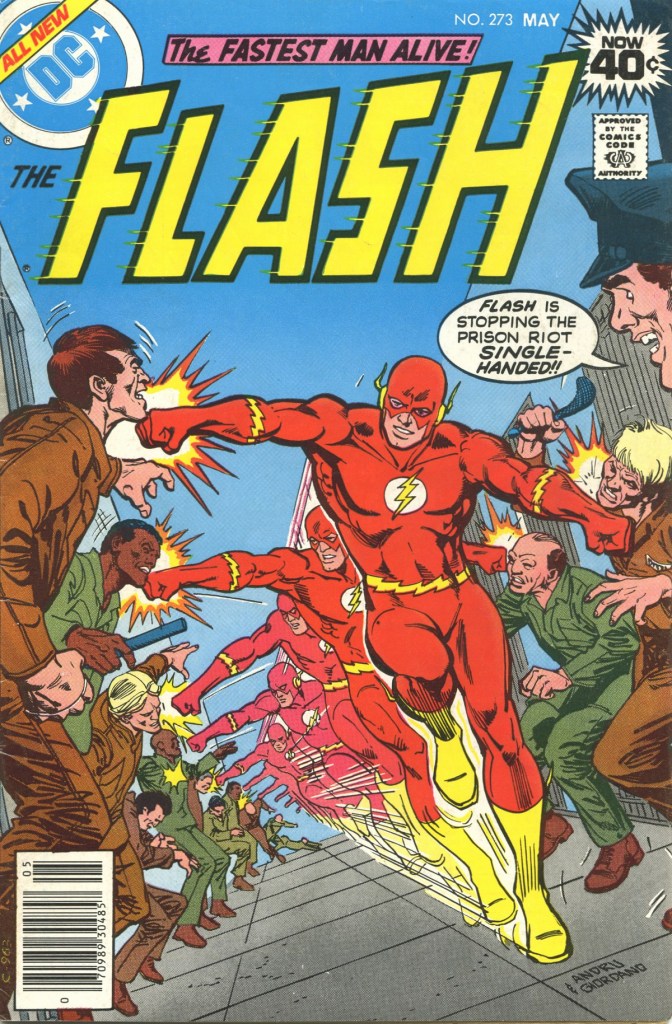
This issue of THE FLASH is where new editor Ross Andru’s vision for the title really crystalized. In essence, this took the form of bring on board a new regular penciler. Longtime FLASH artist Irv Novick had departed one issue after outgoing editor Julie Schwartz, and while Ross had stopgapped for two months, here he put his new kid in on a regular basis. This was Alex Saviuk, who had been delivering on GREEN LANTERN (co-starring GREEN ARROW) for several months. Alex wasn’t yet as accomplished an artist as Novick, but he was young and fresh and more modern-feeling as well. As Ross and writer Cary Bates attempted to update the approach to the story material to better reflect the times, this change was deemed necessary. Alex would only wind up handling a half-dozen issues or so of the book, but they were issues of significance in the series’ run. This cover also reflects Ross’s sensibilities. I can recall feeling that the guard’s word balloon struck me as needlessly juvenile for some reason–and this was at 12 years of age. Clearly, that says more about young me than it does Ross.
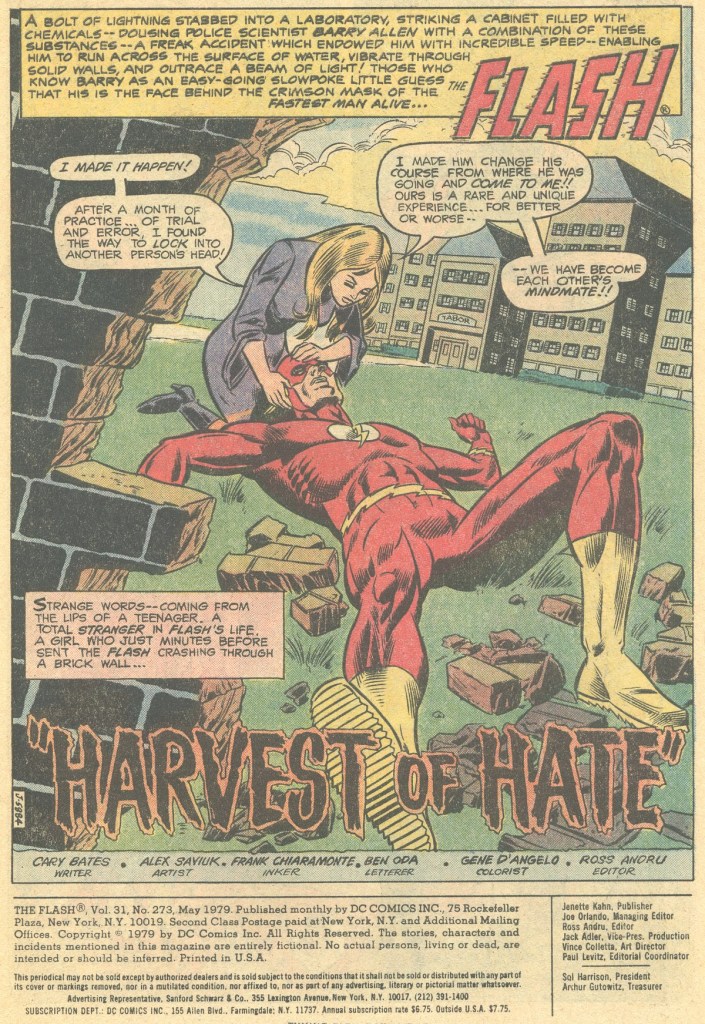
It must be said that this era of FLASH was a strange mixed bag. Ross and Cary were embracing serialized storytelling of the sort that Marvel had made their bread and butter for a decade. They were also trying to inject a bit more realism into the stories, with drug dealers and police corruption and unethical medical experiments. But these topics sat uncomfortably alongside the more vintage Flash super hero elements, making for an odd tone. I can’t say that I loved this period, not as compared to what came before, though it certainly had its charms.
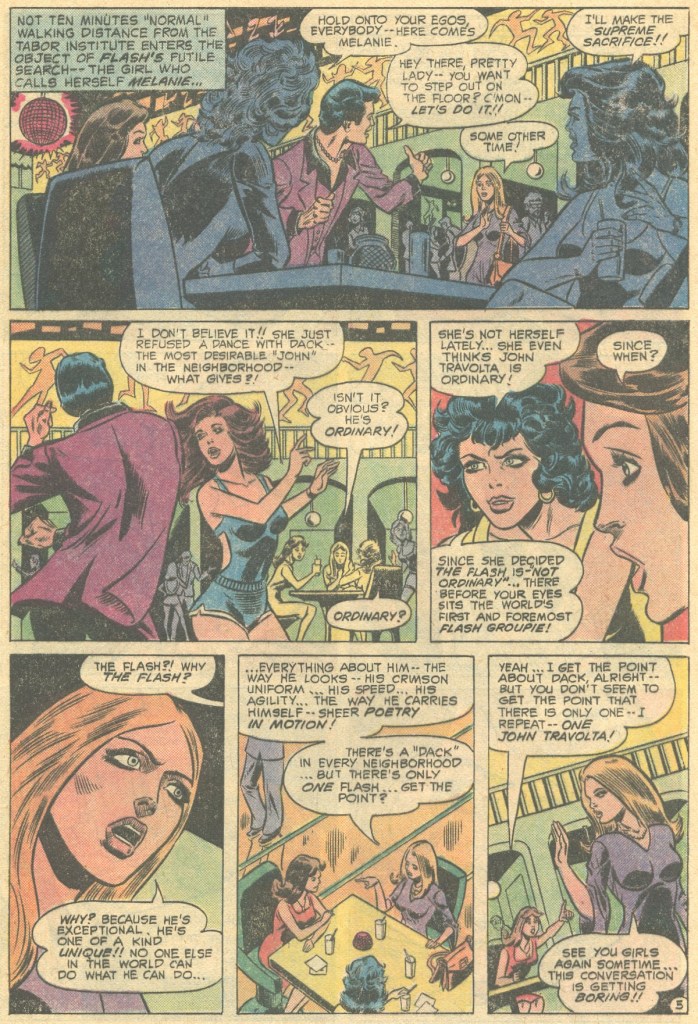
So what’s going on with the Scarlet speedster? Well, for one thing, he’s being stalked by a young woman, Melanie, who possesses ESP powers and has succeeded for the first time in drawing the Flash to her, causing him to smash through a brick wall at super-speed. She’s convinced that she and the Flash are soulmates and that they belong together. The Flash, for his part, has no idea what’s been causing him to do strange things like racing through a wall. But he’s got other problems as well. As Barry Allen, he’s been serving as the police liaison to the Nephron Project that a nearby prison is testing to try to change criminal behavior through brainwashing. It’s a nasty little project, and Barry’s gotten to the point where he’s ready to blow the whistle on how it abuses the inmates. Also, there’s the little matter of the drug smuggling ring that’s being run out of his precinct in the Central City Police Department. Barry found drugs concealed in his lab’s supplies, and needs to let the precinct Chief know. So he doesn’t spend much time wondering about Melanie before heading back towards work.
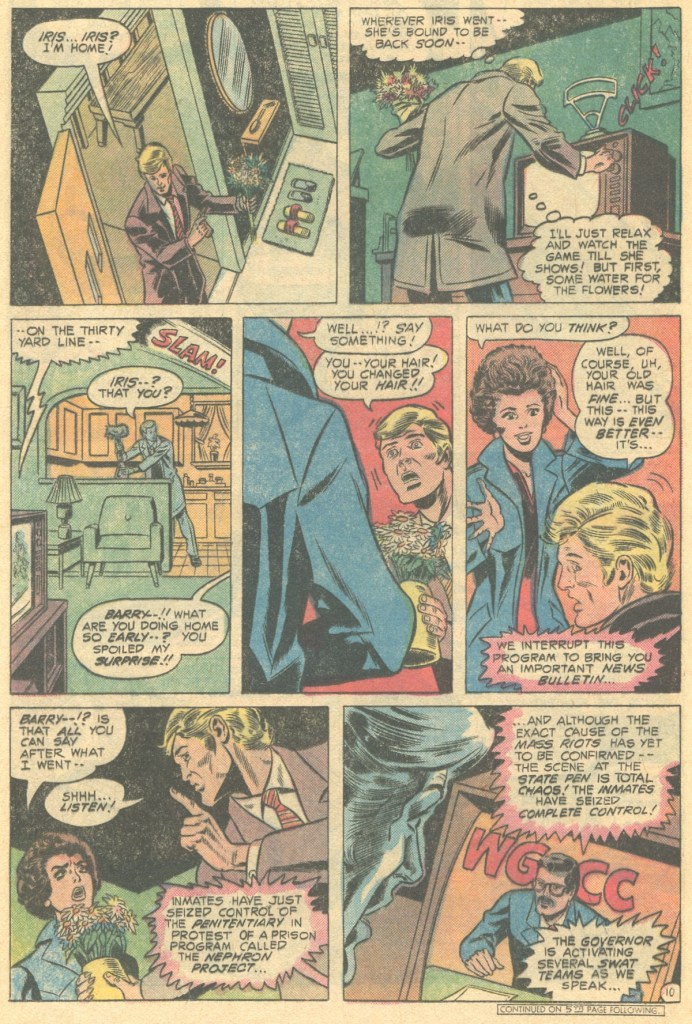
There’s also trouble on the home front, as Barry and Iris Allen’s typically idyllic marriage has been feeling the strain of his super-speed extracurricular activities of late. This has Iris thinking that maybe the thing they need in order to strengthen their union is to have a baby. She goes out and has her hair cut and styled in the hoped of a romantic evening, but as usual, Barry is distracted when a news bulleting comes on the television about a riot breaking out at the prison in protest to the Nephron Project. Iris feels heartbroken and isolated as her husband races off to try to quell the violence.
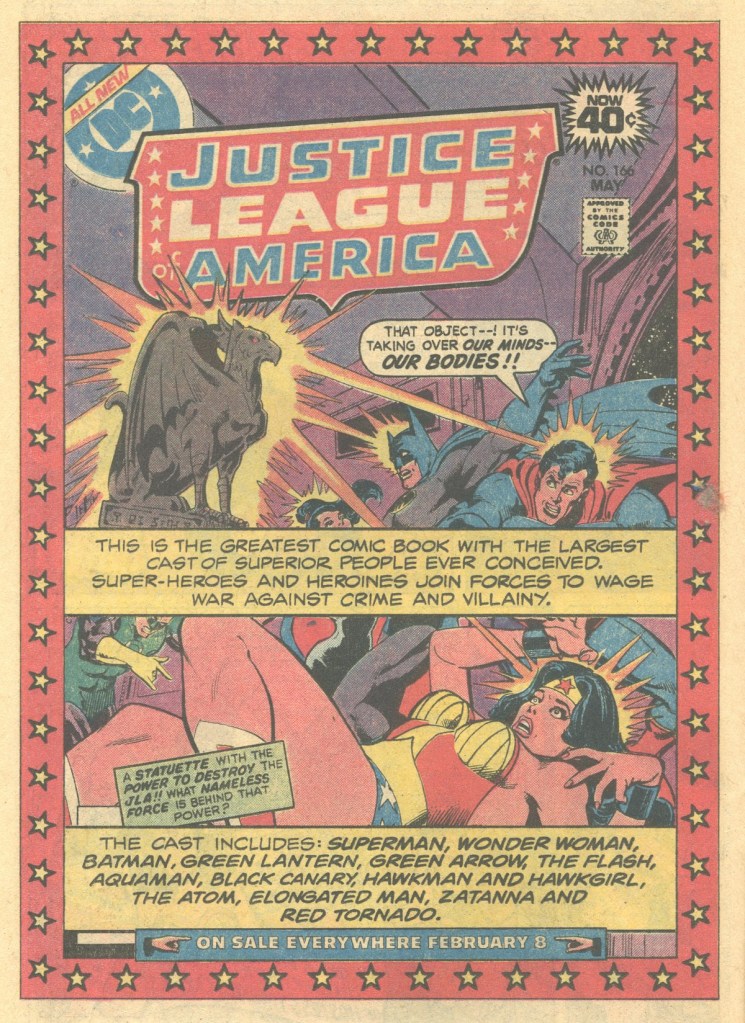
A new month brought new house ads, including this one for JUSTICE LEAGUE OF AMERICA, whose editorship Ross Andru also picked up with the issue being plugged. It’s an interesting choice to plaster all of that promotional copy straight across the cover image like that. There’s something quaintly off-register in describing the JLA as “the largest cast of superior people ever conceived”. That’s some strange phrasing.
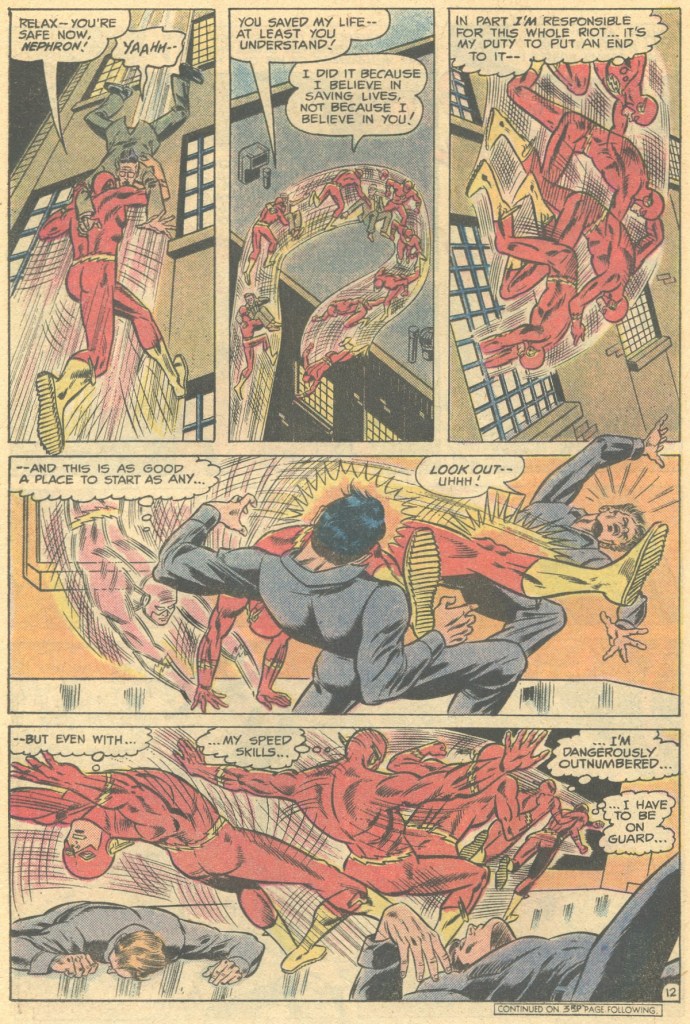
Getting into the action of the issue, flash arrives at the prison just in time to catch Professor Nephron, who has been thrown out of a high window by the rioting inmates that he’s been abusing. Despite having his issues with the program, Flash of course saves the plummeting scientist, depositing him on the roof before wading into the heart of the fray himself. The guards are something of a non-factor here, as the name of the game is the Flash vs. the entire prison population.
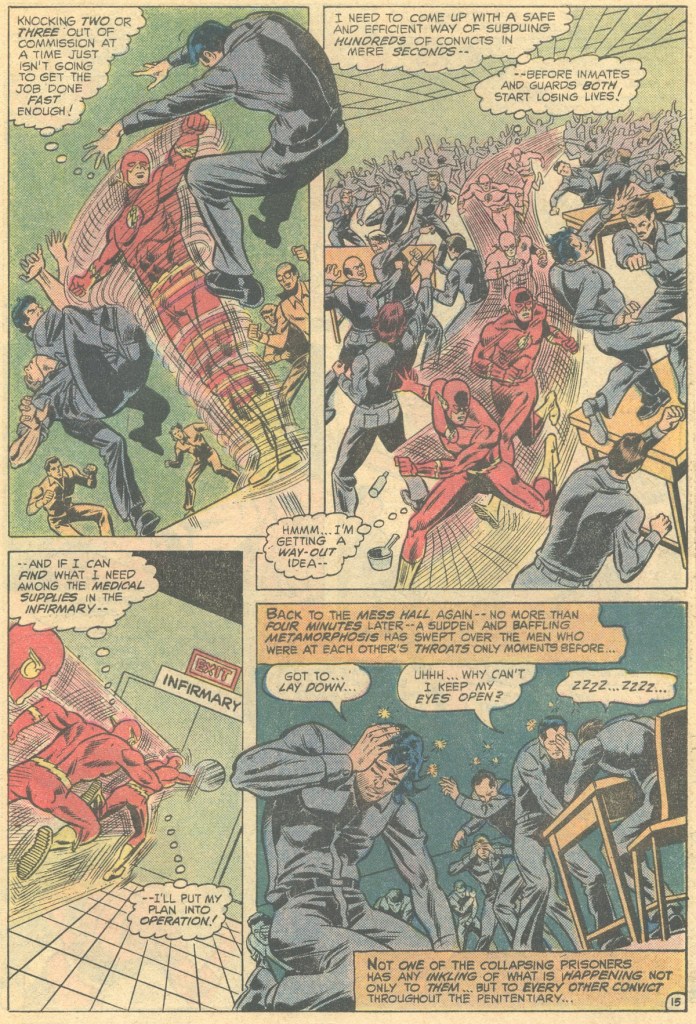
But the truth is, this isn’t really much of a fair fight at all–there shouldn’t be much of anything the inmates can do to tag the Flash. In order to make things more equal and provide at least a bit of suspense in the sequence, Cary has Flash clock himself in the head while trying to avoid some guards, which gives the rioters a chance to take a few cheap punches at him. But this is only a momentary setback, and he proceeds to quell the riot by administering sleeping pills to all of the convicts.
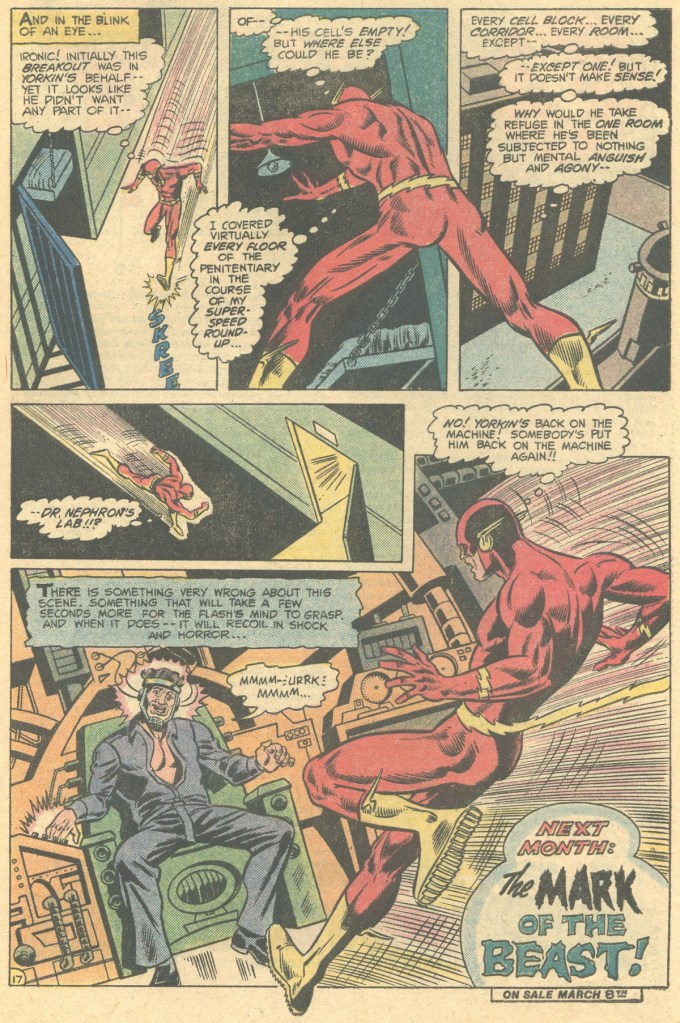
But the one inmate that Flash didn’t see anywhere in the melee is Clive Yorkin, who has been the subject of Nephron’s experiments. Racing through the building to locate him, Flash does eventually find him–and his stunned reaction makes up the climax to this issue. Because without supervision, Yorkin has sought out the Nephron Machine, plugged himself into it and has been giving himself brain shocks–the process having eroded the separation of pleasure and pain in his mind. It’s a weird beat to go out on, but that was the new FLASH all over. And I can’t say that I really loved it.
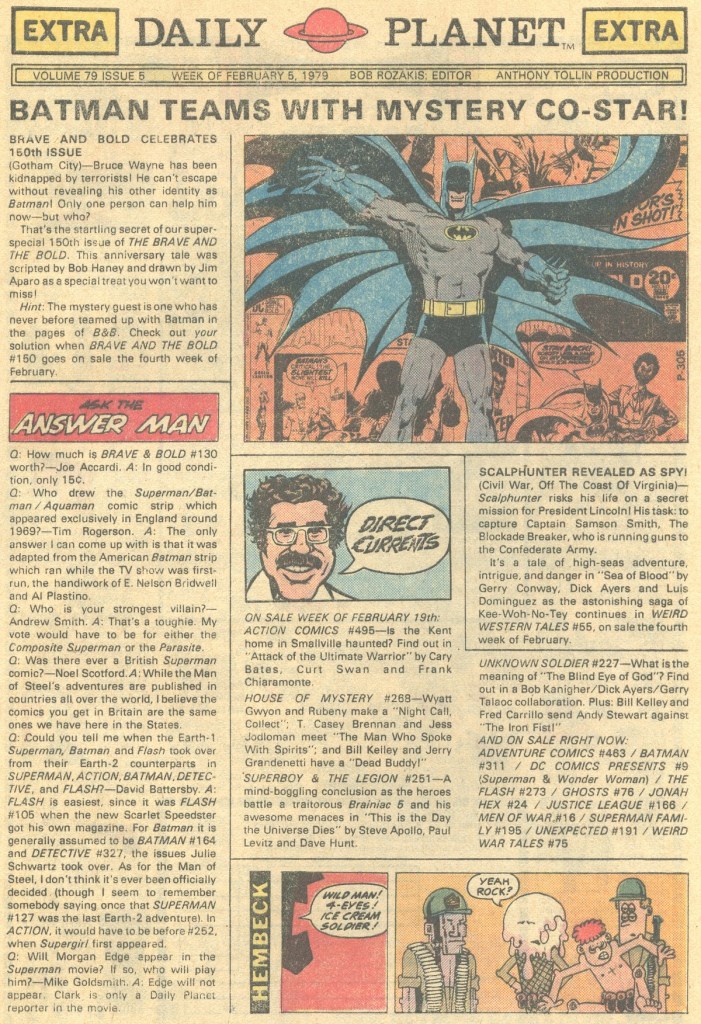
A new week meant a new Daily Planet promotional page and another new goofball cartoon strip from Fred Hembeck. This one makes fun of the nicknames of the assorted members of Sgt. Rock’s Easy Company by treating them literally. It’s not much of a gag, but what do you want from two postage-stamp-sized panels?
 The Tom Brevoort Experience
I was not a fan of this “new direction” either. I get that sales were probably slipping, and changes were needed. But it’s hard to figure out who the target audience is here. Anyone wanting a serious, gritty police procedural is going to be put off by Flash’s ridiculous super-stunts. And those of us who wanted to see Flash in crazy situations fighting outrageous super-villains weren’t getting what we wanted either.
LikeLiked by 2 people
The Flash started going downhill for me at this point. I especially disliked the marital discord between Barry and Iris. It was like seeing your mom and dad heading toward a divorce.
LikeLiked by 2 people
It’s hard to pull that off with a longstanding happy relationship and they did not succeed.
Plus Saviuk’s art hurts my eyes.
LikeLike
Harder to go from cheery comfort food to edgy anxiety malnutrition…
LikeLiked by 1 person
Saviuk was no Novick but his style was breezy and fun and his story telling clear. This novice was a better fit for the book though than Heck, the veteran who would follow. Heck was undeniably the better artist and storyteller but his style did not mesh with the necessary Flash visuals. I kinda wish they had canceled the book when Saviuk left and spared us Iris’ murder and the way too drawn out trial.
LikeLiked by 2 people
The Nephron Project is very A Clockwork Orange ( 1972 film — granted they use drugs, film & music to rehabilitate criminals ), but the question I have is did the late Mark Gruenwald have this or the previous or next issue or all issues involving the Nephron Project and was this the inspiration of the Tom Thumb’s Behaviour Modification machine [ Squadron Supreme#4 ( December 1985 ) — Golden Archer using it on his ex-girlfriend Lady Lark ]?
LikeLiked by 2 people
The Nephron Project storyline is also very reminiscent of 1971’s eighth season Doctor Who serial The Mind of Evil, something I was waiting for Tom to mention, being the avid Who fan we know him to be.
LikeLike
For years, I thought it was a big mistake of Ross Andru’s to take Novick off FLASH, but I just checked the dates, and Novick takes over BATMAN again the month before this. That makes me think it wasn’t Andru’s choice — that Julie, whether he left FLASH voluntarily or un-, took Novick with him.
Either way, I don’t think Alex Saviuk was ready for a regular book, much less two. He developed into a pretty solid artist, but he wasn’t there yet at this point, and while his storytelling was at least functional, I think he needed an overpowering inker to get past his drawing weaknesses. He wasn’t able to draw the more realistic settings Cary and Andru were bringing to the book, and when handed a character like Clive Yorkin, was so limited in how he drew him that all he did was have a frozen grin with his tongue lolling out, over and over. He didn’t know what to do.
There are enough panels in his run that look like Andru laid them out that I expect he was giving editorial notes by sketching out corrections, too.
I liked a lot of the ideas in this run, but I don’t think they were realized well — Cary was figuring out how to do what Andru was asking for, and Alex was young and hungry and open to trying anything, but he just didn’t know how to handle the material, so neither of them could backstop each other, and the inkers were no help. Had Novick stayed, you’d at least have gotten a solid visual base, even if Novick wasn’t suited to the kind of youngsters-out-dancing scene we see here. You’d at least have believed the prison.
I’ll differ with Steve McB — I thought Heck did a far better job, especially when he got to ink himself. He seemed (to my eye, anyway), much more suited to Cary’s scripting than Alex. Once Heck (and Len Wein as editor) come aboard, it feels much more like the creative team is in control of what they’re doing, rather than telling stories they don’t know how to tell. I was sorry to see him go when he left.
LikeLiked by 2 people
Irv Novick was perfectly suited to draw the Flash! I felt that Novick leaving the Flash for Batman hurt the Flash more than it improved Batman. The combination, in my opinion, of less appealing art and the more gritty storyline caused me to drop the Flash pretty quickly after these changes were made. I wonder if they picked up enough new readers to compensate for the previous readers who they alienated.
LikeLiked by 1 person
As a 10-years-old used to classic DC plots – doubly so regarding the Flash – I was quite stunned by the sudden change, but I grew up to like the concept: the realisation not that much. The idea of the Flash facing harsh times not because of a single new rogue but because of an unfortunate combination of events was fine (the avenging clown, the ESP girl, the events in police dept. …) and it is not so unlikely for a “happily everafter” consolidated couple to start to crumble suddenly under unexpected pressure. This would have worked way better if Novick had stayed for at least one year longer, covering the whole Iris murder arc: not just for Novick’s better craftsmanship, but in order to keep some continuity while the series was clearly going into uncharted territory. Watching the art shifting unevenly from one artist to another as key events deployed transmitted a sense of uncertainty and sloppiness which made my young self go full W*T*F.
LikeLike