

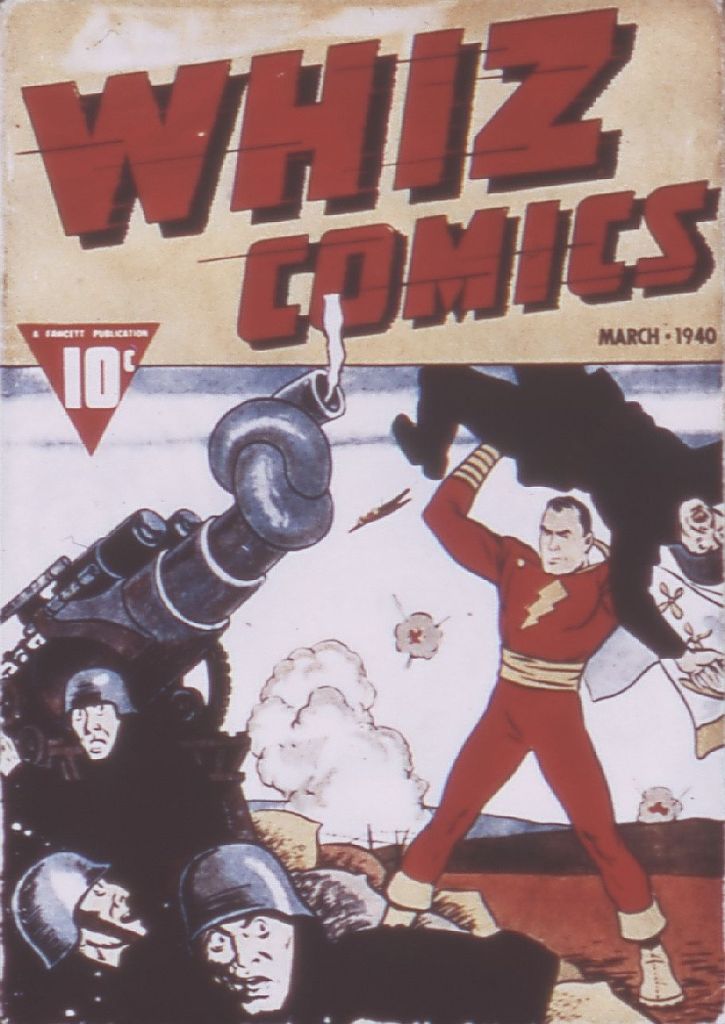
It’s a well-known part of comic book history that Fawcett Publication’s character Captain Marvel was one of the most popular characters of the Golden Age of Comics, regularly outselling Superman. And in fact, the series was successful until a lawsuit from DC/National Comics forced Fawcett to agree to cease publishing the Captain’s adventures. For years, fans have felt that this ruling was unfair, that Captain Marvel and Superman were different enough characters that there wasn’t enough overlap between them. Well, that became true in time, but if you look at the earliest adventures of the Big Red Cheese, you’ll find that they contain not a hint of the whimsy and satire that the series eventually became known for. They read like nothing so much as ersatz Superman adventures. So here’s Captain marvel’s second outing, from WHIZ COMICS #3 (the first issue was an ashcan dummy that wasn’t distributed and only put together to secure trademarks.)

Like the Captain’s first story, this one was written by Bill Parker and illustrated by C. C. Beck. Beck’s style is naturally cartoony, but at this point he’s striving to work in a more quasi-realistic action-adventure style on this series.


The thing that put Captain Marvel over the top as a popular character was doubtless the 1941 ADVENTURES OF CAPTAIN MARVEL live action serial released by Republic Pictures over twelve weeks. This was also the source of the Captain’s legal woes. Before producing Captain marvel, Republic had attempted to negotiate the rights for a Superman serial, but the deal fell through. Upon hearing this, Fawcett’s owner reached out to the studio and offered their big character, Captain Marvel, as an alternative, striking a sweetheart deal with the studio. When the serial was release, DC sued both Republic and Fawcett for infringement on the Man of Steel–something that hadn’t done previously. So that production proved to be a double-edged sword for teh feature, bringing it its greatest popularity but also sealing its eventual fate.
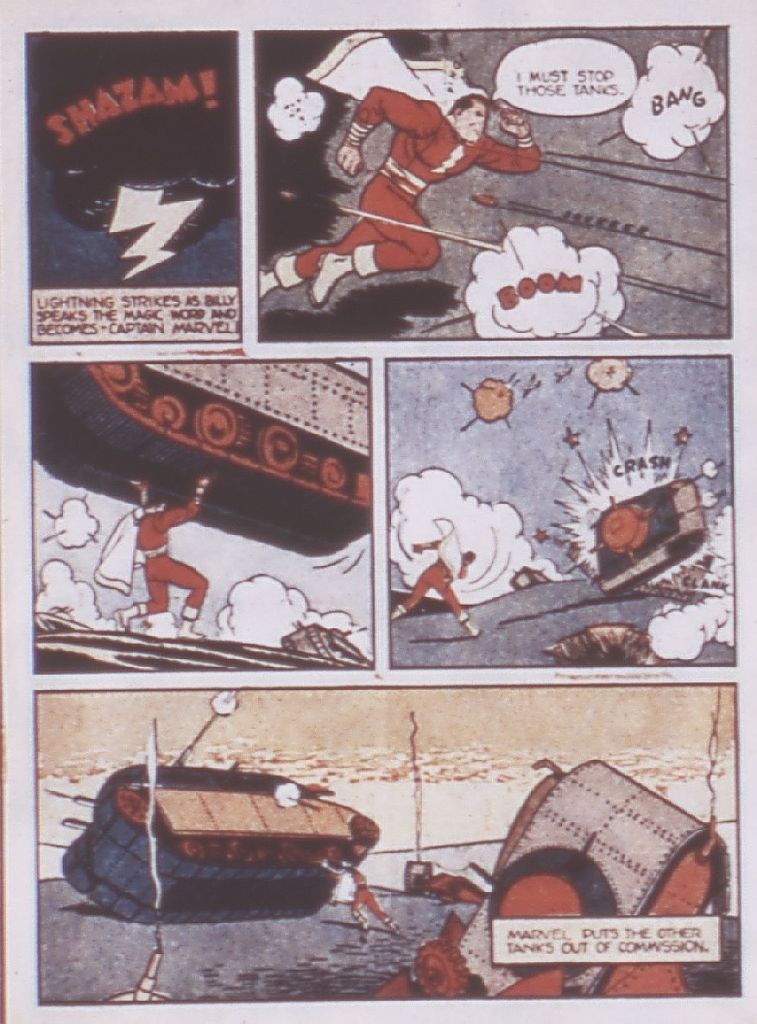
As a story, these early Marvel yarns, like teh equivalent Superman stories, are light on plot, and mostly concern the hero instead contending with all manner of physical challenges. Spectacle was the name of the game in these early days, when it was enough for a super hero to have tremendous strength and ability and be depicted using it in astonishing ways.
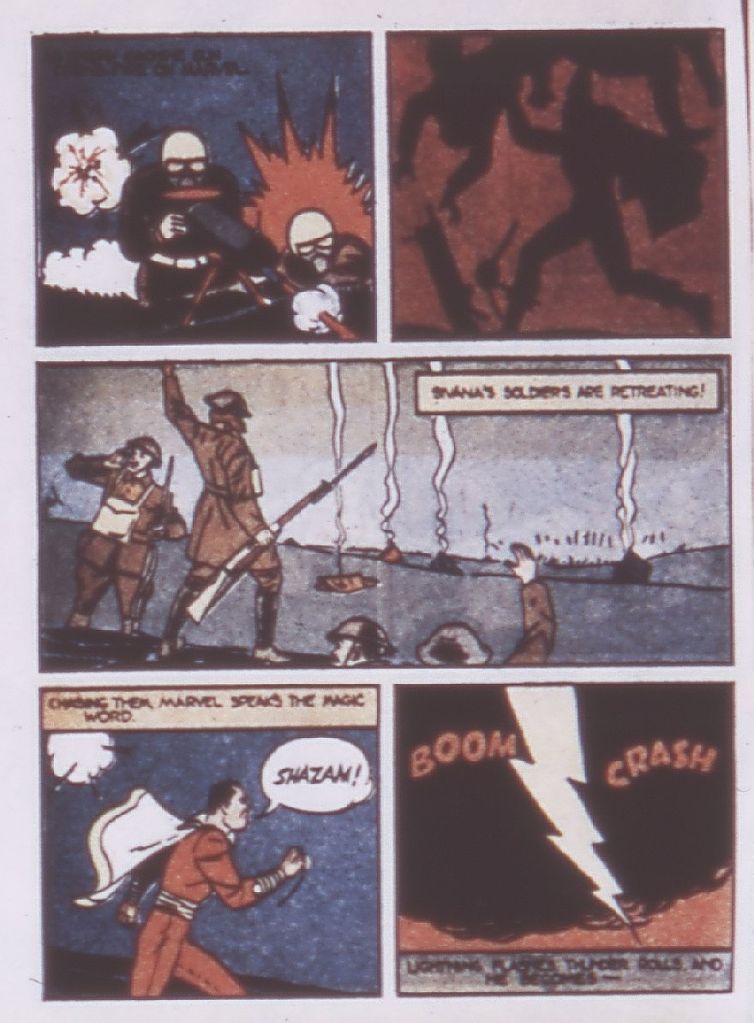

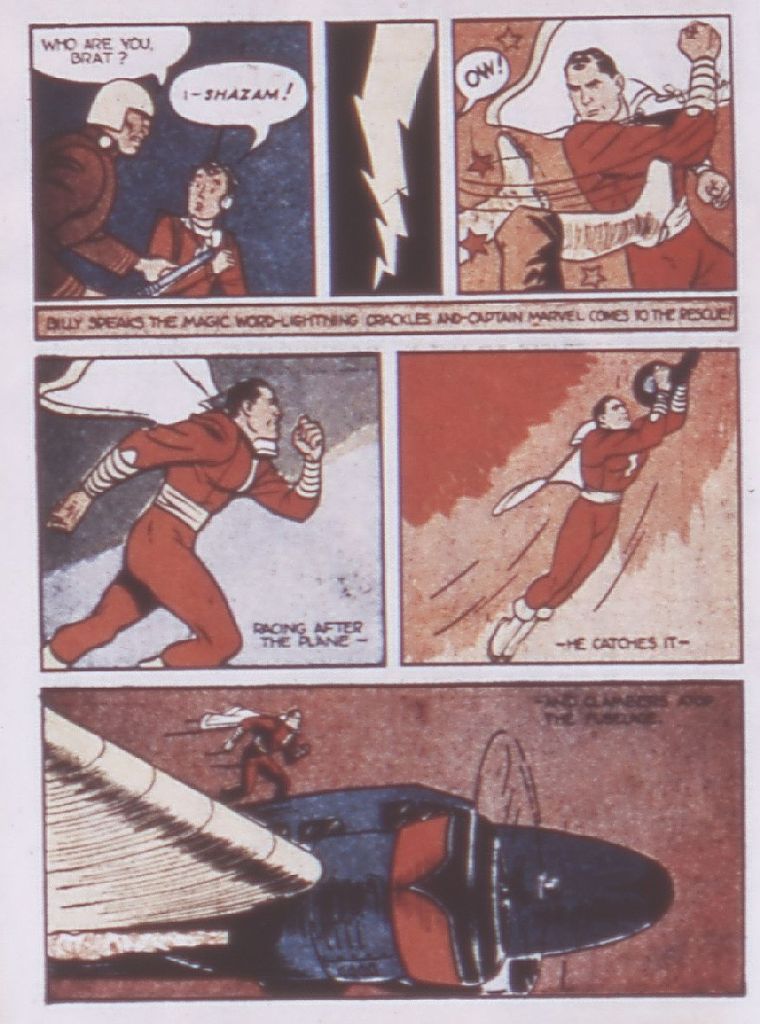
Also like Superman, Captain Marvel couldn’t outright fly in thee earliest episodes, though he grew that ability by the time of the serial. He did leap into teh air an awful lot–just like the Man of Tomorrow.

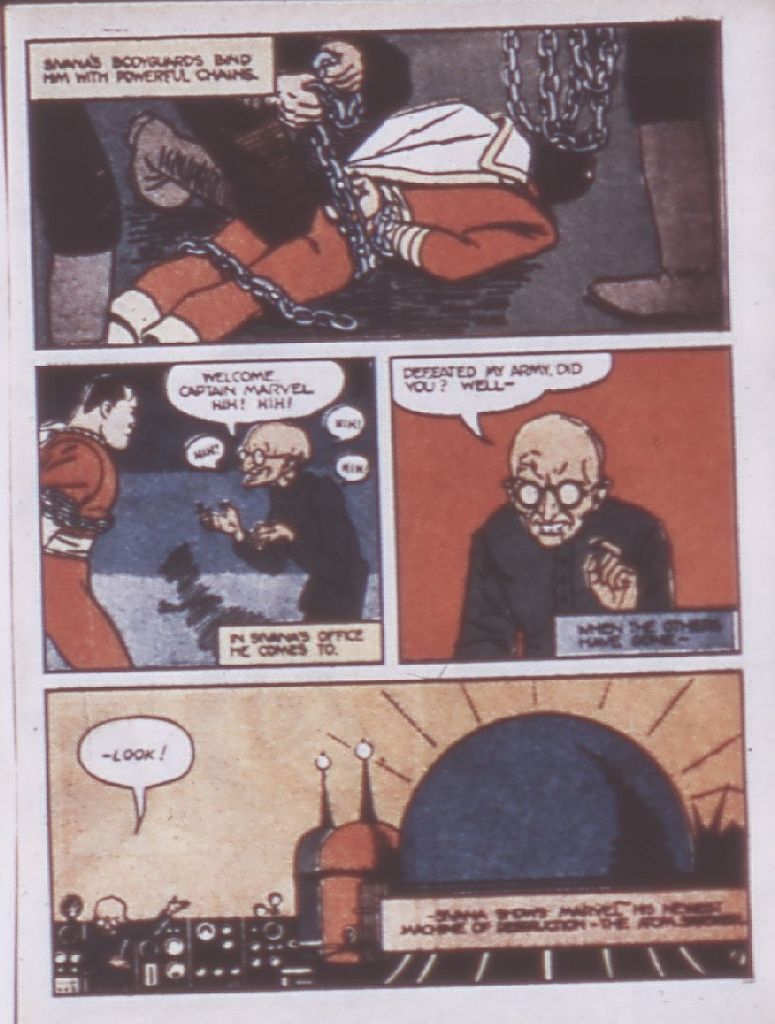
Sivana is a relatively colorless mad scientist from out of central casting at this point, too.

Like Superman, the early Captain Marvel could sometimes be overwhelmed by gas. All the better to keep the story going for the required number of pages.

This panel on the lower left was repurposed from the cover to the WHIZ COMICS #1 ashcan, which as I mentioned earlier, wasn’t actually distributed to the general public.
 The Tom Brevoort Experience
I’ll say it again, if DC had a case against Fawcett over Captain Marvel then Timely Comics had one over Aquaman. Captain Marvel ( Billy Batson — human child powered by magic & says a magic word to turn into a super-powered adult ) while Superman ( Kal-El/Kal-L/Clark Kent is an extraterrestrial adult powered by Earth’s lower gravity & yellow sun light ). Shoot Billy Batson he dies, shoot Clark Kent and bullets bounce off him unless Kryptonite or Magic is involved. Dr. Sivana was bald first, while Lex Luthor was a red head. Then there is the Marvel Family, Black Adam, Captain Nazi and a host of characters that Superman didn’t have counterparts for ( Hell Mary Marvel predates Supergirl like Captain Marvel, Jr. predates Superboy ( Superman’s adventures as a boy ) and Black Adam predates Kryptonian villains. Captain Marvel Adventures#28 ( October 1943 ) Captain Marvel and the Monster Society of Evil Chapter VII: The Lost Sunrise — Captain Marvel is strong enough to start the rotation ( of Earth ) again ( see comics.org ) — I bet he beat Superman to doing something like that. Hell Flash Gordon’s owners had a better case against DC over Hawkman than DC had over Captain Marvel ( who had no stupid Kryptonite weakness or red sun weakness or I’m more vulnerable to magic than anyone else in the DC universe weakness — the gets his but kicked by ordinary werewolves & vampires. A vampire tried to bite Power Man in Power Man and Iron Fist series and broke his teeth ). What was done to Fawcett by DC was pure evil, plus Fawcett had idiots for lawyers.
LikeLiked by 1 person
The court basically decided the copying was enough, it didn’t have to be 100% on every point. It noted the differences, but the total context went against Fawcett. Especially the aspect of being told to copy Superman. You might have decided the case differently, but nobody involved was an idiot. The whole decision is here:
https://law.justia.com/cases/federal/district-courts/FSupp/93/349/1971798/
Copying.
“The evidence as to actual copying is conflicting. Plaintiff called some of the employees of Fawcett just referred to. They testified to instructions from their superiors to imitate the “Superman” strips and the dialogue and script as closely as possible, and that they did so. Fawcett called the superiors, who denied having given any such instructions and denied any copying. An independent artist testified to admissions by Beck, Fawcett’s chief artist, who drew the first “Captain Marvel” cartoons, as to his having copied “Superman”. Beck, however, denied having made any such admissions. Experts were called by both parties, who contradicted each other as to the significance of claimed similarities and dissimilarities between the portrayals of the two characters, their facial appearances, costumes, etc., and the superhuman feats performed by them. It would serve no useful purpose to recite in detail the conflicting testimony, for I am satisfied from all the evidence that there was actual copying.”
It goes on about the similarities and differences.
See also:
https://law.justia.com/cases/federal/appellate-courts/F2/191/594/91314/
LikeLike
“but also sealing its eventual fate.” Do you think it had the mojo to keep going into the Silver Age? I’ve no idea what sales were like by the time Fawcett ended the Marvel Family.
LikeLiked by 1 person
Superheroes were certainly on a downward trend by then, which probably factored into Fawcett’s decision to stop fighting and accept an out-of-court settlement. They ended up shutting down their whole comics publishing operation, in favor of concentrating on the increasingly-lucrative paperback book market.
LikeLike
That’s kind of how I figured it.
Fawcett pioneered the paperback original book when they saw how much the reprint books they distributed sold and couldn’t cut in on that action because of their distribution no-compete contract.
LikeLike
As I mentioned elsewhere, that was the key issue, yes. Superman may still have been selling, at least to DC’s satisfaction, but Captain Marvel had bottomed out, & they just didn’t feel comics were worth the effort anymore.
LikeLike
Fawcett might have survived on Captain Marvel like MLJ/Archie Comics survives on Archie Comics had they not thrown in the towel ( To bad if they had one they didn’t use their Letter Page to ask their readers to help them find evidence to prove the huge differences in the 2 heroes instead of the superficial ones DC fixates on. Anyone see a Billy Batson Lois Lane in this or any other Captain Marvel story? Does Superman have counterparts to Mr. Mind, Mr. Atom, King Kull, Oggar, Mr. Power ( Think Sebastian Shaw only he goes from DJ Qualls in size to The Rock in size as he gets stronger ) and others? Cause it looks like to me with the original 1950s Kryptonian villains or Supergirl that DC is imitating Captain Marvel’s Black Adam and Mary Marvel ).– Niatpac Levram a mirror duplicate of Captain Marvel created by Wizzo the Wizard [ Captain Marvel Adventures#139 ( December 1952 )] predates Bizarro. Maybe the Marvel Age or DC’s Silver Age might have inspired them bring back their comic book universe of heroes.
LikeLike
TRIVIA ( Captain Marvel & Thor ( Marvel’s ) ): comics.org – Thor precursor, Shazam ( I think they meant Captain Marvel since no mention of Shazam in the story as a character ) referred to as “Thunder God” and fights Aliens from Saturn. This motif used when Kirby co-created Thor in Journey into Mystery#83 with Thunder God fighting Aliens from Saturn as per Comic Book Historians article researched by Alex Grand [ 64 Pages of New Captain Marvel Adventures#1 ( March 1941 ) Jack Kirby – “The Monsters of Saturn” ]. ( Me ) Captain Marvel beat Superman to outer space and fighting Aliens, plus fought a vampire in the next story before Superman.
LikeLike
They lasted until 1954 (barely) and the Silver Age began in ’56 with The Flash, but Quality lasted until 1956 and all that continued was Blackhawks.
CPT Marvel might have continued but no one was going to take it over (even DC) given the court holding.
How much “”pseudo-EC stuff had leaked in to the Marvel Family towards the ned is interesting . . . .
LikeLike
I’m amazed BLACKHAWK made it to almost the end of the Silver Age given the DC book was so dull (even by my most generous I Love The Silver Age standards).
LikeLike
Archie Comics site has Archie Andrews as a new version of their golden hero Mr. Justice ( with 3 different covers for issue 1 — one is a homage to Action Comics#1 ).
LikeLike
As a thought experiment I sometimes try to imagine how different things would be today had National offered to buy Captain Marvel from Fawcett after they had won the lawsuit.
LikeLiked by 1 person
I grabbed this years ago, always assumed it was related to the DC lawsuit but not 100% sure.
LikeLike
Tried posting a pic of my copy of Whiz #62 with a court case stamp on it,, that was what I assumed was used in the DC case, but can’t seem to get the pic posted.
LikeLike
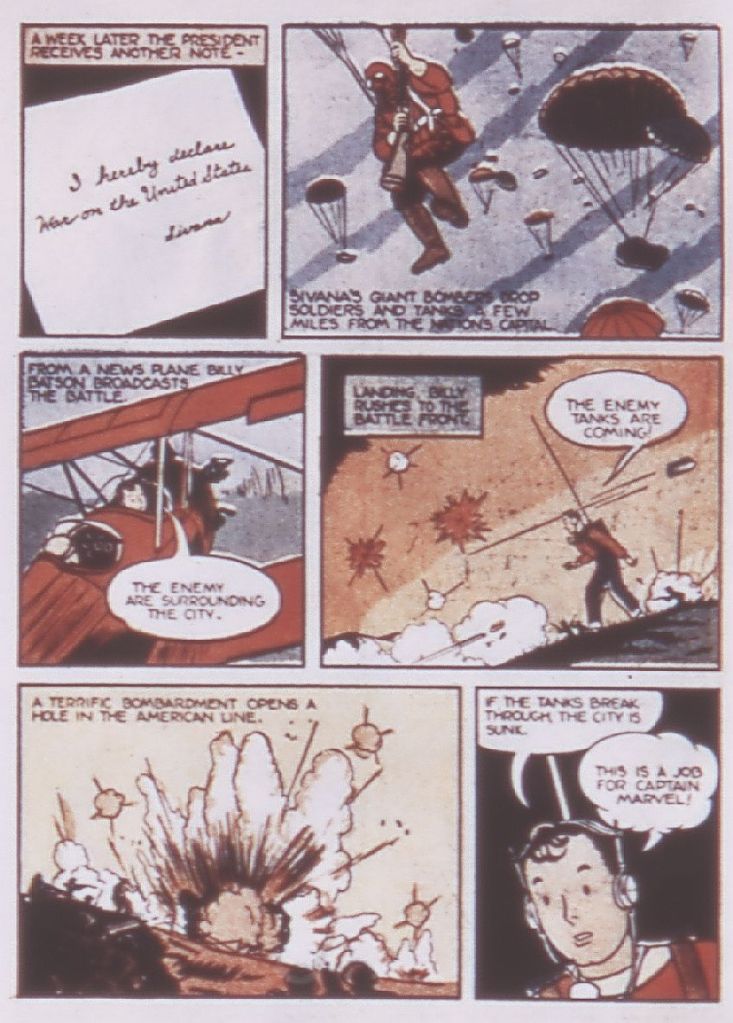
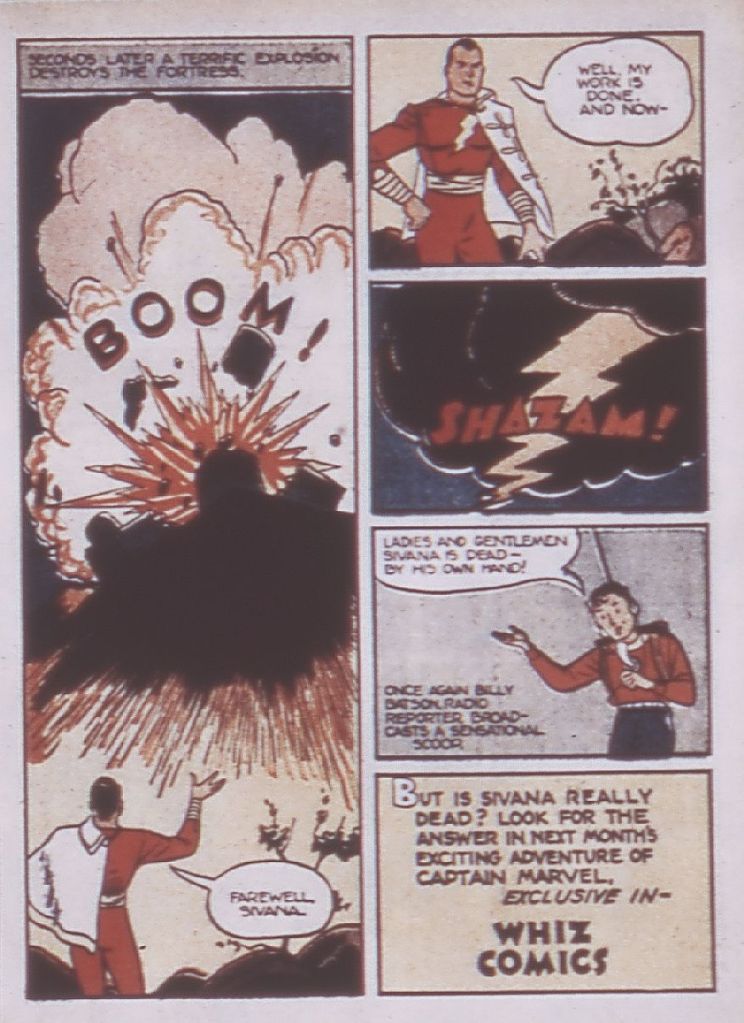
The pages showing Sivana’s deployment of his forces were striking. Reminded me of a news reel or still pics from old Life Magazine. I much prefer Beck’s more naturalistic style here (excluding Bill Batson’s appearance of course).
Billy evens said, “This is a job for Captain Marvel”. That’s about as distinct from “This looks like a job (now to a lower voice) for Superman”, as this issue is from a Golden Age Superman story. Superman could’ve performed the exact same actions (minus the transformation by lightning).
All the sillier stuff that really differentiated Cap from Supes hadn’t appeared, yet. Just based on the actions Cap took, it was very similar to Superman. DC was protecting its income. Decades later, DC allowed a dozen or more Super-facsimiles. DC hasn’t sued over them.
LikeLike
Superman 1941 Quote Clark Kent: This Looks Like A Job For Superman ( YouTube & even a someone on Reddit says Max Fleisher cartoon 1941 is the earliest he could find ). So Looks like once again Superman is imitating Captain Marvel ( March 1940 ). I don’t know if Fawcett Comics March 1940 for this issue matches up ( if they both came out in March ) with Action Comics#22 ( March 1940 ) but there is more war in this Whiz Comics than in Action Comics ( 2 bombers, one Superman downed by sticking his hand in the propellor and the other one he got under and threw at the ground. At sea he intercepted a torpedo and threw it at a U-Boat ) & Action Comics#23 ( April 1940 ) was Luthor ( with red hair ) first appearance: Bombers, a dirigible ( that crashed into the ground that Luthor “dies” in ) & Luthor’s ray machine in this issue. Action Comics#2 ( July 1938 ) some war in it but not much and Superman either murders a soldier called a torturer by ( writer’s words ) throwing like a javelin ( he went very very far too ) that either killed him when he impacted the ground or put him a body cast later on and possibly crippled him for life.
LikeLiked by 1 person
It’s my understanding that “DC sued Captain Marvel out of existence” is a bit of a myth, & what really put Captain Marvel out of business was sales had slacked off so far that Fawcett had come to see trying to defend the property as a bottomless money pit that would bleed them dry if they continued, so they threw in the towel & recouped what they could by selling their superhero properties to DC, which likely would’ve let all of them lie in state forever had not some crazy little upstart company put them on their heels by the early ’70s & they needed a stunt to draw eyes back their way.
But by the time the case shut down, Captain Marvel, like most ’40s superheroes, was (at least for the time being) no longer commercial, & Fawcett’s future lay in crossword puzzles & Dennis The Menace, & like many publishers of the day they were done with comic books…
LikeLike
I wonder if what put CPT Marvel on the road to success was the work Simon & Kirby did on the early Captain Marvel Adventures?
Although they were supposed to follow Beck’s style (and the scripts!) I wonder if they did . . . .
Otto Binder probably was critical to this . . . .
LikeLike
I’d have to check but I’m pretty sure Captain Marvel was a major “selling better than Superman” hit pretty much right out of the gate, which would’ve been before the very short-lived Simon & Kirby version. I doubt it had any influence on the character’s popularity one way or another… (Lemme put it this way: the S&K version was so popular it went virtually unremembered until someone dredged up a copy in the ’80s… The only people who were commonly mentioned in association with Captain Marvel for decades were mainly CC Beck & occasionally Otto Binder…)
LikeLike
Right, the fact that they gave Cap a solo book in the first place means that he was already proving to be very successful.
I mean, the Simon & Kirby art sure didn’t *hurt* him any. In a lot of ways, they were a better fit for this early, more “straightforward superhero” version than Beck was. But Cap’s star was clearly on the rise regardless. And once Binder, Beck, and co. really found their niche, there was no stopping him.
LikeLike