


Well, I’d known this day was coming for several months now, but it was somehow always a surprise when it happened–typically because I was used to budgeting against a particular amount, and now all of those calculations were in the wind again. This issue of DAREDEVIL was the first book I bought where the cover price for a Marvel title went up to 40 cents. This happened late in the book’s development cycle, so much so that it maintained the jagged burst that had previously contained the legend STILL ONLY 35 CENTS. DC’s books had been 40 cents for a few months already, having come down from 50 cents after the DC Implosion. But still, at this point a single comic book cost twice as much as they had when I’d started reading only a couple of years earlier.

It has to be said that Editor in Chief Jim Shooter had a good eye for developing talent. Not only was this the first issue of the series to be drawn by artist Frank Miller, who would come to reinvent the series top-to-bottom shortly, but Shooter and editor Al Milgrom called out his arrival in a big way, both on this credits page and in this month’s Bullpen Bulletins page. Clearly they saw something in this new kid–and they certainly weren’t wrong. I don’t think I took any special notice of the artwork on this issue–it was fine, but didn’t stand out to me at the time as being any better or worse than the issues that preceded it. But in hindsight, even this early on, Miller has a good grasp of the essentials. Just look at the way that shattered window behind Natasha doubles as an indicator of her mental state. That’s a complicated bit of storytelling trickery for a newbie to be attempting on his first page.

This issue was also the wrap-up to the long-running Death Stalker plotline, in which the villain’s true identity and motives are revealed. I have to say, it kinda wasn’t worth the wait, and it’s no real surprise that after Death Stalker’s demise in this issue, nobody since has really brought him back. Sometimes the juice isn’t worth the squeeze. Anyway, this issue picks up where the last one left off, with the Ani-Men attacking the law offices of Nelson & Murdock, intent on abducting Matt Murdock, secretly Daredevil. The Black Widow is there, and she tries to stop them, but she’s outnumbered and can’t prevent the villains’ escape. Well, all except for Bird-Man, whom she succeeds in downing.
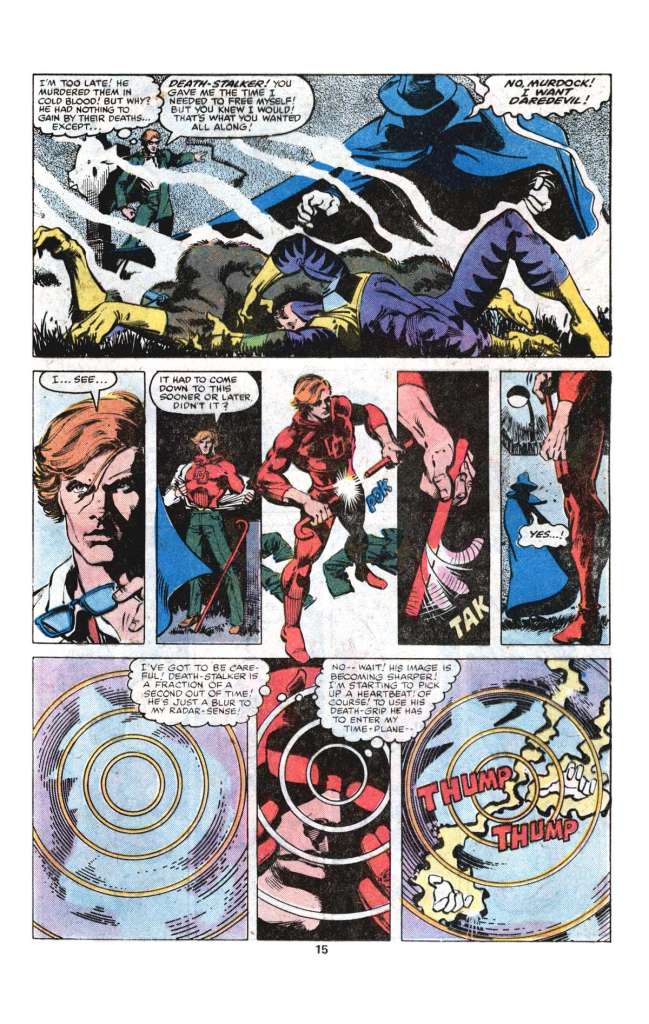
The Unholy Duo bring Murdock to an isolated graveyard, where their employer Death Stalker is waiting. But not being the grateful type, Death Stalker rewards his two henchman by killing them with his fatal touch as they count the cash he’s supposedly paid them. He has a conversation with Murdock, a monologue really, that reveals that he was really an obscure villain from the late 1960s, the Exterminator. But having been smashed into his own Time-Displacement Ray by Daredevil, the man who would become Death Stalker found himself dislocated in time and space. He could only enter the corporeal world infrequently, and even then, he couldn’t become entirely solid any longer. But he used his newfound gifts to steal a set of deadly gloves from A.I.M . and set himself up as Death Stalker both to get revenge and to try to rebuild his equipment and release himself from the void. Oh, and he knows Matt is Daredevil. Wanting a showdown, Death Stalker obligingly waits for Matt to don his costume and get his gear ready for a fight.

The remainder of the issue is pretty much just a fight between the two foes, and Miller gets an initial chance to show off what he can make of an action sequence. He leans very heavily into horizontal panels, and uses both silhouettes and after-images effectively to convey speed and motion. It’s a really nice job. Inker Klaus Janson lends his typical gritty polish to the pages–it’s already apparent that the Miller/Janson combination works exceedingly well. DAREDEVIL had been a series that struggled creatively for a long, long while now, and this at least gives a sense that on a purely visual level, things have taken a turn for the better.

Eventually, though, the pages run out and the fight concludes in the only way it could have once Death Stalker revealed he knew Daredevil’s true identity: he lunges at DD through a gravestone, so blinded by rage and hatred that he materializes partway through in an attempt to grab the Man Without Fear in his fatal grip–and he’s killed instantly, fused into the gravestone. It’s a pretty gruesome end for the villain, memorably so. But it’s all done bloodlessly, so the Comics Code seems to have passed it no problem.

And then at the end of the issue, we get a one-page wrap up with Matt and his supporting cast, including a growing subplot with the firm’s new hire, wheelchair-bound Becky Blake, who like every other woman in the series is completely smitten with Matt Murdock. Sadly, this is a plot thread that doesn’t ever really go anywhere, as writer Roger McKenzie has other things he’s more interested in playing with, and as Miller gains more and more authority over the finished product, it’s clear that he’s got his own ideas as to whom Daredevil should be involved with. Still, this was a good issue, for all that the Death Stalker reveal was a damp squib, and it felt like finally the decks had been cleared for some new business–this death stalker plotline had been lingering around in the title for a couple of years by this point.
 The Tom Brevoort Experience
I think Spymaster in Iron Man died the same way around this time.
LikeLike
Yeah, Spymaster did die the same way because The Ghost [ Iron Man#220 ( July 1987 ) ] killed him for some reason. considering that The Ghost was the Death-Stalker level threat to Iron Man and not Spymaster ( who should have just like the Chameleon been a SHIELD foe ), I just to this day don’t get why he was killed off.
LikeLiked by 1 person
As someone else said about it, Spymaster’s written smart enough he’d have been better prepared for a double-cross.
LikeLike
Spymaster was one of the few decent Ironman foes introduced in the 70’s. I think he worked well as an eternally faceless character. While it wasn’t a particularly big loss…having him killed off and quickly replaced by a newbie trained by the Taskmaster wasn’t an upgrade. A dangerous guy who was a blank slate for ten years has way more story potential than the guy who just graduated super villain high.
LikeLike
Tom,
You’re usually right about everything, on on this one, you are wrong. The visuals and the visual pacing here by young Miller are so awesome and so much fun. As a youngun reading this comic, I started to love DD even before the Miller hype. I recently taught 158 in my comics course and my students loved it, too. You had it right in your first paragraph with the brilliance and creativity Miller brought to the comic — why did you go all opposite on it for the rest of the writeup? Wrong, sir. Wrong.
So there. 🙂
LikeLiked by 1 person
Miller definitely caught my attention — in a fairly short span of time, he’d done a couple of pretty nice issues of Spectacular Spider-Man, a *really* impressive Marvel Two-In-One, and this Daredevil story which (as you point out) looks more like the work of a confident, mature veteran than some promising newcomer. It was an exciting time to be a comics fan.
LikeLiked by 2 people
This was my 1st Daredevil!
Some consider it the first Copper Age Comic – I don’t.
Some also say for Comics it changed everything.
As for me I feel it’s a trio that changed the comics landscape:
LikeLike
The same thing ( type of death ) happened to Adolphe [ Marvel Tales#127 ( October 1954 ) 3rd story “He Walks Through Walls” — see marvunapp.com for profile ] & Lester Creel [ Strange Tales#15 ( February 1953 ) 5th story “He Walked Thru the Wall” –Dr. Smithers ( creator of a salve when rubbed over the body enables the molecules of the skin to pass in between the molecules of solid substances ) ]– both tried robbing banks and got stuck in the walls when their powers wore out and died. Both those Atlas Age stories pre-date 4D Man ( 1959 film ).
LikeLike
Love your blog, as always! One remark – Try not using ‘wheelchair bound’ (most style guides advice against it) – a wheelchair is something to make disabled people more mobile… Thanks 🙂
LikeLiked by 2 people
An interesting historical note about Death Stalker: he first appeared on the last page of DD 113 as some sort of spy and, at the time, the Gladiator’s boss in the first part of a 3 part story written by Steve Gerber. Death Stalker ordered Gladiator to kill DD and behaved like he barely know who DD was, just telling Gladiator to get rid of DD. Of course, in DD 115, DD foiled Death Stalker’s plans and Death Stalker appeared to fall into a vat of acid..but as we know, did not die. It appears that Gerber created Death Stalker as a brand new villain who had nothing to do with past DD villains. Since Gerber left writing DD a few issues later he never had an opportunity to provide an origin for Death Stalker. Other writers such as Marv Wolfman and Jim Shooter used Death Stalker in the DD series but they had him look on DD as a nuisance and never mentioned wanting some major vengeance against DD. Apparently that was all brought up by Roger McKenzie in DD 155-157. However, I have a vague recollection (could be wrong) that it was later mentioned in a letter column that it was Marv Wolfman who suggested the idea to tie Death Stalker in with the completely forgotten Exterminator who appeared to have died in DD 41 (I can admit that I forgot him, and I read DD 41 at the time it came out). When I first read DD 158, I guess I thought it was pretty clever to tie those continuity threads together. Now I’m not sure. Death Stalker certainly had pretty of reasons to hate DD already..DD foiled a lot of his plans! I definitely agree that the art in this issue by Miller was very good and he had found his perfect inker in Klaus Janson.
LikeLiked by 2 people
So that’s 2 Daredevil villains that got upgraded after they died, The Exterminator ( to Death-Stalker ) and Starr Saxon [ DD#49 (February 1969 ) to Mister Fear -DD#54 (July 1969) to Machinesmith -Marvel Two-in-One#47 ( January 1979 ) — I like Machinesmith but I do wonder had Jack Kirby finished his Black Panther storyline with Kiber the Cruel { Black Panther#11 ( June 1978 ) ] would he have been like Machinesmith first or the New God Doctor Bedlam? ]
LikeLike
Marvel was sure burning through Ani-men at a quick pace! A set of 4 Ani-men were killed in an explosion in Ironman about 5 months previous to this issue… where they gave Shellhead way less trouble then when they tangled with a full (new)team of X-men a few years prior.
LikeLike
I had liked Death Stalker’s visual and apparent power set that the casual way he was killed off and his lame ass origin made me feel very let down.
LikeLike
“That’s a complicated bit of storytelling trickery for a newbie to be attempting on his first page.”
Not his first page, of course, but his first page of DAREDEVIL. But Frank was always good as striking layouts.
Al and Jim had an advantage over the rest of us — up until that point, Frank had largely been inked by people like Frank Springer and Danny Bulanadi, whose finishes homogenized the pages. Except for two great-looking jobs by Bob McLeod. But they’d seen the pencils, so they saw how strong the work was underneath the inks, and how fast Frank was improving.
I expect they’d also seen all of DD 158 before that Bullpen Bulletins was written, so they knew how strong it was. Plus, even if they weren’t as jazzed as they seemed to be, promoting a struggling book by talking up a new penciler is free.
But they had the goods, this time. I’d been a regular DD readers since issue 120, and while I’d liked most of the artists who’d drawn the book in that stretch, Frank’s arrival was genuinely exciting and the book was immediately more distinctive, in a way that helped solidify it and start attracting readers who actually stuck around.
I remember liking the reveal of who Death-Stalker was, mostly because I’d read all the issues that got referenced and knew who they were linking him to — but still, it was a real waste of a great-looking villain. I’m kinda surprised the name and outfit weren’t brought back, even if the guy inside wasn’t.
LikeLiked by 3 people
I’d read Death Stalker’s intro in issue #113, but missed 114, and likewise got DD #157 & 159, but missed 158, which I never found on the comics racks when it was new. At the time I was rather aggravated to have missed what seemed like a milestone issue, although little did I realize at the time that the real significance of it was not the conclusion of the longstanding Death Stalker arc, but the beginning of Frank Miller’s association with Daredevil. Issue 159 struck me as really odd, with this new artist and a story that was very different than any previous Daredevil story I’d ever read. My initial reaction, I must confess, was negative, much the same as my reaction to seeing some of Ditko’s old work. But as with Ditko, I gradually grew to appreciate his skill and unique style and to finally love it. I also came to recognize that Miller’s vision for Daredevil didn’t come out of nowhere but instead essentially returned to DD’s roots in that first and only story drawn by Bill Everett., giving the mag a more noirish feel, focusing on more street-level criminals, even borrowing Kingpin from Spider-Man and putting him to better use than ever before. Miller closed out one era and began a whole new one that would finally make Daredevil one of the most popular comics of the day.
LikeLiked by 3 people
We’re opposites there. I can appreciate what Ditko’s contributions mean to comics history but I have never liked his art. Conversely, I loved Miller from a great John Carter issue on but as his art gets looser and inkers get too heavy, I’ve been turned off for some time.
LikeLike
Frank Miller’s art was indeed striking, but as a reader who followed the Death-Stalker “saga” from Steve Gerber’s introduction in DD 113-115 to his final appearance I found the villain’s long-delayed origin and offhand demise very disappointing. I always liked the fact that he looked like an evil version of The Shadow who possessed a touch of death…
LikeLiked by 1 person
Did Steve Gerber’s version of the Death Stalker have a touch of death? Cause 2 Timely Comics villains had an artificial touch of death ( though the second one called his a wish of death — touched people too ): Red Skull ( George Maxon ) [ Captain America Comics#3 ( May 1941 ) 1st story “The Return of The Red Skull” ] & Baxter ( a fake hunchback — source of his electric touch ) [ Captain America Comics#54 ( March 1946 ) Human Torch story -“The Wish of Death” ]– actually a lethal electric jolt emitted from their gloves which killed on contact.
LikeLike
Steve Gerber’s Death-Stalker did indeed possess the touch of death. The story also featured Gladiator and the Man-Thing, a combination that thrilled my 12-year-old self.
LikeLiked by 1 person
“Just look at the way that shattered window behind Natasha doubles as an indicator of her mental state.”
This is indeed a very clever juxtaposition, and I’m embarrassed to say I had never (consciously) noticed the symbolism before.
LikeLiked by 2 people
1979: Return of the old foes–So Carrion [ Peter Parker the Spectacular Spider-Man#30 ( May 1979 -identity revealed ) was intended to be an old Spider-Man foe from the start even if he never got to be the foe the writer originally had in mind, but Death-Stalker [ DD#158 (May 1979 ) ] was revealed after the fact to be DD foe the Exterminator [ Darevel#39-41 ( April-June 1968 ) ]. My question is was Carrion the inspiration for the Death-Stalker turning out to be an old DD foe? Both Carrion & Death-Stalker could become intangible and had a deadly touch ( Carrion –all organic matter turned to ash at his touch & Death-Stalker — had a pair of cybernetic death-grip devices under his gloves that bombarded the victim with microwaves ).
LikeLike