

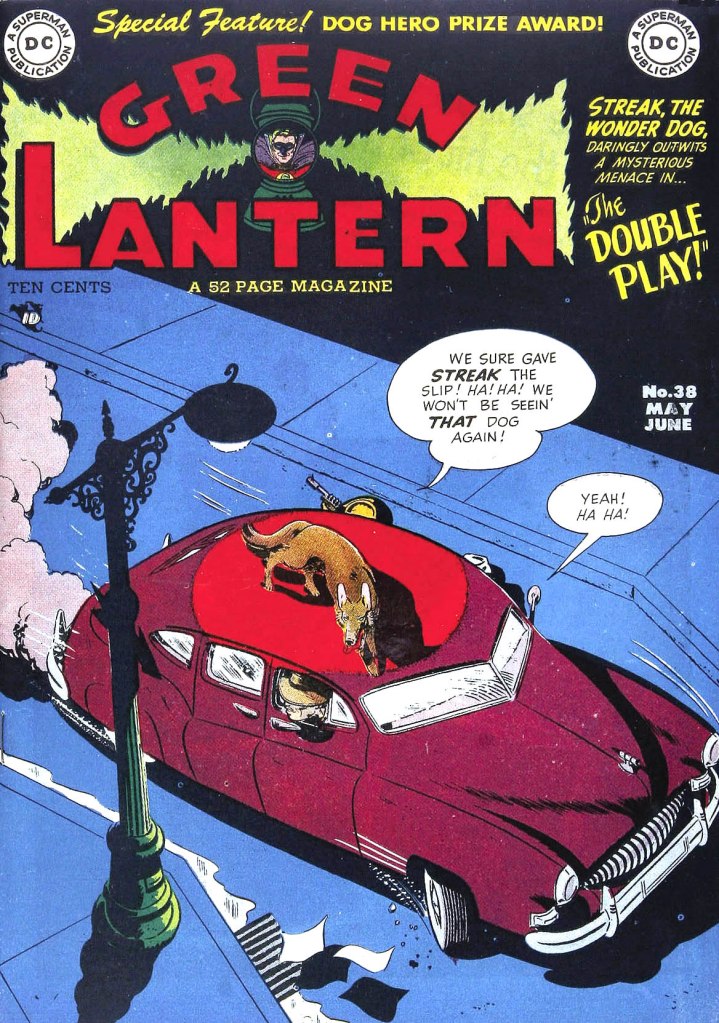
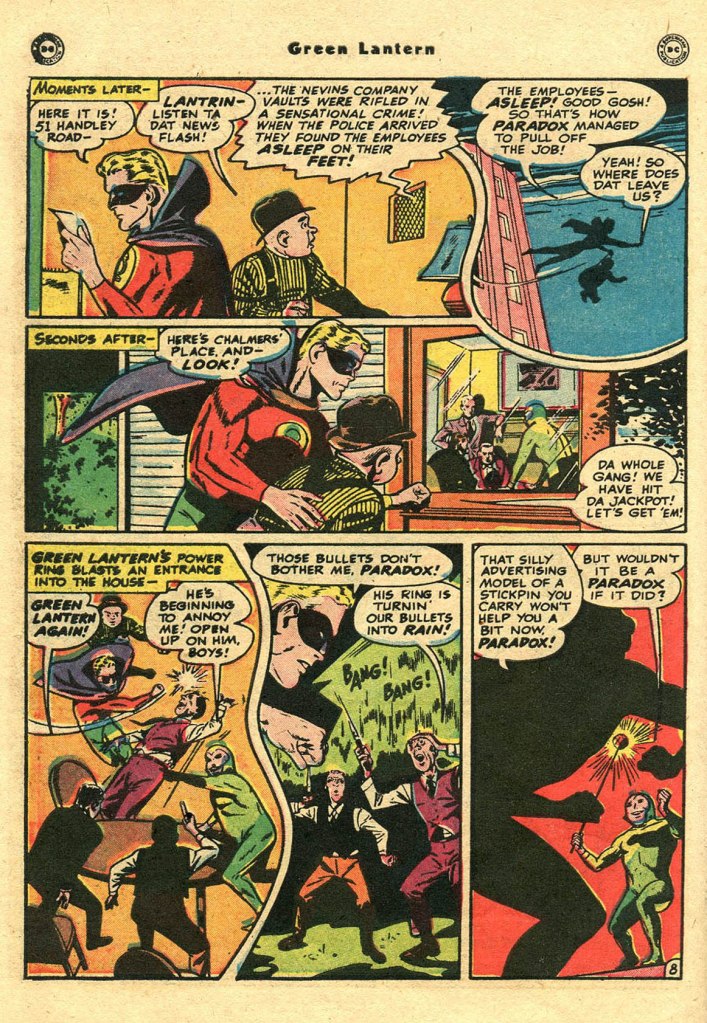
As opposed to the Flash and the other members of the Justice Society of America whose solo series all were discontinued in the pages of the anthology series they were a part of, Green Lantern actually made his final Golden Age solo appearance in his own title, which outlasted ALL-AMERICAN COMICS’ transformation into ALL-AMERICAN WESTERN by a few months. This was a double-edged thing, though, because by this point the Emerald Crusader had been pushed off of the cover of his own magazine by Streak the Wonder Dog, a canine character introduced a short time previously. You can almost feel Alan Scott thinking about the fate that befell fellow member Johnny Thunder after the Black canary showed up in his strip, ousting Johnny from it in just a few issues.
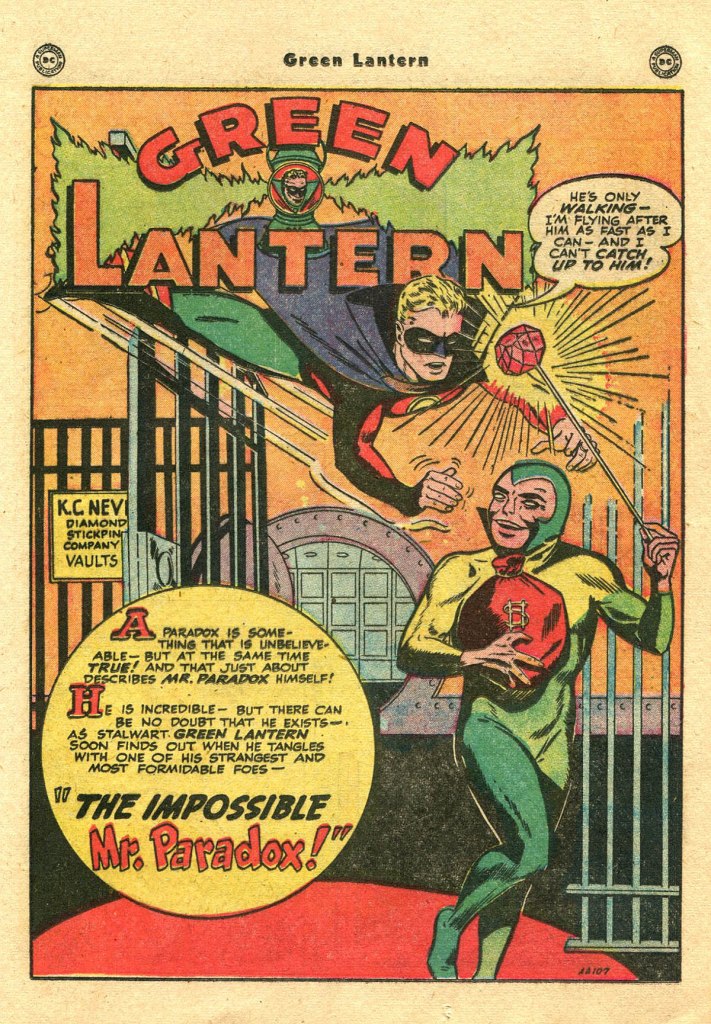
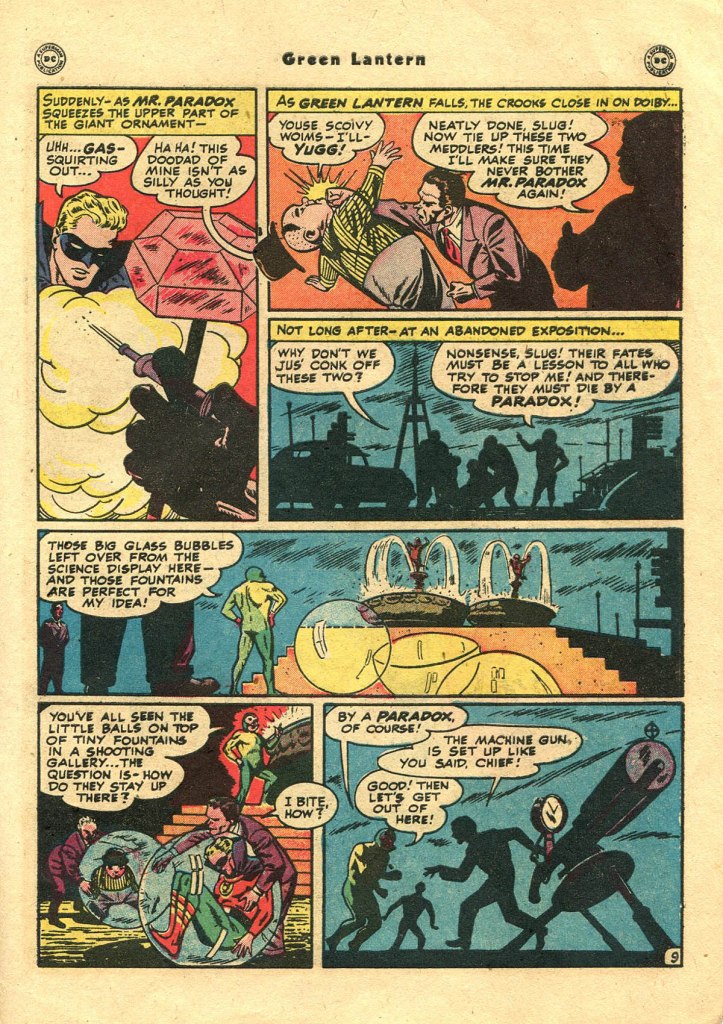
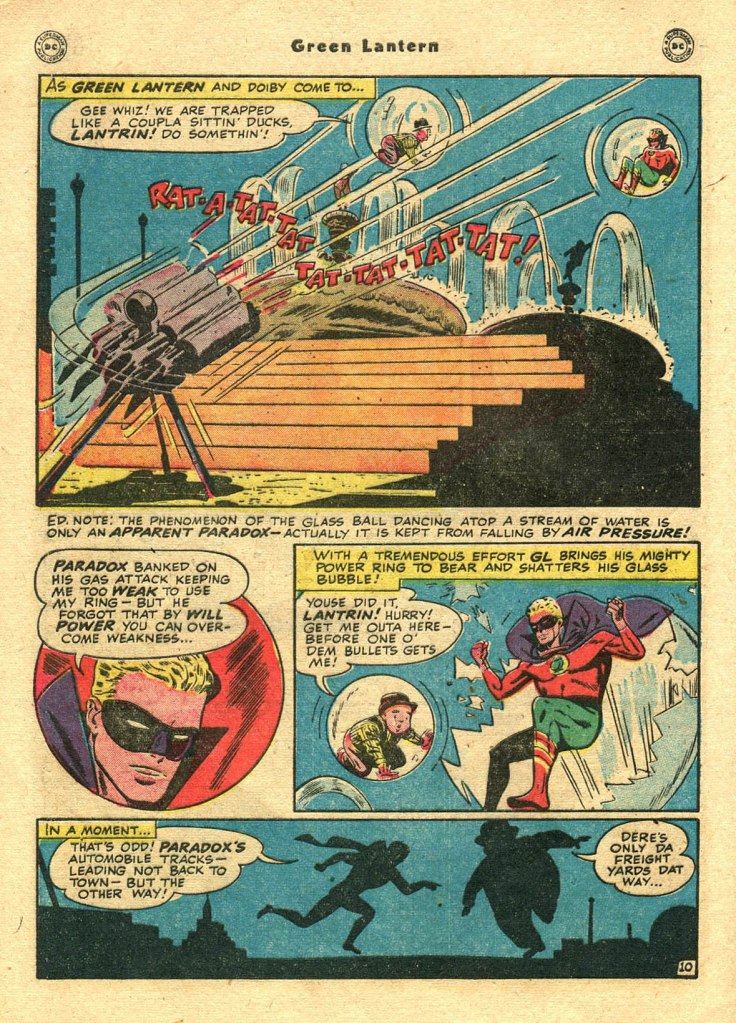
GREEN LANTERN #38 contained two Green Lantern stories bracketing a Streak solo adventure. So for our purposes, the second of these qualifies as the hero’s final solo adventure. Of course, he’d continue on in his capacity as a member of the Justice Society of America in ALL-STAR COMICS for another year or so.
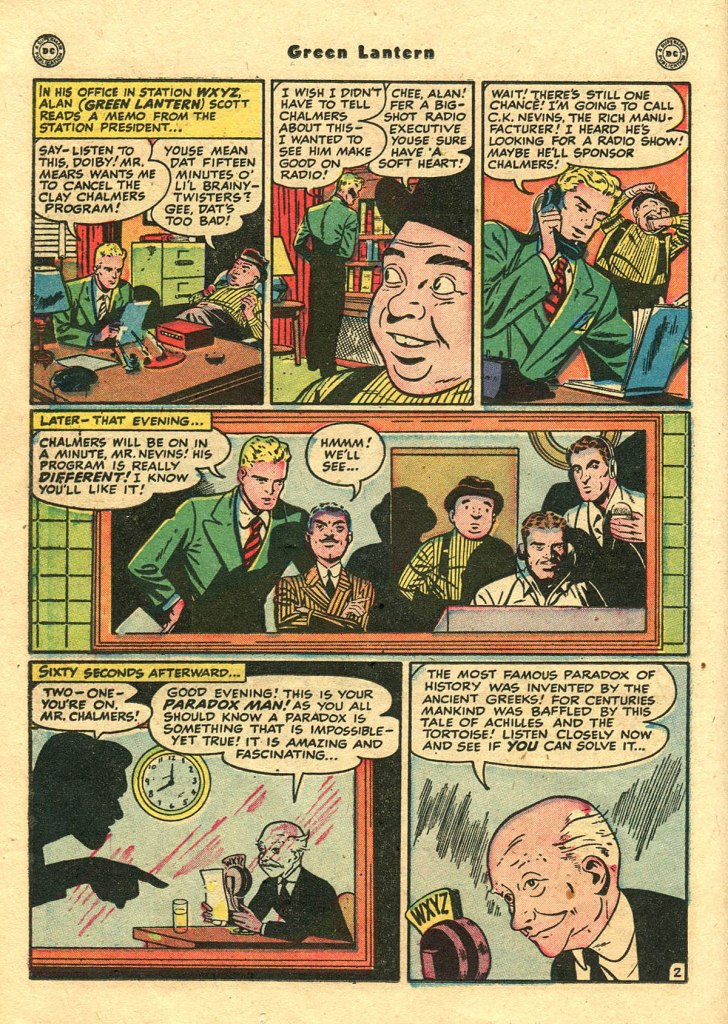
This final outing for the ring-wielding hero was written by Robert Kanigher, illustrated by Irwin Hasen and edited by Julie Schwartz–the same editor who would revive Green Lantern as a more science fiction-based hero a decade later.
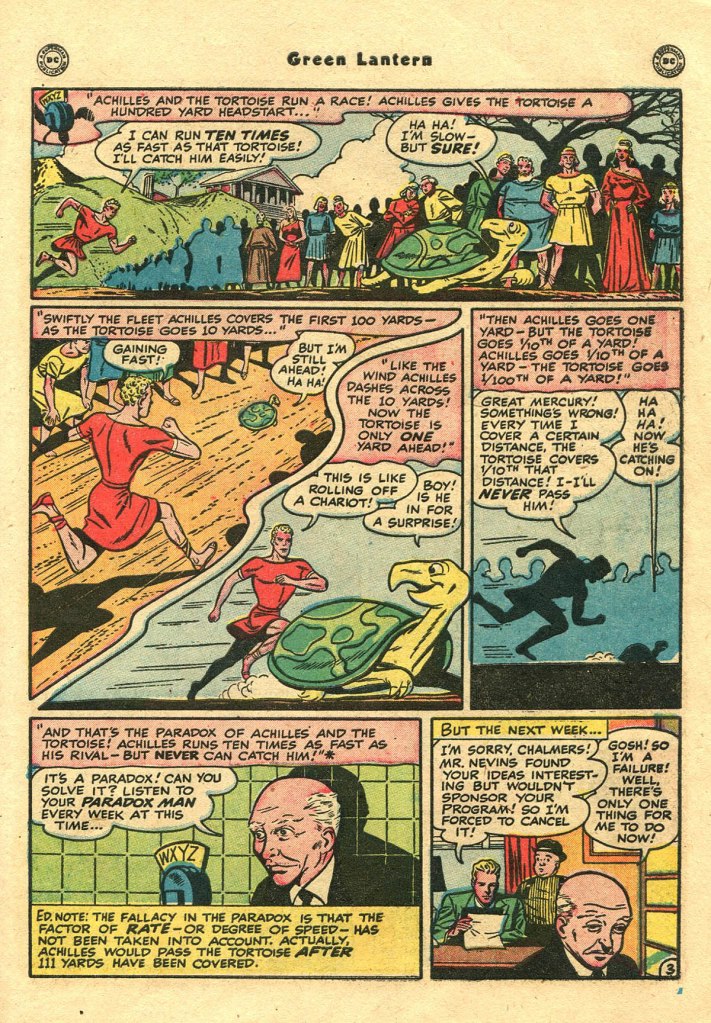
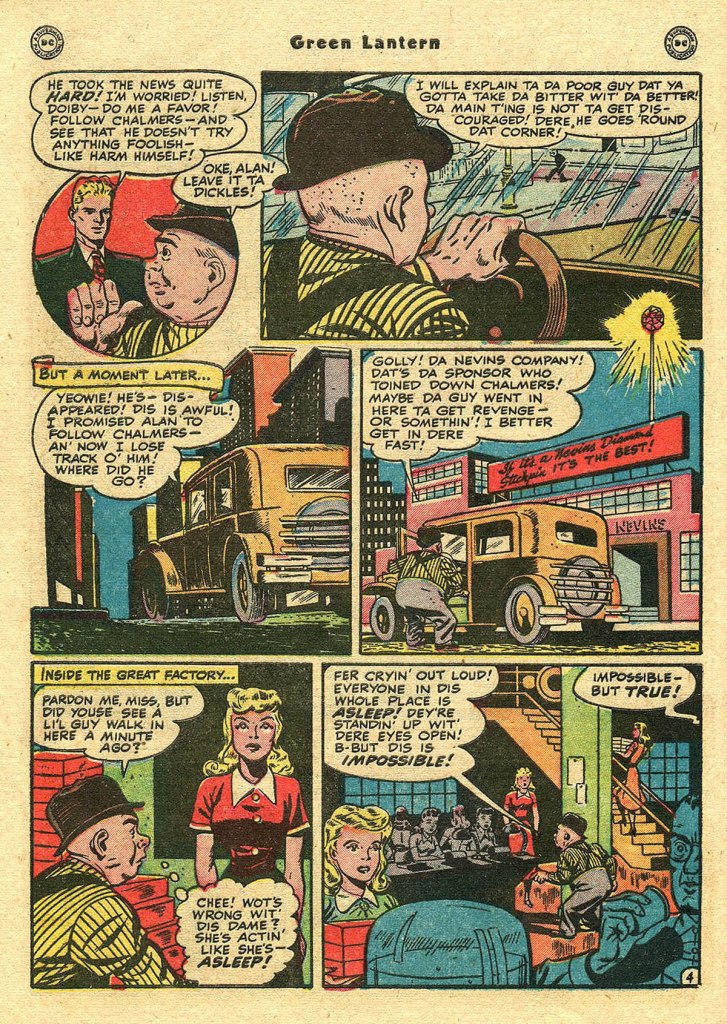
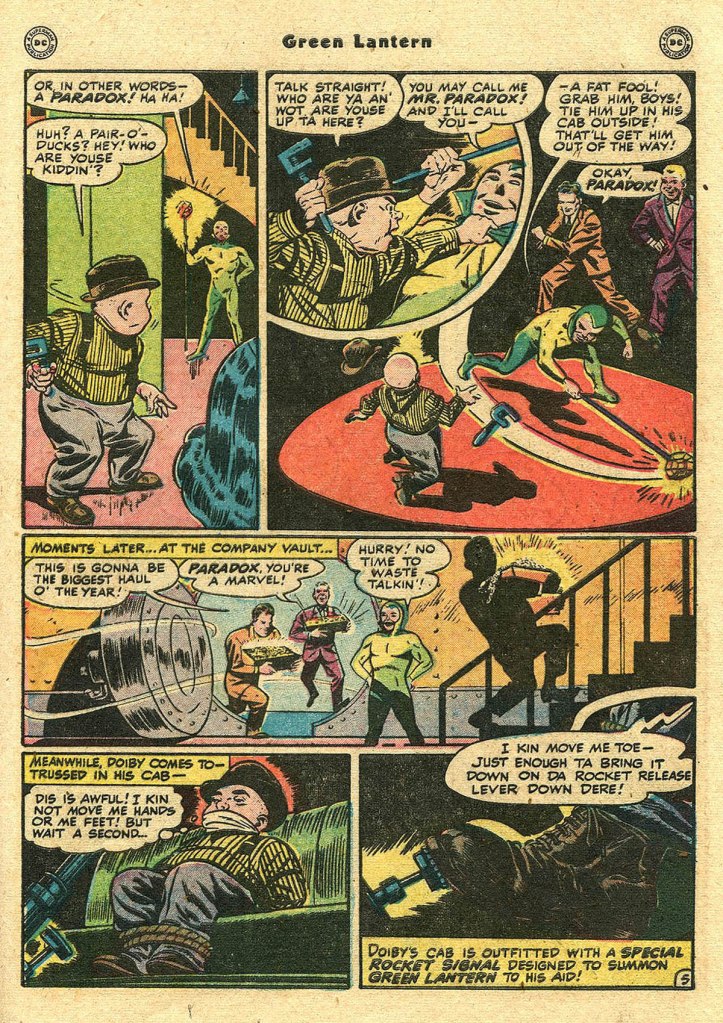
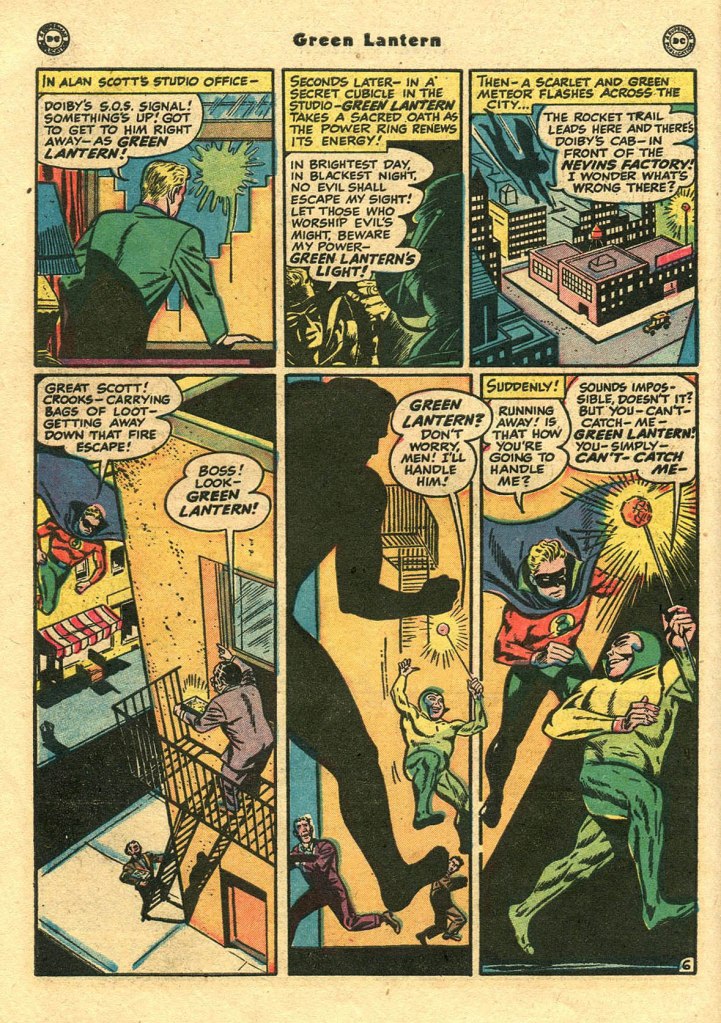
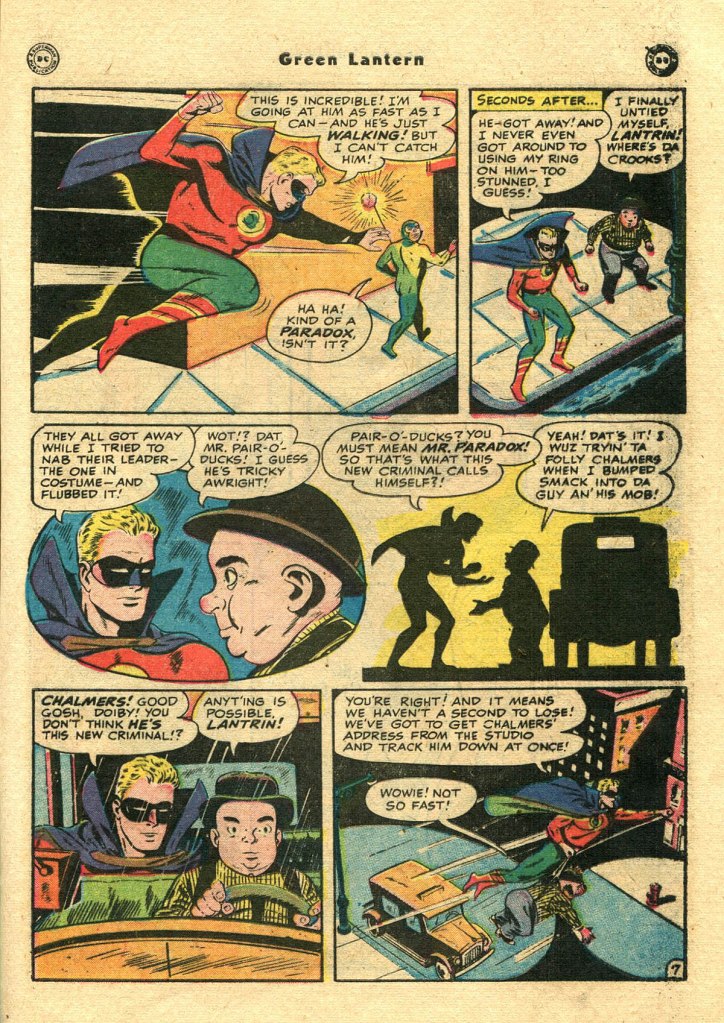
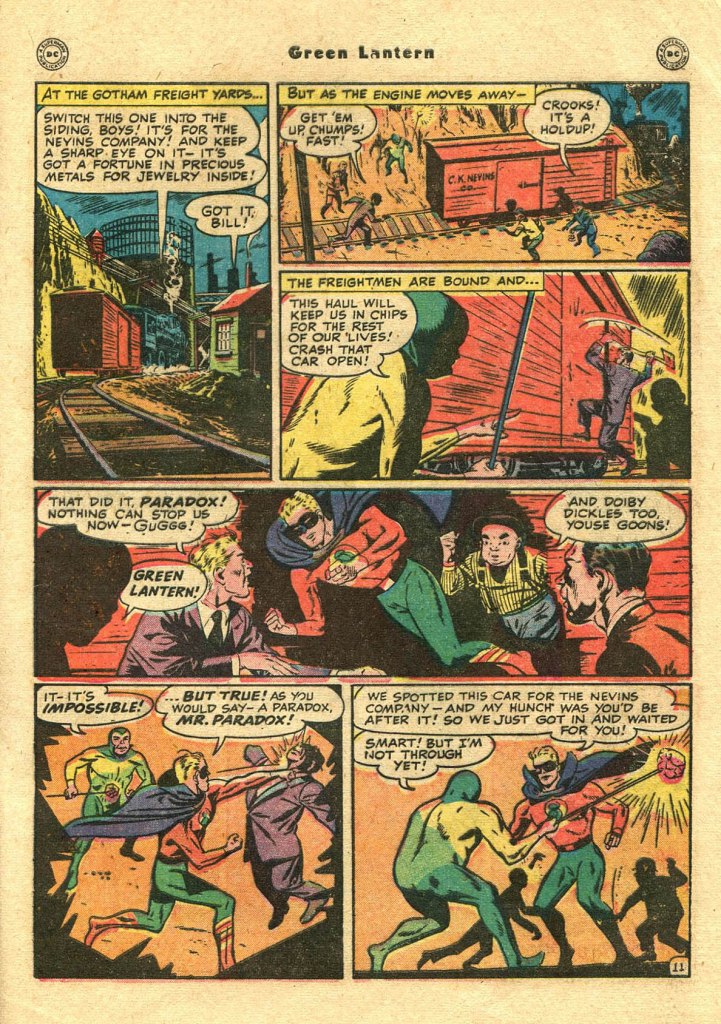
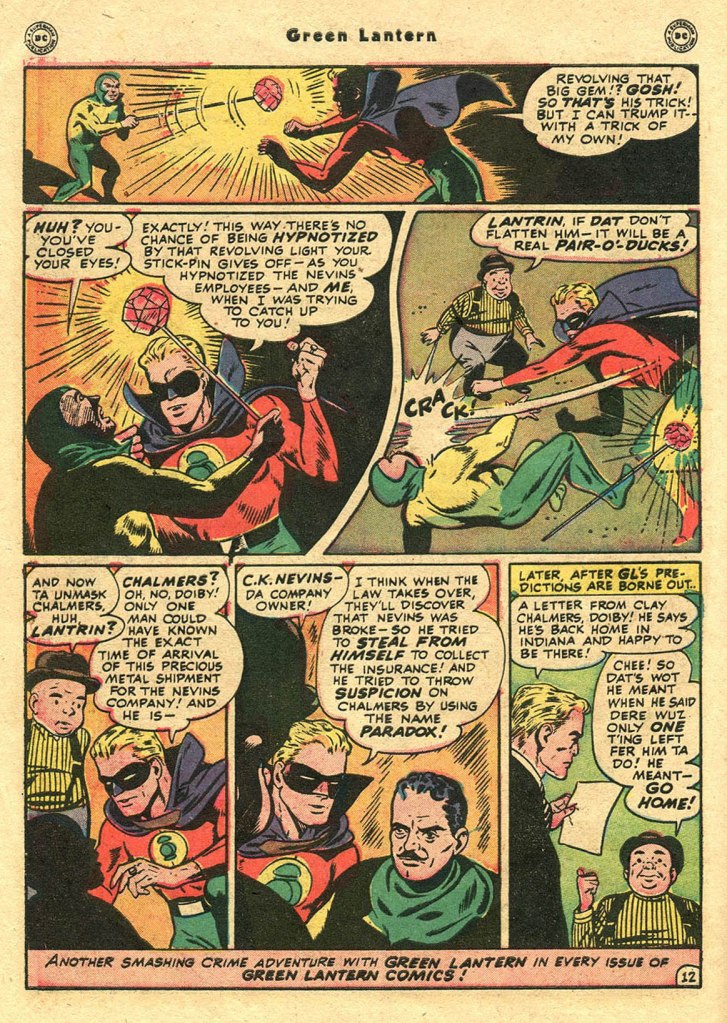
That final blurb looks to me as though it may have originally been there to plug Green lantern’s appearances in ALL-AMERICAN COMICS but got changed when that series changed genres and contents. And it turned out to be false either way, as there wouldn’t be another issue of GREEN LANTERN until 1960’s revival.
 The Tom Brevoort Experience
and there is a story that was intended for the next issue that wasn’t published until #88 of the SA series.
later,
Greg
LikeLike
This was reprinted in GL/GA #89. (also the ;last Issue of Green Lantern) in 1972. in that issue the story is credited to John Broome.
The bad guy being a portrait of Tom Dewey when unmasked was probably a bit of mild editorializing a few months after the “Dewey Beats Truman” Election of 1948.
Irwin Hassan was known for inserting caricatures of Celebes (like Walter Winchell, who Hassan used to imitate) into his work.
Hassan co-created the interminable 1955-1986 comic strip Dondi, that took up the last page of the NY Daily News comics Section. It was made into a 1961 eponymous film that some consider one of the 50 worst movies of all time.
LikeLike
Biggest revelation here for me was Alan Scott reciting the GL oath to charge his ring that I’ve always associated with Hal Jordan. Maybe it was in “All-Star Squadron” where I first saw Scott’s oath was different than Hal’s. I can’t recall it all now, but it ended with something like, “because evil things cannot stand the light of Green Lantern”. I just figured that was the original Golden Age GL “charging” oath.
Maybe it was the original, but was changed to the “Brightest Day/Darkest Night” during the Golden Age? Or maybe Roy (or someone else before him) “retconned” Alan’s oath to differentiate it from Hal’s?
Hansen drew Dondi, as was mentioned in an earlier comment. I think he also taught at the Joe Kubert School much later. His work here looks pretty good. Definitely on par for it time, maybe better than some of his contemporaries.
LikeLike
If you go to comics.org and check out this series you will find the Oath changed over time: Green Lantern#4 ( Summer 1942 ) 1st story -“I Shed my light upon dark evil! For evil cannot stand the light of the Green Lantern!”, GL#5 ( Fall 1942 ) 1st story Chapter 1 -“I shed my Light upon the darkness! Evil has no place to hide itself! Green Lantern goes forth to conquer!”, Chapter 3 -“Let the light of the Lantern penetrate the dark places of Ignorance and Wrong, setting all minds right and overthrowing all servants of evil!” ( Legion of the Lantern – Alan Scott’s Easy Company is in this issue ) and GL#6 ( Winter 1942 ) 1st story -“The light of the Green Lantern pierces darkness and mystery and its radiance will strike at the heart of evil.”
LikeLiked by 1 person
Thanks, Mr. Holstein. 🙂
LikeLike
The oath used by Hal Jordan since 1959 was created by Alfred Bester for the Alan Scott version in about 1943. The bit of doggerel by Bester in his novel The Stars My Destination (“My name is Gully Foyle/and terra is my nation/the stars my detonation.”) shows Bester liked this kind of rhyme . . . .,
LikeLiked by 1 person
John Minehan thanks for motivating me to look for the first appearance of the oath in this issue ( I knew I had seen it before, especially since comics.org does not mention it in this issue ): All-American Comics#53 ( October 1943 ) like you pointed out Alfred Bester — “In brightest day, in blackest night, no evil shall escape my sight. Let those who worship evil’s might, beware my power, Green Lantern’s light.” There are also variations oaths in issue 18, 20, 23, 45 & 47, plus in one of the issue between those is Alan Scott’s middle name Wellington.
LikeLiked by 1 person
That bit of doggerel in THE STARS MY DESTINATION is adapted from a much older, traditional version.
It showed up in James Joyce’s PORTRAIT OF THE ARTIST AS A YOUNG MAN:
“Stephen Dedalus is my name.
Ireland is my nation.
Clongowes is my dwelling place
And heaven my expectation.”
….but it goes back farther than that as well, including the “…my destination” ending.
LikeLike
This is another final story that has much better art than I apparently wrongly associated with the Golden Age. It also suggests Alan’s stature as an outstanding and revered hero was established after Earth Two was created. It surely isn’t based off stories like these.
LikeLiked by 1 person
I once saw that same exposition of Zeno’s Achilles-Tortoise paradox in a 60’s DC comic, though I don’t remember exactly which one. Maybe an issue of Adventure starring the Legion? It had the same resolution given, one which falls into the category of “not even wrong”. In fact there are two valid resolutions, one that the Greeks suggested and one that came much later.
The one that the Greeks suggested is that space and time are quantized: there exists some minimum amount of distance and time, so that there comes a point where the tortoise can’t go 1/10 the distance in 1/10 the time because those quantities aren’t meaningful. Modern physics agrees with this.
The other is the development of modern mathematical techniques to deal with infinities. The Greeks recognized that this was an infinite series and just sort of threw up their hands, saying “you can’t reason about infinity”. But now we realize that yes you can, and that a series may contain an infinite number of elements and yet still converge to a finite value. So in fact the “paradox” really isn’t, even without quantum mechanics in play.
LikeLiked by 1 person
Mr. Paradox’s design looks a bit like he could be a post-Marvel Steve Ditko villain.
LikeLiked by 1 person