


I had sort of backed into buying SGT FURY regularly after my younger brother Ken had started doing it and then lost interest. I’d never really ben interested in war comics, but the fact that present day Nick Fury was such a presence throughout the Marvel line convinced me that it was “important” to read his adventures during the Big One. And it’s not like I didn’t enjoy the series, it was often fun and decently-crafted, even if its depiction of Naziism is crazily cartoonish and the entire conceit–a team of commandos who go around firing off guns wildly in every direction but nobody ever really gets shot or killed–is patently ludicrous. SGT FURY was less a war comic than a war movie, an idealized depiction of global conflict as fun-loving adventure story. Even as a kid, something about this treatment struck me as being very wrong, but I wasn’t yet sophisticated enough to put my finger on it.

Gary Friedrich, who took over penning the series from Roy Thomas, wound up doing a bunch of interesting anti-war stories in it as the 1960s got longer, no doubt the perspective of a Vietnam draft-age writer putting forward his own outlook and frustrations as that conflict began to chew up a generation of young soldiers. Here, though, he’s still mostly doing the kind of two-fisted action movie treatment that Roy and Stan before him had established. Though this issue’s spotlight on black commando Gabe Jones was pretty forward-thinking when the story first saw print in 1968.

Penciler Dick Ayers had been with the series from the moment that Jack Kirby stepped off of it early on. Dick’s work on most super hero titles failed to truly capture the energy of Kirby-inspired super-heroics, but he was a bit more comfortable depicting teh wartime elements of SGT FURY. His figures would still occasionally be stiff, though, like the Gabe Jones on teh splash page here. During this period, his work was aided immensely by the embellishments of John Severin, a master when it came to doing war comics. Severin adds more personality to Ayers’ faces, gives a more complete sheen to his environments, and provides a convincing finish to the entire production. Ayers’ biggest contribution, though, was his storytelling, the manner in which he broke down a story on the page. Ayers and Severin were a very complimentary and effective team.
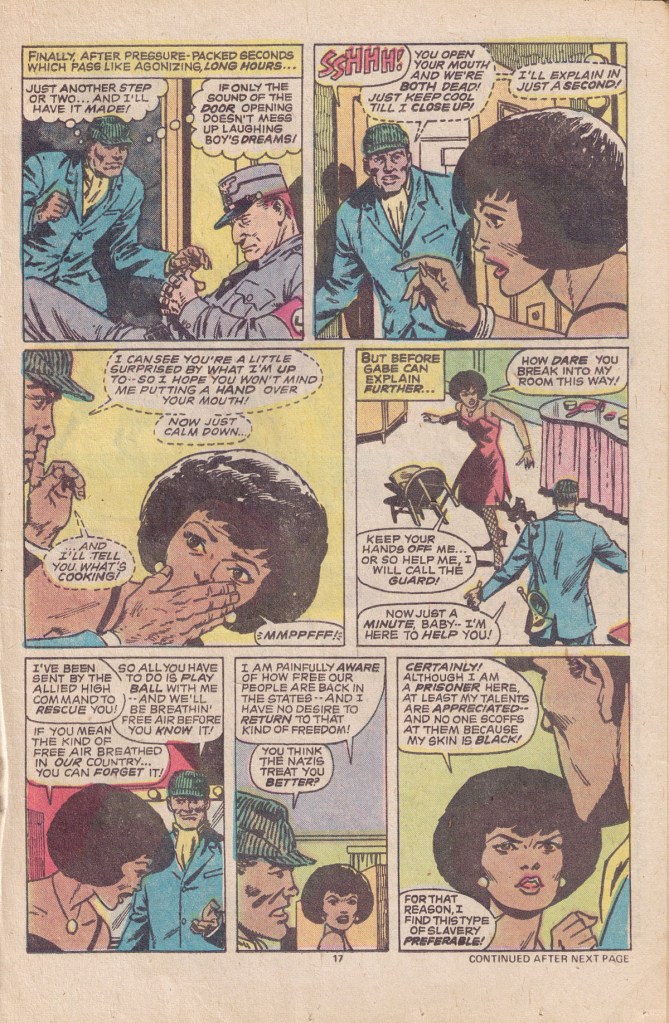
This issue, as we’ve already established, focuses primarily on the horn-blowing Howler, Gabe Jones. Last month, Gabe had been captured by the Nazis during a rescue mission to liberate Nick Fury. But no Howler is ever down for long, and this adventure opens up with him leaping out of the POW truck that is carrying him to permanent detention. He’s also somehow managed to liberate a machine gun for himself, and of course he also carries his ever-present trumpet. After eluding or eliminating his pursuers, Jones makes contact with the Underground, who tell him that they can reunite him with his unit. But they have a mission that he would be well-suited for first,
You see, there’s this black jazz singer, Carla Swain, who has been captured by the Nazis and forces to perform for their entertainment in one of their officers clubs. The Underground is looking to liberate Swain, and they figure that Gabe is exactly the right man to infiltrate the place as a horn-player and get her out. Gabe agrees to the task at hand, and so his Underground handlers set him up in a position at the same club. While performing with Carla, Reb Ralston, the southern-born Howler, happens to hear Gabe playing and realizes that his comrade is all right and at liberty. Earlier, Ralston got into a momentary fist-fight with Fury over the fact that Gabe had been left behind, so this is some good news for him and eventually for the crew.

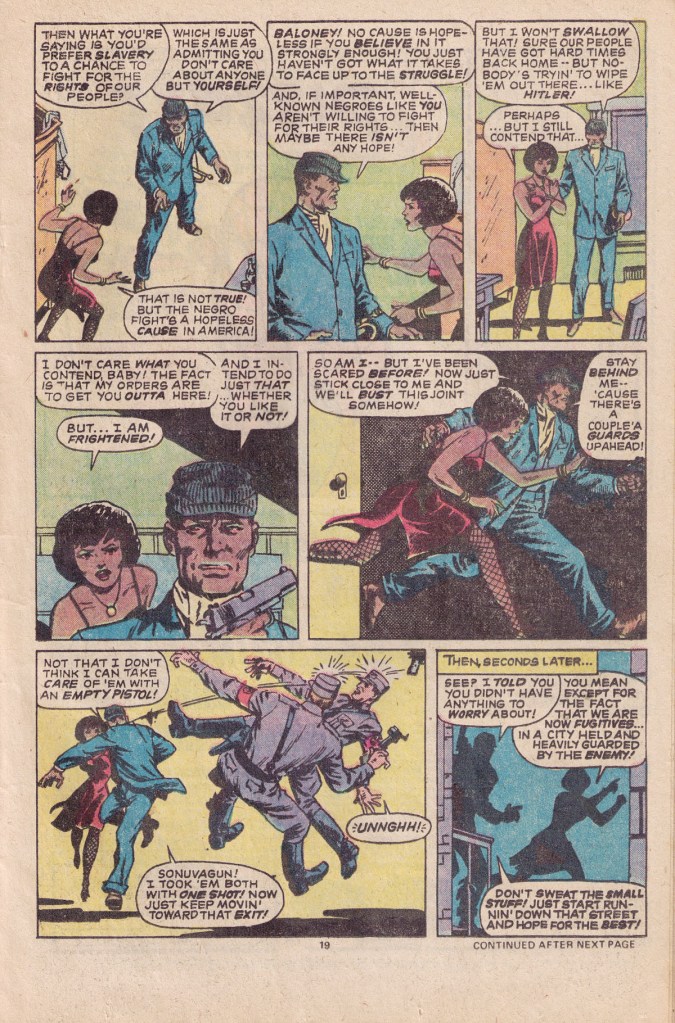
Some less good news is that when Gabe reveals his identity to Carla, she doesn’t want to go. Given how bad she and her people have been treated back in the U.S., she figures she’s better off here working for the Nazis who at least treat her with a certain amount of respect. Jones, though, isn’t hearing about it, and he practically forces Carla to accompany him. The two clock some Nazi guards and escape into the streets. Meanwhile, though, the Howlers have located the Officers Club and unfortunately walked straight into an ambush–all except Reb. They’re about to all be shot when Gabe and Carla discover their predicament. Despite the danger to his own life (and the fact that all of the guys facing Nazi guns are white) Gabe leaps into the fray to rescue his buddies. Carla, who has no use for any white person, is a bit stunned at this decision.
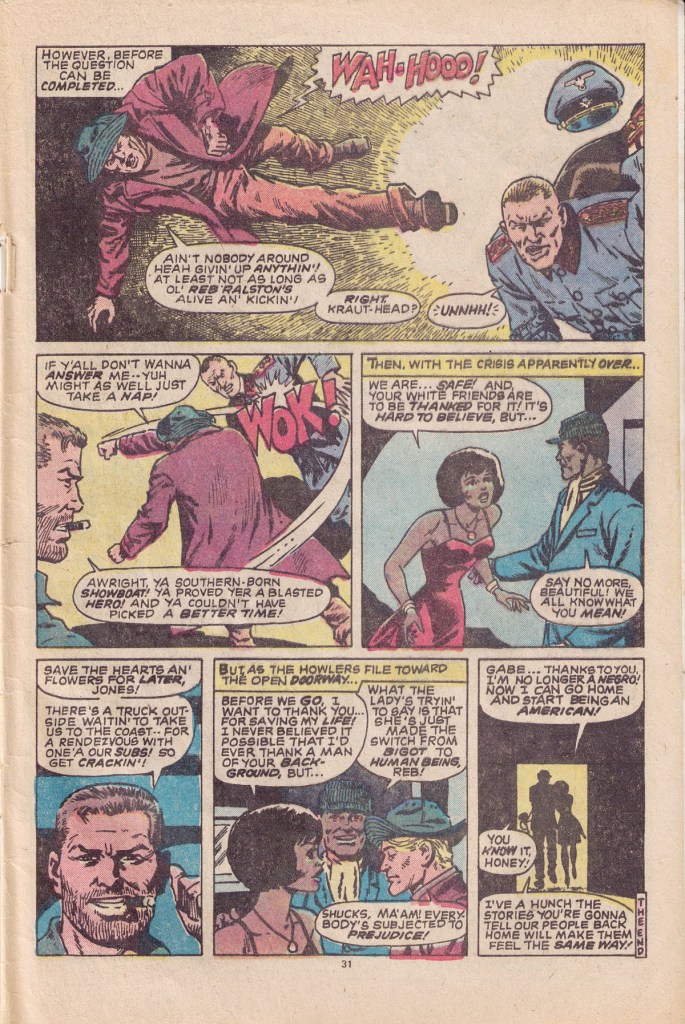
This whole subplot where Gabe lectures Carla on her bigotry is just a little bit hard to read when you realize that it’s being written by a white author. It feels like a lecture to black people in general, and is a bit tone-deaf, for all that it was doubtless well-intentioned. Anyway, Gabe’s distraction is enough to let the Howlers fight back and overcome their captors. But Carla has been grabbed outside. And she’s once again astonished when the Howlers all drop their weapons rather than allow her to be killed. Fortunately, Reb is still at liberty, and he picks this moment to duplicate Gabe’s earlier effort and crash in, saving the day. Carla is absolutely stunned to have been rescued by a southern boy, and the issue ends with her now headed back to freedom and the United States, having learned that white people really aren’t so bad at all. And that’s why racism is a dead issue here in the 21st century!
 The Tom Brevoort Experience
Yeah not all bad unless you count the segregation that was going on during WW2, no voting rights or equal rights or the fact that had Gabriel Jones been a real person he wouldn’t get any of the medals earned with his heroics until decades later when he is an old man ( with no Infinity Formula in him ) or dead. Imagine, people of colour fighting for freedoms they don’t have back home. Where some racist can have you Emmett Till-ed ( 1955 ) or groups of you Black Wall Street-ed ( 1921 ).
LikeLiked by 2 people
Marvel stories of the 60’s to the mid- 70’s were ahead of DC in having some diversity depicted in their stories but yeah…. they could be pretty ham-fisted when race relations became a story topic… and I think the reverse-bigot twist was done at least 3 times in 3 separate titles off the top of my head. It hasn’t aged well in the stories that were set in the present day, and is worse in a story set in the 40’s.
On a separate note: Black US soldiers encountered less racial bigotry on parts of the European continent in WWI and II as opposed to being in the US…. but I doubt the Nazis extended the same courtesy to races that weren’t white.
The art on this story looks very good to me. I agree that Severin inks really makes Ayers shine.
I have a fair amount of affection for Ayers work in general. It’s usually very straightforward but always solid…… a good look for War and Western comics that I think require less flash and more convincing visual detail than super-hero yarns.
LikeLiked by 1 person
You can always spot John Severin inks. He was the only reason I read Cracked magazine for years.
LikeLiked by 1 person
the Severins were both amazing talents.
LikeLiked by 5 people
I meant no slight to Marie. : )
LikeLike
I didn’t pick up war comics until the 70s, when they were squarely in the “War is Hell” mode. That said, I preferred Sgt. Rock to Sgt. Fury because the stories were more grounded than what the Howling Commandos regularly encountered. Which is interesting when you consider that Sgt. Rock was written by Robert Kanigher, who was responsible for some of the most bonkers super-hero stories ever committed to paper. Dick Ayers’ art with John Severin’s inks was stellar however, if not quite at the level of Joe Kubert.
LikeLiked by 2 people