

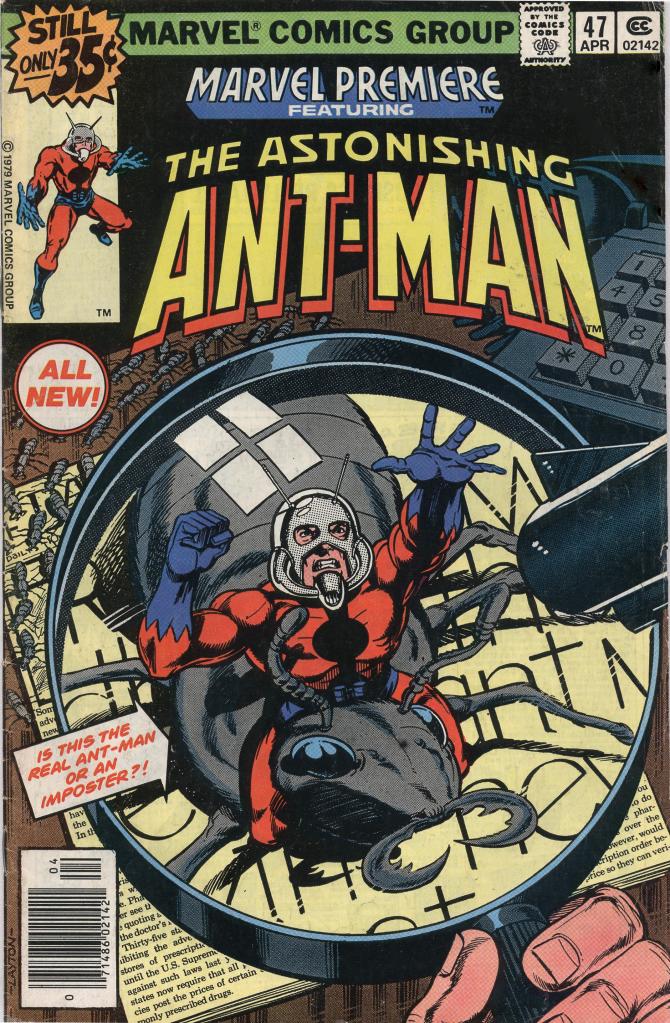
Now I know that I picked this issue of MARVEL PREMIERE up in a candy store in a distant strip mall that my parents had gone to for some shopping reason. My regular 7-11 didn’t seem to carry issues of MARVEL PREMIERE–they had quietly stopped getting all sorts of books, including double-sized issues such as Annuals and pretty much any newly-launched series such as SHADE: THE CHANGING MAN. It was a reflection of the fact that by the late 1970s, comic books as a category weren’t bringing in enough consistent revenue to be worried about. Once video game cabinets hit in a big way a year or so later, many outlets replaced their spinner racks with Space Invaders machines which brought in a lot more money for the same space.

There was something slightly mysterious and intriguing about Ant-Man when I began reading Marvel comics in the late 1970s. He had clearly been one of the founding characters, but over the years he had undergone tremendous changes of identity. Then, and for some time, he was Yellowjacket, doing pretty much all the stuff that his Ant-Man persona could do, plus more. I’d read one or two old Ant-Man stories by this point, and they weren’t especially memorable though they were entertaining. But Hank Pym’s star turn in the Ant-Man identity in AVENGERS #161 in which he single-handedly takes on the entire Avengers roster was still relatively fresh in mind. And so a spotlight on Ant-Man seemed like a cool proposition. And indeed it was.
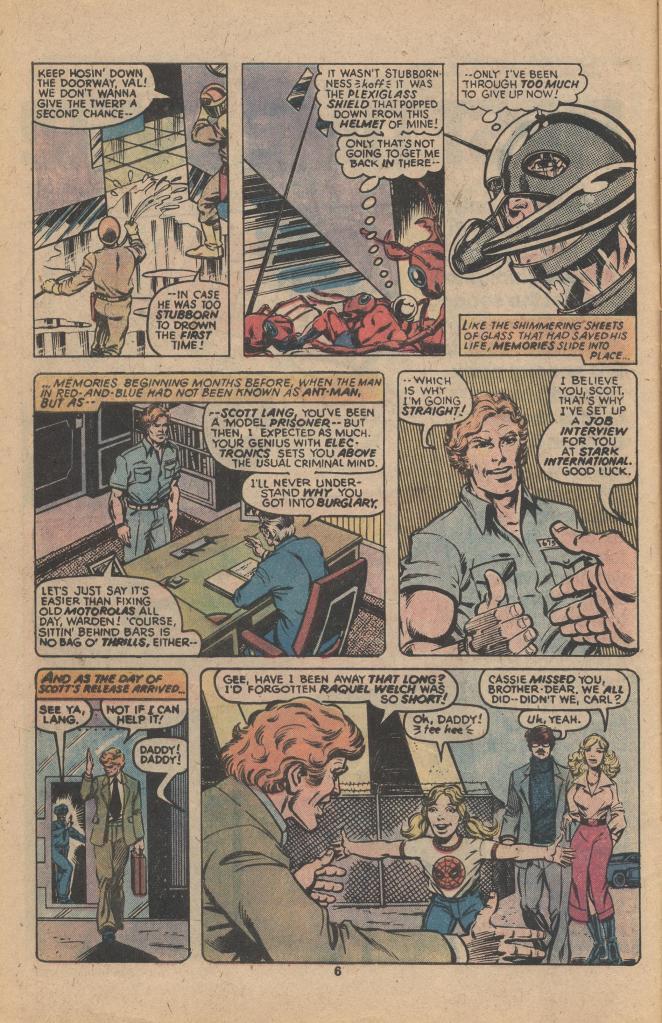
And I think the reason is that the new Ant-Man had a lot more personality to him. The creation mainly of writer David Michelinie, Scott Lang is an electronics whiz who served a stint in jail for some earlier crimes but who is trying to walk the straight and narrow. And the reason for that is that he’s also the single parent to a young daughter, Cassie. But when it turns out that Cassie has a heart defect that requires her to undergo costly specialist surgery to survive, Scott is forced to turn back to his prior smash-and-grab career in order to pay for her treatments. But when he inadvertently burgles the home of Hank Pym, he comes away not with money or treasures but rather Hank’s discarded Ant-Man gear, including its supply of size-changing gas and the helmet that allows the wearer to communicate and command ants. All of this is a lot more interesting motivation and behavior than hank Pym ever had in the role.

The other big draw here is that this issue just looks great. It was penciled by John Byrne, who had a real affection for the original Ant-man, whose adventures he had read as a kid. Byrne was always expert in making any Jack Kirby design look attractive and modern, and he does that here with the Ant-Man outfit. He’s aided by Michelinie’s IRON MAN collaborator Bob Layton, who provides a slick finish similar to what he was doing over on Shell-Head. Byrne has gone on record as not really liking Layton’s inks–in one memorable interview that hasn’t aged well, he complained that Layton made all of the characters “look gay.” Regardless of his feelings, I found it an attractive combination on this Ant-Man feature.

It turns out that the only person who can save young Cassie’s life is a top neurosurgeon, Dr. Sondheim. Scott Lang goes to seek out her assistance, but arrives to see her being hustled off by men working for Cross Technologies. Unable to prevent this in his civilian guise, Scott returns later as Ant-Man, intent on invading the premises, locating Dr. Sondheim and then getting her to save his daughter’s life. This is very much of a piece with the sort of real-world espionage vibe that Michelinie and Layton were giving to Iron Man at around the same time–Lang would wind up becoming a popular recurring character in that series after this two-part tryout–and so it felt contemporary and grounded and exciting.

Byrne and Layton do a really great job with the visual storytelling throughout this sequence, spotlighting Ant-Man’s tiny size and putting his size-changing abilities to good visual use as he works his way past layers of security. Byrne was doing a lot of work during this time, more than two books a month in most cases, but his storytelling work was always spot-on, and his plotting chops were also excellent. He made a lot of stories play better due to how he executed them and what details and emphasis he provided. Even more than the attractiveness of his pages, it was this storytelling strength that made him such a force for Marvel at this time.

By the end of the issue, Ant-Man has made his way to Dr. Sondheim, who is preparing to operate on a mysterious patient. Scott lays out his sales pitch to the Doctor, but before she can agree to go with him, Ant-Man’s attention is distracted by a voice from behind him. And then, in the final double-page spread that closes out the issue, he is challenged by Darren Cross, the wealthy head of Cross Technologies and also Dr. Sondheim’s patient. He’s got an enormous hulklike body, which doesn’t spell an easy fight for poor ol’ Ant-Man. But that’s where this issue is To Be Continued. I have to say, I really liked this outing and hoped that I’d be able to locate the second part when it eventually dropped. (Spoiler warning: I did.)
 The Tom Brevoort Experience
What I loved about this issue and the next is like The Avengers#161 ( July 1977 ) and the Ant-Man movies is that it demonstrates just dangerous ( ? ) or kick-ass an Ant-Man can be ( The Fighting style is similar to a teleporter or a smart invisible person or intangible/phasing hero like Shadowcat ). I Liked the new Ant-Man. Don’t remember thinking the inker made anyone “look gay” ( Odd thing for the guy who made Northstar gay — which flew right over my head, I had to read that he was in a magazine “Comics Feature” (? ) ).
LikeLike
Scott Lang started out such a great character and would go on to replace Reed in the F4 then lead a replacement F4 to take down Doom. Unfortunately movie Scott is a dumbass so the comic version is now too,
LikeLiked by 1 person
Love the look of the page scans! They have a natural quality akin to holding the actual comics in one’s hand 🙂
IMHO approx 98% of digital comics are unnaturally white. Late 70’s Marvel was printed on rather inexpensive stock and even when new was NOT bright white.
Thing is apps/programs to make the everything look bright and white do so at the expense of fine detail. Something late 70’s Marvel books had little of to begin with due to the paper quality and subsequent color interaction. IMHO page scans of this quality are digital comic equivalent of “loaves and fishes”.
Great review. The Byrne/Layton art is sublime as well as the all Layton cover. Many of the early 1979 books like this one were an all-around tour-de-force.
LikeLike
These were great issues and this was a very good review of why it worked so well. I liked Hank Pym as Yellowjacket, but I also liked Scott Lang from the get go. I think he became a very useful side character to plug into Avengers or Ironman when needed.
Also… it should be mentioned that Scott Lang was introduced a few months prior to becoming Antman as a new Stark techno in Avengers 181. He gets roughed up by Wonderman while installing a protective device.
Scott accidentally burgling an Avenger didn’t stand out to me when I first read the issue, but since he’s not portrayed as a knucklehead its a bit of a miss that Scott wouldn’t have better evaluated his risk beforehand via the house nameplate. Especially since he puts it all together while inside the house. Since he works for Stark this would be like an employee of Paul McCartney accidentally breaking into Ringo Starr’s house and remembering that he was a Beatle who drummed…. presuming Paul McCartney had a secret identity and the Beatles had 25 plus members. It’s not a perfect analogy.
LikeLiked by 3 people
Avengers #181 was just a month or so before this issue. His introduction there just before this story was a fun bit of continuity. I remembered him immediately from the Avengers story.
LikeLike