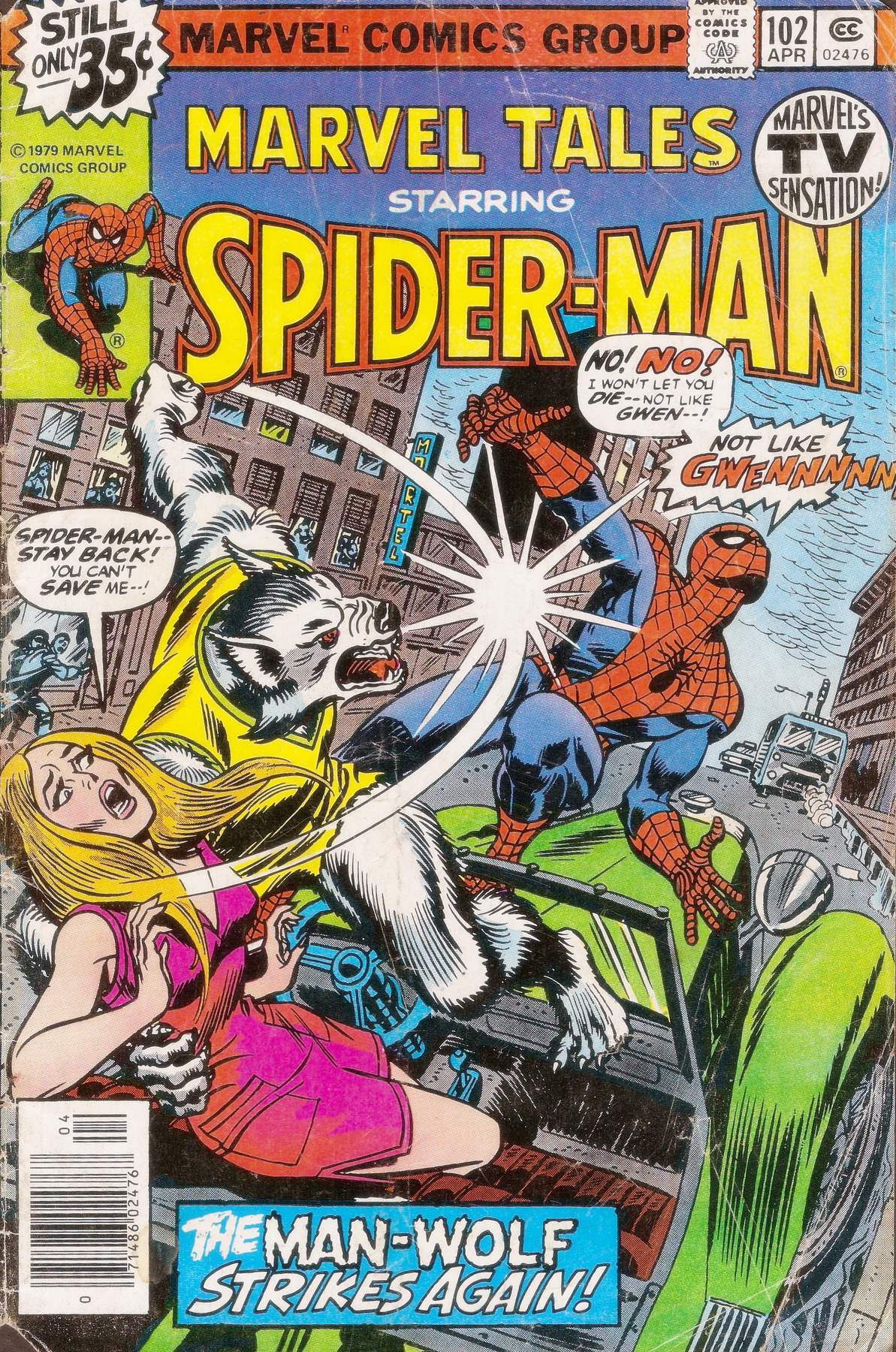


This issue of MARVEL TALES reprinted the story where the series concluded its transition from the Silver Age into the Bronze Age. The book had been there for several months already at this point, with writer Gerry Conway taking over for Stan Lee. But this was the first issue in forever not illustrated by John Romita. Romita had defined the look of Spider-Man over the preceding decade (and he’d continue to do so on licensing artwork and occasional special projects over time) and helped make the wall-crawler the #1 character in comics. Romita’s replacement was hand-selected by him–and in a strange quirk of deja vu, it was the same artist who was selected to replace Carmine Infantino on THE FLASH years before once Carmine had become DC’s Editorial Director.

I’m speaking, of course, of Ross Andru. Andru would continue to illustrate the web-slinger’s exploits for the balance of the 1970s, defining the look of Peter Parker and his friends and foes for the whole of that decade. His work on the title is a bit divisive–his Spider-Man was occasionally awkward, his Peter Parker a bit too old maybe. But he absolutely gave a greater sense of New York City to his work, taking copious reference photos (photos that he followed with such precision that Marvel once got into trouble for featuring a particular house as a villain’s lair in one issue.) For Ross’s first issue as the new penciler, Romita and his background assistant Tony Mortellaro did the inking, keeping the finish of the strip looking consistent. But this was a passing-of-the-torch moment–though by the time I was reading this in 1979, that torch had long since relocated elsewhere.
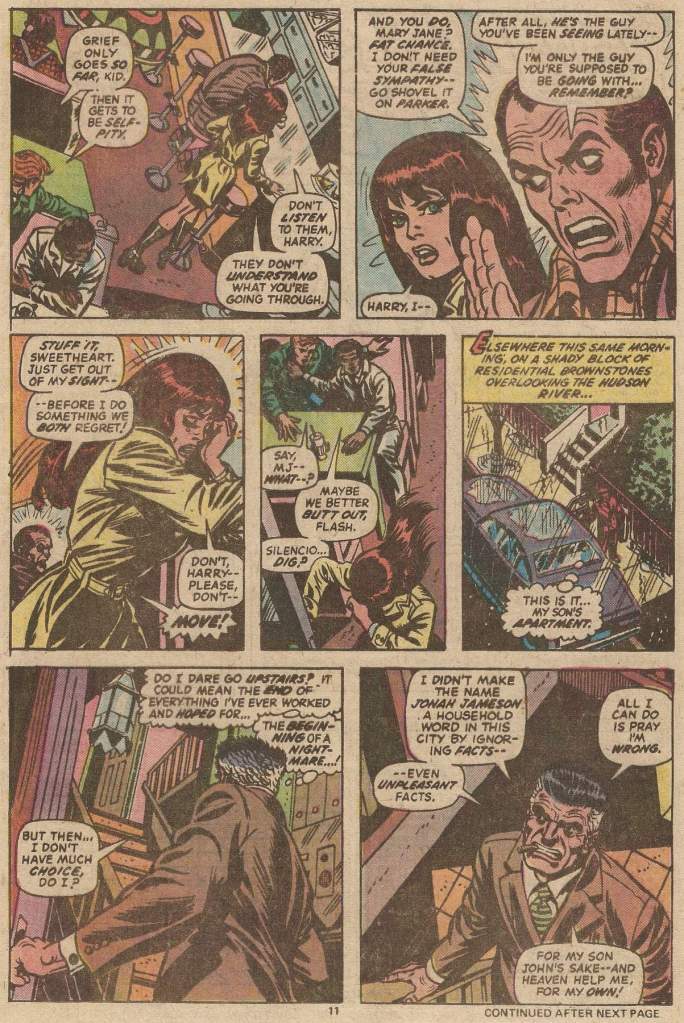
Writer Gerry Conway was also making his mark on the strip at this point, having killed off both Peter’s longtime girlfriend Gwen Stacy and also Norman Osborn, the Green Goblin, a couple of issues previously. The aftershocks of those traumatic deaths would ripple forward for pretty much the rest of Conway’s tenure as writer and beyond. So the book was in something of uncharted territory at this point. Additionally, the revisions recently made to the Comic Code made it viable once again to feature supernatural monsters in mainstream comics, a development that Marvel embraced with both hands in the early 1970s. So last issue, we saw that J. Jonah Jameson’s son John had been transformed on a recent space walk into the bestial Man-Wolf.
This story opens up on the heels of the last one, with Spider-Man again being jumped by the irate Man-Wolf. The two tussle, but the night is ending and the moon is vanishing beyond the horizon–which means that the Man-Wolf needs to skedaddle before he returns to his human form. Defeated for the moment, Spidey returns to his apartment, finding his roommate Harry Osborn absent as he’s ben pretty much since the death of his father a few issues ago. And that’s because he’s clearly cracking, as witnessed by the fact that he picks a fight with his girlfriend Mary Jane Watson in this issue, leading to their break-up. There was always just as much soap opera to Spider-Man’s appeal as there was action and fisticuffs, and Conway steered directly into those stylings.

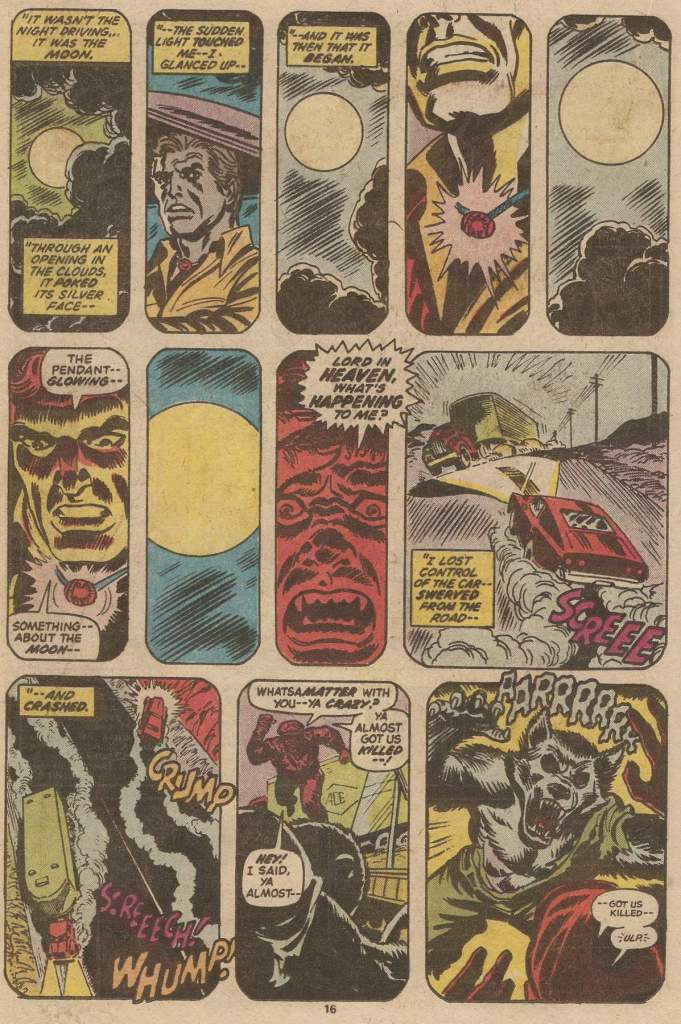
After having been attacked by the Man-Wolf last issue and realizing the truth about him, Jameson meanwhile goes to the apartment of his son John. There, the astronaut tells his father about how he encountered a strange moonstone on his last moon mission, one that he brought back with him and had fashioned into a pendant for no good reason. Unfortunately for John Jameson, that pendant transforms him into the Man-Wolf whenever the full moon rises. What’s more, it’s fused itself to his skin, so he can’t remove it. Meanwhile, having rested up after his fight with the Man-Wolf, Spider-Man heads over to the Daily Bugle in the hopes of getting a line on his foe from Robbie Robertson. But it turns out that there are cops waiting at the Bugle, and Spidey is wanted for questioning in the death of Norman Osborn (some mysterious figure removed Osborn’s Green Goblin costume before his body was discovered) so the wall-crawler needs to light out without having learned anything new.
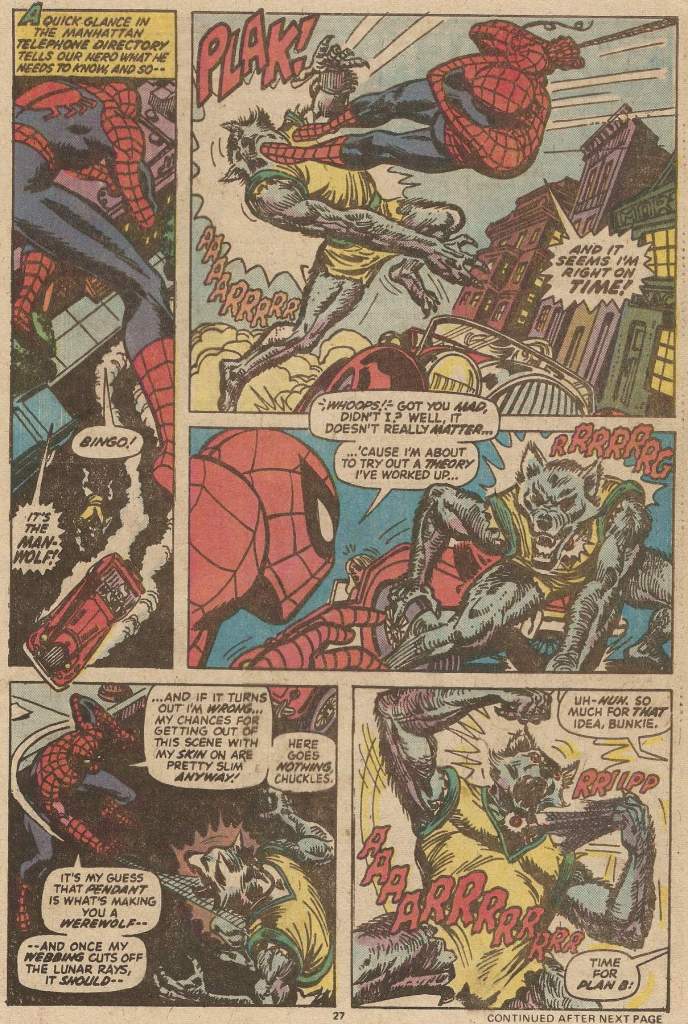
As night falls, John Jameson transforms back into the Man-Wolf again, batting aside his concerned father as he makes his way into the evening air. He’s attracted by the arrival of John’s fiancée Kristine Saunders, and pursues her. Fortunately for Kristine, by this point Spider-Man has happened upon the scene, and he leaps into battle with the crazed lupine figure. Taking a moment to study his opponent, Spidey intuits that it’s the Man-Wolf’s pendant which is responsible for his transformation, and so he tries to web it up, cutting it off from the moonlight that must fuel it. But his effort is futile as the Man-Wolf swiftly rips up his webbing.

So it’s time for Plan B–which in this instance involves Spider-Man ripping the pendant off of the Man-Wolf’s throat physically. which does the trick, though it leaves John Jameson bleeding in the street. Jonah shows up to give Spidey grief for having hurt his son, and the web-slinger retorts that all of the people hurt by the Man-Wolf’s rampage that evening are on Jonah’s head for not having gotten John to medical attention when he could. Spidey disposes of the moonstone in the river, and that’s where this issue wraps things up. It’s a far cry from the days of Steve Ditko on the strip. Spider-Man now seemed to be living in a more nihilistic world, with his personal and emotional problems threatening to completely overwhelm him. It was dramatic for sure, though, and that drama would keep the wall-crawler at the forefront of the industry for the rest of the decade.
 The Tom Brevoort Experience
So it was Gerry Conway who is responsible for killing of Gwen Stacy ( By having a science student forget that it isn’t the fall that kills you but the sudden stop ) and the Green Goblin ( DC had the Joker beat the second Robin to death decades later and never killed him off. Did he ever give a reason for killing off the Green Goblin? ). As for this issue J. Jonah Jameson a big believer in the NO GOOD DEED GOES UNPUNISHED ( I know he tried to thank him after getting a mouth full from Spider-Man, but was a case of to little to late ).
LikeLike
I don’t know for sure what Conway had in mind, but IMHO the Goblin had kind of outlived his usefulness. Once the mystery around his identity was solved, he lost a lot of his mystique. The gimmick then became that Spidey kept giving the Goblin a free pass because he was secretly his best friend’s Dad, which I don’t think was sustainable in the long run. Pete can’t justify shielding him forever…if the Goblin keeps coming back, sooner or later he’s got to turn him in, at which point any uniqueness completely evaporates. Better to let the Goblin go out with a bang — scoring a victory that reverberates to this day — rather than limp along as a mediocrity.
LikeLiked by 3 people
Good answer.
LikeLiked by 1 person
Plus like Daredevil foe The Death-Stalker who knew DD’s secret identity and ended up dead. The original Green Goblin knew Spider-Man’s identity ended up “dead”, Jackal knew Spider-Man’s identity ended up “dead”, Uncle Ben’s killer knew Spider-Man’s identity ended up dead. That use to be the pattern.
LikeLiked by 1 person
That was every book’s pattern at the Big Two. Batman feels like it’s the leader with that trope though.
LikeLike
Wait a minute. WE all know Peter’s Spider-Man, too… Oh, my God… 😉
LikeLiked by 1 person
Peter already lost his parents as a child and grew up without them and his ego after he gained his powers and became performer Spider-Man knocked over the first domino that led to the death of his Uncle Ben ( A death he gets reminded of every time he looks in the eyes of his Aunt May ), so what was the point of Gwen Stacy’s death? Not like the character needs a reminder of loss.
LikeLike
Things had progressed to where marriage was the next step and it couldn’t be taken. I’d have preferred if Gwen had instead that Peter was the Spider-Man she hated,and left him and the book but we got death instead.
LikeLike
There’s a lot of mythology and retconning about who wanted what and decided what about Gwen’s death. But a sense that the series needed the shock of losing a major character was part of it in most accounts.
LikeLike
The switch to Andru was a watershed moment, yeah — count me as a big Andru Spidey fan — but Romita hadn’t penciled an issue since 119. It’d be the next issue that’d be the first where Romita didn’t even ink the book.
I wonder if that next issue (inked by Jim Mooney) was a tryout, with the idea that Jim could ink Andru much as he’d inked Romita, and someone didn’t like it, so they switched to Frank Giacoia, one of Andru’s all-time great inkers, especially on the kind of art he did on SPIDER-MAN.
[Although, now that I think of it, Hunt was inking the backgrounds, and they were a good part of why those issues looked so good — Giacoia and Hunt, between them, managed to capture the depth and perspective in those wild, vertiginous cityscapes, while Andru’s inker-of-choice, Mike Esposito, made the background look flat and unimpressive.]
These early Andru issues were strong on art, but equally strong on story — the Death of Gwen issues are often treated as an ending (which they are for Gwen and Norman, at least), but structure-wise, they’re the beginning of a loose arc that runs at least through 137, as the repercussions of the two deaths drive a ton of character work, affecting Peter as Spider-Man and as Peter, and the whole supporting cast as well, building to a crescendo when Harry becomes the Goblin. I didn’t notice how they fit together that way until I read them all in a row, and now I wish they’d get packaged that way.
Let 120 (the last Romita-penciled issue) be the end of an era, and have the new era start with 121. That’s where I’d say the Bronze Age begins for AMAZING SPIDER-MAN.
[And yes, I know, Alex and I used the Gwen story as a marker of the end of the Silver Age, but I really think it’s the first post-Silver marker rather than the last pre-Bronze one. It just fit our story better as an ending.]
LikeLiked by 2 people
Reading this when it came out, I found the arc insufferable. Okay, she’s dead, is Peter going to keep rehashing it month after month? Jeez!
As an adult I appreciate that yes, people do that with grief. I’ll have to reread them sometime and see if that changes my perception.
As my younger brother started collecting Spider-Man around this time, I guess Andru was my first regular Spider-artist.
LikeLike
I was never the biggest Spider-man fan as a kid, but Andru’s art in Giant-size Spider-man really grabbed me…. the Avengers/Hulk reprint story in the back didn’t hurt. The bones of Andru’s storytelling are strong and when he’s inked by Romita I can’t say that the book suffered at all from Romita not pencilling.
I had this particular Man-Wolf story as the Power record 45. Even as a kid I thought the stone grafting itself to John’s skin was a lame excuse for just rolling with turning into a werewolf. Larry Talbot would have gone to a doctor at least or dug it out with a spoon. At least give me a reason why John wouldn’t go to a doc himself or that the doc failed. If John is losing his mind it’s not made clear in the story.
Also…. what kind of NASA scientist makes a suit intended to block the lunar rays from the stone stuck to your neck with a v neck? This is obviously a turtleneck situation.
LikeLiked by 1 person
Andru did love him the turtlenecks! I loved his art on Spider-Man. I think Morbius’ debut was when I hopped on but Andru became my Spidey artist quickly and no one has ever supplanted him for me.
LikeLiked by 1 person
I had that Man-Wolf Power record 45, too. 🙂
Agreed on Romita inking Andru. And Giacoa (Kurt’s comment) And maybe not for Spidey, but in general, my fave inker for Ross Andru was Dick Giordano, especially on Superman/Action covers. I guess Dick did ink Andru’s Spidey in that Superman vs. Spider-Man book. 😉
LikeLike